


A smart lead generation form turns anonymous website visitors into qualified sales conversations. It captures the right information at the right time, connects directly to your CRM, and gives your sales team everything they need to follow up fast and close deals.
This guide shows you how to build forms that actually fill your pipeline. You’ll learn which form types to use at each funnel stage, which fields drive qualification without killing conversions, and how to connect every submission to a flexible CRM that turns leads into revenue.
Key takeaways
- Match your form fields to the offer: The more valuable the offer, the more fields you can ask for. A newsletter needs one field; a demo request can justify 6 or more.
- Speed is everything after a form submission: Leads contacted within an hour are often more likely to qualify. Every minute of delay costs you pipeline.
- Connect every form directly to your CRM: Manual data entry creates delays and lost leads. Automatic record creation and routing keeps your team focused on selling, not admin.
- A unified platform handles the entire lead journey in one place: From form capture and smart routing to follow-up automation and pipeline tracking, every lead is acted upon while intent is high.
- AI can qualify and prioritize leads before a rep even picks up the phone: Use AI to score submissions, detect urgency in open-text responses, and surface the leads most likely to convert first.
What is a lead generation form?
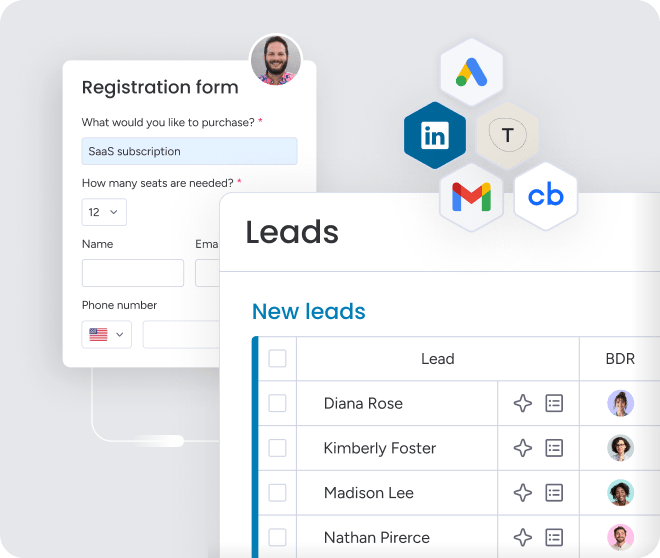
A lead generation form collects contact info from potential customers in exchange for something they want. That could be downloadable content, a product demo, a free trial, or a consultation.
It’s often the first meaningful interaction between your business and a prospective customer. A visitor lands on your page, fills out their name, email, and company info, then hits submit. That submission creates a lead record that flows into your CRM for lead generation or marketing automation platform, where sales and marketing teams can follow up with relevant outreach.
For B2B revenue teams, this process is critical. It’s how anonymous traffic becomes pipeline. The form captures the lead. Your CRM, routing logic, and follow-up speed determine whether that lead becomes revenue.
At its core, every lead generation form is a strategic asset built on 3 key elements. Understanding these components helps you see forms not just as data entry fields, but as the critical bridge between marketing interest and sales conversations.
- Value exchange: Visitors provide their information in return for resources, access, or assistance they perceive as worth the trade.
- Data capture mechanism: Collects structured information that helps qualify leads, route them to the right rep, and personalize follow-up.
- Connection to revenue: Bridges the gap between marketing activity and sales conversations, creating the handoff point where interest becomes opportunity.
Why lead generation forms matter for revenue teams
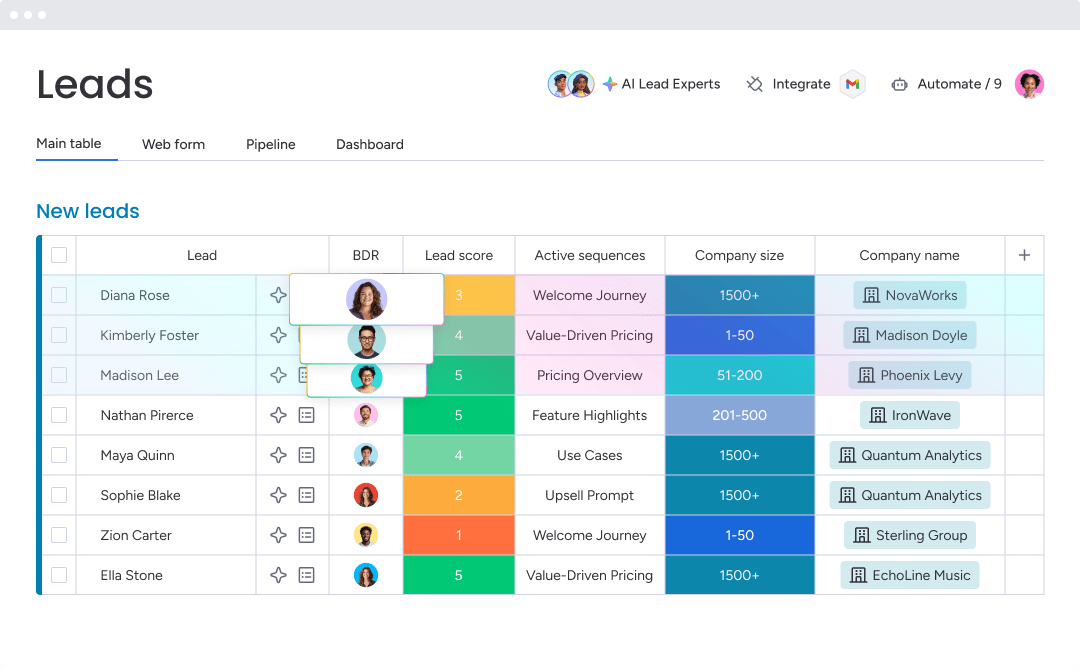
Lead generation forms aren’t just marketing assets. They’re revenue drivers that directly impact pipeline, forecast accuracy, and sales productivity. For CROs, sales leaders, and RevOps teams, forms are where marketing investment turns into sales opportunity.
Here’s why getting this right matters at every stage of the lead generation sales funnel.
Capture buyers when intent is fresh
Lead forms capture prospects when they’re most interested — actively researching solutions, reading content, or requesting demos. Timing matters because buyer intent fades fast. A prospect who downloads a whitepaper today might be gone by next week.
Speed-to-lead is what matters here. Responding to a lead within 5 minutes dramatically increases your chances of converting them — compared to waiting even an hour. Forms give sales reps the context they need to personalize outreach right away:
- What content the prospect downloaded
- What problem they’re trying to solve
- What stage of the buying process they’re in
With the right automations, revenue teams can capture leads instantly and route them to the right rep automatically, ensuring every opportunity is actioned immediately.
Improve lead quality with structured data
Forms collect consistent info that helps qualify leads before they reach sales. Company size, role, budget, and timeline data help you segment, score, and prioritize — so sales teams can focus their energy on high-fit prospects ready for a conversation.
Compare this to unstructured lead sources like generic “Contact Us” emails, which require manual research and qualification before a rep can even determine if the lead is worth pursuing. Form data eliminates that guesswork.
Modern CRM platforms can also use AI to analyze form submissions automatically, helping teams identify high-fit prospects, flag urgent inquiries, and prioritize leads before a sales rep even reviews them.
Help sales respond faster
Lead forms integrate directly with CRMs, and lead generation automation can automatically create lead records and trigger notifications or task assignments. Automation eliminates manual data entry, removes delays, and lets sales reps respond within minutes — not hours or days.
The impact is real: The faster you contact leads, the higher the likelihood they are to convert. Every minute of delay costs you revenue. monday CRM’s automation assigns leads to the right rep instantly — based on territory, product interest, lead score, or any custom criteria.
Connect marketing campaigns to pipeline
Lead forms show which campaigns, channels, and content are generating qualified pipeline. This visibility helps marketing and sales teams align on what’s working, optimize spend, and forecast better.
Without form attribution, marketing teams can only report on clicks and impressions. With it, they can trace the line from campaign to closed deal and prove ROI. monday CRM’s dashboards show you the full journey from form submission to closed deal — so you can see which lead sources drive actual revenue.
Try monday CRM8 types of lead forms to use across the funnel
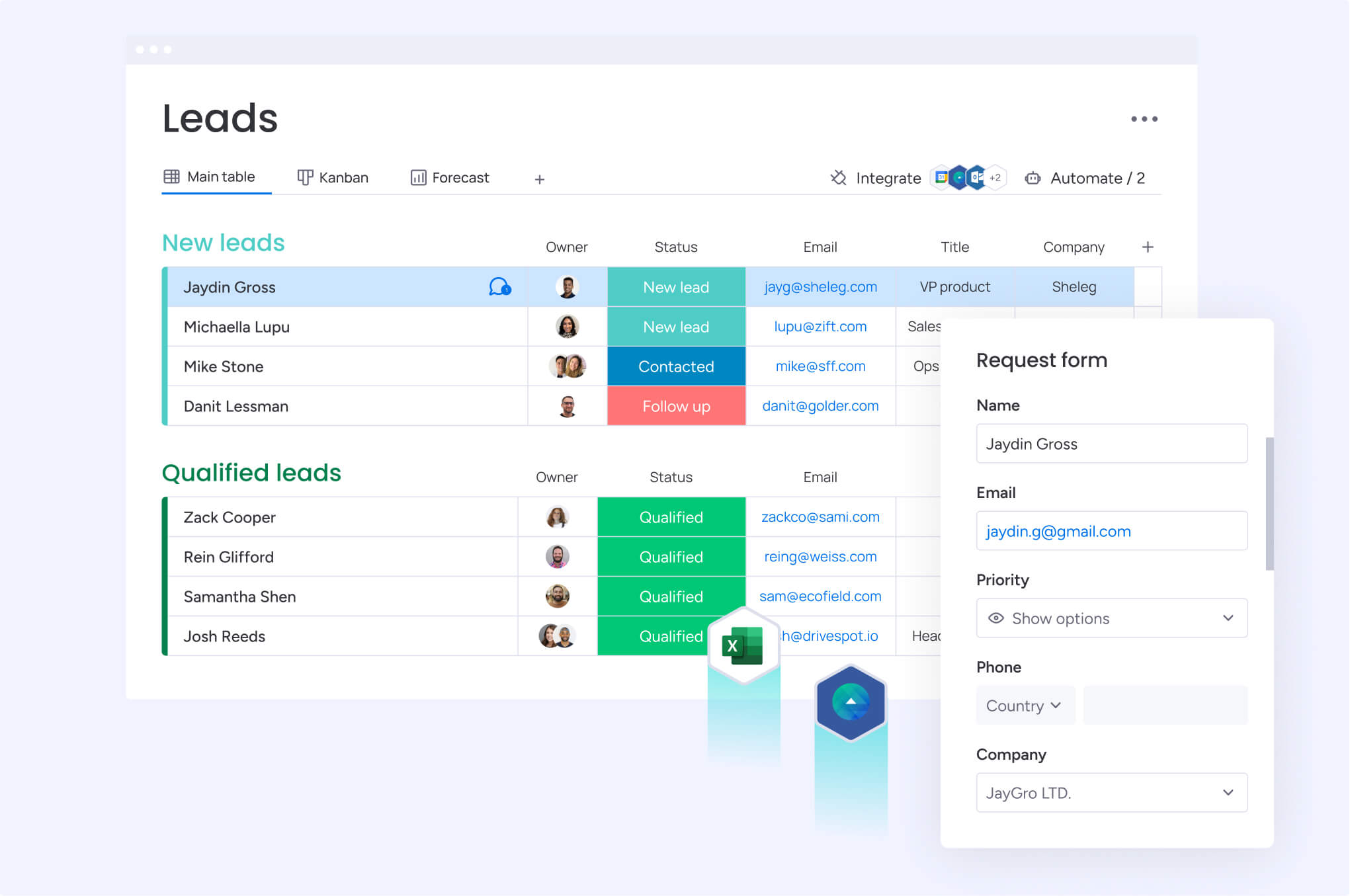
Different lead forms serve different purposes across the buyer journey. Understanding when to use each type helps you capture the right information at the right time without asking for too much too soon.
To capture the right information at the right time, it’s crucial to use the right type of form. The table below breaks down the most common lead forms, their ideal use cases, and where they fit in the funnel, helping you align your strategy with the buyer’s journey.
| Form type | Best use case | Typical fields | Funnel stage |
|---|---|---|---|
| Contact forms | General inquiries and inbound requests | Name, email, message | Any |
| Newsletter signup | Building an early-stage audience | Top | |
| Gated content | Content downloads and research | Name, email, company | Top to mid |
| Demo request | High-intent evaluation | Contact + qualification fields | Bottom |
| Sales lead forms | Capturing offline and referral leads | Contact details, source, notes | Any |
| Webinar registration | Event-based engagement | Name, email, company, role | Mid |
| Social lead gen | Paid social campaigns | Pre-filled profile fields | Top to mid |
| Conversational forms | Interactive qualification | Dynamic fields | Any |
1. Contact forms
Contact forms let prospects reach out with questions, feedback, or inquiries. They typically appear on “Contact Us” pages or in website footers and serve as a catch-all for inbound inquiries.
Standard fields include name, email, company, and message or question field.
2. Newsletter signup forms
Newsletter signup forms capture email addresses in exchange for content updates. They’re for building an audience of prospects who aren’t ready to buy yet but want to stay informed.
Standard fields include email (required) and name and company (optional).
3. Gated content forms
Gated content forms ask for contact info in exchange for downloadable resources — ebooks, whitepapers, templates, or research reports. They capture leads who are actively researching solutions and willing to trade info for valuable content.
Typical fields include name, email, company and role.
4. Demo request forms
Demo request forms let prospects request a live product demo or sales consultation. They capture high-intent leads who are evaluating solutions and ready to talk to sales.
Fields are more extensive and include:
- Name and email
- Company and role
- Company size
- Timeline
- Specific needs or challenges
AI-powered CRMs can automatically analyze these responses to identify buying signals, summarize requirements, and prioritize high-intent demo requests for faster follow-up.
5. Sales lead forms
Sales lead forms let sales teams manually log leads from events, calls, referrals, or other offline sources. They make sure all lead sources get captured in the CRM with consistent data.
Fields include full contact details, lead source, notes, and next steps.
6. Webinar registration forms
Webinar registration forms sign up prospects for live or on-demand webinars and virtual events. They capture prospects who want to learn more about a topic or solution.
Standard fields include name, email, company, and role.
7. Social lead gen forms
Social lead gen forms are native forms on platforms like LinkedIn and Facebook that pre-fill user data for faster submission. They capture leads directly from paid social campaigns without making users leave the platform.
8. Conversational lead forms
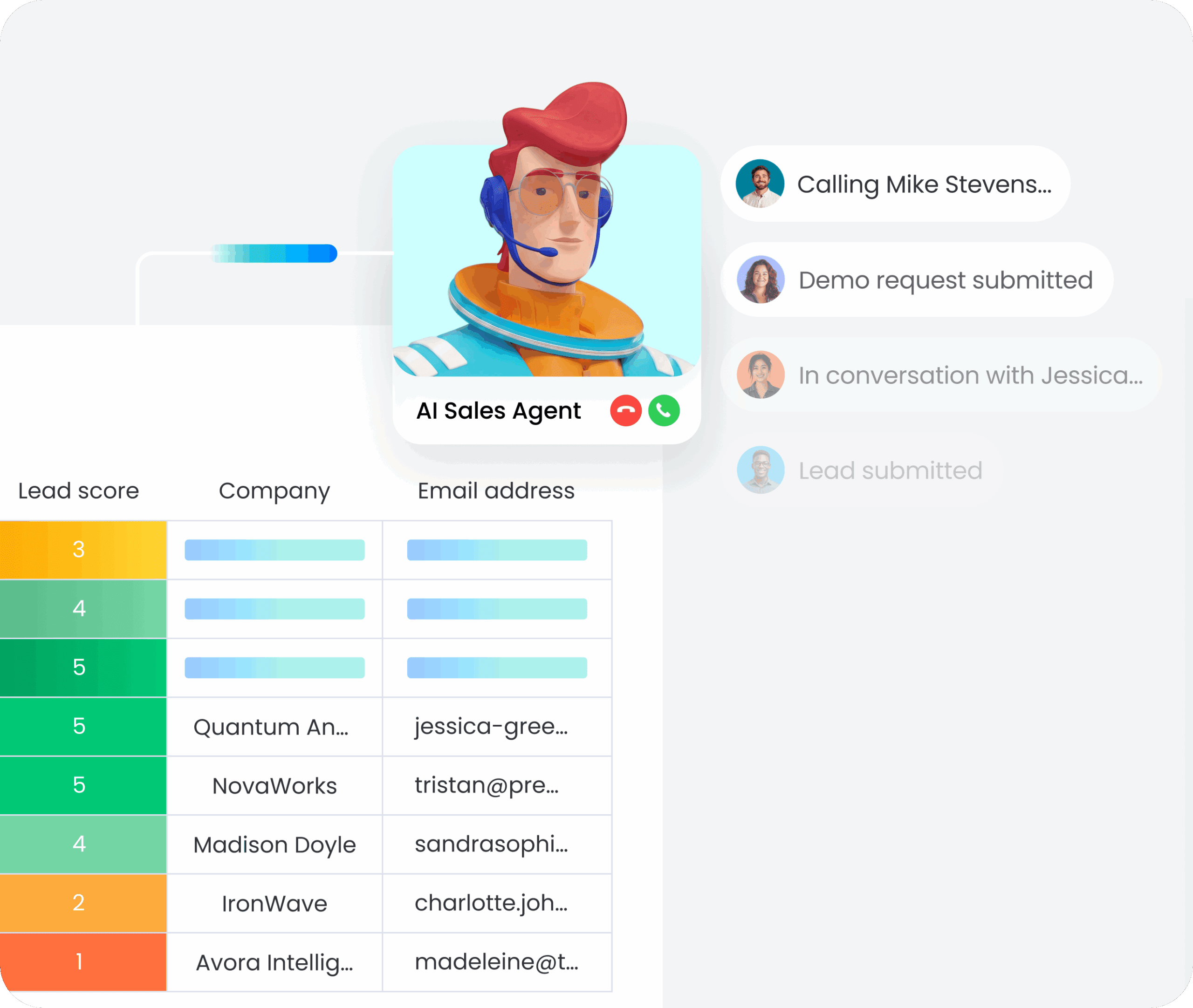
Conversational lead forms are interactive, chatbot-style forms that ask questions one at a time. They improve completion rates by making forms feel easier and more engaging.
What fields to include in a lead generation form
The right form fields depend on what you’re offering. Higher-value offers like demos and trials justify more fields. Lower-value offers like newsletters should keep it short. Every field should serve a purpose — qualifying the lead, routing them correctly, or personalizing follow-up.
Here are the 4 field categories every revenue team should know:
1. Contact information fields
Contact information fields are the foundation for any lead form. They let you identify and reach the prospect.
- Name (first and last): Essential for personalized follow-up and CRM record creation.
- Email address: The primary communication channel and often the unique identifier in your CRM.
- Phone number: Optional for top-of-funnel forms but critical for high-intent forms like demo requests where sales reps need to call quickly.
2. Company and role fields
Company and role fields help qualify leads by fit, so sales teams can prioritize leads from target accounts or industries.
- Company name: Enables account matching and research before outreach.
- Job title/role: Indicates decision-making authority and helps personalize messaging.
- Company size: Useful for segmentation and routing.
- Industry: Helps identify fit with your ideal customer profile and enables industry-specific follow-up.
3. Intent and timeline fields
Intent and timeline fields help you assess buying urgency and readiness, so sales teams can prioritize leads with
- “What are you looking to solve?”: Captures the specific pain point driving the inquiry.
- “When are you looking to implement?”: Indicates urgency and helps prioritize follow-up.
- “Current solution/tool”: Reveals competitive context and potential switching costs.
Open-text fields like “Tell us about your needs” provide valuable context but may reduce completion rates. Use them selectively for high-intent forms where the additional context justifies the friction.
AI-powered CRMs can analyze open-text responses for buying signals, urgency, and common pain points, helping teams extract value from qualitative responses without requiring manual review.
4. Consent and privacy fields
Consent and privacy fields are legally required in many regions and ensure compliance with data privacy regulations like GDPR and CCPA.
- Email marketing consent checkbox: Required for adding leads to marketing communications.
- Privacy policy acknowledgment: Confirms the lead has reviewed your data handling practices.
- Communication opt-in: Specifies which types of communications the lead agrees to receive.
7 best practices for lead generation forms
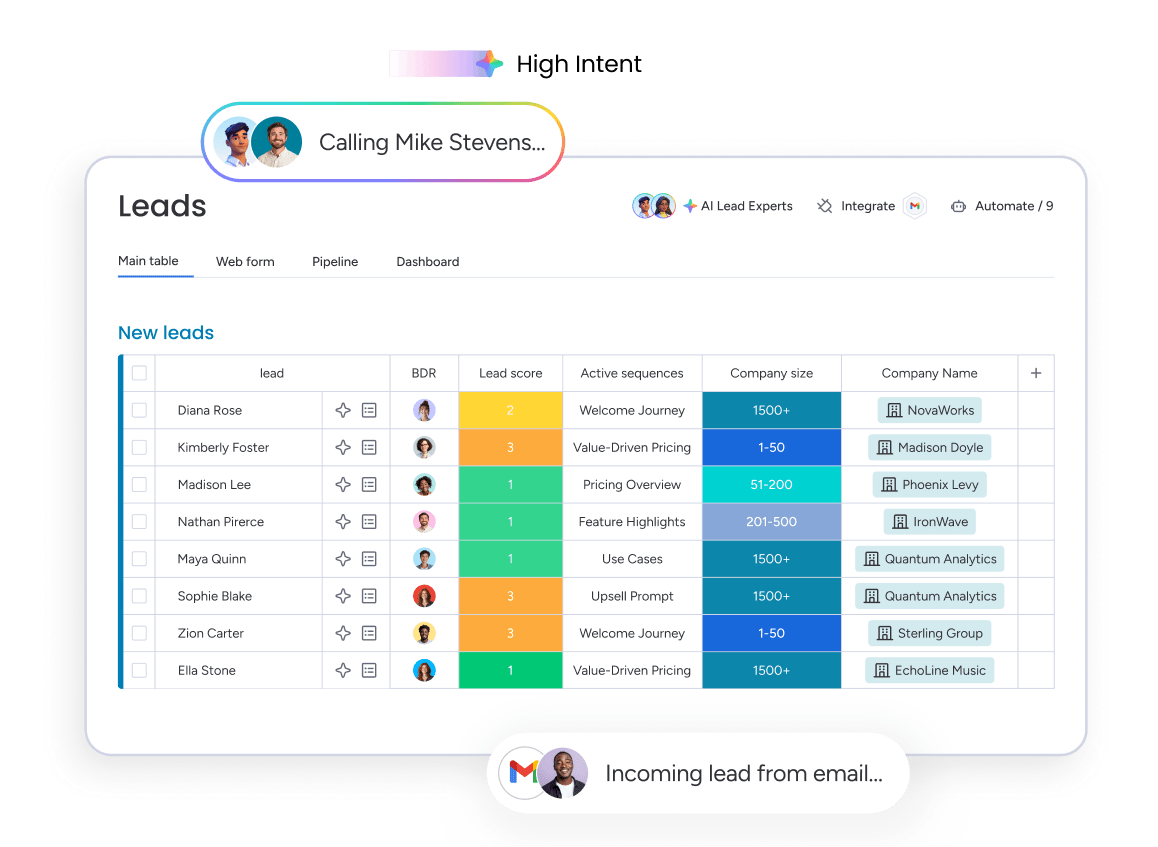
The best lead generation forms balance 2 goals: capturing enough information to qualify leads and minimizing friction to maximize conversions. These practices help you strike that balance without sacrificing lead quality.
Use these 7 practices as a checklist every time you build or audit a form.
1. Match the form to the offer
The number of fields should match the value of the offer. High-value offers like demos and trials justify more fields because prospects are willing to invest more effort for something they perceive as valuable.
A newsletter signup might only need an email address. A demo request can reasonably ask for company size, timeline, and specific challenges. Every field should serve a purpose — if you won’t use the data for qualification, routing, or personalization, don’t ask for it.
2. Keep fields focused on the next step
Forms should only ask for information needed to take the next action. A demo request form should ask for company size and timeline to route the lead correctly, but doesn’t need to ask for budget or current tools upfront. That information can be gathered during the demo conversation.
3. Use conditional logic for cleaner qualification
Conditional logic shows or hides fields based on previous answers, allowing you to ask more questions without overwhelming prospects.
- If a prospect selects “Enterprise” as their company size, the form can show additional fields about procurement process.
- If they select “Small business,” those fields remain hidden.
Advanced platforms can use AI alongside conditional logic to dynamically surface additional questions based on responses, helping teams gather richer qualification data while keeping forms concise.
4. Write a CTA that sets expectations
The call-to-action button should communicate what happens next. Effective CTAs describe the outcome:
- “Get Your Free Template” tells the prospect exactly what they’ll receive.
- “Book My Demo” uses first-person language that feels personal.
- “Start Your Free Trial” emphasizes the value and the action.
5. Design every lead form for mobile completion
A significant portion of form submissions happen on mobile devices. Mobile-friendly design means reducing the effort required to complete the form:
- Large, tappable fields
- Single-column layouts
- Appropriate input types
- Minimal typing through dropdowns and checkboxes
6. Add trust signals near the form
Trust signals like privacy statements, security badges, testimonials, and customer logos reduce hesitation and increase form submissions. Place them close to the form so prospects see them while deciding whether to submit.
7. Test forms and improve over time
The best lead generation forms are continuously tested and optimized. Elements worth testing include:
- Number of fields
- Field labels
- CTA copy
- Form placement
- Conditional logic
Run A/B tests with sufficient sample sizes and measure both lead conversion rate and lead quality.
How to connect lead forms to a CRM
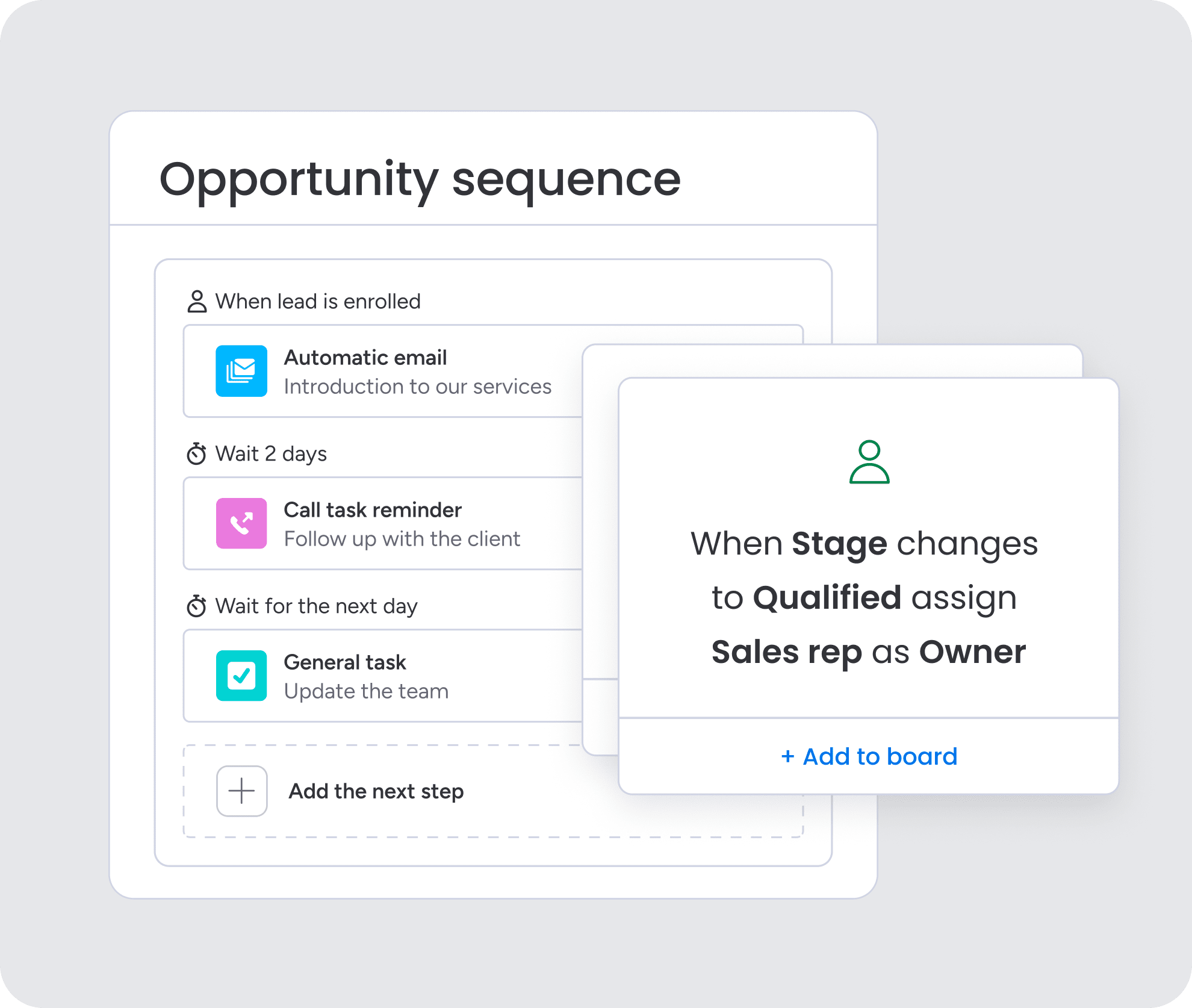
Connecting lead forms to a CRM is essential for turning form submissions into actionable sales opportunities. Integrating forms directly with a CRM turns every submission into an actionable sales opportunity, ensuring fast follow-up and complete visibility.
The 4 steps below cover everything from record creation to pipeline tracking — and show how monday CRM handles each one automatically.
Step 1: Create new lead records automatically
When a form is submitted, the CRM should automatically create a new lead record with all the submitted information. This eliminates manual data entry, ensures no leads are lost, and provides instant visibility into new prospects. Teams using monday CRM’s native forms create lead records instantly, with all form data mapped to the correct fields.
Step 2: Route leads by segment or source
CRM integration allows you to automatically assign leads to the right rep based on territory, company size, product interest, or lead source. This ensures leads are followed up on by the right person and reduces response time. monday CRM’s routing automations can assign leads based on any field or combination of fields.
AI can further enhance routing by identifying high-priority submissions, detecting enterprise buying signals, or flagging leads that match historical conversion patterns.
Step 3: Trigger follow-up workflows
CRM integration allows you to automatically trigger follow-up actions when a form is submitted. Actions can include:
- Sending a confirmation email
- Creating a task for the assigned rep
- Adding the lead to a nurture sequence
- Notifying the sales manager when high-value leads come in
monday CRM’s automation engine can trigger multi-step workflows based on form submissions.
Try monday CRMStep 4: Track every lead form through the sales pipeline
CRM integration allows you to track leads from form submission through the entire sales pipeline: from qualification to demo to proposal to closed-won. monday CRM’s dashboards and reporting provide full visibility from form submission to closed deal, showing which forms drive pipeline and which campaigns generate the best ROI.
AI-powered reporting can uncover which form fields, lead sources, and campaigns are most strongly correlated with pipeline generation and closed-won revenue.
How to optimize lead gen forms for mobile and social channels
Mobile and social channels require different form strategies than desktop web pages. Users expect faster, simpler experiences, and native platform features like auto-fill can significantly improve conversion rates.
The adjustments below cover both mobile optimization and social-specific form strategies, plus how to keep the experience consistent across channels.
Mobile form optimization
Mobile users are often multitasking, have limited patience, and are typing on small screens. Forms that work well on desktop can be frustrating on mobile. Mobile optimization requires specific adjustments:
- Reduce field count: Mobile users abandon forms faster than desktop users.
- Use single-column layouts: Multi-column forms require awkward scrolling on mobile devices.
- Increase tap target size: Buttons and fields should be large enough to tap accurately.
- Use appropriate input types: Email fields should trigger the email keyboard; phone fields should trigger the number pad.
- Enable auto-fill: Allow browsers to auto-fill common fields like name, email, and phone number.
Social lead gen form optimization
Social platforms like LinkedIn and Facebook offer native lead gen forms that pre-fill user data from their profiles. These forms have significantly higher completion rates than forms that require users to click through to an external landing page.
Key principles for social form optimization:
- Pre-fill profile data: Native social forms can auto-populate name, email, company, and role.
- Keep it short: Even with auto-fill, stick to 3–5 fields maximum.
- Match the ad experience: The form should feel like a natural continuation of the ad creative.
- Connect to your CRM immediately: Social form submissions should flow directly into your
Teams using monday CRM integrate with social lead gen forms, ensuring leads captured on LinkedIn or Facebook flow directly into the pipeline with full attribution data.
Cross-channel consistency
Leads captured on mobile and social channels should receive the same quality of follow-up as leads captured on desktop. This means immediate CRM integration, consistent routing, fast follow-up, and attribution tracking. The goal is a seamless experience for both the prospect and the sales team, regardless of where the lead originated.
Build forms that actually fill your pipeline
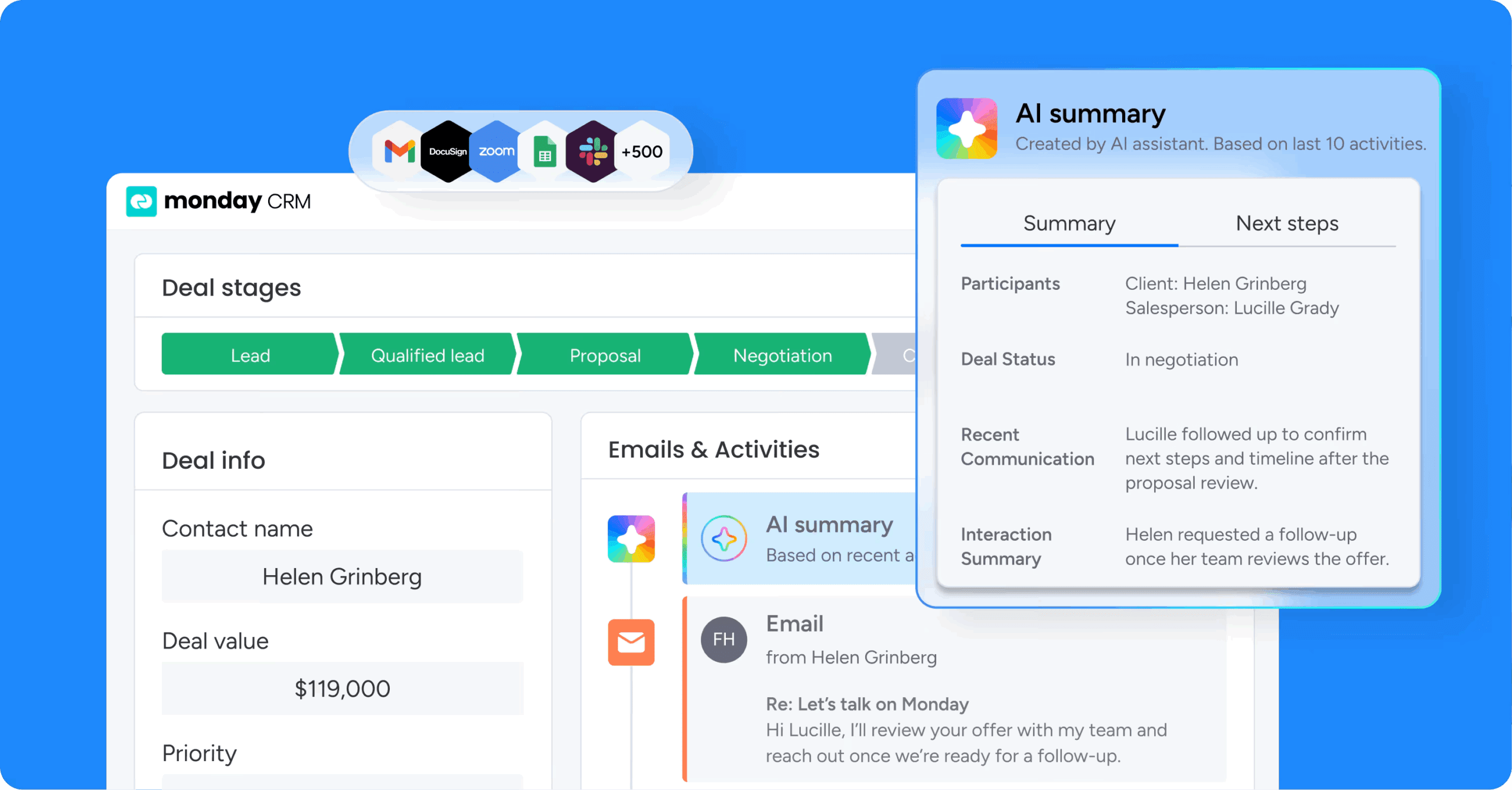
A well-built lead generation form isn’t just a data collection point. It’s the first step in a revenue conversation. When forms are designed with the right fields, connected to a CRM, and backed by smart routing and automation, they become one of the most reliable sources of qualified pipeline a revenue team can have.
Revenue teams that get this right capture the right leads, at the right time, with the context needed to close them. monday CRM brings all of this together in one place: form capture, lead routing, follow-up automation, and pipeline visibility, so every opportunity moves forward.
Try monday CRMFAQs
What is a lead generation form?
A lead generation form is a web-based form that collects contact information from potential customers in exchange for something valuable, such as content, demos, or consultations, creating a record that flows into a CRM for sales follow-up.
How many fields should a lead generation form have?
The number of fields should match the value of the offer. Use 1–2 fields for newsletters, 3–5 for gated content, and 6–10 for demo requests, with every field serving a specific purpose for qualification, routing, or personalization.
What fields should a lead generation form include?
Essential fields include name and email address, with additional fields like company, role, company size, and intent questions added based on the form's goal and the value of the offer being exchanged.
Should I use a single-step or multi-step lead form?
Single-step forms work for low-friction offers like newsletters, while multi-step forms reduce cognitive load for longer forms and can improve qualification by asking intent-based questions progressively.
How do I reduce spam submissions on my lead forms?
Use honeypot fields that are hidden from humans but visible to bots, invisible bot checks like reCAPTCHA v3, work email validation for B2B forms, required-field logic, and duplicate prevention in your CRM.
Where should I place lead generation forms on my website?
Place forms based on intent. Use landing pages for high-intent offers, inline forms for content, pop-ups for low-friction captures, and sticky forms for persistent visibility, with all placements syncing to your CRM for centralized tracking.
