


Deal velocity measures how fast revenue flows through your pipeline in dollars per day. It combines 4 key variables (opportunities, deal value, win rate, and sales cycle length) into one actionable number that shows exactly where to focus, and small improvements to any factor compound fast.
You’ll learn how to calculate deal velocity, benchmark your performance, identify what’s slowing your pipeline, and apply 7 proven strategies to close deals faster. We’ll also cover which metrics to track alongside velocity and how AI and automation speed up deals without creating more work.
Key takeaways
- Deal velocity combines 4 factors — opportunities, deal value, win rate, and cycle length — into one daily revenue number that shows precisely where your pipeline is breaking down.
- Raising your win rate from 20% to 30% boosts velocity by 50% without touching anything else, proving that small improvements to any single factor compound fast.
- Prioritizing high-fit leads and responding within 5 minutes consistently outperforms chasing more deals with slower follow-up because speed and focus beat volume every time.
- Teams that track velocity consistently can predict revenue, allocate resources, and report upward with confidence instead of guesswork, making it your most reliable forecasting signal.
- Lead routing, follow-up reminders, AI deal summaries, and approval workflows in monday CRM automate the work that slows teams down so velocity improvements happen without manual effort.
What is deal velocity?
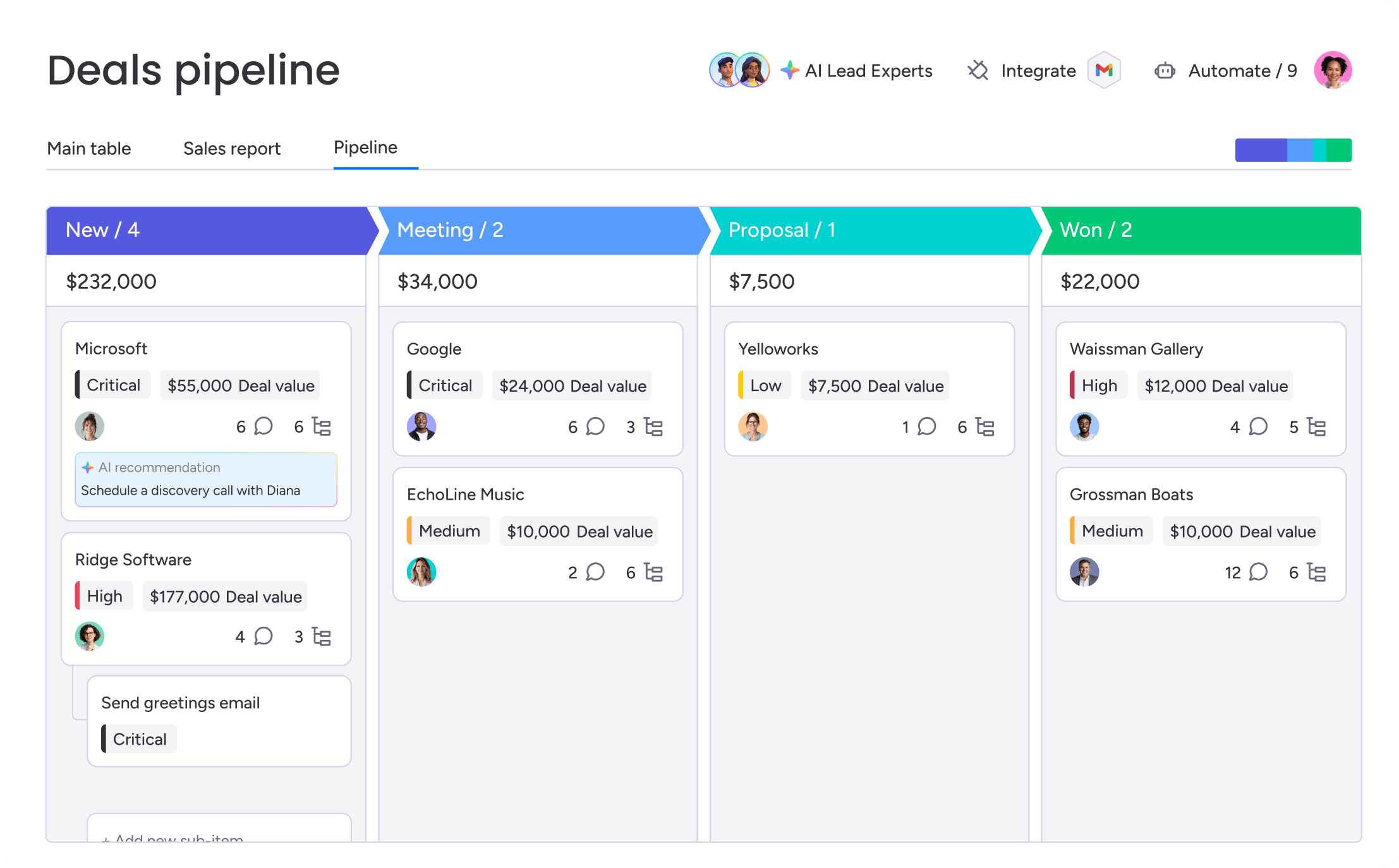
Deal velocity measures how fast revenue moves through your pipeline — the rate at which opportunities convert to closed deals, in dollars per day. It combines 4 factors: number of opportunities, average deal value, win rate, and sales cycle length.
Deal velocity works like a speedometer for your pipeline. For example, a team closing 10 deals monthly at $5,000 each with a 25% win rate and a 30-day cycle produces a measurable daily revenue rate. That number shows how much revenue to expect and where bottlenecks slow you down.
Deal velocity works as both a diagnostic tool and a forecasting metric. When velocity drops, one of the 4 factors is underperforming. When it rises, your pipeline is healthy and moving fast.
Why deal velocity is a forward-looking revenue metric
Deal velocity shows how fast your pipeline generates revenue. It’s a forward-looking metric that helps sales leaders forecast income, spot bottlenecks, and decide where to improve.
It shows how efficiently your sales process turns prospects into paying customers.
- High velocity: Your pipeline is healthy and moving quickly.
- Low velocity: There’s friction or inefficiency somewhere in the process.
Deal velocity vs. sales velocity: What’s the difference?
Teams often use these terms interchangeably, but some make subtle distinctions based on where measurement starts. Here’s how they compare:
| Aspect | Deal velocity | Sales velocity |
|---|---|---|
| Starting point | Sales-qualified opportunities | May include marketing-qualified leads |
| Focus | Qualified pipeline only | Entire funnel (sometimes) |
| Primary users | Sales teams, sales managers | Revenue operations, broader GTM teams |
| Typical application | Pipeline reviews, rep performance | Funnel analysis, marketing-sales alignment |
The formula and metrics stay the same no matter which term you use. Pick one term, define it for your organization, and track it consistently.
Why deal velocity matters for revenue teams
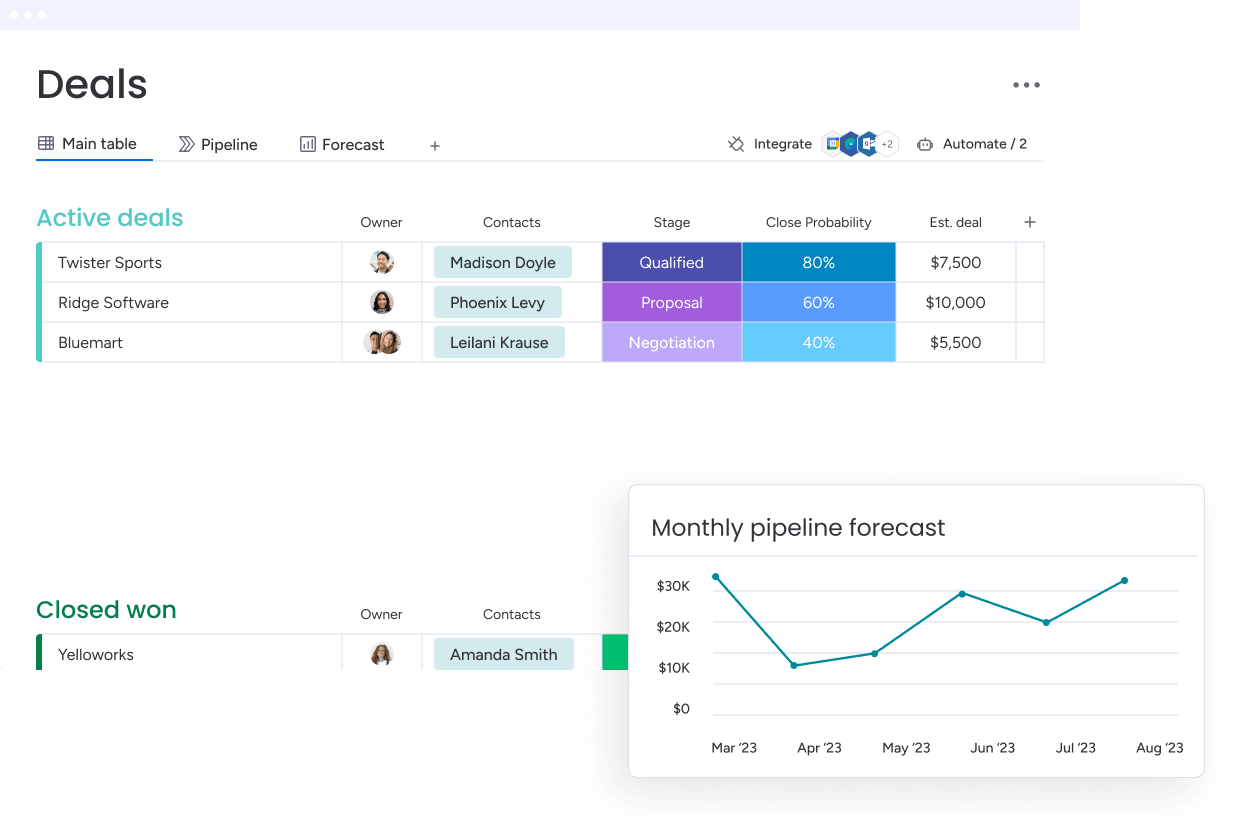
Deal velocity improves forecasting accuracy, speeds up pipeline reviews, and sharpens resource allocation. Revenue teams that track velocity consistently get visibility into pipeline health that raw deal counts and revenue totals can’t match.
More predictable revenue forecasts
Deal velocity improves forecast accuracy by tracking how fast deals close. For example, if your current velocity is $10,000 per day, you can forecast $300,000 in revenue over the next 30 days, assuming pipeline health stays stable.
This predictability helps leadership allocate budgets with confidence, plan hiring based on realistic targets, and investigate pipeline issues before they impact the quarter.
Faster, more actionable pipeline reviews
Deal velocity captures pipeline health in one metric. Instead of reviewing every deal individually, sales managers check whether velocity is trending up or down, then dig into the 4 factors to find the cause.
Let’s say velocity drops from $15,000/day to $10,000/day. The sales team checks whether win rates fell, cycles got longer, or deal sizes shrank using real-time dashboards that make velocity trends visible.
More focused revenue planning and resource allocation
Deal velocity shows which factor limits revenue growth, helping you make smarter decisions. Revenue leaders use velocity trends to decide where to invest.
- More SDRs to increase the number of qualified opportunities
- Sales training to improve win rates
- Pricing changes to boost average deal size
If low win rates drag down velocity, prioritize sales coaching or refine your ideal customer profile. If long sales cycles are the bottleneck, use mutual action plans to speed up deals.
How to calculate deal velocity
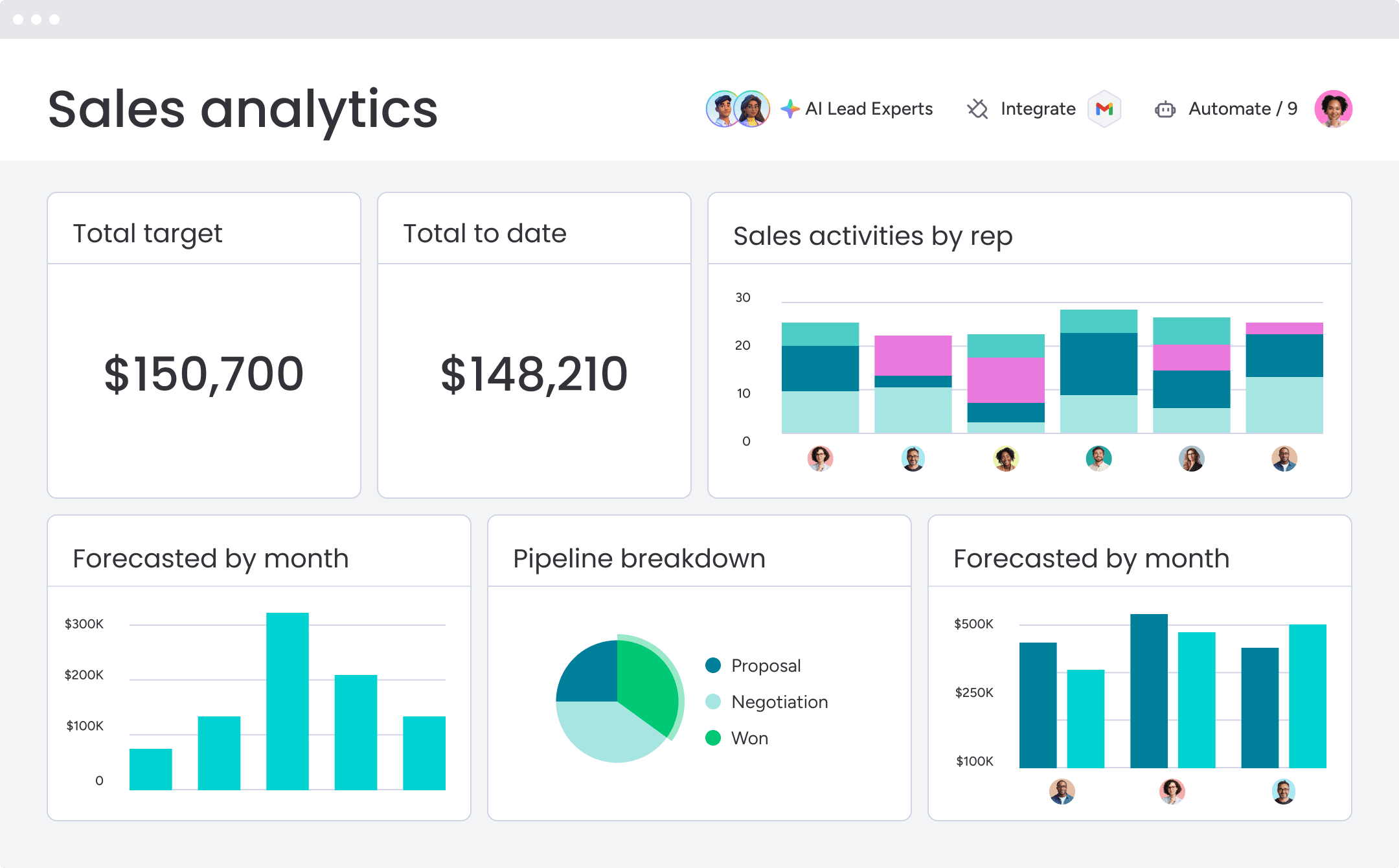
Deal velocity combines 4 pipeline metrics into a single daily revenue figure that shows how quickly opportunities turn into revenue. By tracking these metrics together, you can see not only how much revenue your pipeline is producing, but also which part of your sales process has the biggest impact on growth.
The formula is:
Deal velocity = (Number of opportunities × Average deal value × Win rate) ÷ Sales cycle length
Here’s what each component measures:
| Deal velocity factor | Description |
|---|---|
| Number of opportunities | Qualified deals currently in your pipeline |
| Average deal value | The average revenue generated per deal |
| Win rate | The percentage of qualified opportunities that become customers |
| Sales cycle length | The average number of days from opportunity creation to close |
For example, suppose your team has 50 qualified opportunities, an average deal value of $12,000, a 25% win rate, and an average sales cycle of 45 days.
Your deal velocity would be:
(50 × $12,000 × 0.25) ÷ 45 = $3,333 per day
That means your pipeline is generating approximately $3,333 in revenue each day, assuming those 4 metrics remain consistent. If you want to improve deal velocity, you can increase the number of qualified opportunities, raise your average deal value, improve your win rate, shorten your sales cycle, or optimize a combination of all 4 factors.
Accurate calculations depend on clean CRM data. Opportunity stages, deal values, and close dates should be tracked consistently so dashboards and forecasts reflect your pipeline in real time. Automating these calculations inside your CRM also eliminates spreadsheet work and ensures your deal velocity updates as your pipeline changes.
Deal velocity benchmarks
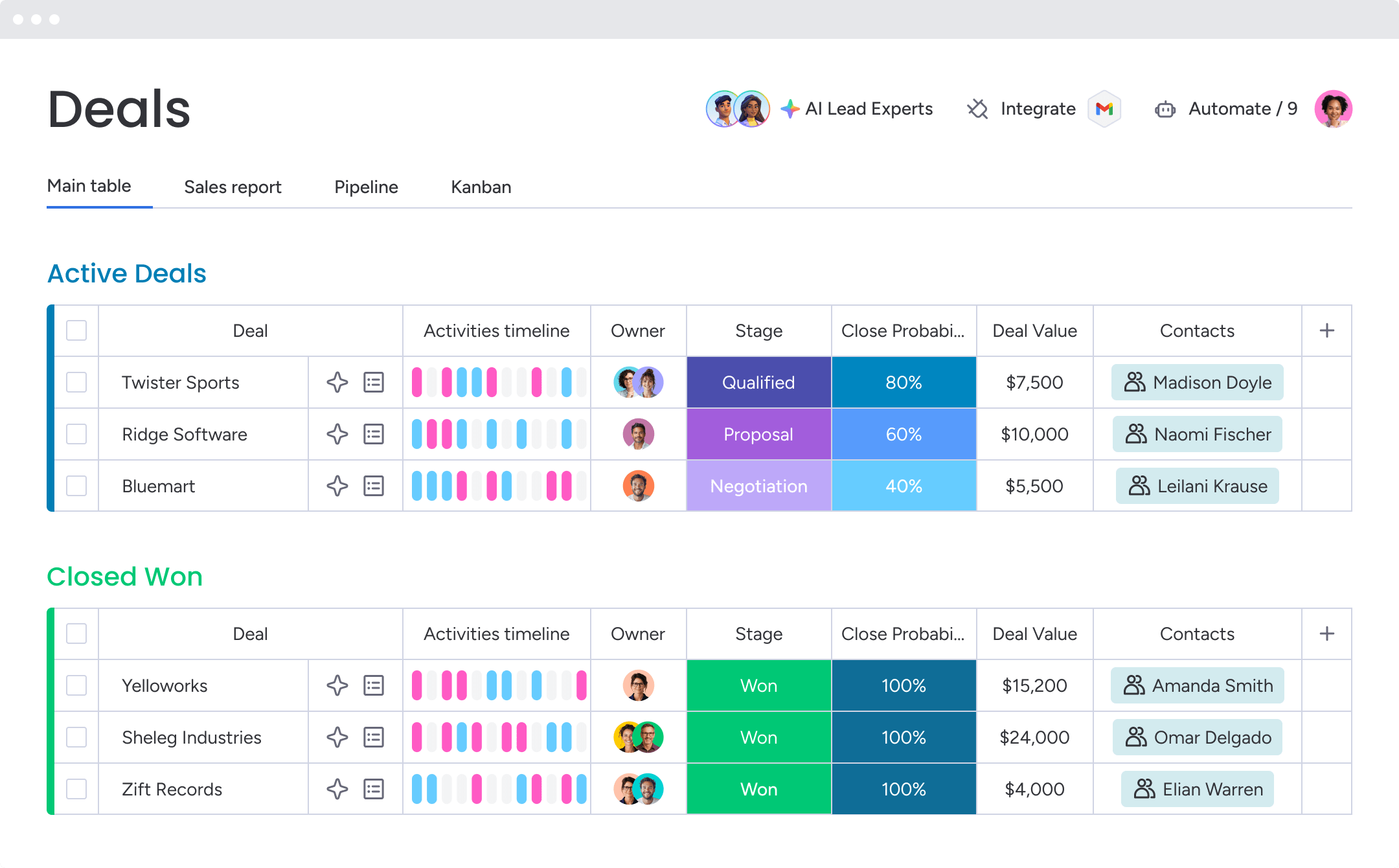
Benchmarks shift based on industry, sales motion, and deal size. The best benchmarks compare your performance against your own history or similar companies in your sector. Here’s how to interpret velocity by sales motion, deal size, and pipeline stage.
Benchmarks by sales motion
Sales motion has a big impact on deal velocity. Different approaches produce different velocity ranges.
| Sales motion | Typical cycle length | Typical deal size | Benchmark velocity range |
|---|---|---|---|
| Transactional/SMB | 7–30 days | $1K–$10K | $500–$5,000/day |
| Mid-market | 30–60 days | $10K–$50K | $2,000–$10,000/day |
| Enterprise | 90+ days | $50K+ | $5,000–$20,000+/day |
These ranges are examples. Your actual velocity depends on your business model, market conditions, and team capabilities.
Benchmarks by deal size
Deal size shapes velocity patterns.
- Small deals (<$5K): Faster cycles, higher volume, moderate velocity
- Medium deals ($5K–$50K): Balanced velocity common in mid-market B2B
- Large deals ($50K+): Slower cycles, fewer opportunities, but higher total revenue per deal
Velocity matters, but it’s not the only metric. Lower velocity with larger deals can still produce higher total revenue. Track velocity alongside total pipeline value and revenue targets.
Benchmarks by pipeline stage
Calculating stage-specific velocity is a core part of sales funnel analysis and helps identify the precise points where deals slow down. Here’s what to expect at each stage.
- Discovery stage: Deals typically move quickly (7–14 days) as reps qualify fit
- Proposal stage: Velocity often slows (14–30 days) as prospects evaluate options
- Negotiation stage: Often the longest stage (30–60 days) due to legal, procurement, and approval processes
If deals spend 45 days in negotiation but only 10 days in discovery, focus on streamlining contract approvals and pricing discussions.
How to use benchmarks in pipeline reviews
Use benchmarks in pipeline meetings to get actionable insights.
- Compare to historical averages: Track current velocity against last quarter and the same period last year.
- Identify trends: Determine whether velocity is increasing, decreasing, or stable.
- Diagnose changes: Drill into the 4 factors to understand what’s driving velocity shifts.
- Set improvement targets: Establish realistic goals based on benchmarks.
Dashboards that surface velocity trends automatically make it easier to spot changes and act during pipeline reviews.
Try monday CRM4 factors that shape deal velocity
Deal velocity depends on 4 variables, all of which sales teams can influence. When velocity drops, one or more of these factors is underperforming. Knowing which one shows you where to act.
1. Number of qualified opportunities
This factor is pipeline volume. “Qualified” means opportunities that meet your ideal customer profile, have a defined need, and are actively evaluating solutions.
More qualified opportunities increase velocity if other factors stay the same. Doubling opportunities from 20 to 40 while maintaining deal size, win rate, and cycle length doubles velocity.
Here’s how to increase qualified opportunities.
- Improve lead generation: Expand inbound and outbound channels.
- Refine lead scoring: Ensure only high-fit prospects enter the pipeline.
- Speed up lead response times: Contact leads within minutes, not hours.
- Align marketing and sales: Ensure marketing delivers leads that match the ICP.
Centralizing lead management, auto-qualifying and assigning leads, and tracking response times boosts pipeline volume without extra manual work.
2. Average deal value
Average deal value is the mean dollar amount of your pipeline deals. Increasing deal size boosts velocity without requiring more opportunities or faster cycles. Raising average deal size from $10,000 to $12,000 increases velocity by 20%, even if nothing else changes.
Here’s how to increase average deal value.
- Upsell existing customers: Expand deal scope during the sales process.
- Bundle products or services: Create packages that increase total contract value.
- Target higher-value accounts: Focus on prospects with larger budgets.
- Improve pricing strategies: Test pricing tiers and value-based pricing.
Larger deals may lengthen sales cycles, so watch the trade-off between deal size and cycle length.
3. Win rate
Win rate is the percentage of opportunities you close. Higher win rates mean more deals convert, increasing revenue flow. Improving win rate from 20% to 30% increases velocity by 50%, without adding opportunities or shortening cycles.
Here’s how to improve win rate:
- Improve sales training: Focus on objection handling and closing techniques.
- Refine ideal customer profiles: Pursue prospects more likely to buy.
- Provide buyer context: Give reps insights into prospect behavior and concerns.
- Use mutual action plans: Create shared accountability for deal progress.
- Leverage competitive intelligence: Arm reps with positioning against alternatives.
An Emails & Activities timeline that logs every interaction gives reps the context they need to tailor their approach and improve win rates.
4. Sales cycle length
Sales cycle length is the average days from first contact to close. Shorter cycles mean deals close faster, speeding up revenue flow. Reducing the sales cycle from 60 to 45 days increases velocity by 33%, without changing deal size, win rate, or opportunity volume.
Here’s how to shorten sales cycles.
- Streamline approval processes: Reduce internal bottlenecks.
- Use mutual action plans: Create shared timelines with buyers.
- Automate follow-ups: Ensure no deal waits for a rep to remember to reach out.
- Improve buyer enablement: Give prospects the content they need to move forward.
- Align sales, legal, and finance: Eliminate handoff delays.
Automations that trigger follow-up reminders and status updates help reps move deals forward faster.
7 proven strategies to improve deal velocity
Improving deal velocity requires identifying which factor is underperforming, then applying targeted strategies to address it. The following strategies map directly to the 4 levers, so you can act on the right problem — not just the most visible one.
1. Prioritize high-fit opportunities
Not all opportunities are equal. Focusing on high-fit prospects improves win rates and shortens sales cycles at the same time.
High-fit prospects match your ideal customer profile, face fewer objections, and move through the pipeline faster. A SaaS company targeting mid-market healthcare organizations closes deals faster and at higher rates than when pursuing small businesses in unrelated industries.
Implementation tactics:
- Define the ideal customer profile (ICP): Base it on firmographics, pain points, and buying behavior from past wins.
- Use lead scoring: Rank opportunities by fit using explicit and behavioral criteria.
- Train reps to disqualify early: Low-fit prospects waste time and drag down velocity.
- Automate lead routing: Ensure high-fit leads reach the right reps quickly.
2. Respond to leads faster with automation
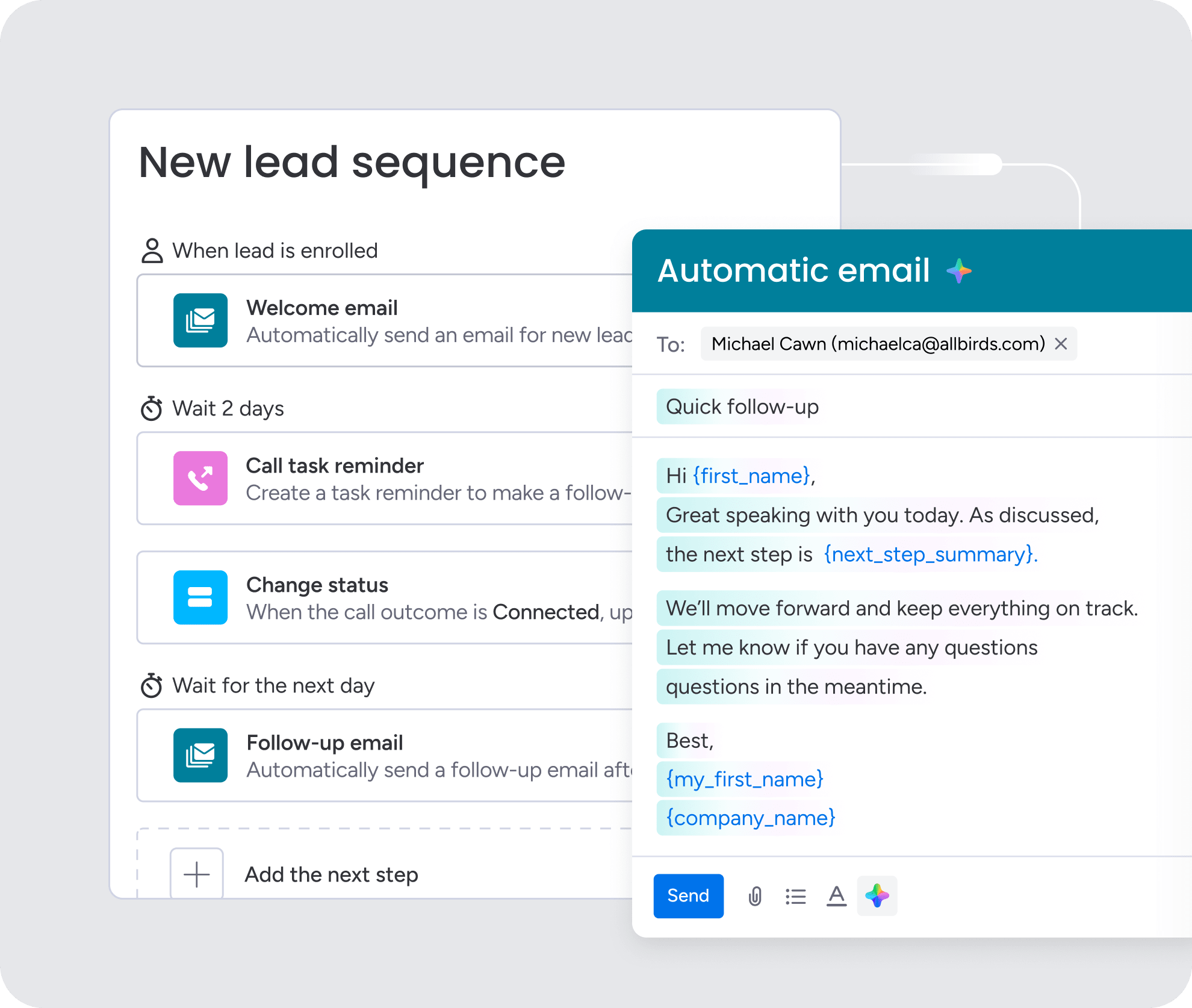
Speed-to-lead directly impacts conversion. Leads contacted within 5 minutes convert at significantly higher rates than those contacted after an hour — faster response to inbound leads increases win rates and shortens sales cycles.
Implementation tactics:
- Set up automated lead routing: Assign leads instantly based on territory, product interest, or availability.
- Use automated acknowledgment: Send immediate email responses to set expectations.
- Trigger real-time alerts: Notify reps of new high-priority leads via mobile or desktop.
- Track speed-to-lead: Make it a key metric in pipeline reviews.
Configurable routing rules ensure no lead waits for a response while maintaining balanced workloads.
3. Use AI to recommend next best actions
Sales reps often lose time deciding what to do next — which deal to prioritize, which prospect to follow up with, or which action will move a deal forward. That indecision costs velocity.
AI deal flow management helps solve this by analyzing deal data, engagement signals, and historical patterns to suggest the most effective next step for each opportunity.
Implementation tactics:
- Use CRM platforms with built-in AI: Surface next-best-action recommendations automatically.
- Train reps to act on AI insights: Prioritize deals flagged as high-intent or at-risk.
- Monitor impact: Track whether AI recommendations improve conversion rates and cycle times.
AI capabilities that analyze deal activity can suggest actions like scheduling follow-up calls, sending proposals, or looping in decision-makers.
4. Improve win rates with coaching and buyer context
Win rates improve when reps understand buyer needs, objections, and decision-making processes. Two complementary tactics drive the most improvement:
| Tactic | Description | Impact on velocity |
|---|---|---|
| Sales coaching | Regular feedback, role-playing, and deal reviews help reps refine their pitch and handle objections. | Improves win rate |
| Buyer context | Insights into buyer behavior help reps tailor their approach. | Improves win rate and shortens the sales cycle |
A rep who knows a prospect has viewed pricing pages multiple times can proactively address budget concerns, increasing the likelihood of closing.
5. Shorten sales cycles with mutual action plans
Mutual action plans (MAPs) are shared documents outlining the steps, owners, and timelines required to close a deal, created collaboratively with the buyer. MAPs create accountability, reduce uncertainty, and keep deals moving by aligning buyer and seller on next steps.
A MAP might include milestones like “Technical evaluation by [date],” “Legal review by [date],” and “Final approval by [date],” with named owners for each step.
Implementation tactics:
- Introduce MAPs: Bring them in early, during discovery or proposal stages.
- Collaborate with the buyer: Define realistic timelines and owners together.
- Use the MAP as a living document: Update it as the deal progresses.
- Track completion rates: Correlate MAP usage with win rates and cycle times.
6. Keep pricing and approvals moving
Pricing discussions and internal approvals are among the most common velocity killers. Delays give competitors time to intervene and buyers time to reconsider.
Implementation tactics:
- Standardize pricing tiers: Reduce back-and-forth on custom pricing.
- Create discount approval processes: Define thresholds and escalation paths.
- Use pre-approved contract templates: Speed up legal review.
- Automate approval routing: Ensure requests reach the right stakeholders instantly.
- Set internal SLAs: Legal reviews completed within 48 hours, pricing approvals within 24 hours.
Workflow automations that route pricing and contract approvals to the right people automatically — sending reminders and escalating overdue requests — keep approvals moving.
7. Connect sales, legal, finance, and customer success

Deal velocity suffers when teams operate in silos. Handoffs are slow, information gets lost, and deals stall waiting for input from other functions.
When these teams collaborate through deal flow management software, contracts move faster, pricing is approved quickly, and onboarding begins immediately after close.
Implementation tactics:
- Create shared workflows: Use boards or workspaces where all teams track deal progress and handoffs.
- Establish SLAs: Define each team’s role and response time in the sales process.
- Use a centralized platform: Ensure all teams have visibility into deal status, next steps, and blockers.
A single source of truth for cross-functional teams ensures everyone sees deal status, collaborates on next steps, and moves deals forward without delays — exactly what monday CRM provides.
Try monday CRMHow AI and automation improve deal velocity
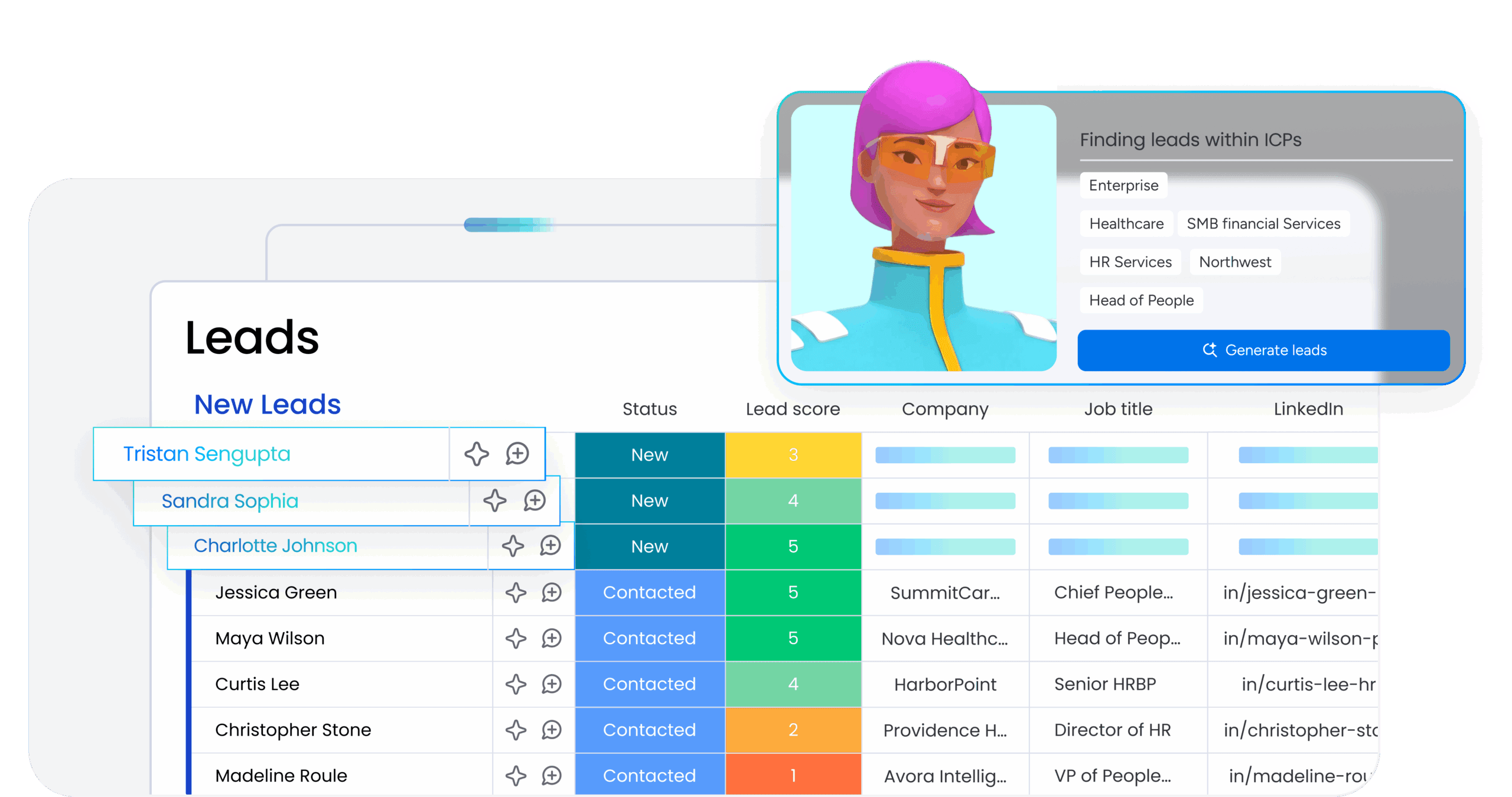
AI and automation address the root causes of slow velocity: manual tasks, delayed follow-ups, poor lead prioritization, and lack of visibility into deal health.
Here’s how AI capabilities help remove common bottlenecks throughout the sales process:
- AI agents for lead scoring and routing: AI agents analyze lead data to score leads by fit and intent, then route high-priority leads to the right reps instantly. Faster lead response increases conversion rates, while prioritization ensures reps focus on opportunities most likely to close.
- AI summaries for faster, more informed follow-ups: Sales reps spend significant time reviewing call notes, email threads, and CRM records to prepare for follow-ups. AI-generated summaries analyze meeting transcripts, emails, and CRM activity to produce concise summaries of key points, next steps, and buyer concerns.
- Sentiment detection to monitor deal health in real time: AI analyzes buyer communications to detect sentiment, identifying whether a prospect is engaged, hesitant, or losing interest. Early detection of negative sentiment allows reps to address concerns before deals stall or are lost.
- Secure document workflows to keep buyer reviews on track: Many deals slow during buyer review stages. Prospects need to share proposals, contracts, or pricing with internal stakeholders, but this process often happens outside the CRM, creating delays and a lack of visibility.
5 metrics to track when improving deal velocity
Deal velocity is a high-level metric. Improving it requires pipeline reports and more granular metrics that reveal where deals slow down or fall apart. These 5 indicators give you the diagnostic detail that velocity alone can’t provide.
1. Speed to lead
Definition: The time between when a lead enters the system and when a rep makes first contact.
Why it matters: Faster response times increase conversion rates and shorten sales cycles.
| Response time | Conversion impact |
|---|---|
| Under 5 minutes | Highest conversion rates |
| 5–30 minutes | Moderate conversion rates |
| 30–60 minutes | Significant drop in conversion |
| Over 1 hour | Leads often go cold |
2. Stage conversion rates
Definition: The percentage of deals that move from one pipeline stage to the next
Why it matters: Low conversion at specific stages reveals where deals stall. If only 30% of deals move from proposal to negotiation, the proposal stage needs attention.
3. Average time in stage
Definition: The average number of days deals spend in each pipeline stage
Why it matters: Identifies which stages create the most friction. If deals spend 20 days in negotiation but only 5 days in discovery, the focus should shift to accelerating the negotiation stage.
4. Activity-to-close ratio
Definition: The number of activities (calls, emails, meetings) required to close a deal
Why it matters: Reveals whether reps are over-working or under-working deals. Too many activities may indicate poor qualification; too few may indicate missed opportunities.
5. Win/loss reasons
Definition: The documented reasons why deals close or are lost
Why it matters: Patterns in loss reasons reveal systemic issues. If 40% of lost deals cite “price,” pricing strategy needs review. If 30% cite “timing,” qualification criteria may need adjustment.
Learn more: AI deal prep briefing agent
How monday CRM helps improve deal velocity
monday CRM gives revenue teams the visibility, automation, and AI capabilities needed to improve deal velocity without adding manual work. Built on a flexible platform, it centralizes pipeline data, automates repetitive tasks, and surfaces actionable insights — so teams can focus on moving deals forward instead of managing spreadsheets.
Here’s how monday CRM helps improve deal velocity:
- Real-time deal velocity dashboards: Track velocity, stage conversion rates, and cycle times in customizable dashboards that update automatically as your pipeline changes.
- AI-powered lead scoring and routing: Automatically score leads by fit and intent, then route high-priority opportunities to the right reps instantly — improving speed-to-lead and win rates.
- AI Timeline Summaries: Generate concise summaries of all deal activity, emails, and meetings so reps can prepare for follow-ups in seconds instead of minutes.
- Sentiment detection: Analyze buyer communications to flag at-risk deals early, allowing reps to address concerns before deals stall.
- Automated follow-up reminders: Trigger reminders based on deal stage, activity, or time elapsed — ensuring no opportunity waits for a rep to remember to reach out.
- Approval workflows: Route pricing, discount, and contract approvals to the right stakeholders automatically, with escalations for overdue requests.
- Cross-functional collaboration: Connect sales, legal, finance, and customer success teams in shared workspaces where everyone sees deal status, next steps, and blockers in real time.
- Document management: Create a centralized library of proposals, contracts, and security materials that keeps buyer reviews on track and visible.
monday CRM doesn’t require heavy IT involvement or months of implementation. Teams of all sizes can configure workflows, dashboards, and automations to match their sales process and then adjust as they grow. The result is a CRM that adapts to how your team works, not the other way around.

“With monday CRM, we’re finally able to adapt the platform to our needs — not the other way around. It gives us the flexibility to work smarter, cut costs, save time, and scale with confidence.”
Samuel Lobao | Contract Administrator & Special Projects, Strategix
“Now we have a lot less data, but it’s quality data. That change allows us to use AI confidently, without second-guessing the outputs.”
Elizabeth Gerbel | CEO
“Without monday CRM, we’d be chasing updates and fixing errors. Now we’re focused on growing the program — not just keeping up with it."
Quentin Williams | Head of Dropship, Freedom Furniture
“There’s probably about a 70% increase in efficiency in regards to the admin tasks that were removed and automated, which is a huge win for us.“
Kyle Dorman | Department Manager - Operations, Ray White
"monday CRM helps us make sure the right people have immediate visibility into the information they need so we're not wasting time."
Luca Pope | Global Client Solutions Manager at Black Mountain
“In a couple of weeks, all of the team members were using monday CRM fully. The automations and the many integrations, make monday CRM the best CRM in the market right now.”
Nuno Godinho | CIO at Velv
“monday.com provides developmental flexibility, operational efficiency, and data transparency — all in one place. We became a company that moved from chasing data to leading with it.”
Hyunghan Lee | Team Lead, Sandbox Network
"monday.com brought every part of our business into one connected space. The harmony between work management and CRM has become our operating system — giving us the clarity and confidence to scale.”
Jennifer Chinburg | Executive Vice President of Corporate Development & Brand, Chinburg Properties
“We just weren’t getting value from our old CRM. With monday.com, it's a thousand times better. Our sales teams are more informed, more consistent, and far more connected."
James Arnold | Chief Operating Officer, CenversaTurn deal velocity insights into action
Deal velocity gives revenue teams a single number that shows both how your pipeline is performing and precisely where to fix it. The fastest improvements come from isolating your specific constraint — whether it’s win rate, cycle length, deal size, or opportunity volume — then applying targeted strategies that compound quickly.
With monday CRM, teams get the dashboards, automations, and AI capabilities to move from reactive problem-solving to proactive execution. Try monday CRM to put these velocity levers to work and build the workflows that keep deals moving.
Try monday CRMFAQs
How do you calculate deal velocity accurately?
Deal velocity is calculated using the formula: (Number of Opportunities × Average Deal Value × Win Rate) ÷ Sales Cycle Length, resulting in a daily revenue rate.
What factors have the biggest impact on deal velocity?
Win rate and sales cycle length typically have the largest impact because small improvements create multiplier effects on daily revenue flow.
How can you shorten the sales cycle without lowering win rates?
You can shorten the sales cycle without lowering win rates by using mutual action plans, automated follow-ups, and cross-functional alignment — all of which reduce cycle time while maintaining or improving win rates by keeping deals moving.
Which CRM workflows and automations help improve deal velocity fastest?
The CRM workflows and automations that improve deal velocity fastest are automated lead routing, follow-up reminders, approval workflows, and AI-powered next-best-action recommendations.
What benchmarks should sales leaders use to evaluate deal velocity by team or segment?
Sales leaders should use historical comparison against their own past performance to evaluate deal velocity by team or segment — it's more valuable than industry averages, though transactional teams typically see $500–$5,000/day while enterprise teams target $5,000–$20,000+/day.
How do you track deal velocity in a CRM?
You track deal velocity in a CRM by using platforms with real-time dashboards, custom views, and forecasting tools that pull opportunity, deal value, win rate, and cycle length data from your pipeline automatically.
