


Your sales team closed 15 deals last month. This month, they closed 18. Sounds like growth, right? But without knowing how to calculate sales growth properly, you can’t tell if that 20% jump is sustainable momentum or just a lucky streak. Sales growth rate measures the percentage change in revenue between two time periods, giving you the data to make informed decisions about resource allocation, strategic planning, and performance evaluation. The math is straightforward, but the insights become powerful when you track consistently and avoid common calculation mistakes that can derail your forecasting.
Here’s what you’ll learn in this piece: the essential formulas for MoM, QoQ, and YoY growth; the 5 calculation mistakes that kill accuracy; and how to automate the process. With a centralized platform like monday CRM, your team can stop building reports and start using them to drive decisions.
Key takeaways
- Master the basic formula: Subtract previous revenue from current revenue, divide by previous revenue, and multiply by 100.
- Compare the right time periods: Use year-over-year for strategic planning, quarter-over-quarter for regular reviews, and month-over-month for tactical adjustments.
- Avoid common calculation mistakes: Keep time periods consistent, account for seasonality, and use the same revenue definitions across all periods.
- Track growth by segments: Break down numbers by team, product, and customer type to spot high performers and problem areas.
- Automate calculations with monday CRM: Real-time dashboards sync data automatically and display MoM, QoQ, and YoY growth without manual spreadsheet work.
What is sales growth rate?
Sales growth rate measures the percentage change in revenue between two time periods. You calculate it by comparing revenue from one period to another (whether month-to-month, quarter-to-quarter, or year-over-year) to see if your business is accelerating, maintaining speed, or losing momentum.
Think of your sales growth rate like your speedometer. One glance tells you speed, and watching it over time shows whether you’re accelerating or coasting. A single snapshot matters less than the trend.
This metric directly informs three critical business decisions:
- Resource allocation: Should you hire more reps or invest in new markets?
- Strategic planning: Which products or segments deserve more attention?
- Performance evaluation: Are your initiatives actually working?
Consistent tracking means you catch slowdowns early and jump on opportunities while competitors are still pulling reports.
Sales growth vs revenue growth
Sales growth and revenue growth often get used interchangeably, but they measure different things. Sales growth typically refers to the number of units sold or deals closed, while revenue growth accounts for total income, including price changes, upsells, and contract expansions.
The distinction matters when you’re diagnosing what’s driving your numbers. If you sold 100 units at $50 last quarter and 120 units at $50 this quarter, your sales growth is 20%. If you sold 100 units at $50 last quarter and 100 units at $60 this quarter, your revenue growth is 20% but sales growth is 0%.
Same top-line improvement, completely different story underneath. This article focuses on revenue-based growth calculations since that’s what most businesses track for financial reporting and strategic planning.
Why should you track sales growth?
Growth tracking isn’t about celebrating wins; it’s about making informed decisions with sales analytics instead of gut feelings. The numbers tell you where to focus, what to fix, and when to act, giving you a significant strategic advantage.
- Forecast accuracy: Understanding growth patterns helps improve sales predictions and plan resources accordingly.
- Performance benchmarking: Comparing your growth against industry standards reveals whether you’re gaining or losing ground
- Early warning system: Declining growth rates signal problems before they become crises
- Investment justification: Growth data supports budget requests for sales team expansion or new platforms
- Strategic planning: Identifying which products, regions, or teams drive growth helps you double down on what works
Manual tracking in spreadsheets works when you’re small, but as you scale, formulas break, data goes stale, and errors pile up fast. That’s when sales automation becomes essential for maintaining accuracy.
Sales growth formula
Every growth calculation starts with the same basic formula. Understanding this formula and its variables ensures accurate sales metrics that drive smart business decisions.
[(Current Period Revenue – Previous Period Revenue) / Previous Period Revenue] × 100
Here’s how it works: subtract old revenue from new revenue, divide by old revenue, and multiply by 100.
A positive percentage means growth, a negative percentage means decline, and zero means you’re flat.
Here’s a simple example: If you earned $100,000 last month and $120,000 this month:
[($120,000 – $100,000) / $100,000] × 100 = 20% growth
This formula applies to any time period you choose. The math stays the same; only the inputs change. Below, we’ll look at how you can put this formula into action in two simple steps.
Step 1: Gather your essential variables
You need three things to calculate growth accurately:
- Current period revenue: Total revenue for the period you’re measuring
- Previous period revenue: Total revenue for the comparison period
- Time period definition: The specific dates that define each period
These variables typically live in your CRM reports, accounting software, or sales dashboards. The source matters less than consistency, so pull from the same place every time.
Clear these up before you start:
- Gross vs net revenue: Decide whether to include or exclude discounts, returns, and refunds
- Revenue types: Determine if you’re including recurring revenue, one-time sales, service revenue, or all of the above
- Refund handling: Choose whether refunds reduce the period they occurred in or the period of the original sale
If you include service revenue in one period, include it in all periods. Otherwise, you’re comparing apples to oranges.
Step 2: Apply the calculation with real examples
Let’s say you’re a mid-market SaaS company calculating Q4 2025 growth vs Q3 2025.
The data:
- Q3 2025 revenue: $450,000
- Q4 2025 revenue: $495,000
Step-by-step calculation:
- Subtract previous from current: $495,000 – $450,000 = $45,000
- Divide by previous period: $45,000 / $450,000 = 0.10
- Multiply by 100: 0.10 × 100 = 10%
Result: This company grew revenue by 10% quarter-over-quarter.
Now consider negative growth. Same company, but Q4 revenue came in at $405,000:
- Subtract previous from current: $405,000 – $450,000 = -$45,000
- Divide by previous period: -$45,000 / $450,000 = -0.10
- Multiply by 100: -0.10 × 100 = -10%
Result: Revenue declined by 10% quarter-over-quarter.
Calculate year-over-year growth
Year-over-year (YoY) growth compares the same period across different years (like Q1 2025 vs Q1 2024). It’s the most reliable way to measure growth because it cancels out seasonal swings.
The YoY formula uses the same structure:
[(Current Year Revenue – Previous Year Revenue) / Previous Year Revenue] × 100
Example calculation:
- January 2025 revenue: $200,000
- January 2024 revenue: $175,000
- YoY growth: [($200,000 – $175,000) / $175,000] × 100 = 14.3%
YoY is the gold standard for growth measurement because it accounts for seasonal patterns and provides a long-term trend view. Comparing December to November tells you almost nothing useful, while comparing December to December reveals whether your business is actually growing. Below, we’ll look at how to calculate YoY growth in two steps.
Step 1: Identify when YoY makes the most sense
Use YoY when other timeframes would mislead you:
- Board and investor reporting: Annual comparisons show business trajectory without monthly fluctuations
- Seasonal businesses: December to December reveals true growth by matching peak-to-peak performance
- Long-term strategic planning: YoY smooths out monthly volatility to show momentum over time
- Compensation and quota setting: Annual growth rates inform realistic targets for sales teams
- Industry benchmarking: Most public companies use YoY metrics, making comparison possible
An automated system can calculate and display YoY, MoM, and QoQ growth automatically, which helps you avoid juggling spreadsheets.
Step 2: Account for seasonal patterns
Comparing December to January can be misleading, even when business is strong. For a retail business, this comparison will naturally show a significant drop after the holiday peak, which doesn’t reflect the business’s actual health.
YoY comparison solves this problem directly. December 2025 vs December 2024 shows true growth because both periods share the same seasonal characteristics.
When you need more frequent insights than annual comparisons provide, two approaches work:
- Rolling 12-month averages: Sum the last 12 months of revenue and compare to the previous 12-month period
- Same-period comparisons: Compare March 2025 to March 2024 for monthly visibility with seasonal adjustment
Know your seasonal patterns before you pick a measurement period. Even businesses that don’t think they’re seasonal often have subtle patterns that skew month-to-month comparisons.
Calculate month-over-month and quarter-over-quarter growth
MoM and QoQ metrics show short-term momentum using the same formula with shorter time periods. They’re more sensitive to recent changes, which makes them perfect for tracking campaigns or catching sudden shifts.
Step 1: Calculate month-over-month growth
Here’s the formula for MoM calculation:
[(Current Month Revenue – Previous Month Revenue) / Previous Month Revenue] × 100
Example calculation:
- March 2025 revenue: $85,000
- February 2025 revenue: $80,000
- MoM growth: [($85,000 – $80,000) / $80,000] × 100 = 6.25%
MoM is highly sensitive to short-term fluctuations. One big deal closing or slipping can swing the number hard, so MoM works best when tracked over multiple consecutive months to identify trends.
Step 2: Calculate quarter-over-quarter growth
This is how to calculate QoQ growth:
[(Current Quarter Revenue – Previous Quarter Revenue) / Previous Quarter Revenue] × 100
Example calculation:
- Q2 2025 revenue: $270,000
- Q1 2025 revenue: $255,000
- QoQ growth: [($270,000 – $255,000) / $255,000] × 100 = 5.9%
QoQ balances the volatility of MoM with the long wait of YoY. Three months of data smooths out weekly noise while still providing timely feedback on performance.
Step 3: Choose the right measurement period
Here’s when to use each one and what to watch out for:
| Time period | Best for | Limitations |
|---|---|---|
| MoM | Tactical adjustments, campaign tracking, early problem detection | High volatility, seasonal distortion, can create false urgency |
| QoQ | Regular business reviews, balanced trend analysis, SaaS metrics | Still affected by seasonality, slower to detect problems than MoM |
| YoY | Strategic planning, investor reporting, seasonal businesses | Slow to reflect changes, can mask quarterly volatility |
Track all three at once. Using a single, real-time dashboard allows you to track MoM, QoQ, and YoY metrics simultaneously, eliminating the need for separate spreadsheets.
What makes a good sales growth rate?
“Good” growth is highly contextual and depends on multiple factors including industry, company size, and business model. These benchmarks tell you if you’re winning or need to adjust.
Sustainable growth beats explosive growth every time. A company growing steadily at 20% with solid retention will outlast one hitting 100% while burning cash and losing customers.
The right platform makes hitting these benchmarks easier. With monday CRM, you can track growth metrics in real-time, compare your performance against targets, and identify exactly which segments are driving sustainable results. Instead of wondering if you’re on track, you’ll see it instantly.
Try monday CRMIndustry benchmarks provide essential context
Growth expectations change by industry. Here’s what to aim for:
- SaaS: 20-40% for early-stage companies, 10-20% for mature businesses
- Retail: 5-10% annual growth is considered healthy
- Manufacturing: 3-7% reflects steady performance
- Professional services: 10-15% indicates strong demand
- Healthcare: 8-12% aligns with sector expansion
- Financial services: 5-10% for established firms
These are guidelines, not rules. Your situation might be different, so compare your growth to similar-sized companies in your specific niche for more actionable insight.
Company size directly impacts growth expectations
It’s easier to grow fast when you’re small. Growing from $1M to $2M is 100% growth, while growing from $100M to $200M is also 100% growth but requires $99M more in absolute revenue.
Growth expectations typically align with company stage:
- Startup (under $5M revenue): 50-100%+ annual growth
- Growth stage ($5M-$50M): 30-50% annual growth
- Mid-market ($50M-$500M): 15-30% annual growth
- Enterprise ($500M+): 5-15% annual growth
These ranges assume you’re venture-backed. Bootstrapped companies often grow slower but stay profitable.
5 mistakes to avoid for accurate growth calculations
Growth calculations look simple, but common mistakes lead to bad conclusions and worse decisions (even experienced teams make them).
Mistake 1: Mismatched time periods
Comparing periods of different lengths gives you garbage data. A 31-day month will almost always beat a 28-day month, even if daily performance declined.
The fix: Normalize to daily or weekly averages when comparing periods of different lengths.
Mistake 2: Seasonal blind spots
Comparing periods with different seasonal patterns leads to wrong conclusions. A tax preparation service comparing April to May will always show decline.
The fix: Compare like periods (April to April) or use rolling 12-month averages.
Mistake 3: One-time event errors
Including non-recurring revenue without noting it creates false expectations. A $500,000 one-time contract makes Q2 look spectacular, but Q3 will show massive decline when that revenue doesn’t repeat.
The fix: Calculate growth both with and without one-time events. On a dedicated platform, you can tag one-time vs. recurring revenue so the system separates them automatically.
Mistake 4: Wrong starting numbers
Using inconsistent revenue definitions across periods makes comparison meaningless. Including service revenue in current period but not previous period shows false growth.
The fix: Document your revenue definition and apply it consistently across all periods. Proper sales data management ensures everyone pulls from the same source with the same definitions.
Mistake 5: Currency confusion
Mixing currencies or ignoring exchange rate changes produces numbers that don’t reflect reality.
The fix: Convert all revenue to a single base currency using consistent exchange rates.
Automate your growth tracking with monday CRM
Manual growth calculations break down as you scale. Automation saves time, sure, but the real win is reliable, real-time data that helps you make more strategic and informed calls.
With monday CRM, the calculations happen automatically and you get insights spreadsheets can’t match. Growth tracking stops being a chore and starts being useful.
Real-time dashboards eliminate manual updates
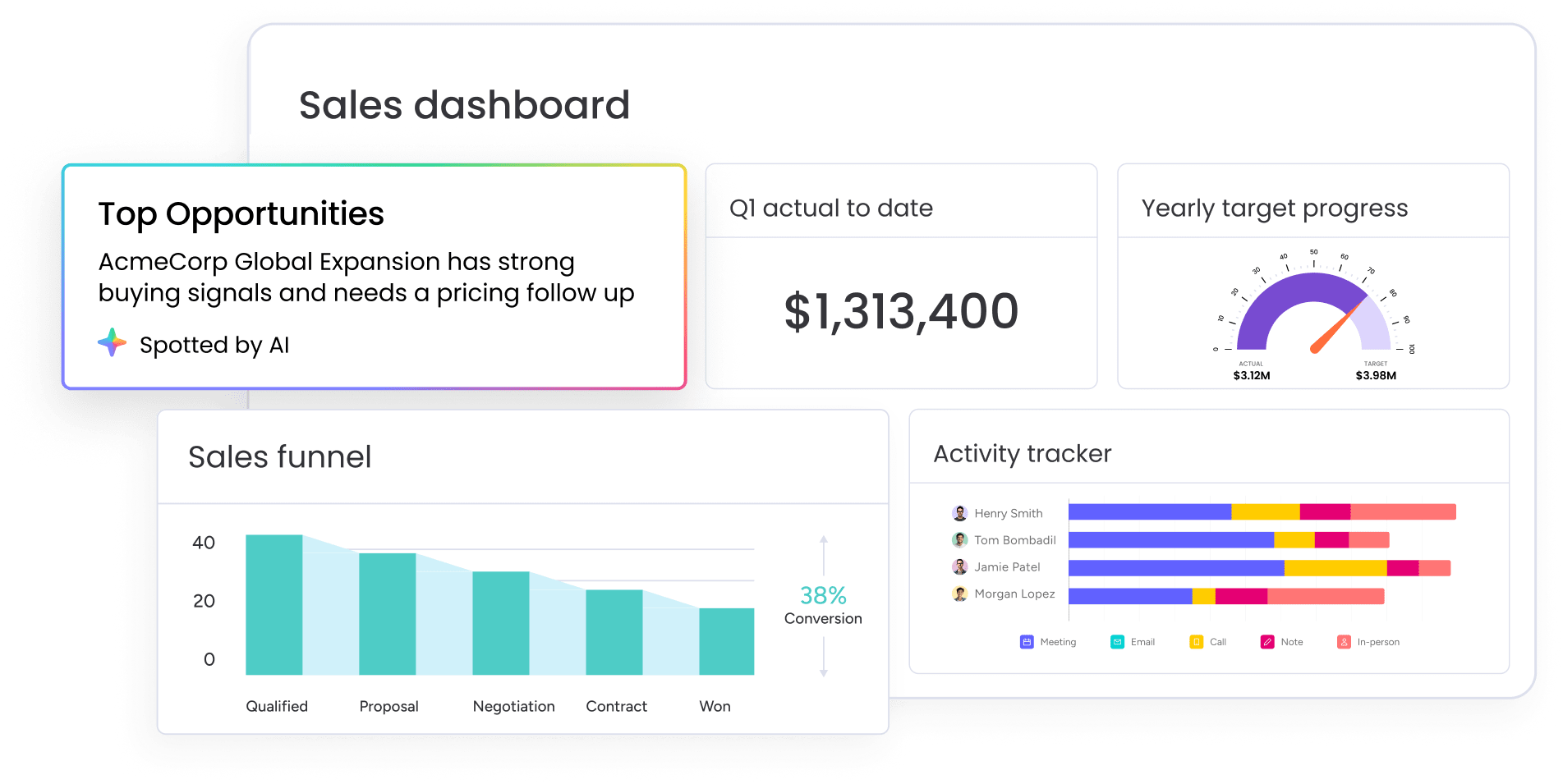
Dashboards update automatically as deals close, so everyone sees the same numbers without manual updates.
The dashboards in monday CRM show MoM, QoQ, and YoY growth side-by-side with visual trend lines. Filter by team, product, or region with a click, compare actual growth to targets, and drill down from high-level metrics to individual deals to understand what’s driving the numbers. The platform’s AI analyzes patterns across your growth data to surface anomalies and highlight which segments are accelerating or declining faster than expected.
Automated data sync prevents errors
Pulling data from multiple sources manually means you’re looking at delays, errors, and version control nightmares.
The platform pulls data automatically from your accounting system, payment processor, and marketing tools. No data entry errors, no incomplete calculations, no manual reconciliation. This level of CRM integration ensures your growth metrics stay accurate as your tech stack expands.
Track growth by team and product segments

Aggregate growth numbers hide what’s really happening. You might be up 15% overall while one team grows 30% and another is underperforming.
Break down the numbers to see what’s really driving growth. With monday CRM, this becomes easy:
- Team performance: Track deal ownership and source data to calculate growth by any dimension
- Product analysis: Compare team performance to reveal who’s accelerating and who needs support
- Customer segments: Enable segmentation by customer size, industry, geography, product line, or custom fields you define
The AI capabilities in monday CRM go further by predicting which segments are likely to maintain momentum and recommending where to focus resources based on historical growth patterns and current pipeline data. These insights help you optimize your sales pipeline management by showing exactly where deals are accelerating or stalling.
Turn growth data into revenue acceleration
Sales growth rate is your compass. The formula is simple, but the insights get powerful when you track consistently and avoid common mistakes. Master growth tracking and you’ll forecast better, catch problems early, and know exactly what’s driving results. Whether you’re measuring month-over-month tactical wins or year-over-year strategic progress, the key is consistency in your approach and accuracy in your data.
With monday CRM, the whole thing is automated. Real-time dashboards, integrated data, and segmented analysis mean no spreadsheets and no calculation headaches. Your team stops building reports and starts using them.
Try monday CRMFAQs
How do you calculate sales growth in Excel?
To calculate sales growth in Excel, enter your previous period revenue in one cell (A1) and current period revenue in another (A2), then use the formula =(A2-A1)/A1*100 to get the percentage.
What is the difference between nominal and real sales growth?
Nominal sales growth measures the raw percentage increase without adjusting for inflation, while real sales growth adjusts for inflation to show actual purchasing power increase.
How often should I calculate sales growth?
Calculate sales growth at multiple intervals simultaneously: monthly for tactical adjustments, quarterly for operational planning, and annually for strategic decisions.
What is a good sales growth rate for a startup?
Startups typically target 50-100%+ annual growth, depending on stage and funding expectations, though sustainable growth matters more than explosive rates.
Can sales growth be negative?
Sales growth can be negative, indicating revenue declined compared to the previous period. Seasonal businesses regularly show negative MoM growth during off-seasons.
How does monday CRM calculate growth metrics automatically?
The platform aggregates revenue data from connected sources, applies formulas for each time period, and updates dashboards in real-time as new deals close, eliminating manual calculation work.

 Get started