


Sales teams often see lead volume rise while pipeline growth stalls. Reps spend hours on research, drafting, and follow-ups, yet engagement drops and burnout increases as top talent gets pulled into administrative work.
AI sales development platforms promise to fix this by automating prospecting and qualification at scale. But with so many vendors making similar claims, it’s hard to separate real innovation from marketing hype. A poor choice leads to wasted budget, broken workflows, and missed revenue targets.
The six features below separate high-impact platforms from underperforming tools: intelligent lead scoring, multi-channel orchestration, advanced NLP, deep CRM integration, predictive analytics, and no-code customization. Evaluating these ensures AI enhances — not disrupts — your revenue engine.
Key takeaways
- Focus on intelligent lead scoring over basic automation: AI SDR platforms that analyze 300+ buyer signals in real-time help your team prioritize the hottest prospects first, not just follow fixed sequences.
- Demand true CRM integration, not basic data syncing: real-time, two-way data flow eliminates manual entry and keeps your entire team working from the same accurate information without delays or conflicts.
- Build hybrid teams where AI handles volume and humans handle complexity: let AI manage initial outreach and routine follow-ups while your SDRs focus on relationship building and closing conversations that actually matter.
- Choose platforms with no-code customization capabilities: revenue teams need AI tools they can configure themselves without IT support, adapting messaging and workflows to match their specific sales process.
- Prioritize native AI with unified workflow automation: a platform’s custom action features provided by solutions like monday CRM, let teams give AI instructions using natural language, generating personalized output directly into any column without switching between tools.
What defines AI SDR tools for revenue teams?
AI SDR platforms automate the foundational aspects of sales development: prospecting, outreach, and qualification. Unlike traditional systems that rely on rigid scripts, these platforms utilize machine learning and natural language processing to manage complex follow-up cycles and initial engagement.
The primary distinction lies in the ability to learn and adapt. Traditional automation is inherently static: it executes a linear sequence, such as sending a specific email after a three-day delay, regardless of prospect engagement. In contrast, AI SDR tools monitor behavioral signals and adjust messaging based on real-time performance. This allows the system to prioritize leads using models that continuously refine their logic based on successful deal outcomes.
Revenue operations teams rely on these platforms to scale sales development without proportionally scaling headcount. A team of five SDRs using AI can manage prospect volumes that would traditionally require fifteen people, while maintaining or improving conversion quality. This aligns with broader trends showing 66% of business units using gen AI in marketing and sales reported revenue increases over the prior 12 months.
The technology handles high-volume activities like initial research, first-touch outreach, and routine follow-ups, freeing human SDRs to focus on complex conversations and strategic account planning.

The 6 essential AI SDR features for revenue leaders
Revenue leaders face dozens of vendor claims when evaluating AI SDR tools. These six features are non-negotiable. They’re what separate tools that work from tools that waste your budget. Each feature directly impacts pipeline quality, team efficiency, and revenue outcomes.
Feature 1: intelligent lead scoring using 300+ buyer signals
Your hottest lead visits your pricing page at 10 p.m. Does your system respond right away, or does that opportunity just sit there until morning? Advanced AI SDR platforms analyze hundreds of signals at once to figure out which prospects are most likely to convert.
Real-world deployments demonstrate this approach’s effectiveness, with one services firm seeing a 10% earnings uplift from AI-based adaptive deal scoring using hundreds of customer and deal parameters.
These systems look at different types of signals to build scoring models:
- Behavioral signals: website visits, content downloads, email engagement patterns.
- Firmographic data: company size, industry, growth rate, funding status.
- Technographic insights: current technology stack, recent software purchases.
- Engagement patterns: response time, meeting acceptance rates, question complexity.
Traditional lead scoring uses fixed point values. Downloaded whitepaper equals ten points, visited pricing page equals 25 points. In contrast, AI-powered scoring learns from thousands of past deals to spot patterns you’d never catch manually.
The system knows a CFO from a Series B SaaS company who visits pricing twice, downloads a case study, and engages on LinkedIn within 48 hours represents a significantly different opportunity than a junior analyst doing the same things. Every scoring updates the second new signals come in.
When a prospect’s company announces funding, the AI immediately recalculates priority based on how similar companies behaved after funding events. This dynamic prioritization ensures SDRs always work the hottest leads first.
Feature 2: multi-channel outreach orchestration
Multi-channel orchestration involves engaging prospects across email, telephonic, and social media platforms based on real-time behavioral data rather than static sequences. Artificial intelligence determines the optimal timing, communication medium, and message order by analyzing historical response rates across diverse prospect segments.
The primary advantage of sophisticated orchestration is its inherent adaptability. Standard automation typically follows a rigid schedule: a LinkedIn connection request on Monday, followed by an email on Wednesday and a phone call on Friday, regardless of prospect engagement. Conversely, intelligent orchestration monitors specific interaction signals.
For example, if a prospect accepts a LinkedIn connection but does not respond to direct messaging, the system can automatically pivot to a personalized email referencing the LinkedIn interaction before attempting a telephone follow-up.
These platforms sync touchpoints so prospects get a consistent experience. After a prospect downloads a resource, the AI might:
- Send follow-up emails: with related content based on download topic.
- Trigger LinkedIn messages: from the assigned SDR at optimal engagement times.
- Schedule phone calls: when similar prospects typically answer.
Each touchpoint builds on the last one, so the conversation feels natural instead of robotic.
Feature 3: natural language processing for authentic conversations
NLP lets AI SDR tools write personalized, relevant messages that still sound human, even when you’re sending thousands. These systems look at prospect data, company info, recent news, and conversation history to write responses that fit.
Advanced NLP goes beyond mail merge personalization to create AI sales pitch content. Instead of just dropping company names into templates, it writes unique messages based on context.
For a VP of Sales at a growing fintech expanding into European markets, the AI crafts messages that reference the expansion, acknowledge specific challenges of international sales operations, and position solutions as particularly relevant for their growth stage.
The system adapts tone, messaging focus, and call-to-action based on prospect characteristics:
- C-level executives: strategic business outcomes and ROI emphasis.
- Managers: operational efficiency and team productivity focus.
- Technical buyers: feature depth and integration capabilities.
Furthermore, it uses industry-specific terms and pain points naturally, so each message feels custom-written.
Feature 4: deep CRM integration with workflow automation
Real CRM integration means data flows both ways instantly, keeping everything in sync. No more manual data entry. You see everything the AI does.
Integration means more than syncing contacts as it includes automated activity logging, lead status updates, opportunity creation, and trigger-based workflows.
When you change something in one system, it updates in the other instantly. When an AI SDR tool updates qualification status, the CRM immediately reflects that change, triggering appropriate workflows like task assignments or AE notifications. When sales reps update contact information in the CRM, the AI SDR tool immediately uses new data for future outreach.
Workflow automation gets rid of data silos and manual handoffs:
- Automatic opportunity creation: when leads reach qualification thresholds.
- Follow-up task scheduling: based on prospect engagement levels.
- Hot lead alerts: sent to account executives via preferred channels.
- Custom triggers: for sophisticated business logic implementation.
A deeply integrated platform demonstrates this approach through native AI capabilities that work directly within the system.
The system logs every interaction in one timeline, uses AI to detect sentiment and extract information from communications, and creates summaries of entire conversation histories. As a result, sales reps get instant context before every call without switching between tools.
Feature 5: performance analytics that connect activity to revenue
Advanced analytics track the entire customer journey: from first touch to closed deal. These systems show metrics across the entire funnel, which activities actually drive revenue, not just how busy you are.
AI-powered analytics spot patterns you’d never see in basic reports. The platform might find that prospects who watch videos in week one convert faster. Or that CFOs respond better to Thursday morning emails than Monday afternoon ones. These insights let you keep optimizing based on what’s actually working.
Key analytics capabilities include:
- Response rate tracking: by channel, message type, and prospect segment.
- Conversion metrics: at each funnel stage with trend analysis.
- Pipeline contribution: showing AI-generated opportunity value.
- Deal velocity: comparing AI-sourced versus traditional leads.
- Revenue attribution: connecting specific AI actions to closed business.
Customizable dashboards provided by solutions like connect AI activity to pipeline and revenue metrics in real-time. Revenue leaders can drill down forecasts by month, sales rep, or any criteria, gaining the visibility needed for data-backed resource allocation decisions.
Feature 6: no-code AI customization and training
No-code customization empowers revenue teams to configure AI task behavior without technical expertise. You can adapt AI SDR tools to your specific process and messaging instead of being stuck with rigid solutions.
Customization options available through visual interfaces include:
- Message template creation: with dynamic personalization variables.
- Scoring criteria adjustment: based on company-specific conversion factors.
- Workflow trigger configuration: for custom business logic.
- Response handling rules: determining escalation to human SDRs.
You can teach AI systems what works for your team. Feed the AI examples of your best messages, call transcripts, and closed deals — and it keeps getting better based on your own data.
Custom action feature exemplifies this approach. Teams give instructions to AI using natural language, referencing any column on the board for input. AI generates output per specifications into selected columns, enabling sophisticated automation without code.
What does true CRM connectivity look like?
Basic CRM integrations create more problems than they solve. Data syncs run hourly or daily, so systems often show conflicting info. Updates require manual intervention when conflicts occur. Activity logging is incomplete, missing crucial context about prospect interactions.
Revenue teams need real connectivity: data flowing both ways instantly so the AI SDR tool and CRM work as one system. Here’s what real integration looks like and why it matters.
1. Real-time, two-way data synchronization
Real-time sync keeps data consistent across all systems; no delays, no conflicts. API connections and webhooks make updates instant.
When prospects respond to emails in the AI SDR tool, the CRM immediately logs activity, updates engagement scores, and triggers configured workflows. When sales reps update contact titles in the CRM, the AI SDR tool instantly uses new information for personalization.
The business impact of real-time sync prevents duplicate outreach and ensures accurate reporting. SDRs checking the CRM see the same information as the AI tool, eliminating confusion about lead status or recent interactions.
2. Automated activity capture and enrichment
AI SDR tools automatically log all prospect interactions without requiring manual data entry. This comprehensive activity capture creates complete records of every touchpoint, ensuring nothing falls through the cracks and providing full context for future interactions.
Enrichment adds value beyond basic logging:
- Sentiment analysis: flags negative responses requiring human attention.
- Engagement scoring: quantifies prospect interest level.
- Next-step recommendations: suggests actions based on successful deals.
- Context summaries: provides an instant overview of relationship history.
Emails & Activities feature provided by monday CRM logs and tracks every interaction including emails, meetings, and notes in one timeline. The platform’s AI capabilities detect sentiment, extract information from communications, and summarize entire conversation histories, giving sales reps instant context before every call.
3. Workflow triggers and automated actions
Advanced CRM integration enables custom business logic through automated triggers that execute complex sales processes without manual intervention. Triggers activate based on lead score changes, engagement thresholds, time-based events, or custom criteria specific to your sales process.
These triggers initiate corresponding actions:
- Task creation: for follow-up activities.
- Team notifications: via email, Slack, or SMS.
- Process escalations: to senior team members.
- Opportunity creation: with pre-populated fields.
- Sequence adjustments: based on prospect behavior.
Automation capabilities provided by advanced platforms like monday CRM allow teams to create these workflows without code. The platform works seamlessly across departments, enabling sales to collaborate with legal and finance through automated handoffs and notifications.

Personalization at scale without sacrificing authenticity
Revenue teams face a fundamental tension. Prospects demand personalized, relevant communication, but sales organizations need to reach hundreds or thousands of prospects to hit pipeline targets. Manual personalization doesn’t scale. Generic mass outreach gets ignored.
AI SDR tools resolve this tension by delivering authentic, contextually relevant messages at volumes impossible for human teams alone. Here’s how advanced platforms maintain human connection while scaling outreach efforts.
Adaptive message generation based on buyer context
AI analyzes multiple data sources to create contextually relevant messages for each prospect. By evaluating industry trends, company news, role responsibilities, and previous interactions, the system crafts unique communications that resonate.
For example, if a VP of Sales at a Series B SaaS company announces new funding, the AI might reference the specific challenges of scaling a sales team with that capital. Ultimately, this level of detail helps you achieve the goal of delivering a tailored message that feels researched and relevant.
Furthermore, the message structure, pain points, and social proof all shift based on the recipient’s profile. In doing so, the system ensures that outreach to an enterprise CFO looks completely different from a mid-market sales director, even when promoting the same solution.
Multi-touch campaign personalization
AI maintains personalization consistency across entire campaign sequences. Each touchpoint builds on previous interactions, creating coherent conversations rather than disconnected outreach attempts.
The system tracks engagement and adjusts accordingly:
- Content preferences: emphasizes ROI case studies for data-driven prospects.
- Format preferences: prioritizes video for visual learners.
- Communication style: maintains concise messaging for time-pressed executives.
- Topic interests: focuses on areas generating most engagement.
AI email assistant generates personalized messages based on deal context, communication history, and custom prompts. The writing assistant feature allows teams to provide simple prompts that guide AI to write contextually appropriate text, with options to adjust tone and length to match prospect preferences.
A/B testing and optimization engines
Built-in testing capabilities enable continuous improvement without manual experiment design. The platform automatically tests subject lines, message content, send timing, call-to-action placement, and personalization depth.
AI analyzes test results to optimize future campaigns automatically. The system discovers that enterprise prospects respond to data-driven subject lines while mid-market prospects prefer question-based hooks, then applies these insights to future outreach.
Optimization insights improve performance over time as AI accumulates data about:
- Optimal message length: for different industries.
- Most effective personalization elements: for various roles.
- Best-performing content themes: for buyer journey stages.
- Ideal outreach frequency: for engagement levels.
“With monday CRM, we’re finally able to adapt the platform to our needs — not the other way around. It gives us the flexibility to work smarter, cut costs, save time, and scale with confidence.”
Samuel Lobao | Contract Administrator & Special Projects, Strategix
“Now we have a lot less data, but it’s quality data. That change allows us to use AI confidently, without second-guessing the outputs.”
Elizabeth Gerbel | CEO
“Without monday CRM, we’d be chasing updates and fixing errors. Now we’re focused on growing the program — not just keeping up with it."
Quentin Williams | Head of Dropship, Freedom Furniture
“There’s probably about a 70% increase in efficiency in regards to the admin tasks that were removed and automated, which is a huge win for us.“
Kyle Dorman | Department Manager - Operations, Ray White
"monday CRM helps us make sure the right people have immediate visibility into the information they need so we're not wasting time."
Luca Pope | Global Client Solutions Manager at Black Mountain
“In a couple of weeks, all of the team members were using monday CRM fully. The automations and the many integrations, make monday CRM the best CRM in the market right now.”
Nuno Godinho | CIO at VelvBuilding your digital sales workforce: AI and human collaboration
AI SDR tools create a hybrid workforce where technology handles high-volume, repeatable activities, allowing your team to focus on complex conversations and relationship building. To succeed, organizations must establish clear role boundaries and smooth handoff protocols.
This section will help you structure this collaboration so your AI investment accelerates growth rather than creating operational confusion.
Defining roles between AI and human SDRs
AI excels at data analysis, initial outreach, and routine follow-up. The technology analyzes thousands of prospects simultaneously, identifies promising opportunities, initiates personalized campaigns, and maintains consistent follow-up without fatigue.
Human SDRs handle complex conversations, relationship building, and strategic decision-making. When prospects ask nuanced questions, raise unexpected objections, or require consultative guidance, human expertise becomes essential.
| Activity type | AI handles | Humans handle |
|---|---|---|
| Research | Initial prospect research and list building | Strategic account planning and competitive analysis |
| Outreach | First-touch outreach to cold prospects | Discovery conversations with engaged prospects |
| Follow-up | Routine follow-up on non-responsive leads | Objection handling and negotiation |
| Qualification | Qualification of inbound leads | Complex deal navigation |
| Administration | Data entry and CRM updates | Coaching and mentoring junior team members |
Handoff protocols for complex conversations
Critical transition points require a seamless escalation from AI to human team members. Specifically, these include questions requiring deep product expertise, consultative responses to objections, or high-intent requests for live demonstrations.
Because preserving the flow of conversation is vital, the AI must provide a complete background during the handoff, including:
- Previous interactions: all touchpoints and responses.
- Engagement history: response patterns and timing.
- Expressed interests: pain points and priorities mentioned.
- Qualification data: budget, authority, need, and timeline information.
- Recommended next steps: suggested actions based on similar prospects.
This context enables human SDRs to continue conversations seamlessly. AI Timeline Summary feature provided by monday CRM supports this handoff process by creating concise summaries of all communication events. Sales and support teams save valuable time when taking over conversations, ensuring they have complete context before engaging with prospects.
Team performance optimization strategies
AI SDR tools provide the granular data necessary to move from generic advice to targeted, data-driven coaching. For example, managers can identify exactly where a rep’s messaging might be underperforming compared to team averages. By doing so, you help your team achieve the goal of continuous skill development based on real-world outcomes.
Sales analytics capabilities support optimization through customizable dashboards providing immediate insights into pipeline status, team performance, and activity metrics. Sales-specific widgets like leaderboards and funnels identify strong and weak points in your pipeline, enabling targeted coaching and resource allocation.
Scale your sales development with AI-powered efficiency
Revenue organizations evaluating AI SDR tools require platforms that deliver sophisticated capabilities without the burden of complex implementation or specialized technical maintenance. The ideal infrastructure transforms how teams prospect, engage, and convert leads, while preserving the strategic human interaction necessary for deal closure.
Solutions like monday CRM facilitate this transition through unified AI features, native integration, and adaptable workflow automation. Rather than functioning as a collection of disconnected tools, the platform provides a cohesive suite of AI-driven functionalities designed to enhance every stage of sales development:
- Automated sentiment analysis and data extraction: AI identifies the emotional tone of prospect communications and automatically extracts critical information to populate relevant CRM fields.
- Advanced text optimization and writing assistance: the system refines messaging quality, assists in drafting personalized outreach, and ensures all communication remains professional and on-brand.
- Intelligent summarization and translation: AI generates concise briefings from long-form interactions and translates international prospect data to maintain global operational consistency.
- Dynamic labeling and lead assignment: automated protocols categorize leads based on behavioral signals and assign them to the appropriate human representative in real time.
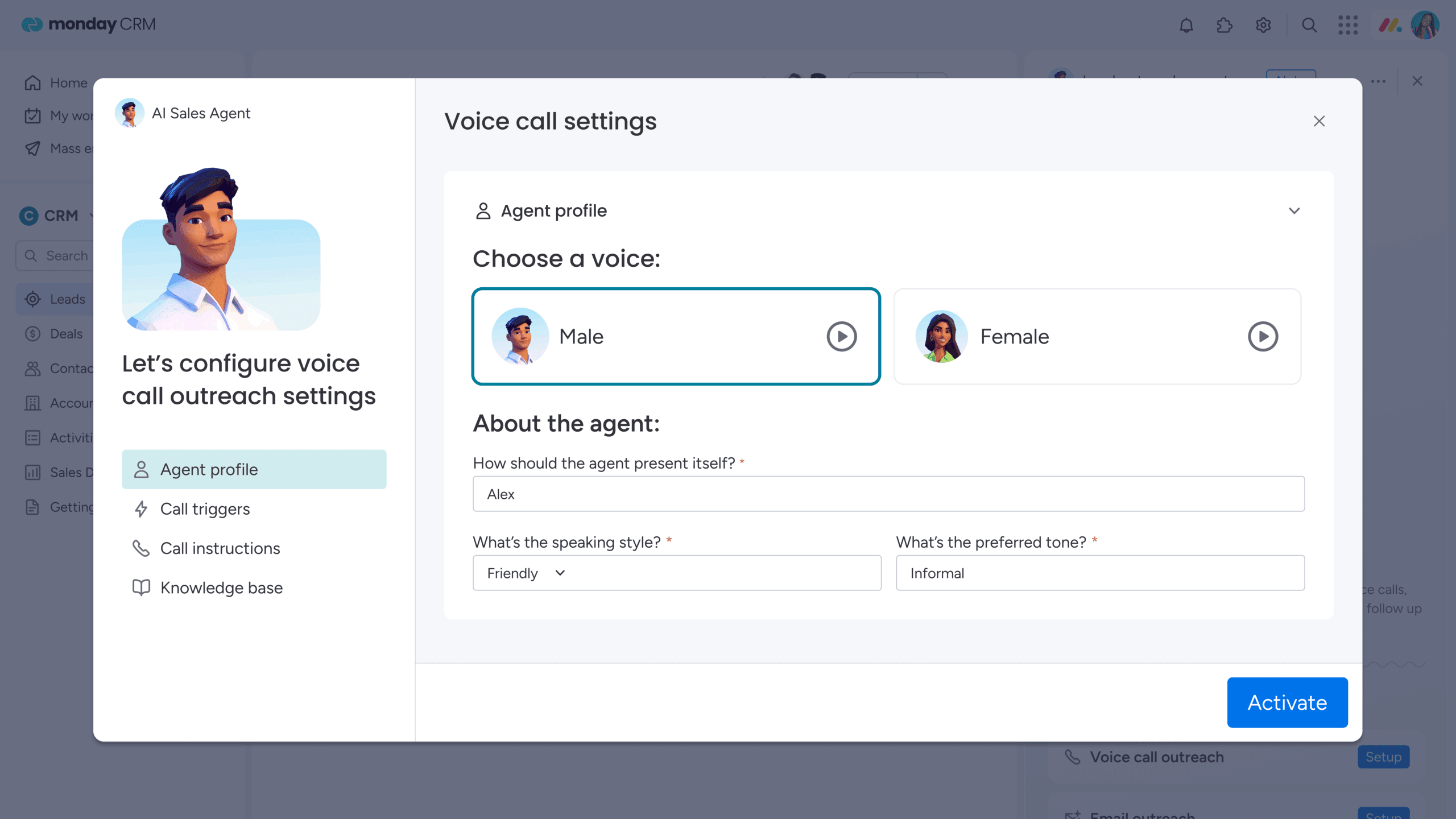
- Customized AI logic and natural language prompts: the Custom Action feature enables teams to provide specific instructions to the AI using natural language, allowing the system to reference any column and generate precise outputs according to organizational requirements.
These capabilities are accessible via a no-code visual interface, allowing revenue teams to configure complex AI behaviors without technical expertise.
Because these features are native to the CRM, data flows instantaneously between systems, ensuring that workflows execute without latency and teams maintain complete visibility into AI-driven activities.
As organizations scale from initial pilot programs to full deployment, monday CRM ensures consistent performance and usability. The unified nature of the platform reduces the learning curve for new team members, as they manage the entire sales lifecycle within a single environment rather than navigating multiple disconnected applications.
Frequently asked questions
What's the difference between AI SDR tools and traditional sales automation?
The difference between AI SDR platforms and traditional sales automation is that AI platforms use machine learning and natural language processing to make intelligent decisions and adapt behavior based on prospect responses. Traditional automation follows fixed rules and sequences regardless of how prospects engage.
How long until I see ROI from AI SDR implementation?
Most organizations see initial productivity gains within 30-60 days as teams become comfortable with the platform. Full ROI typically arrives within three to six months depending on implementation scope and team adoption rates.
Can AI SDR tools handle complex enterprise sales cycles?
AI SDR tools excel at early-stage activities like prospecting, initial outreach, and qualification. Complex deal progression, negotiation, and relationship management still require human expertise and strategic thinking.
What technical expertise is needed to manage AI SDR platforms?
No-code platforms like monday CRM require minimal technical expertise and can be managed by sales operations or revenue teams without ongoing IT involvement. Visual interfaces and natural language configuration make setup and optimization accessible to non-technical users.
How do AI SDRs maintain compliance with data privacy regulations?
Reputable AI SDR platforms include built-in compliance features for GDPR, CCPA, and other regulations. They provide automated opt-out handling, data protection controls, and audit trails documenting all prospect interactions.
What happens when AI SDRs encounter unfamiliar scenarios?
Quality AI SDR tools include escalation protocols routing complex scenarios to human team members while capturing interactions for future training. This ensures prospects receive appropriate responses even in unfamiliar situations.

 Get started