


Your SDR team is drowning in leads, but pipeline growth stays flat. The problem? Human SDRs can only engage so many prospects per day, work limited hours, and inevitably miss high-intent buyers who show interest at 10 PM or over the weekend — while conversion rates refuse to budge.
This is where AI SDRs come in. This guide reveals 5 strategies revenue teams use to accelerate qualified pipeline with AI sales development reps. You’ll learn how to prioritize leads by signal, personalize at scale, build hybrid coverage models, pick the right software, and measure what matters — without choosing between coverage and quality.
Try monday CRMKey takeaways
- AI SDRs analyze dozens of behavioral signals in real-time to prioritize high-intent prospects, eliminating the 2-3 hours SDRs spend researching leads daily.
- Prospects research solutions outside business hours, and AI sales reps respond instantly when competitors are offline, significantly improving conversion rates.
- Use this model for long-tail accounts and initial outreach while human reps focus on enterprise deals and complex relationship-building where they add the most value.
- AI SDRs can generate dozens of qualified meetings monthly at hundreds of dollars per meeting, compared to human SDRs producing a few dozen meetings at much higher cost.
- With monday CRM, you can auto-enrich lead data, centralize prospect information, and build visual workflows that assign leads automatically based on custom conditions without coding.
Understanding the challenges of traditional demand generation
Revenue teams using traditional demand gen can’t predict what’s coming. Manual lead qualification means inconsistent response times, variable messaging quality, and unreliable forecasting. That unpredictability rolls uphill — CROs can’t report confidently to the board, VPs of sales can’t allocate resources, and RevOps leaders lack the data to plan ahead.
Manual lead qualification creates bottlenecks
SDRs using manual qualification processes spend 2-3 hours daily toggling between CRM records, LinkedIn, company websites, and intent platforms. Every switch slows them down. Qualified leads go cold while SDRs work through their queue sequentially — a prospect who downloaded a pricing guide at 9 AM might not receive outreach until 3 PM, by which point they’ve already engaged with competitors.
Inconsistent messaging reduces conversion rates
Even with templates and playbooks, human SDRs naturally deviate based on experience level, prospect interpretation, and fatigue. These variations make optimization nearly impossible — A/B testing becomes unreliable, best practices don’t transfer, and conversion analysis misleads when results reflect SDR skill differences rather than messaging effectiveness.
Limited coverage causes missed opportunities
Human SDRs can engage a fixed number of prospects per day under optimal conditions. They work limited hours and cannot respond instantly when prospects show buying intent outside business hours.
Time zone gaps, after-hours activity, and peak periods create coverage gaps that competitors with faster response infrastructure exploit.
How AI SDRs transform lead identification and qualification
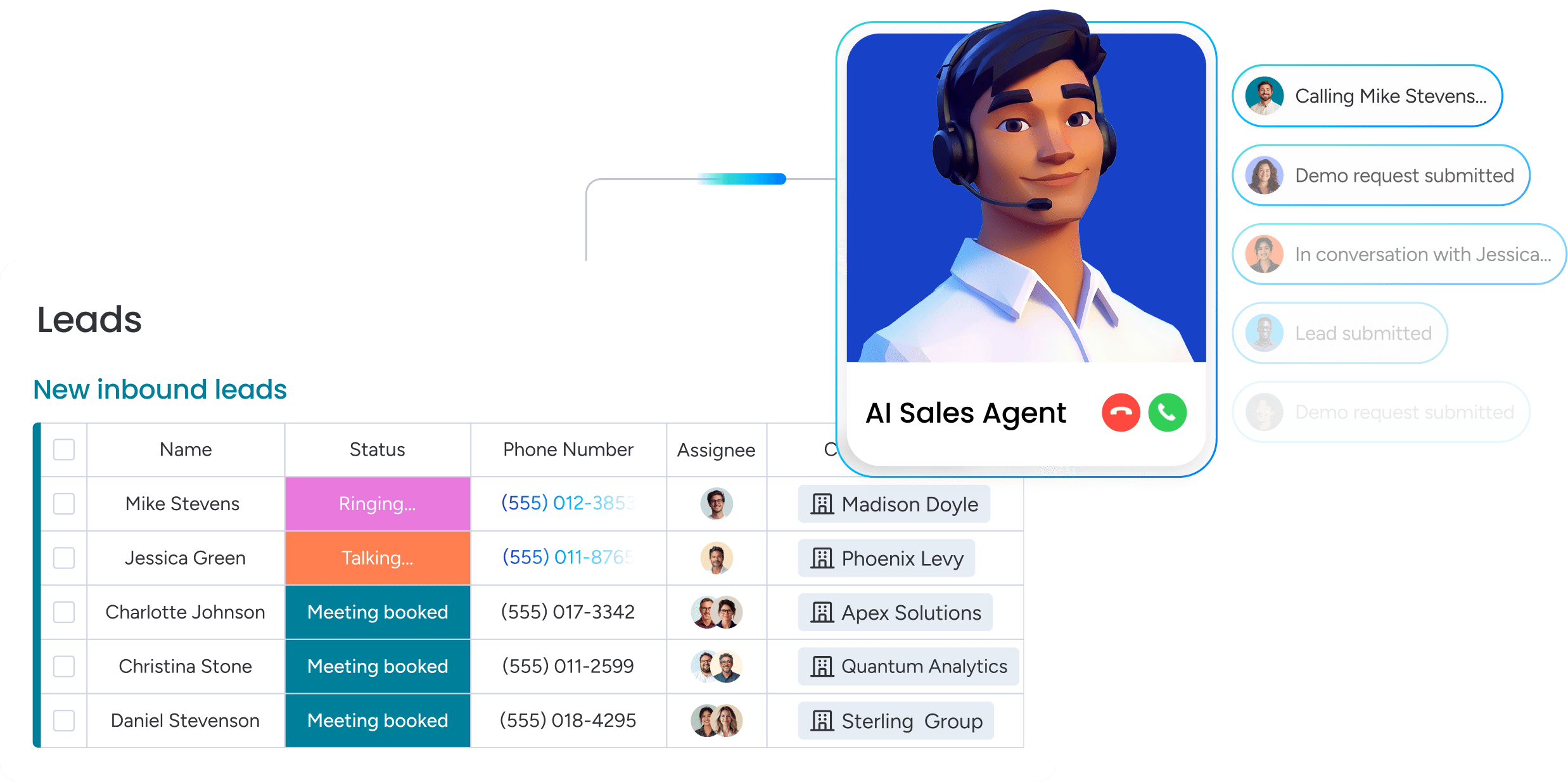
AI SDRs fundamentally change the demand generation equation by using machine learning, natural language processing, and predictive analytics to automate lead identification and qualification.
These systems monitor prospect behavior across channels, score leads in real-time, and engage instantly with personalized messaging — creating a hybrid model where AI handles sales volume and consistency while humans focus on complex, high-value interactions.
Automated lead scoring prioritizes high-intent prospects
This approach uses AI to analyze multiple data points simultaneously: website behavior, content engagement, email opens, social media activity, firmographic data, and technographic signals. They assign adaptive lead scores that update in real-time as prospects take new actions, learning from your actual conversions to spot which signals predict success.
Real-time signal detection captures buyer interest
AI SDRs monitor prospect activity 24/7 and trigger engagement workflows the moment buying signals appear. When a prospect visits your pricing page at 11 PM, AI can send a personalized email within minutes, schedule a meeting for the next day, or route the lead to the appropriate sales rep based on territory and product interest.
Predictive analytics improve lead quality
AI SDRs use historical conversion data to identify patterns that indicate which prospects will become customers. The analysis examines thousands of past interactions to determine which combination of firmographic attributes, behavioral signals, and engagement patterns correlate with closed deals. The models get smarter as you close more deals, adapting to market shifts and changes in your ideal customer profile.

Strategy 1: Implement signal-based lead prioritization

Signal-based prioritization ranks prospects by what they’re doing right now, not just who they are on paper. Your team focuses on prospects showing real buying intent — not just whoever’s next in the queue.
AI SDRs can send thousands of personalized emails, but if those emails go to prospects who aren’t actively evaluating solutions, response rates will disappoint regardless of message quality.
Here’s how to build a system that spots the signals that drive revenue.
Monitor high-intent digital behaviors
The key behaviors AI SDRs track and their recommended responses help teams understand which signals matter most:
| Behavior | Intent signal strength | Recommended response |
|---|---|---|
| Pricing page visit | High | Immediate outreach with ROI focus |
| Case study download | Medium-high | Follow-up with relevant customer story |
| Blog post read | Low-medium | Add to nurture sequence |
| Multiple pages in one session | High | Trigger real-time engagement |
| Return visit within 48 hours | High | Escalate to priority queue |
| Integration page view | Medium-high | Personalize around tech stack |
| Competitor comparison page | Very high | Immediate competitive positioning outreach |
Certain behaviors signal strong buying intent. They take effort and show someone’s actively evaluating. A prospect who visits your pricing page has moved beyond casual interest. They’re trying to figure out if your solution fits their budget. This model tracks behaviors across channels and score them based on what actually leads to conversions.
Create automated alert systems
AI SDRs alert the team when prospects hit certain intent thresholds. High-value opportunities get immediate human attention. The alert system needs the following:
- Trigger conditions: Define when alerts fire
- Notification channels: Reach the right people
- Ownership rules: Assign responsibility
Trigger conditions might include lead score exceeding 80, prospect visiting pricing page twice in 24 hours, or decision-maker from target account engaging with content.
Track cross-channel engagement patterns
Prospects don’t convert based on one channel alone. They research everywhere — your website, social media, email, review sites — before deciding. AI pulls engagement data from all these sources to spot prospects actively evaluating your solution across channels. This omnichannel sales approach ensures you capture the complete picture of buyer intent.
A prospect who visited your website, engaged with your LinkedIn content, and read reviews on G2 is demonstrating serious evaluation behavior that warrants prioritized outreach. You see who’s actively buying versus just browsing.
Strategy 2: Build hyper-personalized outreach sequences

Personalization at scale? It’s tailoring messages to each prospect’s situation, pain points, and behavior. Human SDRs can’t pull this off consistently across hundreds of prospects. AI SDRs create unique messages for every prospect based on their company data, behavior, and engagement history.
Personalization quality drives response rates. Generic outreach gets ignored. Personalized outreach that shows you get their situation? That earns responses.
Generate dynamic content from prospect data
With this model, AI pulls data from multiple sources to craft messages that feel personal:
- CRM records: Company size, industry, current tools
- Website behavior: Pages visited, content downloaded
- Social media profiles: Recent posts, company updates
- Company news: Funding rounds, new hires, expansions
- Industry trends: Market challenges, regulatory changes
An AI SDR engaging a Series B SaaS company that recently posted a vp of sales job opening might reference their growth stage, the challenges of scaling a sales team, and how your solution helps new sales leaders establish predictable pipeline.
Develop role-specific messaging frameworks
Different buyer personas care about different things. Tailor messaging by role to stay relevant:
| Role | Primary pain points | Value proposition focus | Proof points |
|---|---|---|---|
| CRO | Revenue predictability, board reporting | Pipeline visibility, forecasting accuracy | Revenue growth metrics, forecast accuracy improvements |
| VP of Sales | Team efficiency, quota attainment | Rep productivity, deal velocity | Time savings, conversion rate improvements |
| RevOps | Data quality, system integration | CRM unification, automation | Integration capabilities, data accuracy metrics |
| Sales Manager | Rep performance, coaching | Activity tracking, performance insights | Coaching efficiency, ramp time reduction |
AI SDRs keep separate messaging for each role and pick the right one based on title and responsibilities. CROs get messages about pipeline predictability and revenue impact. RevOps leaders hear about CRM integration, data quality, and reporting.
Test personalization variables for impact
Not all personalization elements drive equal results. Some variables significantly improve response rates while others add complexity without impact. Systematic testing helps identify what matters:
- High-impact variables: Role-specific pain points, recent company news, industry-specific challenges
- Medium-impact variables: Company size references, technology stack mentions
- Low-impact variables: Generic personalization like first name, company name
With this approach, AI runs tests automatically across thousands of prospects, identifying winning personalization approaches faster than manual A/B testing. The system can test multiple variables simultaneously across different segments, generating statistically significant results in days rather than weeks.
Strategy 3: Deploy 24/7 lead engagement systems
Buying decisions don’t happen on a 9-to-5 schedule. Prospects research solutions at night, on weekends, and across global time zones. AI SDRs eliminate the coverage gaps inherent in human-only teams by engaging prospects instantly, regardless of when they show interest.
The speed-to-lead advantage compounds over time. Prospects who receive immediate engagement are significantly more likely to convert than those who wait 12-24 hours for a response. Every hour of delay reduces conversion probability as prospects move on to other priorities or engage with faster-responding competitors.
Set up instant response workflows

AI SDRs trigger immediate engagement when prospects take high-intent actions. The workflow architecture includes:
- Trigger events: Form submission, pricing page visit, demo request, content download
- Response timing: Immediate, 5-minute delay, next business day
- Message content: Customized based on the triggering action
When a prospect submits a demo request at 8 PM, the AI SDR immediately sends a confirmation email, provides relevant resources based on the prospect’s industry and role, offers calendar availability for the next day, and creates a task for the human SDR to review before the meeting.
Optimize global time zone coverage
Global expansion traditionally requires hiring SDRs in each region to provide local business hours coverage. AI SDRs provide instant coverage across all time zones without additional headcount, engaging prospects in their local business hours regardless of where your team is located.
The configuration adjusts outreach timing based on the prospect’s time zone, ensuring emails arrive during business hours and follow-ups occur at optimal times. A prospect in Singapore receives outreach during their morning, not during your team’s afternoon when they’re likely asleep.
Capture after-hours opportunities
Many prospects research solutions outside traditional business hours when they have uninterrupted time to evaluate options. These after-hours researchers often represent serious buyers who are investing personal time in the evaluation process.
These AI-powered SDRs capture these after-hours opportunities by engaging prospects immediately rather than letting them go cold overnight. The engagement provides instant value through relevant resources, answers to common questions, and clear next steps, even when human team members are offline.
Strategy 4: Create hybrid human-AI coverage models
The optimal approach strategically deploys AI and humans where each provides the most value. AI SDRs excel at volume, consistency, and speed. Human SDRs excel at complex relationship-building, nuanced objection handling, and high-stakes negotiations.
Resource optimization through hybrid coverage addresses the efficiency concerns that keep revenue leaders up at night. Instead of hiring more SDRs to cover more accounts, the hybrid model multiplies the effectiveness of existing team members by handling routine tasks automatically.
Assign AI SDRs to long-tail accounts
Most revenue teams have hundreds or thousands of accounts that could generate revenue but don’t justify dedicated human SDR attention due to lower deal sizes or conversion probabilities. These long-tail accounts represent untapped potential that traditional coverage models cannot economically address.
AI SDRs make long-tail accounts economically viable by providing consistent engagement at minimal cost. The segmentation approach defines long-tail accounts based on:
- Company size: Under 100 employees
- Industry: Outside core verticals
- Geographic location: Emerging markets
- Deal size potential: Under $10K ACV
AI SDRs handle all initial outreach, qualification, and nurturing for these accounts, escalating to human SDRs only when prospects meet specific qualification criteria or request human interaction.
Reserve human SDRs for enterprise deals
Enterprise deals require relationship-building, multi-threaded engagement, and strategic account planning — justifying dedicated human attention for accounts with $50K+ ACV potential, strategic logo value, or multiple stakeholders.
The hybrid workflow uses AI SDRs for initial research, activity monitoring, and secondary contact engagement, while human SDRs focus on high-value conversations that close deals.
Design smooth transition protocols
The handoff from AI SDR to human SDR can accelerate or derail deal progression. Prospects experience jarring context loss when they’ve had productive AI conversations only to have a human SDR ask the same questions again.
Smooth transitions require careful workflow design and complete context transfer:
- Escalation criteria: Lead score threshold, specific behaviors, explicit request for human contact, budget/timeline confirmation
- Information transfer: Conversation history, behavioral data, qualification details, identified pain points, objections raised, recommended talking points
- Response time commitments: Human SDR follow-up within 2 hours during business hours, next business day for after-hours escalations
- Response messaging: AI SDR introduces the human SDR by name and explains the transition
Teams using monday CRM benefit from the AI timeline summary feature that automatically compiles prospect history, behavioral insights, and recommended next steps, ensuring human SDRs have complete context when they take over.
Try monday CRMStrategy 5: Orchestrate data-driven account targeting

Traditional account targeting relies on static lists and subjective criteria, missing high-potential accounts and wasting resources on poor-fit prospects. AI SDRs use predictive analytics and continuous data enrichment to identify and prioritize accounts most likely to convert.
Enrich accounts with firmographic data
Effective targeting requires comprehensive account intelligence. AI-powered SDRs automatically enrich account records by pulling data from multiple sources to build complete profiles:
- Company information: Size, revenue, growth trajectory
- Technology stack: Current tools and platforms
- Organizational structure: Team size, reporting structure
- Market position: Funding status, competitive landscape
- Hiring patterns: Open roles, team expansion
The enrichment process identifies gaps in your CRM data, queries external data sources, validates information accuracy, and updates records automatically. On monday.com, revenue teams can leverage an auto-enrich lead data capability with Crunchbase’s database, eliminating the manual data entry that consumes SDR time and introduces errors.
Build predictive ICP models
Predictive ICP models analyze your closed-won deals to identify which firmographic and behavioral attributes actually correlate with conversion. The analysis might reveal that your best customers share unexpected characteristics: they use a specific technology, recently raised Series B funding, or have a particular team structure.
These models continuously update as you close more deals, becoming more accurate over time. AI SDRs use them to score accounts based on similarity to your best customers, automatically prioritizing accounts with the highest conversion probability.
Implement dynamic territory management
Static territory assignments create inefficiencies as account priorities shift. Dynamic territory management continuously reassigns accounts based on real-time signals, capacity, and strategic priorities:
| Assignment factor | How it works | Business impact |
|---|---|---|
| Geographic location | Routes accounts to SDRs with regional expertise | Improves relevance and response rates |
| Industry expertise | Matches accounts to SDRs with vertical knowledge | Increases conversion through specialized conversations |
| Current workload | Balances accounts across team based on capacity | Prevents bottlenecks and ensures coverage |
| Account priority | Escalates high-intent accounts to senior reps | Maximizes conversion on best opportunities |
| Real-time signals | Reassigns accounts showing sudden buying intent | Captures time-sensitive opportunities |
How to measure ROI from AI SDR strategies

Proving AI SDR ROI requires tracking specific metrics that connect AI SDR activities to revenue outcomes. The measurement framework focuses on 3 areas:
- Pipeline velocity: How fast deals progress
- Cost efficiency: Cost per qualified meeting
- Revenue attribution: Deals closed from AI SDR pipeline
Understanding these metrics helps revenue leaders make data-driven decisions about AI SDR investment and optimization. Each metric provides different insights into how AI SDRs impact your revenue generation process.
Calculate pipeline velocity gains
Pipeline velocity measures how quickly prospects move from first contact to closed deal. The calculation is:
(Number of opportunities × Average deal size × Win rate) ÷ Sales cycle length
AI SDRs can accelerate velocity by engaging prospects faster, maintaining consistent follow-up, and providing human SDRs with more engaged prospects.
Measuring velocity improvements requires establishing baseline velocity for your current process, tracking velocity for AI SDR-sourced deals separately, and calculating the percentage improvement. Even modest velocity improvements significantly impact revenue when compounded across your entire pipeline.
Track cost per qualified meeting
Cost per qualified meeting is the most direct efficiency metric for comparing AI to human SDRs and other lead sources. The calculation divides total AI SDR costs by the number of qualified meetings scheduled:
| Cost component | Human SDR | AI SDR |
|---|---|---|
| Base cost | Salary + benefits ($80K–120K/year) | Platform fee ($1K–5K/month) |
| Tools | CRM, email, data ($500/month) | Included in platform |
| Management | Manager time allocation | Configuration and monitoring |
| Training | Onboarding and ongoing | Initial setup |
| Meetings/month | 15–25 qualified meetings | 30–60 qualified meetings |
| Cost per meeting | $400–800 | $100–300 |
Build revenue attribution models
Revenue attribution connects AI SDR activities to actual closed deals, providing the ultimate ROI proof. The model tags opportunities with their origination source, tracks these opportunities through your sales cycle, and calculates revenue generated from each source. Monthly reports should show AI SDR contribution to pipeline and revenue, compare to other lead sources, and track trends over time.
Essential platforms for AI SDR demand generation
Successful AI SDR implementation requires integrating multiple systems: the AI SDR platform itself, your CRM system, marketing automation, and data enrichment services. Selection should prioritize integration capabilities, ease of implementation, and alignment with your existing technology stack.
The right tool stack determines whether your AI SDR initiative delivers results or creates more complexity. Here’s how to evaluate and select the components that will drive success for your revenue team.
Compare leading AI SDR platforms
Key capabilities to evaluate when comparing AI SDR platforms help teams make informed decisions:
| Evaluation criteria | What to look for | Why it matters |
|---|---|---|
| NLP quality | Ability to understand context, detect intent, generate natural responses | Determines whether AI SDR conversations feel authentic or robotic |
| Integration breadth | Native connections to CRM, marketing automation, data sources | Affects implementation complexity and data synchronization |
| Customization flexibility | Ability to tailor messaging, workflows, qualification criteria | Determines fit with your sales process |
| Learning capabilities | How the platform improves from interactions and feedback | Impacts long-term performance and ROI |
| Pricing model | Activity-based, outcome-based, or hybrid | Impacts total cost of ownership and ROI predictability |
Evaluate CRM integration requirements
The effectiveness of AI sales reps depends on seamless CRM integration. AI SDRs need to read prospect data, update records, create tasks, and trigger workflows without manual intervention. The integration requirements include bidirectional data sync, real-time updates, custom field mapping, and workflow automation.
Organizations using intelligent CRM software benefit from the platform’s integration framework that enables teams to connect AI SDR platforms and build automated workflows through visual configuration rather than code. The platform offers powerful integrations and the ability to see all connected deals, accounts, contacts, and projects in one place.
Assess data infrastructure needs
AI SDRs require clean, comprehensive data to function effectively. Incomplete or inaccurate CRM data will produce poor results regardless of platform capabilities. Before implementation, assess your data readiness:
- Contact completeness: Do records include name, title, email, phone, and company?
- Account completeness: Do records include company size, industry, and technology stack?
- Behavioral tracking: Is website activity, email engagement, and content consumption tracked?
- Data freshness: When were records last verified or enriched?
- Duplicate management: Are duplicate records identified and merged?
Build your AI SDR demand generation command center with monday CRM

With monday CRM , revenue teams gain the infrastructure they need to execute AI SDR strategies without technical complexity. The platform combines CRM functionality with AI-powered automation, creating a unified system where prospect data, behavioral signals, and engagement workflows live in one place.
Here’s what makes monday CRM essential for AI SDR demand generation:
- Auto-enrich lead data with Crunchbase integration: Eliminate manual data entry by automatically pulling firmographic information, funding status, and company details directly into your CRM records
- Visual workflow builders that require zero coding: Build sophisticated lead routing, alert systems, and engagement sequences through drag-and-drop interfaces that your entire team can configure and modify
- AI timeline summaries for seamless handoffs: When AI SDRs escalate prospects to human reps, the AI automatically compiles conversation history, behavioral insights, and recommended next steps so your team has complete context
- Centralized lead qualification and assignment: Automatically score, qualify, and route leads based on custom conditions you define, ensuring high-intent prospects reach the right rep instantly
- Real-time email tracking and engagement analytics: Monitor individual and mass email performance including open rates and link clicks, giving you the data you need to optimize messaging at scale
- Unified view across deals, accounts, contacts, and projects: See all connected information in one place, eliminating the context-switching that slows down traditional SDR workflows
- Forecast tracking and pipeline reporting: Drill down forecast by month, sales rep, or any custom criteria to prove AI SDR ROI and make data-driven resource allocation decisions
The platform’s integration framework connects your AI SDR tools, marketing automation, and data sources without requiring technical resources, letting you focus on strategy rather than implementation complexity.

“With monday CRM, we’re finally able to adapt the platform to our needs — not the other way around. It gives us the flexibility to work smarter, cut costs, save time, and scale with confidence.”
Samuel Lobao | Contract Administrator & Special Projects, Strategix
“Now we have a lot less data, but it’s quality data. That change allows us to use AI confidently, without second-guessing the outputs.”
Elizabeth Gerbel | CEO
“Without monday CRM, we’d be chasing updates and fixing errors. Now we’re focused on growing the program — not just keeping up with it."
Quentin Williams | Head of Dropship, Freedom Furniture
“There’s probably about a 70% increase in efficiency in regards to the admin tasks that were removed and automated, which is a huge win for us.“
Kyle Dorman | Department Manager - Operations, Ray White
"monday CRM helps us make sure the right people have immediate visibility into the information they need so we're not wasting time."
Luca Pope | Global Client Solutions Manager at Black Mountain
“In a couple of weeks, all of the team members were using monday CRM fully. The automations and the many integrations, make monday CRM the best CRM in the market right now.”
Nuno Godinho | CIO at VelvTransform your demand generation with AI-powered precision
AI SDRs transform demand generation from reactive to proactive by identifying buying intent early, engaging instantly with personalized messaging, and maintaining consistent follow-up across thousands of accounts. The 5 strategies in this guide work together to create a demand generation engine that scales with your growth ambitions while delivering measurable ROI through faster response times, lower cost per meeting, and increased pipeline velocity.
Ready to accelerate your qualified pipeline? monday CRM gives you the AI-powered automation, visual workflow builders, and centralized prospect intelligence you need to implement these strategies without technical complexity. Start transforming your demand generation today.
Try monday CRMFAQs
What is demand generation in the context of AI SDRs?
Demand generation with AI SDRs refers to using artificial intelligence to automate and scale the process of identifying, qualifying, and engaging potential buyers to create qualified pipeline opportunities.
How do AI SDRs differ from traditional SDRs?
AI SDRs differ from traditional SDRs by operating 24/7, engaging thousands of prospects simultaneously with consistent messaging, and responding to buying signals in real-time rather than during business hours only.
What are the main benefits of using AI in demand generation?
The main benefits include faster response times to prospect interest, lower cost per qualified meeting, consistent messaging quality across all interactions, and the ability to engage long-tail accounts that human SDRs cannot economically cover.
Can AI SDRs completely replace human sales development representatives?
AI SDRs cannot completely replace human sales development representatives because complex relationship-building, nuanced objection handling, and high-stakes negotiations still require human judgment and emotional intelligence.
How long does it take to see ROI from AI SDR implementation?
ROI from AI SDR implementation typically becomes visible within 60-90 days when starting with a focused pilot on specific account segments, measuring cost per qualified meeting and pipeline generated against baseline performance.
What data quality requirements exist for AI SDR success?
Data quality requirements for AI SDR success include complete contact records with accurate titles and company information, behavioral tracking across website and email engagement, and ongoing data enrichment processes to maintain record accuracy.

 Get started