

In today’s real estate market, response time directly impacts conversion rates. When potential buyers discover listings online outside business hours, they expect immediate answers and not callbacks during the next business day. Research shows that leads contacted within five minutes are 21 times more likely to convert than those contacted after 30 minutes, yet most real estate teams lack the resources to maintain 24/7 availability.
This creates a significant competitive disadvantage. Prospects who don’t receive immediate responses typically contact multiple agents simultaneously, and the first to respond often wins the business.
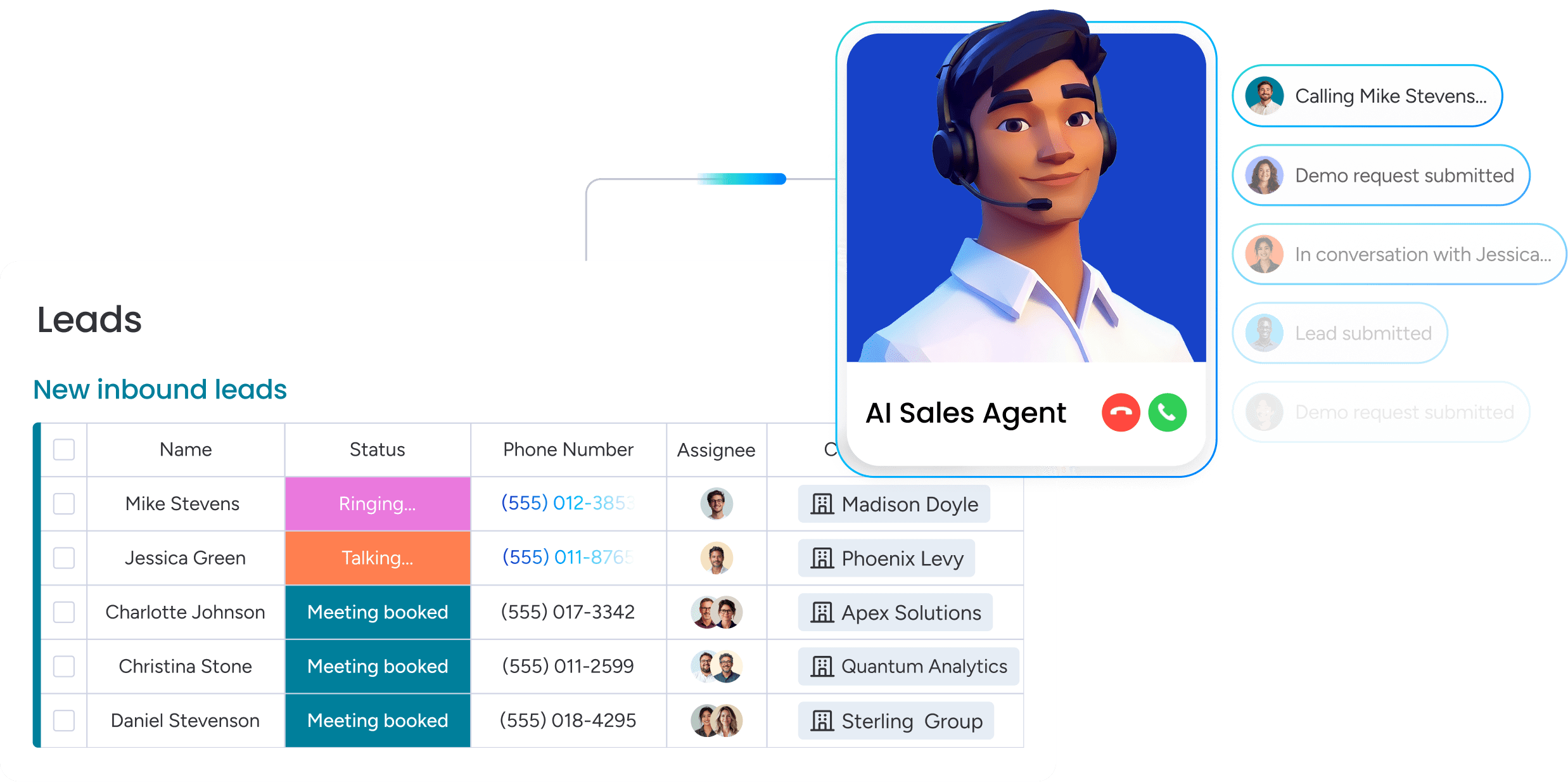
AI voice agents solve this challenge by answering every call instantly. These systems handle complete phone conversations around the clock, qualifying leads, answering questions, and booking showings through fully automated processes. Unlike basic chatbots, AI voice agents conduct actual phone calls. They understand real estate terminology, speak naturally, and log everything in CRM systems automatically.
The article explores implementing AI voice agents in real estate operations. It covers how these systems transform lead qualification, which features deliver genuine value, implementation strategies, and ROI in concrete numbers. The guide also examines CRM integration for automated follow-ups that keep pipelines moving.
Key takeaways
- Capture every conversation detail automatically: AI voice agent data flows seamlessly into your workflows, triggering follow-ups and task assignments without manual entry.
- Scale lead qualification without hiring more staff: handle 500-1,000 leads monthly with consistent thoroughness while human agents focus on relationship building and closing deals.
- Cut lead management costs by 70-85%: replace expensive inside sales agents, who can cost $4,000-$6,000 monthly according to a 2024 Glassdoor analysis, with AI systems that typically run $500-$1,500 per month.
- Capture every conversation detail automatically: flexible integration provided by solutions like monday CRM ensures AI voice agent data flows seamlessly into your workflows, triggering follow-ups and task assignments without manual entry.
- Break language barriers in diverse markets: Serve Spanish, Mandarin, and other language speakers with the same quality experience, expanding your addressable market without multilingual staff.
What is an AI voice agent for real estate?
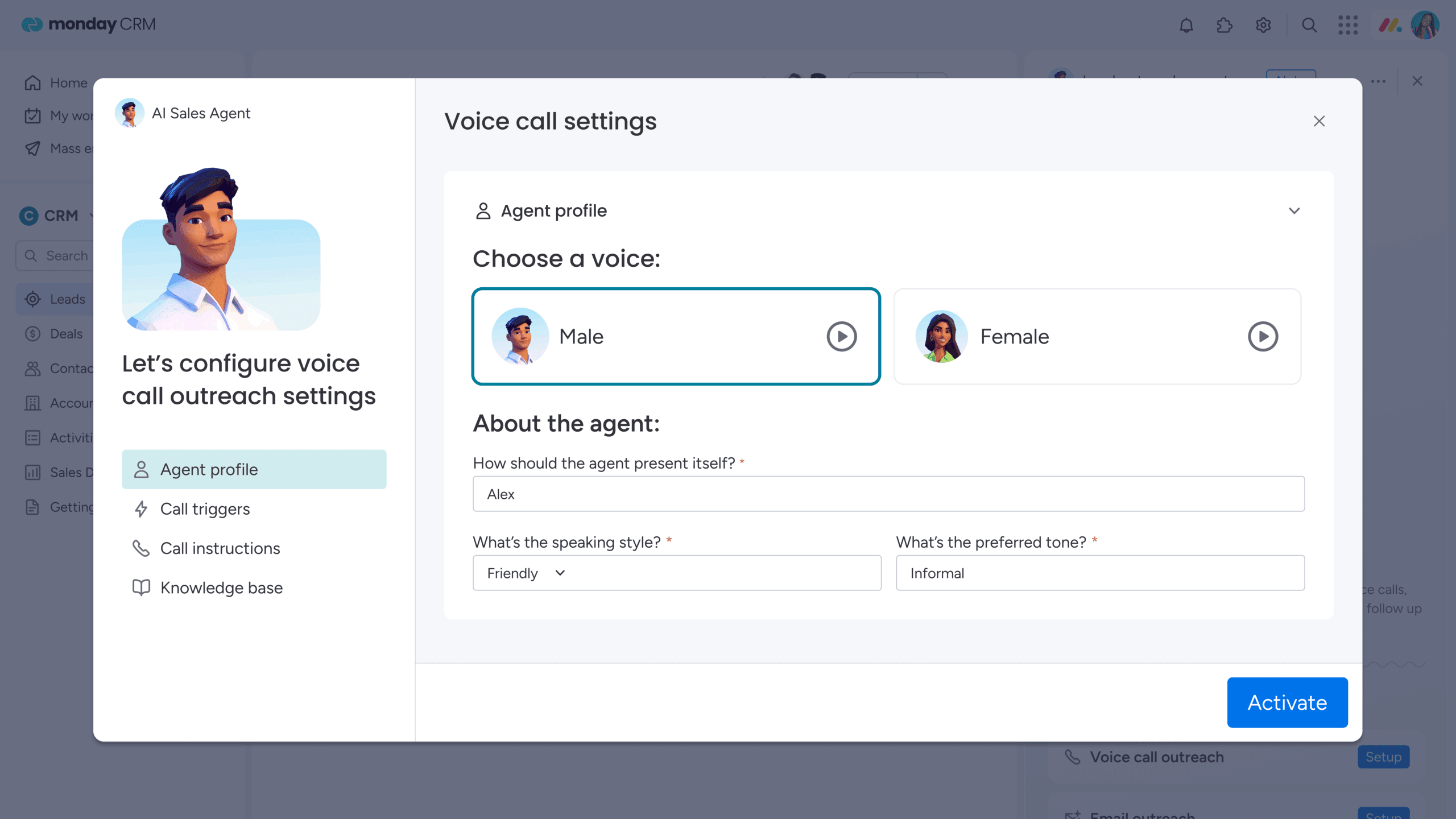
An AI voice agent for real estate manages complete phone conversations with prospects and clients without requiring human intervention. These systems comprehend property terminology, market conditions, and real estate processes with the proficiency of a trained agent. The conversational quality is sufficiently natural that prospects experience interactions as genuinely human.
They make real phone calls, not just text responses. They recognize when someone says “family-friendly neighborhood” or “good schools nearby” and understand these as related concepts. The system also processes terms like “contingent offers,” “earnest money,” or “HOA restrictions” correctly and provides relevant responses.
These systems excel in the following areas:
- Lead qualification: assess buyer readiness, budget alignment, and property preferences through structured conversations that feel natural.
- 24/7 availability: respond immediately whether prospects call at 2 PM on Tuesday or 11 PM on Saturday.
- Instant property information: access MLS data, listing details, and neighborhood information in real-time during conversations.
- Multilingual support: converse fluently in multiple languages, breaking down barriers in diverse real estate markets.
Every conversation detail gets logged automatically: contact info, property interests, qualification status, and next steps. This ensures every detail is captured and available for your follow-up.
7 ways AI voice agents transform real estate teams
AI voice agents reshape how real estate teams work. Instead of scrambling to return calls, these systems handle initial engagement automatically and still feel personal. The impact goes beyond speed. Teams allocate time differently, prioritize better, and grow faster.
1. Instant lead response day and night
Real estate leads require immediate attention to maximize conversion potential. Response speed directly correlates with closing rates. A prospect who submits an inquiry at 9 PM Friday expects timely answers rather than waiting until Monday morning.
AI voice agents respond within seconds regardless of when prospects initiate contact. The system manages weekend calls, late-night form submissions, and early morning inquiries with consistent efficiency. When a prospect requests information about a listing they discovered at 7 AM, the AI agent delivers property details immediately and schedules a showing for later that day.
Integration with CRM systems ensures seamless handoffs to human agents, with the AI documenting conversation details, qualification status, and specific requests.
2. Intelligent lead qualification at scale
AI agents ask every qualification question thoroughly, even during busy periods when human agents might rush. It asks about budget, financing, timeline, property preferences, and motivation every single time. It handles multiple calls at once without losing the personal touch.
The qualification process adapts based on responses:
- Early-stage prospects: when a prospect mentions they’re “just starting to look,” the agent adjusts the conversation to gather long-term preferences
- Urgent buyers: for prospects who say “we need to move in 60 days,” the system prioritizes immediate showing availability and pre-approval status
- Scoring system: qualified leads receive scores based on criteria like price range alignment, timeline urgency, and financing readiness
3. Multilingual property inquiry support
AI voice agents speak multiple languages, so you can serve diverse communities without hiring multilingual staff. Spanish-speaking buyers get the same detailed info, qualification, and scheduling as English speakers. The agent switches languages instantly based on what the caller prefers.
You can serve more markets without hiring multilingual staff or limiting hours to when they’re available. A brokerage serving a community with significant Hispanic and Asian populations can engage both demographics effectively around the clock.
4. Automated appointment scheduling
AI agents schedule property showings by verifying agent availability, property access requirements, and client preferences in real time. When a prospect requests a viewing, the system accesses the calendar, identifies available time slots, and confirms the appointment during the initial conversation.
The system manages scheduling scenarios that typically require multiple interactions:
- Conflict resolution: if a prospect’s preferred time conflicts with an agent’s existing appointment, the AI offers alternative slots or suggests a different team member with availability.
- Automatic confirmations: send calendar invitations, text reminders, and email confirmations to both prospects and agents.
5. Seamless CRM data capture
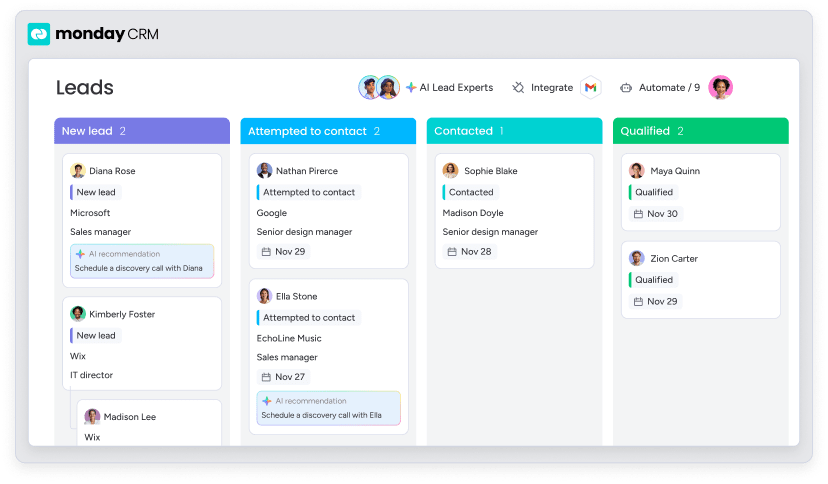
Every conversation detail automatically populates CRM records without manual data entry. Contact information, property interests, qualification status, budget parameters, timeline requirements, and follow-up tasks flow directly into the system as conversations occur.
Your team has complete and accurate call details after every conversation, even on the busiest days. Teams using monday CRM benefit from its flexible structure that accommodates diverse data capture needs from AI voice agents. Custom fields capture specific qualification criteria unique to different business models, whether residential sales, commercial leasing, or property management, as detailed in comprehensive CRM for real estate solutions.
Workflows kick off automatically based on what the AI learns—assigning tasks and starting follow-ups without you lifting a finger.
6. Personalized lead nurturing campaigns
AI agents start follow-up sequences based on what leads do and say. A prospect who expressed interest in waterfront properties receives automated calls with new waterfront listings, market updates about coastal neighborhoods, and check-ins about their search progress.
Follow-up sequences adapt based on lead engagement patterns and qualification data. The system recommends properties aligned with criteria established during initial conversations. Rather than generic “new listing” alerts, prospects receive curated options that match their specific requirements.
For example, a buyer seeking a four-bedroom home near top-rated schools with a pool under $600,000 receives notifications exclusively for properties meeting all specified criteria.
7. Team performance analytics
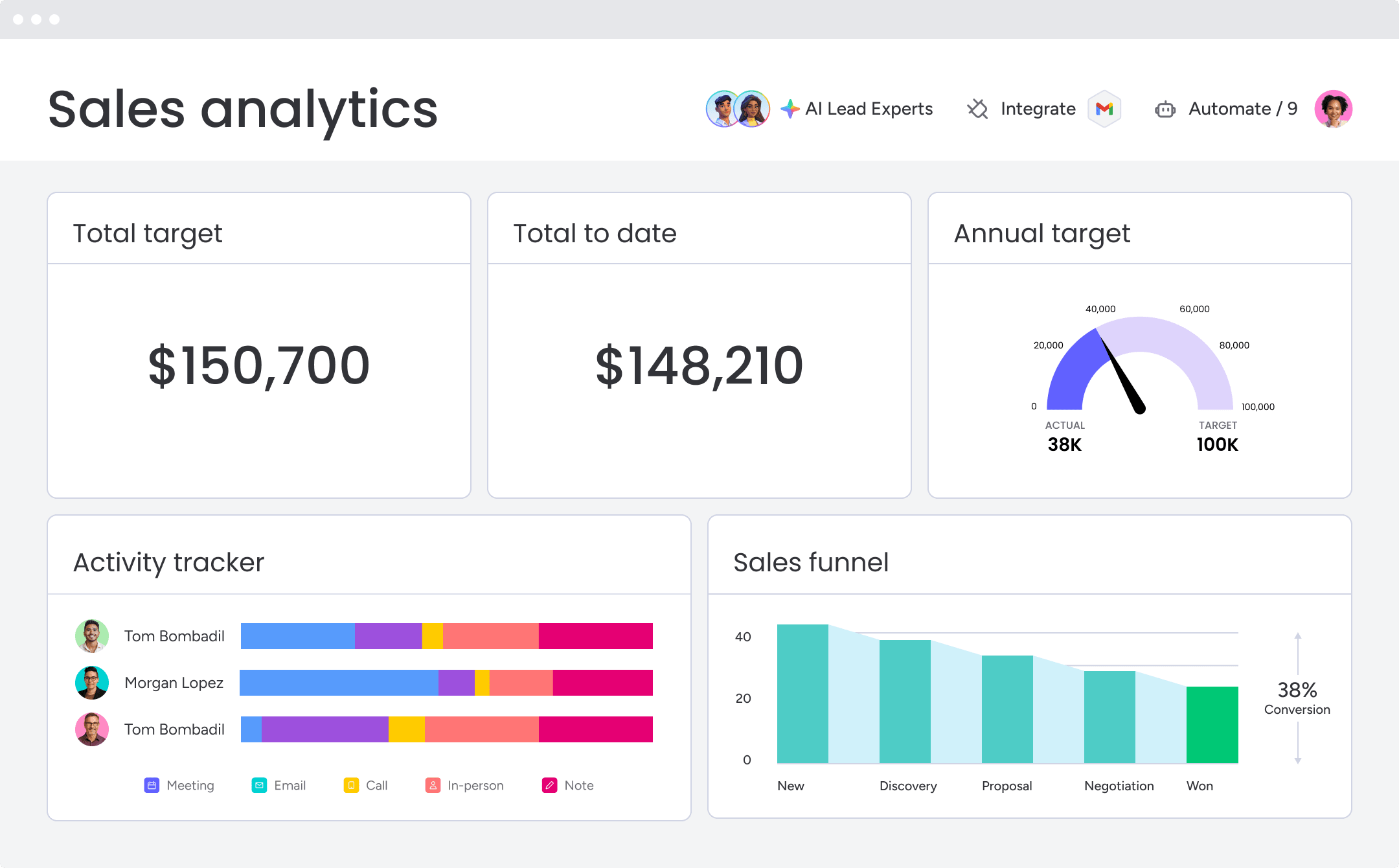
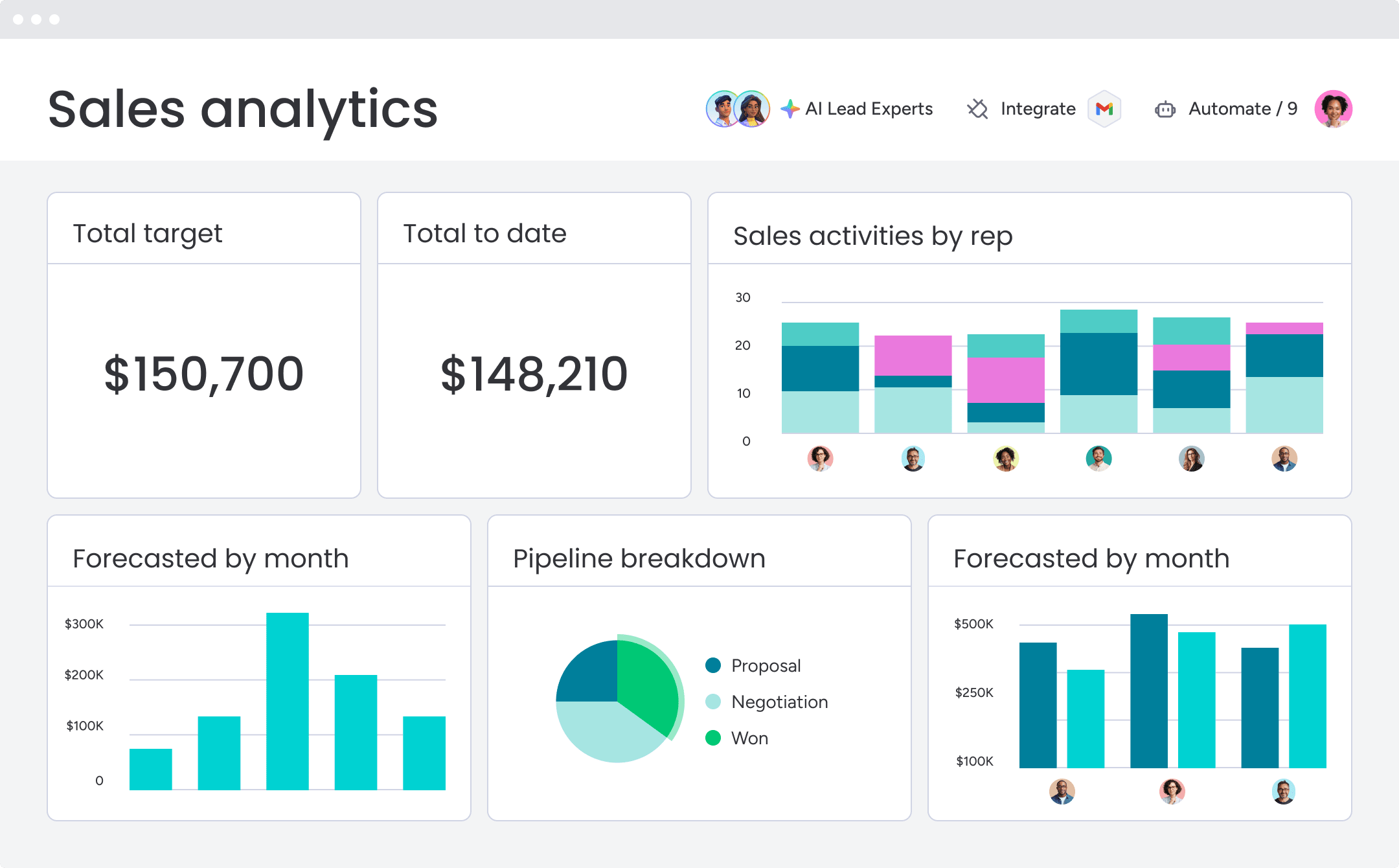
AI voice agents track call volume, conversion rates, common objections, and which sources send quality leads. You’ll see which channels send quality leads, what questions come up most, and where conversations stall.
Performance data helps optimize conversation scripts and identify training needs:
- Script optimization: if analytics show prospects frequently ask about specific neighborhood amenities that the AI handles poorly, teams can refine responses.
- Training development: when certain objections appear repeatedly, managers develop handling strategies for both AI and human agents.
How does voice AI qualify real estate leads?
Lead qualification represents a core strength of AI voice agents. While human agents may adjust their approach during high-volume periods, AI agents consistently maintain thorough qualification processes with natural conversation flow. These systems execute comprehensive questioning protocols regardless of call volume while preserving conversational quality.
Natural language understanding for property queries
AI agents understand complex requests, even when prospects use casual language. When a prospect says “I’m looking for a three-bedroom house near good schools under $400,000,” the system identifies four distinct qualification criteria: bedroom count, property type, location preference, and budget constraint.
The natural language processing goes deeper than simple keyword matching:
- Context recognition: if someone mentions “family-friendly neighborhood,” the agent recognizes this relates to school quality, low crime rates, parks, and community amenities.
- Style preferences: a request for “something with character” signals interest in older homes with architectural details rather than new construction.
- Clarifying questions: when requests are ambiguous, the AI asks conversational follow-ups like “What’s your current square footage, so I can understand what size you’re looking for?”
- Style preferences: a request for “something with character” signals interest in older homes with architectural details rather than new construction.
- Clarifying questions: when requests are ambiguous, the AI asks conversational follow-ups like “What’s your current square footage, so I can understand what size you’re looking for?”
Real-time budget and timeline assessment
Financial readiness assessment occurs through conversational questions that avoid feeling intrusive. Instead of immediately asking “What’s your budget?”, sophisticated AI agents establish context first: “To make sure I show you properties that fit your needs, it helps to understand your price range. What are you comfortable spending?”
The system probes beyond stated budget to assess true financial readiness:
- Pre-approval status: when prospects mention a price range, the AI asks about pre-approval status and down payment availability.
- Contingencies: questions about whether they need to sell a current home first identify genuinely qualified buyers versus those in early research stages.
- Timeline urgency: a prospect who says “we’re just starting to look” receives different treatment than one who states “our lease ends in 60 days”.
Automated lead scoring and routing
AI agents assign numerical scores based on multiple qualification factors weighted by importance. Budget alignment with available inventory might carry 30% weight, while timeline urgency accounts for 25%, financing readiness 25%, and property criteria specificity 20%.
The routing system works in three tiers:
- High-priority leads: prospects who are pre-approved, need to move within 45 days, and seek properties in the team’s primary market area generate instant alerts for immediate human contact.
- Mid-tier leads: enter structured follow-up sequences with a mix of AI and human touchpoints.
- Lower-scoring leads: receive automated nurturing until their status changes, with the AI updating scores and routing priority when circumstances improve.
5 must-have features for real estate voice AI
Not all AI voice agents deliver the same capabilities or quality of experience. Professional-grade solutions distinguish themselves through specific features that make the difference between basic automation and transformative technology. Understanding these features helps teams select systems that deliver genuine value rather than frustrating prospects with robotic interactions.
| Feature | Basic automation | Professional voice AI |
|---|---|---|
| Conversation flow | Scripted, robotic responses | Natural pauses, contextual transitions |
| CRM integration | Manual data export | Real-time sync with custom field mapping |
| Calendar coordination | Simple availability check | Conflict resolution, travel time factoring |
| Follow-up capability | Single channel | Multi-channel based on prospect preference |
| Compliance | Basic call recording | Fair housing programming, TCPA compliance |
1. Human-like conversation flow
Natural conversation patterns make prospects comfortable rather than frustrated. Advanced AI maintains appropriate pauses, uses conversational transitions like “That makes sense” or “I understand,” and handles interruptions gracefully.
When a prospect cuts off the agent mid-sentence to ask a question, the system acknowledges the interruption, answers the question, then returns to the previous topic naturally. Context maintenance throughout longer conversations prevents repetitive questions that frustrate prospects.
If someone mentions they have two children early in the conversation, the AI doesn’t later ask “Do you have kids?” when discussing school districts.
2. Native CRM integration
Seamless data flow between voice agents and CRM systems eliminates manual entry and ensures no leads fall through cracks. Real-time updates mean that as conversations occur, CRM records populate with contact information, qualification details, and follow-up requirements.
Organizations using solutions like monday CRM gain flexible integration options that accommodate various voice AI platforms:
- Native API connections: enable real-time data synchronization.
- Webhook support: allows custom integration scenarios for specialized systems.
- Visual interface: makes it easy to map AI conversation data to appropriate CRM fields without technical expertise.
3. Calendar and showing coordination
Appointment scheduling capabilities extend beyond simple availability checking. The system accesses agent calendars, identifies open time slots, factors in travel time between appointments, and respects buffer periods agents need between showings.
Integration with property access systems streamlines showing logistics:
- Access coordination: the AI coordinates lockbox codes, building access procedures, and special viewing instructions.
- Complete packets: agents receive showing packets with property details, prospect qualification information, and access instructions.
4. Multi-channel follow-up
AI agents coordinate follow-up across phone, email, and text messaging based on prospect preferences captured during initial conversations. Someone who mentions they prefer text communication receives property updates via SMS, while prospects who engage more with email get detailed listing information in their inbox.
The system recognizes when prospects engage across multiple channels and consolidates their activity. If someone receives an email with listing links, clicks through to view properties, then calls with questions, the AI has complete context about their recent engagement when the conversation begins.
5. Compliance and security controls
Fair housing compliance programming ensures AI agents avoid discriminatory language and maintain equal treatment of all prospects. The system never asks about protected characteristics like race, religion, or family status.
When prospects volunteer such information, the AI redirects conversation to property features and requirements.
Data privacy measures protect sensitive financial and personal information shared during qualification conversations through encryption standards and access controls.
Voice AI applications across real estate
AI voice agents adapt to different real estate business models and operational needs. The technology scales from individual agents to large brokerages, and customizes for residential sales, property management, commercial real estate, and investment operations. Each application requires specific conversation flows and data capture approaches tailored to unique business requirements.
Residential sales operations
Buyer inquiry handling represents the most common AI voice agent application. When prospects call about listings, the agent provides property details, neighborhood information, school district data, and recent comparable sales. It answers questions about square footage, lot size, HOA fees, and property taxes by accessing MLS data in real-time.
Seller lead qualification follows a different conversation pattern:
- Property assessment: focused on property characteristics, motivation for selling, timeline expectations, and pricing expectations.
- Information gathering: the AI gathers details about property condition, recent updates, and what sellers hope to accomplish.
- Routing: qualified seller leads get routed to listing specialists.
Open house follow-up automation captures contact information from sign-in sheets and initiates immediate follow-up calls. The AI asks visitors about their impressions of the property, what they liked or disliked, and whether they want to schedule a private showing.
Property management automation
Tenant inquiry handling addresses questions about available units, lease terms, pet policies, and application requirements. The AI provides virtual tours, explains amenities, and schedules in-person showings without property manager intervention.
Maintenance request intake captures tenant issues, assesses urgency, and routes requests to appropriate vendors:
- Emergency response: a tenant reporting a water leak receives immediate response with emergency procedures.
- Routine requests: standard maintenance requests enter the normal workflow.
- Proactive outreach: lease renewal conversations begin 90 days before expiration, asking tenants about their plans and addressing concerns that might prevent renewal.
Commercial real estate teams
Commercial property inquiries require different qualification approaches focused on space requirements, lease term preferences, and business needs. The AI asks about square footage needs, employee count, customer traffic expectations, and specific facility requirements like loading docks or specialized electrical systems.
Investment criteria assessment for commercial buyers explores:
- Financial parameters: cap rate expectations, financing structures, and portfolio strategies.
- Property preferences: target property types, geographic preferences, and acquisition timelines.
- Industry terminology: the system understands commercial terms like “triple net lease,” “CAM charges,” and “tenant improvement allowances.”
Successful AI voice agent implementation requires careful planning around technical requirements, workflow design, team preparation, and performance monitoring. The process typically takes one to two weeks from initial setup to full deployment. Following a structured approach ensures smooth integration and maximum adoption rates.
Step 1: assess technical requirements and setup
Phone system compatibility represents the first technical consideration. Most AI voice agents integrate with existing phone systems through cloud-based connections or SIP trunking. Teams using traditional landlines may need to upgrade to VoIP systems that support cloud integration.
CRM integration capabilities determine how seamlessly conversation data flows into existing systems:
- Native integrations: popular platforms require minimal setup.
- Custom integrations: proprietary CRM systems may require developer involvement to build webhook connections or custom API endpoints.
- Voice recognition training: improves accuracy for industry-specific terminology and regional accents through sample conversations, common property terms, and local neighborhood names.
Step 2: design workflows and customize conversation flows
Conversation flow design matches AI interactions to business processes and brand voice. Teams create decision trees that guide conversations based on prospect responses. Different paths accommodate buyers versus sellers, first-time home-buyers versus experienced investors, or residential versus commercial inquiries.
Teams leveraging workflow capabilities within platforms like monday CRM support complex AI voice agent integrations through customizable automation:
- Automated workflows: trigger based on AI qualification results, sending welcome emails, assigning follow-up tasks, or initiating nurturing sequences.
- Visual workflow builder: makes it easy to design and modify processes without technical expertise.
Step 3: train teams and manage change
Agent preparation for AI-qualified leads focuses on how to handle warm handoffs from the AI system. Training covers reviewing AI conversation summaries, understanding qualification scores, and continuing conversations naturally.
Agents learn to reference information prospects already shared with the AI rather than asking redundant questions. Transparent communication about how AI augments rather than replaces agents makes the difference. The technology handles repetitive qualification tasks, allowing agents to focus on relationship building, complex negotiations, and strategic advice.
ROI of voice AI vs traditional methods
AI voice agent investments deliver measurable returns through cost savings, increased lead capacity, faster response times, and improved conversion rates. The financial impact becomes particularly dramatic when teams scale operations or need extended coverage hours.
| Metric | Traditional ISA | AI voice agent | Improvement |
|---|---|---|---|
| Monthly cost | $4,000-$6,000 | $500-$1,500 | 70-85% cost reduction |
| Weekly availability | 40-50 hours | 168 hours | 3-4x time coverage |
| Monthly lead capacity | 50-100 leads | 500-1,000 leads | 5-10x volume handling |
| Average response time | 5-30 minutes | Under 30 seconds | 95% faster response |
| Consistency | Varies by agent mood | Identical every call | 100% standardization |
Monthly salary and benefits for inside sales agents range from $3,000 to $4,500 depending on experience and market. Adding payroll taxes, health insurance, and other benefits increases total compensation to $4,000 to $6,000 per month. Teams needing coverage beyond standard business hours must hire multiple ISAs or pay overtime.
AI voice agent costs include software licensing ($300 to $1,000 per month), phone system integration ($100 to $300 per month), and setup fees ($500 to $2,000 one-time). Total monthly costs typically range from $500 to $1,500 depending on call volume and feature requirements.
The cost differential becomes more dramatic at scale. A team handling 500 leads monthly would need five to ten human ISAs costing $20,000 to $60,000 monthly, while AI voice agents handle the same volume for $1,000 to $2,000 monthly.
Future capabilities of voice AI
AI voice agent technology continues evolving rapidly, with emerging capabilities that will further transform real estate operations. These advances promise to make AI interactions even more natural and valuable for both prospects and agents.
Multimodal property presentations
Future AI agents will combine voice conversations with visual property presentations delivered simultaneously through text messages or email. While discussing a property on the phone, the AI sends photos, floor plans, and virtual tour links in real-time. Prospects can view property details while the agent explains features.
Document sharing capabilities will allow AI agents to send purchase agreements, disclosure forms, and other transaction documents during conversations. When a prospect asks about contract terms, the AI can immediately send a sample agreement and explain key provisions.
Emotional intelligence in lead interactions
Voice tone analysis will enable AI agents to recognize emotional states like frustration, excitement, or confusion and adapt responses accordingly:
- Empathetic responses: a frustrated prospect who’s been searching unsuccessfully for months receives more patient, understanding responses.
- Enthusiastic engagement: an excited buyer gets matching energy and enthusiasm.
- Proactive objection handling: AI agents recognize hesitation in voice tone and address concerns before they become deal-breakers.
Predictive market analytics integration
Real-time property valuation during conversations will enable AI agents to provide instant estimates when prospects ask “What’s my home worth?” The system accesses recent comparable sales, current market trends, and property characteristics to generate preliminary valuations.
Neighborhood analytics will allow AI agents to answer detailed questions about school ratings, crime statistics, demographic trends, and future development plans. Instead of promising to research and call back, the agent provides immediate, data-backed answers.

“With monday CRM, we’re finally able to adapt the platform to our needs — not the other way around. It gives us the flexibility to work smarter, cut costs, save time, and scale with confidence.”
Samuel Lobao | Contract Administrator & Special Projects, Strategix
“Now we have a lot less data, but it’s quality data. That change allows us to use AI confidently, without second-guessing the outputs.”
Elizabeth Gerbel | CEO
“Without monday CRM, we’d be chasing updates and fixing errors. Now we’re focused on growing the program — not just keeping up with it."
Quentin Williams | Head of Dropship, Freedom Furniture
“There’s probably about a 70% increase in efficiency in regards to the admin tasks that were removed and automated, which is a huge win for us.“
Kyle Dorman | Department Manager - Operations, Ray White
"monday CRM helps us make sure the right people have immediate visibility into the information they need so we're not wasting time."
Luca Pope | Global Client Solutions Manager at Black Mountain
“In a couple of weeks, all of the team members were using monday CRM fully. The automations and the many integrations, make monday CRM the best CRM in the market right now.”
Nuno Godinho | CIO at VelvTransform your real estate operations with AI voice agents
AI voice agents help real estate teams respond to new leads instantly while still qualifying them properly. Instead of choosing between speed and a personal touch, teams can follow up right away and capture the details that matter — timeline, budget, and intent.
The best results come when AI voice agents work alongside a flexible real estate CRM. This combination improves response times, keeps qualification consistent, and helps agents focus their time on serious buyers and sellers.
A modern real estate CRM like monday CRM supports this by fitting into existing workflows. Teams can see how AI conversations are progressing, understand lead status at a glance, and trigger follow-ups automatically based on call outcomes. The result is faster engagement, fewer missed opportunities, and a smoother handoff from AI to agent.
Frequently asked questions
How much do AI voice agents for real estate cost?
AI voice agents for real estate typically cost between $500 and $1,500 per month depending on call volume and feature requirements, representing 70 to 85% cost savings compared to hiring human inside sales agents.
Can AI voice agents handle property negotiation discussions?
AI voice agents handle lead qualification, initial property inquiries, and appointment scheduling rather than complex negotiations that require human expertise and strategic decision-making.
Will AI voice agents work with my current phone system?
Most AI voice agents integrate with existing phone systems through cloud-based connections or SIP protocols, requiring minimal technical changes and typically involving only call routing configuration.
How quickly can I deploy an AI voice agent for real estate?
AI voice agent deployment typically takes one to two weeks including system setup, conversation script customization, CRM integration, and team training.
Which languages do real estate AI voice agents support?
Most professional AI voice agents support ten to 20 languages including Spanish, Mandarin, French, Portuguese, and Vietnamese, with some enterprise platforms offering 50 or more language options.
Are AI voice agents compliant with fair housing regulations?
Professional AI voice agents are programmed with fair housing compliance protocols to avoid discriminatory language and ensure equal treatment of all prospects.

 Get started