


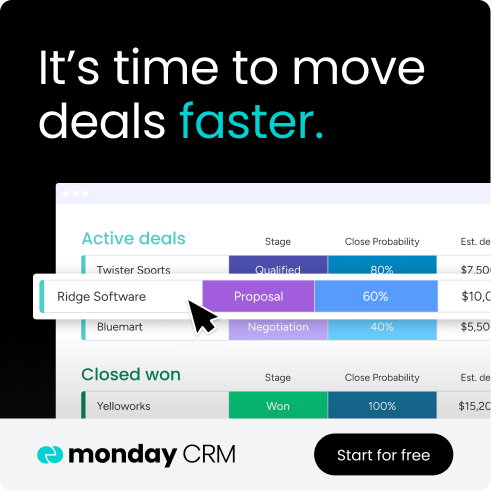
AI for lead generation transforms how sales teams work by automating research, scoring, and follow-up so reps can focus on what they do best: having conversations that close deals. Instead of spending hours manually sorting through prospects, AI analyzes hundreds of leads at once, identifies the ones showing real buying intent, and surfaces them instantly.
This guide covers what AI lead generation is, how it works, and how to implement it on your team. You’ll learn 7 practical ways to use AI in your pipeline, a 5-step implementation plan, and how to choose the right platform to get started.
Key takeaways
- AI handles research, scoring, and follow-up automatically so your team spends time on conversations that close deals, not admin work.
- Train AI on your historical closed-won deals, and it will surface prospects that actually match your ideal customer profile, not just anyone who fills out a form.
- AI routes and follows up with new leads in minutes, giving your team a better chance of booking meetings before competitors do.
- Pick one bottleneck — slow routing, low reply rates, or inconsistent follow-up — fix it with AI, measure the results, and build from there.
- monday CRM gives revenue teams built-in lead scoring, no-code automations, and AI-powered email personalization without stitching together separate tools.
What is AI lead generation?
AI lead generation uses artificial intelligence to automate and improve how you identify, qualify, and nurture potential customers. It uses machine learning and predictive analytics to analyze buyer signals, score leads, personalize outreach, and route opportunities to the right reps.
Traditional prospecting means reps research prospects one by one, manually update CRM records, and make gut-feel decisions about which leads matter. AI flips this approach by analyzing thousands of data points in seconds to spot patterns humans miss and act on signals in real time. While a rep might spend an hour researching one account, AI enriches and scores hundreds in that same period.
Here’s what makes AI different from manual processes:
- Predictive conversion that identifies which leads are most likely to convert based on historical deal data
- Personalization at scale that tailors outreach without manual effort
- Continuous learning that improves accuracy over time by learning from outcomes
Humans can’t analyze every website visit, email open, and content download across thousands of leads at once. Buyers expect instant, relevant responses. The teams that respond fastest with the right message win the deal.
Traditional lead generation vs. AI lead generation
Here’s a side-by-side comparison of how traditional and AI-powered approaches differ across key lead generation activities:
| Traditional lead generation | AI-powered lead generation |
|---|---|
| Manual prospect research | Automated prospect discovery and enrichment |
| Static lead qualification rules | Predictive lead scoring based on behavior and fit |
| Generic outreach templates | Personalized messaging tailored to each lead |
| Manual lead assignment | Intelligent lead routing in real time |
| Periodic follow-up | Automated, behavior-triggered nurturing |
| Limited visibility into intent | Continuous monitoring of buying signals |
| Spreadsheet-based forecasting | Predictive pipeline forecasting |
| Reactive sales process | Proactive identification of sales opportunities |
How AI lead generation works: 5 core capabilities
AI doesn’t replace sales and marketing teams. It amplifies their work by automating repetitive tasks, surfacing insights, and catching opportunities before they slip away.

Here’s how AI-powered lead generation works under the hood:
1. Lead discovery from CRM data and buyer signals
AI lead prospecting automation analyzes CRM data, website behavior, email engagement, social signals, and third-party intent data to identify prospects actively researching solutions or showing buying intent.
AI scans multiple data sources at once, tracking the following:
- Website visits and content downloads
- Email opens and LinkedIn activity
- Anonymous visitor behavior matched to company records
- Accounts showing active research patterns
Instead of waiting for a form submission, AI flags high-intent accounts in real time. Sales teams don’t need to sift through lists or wait for marketing to pass leads. Reps focus on conversations, not research.
2. Lead scoring and qualification

AI lead scoring assigns a numerical value to each lead based on fit and behavior. AI improves traditional lead scoring by identifying the behaviors and attributes most strongly associated with closed-won opportunities.
Here’s how AI weighs multiple variables at once to determine lead priority:
| Scoring factor | What AI analyzes | Impact on score |
|---|---|---|
| Job title | Seniority level, decision-making authority | Higher scores for VP+ titles |
| Company size | Employee count, revenue range | Weighted by ICP match |
| Website behavior | Pages visited, time on site, return visits | Pricing page visits score highest |
| Email engagement | Opens, clicks, replies | Multiple clicks increase score |
| Content consumption | Downloads, webinar attendance | Bottom-funnel content scores higher |
| Social signals | LinkedIn engagement, company news | Recent funding or hiring boosts score |
With this approach, sales reps spend time on leads ready to buy, rather than chasing cold prospects. This is crucial at a time when purchase decisions involve 5–11 stakeholders across departments and evaluation can take anywhere from 3 to 18 months, depending on deal size, according to the Gartner B2B Buying Report.
3. Personalized outreach and follow-up
AI personalization uses lead data to tailor email copy, messaging, and content recommendations for each prospect based on industry, role, pain points, recent activity, and engagement history.
Here’s what AI can do:
- Generate personalized email subject lines, body copy, and follow-up sequences based on what has worked for similar leads
- Determine the best time to send emails and the optimal follow-up frequency
- Recommend which content assets to share based on the lead’s stage and interests
Personalized outreach drives higher open rates, reply rates, and meeting bookings. Buyers expect relevant, timely communication — generic messaging gets ignored.
4. Lead routing across sales and marketing

AI lead routing automatically assigns leads to the right sales rep or marketing campaign based on territory, product fit, rep availability, expertise, or lead score.
AI routing rules beat simple round-robin assignment. It considers rep workload and past performance, as well as language preferences and time zones. AI-powered lead routing also takes into account product expertise and deal history.
Leads get faster responses. Reps work on leads they’re best equipped to close. Every lead is assigned promptly.
Gartner research revealed that 75% of B2B buyers prefer a rep-free sales experience, making AI-powered lead generation strategies essential.
5. Pipeline reporting and continuous improvement

AI pipeline reporting analyzes lead flow, conversion rates, deal velocity, and rep performance to spot bottlenecks, trends, and ways to improve.
AI surfaces insights manual reporting misses:
- Lead source performance: Which channels convert best, from paid search to organic to referrals
- Outreach effectiveness: Which messages get the most replies, including subject lines, send times, and content types
- Funnel analysis: Where leads drop off, stage by stage
- Rep coaching opportunities: Activity metrics, conversion rates, and deal velocity by rep
- Pipeline health forecasts: Predicted revenue vs. quota and at-risk deals
Revenue leaders see what’s working and what’s not, so they can make smarter decisions about lead quality and where to focus resources.
Why revenue teams use AI for lead generation
Revenue teams aren’t adopting AI just because it’s new. They’re adopting it because it solves real problems — poor lead quality, slow response times, generic outreach, and unpredictable pipelines. Here are the 4 core benefits that make AI a practical investment for sales and marketing teams:
1. Stronger lead quality
What it means: Sales reps spend time on prospects who are a good fit for your solution and are actively showing buying intent.
Without AI, sales teams waste time on unqualified leads and chase dead-end prospects. They struggle to separate high-intent buyers from tire-kickers. Marketing passes leads that aren’t ready, sales complains about lead quality, and the result is low conversion rates and long sales cycles.
AI analyzes fit and behavior signals to surface only the leads that match your ICP and show strong buying intent. It learns which attributes and behaviors predict closed deals, so lead quality improves over time.
2. Faster speed-to-lead
What it means: Responding to inbound leads within minutes dramatically increases the likelihood of booking a meeting and closing a deal.
Without AI, leads sit in queues waiting for manual assignment. Reps miss notifications. Follow-up is inconsistent. By the time a rep reaches out, the lead has already engaged with a competitor.
AI routes leads to the right rep, triggers automated follow-up sequences, and sends real-time alerts when high-priority leads enter the pipeline.
3. More relevant sales outreach
What it means: Every email, call, and message is tailored to the prospect’s industry, role, pain points, and recent activity.
Without AI, sales reps send the same email to every lead and struggle to personalize at scale. Reply rates stay low. Buyers ignore generic outreach because it doesn’t speak to their specific needs.
AI analyzes lead data and engagement history to generate personalized email copy, recommend relevant content, and find the best time to reach out.
4. More predictable pipeline visibility
What it means: Revenue leaders can accurately forecast deal flow, identify risks early, and make data-driven decisions to hit revenue targets.
Without AI, pipeline forecasting relies on gut feel, outdated spreadsheets, and inconsistent rep updates. Leaders don’t know which deals are at risk, where bottlenecks exist, or if the team will hit quota.
AI analyzes historical deal data, current pipeline health, and rep activity. It predicts which deals will close, which are at risk, and where the team needs to focus.

7 strategies for using AI for lead generation
These 7 methods are the most impactful ways revenue teams use AI to find, qualify, and convert leads faster. You can implement each method independently, but the best results come from combining multiple approaches into one integrated system.
1. Define your ideal customer profile
Identify the firmographic and demographic traits of your best customers so AI knows which leads to prioritize. Here’s how to build a strong ICP:
- Analyze your last 50–100 closed-won deals and identify common attributes: industry, company size, revenue range, and job titles of buyers.
- Document pain points and triggers by interviewing your best customers.
- Create ICP criteria across 3 dimensions: firmographic, demographic, and behavioral.
- Configure your CRM to use these criteria for lead scoring and prioritization.
2. Build targeted lead lists with AI
Using AI-powered prospecting tools, you can identify companies and contacts that match your ICP and are showing buying intent. Here’s how to build targeted lists:
- Use AI prospecting tools like LinkedIn Sales Navigator, ZoomInfo, Apollo, or Clearbit to search for companies and contacts matching your ICP.
- Filter by intent signals such as recent funding rounds, hiring activity, or technology adoption.
- Export qualified leads directly into your CRM with all available data.
- Let AI append missing information as leads enter your system.
AI scans millions of data points to find prospects that match your criteria faster and more accurately than manual research.
3. Enrich lead records with accurate context
AI can automatically append missing data so sales reps have the context they need to personalize outreach, including job title, company size, industry, email, phone, and social profiles. Here’s how to set up enrichment:
- Integrate enrichment tools with your CRM.
- Set up automated workflows that trigger enrichment when a new lead enters or when a lead’s data is incomplete.
- Ensure enrichment covers firmographic, demographic, and technographic details.
- Use this context for personalized outreach and more accurate lead scoring.
4. Score and prioritize AI sales leads
With AI-powered tools, you can assign a numerical score to each lead based on fit and behavior so sales reps focus on the hottest opportunities first. Here’s how to use this:
- Define scoring criteria based on your ICP and historical deal data.
- Set stage thresholds: leads scoring 80+ are “sales-ready,” 50–79 are “marketing-qualified.”
- Route leads automatically based on score.
- Let AI adjust scoring models based on which behaviors predict closed deals.
Consider this sample scoring framework that AI can apply automatically:
| Scoring component | Criteria | Points |
|---|---|---|
| ICP fit | Job title matches buyer persona | +20 |
| ICP fit | Company size within target range | +15 |
| ICP fit | Industry matches target verticals | +15 |
| Engagement | Visited pricing page | +25 |
| Engagement | Downloaded case study | +15 |
| Engagement | Opened 3+ emails | +10 |
| Engagement | Attended webinar | +20 |
| Recency | Activity within last 7 days | +10 |
5. Personalize outreach at scale

Consider using AI to tailor email copy, subject lines, and messaging for each lead based on their industry, role, pain points, and recent activity. Here’s how to scale personalized outreach:
- Use AI writing tools to generate personalized email templates based on lead data.
- Create dynamic sequences that adjust messaging based on lead behavior.
- Optimize timing using AI to determine the best send times and follow-up frequency.
- Track open rates, reply rates, and meeting bookings to improve AI-generated messaging over time.
Personalized outreach drives higher engagement because it speaks directly to the prospect’s needs.
6. Automate lead nurturing and follow-up
If you want to send timely, relevant follow-up emails, content recommendations, and reminders based on lead behavior, AI can help. Here’s how to build a nurture system:
- Set up behavior-triggered sequences that send emails based on lead actions like downloading a whitepaper or visiting a pricing page.
- Let AI determine when to send follow-ups and how frequently.
- Personalize nurture content based on lead stage, industry, and engagement history.
- Alert sales when a nurtured lead shows buying signals.
Consistent, timely AI lead follow-up keeps your brand top-of-mind and moves leads through the funnel without requiring manual effort.
7. Use AI agents to qualify leads and book meetings
Deploy AI-powered chatbots or virtual assistants that engage with leads in real time, ask qualifying questions, and book meetings directly on a sales rep’s calendar.
Here’s how to deploy AI agents:
- Deploy AI chatbots on your website, landing pages, or email campaigns.
- Program qualifying questions about company size, budget, timeline, and pain points.
- Integrate with your CRM for lead routing and calendar tools for instant meeting booking.
- Use AI to re-engage leads who don’t complete the qualification process.
AI agent lead generation provides instant responses 24/7, qualifies leads while they’re engaged, and books meetings without requiring a human to be online.
5 steps to implement AI lead generation
Adopting AI for lead generation doesn’t mean overhauling your entire sales process. Start with one high-impact workflow, prove value, and scale from there. These 5 steps take you from audit to ongoing improvement.
Step 1: Review your current lead generation process
Audit how leads enter your CRM, how they’re qualified, how they’re routed, and where bottlenecks or drop-offs occur. Here’s how:
- Map your sales lead generation process from first touchpoint to closed deal.
- Identify manual steps that slow down response time.
- Measure key metrics: speed-to-lead, lead-to-MQL conversion rate, and meeting booked rate.
- Pinpoint the biggest issues — whether that’s slow follow-up, poor lead quality, or data gaps.
Step 2: Prepare your CRM data for AI
Clean up duplicate records, standardize field names, and ensure lead data is complete and accurate before AI touches it. Follow these data hygiene steps:
- Remove duplicates and consolidate incomplete profiles.
- Standardize formats for job titles, company names, and industry labels.
- Use enrichment tools to complete missing fields.
- Set validation rules to prevent bad data from entering your CRM in the future.
AI is only as good as the data it’s trained on.
Step 3: Choose 1 high-impact AI lead gen workflow
Select a single AI use case that will deliver quick wins and build confidence in AI across your team. Use this table to match your biggest pain point to the right starting workflow:
| Pain point | Recommended first workflow | Expected impact |
|---|---|---|
| Slow response time | AI-powered lead routing | Reduce speed-to-lead from hours to minutes |
| Poor lead quality | AI lead scoring | Increase MQL-to-SQL conversion |
| Low reply rates | AI email personalization | Improve reply rates |
| Inconsistent follow-up | AI nurture sequences | Reduce lead drop-off |
| Manual data entry | AI enrichment |
Once you’ve identified your workflow, match the workflow to your primary pain point. Then, set clear success criteria before you start. Begin with one team or lead source, and be sure to measure results before expanding.
Step 4: Add AI to your sales and marketing workflow

Integrate AI tools with your CRM, set up automation rules, and train your team on how to use AI-powered features. For example:
- Connect enrichment, scoring, and chatbot tools with your CRM.
- Configure triggers that route high-scoring leads to sales and send personalized emails.
- Train your team on how AI works and how to interpret AI-generated insights.
- Create documentation for ongoing reference.
Step 5: Improve results with rep feedback
Continuously monitor AI performance, gather input from sales reps, and refine AI models based on what’s working.
Build a feedback loop that keeps AI improving:
- Schedule regular check-ins with sales reps to gather feedback on AI-generated leads, scoring accuracy, and outreach effectiveness.
- Track key metrics to measure AI impact.
- Adjust AI models based on feedback and performance data.
- Share success stories to build confidence in AI and encourage adoption.
How AI agents help generate high-quality leads
AI agents are autonomous assistants that perform specific tasks without constant human oversight. Unlike basic automation that follows rigid rules, AI agents make decisions, learn from outcomes, and adapt based on context.

How AI agents strengthen lead generation
AI agents automate four core functions: prospect research (gathering company news, funding, and tech stack data), lead scoring (analyzing behavior to prioritize prospects in real time), personalized follow-up (sending tailored emails based on engagement patterns), and meeting booking (qualifying leads and scheduling directly on sales calendars).
Each agent updates your CRM automatically, flags high-priority prospects, and adjusts actions based on what’s worked for similar leads — saving your team hours of manual work.
People and agents working together
The best AI lead generation strategies combine people and AI agents. AI handles repetitive, data-intensive processes. Humans focus on relationship-building, strategic thinking, and closing deals.
Human oversight remains essential. AI can make mistakes, miss context, or misinterpret signals. Humans provide the judgment, empathy, and strategic thinking AI can’t replicate. Here’s how to build a people-and-agents workflow:
- Define AI’s role: Data entry, scoring, and initial outreach
- Define the human role: Complex conversations, relationship building, and closing
- Set up feedback loops: So AI learns from human decisions over time
Revenue teams that combine AI automation with human expertise get faster lead response, higher conversion rates, and more predictable pipelines. monday CRM supports people-and-agents collaboration by centralizing AI insights and human activity in one platform.
What to look for in an AI-powered lead generation platform
Not all CRMs and AI lead generation software offer the same AI capabilities. Choosing the right platform means evaluating 6 key criteria that determine whether AI delivers real value for your revenue team. Use this as a checklist when comparing your options.

1. CRM integration
The AI platform connects with your existing CRM so lead data, activity history, and AI insights live in one place. If your AI tools are disconnected from your CRM, sales reps toggle between systems, data gets out of sync, and AI insights don’t reach the people who need them.
Look for: Native integration with your CRM, in-CRM visibility of AI-generated insights, and bi-directional data sync.
2. No-code workflow automation
Sales and marketing teams can build and customize AI-powered workflows without requiring IT or engineering support. If building AI workflows requires coding, adoption slows down and customization stays limited.
Look for: A visual workflow builder, pre-built templates for common use cases, and easy testing capabilities
3. AI lead scoring and routing
The platform automatically assigns scores to leads based on fit and behavior, then routes high-priority leads to the right sales rep.
Look for: Predictive scoring that uses machine learning, real-time score updates based on new behavior, and intelligent routing that considers factors beyond round-robin.
4. Email personalization
The platform generates tailored email content, subject lines, and follow-up sequences based on lead data and engagement history.
Look for: AI-generated content based on lead data, dynamic sequences that adapt based on lead behavior, and performance optimization recommendations.
5. Dashboards and forecasting
The platform provides real-time visibility into pipeline health, conversion rates, and predicted revenue.
Look for: Real-time dashboards showing lead flow and conversion rates, predictive forecasting that identifies which deals will close, and actionable insights for improving performance.
6. Permissions and human review
The platform allows you to control who can access AI features, what actions AI can take autonomously, and where human approval is required.
Look for: Role-based permissions, approval workflows that require human sign-off before certain actions, and audit trails that log AI actions.
Why monday CRM's AI-powered workflows are built for lead generation
monday CRM gives revenue teams everything they need to implement AI lead generation without stitching together multiple tools or writing a single line of code. Built-in AI capabilities work directly inside your CRM, so lead scoring, automated routing, and personalized outreach happen in the same platform where your team already manages deals and tracks pipeline.

Here’s what makes monday CRM’s AI different:
- Native AI lead scoring: Automatically prioritize leads based on fit and behavior without building complex scoring models from scratch
- No-code workflow automation: Build intelligent routing, follow-up sequences, and nurture campaigns using a visual builder that requires zero technical expertise
- AI-powered email personalization: Generate tailored outreach at scale based on lead data, engagement history, and what’s worked for similar prospects
- Real-time dashboards and forecasting: See pipeline health, conversion rates, and predicted revenue in one view so you can make faster, smarter decisions
- Built-in enrichment and data hygiene: Keep lead records complete and accurate without manual data entry or third-party integrations
- People-and-agents collaboration: AI handles repetitive tasks while your team focuses on conversations, with full visibility into what AI is doing and why
Revenue teams using monday CRM see faster speed-to-lead, higher conversion rates, and more predictable pipelines because AI insights and human activity live in one platform. No data silos. No context switching. Just better leads and more closed deals.

“With monday CRM, we’re finally able to adapt the platform to our needs — not the other way around. It gives us the flexibility to work smarter, cut costs, save time, and scale with confidence.”
Samuel Lobao | Contract Administrator & Special Projects, Strategix
“Now we have a lot less data, but it’s quality data. That change allows us to use AI confidently, without second-guessing the outputs.”
Elizabeth Gerbel | CEO
“Without monday CRM, we’d be chasing updates and fixing errors. Now we’re focused on growing the program — not just keeping up with it."
Quentin Williams | Head of Dropship, Freedom Furniture
“There’s probably about a 70% increase in efficiency in regards to the admin tasks that were removed and automated, which is a huge win for us.“
Kyle Dorman | Department Manager - Operations, Ray White
"monday CRM helps us make sure the right people have immediate visibility into the information they need so we're not wasting time."
Luca Pope | Global Client Solutions Manager at Black Mountain
“In a couple of weeks, all of the team members were using monday CRM fully. The automations and the many integrations, make monday CRM the best CRM in the market right now.”
Nuno Godinho | CIO at Velv
“monday.com provides developmental flexibility, operational efficiency, and data transparency — all in one place. We became a company that moved from chasing data to leading with it.”
Hyunghan Lee | Team Lead, Sandbox Network
"monday.com brought every part of our business into one connected space. The harmony between work management and CRM has become our operating system — giving us the clarity and confidence to scale.”
Jennifer Chinburg | Executive Vice President of Corporate Development & Brand, Chinburg Properties
“We just weren’t getting value from our old CRM. With monday.com, it's a thousand times better. Our sales teams are more informed, more consistent, and far more connected."
James Arnold | Chief Operating Officer, CenversaTurn AI into your best sales rep
AI lead generation is a practical, proven approach that helps revenue teams find better leads, respond faster, and close more deals by automating research, scoring, and follow-up. The teams seeing the biggest results start with one high-impact workflow — whether that’s AI lead scoring, automated routing, or personalized outreach — measure the results, and build from there.
Ready to see how AI-powered lead generation works in practice? Try monday CRM to automate your lead workflows, score prospects in real time, and give your team more time for the conversations that close deals.
Try monday CRMFAQs
What is AI lead generation?
AI lead generation is the use of artificial intelligence to automate and improve the process of identifying, qualifying, and nurturing potential customers by analyzing buyer signals, scoring leads, personalizing outreach, and routing opportunities to the right sales reps.
How does AI improve lead quality?
AI improves lead quality by analyzing thousands of data points to identify prospects who match your ideal customer profile and show buying intent. It learns which attributes and behaviors predict closed deals, then surfaces only the leads most likely to convert.
Can AI replace sales reps in lead generation?
AI cannot replace sales reps in lead generation because it handles repetitive, data-intensive work like research, scoring, and initial outreach while humans own strategy, judgment, relationship-building, and closing deals.
What data does AI need for lead generation?
AI needs accurate, complete data including firmographic data (company size, industry, revenue), demographic data (job title, seniority, department), behavioral data (website visits, email engagement, content downloads), and historical deal data to generate high-quality leads.
How long does it take to implement AI lead generation?
Most teams can implement a single AI workflow like lead scoring or automated routing within 2–4 weeks, with platforms that offer no-code automation builders and native AI capabilities reducing implementation time significantly.
What's the difference between AI lead generation and marketing automation?
Marketing automation follows pre-defined rules to send emails and trigger workflows, while AI lead generation goes further by analyzing data to make predictions, learning from outcomes, adapting actions based on context, and continuously improving based on results.
Is AI lead generation worth it for small businesses?
AI lead generation is worth it for small businesses because it levels the playing field against larger competitors by automating time-consuming tasks like lead research, scoring, and follow-up. Small teams get the same capabilities as enterprise sales organizations without needing to hire additional headcount. The key is starting with one high-impact workflow — like automated lead routing or AI-powered email personalization — that addresses your biggest bottleneck, then scaling as you see results.
