


Your sales reps spend more than 20% of their day on admin work. Researching prospects, updating records, chasing down contact info. That’s time they’re not spending on actual conversations with buyers. AI lead generation software changes that equation. It handles the repetitive work of finding, scoring, and qualifying leads so your team can focus on the conversations that move deals forward.
We’re breaking down 15 AI lead generation platforms for 2026, from full CRM solutions like monday CRM to specialized prospecting and enrichment platforms. We’ll cover the features that actually drive results, how to evaluate platforms for your team size and sales motion, and a practical implementation plan that gets you from pilot to ROI.
Try monday CRMWhat makes AI lead generation software game-changing for revenue teams
Your sales team spends over 20% of their day buried in admin tasks, not selling. AI lead generation software gives that time back by automating prospect research, lead scoring, and initial outreach so your reps can focus on closing deals. Old-school lead gen relies on guesswork and stale lists, but AI delivers data-driven precision that spots buying signals and behavioral patterns even your sharpest rep would miss.
Traditional vs. AI-powered lead generation
| Stage | Traditional approach | AI-powered approach |
|---|---|---|
| Lead identification | Guesswork and stale lists | Finds active buyers using real-time intent data |
| Lead qualification | Relying on job titles and luck | Scores leads based on actual buying behavior |
| Lead nurturing | One-size-fits-all emails and calendar reminders | Smart, personalized outreach that feels one-to-one |
| Performance tracking | Endless spreadsheets and outdated reports | Live dashboards that show you what's next |
Timing separates good outreach from great outreach. AI knows when a prospect visits your pricing page or checks out a competitor, and it alerts your team instantly. Your reps connect when the buyer is actually ready to talk. No more cold follow-ups or missed signals.
15 AI lead generation platforms to build a stronger pipeline
Every AI lead generation platform promises a bigger pipeline. Most platforms just create noise. The goal is to find the signal in that noise. The platforms below offer different strengths, from finding new prospects to automating your outreach.
| Platform | Best for | Key AI feature | Starting price |
|---|---|---|---|
| monday CRM | Customizable workflows with AI automation | AI Blocks for no-code lead automation | $9/seat/month |
| HubSpot | All-in-one marketing and sales ecosystem | Predictive lead scoring | $20/seat/month |
| ZoomInfo | B2B contact database with intent data | AI-powered prospect identification | Custom pricing |
| 6sense | Account-based marketing with predictive analytics | Revenue AI for pipeline forecasting | Custom pricing |
| Clay | Data enrichment and personalization at scale | AI-powered data waterfall | $149/month |
| Apollo.io | Sales intelligence and engagement platform | AI email sequencing | $49/user/month |
| Reply.io | Multi-channel sales automation | AI-powered email optimization | $60/user/month |
| AiSDR | AI sales development representative | Autonomous prospect outreach | $750/month |
| Cognism | Global B2B database with compliance focus | AI lead scoring and routing | Custom pricing |
| Lusha | Contact enrichment and prospecting | AI-powered data accuracy | $29/user/month |
| UnifyGTM | Revenue operations platform | AI pipeline forecasting | Custom pricing |
| Salesforce Einstein | Enterprise CRM with AI capabilities | Einstein Lead Scoring | $25/user/month |
| Clearbit | Data enrichment and lead qualification | AI-powered lead routing | $99/month |
| LinkedIn Sales Navigator | Professional network prospecting | AI-powered lead recommendations | $79.99/user/month |
| Drift | Conversational marketing and sales | AI chatbots for lead qualification | $2,500/month |
1. monday CRM
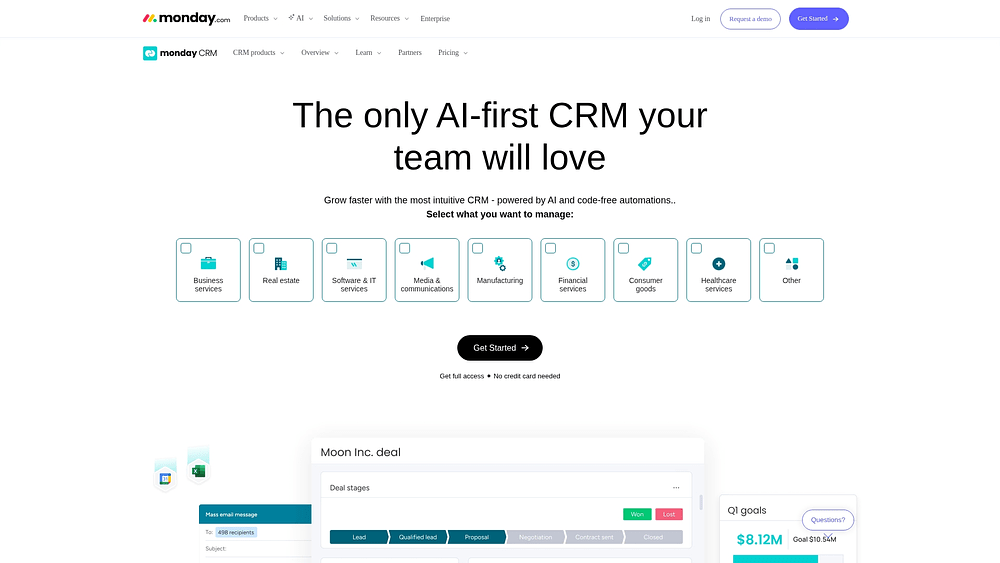
monday CRM helps you build a lead gen engine that stays organized once leads start flooding in. It’s built for revenue teams who want strong workflows without signing up for months of admin work. You set up your pipeline, lead routing, and follow-ups in a visual way your team will actually stick with.
Example:
Revenue teams use monday CRM to capture and qualify leads from sources like website forms and social ad campaigns, then keep every handoff tight. Instead of chasing context across inboxes and spreadsheets, teams log emails, meetings, and notes in one Emails & Activities timeline.
Key features:
- AI actions (Autofill with AI) for lead processing: Autofill board columns with actions like Extract information, Summarize, Detect sentiment, Assign label, Assign person, Writing assistant, and Custom action. RevOps can standardize what “qualified” means, and reps stop copy-pasting.
- Timeline summary with AI: AI creates a short summary of communication events—emails, calls, meetings, and notes—so reps and managers get the full story fast before a first call or handoff.
- AI email assistant: Draft emails where you already work, then personalize and send without bouncing between tabs.
- Visual pipeline management: Track deals in a visual pipeline, customize stages with drag-and-drop, and keep deal movement easy to scan during reviews.
- Lead management and outreach: Centralize and assign leads, send individual and mass emails using templates and dynamic fields, and track engagement like open rate and link clicks.
Pricing:
- Basic CRM: $9/seat/month (billed annually)
- Standard: $17/seat/month (billed annually)
- Pro: $28/seat/month (billed annually)
- Enterprise: Contact sales for a quote
- Annual discount: Save 18% when billed yearly.
- AI Credits: AI features require a Standard plan or higher. Credits are priced per use, with standard actions consuming about 8 credits.
Why it stands out:
- AI that fits your process: Teams apply AI directly inside board columns and the Emails & Activities timeline, so adoption feels natural for reps.
- Visibility leaders can use: Dashboards give fast views into pipeline status, forecasting, activities, and team performance, with sales widgets like leaderboard and funnel.
- CRM+ for the full customer journey: monday CRM supports sales and customer-facing teams beyond lead gen, including account management, onboarding, renewals, and even collection tracking.
Advanced AI features:
- Autofill with AI across key columns: Apply AI to Text, Date, Number, Dropdown, People, and Status columns, then choose the action that matches your workflow.
- Extract information from real-world files: Pull structured data from files like .pdf, .png, .jpg, .jpeg, .webp, .docx, .xlsx, and .pptx, plus images and monday docs stored in the Files column. Helpful when inbound leads arrive as “attached contract” or “RFP.pdf.”
Automations:
- Automate actions based on custom conditions: Trigger next steps when a lead or deal changes status, including conditional label change, so routing and follow-ups don’t depend on someone remembering.
Integrations:
- Works with your existing stack: Revenue teams connect monday CRM with the rest of their process, so lead capture, enrichment, and handoffs stay consistent.
AI lead generation software features:
- Lead categorization that stays consistent: Use Assign label on a Status or Dropdown column to classify inbound leads (industry, segment, intent), then keep routing and reporting clean.
- Fast context for outreach: Use timeline summary with AI and Summarize actions to turn long threads into a quick read, right before a call or follow-up.
2. HubSpot
HubSpot brings marketing automation, sales CRM, and AI-powered lead generation into one platform built for mid-market companies. It’s built for inbound marketing, with AI agents that automate lead scoring, nurturing, and conversion. With over 267,000 customers and a comprehensive ecosystem of 1,800+ integrations, HubSpot positions itself as the go-to solution for scaling companies that want all their revenue operations in one place.
Use case:
Mid-market organizations building inbound lead generation strategies around content marketing, SEO, and multi-channel customer engagement benefit most from HubSpot’s integrated marketing and sales capabilities.
Key features:
- Breeze AI agents and assistants: Automate lead scoring, email personalization, and customer support with AI that learns from your unified customer data and can resolve over 50% of support tickets autonomously.
- Predictive lead scoring: Analyzes prospect behavior and firmographic data to rank leads by conversion likelihood, helping sales teams prioritize high-value opportunities.
- Automated nurturing workflows: Trigger personalized content sequences based on prospect actions, with AI optimizing send times, subject lines, and content for maximum engagement.
Pricing:
- Free tier: $0/month with foundational tools
- Starter: $20/seat/month for basic features
- Professional: $1,600/month (5 seats included) with advanced AI capabilities
- Enterprise: $5,000/month (7 seats included) with access to the most powerful AI capabilities
- Additional HubSpot Credits required for advanced AI features (starting at $10 per 1,000 credits)
Considerations:
- Advanced AI features require Professional or Enterprise subscriptions, with additional credit-based usage costs that can add up quickly for high-volume teams.
- Some prebuilt AI agents have non-editable default settings, limiting customization for specific business workflows.
3. ZoomInfo
ZoomInfo combines one of the largest B2B contact databases with AI-powered intent intelligence to identify prospects actively researching solutions. The platform specializes in helping sales teams find and prioritize accounts showing buying signals, making it ideal for enterprise B2B organizations with dedicated operations support.
Use case:
Enterprise B2B sales teams that need extensive contact data and intent intelligence for account-based strategies benefit from ZoomInfo’s comprehensive database and AI-driven prospect scoring capabilities.
Key features:
- Intent data tracking monitors prospect research behavior across thousands of websites to identify companies entering buying cycles
- AI-powered prospect scoring combines firmographic, technographic, and behavioral signals to rank leads by likelihood to convert
- Automated list building creates targeted prospect lists based on ideal customer profiles with native CRM integrations for seamless data flow
Pricing:
- Custom pricing: Quote-based pricing typically starting around $14,995/year for basic packages
- Database access: Pricing varies based on database access level and user count
- Additional users: Per-user fees apply for adding team members during the contract
Considerations:
- Contracts are non-cancellable for the stated term, which may limit flexibility for changing business needs
- Pricing transparency is limited with quote-only models requiring sales engagement to determine total costs
4. 6sense
6sense delivers predictive AI that identifies anonymous website visitors and forecasts which accounts will enter buying cycles, processing billions of data points to predict revenue and optimize marketing spend. This makes it a strong choice for large enterprises with long, complex B2B sales cycles.
Use case:
Large enterprises with long, complex B2B sales cycles involving multiple stakeholders and extended evaluation periods.
Key features:
- Revenue AI: Analyzes historical data and current engagement patterns to forecast pipeline and predict deal outcomes
- Account identification: Reveals which companies visit your website, even when visitors don’t fill out forms
- Predictive analytics: Scores accounts by likelihood to purchase and optimal timing for outreach
Pricing:
- Sales Intelligence: Free plan available with 50 data credits per month
- Enterprise modules: Custom pricing typically starting at $3,000+ per month depending on account volume and feature requirements
- Credits model: Additional data credits can be purchased as needed for contact/company data exports
Considerations:
- Enterprise reviewers often cite a learning curve and some rigidity in analytics and reporting
- Without broader 6sense modules, AI personalization relies on CRM data only and cannot leverage 6sense-native fields like recent web visits or technographics
5. Clay
Clay transforms raw prospect data into personalized outreach campaigns using AI to pull information from 50+ data providers automatically. The platform’s “waterfall” approach tests multiple data sources until it finds what you need, while AI agents handle research tasks that would normally eat up hours of manual work.

Use case:
Revenue teams running high-volume outbound campaigns who need comprehensive prospect data and AI-powered personalization at scale.
Key features:
- AI-powered data enrichment: Automatically pulls contact details, company information, and behavioral signals from 50+ sources using a waterfall approach that tries multiple providers until successful.
- Claygent AI research agents: Handle complex research tasks like analyzing company news, social activity, and industry trends to generate unique talking points for each prospect.
- End-to-end GTM activation: Seamlessly connects enriched data to message generation, sequencing, and CRM integration for complete campaign execution.
Pricing:
- Free: $0/month with 1,200 credits annually
- Starter: $149/month with 24,000-36,000 credits
- Explorer: $349/month with 120,000-240,000 credits
- Pro: $800/month with 600,000-1.8M credits
- Enterprise: Custom pricing with expanded quotas and features
Considerations:
- Credit consumption can add up quickly with AI research and enrichment tasks, requiring careful workflow design to manage costs.
- Relies on third-party AI models (OpenAI, Anthropic, Google) rather than proprietary technology, which can affect pricing and rate limits.
6. Apollo.io
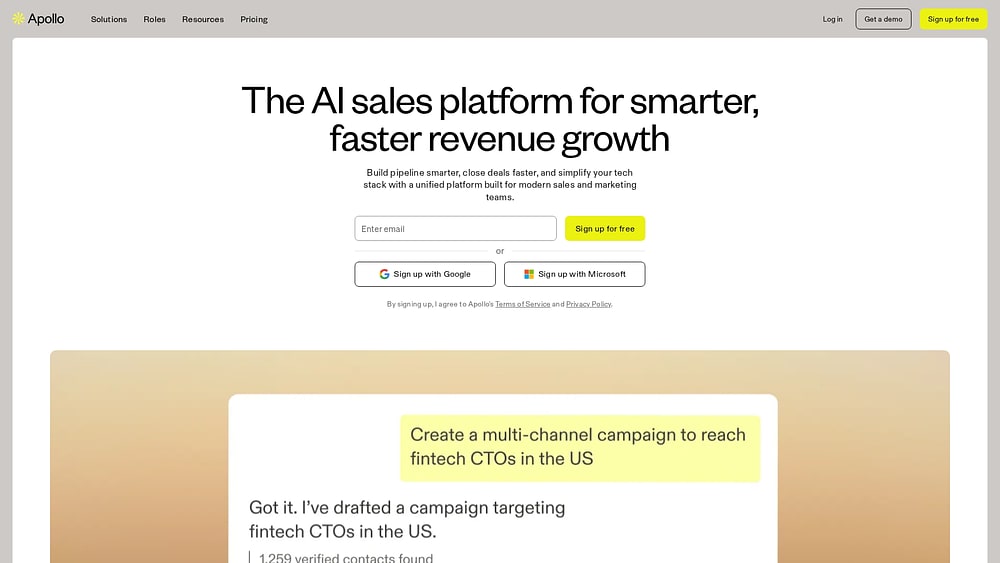
Apollo.io combines B2B data, sales engagement, and AI automation in one unified platform designed for revenue teams who need both prospecting intelligence and execution power. SDRs and sales leaders both get what they need: an integrated way to find, engage, and convert prospects. With nearly 100,000 paying customers and approaching $200M ARR, Apollo has built serious momentum in the sales tech space.
Use case:
Sales teams wanting to eliminate tool sprawl by combining prospecting database access, engagement automation, and AI-powered research in a single platform will find Apollo particularly valuable.
Key features:
- AI-powered workflow automation: Drag-and-drop AI agents that research contacts, qualify prospects, and trigger automated actions based on engagement patterns.
- Integrated engagement suite: Native email sequences, dialer functionality, and conversation intelligence that work seamlessly with the prospecting database.
- Living data network: Continuously updated B2B database with up to 275M+ contacts, verified through contributor feedback and engagement signals.
Pricing:
- Free plan: Basic access with limited credits.
- Basic: $49/user/month with core features and foundational AI capabilities.
- Professional: Higher-tier plan with advanced AI features and increased credit allowances.
- Custom/Organization: Enterprise pricing available through sales consultation.
- Additional costs apply for credits (data access, AI research, dialer minutes) and add-ons like international calling.
Considerations:
- Heavy usage of AI research, enrichment, and dialer features can significantly increase costs beyond base subscription pricing through credit consumption.
- Key AI features like AI Projects, the AI Assistant, and the Claude connector are still in beta, which may limit availability and functionality for some users.
7. Reply.io
Reply.io delivers AI-powered multichannel sales automation that coordinates email, LinkedIn, and phone outreach in one unified workflow. The platform combines an integrated B2B database of 1B+ contacts with Jason AI, their autonomous SDR agent that handles everything from lead discovery to meeting booking. Perfect for outbound-focused teams who want to automate their entire prospecting funnel in one place.
Use case:
Sales teams executing coordinated outbound campaigns across multiple channels—especially those targeting prospects active on LinkedIn—benefit from Reply.io’s integrated data and engagement capabilities.
Key features:
- Jason AI SDR automates the complete outreach process from ICP creation and lead discovery to AI reply handling and meeting scheduling
- Multichannel conditional sequences coordinate touchpoints across email, LinkedIn messages, SMS, WhatsApp, and phone calls with smart branching logic
- AI Variables generate unique personalization for each prospect at scale, improving deliverability and response rates while reducing manual editing
Pricing:
- Email Volume plan: Starting from $49-$89/user/month (billed annually)
- Multichannel plan: Starting from $89/user/month (billed annually)
- Jason AI SDR: Starting from $500/month with higher-tier Growth/Enterprise options available by quote
- Add-ons: LinkedIn Automation ($69/account/month), Calls & SMS ($29/account/month), additional AI credits and email validation packs
- 14-day free trial available for core features
Considerations:
- LinkedIn automation features carry inherent risks since LinkedIn prohibits automated outreach, requiring conservative usage to avoid account restrictions
- AI SDR and premium features often require sales-led engagement rather than full self-serve access, which can slow trial and proof-of-concept processes
8. AiSDR
AiSDR operates as an autonomous AI sales development representative that handles end-to-end prospecting without human intervention. The platform specializes in intent-first prospecting using live AI signals and research-driven personalization. Founded by Y Combinator alumni in 2023, AiSDR has already booked over 12,000 meetings for more than 250 companies. It’s a strong choice for teams wanting to fully automate their top-of-funnel activities.

Use case:
Revenue teams struggling to scale SDR capacity or those wanting to eliminate manual prospecting while maintaining high-quality, personalized outreach.
Key features:
- Autonomous prospect research: Live AI scans 323+ data sources, LinkedIn activity, company news, and hiring signals to build fresh prospect lists and craft contextual messaging.
- Multi-channel execution: Runs sequences across email, LinkedIn (DMs, InMails, voice notes), text, and phone calls with AI-generated scripts and sub-10-minute reply handling.
- Built-in deliverability infrastructure: Handles mailbox warm-up, rotation, domain setup, and DMARC/SPF/DKIM configuration to protect sender reputation at scale.
Pricing:
- Simple pricing: $750 per month for unlimited outreach volume.
Considerations:
- As a newer platform, it has limited A/B testing capabilities and fewer granular targeting options compared to more established tools.
9. Cognism
Cognism delivers compliance-first B2B data with AI-powered prospecting for European markets. It combines phone-verified contact data with natural language search. This combo works especially well for mid-market teams expanding across GDPR-regulated territories.

Use case:
European revenue teams requiring verified, legally compliant contact data with AI-assisted prospecting to accelerate market discovery and improve connection rates.
Key features:
- AI Search enables natural language and voice queries for up to 3x faster TAM identification than manual filtering
- Diamond Data provides phone-verified mobile numbers with up to 3x higher connect rates than standard databases
- Research by Cognism AI generates source-grounded company insights with embedded citations to help prevent hallucinations
Pricing:
- Grow plan: Custom pricing based on team size and data requirements
- Elevate plan: Quote-only pricing with advanced features and intent data add-ons
- Diamonds-on-Demand: Available as add-on for verified mobile numbers on demand
- All pricing requires sales consultation with no published rates
Considerations:
- AI Search launched in beta with occasional unexpected behavior warnings in help documentation
- High perceived cost according to G2 reviews, with an average ROI timeline of 9 months that’s typically realized when teams fully adopt the platform’s features
10. Lusha
Digging for contact info wastes hours every week. Lusha uses AI-powered data verification to quickly find and check prospect details. With a slick browser extension and easy CRM integrations, it’s built for sales teams who need reliable contact data for outbound prospecting—without the manual grunt work.

Use case:
Sales teams running LinkedIn prospecting and outbound campaigns get a major boost from Lusha’s quick data access and solid accuracy.
Key features:
- AI-powered contact enrichment finds and verifies emails and phone numbers, targeting 98% email deliverability and ~85% phone accuracy.
- The Chrome extension gives you contact data right on LinkedIn profiles or company websites. No tab-switching required.
- One-click CRM sync keeps all your contact information updated automatically across your systems.
Pricing:
- Free plan: A limited number of contact reveals per month.
- Pro plan: Starts at $29/user/month for core contact enrichment.
- Premium and Scale plans: Pricing varies based on your plan and contract, unlocking advanced features and more credits.
Considerations:
- The credit-based model means heavy use, especially for phone numbers, can burn through your monthly allowance fast.
- New AI features like recommendations and playlists are in a staged rollout, so access may be limited at first.
11. UnifyGTM
UnifyGTM operates as a revenue operations platform that uses AI to optimize the entire go-to-market process. The platform specializes in agentic AI research and explainable automation—capabilities that appeal to teams who want to eliminate tool sprawl while maintaining high-fidelity lead qualification. Computer-use capabilities and integrated deliverability management turn complex outbound workflows into revenue engines that actually work.

Use case:
Large organizations with mature sales processes and dedicated revenue operations teams seeking comprehensive go-to-market intelligence and automated lead qualification.
Key features:
- AI pipeline forecasting predicts revenue outcomes based on historical data and current deal characteristics
- Revenue attribution tracks which marketing and sales activities drive actual revenue
- Automated reporting generates executive dashboards without manual data compilation
Pricing:
- Growth: Starting from $1,000/month with 2,500 credits, two active Plays, three platform users
- Pro: Custom pricing with annual commitment required
- Enterprise: Quote-based with SSO and white-glove onboarding
Considerations:
- Email integration currently centers on Gmail with Outlook support coming later — a potential limitation for Microsoft-centric enterprises.
- Credit-based usage model can increase costs at scale, especially for teams running multiple AI agents across workflows
12. Salesforce Einstein
Salesforce Einstein brings enterprise-grade AI to the world’s most established CRM platform. The AI layer plugs into Salesforce’s feature set and turns your CRM data into insights using machine learning trained on your past performance. Large organizations already invested in the Salesforce ecosystem will find Einstein a natural extension of their current setup.

Use case:
Large enterprises already using Salesforce who want to add AI capabilities to their existing CRM investment without switching platforms.
Key features:
- Einstein Lead Scoring: Ranks prospects by conversion likelihood using machine learning trained on your historical data
- Opportunity Insights: Surfaces risks and opportunities in active deals with predictive analytics
- Activity Capture: Automatically logs emails and calendar events to CRM records, eliminating manual data entry
Pricing:
- Einstein features: Start at $25/user/month (requires existing Salesforce CRM subscription)
- Agentforce consumption: $500 per 100k credits (approximately $0.10 per action)
- Conversation pricing: $2 per conversation for customer-facing AI agents
Considerations:
- Requires existing Salesforce subscription, making it expensive for teams not already on the platform
- Complex setup and configuration may require dedicated admin resources or consulting services
13. Clearbit
Clearbit delivers AI-powered data enrichment that turns anonymous website visitors into qualified leads with full company profiles. Now fully integrated into HubSpot, its strength lies in real-time lead qualification and intelligent routing based on 100+ B2B attributes. Perfect for HubSpot-centric revenue teams who need to qualify and route leads instantly without leaving the platform.

Use case:
Marketing and sales teams generating high volumes of inbound leads who need instant lead qualification and smart routing to the right reps based on territory, industry, or account characteristics.
Key features:
- Real-time enrichment appends company and contact data to form submissions instantly, turning anonymous visitors into qualified prospects
- AI-powered lead routing automatically assigns leads to appropriate sales reps based on predefined criteria like geography, industry, or account size
- Form optimization reduces friction by shortening forms while still capturing essential qualification data through background enrichment
Pricing:
- HubSpot Credits model: Uses HubSpot’s flexible, credit-based system for enrichment features.
- Enterprise: Custom pricing is available through HubSpot sales for higher volumes and advanced needs.
Considerations:
- Requires a HubSpot subscription, as Clearbit no longer offers standalone plans to new customers.
- The credit-based pricing model can add complexity to budget planning compared to fixed monthly fees.
14. LinkedIn Sales Navigator
LinkedIn Sales Navigator transforms professional networking data into actionable sales intelligence for B2B teams. The platform leverages LinkedIn’s massive member network to deliver real-time buyer insights and warm introduction paths. Built specifically for relationship-based selling, it connects sales teams directly to decision-makers through trusted network connections.
Use case:
B2B sales teams targeting executive-level buyers who need live professional data, warm introductions, and AI-powered prospecting to accelerate deal cycles.
Key features:
- AI-powered prospecting & insights: Get AI-driven lead recommendations, plus instant summaries for accounts (Account IQ) and people (Lead IQ) using LinkedIn’s first-party data.
- Advanced search filters: Precise targeting by job title, company size, industry, and recent professional activity or job changes.
- InMail messaging with AI assist: Direct outreach to prospects outside your network with Message Assist drafting personalized messages.
Pricing:
- Core: Starts at $79.99/user/month (billed annually)
- Advanced: Starts at $149.99/user/month (billed annually)
- Advanced Plus: Custom pricing with CRM integrations and embedded experiences
Considerations:
- AI features like Lead IQ and Message Assist are currently English-only, limiting global team adoption.
- Advanced integrations and CRM embedded experiences require the highest-tier Advanced Plus plan with custom pricing.
15. Drift
Drift transforms website visitors into qualified leads through AI-powered conversational marketing that engages prospects at peak interest moments. Now part of Salesloft’s revenue orchestration platform, Drift specializes in real-time chat qualification and instant routing to sales reps. The platform excels at capturing high-intent buyers and seamlessly connecting them with the right team members when they’re ready to buy.
Use case:
Companies with high website traffic and inside sales teams that need to engage prospects immediately when they show buying intent.
Key features:
- Bionic chatbots: AI-powered conversations that engage visitors with personalized, brand-trained responses based on their behavior and company data.
- Instant lead routing: Qualified prospects get connected directly to available sales reps through Fastlane technology.
- Revenue attribution: Track which conversations and campaigns actually drive closed deals, not just meetings.
Pricing:
- Premium plan: Starts at $2,500/month for core conversational marketing features.
- Advanced & Enterprise plans: Quote-based. As part of Salesloft, pricing and packaging are handled directly through their sales team.
Considerations:
- Premium pricing puts it out of reach for smaller teams or companies with limited budgets.
- Quote-based pricing model makes it difficult to evaluate costs upfront without engaging sales.
Must-have AI lead generation features that deliver results
AI for lead gen sounds great, but what features actually find you leads that close? The difference is a system that finds the right people and engages them when they’re ready to talk. Here are the capabilities that separate the noise from real results.
Find your future customers with predictive lead scoring
Predictive lead scoring uses AI to analyze your past wins, then scores new prospects based on their real likelihood to buy. The AI tracks the signals that matter: page visits, content downloads, return frequency. You get a score based on real interest, not just a demographic profile that looks good on paper.
Know who’s ready to buy with intent data
Intent data tells you who’s shopping for a solution like yours before they ever fill out a form. AI tracks buying signals across the web and spots patterns that signal a deal is heating up, like when multiple people from one company suddenly start viewing your pricing page. Your reps reach out with the right message at the right time.
Personalization that feels personal
AI personalization uses data to customize the entire conversation: what content you recommend, when you send it, how you frame it. Revenue teams find success using monday CRM to make this happen without a huge ops team. The AI helps compose emails that pull in relevant context from past interactions and online activity.
One conversation, across every channel
AI coordinates campaigns across email, social, and phone so the conversation stays connected no matter where it happens. It figures out where each prospect is most likely to respond and focuses the effort there. No more disconnected messages from different platforms.
Qualify leads 24/7 with conversational AI
Conversational AI platforms engage visitors instantly, answer questions, gather qualifying info, and never clock out. When a lead is qualified, the AI can book a meeting directly on the right rep’s calendar. Because all of this is captured in your CRM, the handoff is seamless.
Try monday CRMHow to choose the right AI lead generation platform
Picking an AI platform isn’t about a features checklist; it’s about finding one your team will actually use. Pick wrong, and you’ll spend more time managing the tool than closing deals. The right one becomes the engine for predictable growth.
Find the right fit for your company’s size
Your company’s size and stage dictate what you truly need. A one-size-fits-all approach just doesn’t work.
- Small businesses (1-50 employees): You need a platform that works right away. Simple systems that get used beat powerful ones gathering dust.
- Mid-market companies (51-500 employees): You need scalability without enterprise costs. Find the sweet spot: enough power for your sales motion, simple enough to manage.
- Enterprise organizations (500+ employees): You need deep customization, security, and seamless integration with your extensive tech stack.
Consider these decision factors that actually matter:
| Factor | Small business | Mid-market | Enterprise |
|---|---|---|---|
| Budget constraints | Tight budget | Flexible, but watched | ROI is everything |
| Technical resources | Limited to none | Some dedicated staff | Full IT teams |
| Integration needs | Basic CRM, email | Multiple sales and marketing tools | Complex tech ecosystem |
| Growth trajectory | Rapid, unpredictable | Steady and planned | Structured, multi-year |
| Compliance requirements | Basic | Industry-specific | Comprehensive and global |
Check for native integrations
A new platform that doesn’t play nice with your existing software is dead on arrival. Painful surprises after you’ve signed the contract can kill momentum and team morale.
Does the AI platform work with your current CRM, or does it force a complete system switch? A full migration is a massive headache that can disrupt operations for months. If you’re keeping your CRM, verify the new platform offers a real, native integration.
monday CRM works well here. It functions as a powerful standalone CRM for teams starting fresh or plugs right into an established tech stack. Native integrations and open architecture mean you don’t have to make unnecessary compromises.
Look beyond the monthly price tag
The monthly subscription is just the cover charge. The total cost of ownership tells the real story and prevents budget blow-ups down the line.
- Implementation and setup: Factor in costs for configuration, data migration, and any professional services needed to get started. This can range from a few hours to a few months of work.
- Data and usage fees: Some platforms charge extra for contact data, intent signals, or API calls. These variable costs can quickly turn a good deal into a budget-buster.
- Maintenance and overhead: Who is going to run this thing? Even simple systems require ongoing management, which is time taken away from selling.
Watch for these red flags
Certain warning signs during the evaluation process predict future problems. Knowing what to spot saves you time, money, and a whole lot of frustration.
- Overly complex demos: If the vendor struggles to explain a workflow in simple terms, your team will struggle to use it.
- Vague AI claims: Ask how the AI works. If you get buzzwords instead of a straight answer, it’s probably marketing hype.
- Short trial periods: A 30-day trial is a sales tactic, not a real evaluation. You need time to see how the platform performs under real-world pressure.
- Poor customer support: If they’re slow to respond when trying to win your business, imagine what it will be like after you’ve paid.
Learn more: Lead generation automation tools
A practical plan for AI lead gen that actually works
Ready for AI lead generation? Great. Just don’t jump in without a plan. That’s how projects stall and budgets disappear. A little groundwork now prevents a lot of headaches later.Here’s a no-nonsense guide to get it right from the start. You’ll move from platform selection to measurable results that actually stick.
Step 1: Clean up your data first
Getting your data house in order is the foundation for everything. Before you do anything else, focus on these key areas to make sure your AI has good fuel to work with.
- Audit what you have: Find the duplicates, outdated info, and weird formatting that’s holding you back.
- Standardize your fields: Set up consistent formats for job titles, company names, and industries to stop bad data before it starts.
- Enrich your contacts: Add missing emails, phone numbers, and company details to give your AI a complete picture.
- Segment your audience: Group prospects by industry, company size, or buying stage for sharper targeting.
Teams find that keeping data clean is less of a chore on monday CRM. You can use automations to flag incomplete records and even extract key info from emails automatically. Less time fixing data, more time acting on it.
Step 2: Run a 30-day pilot program
Don’t try to boil the ocean. A structured pilot program lets you test your AI strategy, reduce risk, and build momentum before going all-in. Here’s a four-week plan to get you from zero to confident.
- Week 1: Get set up. Import 100-200 prospects, configure your settings, and train the core team.
- Week 2: Launch and listen. Go live with a few small campaigns and get immediate feedback from your sales reps on lead quality.
- Week 3: Optimize and expand. Tweak your AI settings, expand to new segments, and document what’s working best.
- Week 4: Evaluate and plan the rollout. Measure your results against your baseline. If the ROI is there, build your plan for a full-scale rollout.
Step 3: Prove the ROI to your finance team
Vague promises about “productivity” won’t cut it with your finance team. You need to connect your AI lead gen efforts directly to revenue. They want hard numbers, so let’s give them some.
Focus your reporting on three key areas: lead quality, team efficiency, and direct revenue impact. Improvement across the board makes the investment a no-brainer.
- Lead quality metrics: Track lead-to-opportunity conversion rate, sales cycle length reduction, and average deal size increases.
- Efficiency metrics: Measure time saved on manual prospecting and the increase in meaningful conversations your reps are having.
- Revenue impact calculations: Show the new revenue from higher conversion rates and the cost savings from automated work.
This isn’t fuzzy math. It’s the kind of concrete evidence that gets budgets approved and proves your AI strategy is more than just a shiny new toy.
How monday CRM delivers AI for lead gen that actually works
Most CRMs talk a big game about AI but leave you with complex platforms your team never uses. You need AI that works on day one, fits your process, and helps reps hit their numbers. No IT degree required.
That’s the problem monday CRM solves. Revenue teams find success using monday CRM to access powerful AI through visual, intuitive workflows. AI that your sales team will actually want to use.
Build any AI workflow with no-code blocks

AI Blocks let you build smart automation without code. Your team creates powerful workflows in a few clicks, eliminating the tedious work that slows down sales.
- Extract Information: AI pulls key details from emails and forms straight into your CRM. No copy-pasting, no lost details.
- Categorize (Assign Labels): AI sorts leads by industry, intent, or custom rules. The right reps get the right leads, instantly.
- Detect Sentiment: AI analyzes emails and messages to flag positive or negative sentiment. Your team prioritizes the warmest leads first.
- Summarize: AI creates quick summaries of conversations and meeting notes. Reps get context in seconds.
- Custom Actions: Describe what you want in plain English and AI builds it. “Find this prospect’s company size and add it to their profile” becomes an instant automation.
Mix and match these blocks to create any workflow. A new lead gets extracted, categorized, and routed to the right rep before you’ve finished your coffee.
Put your lead gen on autopilot with a digital workforce
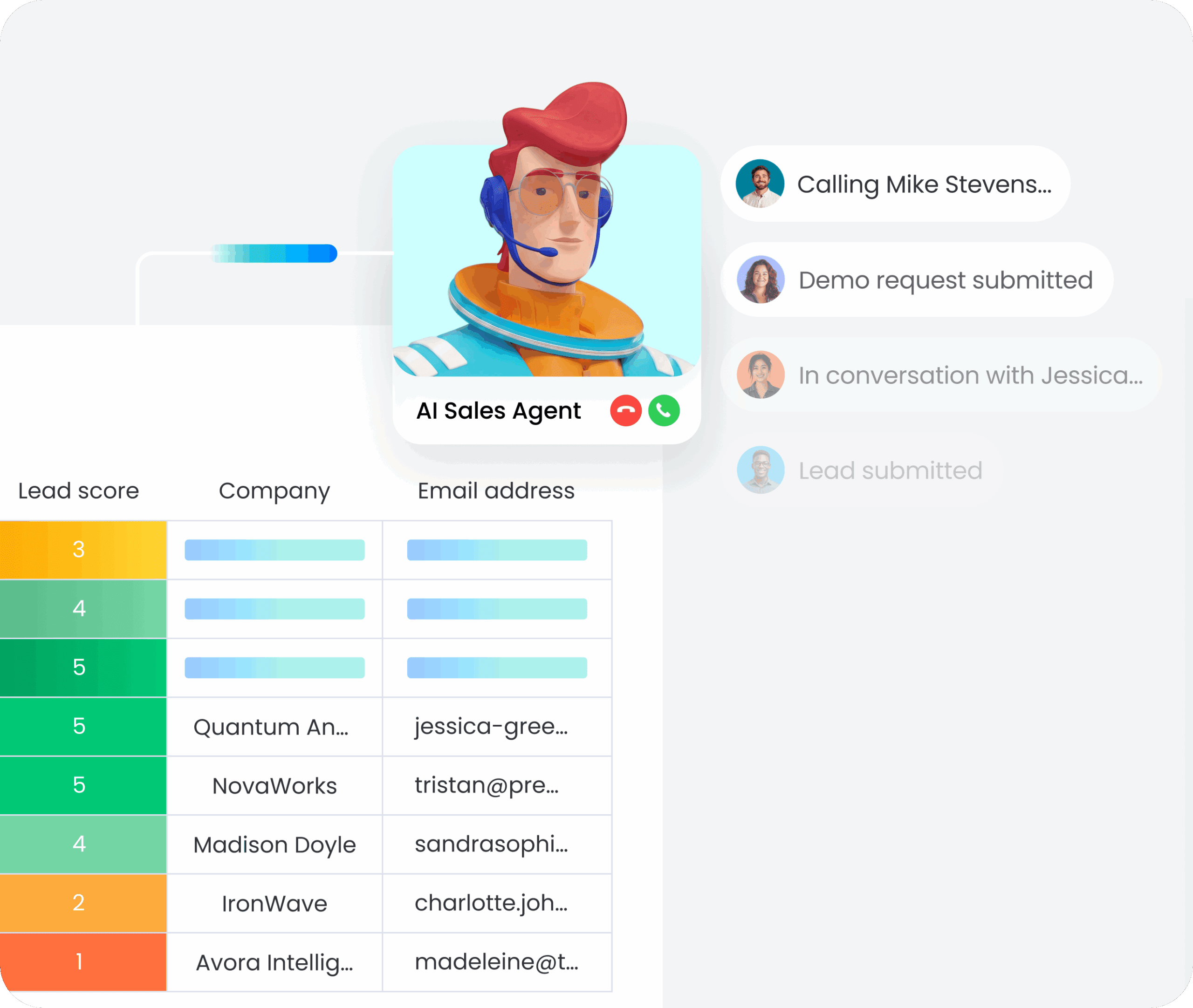
This goes beyond automation. It’s like having an AI crew working 24/7 to optimize your pipeline. These digital team members learn your process and find ways to improve results.
- Sales Advisor: The advisor analyzes performance and gives reps specific, data-backed tips based on what your top performers do to win deals.
- Research Assistant: This assistant enriches new leads with company news, funding alerts, and key intel so reps start conversations with confidence.
- Deal Facilitator: The facilitator spots stalled opportunities and suggests the exact next step to move the conversation forward.
monday CRM’s Digital Workforce adapts to your sales process, learns from your wins, and applies those insights to every new opportunity.
Get smarter AI with a single, unified platform
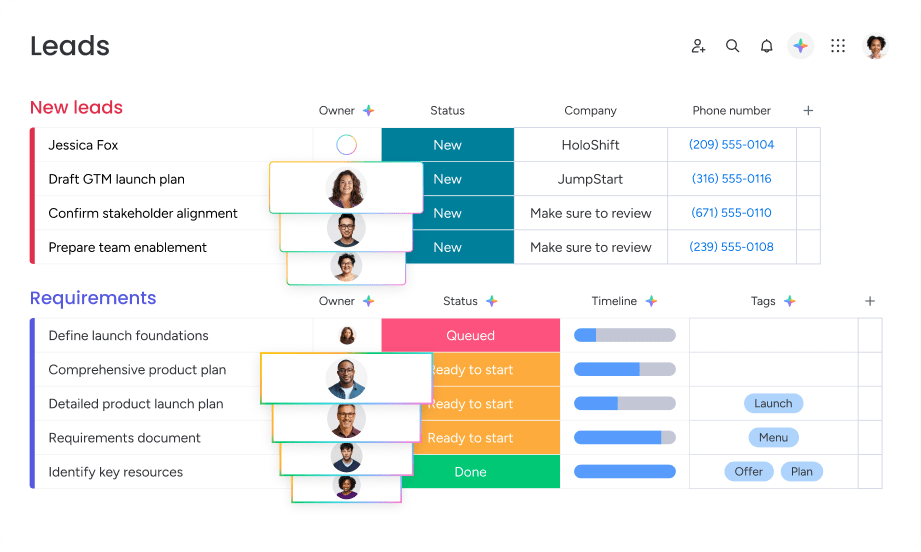
Since monday CRM is part of the monday.com Work OS, your entire revenue operation runs in one place. When everything connects, your AI gets smarter, faster.
- Cross-functional collaboration: Marketing, sales, and success work from the same playbook. Handoffs stay seamless, context never gets lost, and everyone sees the same data.
- Unified reporting: See the full customer story from first ad click to latest renewal. No more stitching reports together to figure out what drives revenue.
- Scalable architecture: As you grow, monday.com grows with you. Add project management, dev, or service tools without switching platforms.
- No integration headaches: Everything works together natively. No broken integrations, data sync errors, or tech debt from a messy stack.
AI that accelerates revenue instead of creating more work. When all your tools and teams are connected, your AI gets smarter and your people get results.
Ready to automate your growth?
AI lead generation gives your team the freedom to focus on what matters: closing deals. Automate the manual work of finding and qualifying leads, and watch your sales cycles speed up. Your team gets more efficient. Your data gets cleaner. Your pipeline fills with prospects who are actually ready to buy.
Start small by cleaning your data and testing a pilot program to see what works for your specific market. As you see results, expand your AI workflows to cover more of the customer journey. The key is choosing a platform that grows with you and makes adoption easy for your reps. monday CRM delivers exactly that: powerful AI your team will actually use, built into workflows that feel natural from day one.
Try monday CRMFAQs
How long does it really take to see ROI from AI lead generation?
Regarding the time it takes to see ROI from AI lead generation, initial lead quality improvements typically appear in 2–4 weeks. Measurable revenue impact usually shows within 60–90 days, assuming your data is clean and set up correctly.
What happens when multiple AI tools conflict in my tech stack?
When multiple AI platforms conflict in your tech stack, it can lead to data inconsistencies and competing automations that confuse prospects. A unified platform avoids this by ensuring all AI features work from a single, reliable source of truth.
Do I need a data scientist to use AI lead generation software?
No. Today's platforms are built for business users with no-code interfaces, so your team can set up workflows without technical expertise.
How do I prevent AI from over-automating and annoying prospects?
Set clear frequency limits on automated messages and use AI for personalization, not just volume. Always keep a human in the loop to review AI-generated content before it goes out.
Can AI lead generation software work without a CRM?
While AI software can work without a CRM, it's far more effective when integrated. A CRM provides the essential historical data and context that AI needs to learn and improve its accuracy over time.
What's the minimum data quality needed for AI to be effective?
You need clean contact data with basic firmographic information like company, industry, and job title. Starting with 500–1,000 high-quality records is usually enough for the AI to begin identifying useful patterns.