


What if your sales team could reclaim valuable time every week and focus entirely on closing deals instead of updating spreadsheets? AI transforms how revenue teams work by automating repetitive tasks, identifying high-value opportunities, and personalizing outreach at scale — all without adding headcount.
This guide walks you through 12 proven AI applications that drive real revenue growth, from predictive lead scoring to autonomous qualification. You’ll discover exactly how each works, what results teams achieve, and how to implement them without technical complexity or massive investment.
Key takeaways
- AI analyzes hundreds of behavioral signals to score leads by conversion likelihood, so your reps spend time on deals most likely to close.
- AI handles data entry, email drafting, and follow-up sequences, giving each rep back valuable hours weekly to focus on actual selling.
- AI-powered forecasting delivers greater accuracy by analyzing objective deal signals rather than relying on rep intuition.
- AI creates genuinely customized emails and content recommendations based on prospect behavior, industry, and engagement patterns.
- A unified CRM with native AI across lead scoring, automated data entry, email assistance, and forecasting like monday CRM eliminates the need for multiple disconnected point solutions.
What is AI for sales?
AI in sales uses machine learning and automation to help teams work faster and make smarter decisions. It spots patterns you’d miss, automates repetitive tasks, and tells you what to do next based on what’s actually worked.
According to Gartner’s The Future of Sales 2030 report, 70% of routine sales tasks will be automated using AI by 2030. Think of AI as an AI sales assistant that never sleeps. It handles the tedious work like data entry and lead scoring while your reps focus on building relationships and closing deals. It looks at hundreds of data points at once to predict which leads will convert, which deals need attention, and what content actually lands with prospects.
AI helps teams prioritize the right opportunities, follow up faster with relevant messaging, and forecast revenue with greater accuracy. Instead of reps spending hours updating CRM records or crafting personalized emails, AI handles these tasks in seconds.
Generative AI versus other AI in sales: Key differences
Knowing the different AI types helps you pick the right platform for your sales process. Each type does something different, and most sales teams get the best results by mixing a few. The table below breaks down the 4 main AI types and their specific sales applications.
| AI model | What it does | Sales application |
|---|---|---|
| Predictive AI | Analyzes patterns to forecast outcomes | Scores leads, predicts deal close probability, flags at-risk opportunities |
| Generative AI | Creates new content based on prompts/data | Writes emails, summarizes call notes, drafts proposals |
| Conversational AI | Analyzes spoken or written conversations | Transcribes calls, identifies coaching moments, tracks competitor mentions |
| Autonomous AI | Executes workflows independently | Qualifies leads 24/7, routes leads, books meetings automatically |
12 AI sales examples that drive revenue today
According to a Forbes survey, the average employee saves up to 5 hours of work per week using AI tools, but saving time is just the start. Here’s a quick look at how AI changes every stage of the sales process — from first contact to renewal — followed by a deep dive into each.
| Example | What it does | Key benefit |
|---|---|---|
| Predictive lead scoring | Ranks leads by conversion likelihood | Focus on prospects most likely to buy |
| Intelligent lead routing | Matches leads to best-fit reps | Higher close rates through expertise alignment |
| Account prioritization | Identifies buying committee activity | Strategic time allocation for complex deals |
| Automated data entry | Captures details without manual input | 5–10 hours saved per rep weekly |
| AI scheduling | Eliminates back-and-forth emails | Faster meeting booking |
| Automated follow-up sequences | Creates personalized multi-touch campaigns | Consistent outreach at scale |
| Personalized email outreach | Generates customized messages | Genuine personalization without manual research |
| Content recommendations | Suggests relevant assets | Right content at every stage |
| Revenue forecasting | Predicts outcomes using deal signals | 85–90% forecast accuracy |
| Conversation intelligence | Analyzes calls for insights | Data-driven coaching at scale |
| AI sales coaching | Provides real-time feedback | Personalized development for every rep |
| AI sales agents for qualification | Engages and qualifies leads autonomously | Instant response to every inquiry |
1. Predictive lead scoring
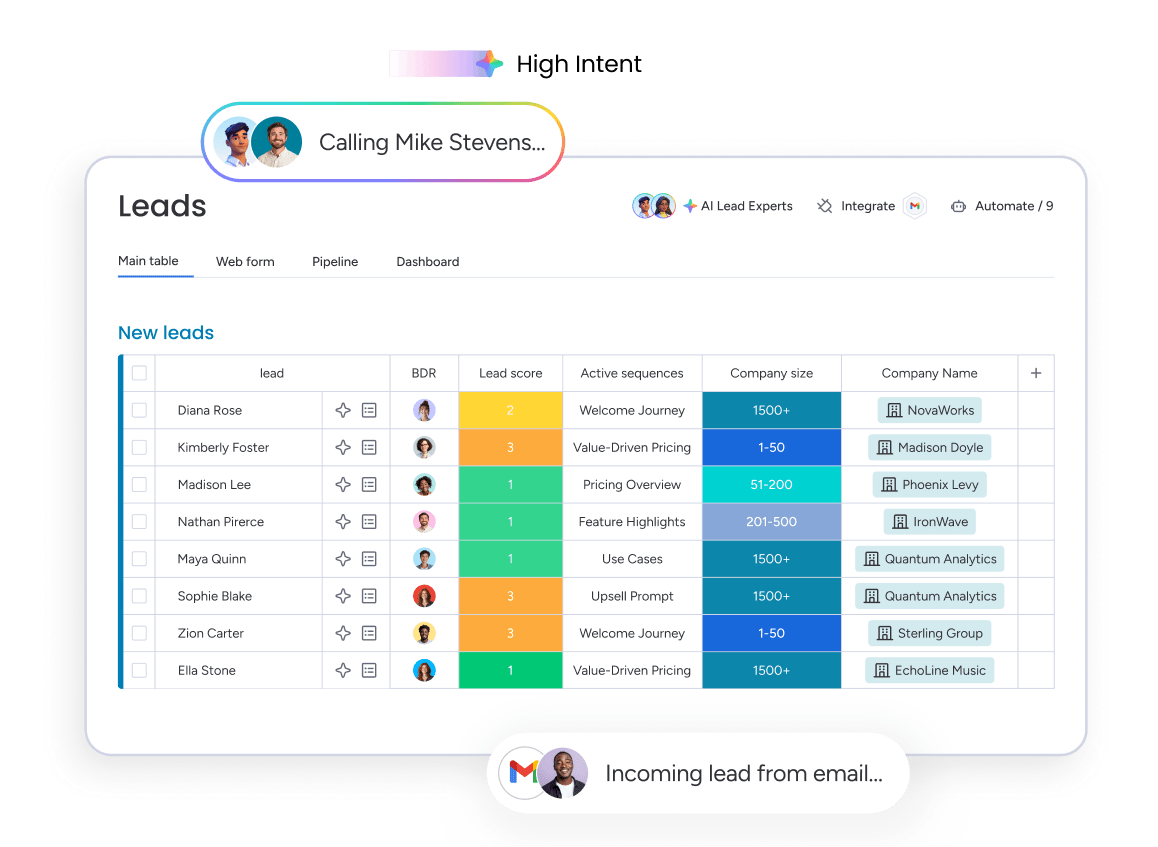
Traditional lead scoring uses basic stuff like job title and company size. AI helps teams qualify sales leads by examining hundreds of behavioral signals to identify genuine buying intent. A lead visiting your pricing page 3 times, downloading a case study, and spending 8 minutes on integration docs? That’s research behavior that leads to purchases.
AI tracks multiple data sources simultaneously:
- Website behavior: Page visits, time spent, content consumed
- Email engagement: Click patterns, response timing, link preferences
- Firmographic fit: Company size, industry, growth trajectory, tech stack
- External signals: Job changes, funding announcements, technology adoptions
You get a prioritized list showing which leads need attention right now. monday CRM supports this through customizable scoring rules and automated workflows that route high-priority leads instantly.
Try monday CRM2. Intelligent lead routing
When a healthcare technology company submits a demo request, AI evaluates which rep has the highest close rate with healthcare accounts, appropriate capacity, and relevant product expertise. The lead gets routed automatically in seconds, not hours.
The matching looks at several things:
- Industry expertise: Routes to reps with proven success in that vertical
- Deal size alignment: Matches enterprise leads to enterprise specialists
- Current workload: Balances distribution to prevent rep overload
- Geographic territory: Respects boundaries while optimizing coverage
- Product specialization: Connects technical buyers with technical reps
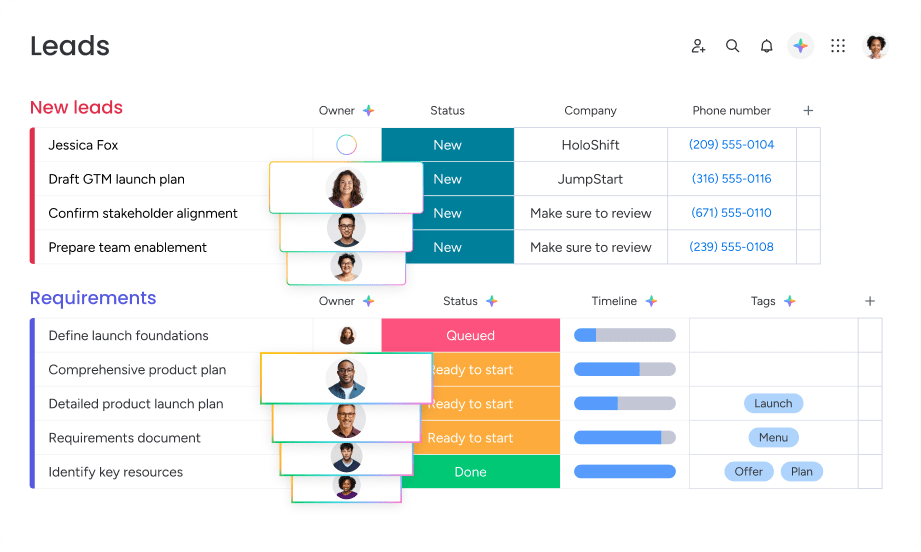
Teams using monday CRM leverage the Assign person AI action to route work based on defined roles and skills. You define each teammate’s expertise, and AI handles the matching automatically.
3. Account prioritization
For account-based selling, AI analyzes entire buying committees rather than individual contacts. When 3 people from the same organization engage with content in one week, AI flags that account as showing collective buying intent.
This keeps you from focusing on one enthusiastic contact while missing what’s happening across the whole account. AI shows you which accounts have multiple people engaged, execs paying attention, and patterns that showed up before past enterprise deals closed.
4. Automated data entry
After every call, email, or meeting, reps usually spend 5-15 minutes logging information. AI captures this automatically — it monitors email threads, analyzes call recordings, and pulls out key details without anyone typing a thing.
AI automatically captures and logs:
- Contact information: Extracts phone numbers, job titles, addresses from email signatures
- Meeting outcomes: Identifies action items, commitments, objections, next steps
- Deal progression: Recognizes stage changes and updates opportunity records
- Follow-up tasks: Creates tasks with deadlines when commitments are made
monday CRM’s Extract information AI action pulls data from files like invoices, resumes, or contracts directly into board columns. Information extraction works with text columns, documents, and images.
5. AI scheduling
The typical scheduling dance wastes hours. AI scheduling eliminates that back-and-forth completely.
Reps send one email containing a scheduling link. Prospects click, see available times in their timezone, and book instantly. Meetings appear on both calendars with automatic confirmations and reminders.
6. Automated follow-up sequences
Most deals require 5-7 touchpoints, yet most reps give up after 2-3 attempts. AI creates customized follow-up sequences that adapt based on prospect behavior.
The sequences change based on what happens:
- Prospect opened but didn’t respond: AI sends a shorter message with a direct question
- Prospect clicked specific feature: Next email references that interest with relevant content
- Prospect went silent after engagement: AI shifts to a pattern-interrupt approach
7. Personalized email outreach
Generic emails get deleted. AI looks at several data sources to create actually customized content in seconds. On monday CRM, the AI email assistant helps compose emails directly from Emails & Activities, using account context to draft relevant messages.
| Element | Generic approach | AI-personalized approach |
|---|---|---|
| Opening line | I hope this email finds you well | Congratulations on your Series B announcement last week |
| Value proposition | Our platform helps sales teams close more deals | As your team scales from 10 to 50 reps, here's how we help maintain forecast accuracy |
| Social proof | Many companies use our solution | Similar SaaS companies in your space achieved 30% faster sales cycles |
| Call-to-action | Let me know if you'd like to learn more | Would a 15-minute call next week make sense given your Q2 expansion timeline? |
8. Content recommendations
As content libraries grow, sales enablement becomes critical because sales teams accumulate dozens of assets, but reps struggle to remember which fits each situation. AI analyzes the prospect’s current stage, industry, role, and expressed interests to recommend relevant content.
When prospects mention implementation concerns during discovery, AI immediately suggests case studies addressing those specific worries.
9. Revenue forecasting
Instead of relying on rep intuition that a deal is “70% likely to close,” predictive sales AI analyzes objective signals from the deal itself. It looks at engagement patterns, who’s involved, how fast the deal’s moving compared to similar wins, and what happened in thousands of past deals.
monday CRM enables this through real-time dashboards and forecast tracking by rep or month. Revenue leaders drill down forecasts by any criteria and track key sales metrics like forecast versus actual sales to improve accuracy over time.
10. Conversation intelligence
Conversational AI transcribes and analyzes every sales call, identifying specific moments where reps excelled or struggled. It flags when reps talk too much, skip qualification questions, fumble objections, or don’t nail down next steps.
monday CRM’s timeline summary with AI creates short summaries of all communication events including emails, calls, meetings, and notes. Sales managers quickly review account history and identify coaching opportunities without listening to every recording.
11. AI sales coaching
AI figures out what separates top performers from average reps by looking at thousands of interactions. For example, AI might uncover that top performers ask about consequences of inaction in 80% of won deals whereas average performers only do it 20% of the time. These insights get shared across the team as standard practices.
This spreads excellence across the team. Best practices don’t stay locked in top performers’ heads. AI extracts and shares them across the entire team.
12. AI agents for lead qualification

AI sales agents handle initial lead qualification and nurturing, acting as tireless SDRs that respond instantly to every inbound inquiry. They send personalized messages, ask discovery questions to see if there’s a fit, figure out if the lead qualifies, and book meetings straight onto rep calendars.
A lead fills out your website form at 11 PM. The AI agent immediately sends a personalized email asking qualifying questions. When the lead responds the next morning, the AI qualifies them as high-priority, sends a calendar link, and notifies the appropriate rep. The rep arrives at the meeting with complete qualification notes.
How AI enhances the sales process
AI transforms sales by fixing inefficiencies at every stage. The impact isn’t just individual productivity — it reshapes how entire revenue organizations work. Here’s how AI improves 4 key areas.
- AI reduces manual work so reps focus on selling. Instead of spending hours on data entry, email drafting, and activity logging, reps invest that time in conversations and relationship building.
- AI improves prioritization so teams work on the right deals. Rather than chasing every lead equally, reps focus on prospects showing genuine buying signals. This targeted approach increases conversion rates and cuts wasted effort on deals that won’t close.
- AI increases forecast accuracy so leaders plan with confidence. AI looks at real deal signals instead of gut feelings, helping revenue leaders make data-backed decisions on headcount, territories, and quotas.
- AI speeds up cross-functional handoffs. When deals require input from legal, finance, or technical teams, AI routes requests to the right people instantly. monday CRM automates these workflows, ensuring nothing stalls due to manual coordination.
How to increase sales with AI prompts
Good prompts speed up the work that actually drives revenue. They help reps research faster, personalize for more people, and keep up consistent follow-up without losing quality.
Prompts that mention specific interactions and data points make reps sound relevant and timely. A prompt like “Reference their comment about Q4 budget planning” creates more engaging outreach than generic templates. That relevance boosts response rates and keeps conversations moving.
You get the best results when you combine prompts with CRM data and workflow automation. When AI can see complete account history, interaction timelines, and deal context, prompts create responses that feel actually personalized. monday CRM centralizes this data, making AI prompts more effective.
The best AI prompts for sales teams
Good AI prompts are specific and include context. The best prompts include the role, task, context, and what format you want back. This precision gets you responses that actually help instead of generic suggestions.
Strong prompt examples that drive results:
- “Summarize this account’s last 10 interactions and flag any concerns about deal momentum”
- “Draft a follow-up email referencing their pricing question from yesterday’s call, emphasizing our implementation timeline”
- “Analyze this opportunity’s engagement pattern and compare to similar won deals in healthcare”
- “Generate 3 subject lines for a re-engagement campaign targeting stalled opportunities”
- “Create a discovery question list for a CFO evaluating sales forecasting solutions”
monday CRM’s AI actions reduce prompt complexity with pre-built workflows. Instead of crafting detailed prompts, teams select from proven templates that already understand sales context.
Try monday CRM AI WorkflowsThe future of AI for sales: Trends and insights

Agentic AI in sales will handle increasing amounts of qualification, research, and administrative work. This shift evolves the sales role, focusing it on what salespeople do best. Reps will need to stand out in sales through strategy, complex problem-solving, and relationship building.
Teams will get smaller and more productive. A 10-person team with comprehensive AI support can cover the same territory as a 15-person team without AI. This efficiency comes from faster response times, consistent follow-up, and cutting out manual tasks.
Success will depend on clean data, clear workflows, and team adoption. AI works best when customer communication lives in one place, CRM data stays current, and someone owns each process. Companies that invest in data quality and clear processes will see the biggest returns.
The technology will reshape roles through human-AI collaboration in sales rather than replace them. Reps will focus on high-touch, strategic activities while AI handles repetitive tasks. This evolution makes work more engaging for salespeople and creates better experiences for buyers.
Why monday CRM delivers comprehensive AI for revenue teams
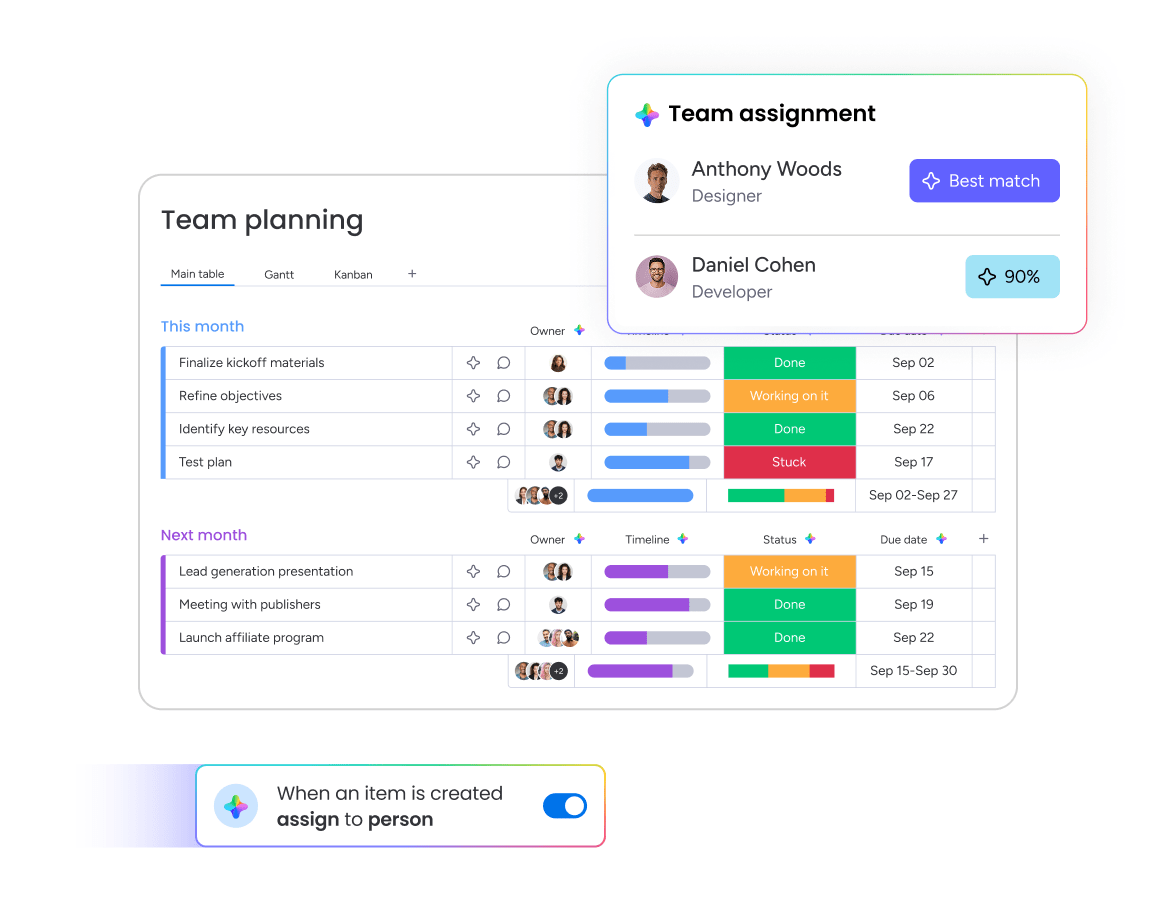
With monday CRM, you get AI natively across lead management, deal tracking, forecasting, and post-sale workflows. This full coverage means you don’t need multiple point solutions that create data silos and integration headaches.
Here’s what sets monday CRM apart for AI-powered sales:
- Native AI integration across the entire platform: AI capabilities work seamlessly within your existing workflows rather than requiring separate tools or context switching
- No-code AI actions you can configure yourself: Sales teams set up AI workflows through visual builders without waiting for IT or technical resources
- Pre-built AI templates for common sales scenarios: Start with proven workflows for lead scoring, email assistance, data extraction, and forecasting instead of building from scratch
- Unified data foundation that makes AI smarter: When all customer interactions, deal history, and communication live in one place, AI recommendations become more accurate and contextual
- Transparent AI governance and controls: Visibility into how AI makes decisions, with controls to adjust scoring criteria, routing rules, and automation triggers based on your business logic
- Scalable pricing that grows with your team: Access AI capabilities without enterprise-only pricing tiers that lock out growing teams
Teams using monday CRM leverage AI across the full revenue lifecycle — from the moment a lead enters the system through renewal and expansion. The platform eliminates the need to stitch together separate tools for prospecting, deal management, forecasting, and customer success.
Start building your AI-powered sales process
AI turns sales teams from reactive to proactive, manual to automated, and guessing to knowing. The technology handles repetitive tasks and amplifies what humans do best — relationship building and strategic thinking.
The most successful implementations start small and scale based on results. Choose one area where your team loses the most time or has the biggest gaps. Implement AI there first, measure the impact, then expand to other areas.
Revenue teams that embrace AI now get a competitive advantage that grows over time. While competitors struggle with manual processes, AI-powered teams move faster, prioritize better, and close more deals with the same resources.
Try monday CRM AI CapabilitiesFAQs
What is an example of AI being used successfully in sales?
An example of AI being used successfully in sales is predictive lead scoring, where AI analyzes website behavior, email engagement, firmographic data, and historical patterns to identify which leads are most likely to convert, enabling reps to focus their time on the highest-probability opportunities.
How does AI help sales teams close more deals?
AI helps sales teams close more deals by automating administrative tasks, improving lead prioritization, personalizing outreach at scale, providing real-time coaching insights, and increasing forecast accuracy so teams can allocate resources more effectively.
What are the main benefits of using AI in sales?
The main benefits of using AI in sales include saving 5-10 hours per rep weekly on manual tasks, improving forecast accuracy, increasing conversion rates through smarter prioritization, enabling consistent follow-up at scale, and scaling outreach without proportionally increasing headcount.
How do I start implementing AI in my sales process?
Start implementing AI in your sales process by identifying where your team loses the most time or has the biggest gaps, choosing one AI application that addresses that specific challenge, implementing it with a small group first, measuring results, and expanding based on what works.
Will AI replace human salespeople?
AI will not replace human salespeople but will significantly change their daily activities, handling repetitive tasks like data entry and initial qualification while humans focus on relationship building, complex negotiation, creative problem-solving, and strategic account planning.

 Get started