

Your customer data is scattered across your CRM, support tickets, marketing platform, and spreadsheets no one wants to admit exist. Traditional customer data platforms promised to fix this by pulling everything into one place. They did, sort of. But then your data just sat there, waiting for someone to make sense of it.An AI customer data platform flips that script. Instead of storing data and hoping someone asks the right question, it finds patterns, predicts behavior, and triggers actions on its own. For revenue teams, that means less time hunting for context and more time closing deals.
This guide breaks down 15 AI customer data platforms built for revenue teams that need results now. You’ll learn what separates AI-powered platforms from traditional CDPs, why legacy systems hold teams back, and a 90-day plan to see real returns. Whether you’re evaluating your first platform or looking for one that delivers, you’ll have a practical framework for turning scattered data into pipeline momentum with tools like monday CRM.
Try monday CRMWhat AI customer data platforms do that traditional CDPs cannot
Traditional CDPs are digital filing cabinets. They collect and organize your customer data, but you still do all the work: building segments, writing rules, and figuring out what it means. An AI customer data platform doesn’t just store information. It thinks, predicts, and acts on it.
While a traditional CDP waits for you to ask the right questions, an AI platform finds insights you didn’t even know to look for.
Autonomous decision-making
AI agents make decisions on their own, without waiting for your approval. A prospect reads three blog posts tracked in their customer journey map. The AI instantly flags them as a hot lead, triggers a follow-up, and alerts the right sales rep. No one had to write a rule for that scenario. The AI learns what works and adapts.
The AI goes deeper than basic triggers:
- Support sensitivity: Does a support ticket sound frustrated? The AI can pause renewal outreach.
- Stakeholder mapping: Did a new person join an email chain? It can automatically add them as a stakeholder in the account.
Revenue teams use monday CRM and CRM automation to turn these signals into action, so reps only get alerts that matter.
Real-time personalization across every channel
AI syncs the experience across every channel, instantly. When a prospect downloads a pricing guide, their next visit to your site changes, the email nurture updates, and their sales rep gets an alert. This all happens in milliseconds, so every touchpoint stays in sync with what the customer cares about right now.
It also knows when to back off. If a customer sends a frustrated support ticket, the AI can pause all marketing emails. The outcome: conversations that feel personal because they actually are.
Zero-copy architecture that cuts costs by 50%
Instead of copying your data over and over, a zero-copy approach analyzes it right where it already lives. It connects directly to your CRM, support desk, and marketing platforms to get the full picture without the mess.
Here’s what that means for your team:
- No sync delays: You stop waiting for data to match up.
- Reduced overhead: You ditch the expensive engineering work it takes to constantly move data around.
For teams managing data across multiple platforms, this can cut storage and engineering costs by up to 50%. This shift lets revenue teams stop babysitting databases and start building relationships.
The advantages of moving beyond legacy systems
Your data’s scattered. Your forecasts are guesswork. And your team spends more time hunting for context than closing deals. Legacy platforms promised to unify everything but just created new silos. Revenue’s slipping away because your tech can’t keep pace.
AI-powered platforms pull scattered data together automatically, surface insights you can act on, and give you forecasts you can trust, so your team actually hits quota.
The real cost of scattered data
Fragmented customer data drags down every part of your revenue org:
- Sales reps: Up to 30% of their week disappears hunting for info across systems.
- Marketing teams: Strategy turns into guesswork. The wrong message hits the right person, burning budget and trust.
- Leadership: Forecast calls turn into wishful thinking. Without the full pipeline picture, you can’t allocate resources with confidence.
Stay compliant without killing personalization
Privacy rules keep tightening. Your old system can’t handle this, so you’re stuck choosing between compliance and the personalized experiences customers want.
AI platforms handle consent automatically and keep data use responsible across every touchpoint. Customers who trust you with their data convert more.
Close the AI gap in your tech stack
Most CRMs were built before AI made sense for sales teams. Their foundations can’t handle unstructured data like call notes or emails, which is exactly where the best insights live.
The right platform makes your existing tools smarter without replacing them. It pulls data from your legacy systems, uses AI to spot opportunities, then feeds insights back into the workflows your team already runs.
15 AI customer data platforms for teams that need to grow now
You don’t need another data platform that overpromises and underdelivers. You need AI that cuts the noise, handles grunt work, and delivers insights your team can use today.
We evaluated the top platforms and skipped the marketing fluff. This list focuses on what revenue teams actually need: AI that decides for you, features built for selling, and setups you can run without a data science team.
See all that “Custom pricing”? That’s usually code for “long, complicated, and expensive.” Platforms with clear pricing are built to get you started fast, without needing a huge budget or a dedicated tech team.
| Platform | Use case | Key AI features | Starting price |
|---|---|---|---|
| monday CRM | Revenue teams needing CRM-native AI CDP | Native AI blocks, unified customer timeline, no-code automation | $12/user/month |
| Salesforce Data Cloud | Enterprise teams with complex Salesforce ecosystems | Einstein AI, Data Cloud Einstein, predictive analytics | Custom pricing |
| Adobe Real-Time CDP | Marketing-heavy organizations with Adobe ecosystem | Adobe Sensei AI, real-time segmentation, journey orchestration | Custom pricing |
| Twilio Segment | Developer-friendly teams needing flexible data routing | Personas AI, predictive traits, real-time compute | $120/month |
| Tealium Customer Data Hub | Privacy-focused enterprises with compliance needs | AudienceStream AI, machine learning predictions | Custom pricing |
| Treasure Data CDP | Data-heavy enterprises needing advanced analytics | Treasure Data AI, predictive scoring, audience intelligence | Custom pricing |
| Hightouch | Reverse ETL and warehouse-native approach | AI-powered sync, predictive audiences, smart campaigns | $300/month |
| BlueConic | Marketing teams focused on first-party data | AI-driven insights, predictive modeling, dynamic content | Custom pricing |
| Bloomreach Engagement | E-commerce and retail revenue teams | AI product recommendations, predictive analytics, smart campaigns | Custom pricing |
| Blueshift | Performance marketing teams needing scale | AI decisioning engine, predictive recommendations, smart delivery | Custom pricing |
| Insider | Digital experience and personalization focus | AI-powered personalization, predictive segmentation, smart recommendations | Custom pricing |
| Amperity | Retail and consumer brands with identity resolution needs | AI identity resolution, predictive CLV, intelligent audiences | Custom pricing |
| ActionIQ | Enterprise marketing teams with complex data needs | AI-powered journey orchestration, predictive analytics, real-time decisioning | Custom pricing |
| The Modern Data Company (DataOS) | Data-first organizations needing infrastructure | AI-powered data fabric, intelligent data discovery, automated governance | Custom pricing |
| Oracle AI Data Platform | Oracle ecosystem enterprises | AI-powered insights, predictive analytics, automated data management | Custom pricing |
1. monday CRM
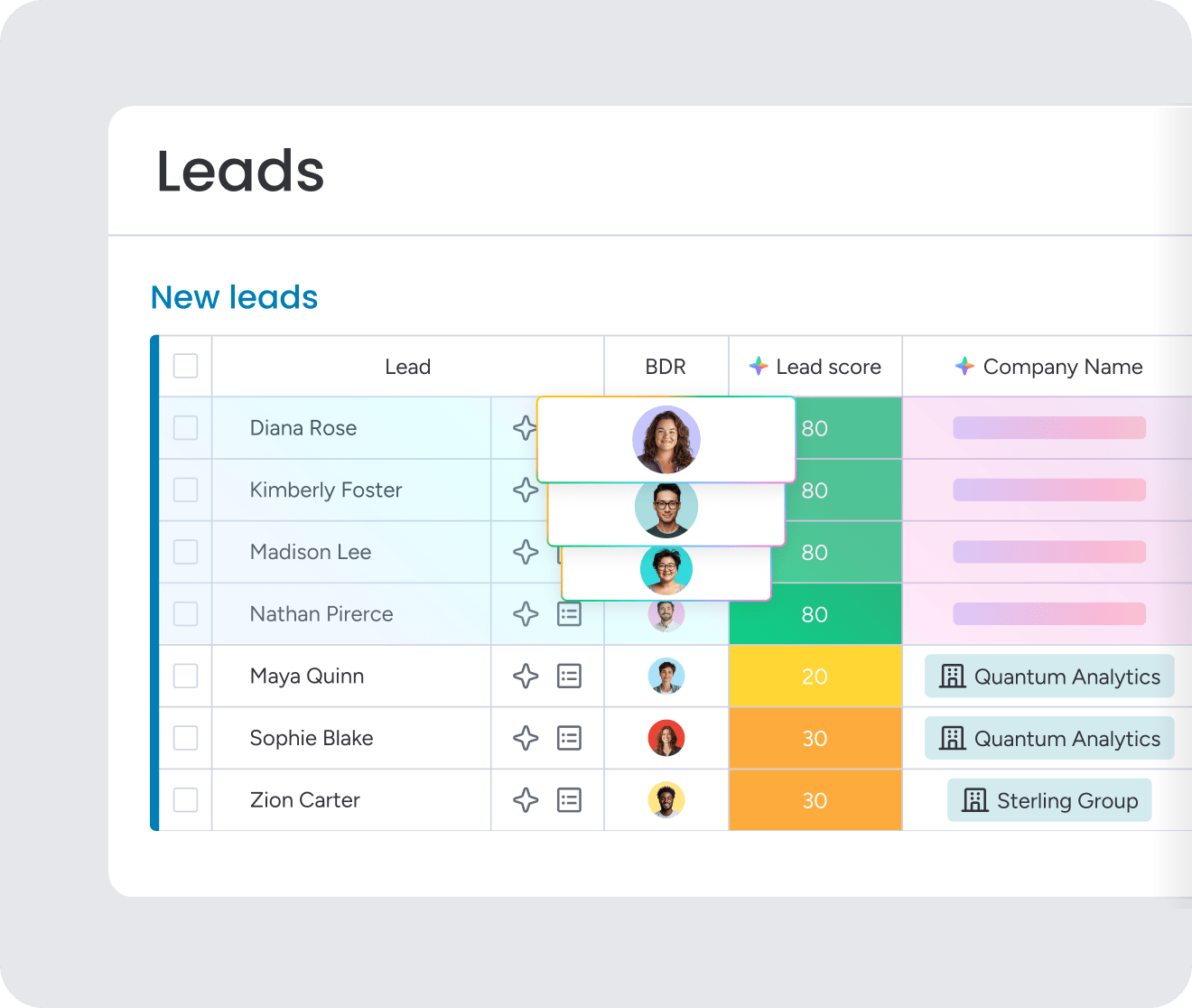
monday CRM turns scattered customer info into one workspace where revenue teams actually run sales. Instead of hunting across tabs and threads, teams track deals, accounts, and contacts in one place, then use built-in AI to summarize history, draft emails, and pull key details into structured fields. When you’re running a data-driven team, small gaps turn into big problems—who said what last week, what did legal approve, what changed in the customer’s requirements? With monday CRM, those answers are within reach, so reps and managers move fast.
Example:
Revenue teams get usable customer context inside the CRM, then let AI handle the parts that usually slow sales down: recapping long histories, drafting outreach, and turning unstructured info into fields your pipeline and reporting can actually use.
A few real examples teams run on monday CRM:
- A rep opens a deal and uses an AI sales assistant with Timeline Summary to recap emails, calls, meetings, and notes before a high-stakes call.
- RevOps takes inbound leads from website forms, auto-enriches lead data using Crunchbase’s database, then assigns and qualifies leads in one workflow.
- An account manager drops a contract or invoice into a board and uses Extract information to pull values into columns instead of typing them in.
Key features:
Before you pick an “AI customer data platform,” it’s worth asking: will your team use it every day, or will it become a fancy database no one updates? monday CRM focuses on features revenue teams already live in.
- Emails & Activities timeline: Log and track emails, meetings, and notes in one timeline, so your team has the history when it matters.
- AI in the flow of work: Use AI to summarize the Emails & Activities timeline, compose emails, and autofill board columns with AI.
- Flexible sales process support: Customize pipelines, move deals through stages, and automate actions based on conditions.
- Lead management that doesn’t drop the ball: Collect, qualify, assign, and follow up on leads, including mass email and tracking.
- Sales analytics and forecasting: Use dashboards and sales widgets, like the leaderboard and sales funnel, to track performance and spot gaps early.
Pricing:
- Starting price: $12/user/month
Why it stands out:
Revenue leaders usually want two things at the same time: tighter control and less admin work. monday CRM supports that without turning your CRM into an IT project.
- AI you can put to work fast: Teams use AI Timeline Summary, AI email composition, and Autofill with AI to cut down on manual updates.
- A CRM that adapts to your process: Drag-and-drop deal stages, custom conditions, and CRM workflows that match how your team sells.
- Works beyond pre-sales: Track onboarding progress, manage renewals, and support post-sales workflows when the deal closes and the real work starts.
Advanced AI features:
AI on monday CRM isn’t a separate module you have to “implement.” It shows up where teams already spend time: in Emails & Activities and in board columns.
- Timeline summarization (AI Timeline Summary): Turns a long trail of emails, calls, meetings, and notes into a short summary.
- Email composition (AI email assistant): Helps reps compose emails directly in Emails & Activities.
- Autofill columns with AI: Apply AI to compatible columns, including Text, Date, Number, Dropdown, People, and Status columns.
Automations:
If you’re putting AI into your CRM, you need control, not mystery. monday CRM gives teams ways to manage and audit AI-driven updates.
- Autofill with AI runs at scale: Once you save an AI-powered column, it applies to existing items and new items on the board.
- Run history for visibility: Team members can review Run history in the Automation Center to see what happened and why.
- Easy governance: You can Deactivate AI on a column when a workflow changes.
Integrations:
monday CRM supports common revenue workflows that depend on connected data, without forcing you into a complicated build.
- Lead enrichment: Auto-enrich lead data using Crunchbase’s database.
- One platform across teams: Because monday CRM is part of a broader product suite, organizations can manage handoffs and downstream work in the same ecosystem.
AI customer data platform features:
If your goal is “AI customer insights,” start with what your team can use daily: a consistent record of interactions, and AI that turns that record into next steps.
- AI Timeline Summary for fast context: Sales and support teams summarize the full communication history in seconds.
- Sentiment you can operationalize: Use Detect sentiment to categorize text as Positive, Negative, or Neutral, then reflect that in a Status or review workflow.
- Structured data from messy inputs: Use Extract information to pull key details from files (including .pdf, .png, .jpg, .jpeg, .webp, .docx, .xlsx, .pptx), images, and text into board columns.
- Consistent routing and categorization: Use Assign label for Status or Dropdown columns, and Assign person in a People column by defining each teammate’s role and skills.
2. Salesforce Data Cloud
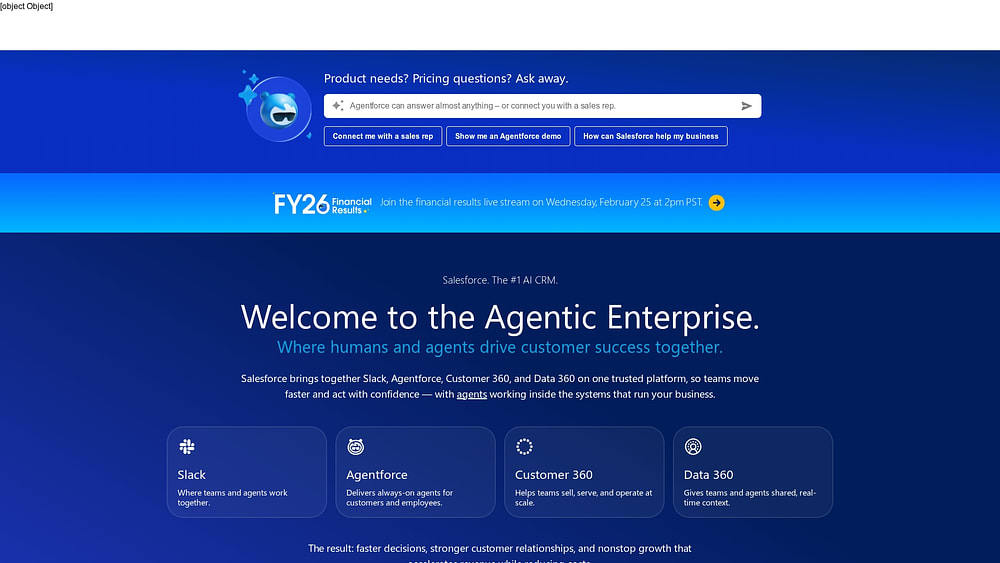
Salesforce Data Cloud delivers enterprise-grade AI customer data capabilities for organizations already invested in the Salesforce ecosystem. The platform excels at unifying customer information across Sales Cloud, Service Cloud, Marketing Cloud, and external systems with Einstein AI integration. It’s built for large enterprises with complex, multi-cloud data scenarios requiring deep customization and governance controls.
Use case:
Large enterprises with existing Salesforce implementations benefit most from Data Cloud’s ability to unify customer data across multiple clouds while maintaining enterprise-grade security and governance controls.
Key features:
- Zero-copy connectivity to external data sources like Snowflake, Databricks, and BigQuery without duplicating sensitive information
- Native vector database to tap into unstructured data for AI grounding and retrieval
- Real-time segmentation to create precise audiences instantly
- Einstein AI integration providing predictive lead scoring, opportunity insights, and customer lifetime value calculations
Pricing:
- Data 360 credits: $500 per 100,000 credits
- Storage: Priced per TB with additional costs for premium features
- Agentforce Foundations: $0 (includes 200k Flex Credits and 250k Data 360 credits)
- Flex Credits: $500 per 100,000 credits for AI and automation features
Considerations:
- Implementation complexity requires dedicated Salesforce expertise and data engineering resources to configure properly
- Pricing typically starts in six figures annually for meaningful enterprise deployments, making it cost-prohibitive for mid-market teams
3. Adobe Real-Time CDP
Adobe Real-Time CDP is an enterprise-grade platform built for marketing-heavy organizations that need to unify customer data and deliver real-time personalization. It uses Adobe Sensei AI to analyze customer behavior and adjust experiences on the fly. Since it’s part of the Adobe Experience Cloud—a suite used by 85% of Fortune 100 companies—it’s a natural fit for teams already deep in the Adobe ecosystem.

Use case:
Perfect for large enterprises with existing Adobe Experience Cloud investments who need sophisticated real-time personalization across web, mobile, and advertising channels.
Key features:
- Real-time profile unification: Stitches together customer data from multiple sources, processing signals in milliseconds to keep profiles fresh.
- AI-powered segmentation: Build and optimize segments using natural language with Audience Agent, and tap into Customer AI for predictive insights and propensity scores.
- Omnichannel activation: Native integrations across Adobe’s Experience Cloud enable seamless campaign orchestration and journey optimization.
Pricing:
- B2C Edition: Quote-based pricing with Prime and Ultimate packages
- B2B Edition: Custom pricing based on licensed profile volume and package level
- B2P Edition: Hybrid B2C/B2B pricing for complex business models
- Add-ons: Additional costs for Customer AI insights, API calls, sandboxes, and streaming segmentation capacity
Considerations:
- Requires significant Adobe consultant involvement for implementation and ongoing management
- Complex pricing structure with multiple add-ons can increase total cost of ownership for high-scale AI usage
4. Twilio Segment
Twilio Segment delivers developer-friendly customer data infrastructure that collects information from any source and routes it anywhere you need. The platform excels at flexible data architecture, making it the go-to choice for technical teams building custom integrations. With AI-powered features like Personas AI and predictive modeling, Segment transforms raw customer data into actionable insights.
Use case:
Technical teams with developer resources who need flexible data collection, routing, and custom data architectures benefit from Segment’s API-first approach and extensive destination catalog.
Key features:
- Real-time data collection and routing: Gather customer data from web, mobile, and server-side applications using consistent APIs, then route it to any destination with sophisticated workflow rules.
- AI-powered customer insights: Leverage Predictions for churn likelihood and LTV modeling, Recommendations for personalized product suggestions, and Generative Audiences for natural-language audience creation.
- Warehouse-native activation: Reduce data duplication by activating data where it lives with zero-copy architecture, and use Reverse ETL to sync warehouse data to your other tools.
Pricing:
- Free: 1,000 visitors/month, 2 sources, 700+ integrations, 1 warehouse destination
- Team: Starts at $120/month for 10,000 visitors, +$10 per additional 1,000 visitors, unlimited sources, 1,000,000 Reverse ETL records
- Business: Custom pricing with advanced governance, HIPAA eligibility, EU/US regional infrastructure
- Customer Data Platform (CDP): Quote-only pricing with AI features included
Considerations:
- Implementation requires significant technical expertise that many mid-market revenue teams lack, creating a barrier for business users who need quick deployment.
- Teams must build their own analytics and activation workflows on top of Segment’s infrastructure, contrasting with platforms that offer pre-built revenue team workflows.
5. Tealium Customer Data Hub
Tealium Customer Data Hub is built for real-time, privacy-first data management. It nails consent-aware governance and hits sub-100ms activation speeds—perfect for enterprise teams juggling complex compliance rules across the globe.
Use case:
For enterprises that can’t afford to get privacy wrong. You get real-time AI activation without compromising on data governance or consent.
Key features:
- Real-time data orchestration hitting sub-100ms latency for your AI models and feature stores
- A privacy-first design with tight consent management, automated compliance, and audit trails that keep regulators happy
- Plays nice with others. Connect to 1,300+ tools with prebuilt connectors and an open design that fits right into your AI stack.
Pricing:
- Enterprise pricing: Quote-based with annual contracts starting around $150,000
- Usage-based overages: Additional charges apply beyond contracted volumes
- Premium add-ons: Predict ML and enhanced support packages available
- AWS Marketplace: Contract and installment payment options available
Considerations:
- This is an enterprise tool, and it feels like one. Expect significant setup and a dedicated team to manage its privacy and compliance power.
- Tealium isn’t an all-in-one AI modeling shop. It offers built-in predictive features (like its Predict ML add-on), but for custom or advanced AI work, you’ll need to connect your own models and platforms.
6. Treasure Data CDP
Treasure Data CDP delivers enterprise-grade customer data unification with AI-powered analytics for complex data environments. The platform specializes in handling massive data volumes while providing advanced AI capabilities through its Agent Foundry, making it ideal for global enterprises with sophisticated data science requirements. Their hybrid architecture approach lets organizations run as a packaged CDP or integrate with existing cloud data warehouses.
Use case:
Data-intensive enterprises requiring advanced analytics capabilities and organizations with dedicated data science teams who need to build custom models and analyses on unified customer data benefit from the platform’s computational power and analytical flexibility.
Key features:
- AI Agent Foundry: Build and orchestrate custom AI agents with no-code/low-code tools, multi-agent workflows, and direct access to unified customer profiles
- Diamond Record identity resolution: Persistent, real-time customer ID system that unifies identity across channels and powers AI decisioning with embeddable capabilities
- Hybrid CDP architecture: Choose between Complete Mode (packaged CDP) or Composable Mode (sits atop existing cloud data warehouse) with “No Compute” pricing that decouples costs from processing resources
Pricing:
- Intelligent CDP: Annual subscription based on Profiles + Behaviors (P+B) units with tiered pricing structure
- AI Marketing Cloud: Fixed annual suite licenses plus consumption-based “AI Suite Credits” for real-time features
- Trade-Up Program: Incentive pricing available for organizations switching from legacy CDPs, ESPs, or CEPs
- Specific pricing requires custom quotes with 8-12 week typical implementation timeline
Considerations:
- Technical complexity and resource requirements position this as an enterprise solution requiring data engineering expertise and dedicated technical resources for ongoing management
- AI Foundry requires data to reside within Treasure Data to be accessible, and current Foundry Workspace supports limited agent types compared to the full platform capabilities
7. Hightouch
Hightouch pioneered the reverse ETL approach, activating customer data directly from cloud warehouses without duplicating it into separate systems. The platform targets organizations with existing data warehouse investments, using AI to optimize sync timing and predict audience characteristics for teams who want warehouse-native activation.
Use case:
Organizations with mature data infrastructure who need to activate warehouse data across business tools without building custom integrations benefit from Hightouch’s zero-copy architecture.
Key features:
- AI-powered sync optimization that intelligently schedules data updates based on usage patterns and business requirements
- Predictive audience segmentation using machine learning to identify high-value customer segments directly in the warehouse
- Smart campaign automation that adjusts targeting and messaging based on real-time warehouse data
Pricing:
- Free/Basic Reverse ETL: Up to 2 active syncs with hourly frequency
- Self-serve: 10 active syncs with 100M operations/month cap
- Business/Enterprise: Usage-based pricing (contact for quote)
Considerations:
- Requires organizations to maintain their own data warehouse infrastructure and build data models before activation
- Enterprise pricing lacks transparency with quote-only structure for advanced features
8. BlueConic
BlueConic transforms first-party data into personalized customer experiences that drive real growth. The platform specializes in capturing data directly from owned channels and activating it through AI-powered personalization, making it perfect for marketing teams building direct customer relationships. With native interactive experiences and predictive modeling, BlueConic goes beyond traditional customer data platforms to deliver execution where it matters most.
Use case:
Marketing teams prioritizing first-party data strategies and organizations moving away from third-party cookies benefit from BlueConic’s comprehensive data collection and real-time activation capabilities.
Key features:
- AI-powered personalization: Bedrock-powered generative AI assistants create on-site experiences through simple prompts, while predictive modeling identifies high-value customer segments.
- Interactive data collection: Capture zero-party data with quizzes, surveys, and guided journeys (powered by its Jebbit integration) right inside your personalization workflow.
- Real-time agent access: AI agents get governed access to live customer data to run automated insights, audits, and anomaly detection. (Heads up: Some agentic features are in public preview or coming soon.)
Pricing:
- Contact for quote: Pricing requires direct sales engagement with no publicly available tiers.
Considerations:
- Marketing-focused platform lacks revenue team workflows and sales-specific features that comprehensive platforms provide.
- Implementation requires marketing operations expertise and dedicated technical resources rather than plug-and-play simplicity.
9. Bloomreach Engagement
Bloomreach Engagement uses AI to connect customer data with personalization, giving revenue teams the tools to drive sales. It’s built for any organization with an e-commerce heart—whether in retail, finance, or hospitality. The platform shines at product recommendations, predictive analytics for shopping behavior, and smart campaign orchestration.
Use case:
Organizations with a strong e-commerce focus—including retail, travel, and finance—benefit most from its product recommendation engines and shopping behavior predictions.
Key features:
- AI content blocks drag directly into email builders, generating on-brand copy with centralized tone-of-voice controls
- Real-time product recommendations analyze browsing patterns, purchase history, and customer behavior to suggest relevant products
- Predictive analytics identify customers likely to make purchases, abandon carts, or respond to specific promotions
Pricing:
- Quote-based pricing: Module and usage-based fees with tiered pricing that decreases at higher volumes
- Premium AI features: Loomi AI capabilities split between Standard and Premium tiers with separate add-on costs for features like Predictions
- Annual subscriptions: Standard billing with better rates available for longer-term agreements
Considerations:
- Industry-specific focus makes it powerful for retail and e-commerce but less relevant for B2B revenue teams or service-based organizations
- Implementation requires e-commerce expertise and integration with product catalogs and inventory systems
10. Blueshift
Blueshift delivers AI-powered customer engagement through a unified CDP and cross-channel orchestration platform. The platform specializes in real-time decisioning across millions of customer interactions, making it ideal for performance marketing teams managing large-scale campaigns. Their “Customer AI” combines predictive, generative, and agentic intelligence to optimize messaging, timing, and channel selection automatically.
Use case:
Performance marketing teams running high-volume campaigns benefit from Blueshift’s AI decisioning engine that continuously tests and learns which messages, offers, and channels drive the best results for different customer segments.
Key features:
- AI-powered recommendation blocks with drag-and-drop configuration through Recommendations Studio
- Real-time decisioning engine that optimizes messaging, timing, and channel selection across millions of interactions
- Cross-channel orchestration with unified customer profiles and predictive optimization capabilities
Pricing:
- Free Trial: $0/month for the CDP Starter Pack (capped at 10k profiles and 100k events/month)
- Growth (CDP): Starts at $750/month (billed annually) for 1:1 recommendations and A/B testing
- Growth (CEP): Starts at $1,250/month (billed annually) to add multi-channel orchestration
- Enterprise: Custom pricing for advanced AI features and governance
Considerations:
- Requires significant marketing operations expertise to configure and manage effectively
- Complex platform better suited for large-scale operations rather than mid-market teams seeking straightforward customer data unification
11. Insider
Insider delivers AI-powered customer experience personalization across web, mobile, and messaging channels. The platform specializes in real-time content adaptation and cross-channel orchestration, making it a solid choice for digital-first organizations with heavy web and mobile traffic. Its AI engine automatically adjusts website layouts, product displays, and messaging based on individual customer behavior and predicted intent.
Use case:
Enterprise marketing and CX teams who need unified data and advanced personalization across every digital touchpoint find Insider’s capabilities particularly valuable.
Key features:
- Sirius AI-powered content blocks that generate and optimize email copy, app push notifications, and visual assets directly within campaign builders
- Real-time personalization engine that adapts website experiences, mobile app interfaces, and messaging based on customer behavior patterns
- Predictive segmentation that identifies micro-audiences and delivers targeted content recommendations across 12+ channels, including web, email, SMS, and WhatsApp
Pricing:
- Custom pricing: Quote-only pricing based on channels, monthly active users, features, and services required
- Average contract value: Approximately $48,000 annually, according to third-party procurement benchmarks
- Enterprise-level investment: Some implementations reach six-figure annual contracts depending on scope
- ROI timeline: Median 7-month return on investment reported by users
- Implementation: Median 3-month setup time, according to user reviews
Considerations:
- Implementation complexity requires dedicated digital experience teams and ongoing optimization by experienced marketers.
- Enterprise-level pricing may not align with smaller organizations’ budgets or technical resources.
12. Amperity
Amperity delivers AI-powered identity resolution for retail and consumer brands drowning in fragmented customer data. The platform excels at connecting online and offline customer touchpoints, creating unified profiles even when data quality is messy or incomplete.
Use case:
Enterprise retail and consumer brands with complex identity resolution challenges who need to unify customer records across multiple channels and systems.
Key features:
- Patented AI identity resolution: Uses machine learning to match customer records across systems, even when names, emails, or addresses don’t match exactly
- Predictive customer lifetime value: Automatically calculates CLV to help prioritize high-value customers and optimize resource allocation
- Zero-copy data sharing: Connects with Databricks, Snowflake, and BigQuery without moving data, reducing ETL complexity and maintaining security
Pricing:
- Standard: Usage-based pricing measured in “Amps” with complete platform access including data ingestion, identity resolution, Customer 360, predictive modeling, and orchestrations
- Enterprise: Includes all Standard features plus 24/7 support coverage, enhanced SLAs, priority ticketing, and private training sessions
- Pricing is quote-only through sales contact
- No add-ons or hidden fees within the usage-based model
- Up to 10% unused Amps can roll over to future terms
Considerations:
- Requires substantial historical data (4+ years, 100k+ transactions annually) for predictive models to function effectively
- Enterprise-focused pricing and implementation complexity make it less suitable for mid-market organizations with simpler identity resolution needs
13. ActionIQ
ActionIQ delivers enterprise marketing orchestration with AI-powered journey capabilities and sophisticated data handling. The platform excels at managing complex, multi-touch marketing campaigns that adapt based on customer behavior and AI predictions, making it ideal for large organizations running sophisticated campaigns across multiple channels and touchpoints.
Use case:
Enterprise marketing teams with complex journey orchestration needs benefit from ActionIQ’s advanced orchestration and data processing capabilities for sophisticated, multi-channel campaigns.
Key features:
- AI-powered journey orchestration automatically adjusts campaign flows based on customer behavior and predicted outcomes
- Predictive analytics identify the optimal next action for each customer in complex, multi-step journeys
- Real-time decisioning enables immediate campaign adjustments based on current customer context
Pricing:
- Enterprise packages: Quote-only pricing with custom contracts
- CXHub POC: $150,000 for one month (AWS Marketplace reference)
- Additional costs: Cloud infrastructure costs may apply
- Professional services: Implementation and partner services typically required
Considerations:
- Enterprise focus and resource requirements make ActionIQ inaccessible for mid-market teams
- The platform requires dedicated marketing operations resources and significant implementation effort
14. The Modern Data Company (DataOS)
DataOS transforms enterprise data into AI-ready assets through governed data products and intelligent automation. The platform specializes in creating unified data fabrics across complex enterprise landscapes, making it ideal for data-intensive organizations with sophisticated governance requirements.
Use case:
DataOS serves enterprises needing AI-powered data infrastructure with automated governance capabilities across multiple data sources and complex data landscapes.
Key features:
- AI-powered data fabric that automatically discovers and catalogs data across enterprise systems
- Intelligent data discovery using machine learning to identify dataset relationships and suggest relevant data
- Automated governance with policy-as-code primitives and attribute-based access controls
Pricing:
- Try DataOS, Free: Guided trial and POC experience to connect data and test use cases
- Pay-as-you-go: Usage-based pricing model (contact for rates)
- Enterprise: Annual subscription with unlimited usage and functionality (contact for pricing)
Considerations:
- Technical complexity requires significant data engineering expertise to implement and manage effectively
- Limited public third-party reviews make external benchmarking challenging for potential buyers
15. Oracle AI Data Platform
Oracle AI Data Platform delivers enterprise-grade AI capabilities for organizations already invested in Oracle’s ecosystem. The platform combines predictive analytics, automated insights, and unified data management across Oracle Cloud applications, making it ideal for large enterprises seeking integrated AI solutions.
Use case:
Oracle ecosystem enterprises with significant existing Oracle investments benefit from native integration with Oracle applications and infrastructure.
Key features:
- Unified catalog with medallion architecture (bronze, silver, gold) supporting open table formats like Apache Iceberg and Delta Lake
- AI Data Platform Workbench with collaborative notebooks, visual workflow orchestration, and integrated compute clusters
- Pairs with Oracle AI Database 26ai for advanced capabilities like quantum-resistant security and included AI Vector Search
Pricing:
- Free tier: Oracle Cloud Free Tier with $300 trial credits (30 days) plus Always Free services
- Pay-as-you-go: Standard list pricing with enterprise support included in base OCI fees
- Committed use: Universal Credits and Monthly Flex options with volume discounts
- AI Data Platform Workbench: 230 AIDP Units/hour for default Master Catalog cluster (~$0.230/hour)
- GPU clusters: 4,110 AIDP Units/hour per GPU
- Additional costs for object storage, logging, metrics, and databases billed separately
Considerations:
- Oracle dependency limits applicability for organizations without existing Oracle investments and requires Oracle expertise for optimal implementation
- Implementation complexity and ecosystem lock-in make it less practical for revenue teams seeking standalone capabilities or platform-agnostic solutions
The CDP dilemma: warehouse-native vs. traditional
Your customer data has to live somewhere. The big debate is whether to keep it in your cloud warehouse or move it to a separate customer data platform (CDP). Both paths are paved with engineering overhead, surprise bills, and slow progress.
But what if the choice itself is the problem? Revenue teams just need reliable data to hit their targets, not another massive IT project. The difference between these approaches directly impacts your team’s budget, speed, and ability to get work done.
| Factor | Warehouse-native | Traditional CDP | monday CRM approach |
|---|---|---|---|
| Infrastructure cost | Requires separate data warehouse | Included in CDP pricing | Zero extra infrastructure costs |
| Implementation time | 3–6 months | 1–3 months | Go live in days, not months |
| Technical resources | Requires dedicated data engineers | Marketing ops with some support | Your RevOps team can own it |
| Data freshness | Depends on warehouse syncs | Real-time processing | Instantly updated data |
| Scaling costs | Warehouse costs increase with use | Pricing scales with profiles | Simple pricing that scales with you |
What’s the real cost?
Warehouse-native sounds simple, but you’re paying twice: once for the warehouse and again for the CDP layer on top. Traditional CDPs hide storage costs in their fees, but then you’re stuck paying engineers to build and fix all the connections. monday CRM takes a different approach: your data, AI tools, and automations live in one place with simple per-user pricing. No surprise infrastructure bills or hidden integration fees, just one predictable cost.
How fast can you get results?
Getting value from a warehouse-native CDP can take over six months of data modeling and engineering work before your team sees anything. Traditional CDPs are faster but still require multi-month projects bogged down by vendor timelines and technical hurdles. monday CRM’s pre-built templates for revenue teams let you launch your first workflow and see value in days, not quarters.
Can it grow with your team?
Scaling either traditional approach is painful. Warehouse-native systems bring unpredictable costs as your team uses more data, while traditional CDPs lock you into expensive new tiers or complex re-implementations. monday CRM eliminates that friction with simple user additions and workflow expansion that doesn’t require engineers or new contracts, letting you focus on revenue instead of infrastructure maintenance.
5 data quality foundations before you deploy an AI CDP
Your new AI platform is only as smart as the data you give it. Bad data turns expensive AI into a glorified guessing game, frustrating your team and annoying your customers. These five steps are your playbook for making sure your AI investment actually pays off.
Step 1: Run a full data audit
You can’t fix what you don’t know is broken. A data audit gives you a brutally honest look at what you’re working with across every system. Examine your data’s health by checking for completeness (are key fields filled out?), accuracy (valid emails and phone numbers?), and consistency (does the same customer look the same everywhere?).
Step 2: Clean up your contact list
Duplicate records create fragmented account views and obscure the full picture of your customer relationships. Most CRMs have tools to help you find and merge duplicates. A clean, single source of truth is the only way your AI can deliver truly accurate insights.
Step 3: Standardize how you track events
When one system tracks an action as “form_submission” and another calls it “form-fill,” your AI gets confused. Create a single, consistent naming system for every event you track, from website visits to email clicks. This ensures your AI can connect the dots and understand what’s really happening.
Step 4: Get your consent signals in order
Without a clear handle on customer consent, you risk breaking trust and violating privacy regulations. Centralize your consent information in one place that all your platforms can reference. This ensures your automations stay on the right side of the law.
Step 5: Make your systems talk to each other
When a sales rep updates a contact in the CRM, that change needs to show up everywhere, instantly. Set up automated checks to make sure your tech stack stays in sync. This ongoing process keeps your data reliable and your AI recommendations sharp.
With these foundations in place, you’re ready to deploy AI that actually works.
Try monday CRMA 90-day plan for AI CDP results
Forget the 18-month tech projects that promise the world and deliver nothing. Most CDP rollouts are slow, expensive, and show zero results for way too long. Your pipeline can’t wait for perfect.
This plan gets your AI CDP working and proving its worth in 90 days. Ready to see a real return on your investment?
| Phase | Timeline | Focus | Key actions |
|---|---|---|---|
| Launch pilot | Days 1-30 | Prove value with one high-impact use case | Pick a visible pain point (automated lead scoring, email personalization, or churn prediction). Track specific metrics to show results. |
| Expand wins | Days 31-60 | Build on what worked | Identify adjacent problems and tackle related challenges. Use cleaner data and team familiarity to move faster. |
| Get buy-in | Days 61-75 | Show each team what's in it for them | Frame wins around what each team cares about: pipeline growth for sales, engagement for marketing, retention for CS, low maintenance for IT. |
| Measure impact | Days 76-90 | Track what matters at three levels | Monitor technical health (data quality, model accuracy), business outcomes (pipeline velocity, win rates), and user adoption (active users, feature usage). |
How monday CRM delivers AI customer insights, without the complexity
Most teams face a bad choice: stick with a basic CRM that tells you nothing, or start a massive CDP project that eats your budget and calendar. We think that’s a ridiculous choice. You shouldn’t need a data science degree to understand your customers.
monday CRM builds customer data platform smarts directly into the workspace your team already uses. No messy integrations, no data Frankenstein. Just one platform where your deals, customer data, and AI-powered insights live together in a single, unified timeline.
This gives your team the full story so you can get insights that actually help you win. According to a survey of monday CRM customers, revenue teams spend 40% less time searching for customer information and see a 25% faster deal velocity. It’s the outcome of an integrated platform, not a complex project.
| Capability | monday CRM | Traditional CDP + CRM |
|---|---|---|
| Implementation | Configure templates in days | Custom project over months |
| User training | Minimal, it's a familiar interface | Extensive, it's a whole new system |
| Data sync | None, data is unified | Constant, creating lags and errors |
| AI management | Handled by the platform | Requires a data science team |
| Total cost (50 users) | $450 – $800/month | $3,000 – $8,000/month |
AI blocks for instant intelligence
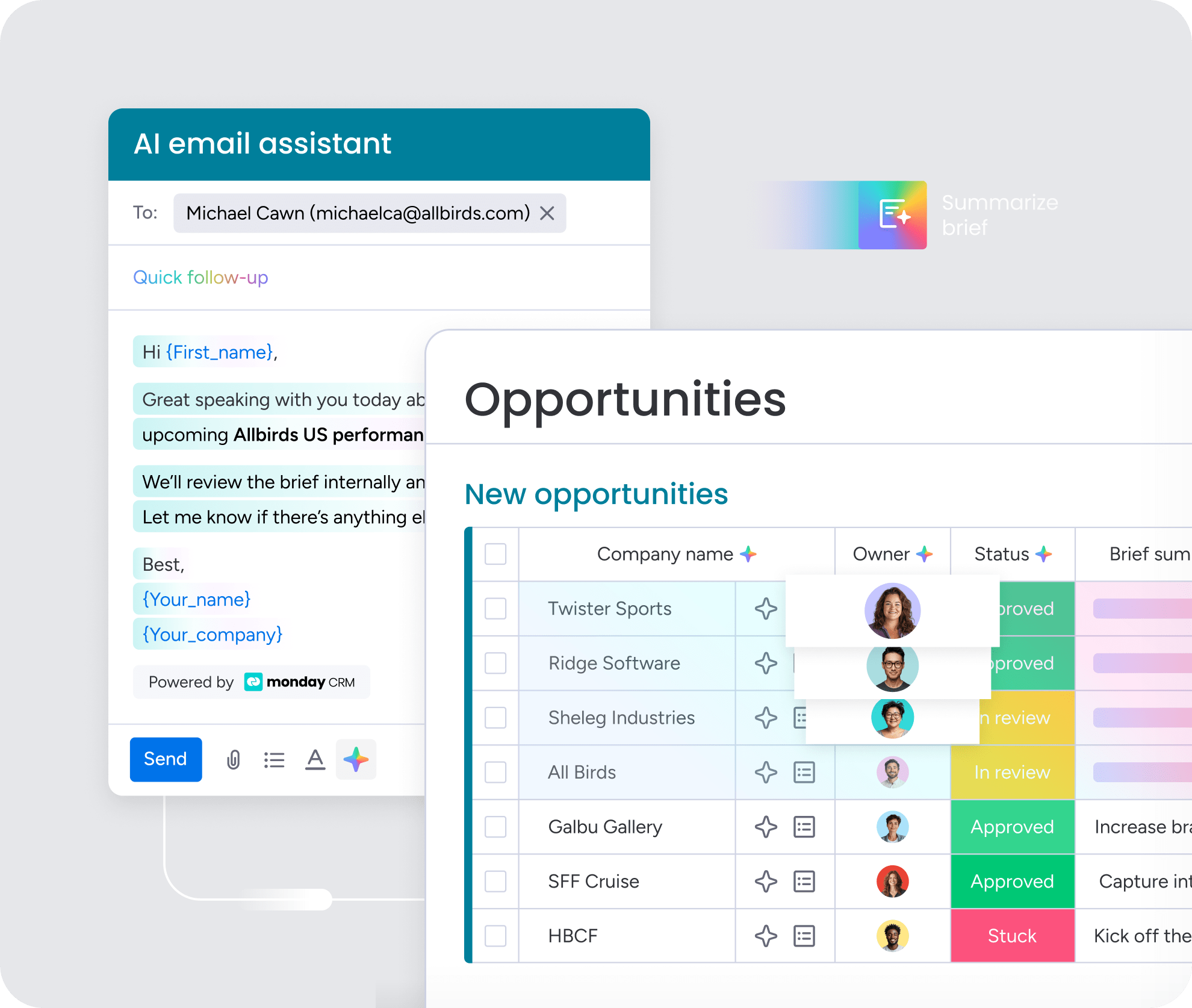
AI blocks are like superpowers for your workflows. No code needed. Just add them to summarize long conversations, pull key details from documents, or check the vibe on customer emails before you hit send. A rep clicks a button before a call and gets a perfect summary of the entire relationship, or an email with prospect requirements automatically fills out the deal fields.
Unified revenue data without duplication
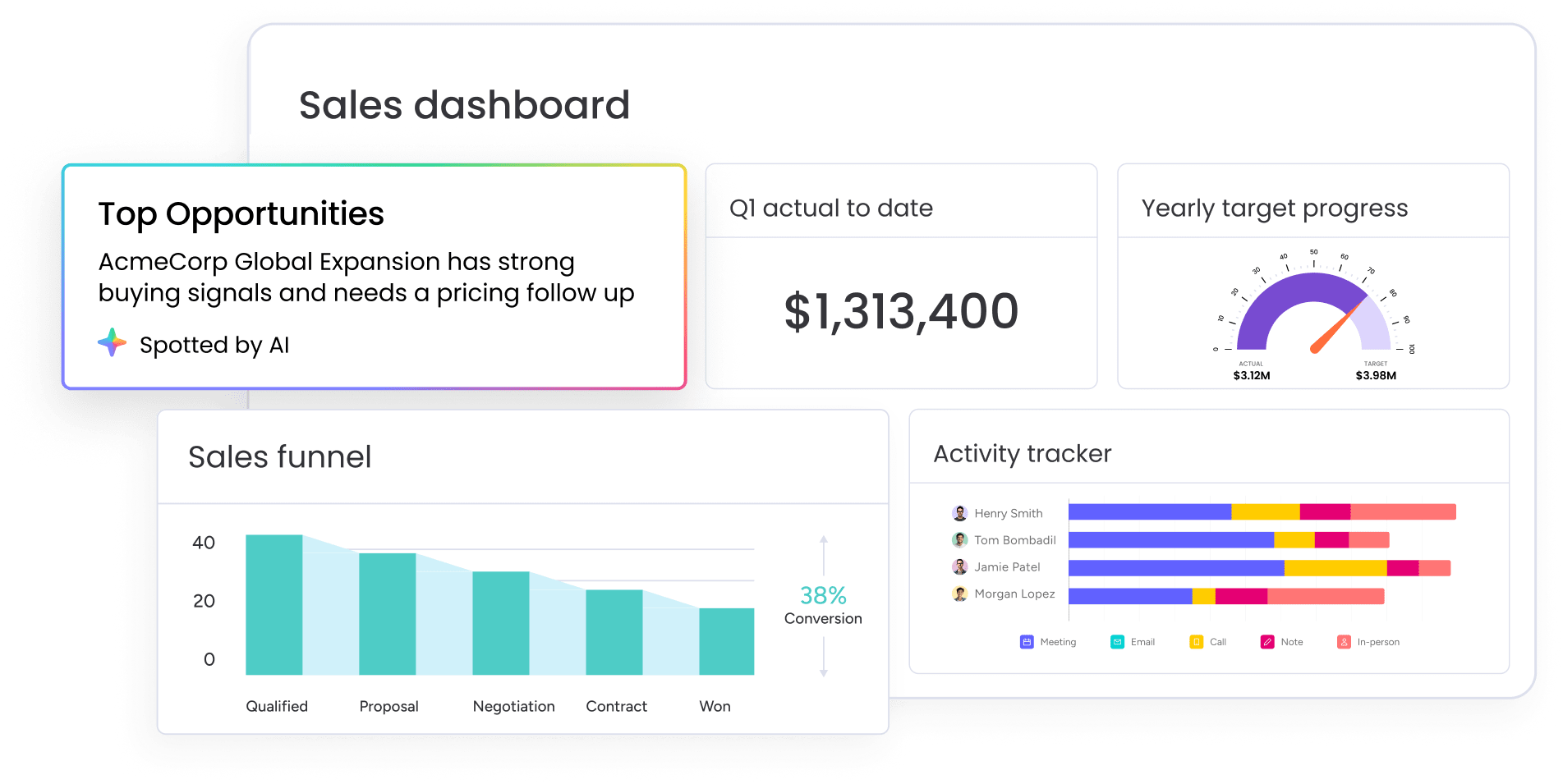
Stop playing data telephone between your systems. With monday CRM, every customer interaction lives in one unified timeline. Emails, meetings, support tickets, deal notes: it’s all there, in order, in one place. No sync delays, no data gaps, and no paying to store the same information twice. Revenue teams get a complete customer picture, and you can save 50–70% on storage costs.
No-code automation that scales
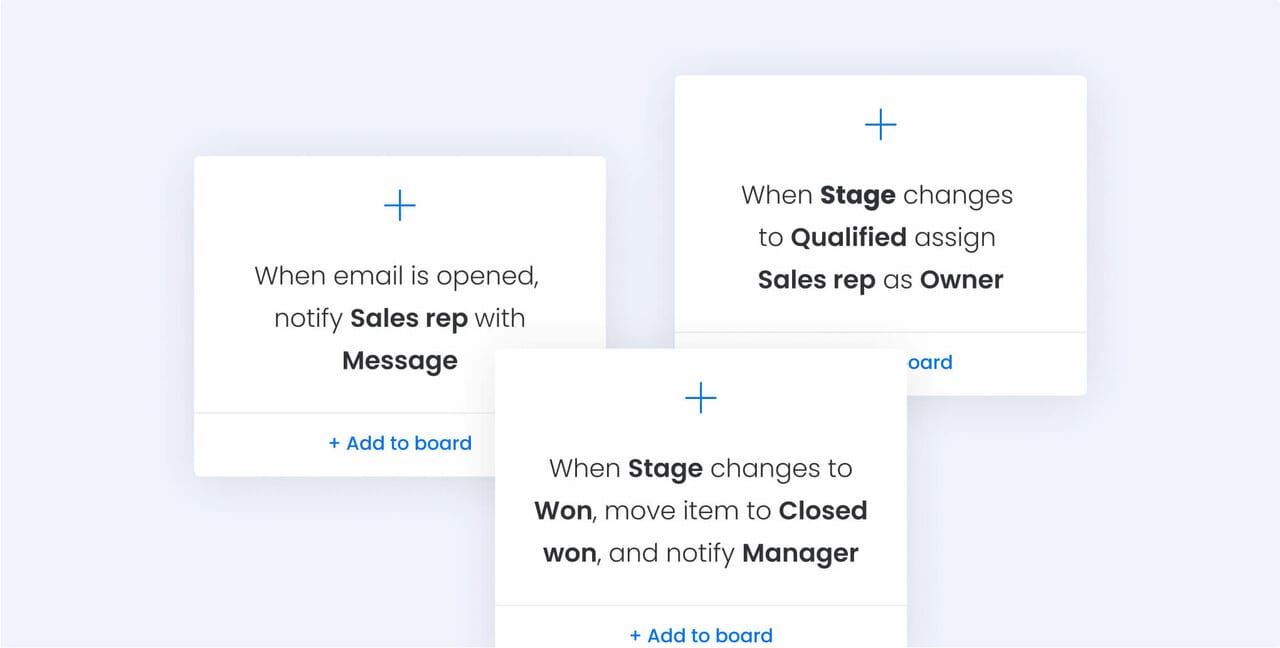
Our visual automation builder lets your revenue ops team create smart, AI-powered workflows themselves. If you can use a dropdown menu, you can build an intelligent process that works for your team. Test new ideas in hours, not weeks. A workflow that detects a frustrated customer and flags it for follow-up can be built before your coffee gets cold. As you grow, these automations scale right along with you
Turn your data into your best sales rep
You don’t need to overhaul your entire tech stack to get smarter about customer data. Focus on clean foundations and quick wins: automate lead scoring, unify your customer timeline, and let the results drive adoption. The goal isn’t building a perfect database; it’s giving your team the insights they need to close more deals today. With monday CRM, every step toward better data becomes a step toward a more predictable pipeline.
Try monday CRMFAQs
What is the difference between an AI CDP and a traditional CDP?
The difference between an AI CDP and a traditional CDP is that an AI CDP thinks for itself, finding patterns and predicting what customers will do next, while a traditional CDP just holds data until you tell it what to do.
How much does an AI customer data platform cost compared to traditional CDPs?
Standalone AI platforms can run $3,000–$8,000 monthly. An integrated CRM with the same power costs a fraction of that because you avoid separate licenses and heavy technical work.
Can mid-market companies implement AI CDPs without dedicated data teams?
Yes, if you choose a platform built for revenue teams, not data scientists. A no-code interface means your RevOps team can get it running fast without writing a single line of code.
Do I need a separate CDP if my CRM already has AI capabilities?
No. If your CRM has built-in AI, a separate CDP just adds cost and complexity. An integrated approach keeps everything in one place, right where your team actually works.
How do AI CDPs maintain compliance with privacy regulations?
They automate compliance by managing customer consent and using only the necessary data for analysis. The platform handles the technical privacy rules so your team doesn't have to.
What's the typical ROI timeline for AI CDP implementation?
Most teams see a return within 90 days from quick wins like better lead scoring and smarter automation. The full predictive impact usually kicks in by month six as the AI learns from your data.