


The best AI for writing a book in 2026 is not a single tool that tries to do everything. Writing a book is a long, multi-stage process that requires different kinds of support at different moments: research, outlining, drafting, editing, and consistency checks. No one AI excels at all of it.
The most effective authors treat AI the same way they treat human collaborators. They assemble a small group of focused helpers, each responsible for one clear task, and stay firmly in control of the creative direction. This mindset shift, from using AI as a tool to organizing it as a system, is what separates productive writers from frustrated ones.
In this guide, we break down the top AI solutions for fiction and non-fiction authors, explain what each is actually good at, and show how platforms that support custom, task-specific agents make it easier to build a writing workflow that adapts to your process instead of dictating it.
Key takeaways
- AI supports authors, it does not replace them: the strongest tools handle research, structure, editing, and consistency so writers can stay focused on voice, storytelling, and original thinking.
- Different stages of a book need different AI strengths: brainstorming, outlining, drafting, and revision each benefit from specialized AI support rather than a single general-purpose assistant.
- Focused AI roles produce better results: assigning one clear responsibility to each AI helper, such as research, character tracking, or line editing, leads to more reliable output and less creative friction.
- Agent-based platforms enable stronger writing workflows: AI platforms make it easier to create task-specific AI helpers that support long-form writing without taking control away from the author.
- AI book writing is about process, not shortcuts: the goal is to reduce friction, maintain momentum, and create a smoother, more consistent writing experience from first outline to final draft.
What are AI tools for writing a book?
AI tools for writing a book are designed to support authors across every stage of the writing process. They help with research, outlining, drafting, editing, and language refinement, so you can spend more time on storytelling and less time on repetitive or administrative work. Each tool has its own strength, whether that’s generating ideas, improving structure, or tightening prose.
Instead of relying on a single all-purpose chatbot, the most effective approach is to use a small group of focused AI helpers. Some are better suited to planning and organization, while others excel at editing, fact-checking, or maintaining consistency across long manuscripts.
More advanced platforms take this further by allowing authors to create task-specific AI helpers for different parts of the workflow. When each assistant has a clear role, the writing process becomes more structured, efficient, and easier to manage without sacrificing creative control.
Best AI novel writing software for fiction authors
Writing a novel isn’t just about having a great idea. It’s about weaving together believable worlds, consistent characters, and a plot that holds together from start to finish. The right AI writing software acts as part of your creative team, helping you manage the structure and detail behind the story while you focus on the art of telling it.
Each platform brings its own specialty to the table. Some are built for deep character work and creative writing, others excel at mapping complex plots or maintaining continuity across hundreds of pages. The key is to choose the right combination of tools for your writing style and genre.
Below, we explore the leading AI writing software for fiction authors. These platforms cover everything from brainstorming and outlining to editing and story consistency, giving you the support you need to stay creative, productive, and focused on what matters most
| Platform | Key features | Plot assistance | Price | Use case |
|---|---|---|---|---|
| Sudowrite | Advanced character voice consistency, Story Bible, "Show, don't tell" functionality | Scene-by-scene guidance | $10-44/month | Literary fiction, character-driven stories |
| NovelCrafter | The Codex story database, flexible AI connectivity, Scene Beats system | AI-assisted scene planning with Scene Beats | $4-20/month | Novelists needing deep organization with flexible AI integration |
| NovelAI | Lorebook system, multiple writing modes, customizable AI models | Genre-specific plot templates | $10-25/month | Fantasy, sci-fi, world-building heavy genres |
| Squibler | Smart Writer AI, story development tools, collaboration workspace | Basic plot brainstorming | $0-29/month | Writers needing AI assistance plus robust organizational tools |
1. Sudowrite
For the fiction author, Sudowrite offers an AI-powered creative partner designed with narrative in mind. The platform’s features are tailored for storytelling, focusing on story development, character building, and descriptive writing enhancement. It’s an invaluable tool for novelists looking to break through writer’s block and accelerate their creative momentum.
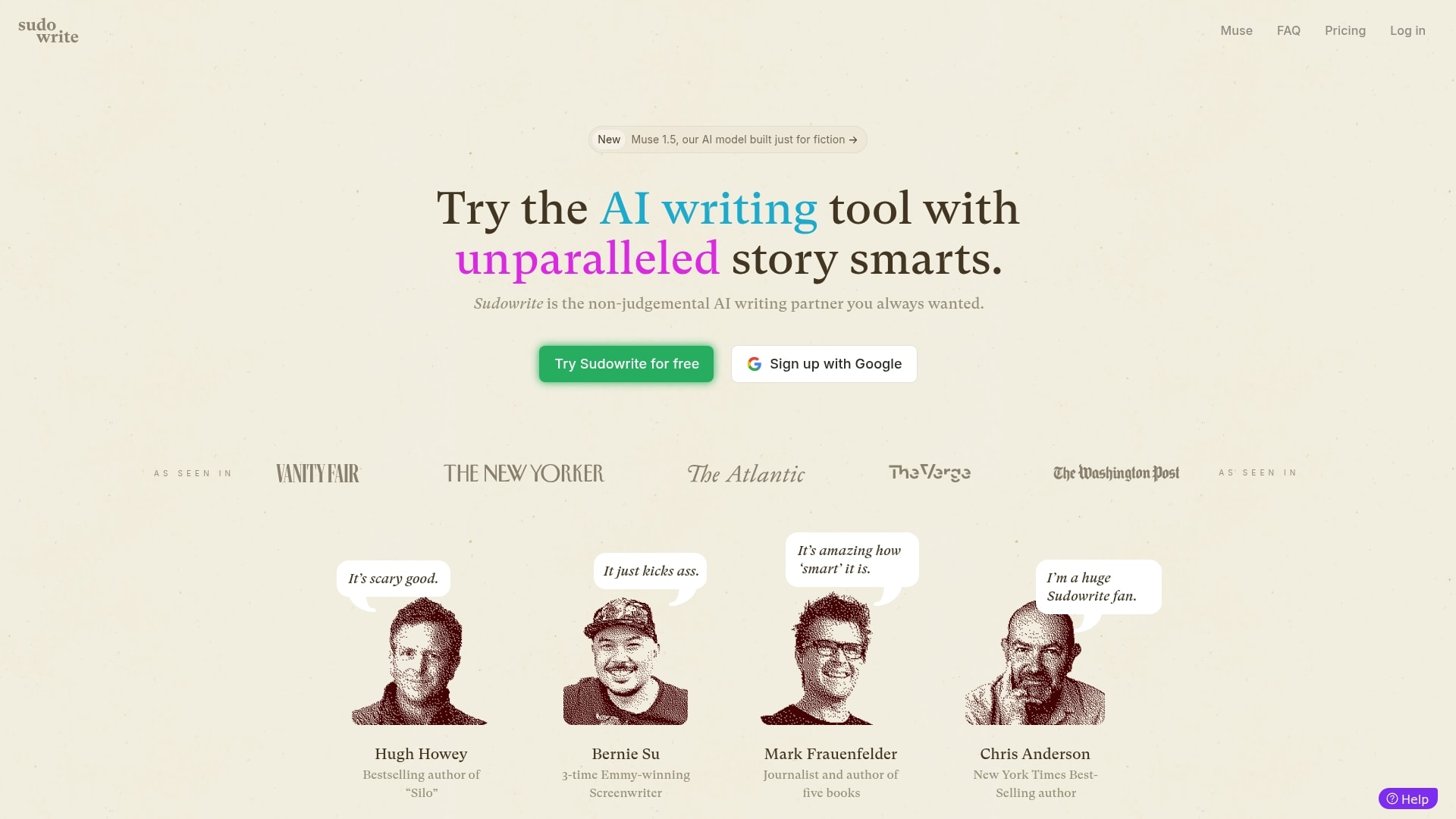
Use case: this tool acts as a collaborative AI writing partner, helping fiction writers generate ideas, flesh out characters, enrich descriptions, and preserve narrative consistency throughout their storytelling journey.
Key features:
- Write and Story Bible: advanced autocomplete that analyzes your characters, tone, and plot to generate the next 300 words in your voice, plus comprehensive story organization tools.
- Describe and Rewrite: creates vivid sensory descriptions and offers flexible revision options with “Show, don’t tell” functionality to elevate prose quality.
- Canvas and Brainstorm: AI-powered brainstorming workspace for exploring plot points, character arcs, and generating creative story elements like names and plot twists.
Pricing:
- Hobby & Student: $10/month with 225,000 credits.
- Professional: $22/month with 450,000 credits.
- Max: $44/month with 2,000,000 credits (unused credits rollover for a year).
- Free-trial: available with no credit card required.
Considerations:
- Its functionality is primarily web-based, with limited integrations into popular writing software like Scrivener.
- The credit-based pricing model can be confusing and potentially restrictive for authors who heavily use complex features.
2. NovelCrafter
NovelCrafter provides a complete AI-enhanced writing ecosystem built specifically for authors of long-form fiction. By merging traditional manuscript organization with a flexible “Bring Your Own Key” AI model, the platform gives serious writers ultimate authority over their creative process and toolset.
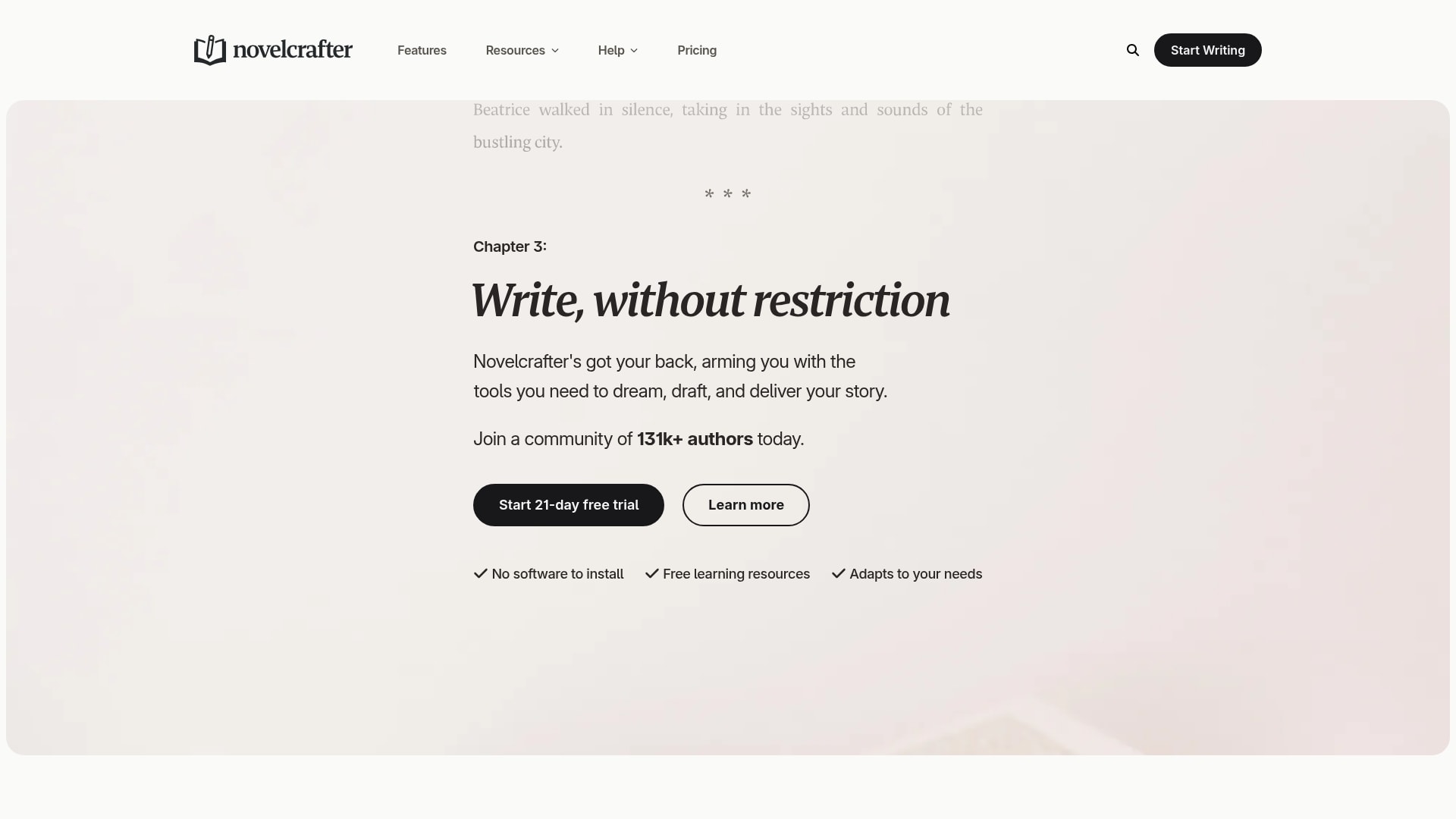
Use case: NovelCrafter is an all-in-one writing workspace for novelists who require deep organizational tools alongside flexible AI integration, combining manuscript editing, story planning, and world-building.
Key features:
- The Codex: an intelligent story database that tracks characters, locations, and lore while providing context to AI for consistent narrative generation.
- Flexible AI connectivity: support for multiple AI providers including OpenAI, Anthropic, and local models through user-controlled API keys.
- Scene Beats system: AI-assisted scene planning that helps writers outline what happens next while maintaining creative control.
Pricing:
- Scribe: $4/month (unlimited books, series management, basic review features).
- Hobbyist: $8/month (adds AI integration with bring-your-own-key model).
- Artisan: $14/month (includes chat features and advanced review tools).
- Specialist: $20/month (collaborative writing and team management).
- Free-trial: 21-day free trial available with all features unlocked.
- Annual billing offers two months free.
- Additional AI usage costs paid directly to your chosen AI provider.
Considerations:
- The “Bring Your Own Key” model necessitates some technical setup and introduces separate AI costs, which could be a hurdle for beginners.
- A potential learning curve exists due to its extensive features and customization options, which might initially overwhelm new users.
3. NovelAI
With a focus on unrestricted creative freedom, NovelAI offers a suite of AI-powered storytelling tools for creative writers and fiction enthusiasts. The platform stands out by imposing minimal content filters, making it a great choice for authors exploring mature themes or narratively complex territory.
Its unique blend of literature-trained AI models and anime-style image generation carves a distinct niche in the AI writing landscape.

Use case: NovelAI functions as a collaborative writing partner for fiction authors, delivering AI-assisted story generation with unparalleled creative liberty and minimal content restrictions.
Key features:
- Lorebook system: maintains detailed character, setting, and plot information to ensure narrative consistency across long-form stories.
- Multiple writing modes: choose between Storyteller Mode for traditional writing or Text Adventure Mode for interactive, RPG-style storytelling.
- Customizable AI models: select from various AI personalities like Kayra and Clio, each with distinct writing styles and strengths.
Pricing:
- Paper: free with 50 text generations and 30 image generations after email verification.
- Tablet: $10/month with unlimited text generations and 1,000 Anlas for image creation.
- Scroll: $15/month including all Tablet features plus larger AI memory and context size.
- Opus: $25/month featuring the largest context window (up to 28,672 tokens), 10,000 Anlas monthly, and access to exclusive AI models.
Considerations:
- A steep learning curve for advanced features and customization options can be daunting for new users.
- In very long stories, context memory limitations may cause the AI to forget earlier plot points, demanding careful narrative management from the author.
4. Squibler
Squibler transforms your story ideas into full-length manuscripts using AI-powered writing assistance and comprehensive project management tools. The platform specializes in story development features and collaboration capabilities, making it ideal for screenwriters and novelists who want an all-in-one writing environment.
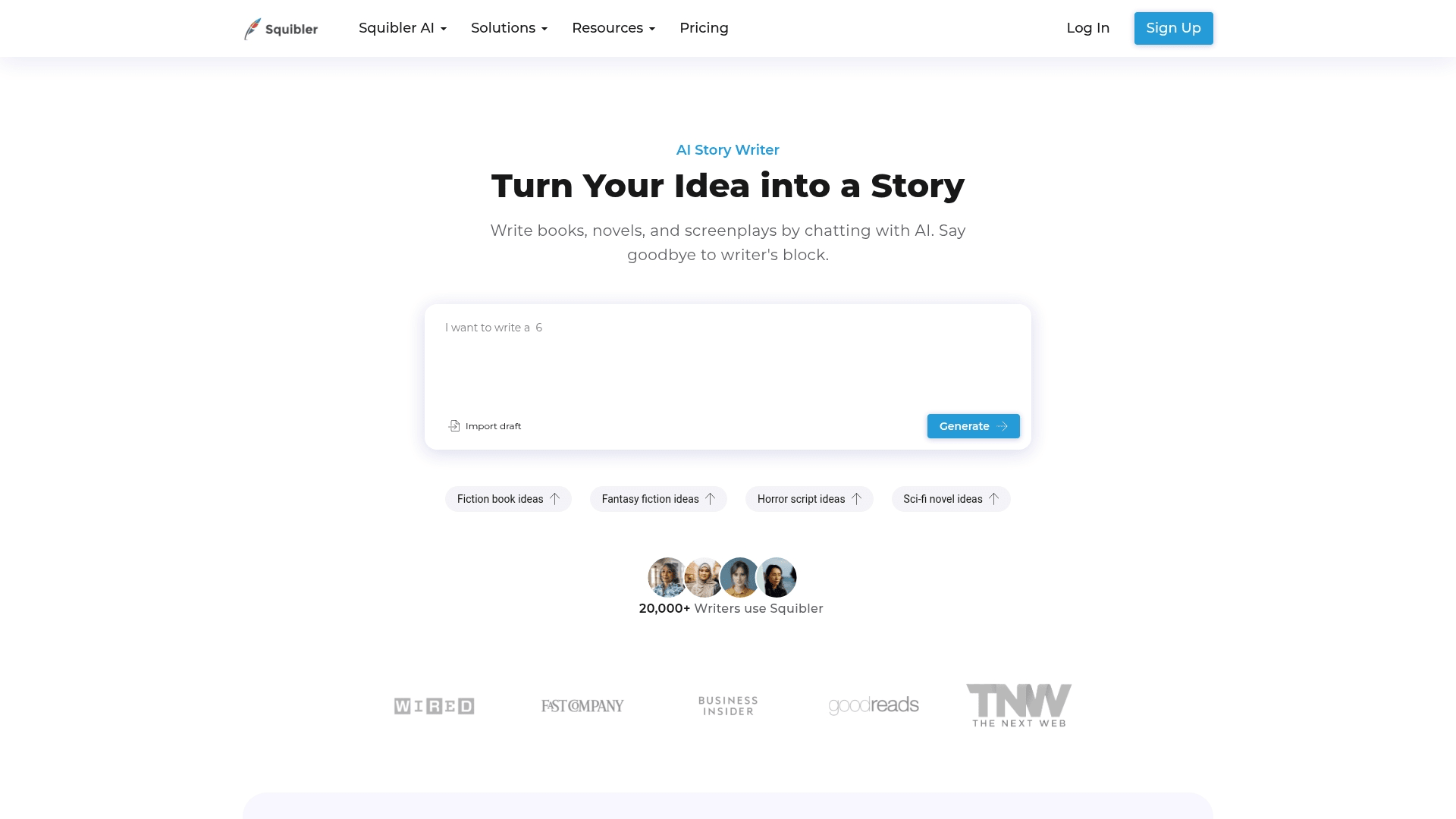
Use case: Squibler is designed for writers who need a combination of AI assistance and robust organizational tools to manage complex creative projects from the initial concept to the finished manuscript.
Key features:
- Smart Writer AI: generates content, rewrites sections, and helps overcome writer’s block with both automated and guided modes.
- Story development tools: creates detailed character profiles, settings, and story elements with minimal input to build comprehensive story bibles.
- Collaboration workspace: enables real-time editing and reviewing with multiple team members, plus export options for PDF, Kindle, Word, and text formats.
Pricing:
- Free Plan: $0 (includes 6,000 AI words per month, five AI image generations, 15 files, one project).
- Pro Plan: $16/month (billed annually) or $29/month (billed monthly).
- Savings: annual billing saves 45% compared to monthly pricing.
Considerations:
- AI-generated content often requires substantial editing to meet publishing standards and may lack a consistent tone and flow.
- The platform’s performance can lag with larger projects, and the web-based interface does not offer offline writing capabilities.
Best AI book writing software for non-fiction authors
Writing non-fiction is an exercise in architecture and authority. You are not just an author but a project manager juggling mountains of research, a detective verifying every fact, and a librarian wrestling with citations. The process is less about chasing a muse and more about taming a beast of information, where credibility is the ultimate prize.
The right AI partner understands this intellectual rigor. It’s not about generating fluffy prose; it’s about providing reinforcement for the heavy lifting: organizing complex topics, maintaining consistency, and ensuring every claim stands on a solid foundation of fact.
These tools below bring structure to chaos, allowing you to focus on conveying your story with authority.
1. Jasper AI
Engineered for marketing-focused content, Jasper AI leverages advanced models and brand voice training to produce compelling copy. The platform excels at generating on-brand text across multiple marketing channels, making it a go-to for content marketers and agencies that require consistent, high-quality output at scale.

Use case: Jasper AI is for marketers and content creators who need to produce consistent, on-brand content across various marketing channels while preserving their unique voice and style.
Key features:
- Brand Voice training: upload samples of your writing to train the AI on your specific tone, style, and messaging approach.
- 80+ marketing templates: access pre-built apps for blog posts, social media captions, ad copy, email campaigns, and product descriptions.
- Multi-model AI integration: combines proprietary models with GPT-4, Google, and Anthropic technologies for optimized content generation.
Pricing:
- Pro: $59/month (yearly) or $69/month (monthly) — includes one seat, Canvas platform, essential apps, two Brand Voices, five Knowledge assets, and three Audiences.
- Business: custom pricing (contact sales) — includes advanced apps, no-code AI app builder, unlimited customization, API access, and enterprise governance.
- Free-trial: 7-day free trial available for Pro plan.
- Discount: 20% non-profit discount available with documentation.
Considerations:
- The generated content often requires a human touch to add nuance and ensure complete accuracy.
- Its higher cost compared to general-purpose AI tools like ChatGPT may not be justifiable for experienced prompt engineers.
2. Copy.ai
Copy.ai transforms go-to-market teams into content powerhouses with its comprehensive AI writing platform. The platform specializes in workflow automation and brand-aligned content creation, making it ideal for marketing teams and business authors who need to scale their content production without sacrificing quality.

Use case: this sophisticated platform operates as a unified GTM AI solution that automates content creation workflows while maintaining a consistent brand voice across all marketing and sales materials.
Key features:
- Workflow automation: create multi-step content processes that transform one piece of content into multiple formats automatically.
- Content Agent Studio: train AI agents on your brand voice to generate consistent, on-brand content at scale.
- 90+ templates: access pre-built templates for everything from blog posts to sales automation emails and social media content.
Pricing:
- Chat: $24/month (annually) or $29/month (monthly) for up to five seats.
- Agents: $211/month (annually) or $249/month (monthly) for up to ten seats with workflow credits.
- Growth: $1,000/month (annually) for 75 seats with 20K workflow credits.
- Expansion: $2,000/month (annually) for 150 seats with 45K workflow credits.
- Scale: $3,000/month (annually) for 200 seats with 75K workflow credits.
- Enterprise: custom pricing with guided implementation and API access.
Considerations:
- Output quality can vary significantly depending on the prompt and may require human editing for optimal results.
- The credit-based workflow system can become costly for teams that rely heavily on its automation features.
3. WriteSonic
As an all-in-one AI writing platform, WriteSonic merges content creation with powerful SEO optimization tools. It functions as a strategic asset for building authority, employing data-driven methods to help you emerge as a thought leader in your field. This makes it especially useful for non-fiction authors and content marketers aiming for expert visibility.

Use case: WriteSonic is a comprehensive content creation and SEO platform for authors who want to establish their expertise while ensuring their writing connects with the right audience through search optimization.
Key features:
- AI Article Writer 6.0: creates long-form content up to 5,000 words with structured workflows that include keyword integration and competitor analysis.
- Built-in SEO and GEO (Generative Engine Optimization) tools: analyze content for keyword coverage, heading structure, and competitive gaps using real-time Google data to improve visibility in both traditional and AI-powered search.
- Botsonic no-code chatbot builder: allows authors to create AI-powered assistants trained on their own content and expertise, turning your knowledge into an interactive resource.
Pricing:
- Lite: $39/month for freelancers needing professional SEO and content tools.
- Standard: $79/month for small marketing teams growing their content and SEO presence.
- Professional: $199/month for growing brands requiring full SEO plus AI search visibility.
- Advanced: $399/month for scaling teams improving AI search visibility and SEO performance.
- Enterprise: custom pricing for large brands and agencies with tailored solution needs.
- Free-trial: free trial is available with no credit card required.
Considerations:
- AI-generated content often requires a human touch; plan for significant editing to remove generic phrasing and ensure factual accuracy.
- The credit-based system on certain plans can be depleted quickly, which might be a hurdle for high-volume users.
4. Grammarly
Grammarly has evolved far beyond its origins as a grammar checker. It now operates as an all-in-one writing partner, using AI to both polish existing text and help generate new ideas from scratch. While it still excels at real-time grammar checks, style suggestions, and tone analysis, its generative AI features are designed to help you brainstorm, rewrite, and overcome writer’s block.

Use case: Functioning as a personal writing coach and creative partner, Grammarly not only catches errors to boost your book’s readability but also helps generate and refine content, ensuring your manuscript is polished and professional from first draft to final edit.
Key features:
- Generative AI tools to brainstorm, compose, and rewrite content.
- Real-time grammar, spelling, and punctuation corrections in over 500,000 apps.
- Advanced tone detection and style suggestions to keep your voice consistent.
- Plagiarism detection that scans billions of web pages and academic databases.
- Personalized voice profiles (for business users) and an AI detector to ensure originality.
Pricing:
- Free: $0/month with basic grammar checks and 100 AI prompts monthly.
- Premium: $12/member/month (billed annually) or $30/member/month with advanced suggestions and 1,000 AI prompts.
- Business: custom pricing with unlimited AI prompts, personalized voice profiles, and advanced security.
Considerations:
- Its suggestions can sometimes be overzealous, so you’ll want to review them to ensure they don’t strip away your unique authorial voice.
- The built-in plagiarism checker is useful for a quick scan but may not be as exhaustive as dedicated plagiarism detection tools.
Top AI chatbots for book writing
Most big-name AI chatbots aren’t exactly aspiring novelists. Think of them as eager assistants you can recruit for specific gigs on your book-writing team, like brainstorming plot twists or digging up obscure facts. They’re a great starting point for building out your support crew.
Their best work happens on the sidelines, not center stage. Use one to outline a chapter or tighten up a clunky paragraph, but don’t ask it to write the book for you. That’s your job as the creative lead; these tools are just here to help you get it done better and faster.
Knowing each tool’s limits and strengths helps you assign the right task to the right assistant. While no chatbot can capture your unique voice, the right one can handle the tedious work, clearing the path so you can focus on what really matters: telling your story.
| Chatbot | Context limit | Pricing | Use case | Writing strengths |
|---|---|---|---|---|
| ChatGPT | 128k tokens (~96k words) | Free to $200/month | Research, brainstorming, editing feedback | Character development, plot hole identification, style analysis |
| Claude | 200k tokens (~150k words) | Free to $100/month | Long-form editing, manuscript review | Developmental editing, consistency checking, tone refinement |
| Gemini Advanced | 1M tokens (~750k words) | $19.99-$249.99/month | Massive document analysis | Full manuscript review, cross-referencing, fact-checking |
| Perplexity | 4k tokens (~3k words) | Free to $40/month | Real-time research, citations | Current events, source verification, research compilation |
| OpenAI Playground | Varies by model | Pay-per-use | Advanced customization, experimentation | Fine-tuned control, parameter adjustment, model testing |
1. ChatGPT
Having rocketed to over 100 million users within two months of its launch, ChatGPT has become the default AI writing companion for countless professionals and content creators. Its strength lies in versatile text generation through natural language prompts, making it a powerful tool for quick brainstorming sessions and initial draft creation, from simple emails to complex creative projects.

Use case: ideal for authors who need a versatile AI writing assistant, ChatGPT helps generate, edit, and refine content through intuitive conversational interactions.
Key features:
- Text generation for diverse content types from emails to creative writing.
- Conversational editing and proofreading with tone and style customization.
- Multimodal capabilities including image processing and file analysis.
Pricing:
- Free: $0/month – advanced reasoning using GPT-5, with limits on messages, uploads, image generation, deep research, memory, and context.
- Plus: $20/month – expanded messaging and uploads, faster image creation, deep research, agent mode, custom GPTs, and limited Sora 1 video generation.
- Pro: $200/month – unlimited messages and uploads, maximum deep research, extended Sora 1 video generation, and a research preview of new features.
- Business: $25/user/month (annual) or $30/user/month (monthly) – A secure workspace with admin controls, SAML SSO, compliance support, and unlimited GPT-5 messages. Your business data is not used for training by default.
- Enterprise: contact sales – enterprise-grade security, unlimited users, and everything in the Business plan.
Considerations:
- A critical eye is essential, as the AI can generate factually incorrect information or “hallucinations” that require fact-checking.
- The free version’s knowledge is constrained by its training data cut-off, limiting its awareness of recent events.
2. Claude
With its remarkable ability to understand context, Claude provides a conversational AI that maintains coherent discussions throughout lengthy writing projects. The platform’s safety-first Constitutional AI approach makes it a particularly valuable and ethical assistant for authors engaged in creative work.

Use case: Claude offers authors a conversational AI partner capable of maintaining context across entire manuscripts, providing natural, human-like dialogue for brainstorming, drafting, and editing long-form content.
Key features:
- Large context window: process and analyze extensive documents, perfect for reviewing entire chapters or maintaining story continuity across long manuscripts.
- Constitutional AI safety: built-in ethical guidelines ensure responsible content generation, giving authors confidence in their AI writing partner.
- Natural conversational flow: maintains coherent, human-like dialogue that feels less robotic than other AI writing tools, ideal for creative collaboration.
Pricing:
- Free: $0/month with basic chat functionality, content creation, and code generation.
- Pro: $20/month (or $17/month annually) with increased usage, unlimited projects, and access to advanced features.
- Max: starting at $100/month with 5-20x more usage than Pro and priority access during high traffic periods
- Team plans: starting at $30/month per person with collaboration features and admin controls.
Considerations:
- The free version imposes daily message limits that may interrupt intensive writing sessions.
- It does not generate images, which limits its multimedia content creation capabilities compared to some competitors.
3. Gemini Advanced
Google’s Gemini Advanced transforms book writing with its massive 1-million-token context window and deep research capabilities. The platform specializes in comprehensive document analysis and real-time information access, making it ideal for authors who need extensive research support and seamless integration with Google Workspace.

Use case: Gemini Advanced excels at analyzing entire manuscripts, generating comprehensive research reports, and maintaining context across lengthy writing projects through its exceptional memory capacity.
Key features:
- Deep Research functionality: automatically generates multi-page reports by analyzing extensive web data for thorough background research.
- Massive context window: processes up to 1 million tokens, allowing analysis of entire book drafts and extensive source materials.
- Google Workspace integration: provides seamless writing assistance directly within Google Docs, Gmail, and other productivity apps.
Pricing:
- Google AI Pro: $19.99/month with one-month free trial.
- Google AI Ultra: $249.99/month ($124.99/month for first three months).
Considerations:
- Users report occasional accuracy issues and “hallucinations” even on basic questions, requiring careful fact-checking.
- Its writing style can feel less conversational and natural when compared to competitors like ChatGPT and Claude.
4. Perplexity
Perplexity transforms the research-heavy process of book writing by combining real-time web search with AI-powered content generation. The platform specializes in creating well-sourced, citation-backed content, making it particularly valuable for non-fiction authors who need credible, up-to-date information woven throughout their manuscripts.

Use case: this tool is perfect for generating research-backed content with automatic citations, making it ideal for authors writing non-fiction books, academic works, or any manuscript that demands factual accuracy and source verification.
Key features:
- Perplexity Pages: generate complete articles and reports from a single prompt, with structured sections and automatic footnotes for every sentence.
- Real-time web integration: every query searches the web live to ensure the most current information and sources.
- Comet browser workspace: AI-native browser with integrated assistant for seamless research and writing in one environment.
Pricing:
- Free tier: basic search and writing features with limited queries.
- Pro: $20/month or $200/year (16% savings with annual billing).
- Enterprise Pro: $40/month per seat or $400/year per seat.
- Enterprise Max: $325/month per seat or $3,250/year per seat.
Considerations:
- Its creative writing capabilities are less robust compared to dedicated fiction writing tools like ChatGPT.
- Advanced features such as Perplexity Labs and unlimited Pro searches require a paid subscription.
5. OpenAI Playground
OpenAI Playground offers a direct line to the raw power of GPT models, functioning like the engine room of AI. This developer-centric platform is perfect for technical writers and AI enthusiasts who demand granular control over their writing experience, allowing them to tinker with everything from creativity levels to response patterns.

Use case: this AI is a powerful experimentation sandbox for writers who want maximum control over AI-generated content, offering direct access to state-of-the-art language models with extensive customization options.
Key features:
- Advanced parameter control — adjust temperature, top-p, and penalty settings to fine-tune creativity and coherence levels.
- Access to the latest models — experiment with a wide range of models, from the cutting-edge GPT-5 and versatile GPT-4o to hyper-efficient nano models, to find the perfect fit for your task.
- System instruction capabilities — set detailed context and persona instructions to guide the AI’s writing style and approach.
Pricing:
- Pay-per-use across tiers: costs are based on a pay-per-use model and vary by model, token usage (with output tokens typically costing more than input), and service tier (e.g., Batch, Standard, Priority).
- GPT-5 pricing: starts at $1.25 per 1M input tokens in the Standard tier, with higher rates for output tokens.
- GPT-4o pricing: the popular GPT-4o model costs $2.50 per 1M input tokens in the Standard tier.
- Budget-friendly options: for less urgent tasks, nano models in the Batch tier can cost as little as $0.025 per 1M input tokens.
- Additional costs: image generation (DALL·E 3), audio processing, and model fine-tuning have their own separate pricing.
Considerations:
- The learning curve can be steep for non-technical users unfamiliar with AI parameters and prompt engineering.
- It lacks the document management features and collaborative tools that dedicated AI book writing software typically provides.
How to choose the right AI book writer
Selecting an AI writer is less about finding a single, all-powerful genius and more about recruiting the right specialist for the job. You are the manager building your writing team; you wouldn’t ask your brilliant novelist to draft a technical manual.
Before you commit, clarify the mission. Are you facing a tight deadline? Will you need an AI that collaborates well with human editors? Is this a research-intensive project, or is the primary goal to nail a specific narrative voice?
This is how you make a smart decision. Recognize that the AI that’s a rockstar at crunching data for your business book might bomb the audition for your heartfelt memoir. The goal is to match the tool to the task.
Hire the right specialist for your genre
Consider your book’s genre as the job description for your AI assistant. Each one demands a different skill set, and the best platforms understand this distinction.
Writing literary fiction? You need a wordsmith, an AI with a poet’s soul that can handle complex prose and character depth. For genre fiction, you’re hiring a lore-keeper that can track plot threads and character arcs to keep your world consistent.
Drafting a business book? Your best hire is a research analyst that can pull in data, manage citations, and structure arguments like a seasoned consultant. And for a memoir, you’re looking for a storyteller who can help weave personal events into a compelling narrative with the nuance your story deserves.
Tools to manage the marathon
A 50,000-word manuscript is a marathon, not a sprint. Your AI platform shouldn’t just be a writer; it needs to be your project manager, keeping everything organized so you don’t lose your mind (or your best chapter).
Look for solid version control. This is your safety net, letting you experiment with a new plot twist, knowing you can always jump back to a previous draft. Good collaboration tools are also key, letting you control who can make changes versus who can only leave notes.
Remember, you’re the boss, and you decide who gets a key to the office.
Budgeting for your new AI teammate
Let’s talk about the budget. Most platforms have a few common ways they charge, and knowing the difference will keep you from getting a surprise bill later.
Subscription plans are like putting your AI on a monthly salary: great if you’re writing consistently and want predictable costs. Credit-based systems are more like hiring a freelancer, where you pay as you go, which is perfect for a single project.
One-time purchases are the rare unicorns, but they’re worth a look. You pay a larger fee upfront to “own” the tool, which means no more monthly subscription anxiety. It’s a solid choice if your income is less predictable.
Free AI for writing fiction and non-fiction
You don’t need a big budget to start experimenting with AI writing tools. Free platforms give you an accessible way to test what’s possible — from brainstorming and outlining to editing and research. They’re perfect for learning how AI fits into your writing process before you commit to a paid plan.
Most free tools offer generous features that let you explore their strengths, limits, and ideal use cases. Treat this stage as a hands-on workshop to build confidence and find the tools that complement your creative workflow.
Below are some of the best free AI writing options available, each with its own strengths and specialties to help you get started on your next project.
Best free AI writing software options
Ready to assemble your starting line-up? Each free AI has its own personality and specialty, so it pays to know who you’re recruiting. These are the top players and what you can expect from their free tiers.
- ChatGPT Free: about 40 messages every three hours during peak use, but unlimited during off-peak times. It’s a great all-rounder for brainstorming and drafting, but lacks advanced features like web browsing.
- Claude (Anthropic): generous daily message limits that reset each day. It excels at crafting natural dialogue and developing character voice.
- Google Gemini (formerly Bard): generally unlimited use with occasional restrictions. Its strength lies in research, as it’s deeply connected to Google’s ecosystem.
- Writesonic Free: 10,000 words per month. Good for exploring basic templates but doesn’t include their plagiarism checker or brand voice features.
- Copy.ai Free: 2,000 words per month. You get access to basic templates, making it useful for short-form copy, but team features are reserved for paid plans.
Working within free tool limitations
Being the boss of a free AI team means being a smart manager. Instead of fighting their limits, you learn to direct their energy where it matters most. Get your game plan ready before you send them to work, and have your prompts lined up so every interaction is focused and productive.
Don’t rely on just one assistant. Assign tasks based on individual strengths: use one for brainstorming plot points, another for refining dialogue, and a third for fact-checking. This approach not only maximizes your daily limits but also helps you learn which AI “birds” you work with best.
When to upgrade to paid plans
So, when is it time to promote your team from the free tier? The answer is simple: when their limits are holding you back from doing your best work. If you’re constantly hitting daily caps or spending more time juggling free accounts than actually writing, you’ve outgrown your starter team.
The decision is a practical one. Look for the signs: your creative flow is being interrupted, you need premium features like a plagiarism checker for client work, or the friction of managing free tools is costing you valuable writing time.
Think of it this way: if a small monthly fee buys you back hours of focused work, it’s not an expense, it’s an investment in your own output.
Using AI throughout your book writing process
Writing a book is a long game — from planning and drafting to editing and polishing — and the right AI tools can make every stage smoother. Instead of juggling research, structure, and rewrites on your own, you can build a small team of AI helpers to share the load and keep you focused on the creative work that only you can do.
Each stage of the process benefits from a different kind of assistant: one to organize your outline, another to strengthen your prose, and a third to catch every last typo. These AI teammates don’t replace your voice — they support it, ensuring the writing process stays consistent, efficient, and enjoyable from start to finish.
AI for book planning and outlining
A great book starts with a solid plan. AI can help you move past the blank page by turning loose ideas into a clear structure you can build on. By providing basic inputs like genre, themes, and goals, you can generate an outline that gives your project momentum early.
At this stage, AI is most useful for shaping direction, not making creative decisions for you.
- Generate high-level story or chapter outlines quickly.
- Test different structural approaches before committing to one.
- Identify gaps in pacing or flow early in the process.
Drafting chapters with AI assistance
Drafting works best when AI supports your momentum rather than replaces your voice. You remain the creative lead, while AI helps expand rough ideas, refine phrasing, or push past moments of writer’s block.
Giving the AI clear context, such as character details or tone preferences, helps maintain consistency across chapters. Platforms that support persistent context, including agent-based systems, can reduce repetition by carrying that information forward.
- Expand notes or rough drafts into fuller sections.
- Rephrase sentences while preserving your tone.
- Explore alternate wording or dialogue options
AI-powered editing and revision
Editing is where AI can catch issues that are easy to miss after multiple drafts. Because it isn’t attached to the text, AI can review your manuscript with fresh eyes and consistent criteria.
Used in focused passes, AI can support both structural and line-level revision.
- Flag pacing problems, plot gaps, or inconsistencies.
- Catch issues with repetition, clarity, or awkward phrasing.
- Prepare a cleaner draft before human editing or publication.
How to publish books written with AI
The publishing world is still developing its AI playbook, and that’s good news for modern authors. The rules are still flexible, which means you can define how to use AI responsibly while keeping full creative control. Success comes from understanding where AI fits in the process — and how to navigate the legal, ethical, and platform guidelines that come with it.
From copyright ownership to disclosure requirements and publisher policies, the landscape is evolving quickly. Knowing the basics will help you stay compliant, confident, and ahead of the curve as you bring your AI-assisted book to market.
Copyright ownership and AI content
You own the copyright to your AI-assisted work, period. Current U.S. law protects work with “sufficient human authorship,” and that covers the creative choices you make when guiding, editing, and arranging content. Pure AI output can’t be copyrighted, but your vision and direction absolutely can.
As the legal side of AI evolves, the smartest play is to document your creative process. It’s simple, effective, and proves you were the boss of your project all along. This keeps you in the clear and reinforces your role as the author.
Disclosure requirements for authors
Right now, the industry is leaning toward transparency, not prohibition. Platforms like Amazon KDP ask you to note AI usage during the upload process, and some publishers are starting to add AI clauses to their contracts. Honesty is becoming the best policy.
Being upfront about the tools you use actually builds trust with readers. A simple note in your acknowledgments positions you as a forward-thinking author who knows how to lead an AI team, not hide behind one. It’s a power move.
Platform policies on AI-generated books
Most major publishing platforms, including Amazon KDP, allow AI-assisted books as long as they meet quality and content standards. The focus is not on how a book is created, but on whether it delivers original, useful, and well-edited content to readers.
Platforms are primarily concerned with preventing low-effort or misleading submissions. As long as authors maintain creative control, review AI-assisted material carefully, and ensure accuracy and coherence, AI-supported books are treated the same as traditionally written ones.
In practice, quality matters far more than the tools used. A well-structured, properly edited manuscript that provides real value is what determines acceptance and long-term success.
Frequently asked questions
Can I legally sell a book written with AI assistance?
Yes. You own the copyright to the final work as long as you are the author who guides, edits, and takes ultimate creative responsibility.
How much do AI book writing platforms typically cost?
Plans range from free to over $100 per month, with most authors finding the best value in mid-tier plans costing between $20 and $50 monthly.
Will readers be able to detect AI assistance in my book?
No, not when you use AI as a collaborator. Readers detect an author's unique voice, which you maintain through careful guidance and editing.
Can AI writing platforms help with books in languages other than English?
Yes, many platforms support multiple languages. However, performance is strongest and most reliable in widely spoken languages like English, Spanish, and German.
How do I maintain consistency when using AI for long manuscripts?
Use detailed character sheets and style guides, and choose a platform with a strong memory function to track plot points and story elements for you.
Which book genres work most effectively with AI writing assistance?
Both fiction and non-fiction are highly effective. AI can help structure research for non-fiction or brainstorm plot points and dialogue for fiction.

 Get started