


The search for the best AI for writing often starts with the wrong goal: finding one perfect platform to do everything. In reality, professionals don’t have one writing project, they have dozens. You need an assistant for quick emails, a researcher for deep reports, and a copywriter for sharp marketing content. The most effective approach is to stop looking for a single magic bullet and start thinking like a manager building a specialized team.
This guide will help you assemble that team. We will explore what separates a good bot from a great AI teammate and rank the top tools for specific jobs, from long-form content to quick copy.
You will also learn how to choose the right assistant for any task and see how leading AI platforms let you build your own custom helpers, giving you a full crew of AI agents ready to work.
Key takeaways
- Stop searching for one perfect tool: the best AI for writing in 2026 is a team of specialized assistants, each designed for a specific writing job.
- Think in roles, not features: research, drafting, editing, and optimization work best when each task has a dedicated AI helper.
- Use AI to support your process, not replace your voice: strong results come from collaboration, where AI accelerates output while you retain creative control.
- Choose tools that fit how you already work: the most effective AI writing assistants integrate smoothly into your existing workflows and tools.
- Build repeatable writing systems over time: platforms like ChatGPT, Claude, and Jasper let you create task-driven AI agents for specific writing roles, so quality scales without adding manual effort.
What makes a great AI writing assistant?
A great AI assistant is less a single, all-knowing tool and more a new teammate you train. It’s a helper designed to learn your style, understand your needs, and assist in creating and polishing your work. The gap between a basic text generator and a truly effective assistant, however, is massive.
The best assistants don’t just spit out generic text; they act as a true extension of your own capabilities. They understand context, adapt to your voice, and plug right into your workflow.
Understanding what separates a genuine game-changer from just another bot is absolutely essential as we head into 2026.
An assistant that actually gets the context
A truly smart assistant understands what you mean, not just the words you type. It picks up on tone, intent, and the bigger picture behind your request, so you don’t have to constantly repeat yourself.
This means it can maintain a consistent argument throughout a long report or draft a casual follow-up email that perfectly matches the tone of the first one.
Customization that captures your voice
This is where you go from being a user to being the boss. The best platforms let you train your AI on your unique voice, brand guidelines, and specific terminology. You can feed it your past work, teach it your style, and build an assistant that doesn’t just write well — it writes like you.
Integration that fits your workflow
The most valuable AI helpers don’t force you to change how you work; they slide right into your existing tools. Your assistant should be there with you, whether you’re in Google Docs, Slack, or your project management app.
When your AI can collaborate within the systems you already use, it becomes a seamless part of the team.
How to choose the right AI writing assistant
Finding the right AI writing assistant isn’t about choosing one tool to do everything. It’s about assembling a set of specialized helpers that support each stage of your writing process. Research, drafting, editing, creative writing, and refinement all benefit from different strengths, and the most effective setups treat AI like a team, not a single catch-all solution.
Platforms built around task-driven AI agents make this easier by letting you assign one clear job to each assistant. Instead of constantly re-prompting the same tool, you can rely on focused agents that handle specific writing responsibilities and work together as a system that fits how you already work.
Here’s what to consider when building your team:
- Match the task to the assistant: start with one clear goal. Some AI tools are better suited for long-form research, while others excel at short-form copy, editing, or summaries.
- Check integration: your assistants should fit seamlessly into your workflow, working inside the tools you already use for writing, collaboration, and planning.
- Start small and grow: begin with one reliable helper for a high-impact task, then expand your setup as your writing needs evolve.
- Protect your data: make sure any platform you use follows strict security and privacy standards before sharing drafts, research, or sensitive information.
The 12 best AI writing tools ranked
The search for the right AI writer mirrors the process of building a specialized team, the goal is to find the best player for each specific position. This list is approached with that mindset, examining which tools excel at particular tasks — from snappy social posts to in-depth reports. We’re not looking for a single MVP, but a whole roster of specialists you can call on.
There’s no one-size-fits-all winner here, because your needs change from task to task. A tool that’s a genius at creative copy might stumble on technical articles, and the real win is knowing which assistant to tap for which job.
Consider this your personal scouting report for building a more efficient workflow. It’s all about finding the right helpers to take things off your plate, giving you back the time and focus to do your best work.
1. ChatGPT: best all-purpose AI writer
With its intuitive chat interface, ChatGPT provides conversational AI assistance that adapts to virtually any content need. The platform excels at handling diverse writing tasks, making it accessible for everyone from students to Fortune 500 companies.
With over 800 million weekly active users, it’s become the go-to AI writing assistant for brainstorming, drafting, and refining content across industries.

Use case: ChatGPT streamlines content creation through conversational AI that remembers context within conversations, allowing for iterative refinement of written content across multiple formats and styles.
Key features:
- Conversational interface: natural chat-based interaction that maintains context throughout your writing session.
- Versatile content generation: creates everything from emails and blog posts to creative writing and technical documentation.
- Custom instructions and GPTs: personalize the AI’s behavior and create specialized writing assistants for specific tasks.
Pricing:
- Free: $0/month – limited messages, uploads, image generation, deep research, memory, and context.
- Plus: $20/month – expanded messaging, uploads, image creation, deep research, memory, context, projects, tasks, custom GPTs, limited Sora 1 video generation, Codex agent.
- Pro: $200/month – unlimited messages, uploads, image creation, deep research, memory, context, projects, tasks, custom GPTs, extended Sora 1 video generation, expanded Codex agent, research preview of new features.
- Business: $25 per user/month (billed annually), $30 per user/month (billed monthly) – Secure workspace with advanced models and connectors to internal sources.
- Enterprise: contact sales for pricing.
Considerations:
- Can generate factually inaccurate information with confidence, requiring human fact-checking for important content.
- May produce generic or clichéd content since it learns from existing data patterns rather than creating truly original ideas.
2. Claude: best for long-form content
For professionals wrangling extensive reports and multi-chapter content, Claude transforms complex writing projects into manageable tasks with its impressive context window and constitutional AI framework. The platform excels at maintaining coherence across lengthy documents, making it the go-to choice for professionals in research and academia.

Use case: Claude specializes in processing and generating long-form content while maintaining consistency and accuracy throughout extended documents.
Key features:
- Large context window: processes up to 200,000 tokens with its latest models, allowing you to analyze entire books or comprehensive reports in a single go.
- Vision capabilities: can analyze images, charts, and graphs, giving you insights on visual data.
- Constitutional AI framework: built-in safety protocols ensure reliable, unbiased output for professional and academic writing.
- Artifacts feature: a dynamic workspace where you can view, edit, and build upon AI-generated content in a separate window, helping you iterate on your work.
Pricing:
- Free: $0/month with basic chat functionality and core writing features.
- Pro: $20/month (monthly) or $17/month (annual) with increased usage and advanced tools.
- Team: $30/month per person (monthly) or $25/month per person (annual) for teams of five or more, with collaboration features and admin controls.
- Max: starts at $100/person/month for teams needing higher usage and advanced features.
- Enterprise: custom pricing with enhanced security, SSO, and compliance features.
Considerations:
- While it can analyze images, it lacks built-in image generation capabilities.
- Can be overly cautious with creative or ambiguous prompts due to its safety-first approach.
3. Jasper: best for marketing teams
Engineered for marketing professionals who need to scale output while maintaining brand consistency, Jasper provides a suite of AI-powered content creation tools. The platform specializes in marketing-focused templates and brand voice capabilities, making it ideal for agencies and enterprise marketing teams.
With over 100,000 paying customers and a focus on end-to-end marketing workflows, Jasper has established itself as the go-to AI writing assistant for marketers.
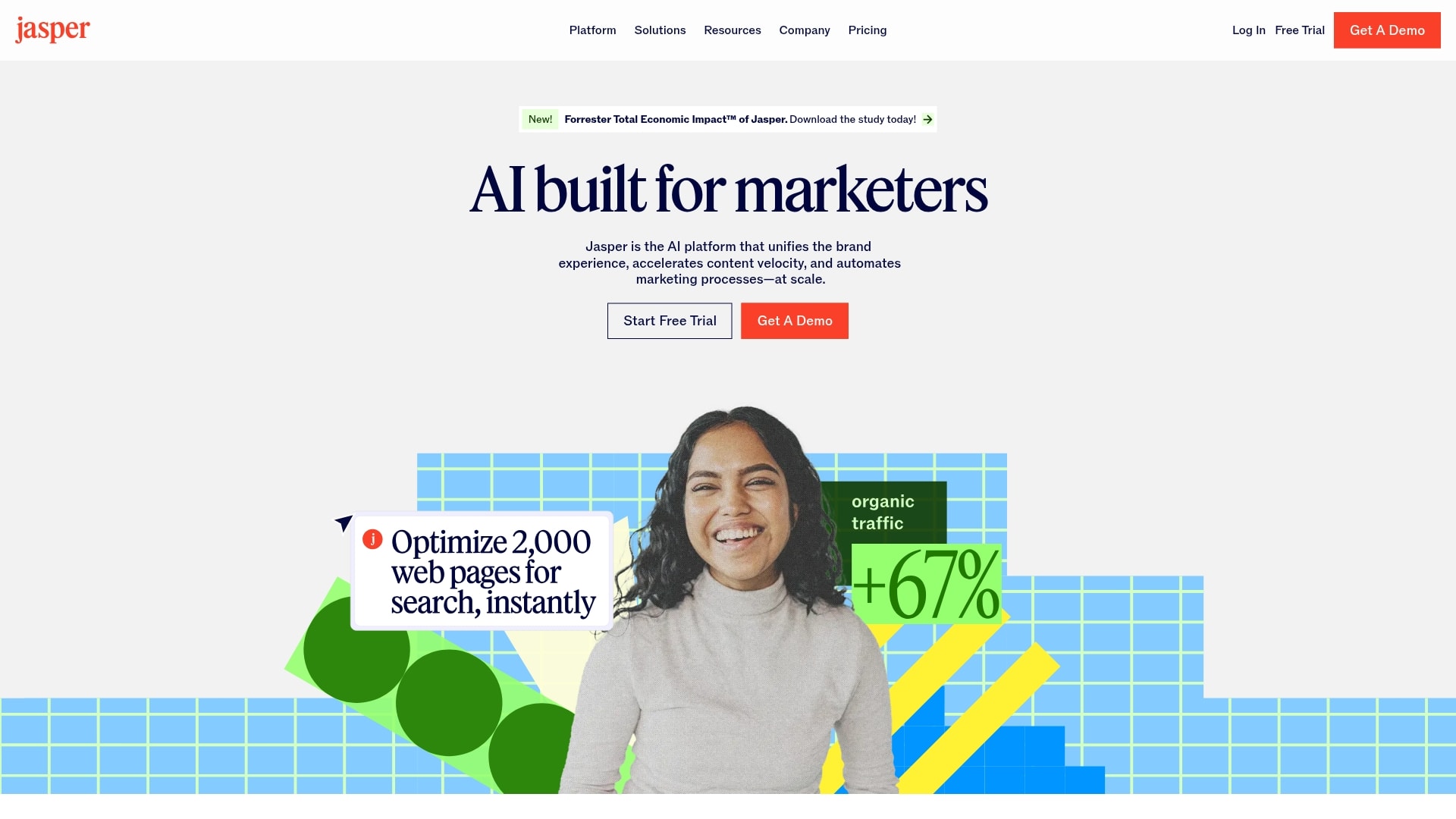
Use case: Jasper helps marketing teams create on-brand content at scale through AI-powered templates, brand voice training, and integrated marketing workflows that streamline campaign development from ideation to execution.
Key features:
- Brand Voice technology: learns and maintains your company’s specific tone and style across all content.
- 50+ marketing templates: for blog posts, social media captions, ad copy, email campaigns, and product descriptions.
- Canvas workspace: with AI Editor for collaborative content creation and real-time editing.
Pricing:
- Pro Plan: $59/month per seat (billed annually) or $69/month (billed monthly).
- Business Plan: custom pricing with advanced features, unlimited brand voices, and enterprise-grade governance.
- 7-day free trial: available for the Pro plan.
- 20% discount: available for non-profit organizations.
Considerations:
- Higher pricing compared to general AI writing tools like ChatGPT, which may not justify the cost for smaller teams.
- Content often requires significant editing to sound natural and avoid repetitive phrasing, especially in long-form pieces.
4. Copy.ai: best for quick copy generation
Designed for speed and scale, Copy.ai equips marketing teams to become content powerhouses with its AI-powered writing platform. The platform specializes in rapid content creation through an extensive template library and workflow automation, making it ideal for businesses that need to produce high-volume marketing materials without expanding their writing teams.

Use case: Copy.ai serves as a comprehensive Go-to-Market AI platform that automates content creation workflows and eliminates repetitive marketing tasks for sales and marketing teams.
Key features:
- Workflow automation: build custom, no-code sequences that transform one piece of content into multiple formats across different channels.
- 90+ templates: access pre-built generators for everything from email campaigns and social media posts to product descriptions and ad copy.
- Brand voice consistency: train the AI on your specific tone and style using the Infobase feature to maintain consistent messaging across all content.
Pricing:
- Chat: $24/month (annually) or $29/month (monthly) for up to five seats with unlimited words and access to multiple AI models.
- Agents: $211/month (annually) or $249/month (monthly) for up to ten seats with 10k workflow credits and content agent training.
- Growth: $1,000/month (annually) for 75 seats with 20k workflow credits.
- Expansion: $2,000/month (annually) for 150 seats with 45k workflow credits.
- Scale: $3,000/month (annually) for 200 seats with 75k workflow credits.
- Enterprise: custom pricing with guided implementation, API access, and dedicated support.
Considerations:
- Content quality can be average without detailed input, and long-form pieces may feel repetitive or vague.
- Pricing becomes steep for users with limited needs compared to accessing AI models directly from providers like OpenAI.
5. Writesonic: best SEO writing tool
By combining multiple advanced AI models with real-time web data, Writesonic offers a comprehensive content creation platform with built-in SEO optimization features to help content rank higher. This approach makes it perfect for content marketers and businesses who need to produce high-volume, search-engine-friendly content at scale.

Use case: Writesonic excels at creating SEO-optimized long-form content and marketing copy that drives organic traffic and conversions for businesses of all sizes.
Key features:
- AI Article Writer that generates factually accurate, SEO-optimized articles up to 5,000 words with real-time data integration.
- Built-in SEO checker and optimizer that provides content scores and real-time insights for search engine performance.
- Access to multiple advanced AI models including GPT-4, Claude 3.5, and Gemini 1.5 Pro for versatile content creation.
Pricing:
- Lite: $39/month (billed annually) or $49/month.
- Standard: $79/month (billed annually) or $99/month.
- Professional: $199/month (billed annually) or $249/month.
- Advanced: $399/month (billed annually) or $499/month.
- Enterprise: custom pricing available, contact sales.
Considerations:
- AI-generated content may require manual editing for accuracy and uniqueness, particularly for technical or highly specialized topics.
- Advanced features like GEO tools are only available on higher-tier plans, which may not be accessible for smaller teams or startups.
6. Grammarly: best AI writing assistant for grammar
Functioning as an eagle-eyed editor, Grammarly elevates writing from good to great with its AI-powered suggestions. It works almost everywhere you do, helping over 30 million daily users communicate more effectively across emails, documents, and social media.
With seamless integration across 500,000+ apps and websites, Grammarly acts as your personal writing coach, catching errors and improving your writing before you hit send.

Use case: Grammarly empowers writers to produce polished, professional content by providing intelligent suggestions for grammar, clarity, tone, and style across all digital platforms.
Key features:
- Real-time grammar and spelling corrections with 99% accuracy across your favorite apps and websites.
- Advanced tone detection that analyzes your writing’s emotional impact and suggests adjustments for your intended audience.
- GrammarlyGO generative AI that helps you draft, rewrite, and brainstorm content with personalized voice matching.
Pricing:
- Free: $0/month with basic grammar checking, tone detection, and 100 generative AI prompts per month.
- Premium: $12/member/month (billed annually) or $30/member/month (billed monthly) with advanced suggestions, plagiarism detection, AI-generated text detection, and 1,000 generative AI prompts.
- Business: custom pricing with a dedicated success manager, advanced security features, and 2,000 generative AI prompts per member.
Considerations:
- Free version has significant limitations that push users toward paid subscriptions.
- AI suggestions can sometimes miss nuanced context or personal writing style, leading to overly prescriptive recommendations.
7. Sudowrite: best for fiction writers
Creative writing finds a powerful ally in Sudowrite, which offers AI-powered tools specifically designed for storytelling, character development, and narrative structure.
The platform specializes in fiction writing assistance through its proprietary “Muse” AI model, making it ideal for novelists, screenwriters, and creative writers looking to overcome writer’s block and enhance their prose.
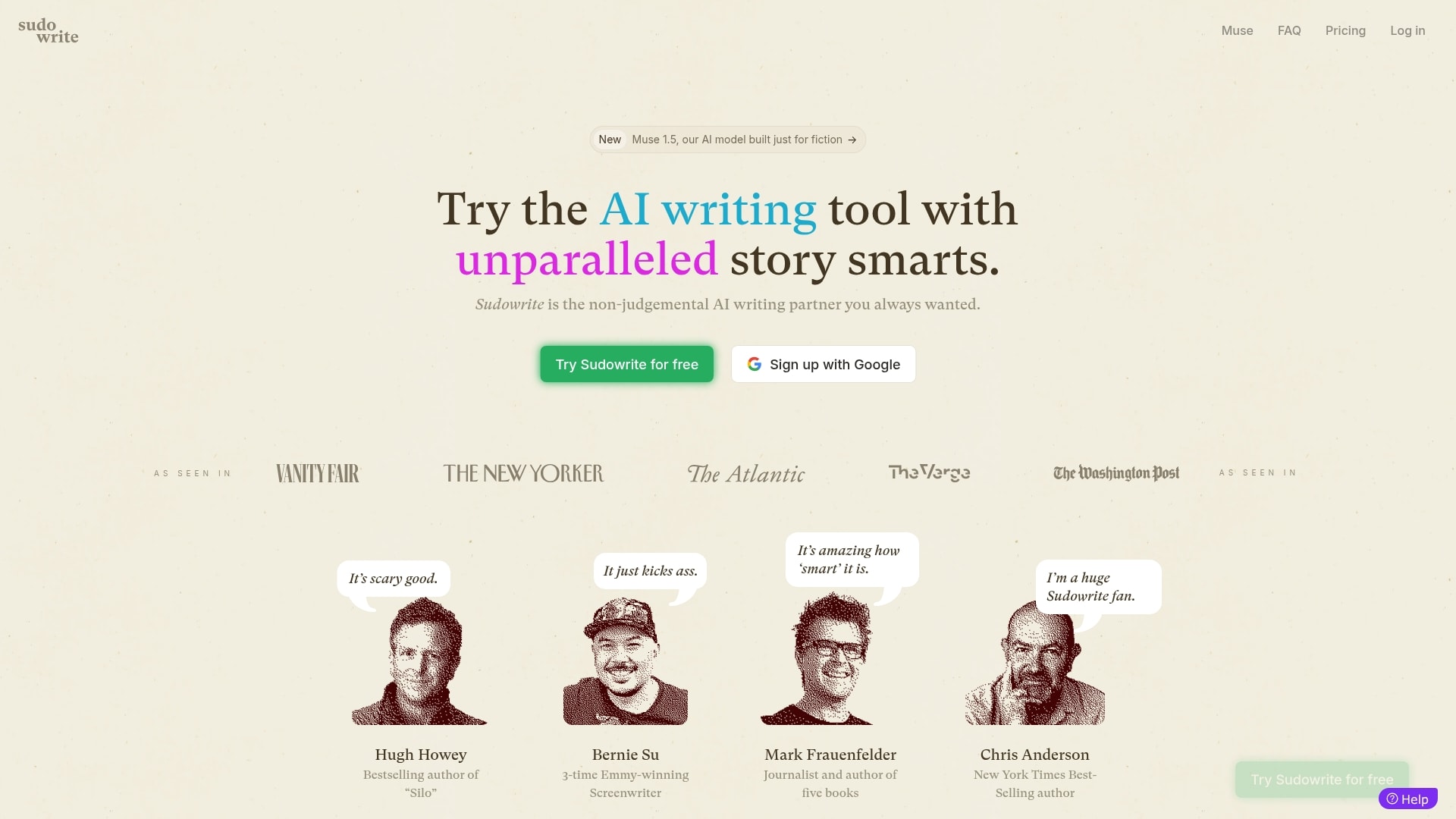
Use case: Sudowrite serves as an AI writing partner that helps fiction writers generate creative content, develop characters, and refine their storytelling from initial brainstorming through final editing.
Key features:
- Story Bible: comprehensive tool that organizes characters, world-building details, and plot points while maintaining consistency across your narrative
- Write and Rewrite: advanced autocomplete that generates text in your voice with multiple variations, plus flexible revision tools for improving prose.
- Canvas: visual brainstorming space for exploring plot points, character arcs, and generating plot twists with AI assistance.
Pricing:
- Hobby & Student: $10/month with 225,000 credits.
- Professional: $22/month with 450,000 credits.
- Max: $44/month with 2,000,000 credits (unused credits rollover for one year).
- Free-trial: available with no credit card required.
- Enterprise: plans available by contacting Sudowrite directly.
Considerations:
- Credit-based pricing system can be difficult to predict and may become expensive with heavy usage of advanced AI models.
- Primarily focused on English language content, limiting utility for writers working in other languages.
Learn more: The best AI for writing books
8. Anyword: best data-driven AI writer
By leveraging performance prediction technology, Anyword revolutionizes marketing copy creation, using billions of data points to forecast how well content will convert before it’s published. The platform specializes in conversion-focused writing for marketers and enterprises, making it ideal for teams who need measurable results.
With its unique Predictive Performance Score, Anyword takes the guesswork out of content creation by telling you which variations will drive the best outcomes.

Use case: Anyword excels at creating high-converting marketing copy across multiple channels while providing data-backed insights to optimize performance before content goes live.
Key features:
- Predictive Performance Score: get numerical predictions on how well your copy will perform, with 82% accuracy in A/B test outcomes.
- Copy Intelligence: analyze your brand’s existing content to identify high-performing messaging patterns and talking points.
- Brand Voice customization: train the AI to match your specific tone, style, and target audience preferences across all generated content.
Pricing:
- Starter: $39/month (billed yearly) or $49/month (monthly billing).
- Data-Driven: $79/month (billed yearly) or $99/month (monthly billing).
- Business: Custom pricing with advanced features and integrations.
- Enterprise: Custom pricing with dedicated support and private language models.
- Free-trial: 7-day free trial available on Starter and Data-Driven plans.
Considerations:
- Higher pricing compared to general-purpose AI writing tools may not suit small businesses or individual freelancers.
- Less effective for long-form content creation compared to specialized blog writing platforms.
9. Rytr: best budget AI writing software
For individuals and small teams seeking quality writing without a hefty price tag, Rytr delivers affordable AI-powered content generation. It’s a handy sidekick for marketers, bloggers, and entrepreneurs, specializing in short-form content across 40+ use cases.
While its full power, including 35+ languages, is unlocked on the premium plan, its free and low-cost options provide a fantastic starting point for budget-conscious creators.

Use case: Rytr serves as a comprehensive AI writing assistant that helps users overcome writer’s block and streamline content creation workflows across marketing, social media, and business communications.
Key features:
- AI-powered content generation for 40+ use cases, including blog posts, social media ads, emails, and product descriptions.
- A rich-text editor with built-in expansion and rephrasing capabilities to fine-tune your copy.
- Browser extension to bring your AI assistant into your favorite apps like Gmail, Slack, and WordPress.
- Premium features include an AI image generator, a plagiarism checker, support for 35+ languages, and the ‘MyVoice’ feature for creating unlimited custom tones.
Pricing:
- Free: $0/month for 10,000 characters per month in one language.
- Unlimited: $9/month ($7.50/month billed yearly) for unlimited characters, 50 plagiarism checks/month, and one custom voice profile. Limited to one language.
- Premium: $29/month ($24.16/month billed yearly) for unlimited characters, 100 plagiarism checks/month, support for 35+ languages, unlimited custom voices, custom use cases, and priority support.
Considerations:
- Long-form content quality can be inconsistent and may require significant editing and refinement.
- SEO and keyword research features are less robust compared to premium competitors like Jasper or Copy.ai.
10. Writer: best for enterprise teams
As a full-stack generative AI platform, Writer is engineered for large organizations that demand brand consistency and security at scale. The platform specializes in proprietary AI models and enterprise-grade governance, making it ideal for regulated industries like finance and healthcare.
With its Knowledge Graph technology and AI Guardrails, Writer ensures every piece of content aligns with company standards while maintaining compliance requirements.

Use case: Writer transforms how enterprise teams create content by providing AI agents that understand company voice, connect to internal data sources, and enforce brand guidelines automatically across all written communication.
Key features:
- Palmyra LLMs: proprietary large language models trained specifically for business writing that deliver more accurate, on-brand content from the first draft.
- Knowledge Graph: connects AI to your company’s internal documents and data sources, ensuring generated content is contextually relevant and citable.
- AI Guardrails: automated system that enforces brand consistency, style guidelines, and regulatory compliance across all AI-generated content.
Pricing:
- Starter: $29/month per user (billed annually) or $39/month (billed monthly).
- Enterprise: Custom pricing for organizations with more than 20 users.
Considerations:
- The platform’s extensive enterprise features can present a steep learning curve for smaller teams or individual users.
- Full customization capabilities and unlimited agents are only available in the custom-priced Enterprise plan, limiting accessibility for smaller organizations.
11. Quillbot: best AI paraphrasing tool
Through its advanced AI paraphrasing technology, Quillbot refines existing content, helping writers improve their text without starting from scratch. The tool really excels in intelligent rewriting with multiple style modes, making it ideal for students, academics, and content creators who need to enhance clarity while avoiding repetition.

Use case: Quillbot serves as a comprehensive writing companion that helps users paraphrase, summarize, and refine existing content while maintaining original meaning and context.
Key features:
- Multi-mode paraphraser with Standard, Fluency, Formal, Creative, and Shorten options for different writing styles.
- Integrated suite including grammar checker, summarizer, citation generator, and plagiarism detection.
- Co-Writer platform that combines all tools with research capabilities and note-taking functionality.
Pricing:
- Free plan: basic paraphrasing with word limits and standard mode access.
- Premium plan: enhanced features with increased word limits, additional paraphrasing modes, and full tool access.
- Plagiarism checker: available only with premium subscription with monthly page limits.
Considerations:
- Free version has significant limitations on word count per paraphrasing session.
- Paraphrased text occasionally requires manual editing to maintain natural flow and original nuance.
Best AI writing tools by content type
The best results come from pairing each writing task with the right AI assistant. Different tools shine in different areas — some are persuasive marketers, others are patient researchers or creative collaborators. The key is knowing which assistant to call on for which job.
Below, we’ve outlined the top AI platforms by content type, highlighting which tools perform best for marketing, research, fiction, and technical writing. This approach helps you build a balanced team of specialists that complement your unique workflow.
| Content type | Platform | Key features |
|---|---|---|
| Marketing copy | Jasper, Copy.ai | Templates, A/B testing, brand voice |
| Long-form articles | Claude, Agent Factory | Context retention, research, summarization |
| Fiction writing | Sudowrite | Character development, plot assistance |
| Technical docs | ChatGPT, Writer | Accuracy, code interpretation, collaboration |
Marketing copy and sales content
For marketing, you need a teammate who understands persuasion and speed. Tools like Jasper and Copy.ai are trained on high-converting copy, offering templates that give you a fast starting point for ads, emails, and landing pages.
Where this work often breaks down is consistency. That’s where AI platforms come into play. Instead of relying on one-off prompts, you can set up a dedicated agent for marketing copy that learns your brand voice, messaging guidelines, and campaign goals, then applies them consistently across channels.
This isn’t just about writing faster — it’s about having a specialist on your team focused purely on results, without re-explaining the brief every time.
Academic and research writing
Research demands an AI partner that sweats the details. Assistants like Claude are fantastic at holding context across long documents, helping you synthesize information and spot gaps in your arguments without losing the thread.
Think of this specialist as your meticulous research assistant. They help with citations, summarize dense papers, and ensure your work is built on a foundation of accuracy, freeing you up to focus on the big ideas.
Creative writing and fiction
Writing fiction requires a different kind of AI: less of a worker, more of a muse. A tool like Sudowrite is designed to be a creative partner, helping you brainstorm plot twists, flesh out characters, or simply break through a nasty case of writer’s block.
Again, this isn’t about replacing your imagination; it’s about having a collaborator to bounce ideas off of. It helps you explore new narrative paths while keeping the creative control firmly in your hands.
Technical documentation
Clarity and precision are non-negotiable in technical writing. Here, your AI teammate needs to speak fluent ‘developer.’ Tools like Writer and ChatGPT excel at translating complex technical concepts into clear, easy-to-understand documentation.
Their strength lies in integrating with your workflow, understanding code snippets, and adapting the content for different audiences. It’s like having a technical writer on call who ensures your developers and users are always on the same page.
How to use AI for writing without sounding robotic
AI can make writing faster, but it’s your voice that makes it real. To keep your work sounding human, treat your AI assistants like new teammates — they can generate strong first drafts, but they rely on your direction to find the right tone.
Here’s how to keep your writing natural and authentic:
- Lead the voice: guide your AI with clear tone and style cues so it reflects your personality, not a generic one.
- Mix up the rhythm: vary sentence lengths and structures — humans don’t write in perfect patterns, and that unpredictability is what makes text feel alive.
- Treat AI output as a draft: use it as a foundation, then rewrite and refine until it sounds like something you’d actually say.
- Add your human touch: include personal stories, opinions, or small details an AI couldn’t invent — that’s where authenticity lives.
- Read it aloud: if it sounds stiff or unnatural, it needs another pass. Your ear will always catch what the algorithm misses.
AI agents vs traditional AI writing tools
Most traditional AI writing tools are designed for one-off use. They’re effective for brainstorming ideas or mind mapping, but much of the context is lost once the session ends. That often means repeating instructions, re-prompting tone, and manually enforcing consistency across projects.
AI agents are built for ongoing work. AI Platforms let you create task-driven agents that take ownership of specific writing responsibilities and support repeatable processes instead of isolated outputs.
Here’s how the two approaches differ:
- One-off prompts vs defined roles: traditional tools respond to individual requests, while AI agents are assigned clear jobs like research, drafting, or editing.
- Manual consistency vs built-in structure: with agents, tone, formatting, and guidelines are applied automatically instead of being re-specified every time.
- Ad hoc output vs repeatable workflows: agents are designed to support recurring writing needs such as weekly content, campaigns, or reports.
- Heavy prompting vs lighter oversight: instead of crafting perfect prompts, you review and refine output from agents that already understand their role.
When does an agent-based approach make sense? When writing becomes an ongoing process rather than a single task. If you manage a content calendar, coordinate multiple campaigns, or need consistent output across teams and formats, AI platforms help turn AI from occasional assistance into a dependable part of your workflow.
Frequently asked questions
How do AI writing tools protect my data and maintain privacy?
AI writing tools protect your data through encryption, secure servers, and strict access controls. Most reputable platforms don’t use your content to train models or store it long-term. Always check the platform’s privacy policy to ensure your data stays confidential and under your control.
Can AI writing assistants work without an internet connection?
The vast majority of AI writing tools require an internet connection to access their language models. Some may offer very limited offline functionality for basic tasks.
What is the typical learning curve for new AI writing software users?
Most tools are designed for immediate use, allowing you to get value on day one. Mastering advanced features and customization options usually takes a couple of weeks.
Do AI writing tools support languages other than English?
Yes, many leading platforms support multiple languages. However, the quality and range of features can vary significantly depending on the language.
How frequently do AI writing platforms update their capabilities?
Updates are frequent, with many platforms releasing new features monthly. The underlying AI models are typically updated quarterly or as major advancements occur.
Which free AI writing assistant offers the most features for beginners?
Some of the best free AI writing assistants include ChatGPT, Google Gemini, Grammarly, and QuillBot. These tools can help with drafting content, improving grammar and clarity, paraphrasing text, and generating ideas, often with generous free plans but some usage limits.

 Get started