


Successful stock trading requires more than just good instincts; it demands tireless data analysis and disciplined execution. While many seek the best AI for stock trading, the real advantage is not found in a single, all-powerful bot. It comes from building a personalized team of AI assistants that handle specific tasks, freeing you to focus on strategy. This approach lets you delegate jobs while another tracks performance, keeping you in full control.
This guide explores the top AI platforms available as we head into 2026, from complex trading engines to flexible tools for building your own helpers. Take a few minutes and join us as we walk through their key features, pricing, and ideal use cases to help you assemble the right system for your trading style.
Key takeaways
- AI works best as a system: consistent trading results come from combining specialized tools for research, execution, and risk management rather than relying on one all-in-one bot.
- You stay in control: AI can scan markets and execute rules, but strategy, risk tolerance, and final decisions always depend on human judgment.
- Specialization beats generalization: separating tasks like news monitoring, technical analysis, and portfolio tracking leads to clearer signals and fewer emotional trades.
- Custom agents add flexibility: platforms like Trade Ideas or TrendSpider allow investors to build focused AI helpers that monitor watchlists, summarize market events, or track performance without rebuilding workflows each session.
- Start small and scale responsibly: test strategies in paper trading, validate performance, and expand automation only after confidence and consistency are established.
What is AI stock trading software?
AI stock trading software operates not as a single, monolithic program, but as a personalized suite of market-watching agents. Each agent is a specialist you deploy to monitor opportunities, analyze trends, or track news: 24/7. You remain the manager who directs the strategy; they are the tireless assistants watching the field for you.
This is about building a team of helpers, one function at a time. It’s about building a team of helpers, one task at a time. You can assign one agent to simply read financial news and flag keywords, while another becomes an expert at spotting specific chart patterns you care about.
It’s a focused, predictable approach to getting an edge.
Ultimately, these agents execute your strategy with precision, freeing you from the screen. You set the rules — buy at this price, sell if it drops, send me an alert — and your team gets it done, acting as your financial safety net. The tedious monitoring is handled, so you can focus on your next big move.
Top 12 AI platforms for stock trading
AI has reshaped how investors research, monitor, and act on market opportunities. Modern platforms can scan thousands of securities, surface patterns, and automate rule-based actions in real time. But performance does not come from automation alone. The real edge comes from how well these tools fit your strategy and how clearly responsibilities are defined.
Instead of relying on a single, all-in-one trading bot, many investors now build modular systems. One tool handles technical analysis, another tracks news and sentiment, while another focuses on portfolio oversight or risk controls. This structure keeps signals clearer, reduces noise, and makes it easier to adapt as market conditions change.
The platforms below represent the strongest AI-driven trading solutions heading into 2026. Each approaches automation and analysis differently, giving you the flexibility to assemble a system that matches your trading style.
1. Horizon
Horizon.Trade is the first agentic trading platform.
It lets traders create any strategy idea in plain English, backtest it, connect their broker, and deploy it live in one click.
Instead of jumping between research tools, charting platforms, backtesting software, Discord groups, and brokers, Horizon brings the entire trading workflow into one AI-native platform.
Users can build strategies from scratch, copy strategies from other traders, explore community ideas, or create strategies inspired by public traders, hedge fund filings, politician stock disclosures, market anomalies, and proven trading patterns.
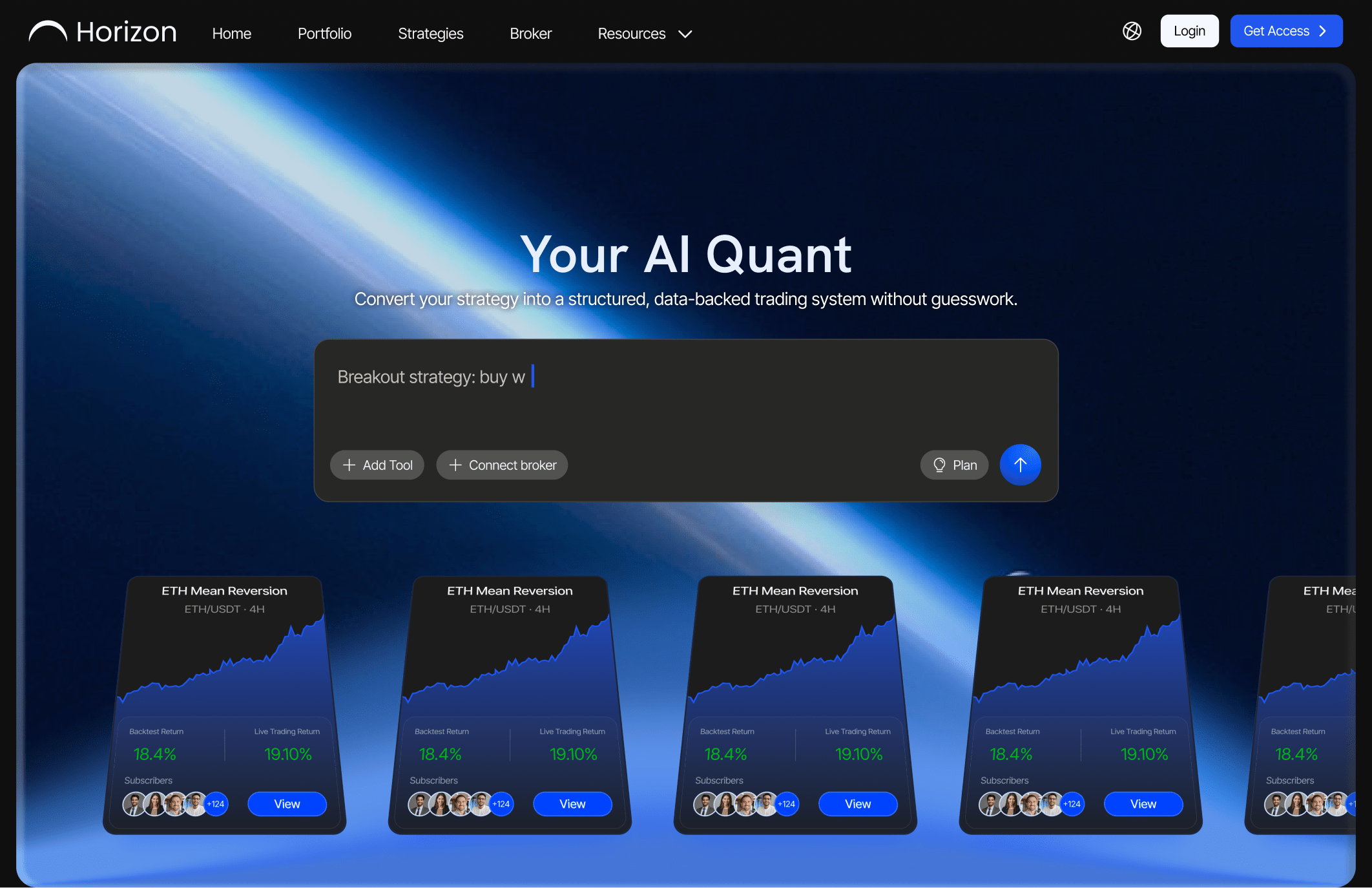
Use case: Create, backtest, copy, and deploy trading strategies in one click. Connect your broker and trade live with zero code.
Key features:
- AI strategy creation: describe any trading idea in plain English and turn it into a real trading strategy.
- Instant backtesting: test strategies on historical market data before going live.
- One-click deployment: connect your broker and deploy strategies live.
- Strategy copying: copy and adapt strategies from other traders.
- Community strategies: discover strategies, ideas, and playbooks from the Horizon trading community.
- Market intelligence strategies: build strategies inspired by public traders, hedge fund filings, politician stock disclosures, market anomalies, and proven trading patterns.
- Zero-code automation: create, copy other strategies, deploy, and automate strategies without coding.
Pricing:
- Essential: $59/month
- Pro: $99/month
- Elite: $199/month
- Institutional: contact sales
Considerations:
Horizon is built for traders who want to create, test, copy, deploy, and improve strategies, not just receive basic alerts. Live trading requires proper risk management and validation before deploying real capital. Broker availability, supported assets, community strategies, and data sources may vary by region and account type.
2. Trade Ideas
Through its flagship Holly AI engine, Trade Ideas provides AI-powered stock scanning and trading signals designed to identify high-probability trading opportunities in real-time. The platform prides itself on momentum trading and offering pre-built strategies, making it ideal for active day traders who need instant market insights and actionable trade ideas.
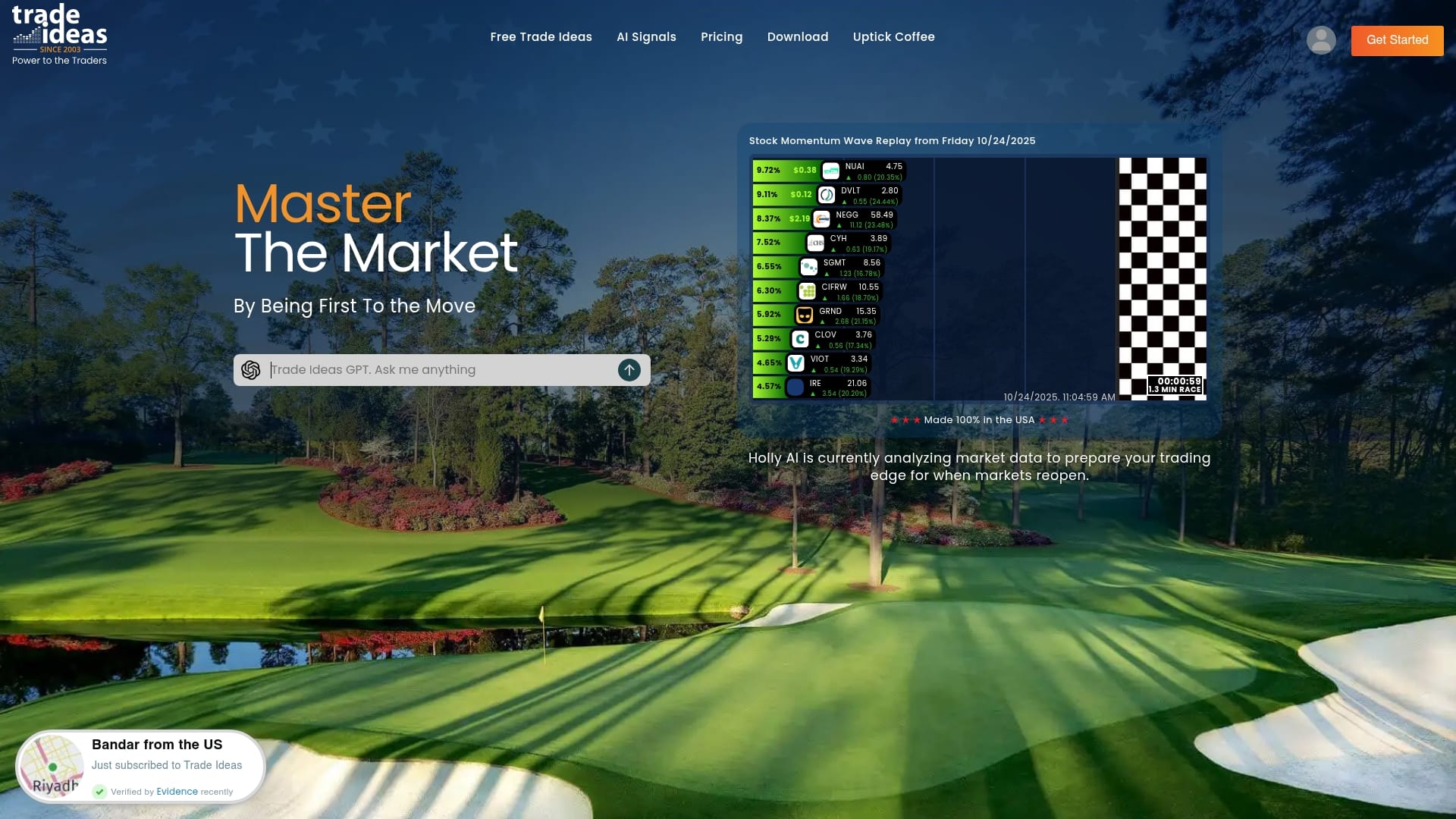
Use case: Trade Ideas empowers active traders with AI-generated daily trade recommendations, complete with entry and exit points, eliminating hours of manual market research.
Key features:
- Holly AI virtual assistant: provides five to eight curated, high-probability trade ideas daily with specific buy/sell signals and stop-loss levels.
- Real-time market scanning: server-side analytics monitor every stock and ETF trade with customizable alerts and over 500 filters.
- OddsMaker backtesting: no-code strategy testing against historical data to validate trading approaches before risking capital.
Pricing:
- The Par Plan: free with delayed data, stock racing, and basic charting features.
- The Birdie Bundle (TI Basic): $127/month or $1,068/year (save $456) with real-time data and paper trading.
- The Eagle Elite (TI Premium): $254/month or $2,136/year (save $912) including Holly AI signals and advanced backtesting.
Considerations:
- Premium AI features require expensive subscription plans that may not justify costs for casual traders.
- Desktop application has a steep learning curve and dated interface that can overwhelm new users.
3. TrendSpider
Automating the meticulous work of chart pattern recognition and trendline drawing is the core strength of TrendSpider. The platform specializes in AI-powered trading tools that identify over 220 chart patterns and 150 candlestick patterns automatically, making it perfect for active traders who want to eliminate human bias from their analysis.
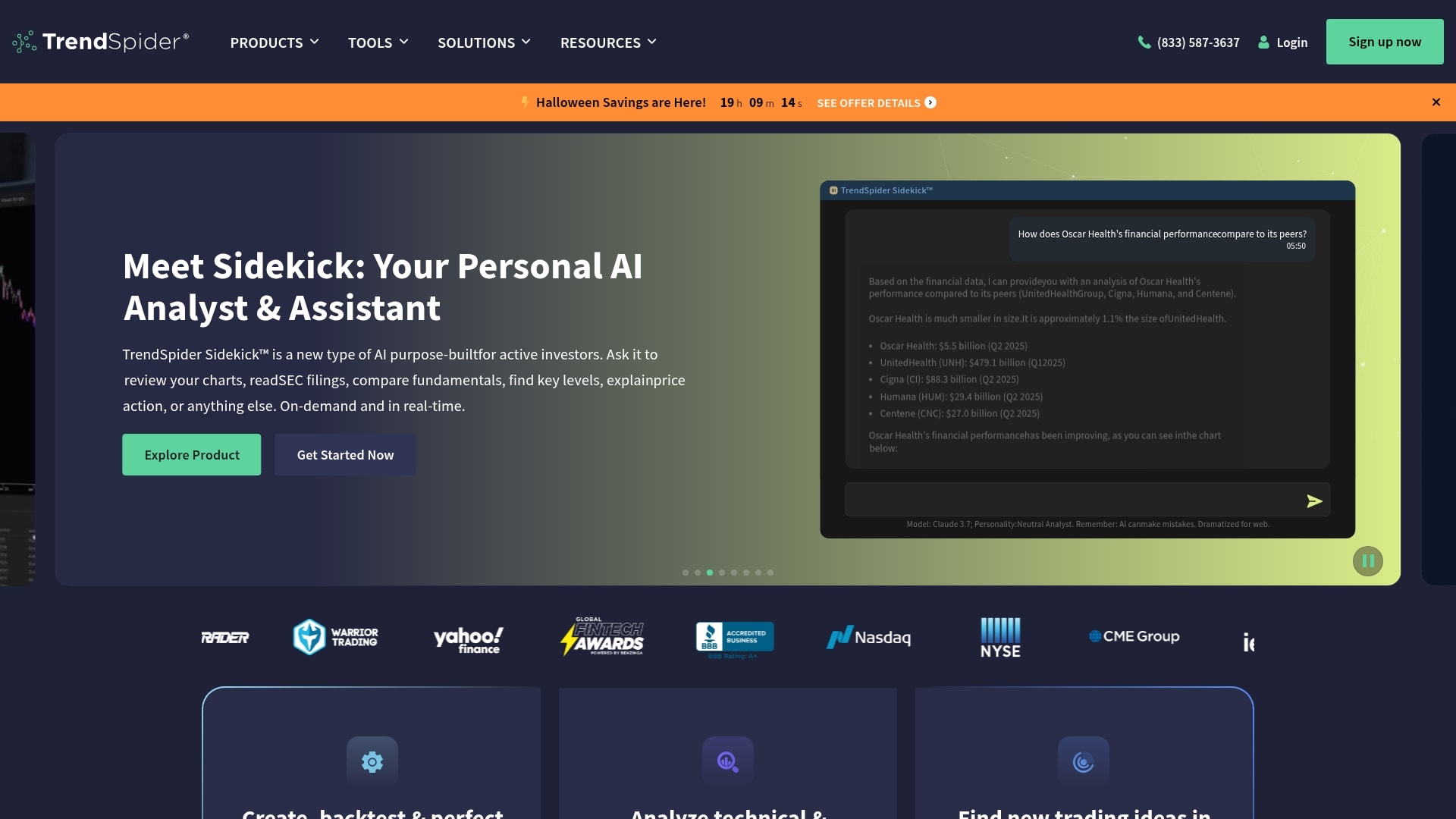
Use case: TrendSpider saves traders hours of manual chart analysis by automatically detecting patterns, support/resistance levels, and trend lines with mathematical precision across multiple timeframes.
Key features:
- AI Strategy Lab: train custom machine learning models for market prediction without coding knowledge, using multiple algorithms like Random Forest and K-nearest Neighbors.
- Automated pattern recognition: instantly identifies over 220 chart patterns and 150 candlestick patterns across stocks, ETFs, forex, and cryptocurrencies.
- Sidekick AI assistant: natural language chatbot that scans markets, analyzes charts, and answers trading queries in real-time.
Pricing:
- Standard: $51.30 to $77.90 per month (normally $54 to $89/month, up to 5% off first invoice).
- Premium: $52.78 to $79.46 per month (normally $91 to $149/month, up to 42% off first invoice).
- Enhanced: $67.10 to $100.65 per month (normally $122 to $199/month, up to 45% off first invoice).
- Advanced: $96.30 to $144.45 per month (normally $214 to $349/month, up to 55% off first invoice).
- Free-trial: all plans include 14-day trial for $5 and 25 free Sidekick AI messages per month.
- Additional Sidekick AI plans range from free (25 messages) to $349/month (1,000 messages).
Considerations:
- Premium pricing may be prohibitive for casual or new traders compared to other AI trading platforms.
- Learning curve can be steep due to advanced features, potentially overwhelming beginners despite the user-friendly interface.
4. Tickeron
By combining sophisticated machine learning with confidence ratings and educational resources, Tickeron provides AI-powered forecasting to help traders make smarter decisions across stocks, ETFs, forex, and crypto markets. The platform is ideal for both novice investors and experienced traders who want data-driven insights.
With its unique blend of AI predictions and human community insights, Tickeron democratizes access to institutional-grade trading intelligence.
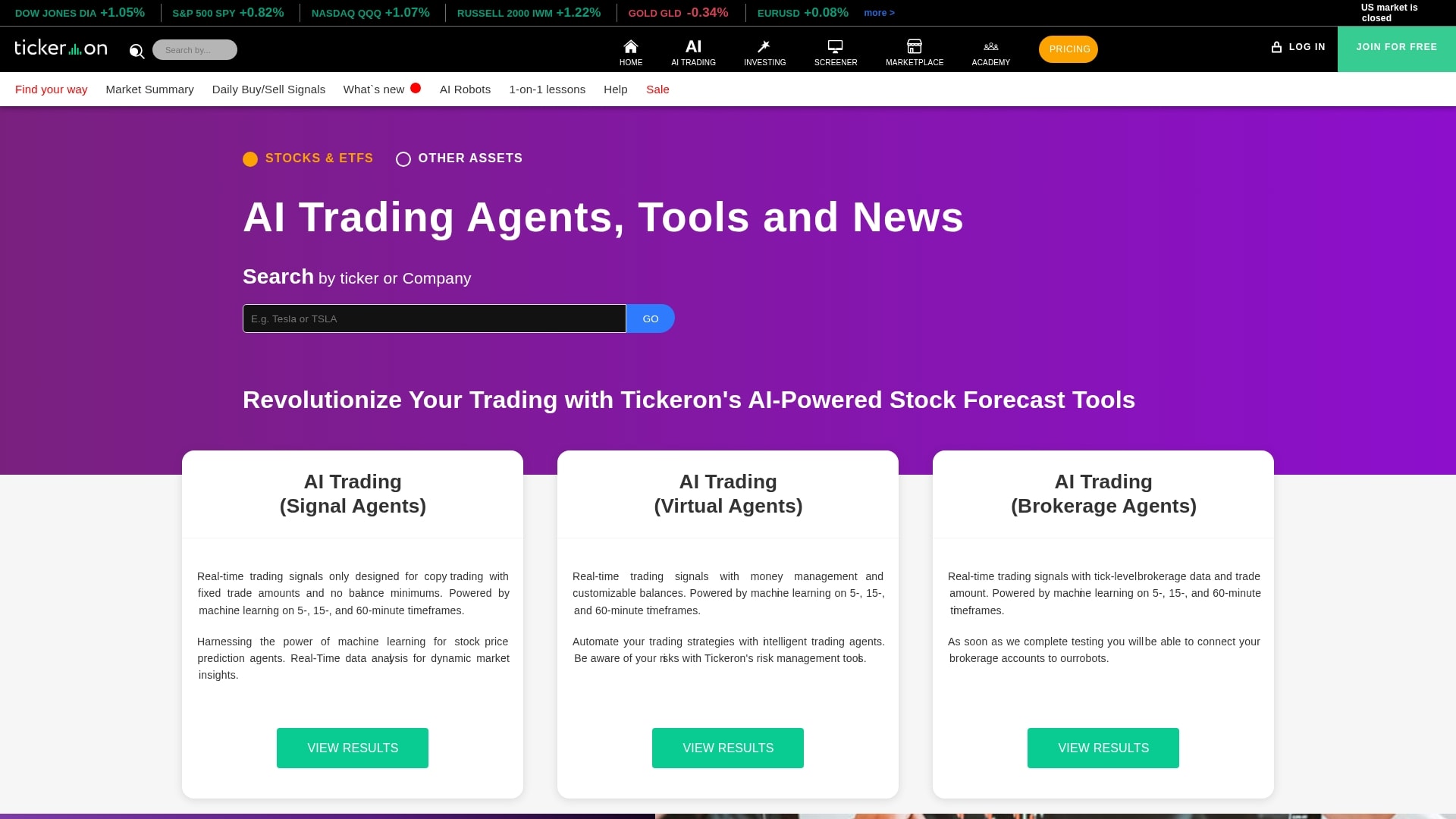
Use case: Tickeron processes vast amounts of technical and fundamental market data in real-time to generate trading signals, identify patterns, and provide confidence ratings for predictions across multiple asset classes.
Key features:
- AI-powered pattern recognition engine that scans thousands of securities for technical trading patterns with historical success probabilities.
- Three generations of customizable AI trading bots, from simple signal alerts to fully automated brokerage-connected trading systems.
- Comprehensive backtesting and forward testing capabilities with detailed performance analytics including Sharpe ratios and profit factors.
Pricing:
- For current pricing details, visit their pricing page directly at tickeron.com/pricing.
Considerations:
- Steep learning curve for beginners who may find the abundance of advanced features overwhelming initially.
- Mobile app functionality is limited compared to the web platform, with some users reporting interface constraints and fewer customization options.
5. QuantConnect
A comprehensive, cloud-based algorithmic trading platform, QuantConnect transforms how quantitative analysts approach AI-powered stock trading. The platform specializes in end-to-end strategy development with native machine learning integration and a groundbreaking AI assistant interface, making it ideal for technical users who want to build, test, and deploy sophisticated trading algorithms.
Boasting over 431,000 global users and $45 billion in monthly trading volume, it’s become the go-to choice for serious quants and data scientists.

Use case: QuantConnect provides institutional-grade infrastructure for developing, backtesting, and deploying AI trading strategies across multiple asset classes, from initial research through live trading execution.
Key features:
- MCP Server integration: revolutionary AI assistant that uses natural language to design, backtest, optimize, and deploy trading strategies through conversational commands.
- Comprehensive data library: access to terabytes of historical and alternative data across equities, options, futures, forex, and crypto with point-in-time accuracy.
- Open-source LEAN engine: battle-tested algorithmic trading engine with native support for TensorFlow, PyTorch, and other machine learning libraries.
Pricing:
- Free Plan: $0/month (unlimited backtesting, community support, basic data access).
- Researcher: $60/month ($720 annually with savings) (local coding, expanded datasets, unlimited projects).
- Team: $120/user/month ($1,200 annually with savings, minimum two users) (collaboration features, increased compute).
- Trading Firm: $336/user/month ($3,360 annually with savings, minimum two users) (team management, unlimited compute).
- Institution: $1,080/user/month ($10,800 annually with savings, minimum five users) (on-premise platform, enterprise features).
Considerations:
- Steep learning curve requiring strong programming skills in Python or C#, making it challenging for non-technical traders.
- Resource limitations on lower-tier plans can restrict computationally intensive machine learning models and backtesting speed.
6. TradingView
TradingView distinguishes itself as the ultimate hub for traders, functioning as both a top-tier charting platform and a massive social network where millions of users share strategies, scripts, and market insights.
While TradingView itself doesn’t offer proprietary AI tools, it provides the stage for the community to shine. Its secret weapon? Pine Script, a coding language that lets you create your own indicators and tap into a huge library of community-made “AI” scripts.
Use case: TradingView is your all-in-one charting hub and social network. Tap into a library of community-built indicators (some using AI concepts), create custom alerts with Pine Script, and brainstorm with over 100 million other traders.
Key features:
- Vast library of community-built indicators: access thousands of scripts created by users, including some that use machine learning concepts like K-Nearest Neighbors, adaptive indicators, and breakout detection.
- Pine Script language: a user-friendly scripting tool for building custom indicators and strategies. While complex AI is a stretch, it’s great for creating adaptive algorithms and statistical models.
- Massive social trading network: share, discuss, and collaborate on trading ideas and scripts with a global community of traders.
Pricing:
- Basic: $0 forever (no credit card needed).
- Essential: $12.95/month (billed annually, saves $24 per year).
- Plus: $28.29/month (billed annually, saves $68 per year).
- Premium: $56.49/month (billed annually, saves $138 per year).
- Ultimate: $199.95/month (billed annually, saves $480 per year).
- Enterprise: plans available by contacting TradingView directly.
- Extra real-time data available as add-ons for paid plans.
Considerations:
- Requires third-party automation services to execute trades, adding complexity and additional costs beyond TradingView subscriptions.
- Community-created AI indicators vary widely in quality and effectiveness, requiring careful evaluation before implementation.
7. StockHero
StockHero enables the deployment of automated trading bots that work around the clock, so you don’t have to. It handles stocks, ETFs, and crypto, analyzing market data and executing trades without you needing to write a single line of code. The platform mixes a friendly drag-and-drop strategy builder with a marketplace of ready-made bots, making algorithmic trading and AI investing a breeze for everyone from total newbies to trading veterans.
Plus, you can manage your bot army from anywhere with their iOS and Android apps.
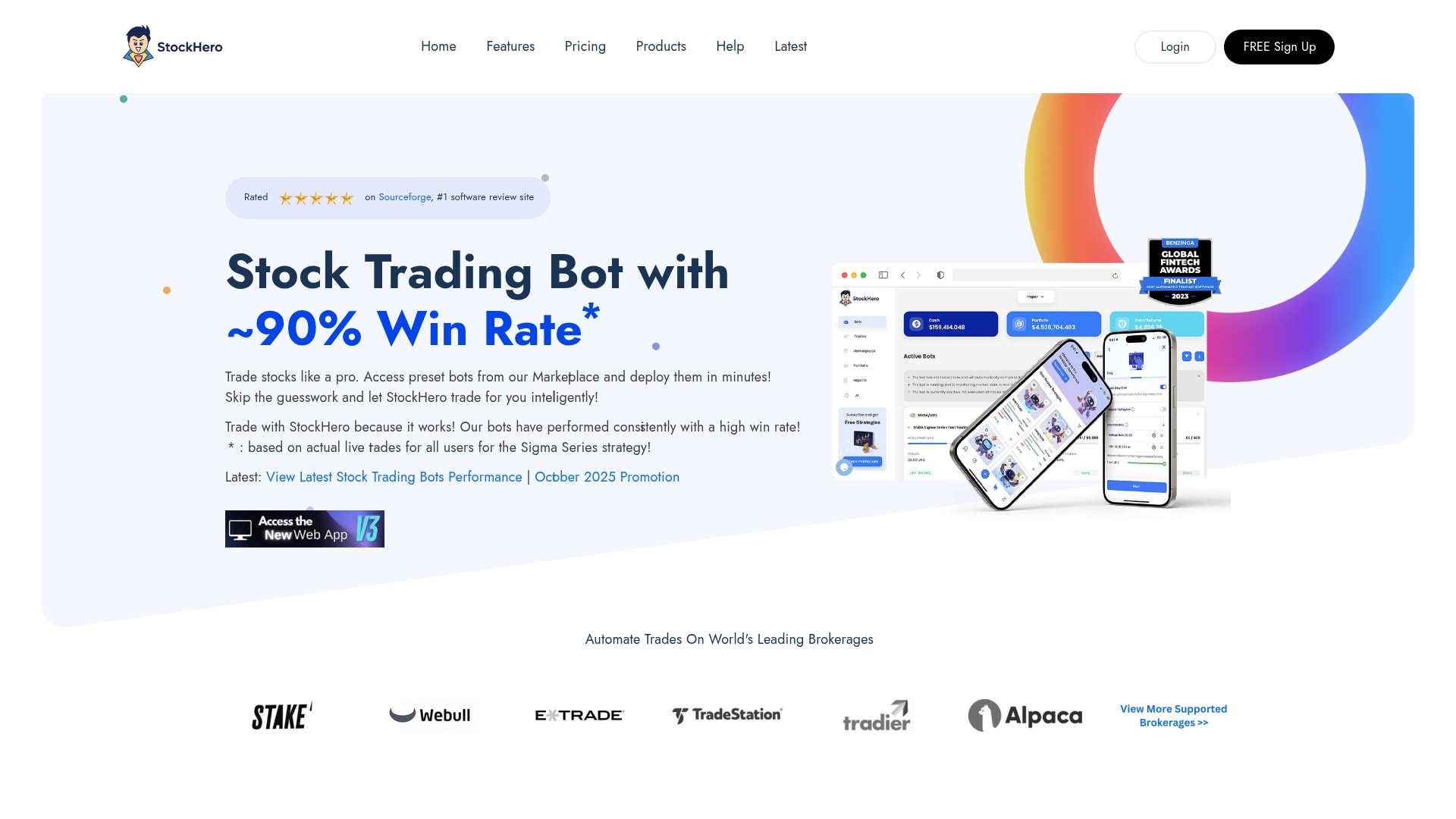
Use case: StockHero enables traders to automate their strategies through cloud-based bots that execute trades 24/7 while connecting directly to existing brokerage accounts.
Key features:
- No-code bot builder with a drag-and-drop interface for creating your own trading strategies.
- Marketplace of pre-configured bots from experienced traders, including the high-performing Sigma Series.
- Paper trading environment for risk-free strategy testing with real-time market simulation.
- Trade across multiple asset classes, including stocks, ETFs, and cryptocurrencies.
- Personalized support through an AI ChatBot and White Glove onboarding service.
- ISO 27001 certified and award-winning platform, so you know your strategies are in safe hands.
Pricing:
- Lite: $29.99/month ($299.99 annually) – includes a 14-day free trial. You get one active bot, unlimited signals and backtests, and access to all supported brokers. Paid subscribers also get a free Sigma Series Alpha bot.
- Premium: $49.99/month ($499.99 annually) – everything in Lite, plus 15 active bots, TradingView integration, marketplace access, the Alpha Pack (free strategies), an AI ChatBot, and White Glove Service.
- Professional: $99.99/month ($999.99 annually) – the full toolkit: 50 active bots, one-minute trading frequency, SMS notifications, extended-hours trading, and custom backtest periods. The annual plan gives you all existing and future Marketplace strategies for free, forever.
Considerations:
- While it supports major brokers, the number of integrations is more limited compared to some competitors, and certain advanced features are reserved for higher-tier plans.
- Marketplace bots are “black boxes” (you can’t see the code), but they come with detailed performance stats to help you vet them before deploying.
8. MetaStock
For serious traders who demand institutional-quality data, MetaStock provides professional-grade technical analysis and AI-powered forecasting tools. The platform combines decades of proven analytical capabilities with advanced AI features like neural network-based signal generation and statistical price forecasting.
With over 40 years in the market and a loyal base of 150,000+ users worldwide, MetaStock has earned its reputation as a powerhouse for traders who rely heavily on technical analysis.
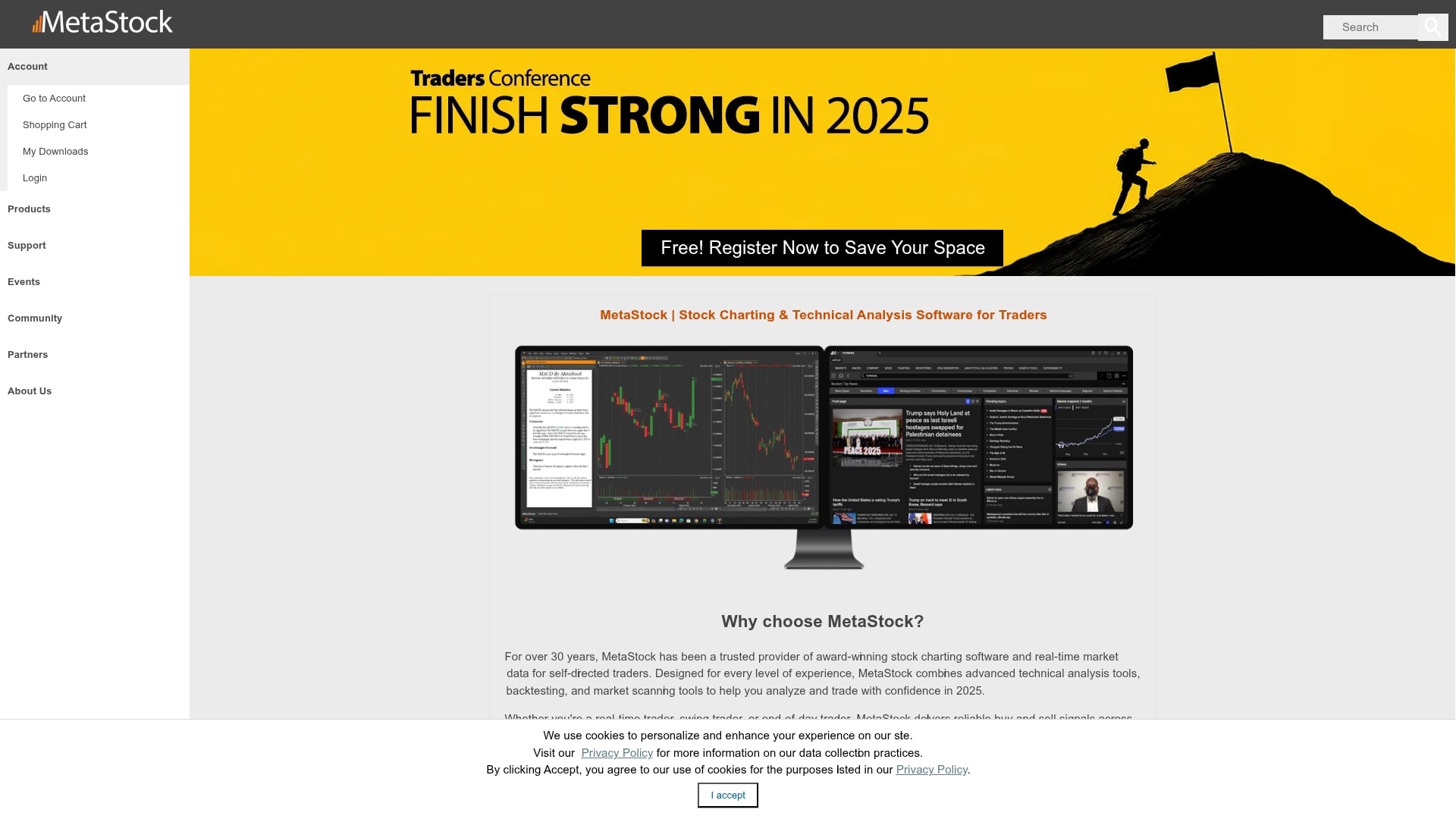
Use case: MetaStock provides comprehensive technical analysis and AI-driven trading insights for active traders who need professional-grade tools to analyze market patterns and generate high-probability trading signals.
Key features:
- Fulgent AI add-on: neural network-powered signal generation that identifies four types of trading opportunities including major market reversals and volatility breakouts.
- MetaStock Forecaster: creates statistical “probability clouds” showing potential future price movements based on 67 built-in pattern recognizers.
- Enhanced System Tester: robust backtesting engine that allows traders to validate AI-generated strategies against historical data.
Pricing:
- MetaStock D/C (End-of-Day): starting around $59/month.
- MetaStock R/T (Real-Time): starting around $99/month.
- Fulgent AI Add-on: additional cost (specific pricing available upon request).
- Real-time data feeds: additional monthly fees vary by exchange.
- Full suite with AI features can exceed $250/month when combining software, data, and AI add-ons.
Considerations:
- Steep learning curve with a dated interface that may feel overwhelming for newer traders.
- Core AI capabilities require expensive add-ons rather than being integrated into the base software, significantly increasing total costs.
9. VectorVest
VectorVest simplifies complex market data into clear buy, sell, or hold signals through its proprietary VST rating system. The platform targets individual investors who want systematic, emotion-free trading decisions backed by over 30 years of mathematical modeling. With its RoboTrader feature, users can automate their trading strategies while maintaining full control over execution.

Use case: VectorVest transforms overwhelming market data into simple, actionable trading recommendations through its Value, Safety, and Timing (VST) indicators that analyze over 18,000 stocks daily.
Key features:
- VST rating system: combines fundamental and technical analysis into clear numerical ratings for every stock.
- RoboTrader automation: connects directly to brokerage accounts to execute trades based on predefined strategies.
- Market timing signals: provides bullish or bearish market direction guidance to optimize portfolio performance.
Pricing:
- Basic: $69/month or $695/year (save $133 annually).
- Enhanced: $99/month or $995/year (save $193 annually).
- Premium: $149/month or $1,495/year (save $293 annually).
- Free-trial: 30-day trial available for $9.95 across all plans.
- Cancel anytime with no contracts or hidden fees.
Considerations:
- The platform’s “AI” relies on traditional mathematical models rather than modern machine learning technology.
- Interface can feel overwhelming for new users due to the density of information presented on dashboards.
10. Composer
Complex algorithmic trading becomes a visual, no-code experience with Composer, a platform designed for any investor to master. It excels in AI-assisted strategy creation, allowing retail investors to build, backtest, and automate sophisticated trading algorithms without writing a single line of code.
According to latest figures, the platforms has $20 billion in trading volume and a thriving community of strategy creators: it’s essentially democratizing quantitative investing for everyday traders.
Use case: composer empowers retail investors to create and automate sophisticated trading strategies using natural language prompts and visual building blocks, eliminating the need for programming knowledge while providing institutional-grade algorithmic trading capabilities.
Key features:
- AI-powered strategy creation that translates plain English descriptions into executable trading algorithms.
- Visual drag-and-drop editor for building custom “symphonies” with conditional logic and dynamic filtering.
- Comprehensive backtesting engine with performance metrics, fee modeling, and benchmark comparisons.
Pricing:
- Free Plan: unlimited strategy building and backtesting.
- Pro Plan: $5/month (currently 88% off regular price) for automated trading execution.
- Zero commissions: no trading fees or management fees on executed strategies.
Considerations:
- Trades execute only once daily in batches, preventing intraday trading strategies.
- Limited selection of technical indicators compared to more advanced platforms.
11. Superalgos
As a completely free and open-source platform, Superalgos provides the tools for building sophisticated AI trading strategies from the ground up. This community-driven ecosystem empowers developers and technical traders to create custom machine learning models using visual scripting tools, making advanced algorithmic trading accessible without subscription fees or vendor lock-in.
Use case: Superalgos provides a comprehensive framework for technically-minded traders who want complete control over their AI trading strategies, from data mining and model training to live execution across 120+ cryptocurrency exchanges.
Key features:
- Visual TensorFlow integration for building and training custom neural networks without extensive coding.
- Complete data mining capabilities with API connections to process market data from multiple exchanges simultaneously.
- Collaborative ecosystem where users can share trading intelligence and crowdsource machine learning model training.
Pricing:
- Core platform: free and open-source with no subscription fees or premium tiers.
- Premium community services: requires holding Superalgos (SA) tokens for AI predictions and priority trading signals.
- Token access: SA tokens can be earned through project contributions or purchased on supported exchanges.
Considerations:
- Steep learning curve requires significant time investment to master the complex visual scripting environment.
- TensorFlow integration remains experimental and may have bugs or incomplete features for advanced AI implementations.
12. FinViz Elite
Market research is transformed by FinViz Elite through powerful visual screening and pattern recognition tools that help traders spot opportunities fast. The platform specializes in heat maps and automated technical analysis, making it ideal for swing traders and investors who need quick market insights without the complexity of full AI automation.
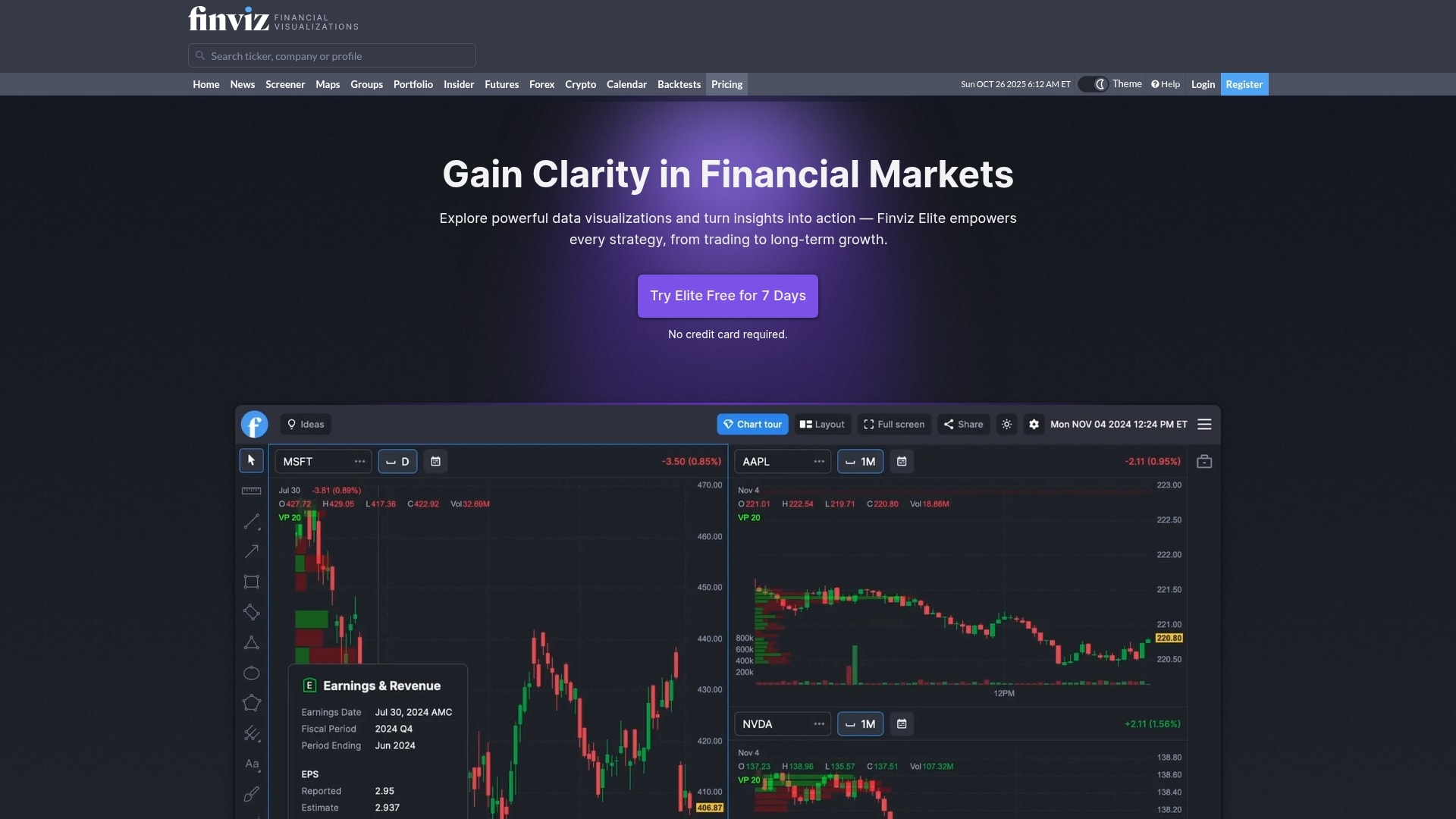
Use case: FinViz Elite provides real-time market data and advanced screening capabilities for traders who want to quickly identify trading opportunities through visual market analysis and no-code backtesting.
Key features:
- Advanced stock screener with 67 filtering criteria across 8,500+ stocks and ETFs.
- Automatic pattern recognition for 33 technical chart patterns and candlestick formations.
- No-code backtesting with up to 24 years of historical data across 100+ technical indicators.
Pricing:
- Free-trial: 7-day trial with no credit card required.
- Monthly plan: $39.50/month (billed monthly).
- Annual plan: $24.96/month (billed annually at $299.50).
Considerations:
- Limited to US markets only (NYSE, Nasdaq, and Amex), excluding global equities.
- Lacks true AI-driven trading signals and automated execution capabilities compared to dedicated AI trading platforms.
How to choose the right AI trading platform
Choosing the right AI trading platform is less about flashy features and more about fit. The best choice aligns with your strategy, giving you the tools to deploy automation that supports your goals instead of dictating them.
Some traders prefer a single, all-in-one bot, while others build flexible systems with specialized helpers. A versatile platform lets you start small and scale as your strategy grows, all without deep technical skills.
The key question is simple: does this platform help you delegate the details while keeping control of the big decisions? The right setup works for you, not the other way around.
Building your AI trading team: the must-have skills
An effective AI trading system is not a monolith; it’s a collection of specialized functions working in concert. The objective isn’t to be buried in data, but to receive clear, focused support that enhances your decision-making.
The best platforms allow you to assemble these capabilities yourself, one function at a time. Each automated process should have a clear purpose, whether it’s identifying trends or safeguarding your portfolio. This modular approach ensures you remain in control while the system handles the heavy lifting.
Real-time market intelligence
Your system needs a function that scans live market data to spot patterns and opportunities before they become obvious. This isn’t just about crunching numbers; it’s about getting an early warning on market sentiment shifts or sudden volatility, turning raw data into a signal you can act on.
Automated strategy execution
Once an opportunity is identified, you need a component ready to act on it. Look for AI that can generate buy/sell alerts based on your rules and, more importantly, can execute the trade for you. Receiving a notification is useful, but having a trade handled automatically is where you gain a real edge, with you always setting the final say on timing and execution.
Dynamic portfolio oversight
A great AI system includes a strategic function that monitors the big picture. This component should track your portfolio’s health, suggesting adjustments to position sizing and diversification to keep your strategy on track. It’s not about chasing wild gains, but about smart, steady growth and making adjustments before a small issue becomes a big one.
Integrated risk management
Every strategy needs a defensive layer whose sole job is to protect your capital. Features like automated stop-losses and intelligent position sizing are your built-in safety net, working quietly to prevent a bad day from becoming a disaster. This risk management function keeps an eye on your exposure so you can focus on the opportunities ahead.
Seamless system connectivity
Your AI system shouldn’t be an isolated island; it needs to connect to your existing tools. Look for a platform that easily integrates with your broker and other systems through APIs. The goal is a smooth, unified setup where your AI can access data and execute trades without you having to juggle a dozen different apps.
Benefits of using AI for stock trading
Human instincts can only go so far. AI expands that reach, scanning markets and analyzing data faster and more accurately than any individual could. It is like having a dedicated analyst for every stock on your list — one that never tires or hesitates.
Key benefits include:
- Scale and speed: AI tracks countless data points in real time, spotting opportunities before they hit your radar.
- Unbiased execution: automated decisions remove the emotion that often leads to reactive or inconsistent trading.
- Precision under pressure: AI sticks to the strategy you set, maintaining discipline even when markets get volatile.
- Custom teamwork: build a team of AI assistants, each with a defined role — from tracking price dips to flagging sudden news events.
Limitations of AI trading tools
AI trading tools are powerful analytical engines, not clairvoyant oracles. They process enormous amounts of data to spot patterns, but they cannot predict the future with certainty.
Consider them an expert research team, but you’re still the one making the final strategic calls.
Markets can be wonderfully unpredictable, and no amount of data can foresee a sudden global event or a viral tweet that shifts everything. This is why your oversight is the most important part of the strategy. Your AI provides the intelligence; you provide the wisdom.
Even the best game plan needs a periodic review. You’ll want to check in on your automated strategies and tweak their approach as market conditions change. It’s also smart to remember that technology can have hiccups, which makes diversification and backup plans your most valuable assets.
When to use AI trading platforms
AI trading platforms are most valuable when speed, scale, and focus matter most. They analyze market data around the clock, filtering noise and highlighting what deserves attention. The key is knowing when automation adds value — and when human judgment should take the lead.
AI trading delivers the most impact when:
- Data overload hits: thousands of data points, indicators, and news updates become impossible to track manually.
- Precision is critical: split-second decisions or strict rule-based execution are required to avoid missed opportunities.
- Market volatility spikes: automation keeps emotions in check and ensures your plan stays consistent under pressure.
- Strategy testing scales up: you need to run hundreds of backtests or simulations in a single session to validate your approach.
How to get started with AI stock trading
Adopting AI in your trading is a methodical process, not a shortcut to instant expertise. The first step is to build your trading intelligence step by step, just as you’d assemble a team of specialists for a big project. You are the architect of your strategy.
Start by understanding the fundamentals: how the market moves and what role your AI agents can realistically play. This isn’t about finding a magic button; it’s about building a solid foundation so you can direct your automated tools with confidence. Your knowledge is what separates a smart strategy from a blind gamble.
Once you have a game plan, it’s time for a scrimmage. Use a demo account to run your plays with zero risk, seeing how your strategies perform in a live environment.
Frequently asked questions
Can AI trading platforms connect with my existing brokerage account?
Yes, most platforms connect to major brokerage accounts via secure APIs for automated trading. Always confirm your specific broker is supported before you commit to a platform.
What is the typical success rate of AI trading algorithms?
Success rates are not guaranteed and depend entirely on the strategy, market conditions, and your risk settings. Performance should be measured against your personal financial goals, not a universal benchmark.
Do I need programming skills to use AI trading platforms?
No, many leading platforms offer no-code builders that let you create strategies visually. Platforms for advanced custom algorithms may still require programming knowledge.
How much capital do I need to start using AI trading platforms?
Capital requirements are set by each platform and can range from a few hundred dollars to over $10,000. Start with an amount you are comfortable testing to validate a platform's fit for your strategy.
Are AI trading platforms regulated by financial authorities?
Reputable platforms are regulated, but compliance varies by jurisdiction, such as the SEC in the US. You are responsible for verifying a platform's regulatory status before investing.
How do AI trading platforms handle market crashes or unusual events?
Platforms use built-in risk management tools like stop-losses, but their effectiveness can be limited in extreme market events. An AI is a tool to execute your strategy, not a replacement for your oversight during major volatility.

 Get started