


The modern job application process isn’t a simple exchange between you and a hiring manager anymore. It starts with automated software quietly judging your every word. Applicant Tracking Systems (ATS) now act as the first round of recruiters, scanning, sorting, and ranking resumes before a human even glances at them. If your application doesn’t speak their language, your skills could be lost in the shuffle.
Finding the best AI for resume building is about getting an edge in this digital first impression. These tools help you tailor your experience, refine your tone, and structure your resume so both humans and algorithms take notice.
This helpful article breaks down the top AI platforms leading the way, shows how they optimize for ATS, and reveals the features that truly make a difference when your next opportunity is on the line.
Key takeaways
- ATS systems decide first impressions: modern resumes must be written for both humans and applicant tracking systems to avoid being filtered out before review.
- AI resume builders translate experience into impact: these tools refine structure, language, and keywords so your skills align with what recruiters and software are looking for.
- Automation saves time without sacrificing control: AI speeds up resume creation and customization while still letting you review, edit, and personalize every detail.
- Free plans are a smart starting point: they help you test templates and basic optimization, while paid plans unlock deeper ATS insights and advanced feedback.
- Career management goes beyond a single resume: platforms point toward a more agent-driven approach, where AI can support ongoing job search tasks such as resume updates, application tracking, and interview preparation.
Why AI resume builders are essential for modern job seekers
Your impressive experience deserves an audience, but automated filters often sideline top candidates before a human ever sees their resume. AI resume builders are the key to getting past those digital gatekeepers: they’re built to ensure your application doesn’t just enter the void, but actually lands on the right desk.
These platforms function as a specialized translator for your career, converting your history into the precise language hiring software understands. By analyzing job descriptions, these tools identify the exact keywords and formatting cues that Applicant Tracking Systems (ATS) are programmed to detect.
In simple terms, you supply the professional expertise; the AI ensures it’s presented in a format optimized for discovery.
This process isn’t about relinquishing control either — it’s about reclaiming it. Delegating the tedious, technical aspects of resume optimization to an AI frees you to concentrate on what truly matters: preparing for the interviews you are now positioned to secure.
How do AI resume builders work?
AI resume builders use intelligent workflow automation to turn your experience into a polished, optimized resume. You provide your background and a target role, and the system refines your content so it’s clear, relevant, and ready to impress.
- Input your details: the AI uses your work history, skills, and goals as the foundation for your resume.
- Analyze job descriptions: it identifies key skills and phrases that hiring software looks for.
- Refine your language: simple statements become quantified, achievement-focused bullet points.
- Benchmark performance: your resume is compared against successful examples to reveal strengths and gaps.
- Suggest improvements: the AI recommends edits for clarity, tone, and formatting to boost your chances.
The result is a professional, ATS-friendly resume that speaks both human and machine language.
8 best AI platforms for resume building
Condensing an entire career into a single document can feel like a battle against word processors and ambiguous advice. The objective is to narrate your professional story effectively, yet the process often devolves into endlessly tweaking bullet points and second-guessing keywords. A compelling resume is your entry pass to an interview, and perfecting it is a significant part of the process.
AI resume builders operate as a suite of specialized instruments, each engineered for a specific function. Some are masters of parsing job descriptions to extract critical language, while others excel at structuring your achievements for maximum impact. You remain in command: these tools simply automate the laborious details, enabling you to concentrate on high-level strategy.
So, how do you ensure your resume speaks the right language? Let’s explore the AI assistants that can elevate your resume from average to outstanding.
1. Kickresume
With its GPT-4 powered AI writing assistant and an impressive template library, Kickresume redefines the resume creation experience. The platform merges advanced artificial intelligence with professionally designed layouts, serving job seekers who demand both powerful content and a visually striking presentation.
Its adoption by over 8 million users worldwide confirms its status as a premier choice for crafting resumes that get results.
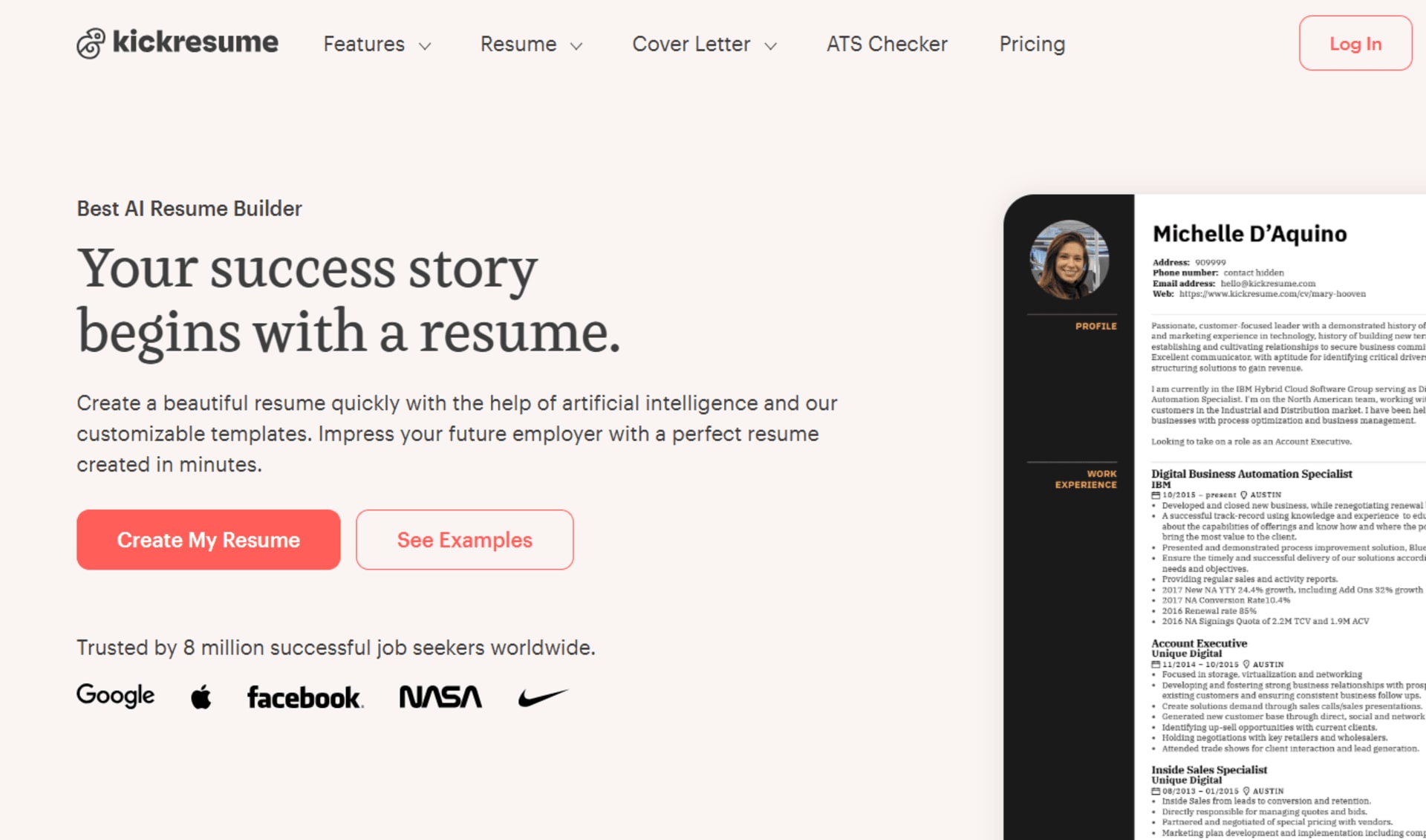
Use case: this tool is ideal for job seekers aiming to produce visually impressive, ATS-optimized resumes, using AI-generated content that is specifically tailored to different job titles and industries.
Key features:
- GPT-4 AI resume writer: generates complete resume sections from scratch based on your job title and background.
- 40+ professional templates: designed by typographers and HR experts with full customization options.
- Personal website builder: converts your completed resume into a professional portfolio website with one click.
Pricing:
- Free plan: $0/month with four basic templates, unlimited downloads, and access to pre-written phrases.
- Monthly plan: $24/month with all premium features including AI writer and ATS checker.
- Half-yearly plan: $14/month (billed $84 every six months) with additional gift vouchers.
- Student/Teacher plan: free premium access with proof of student status.
Considerations:
- Free version limits you to only four basic templates with restricted customization options.
- AI-generated content can sometimes feel generic and requires manual editing for personalization.
2. Rezi
By integrating AI-powered content generation with real-time ATS optimization feedback, Rezi reshapes the resume-building workflow. The platform’s primary focus is on creating documents that successfully navigate automated screening systems, making it an essential tool for professionals in competitive fields where ATS compatibility is non-negotiable.
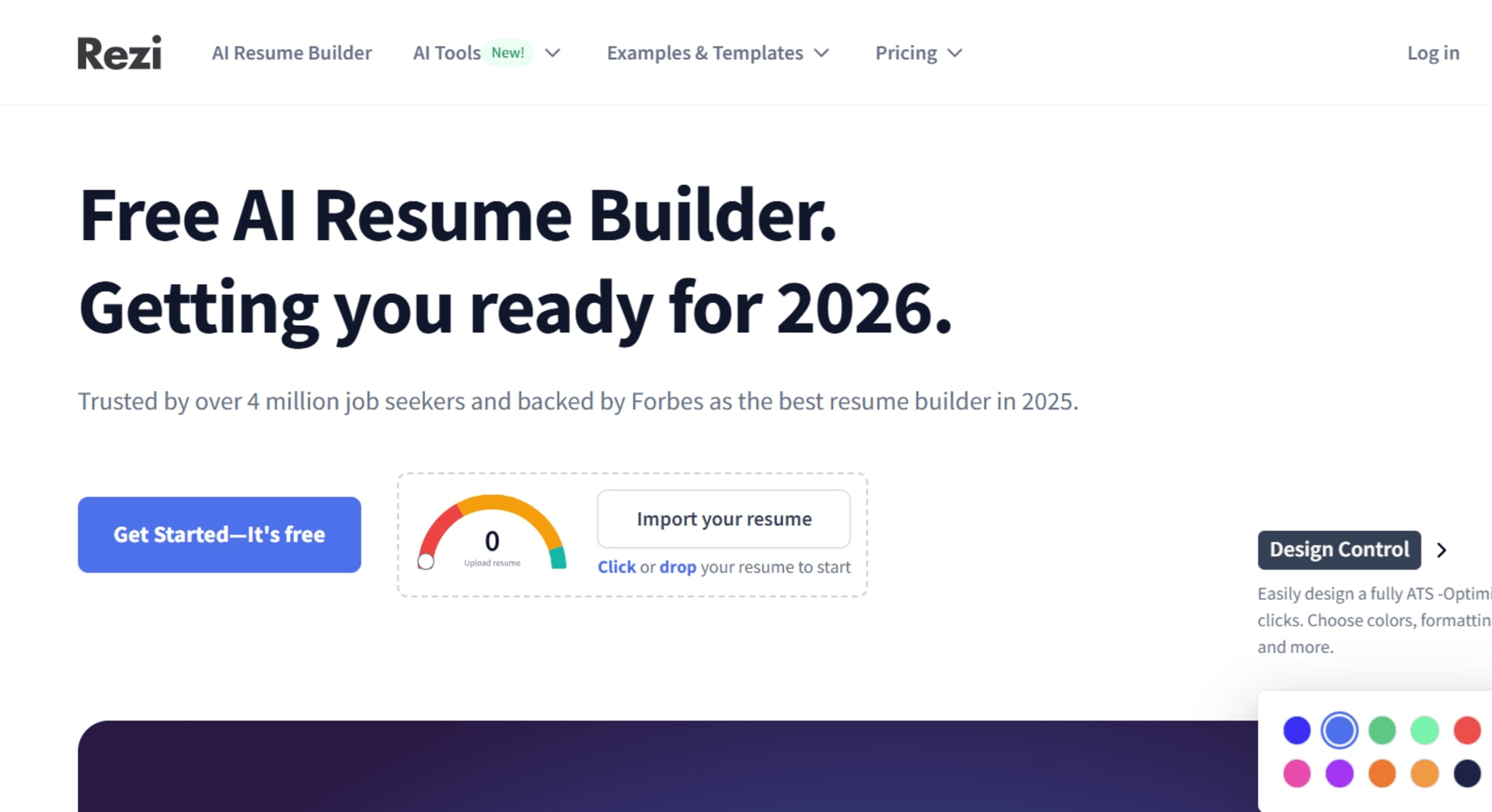
Use case: Rezi is designed for job seekers who need to create ATS-optimized resumes, offering AI-generated content and a real-time scoring system to maximize their chances of passing automated filters.
Key features:
- Real-time Rezi Score: provides instant feedback across 23 criteria to optimize your resume before submission.
- AI keyword targeting: analyzes job descriptions and naturally incorporates relevant keywords to improve ATS compatibility.
- ATS-friendly templates: clean, single-column designs specifically formatted to be easily parsed by applicant tracking systems.
Pricing:
- Free: $0/month with one resume, limited AI tools, and three PDF downloads.
- Pro: $29/month with unlimited resumes, full AI features, and unlimited downloads.
- Lifetime: $149 one-time payment for permanent access to all Pro features.
- Enterprise: custom pricing with team collaboration and bulk processing features.
- Available discounts:
welcome20(20% off) andwelcome40(40% off) codes.
Considerations:
- Free plan is quite restrictive with limited AI features and download options
- AI-generated content can sometimes feel formulaic and require significant editing to add personality
3. Teal
Teal brings order to the often chaotic job search by offering a comprehensive career platform. Its specialty lies in combining an AI-powered resume builder with powerful job tracking capabilities, positioning it as the ideal co-pilot for active job seekers who are managing numerous applications simultaneously.

Use case: with Teal, job seekers can produce tailored, ATS-optimized resumes while simultaneously managing their entire application pipeline through an integrated job tracking dashboard.
Key features:
- Job Application Tracker: organize and monitor all your applications, contacts, and target companies in one centralized dashboard.
- Chrome Extension: bookmark jobs from over 40 job boards to import details directly into your tracker — no more manual data entry.
- AI Resume Builder & Checker: get a real-time match score for your resume against a job description, with keyword suggestions to boost your chances.
- Cover Letter Generator: quickly create tailored cover letters with AI assistance.
Pricing:
- Free Forever: $0 (unlimited resumes, ten templates, basic keyword matching, and a starter pack of AI credits).
- Teal+: $29/month, $79/quarter, or $9/week (billed annually) for unlimited AI features, advanced analysis, and premium templates.
Considerations:
- Limited template variety with somewhat plain design options.
- AI-generated content can be generic and requires significant editing.
4. Resume.io
Offering a streamlined, AI-powered resume builder, Resume.io reduces the job application process from hours to mere minutes. The platform’s strength is its fusion of an intuitive drag-and-drop interface with intelligent AI suggestions, making it an excellent choice for job seekers who want professional-grade results without needing design expertise.
With over 30 templates and an integrated cover letter creator, it’s built for speed and efficiency.
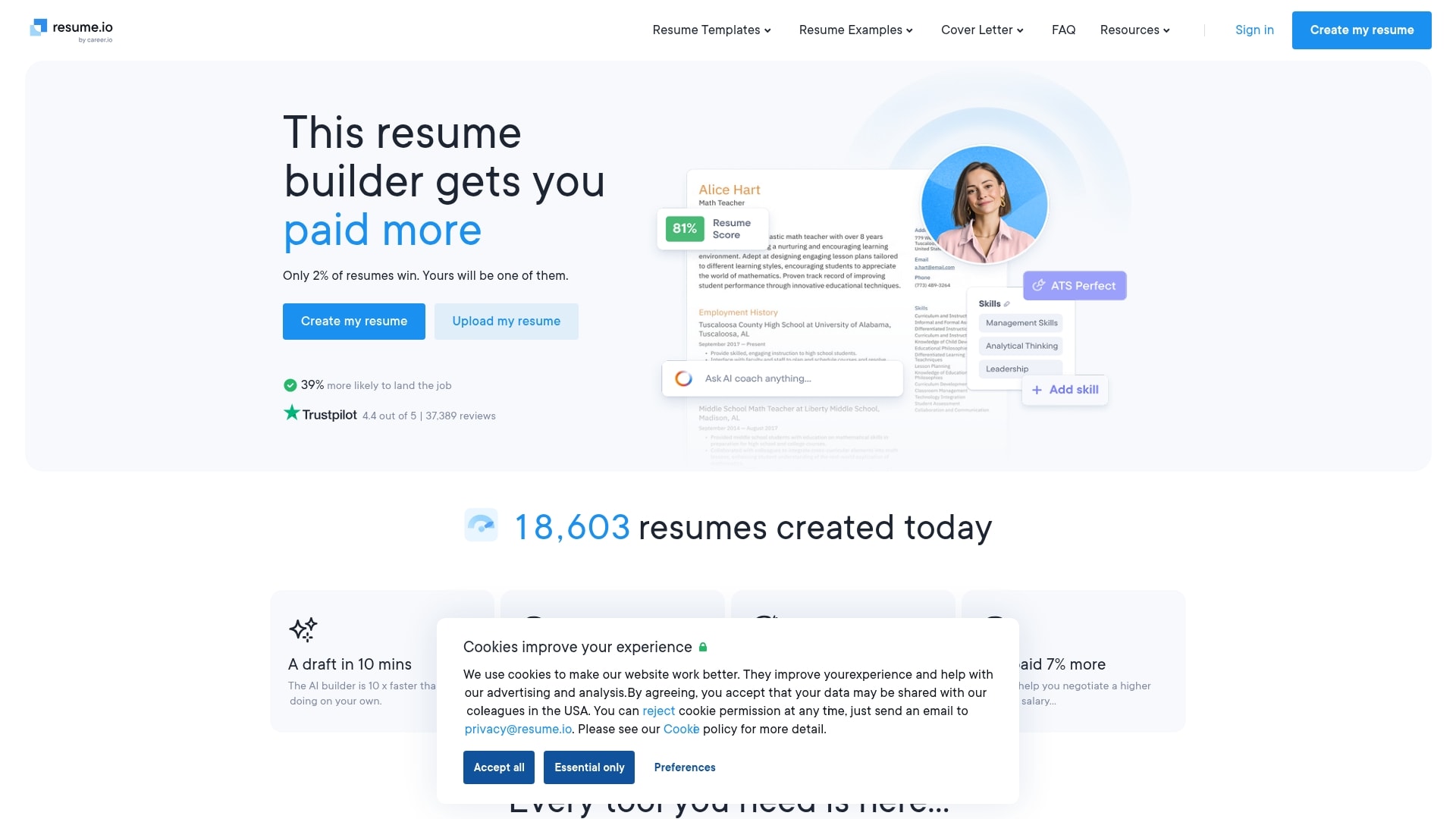
Use case: this platform is particularly effective for job seekers who need to create polished, ATS-compliant resumes quickly, leveraging AI-powered content suggestions and a library of professional templates.
Key features:
- AI resume assistant: generates professional summaries and tailored content by analyzing job descriptions and career details.
- 30+ professional templates: choose from creative, modern, and ATS-compliant designs across multiple industries.
- Integrated cover letter builder: creates matching cover letters in minutes using your existing resume data.
Pricing:
- 7-day trial: $2.95 for seven days (auto-renews at $29.95 every four weeks).
- Quarterly plan: $49.95 every three months.
- Free plan: $0 (limited to TXT downloads only).
Considerations:
- Free version only allows TXT file downloads — PDF and Word formats require paid subscription.
- Automatic subscription renewal has drawn customer complaints about transparency in billing practices.
5. Jobscan
Jobscan is engineered to turn your resume into a document that consistently beats automated screening systems. The platform’s core competency is its ability to reverse-engineer applicant tracking systems, making it the definitive choice for job seekers frustrated by their applications disappearing into a digital void.
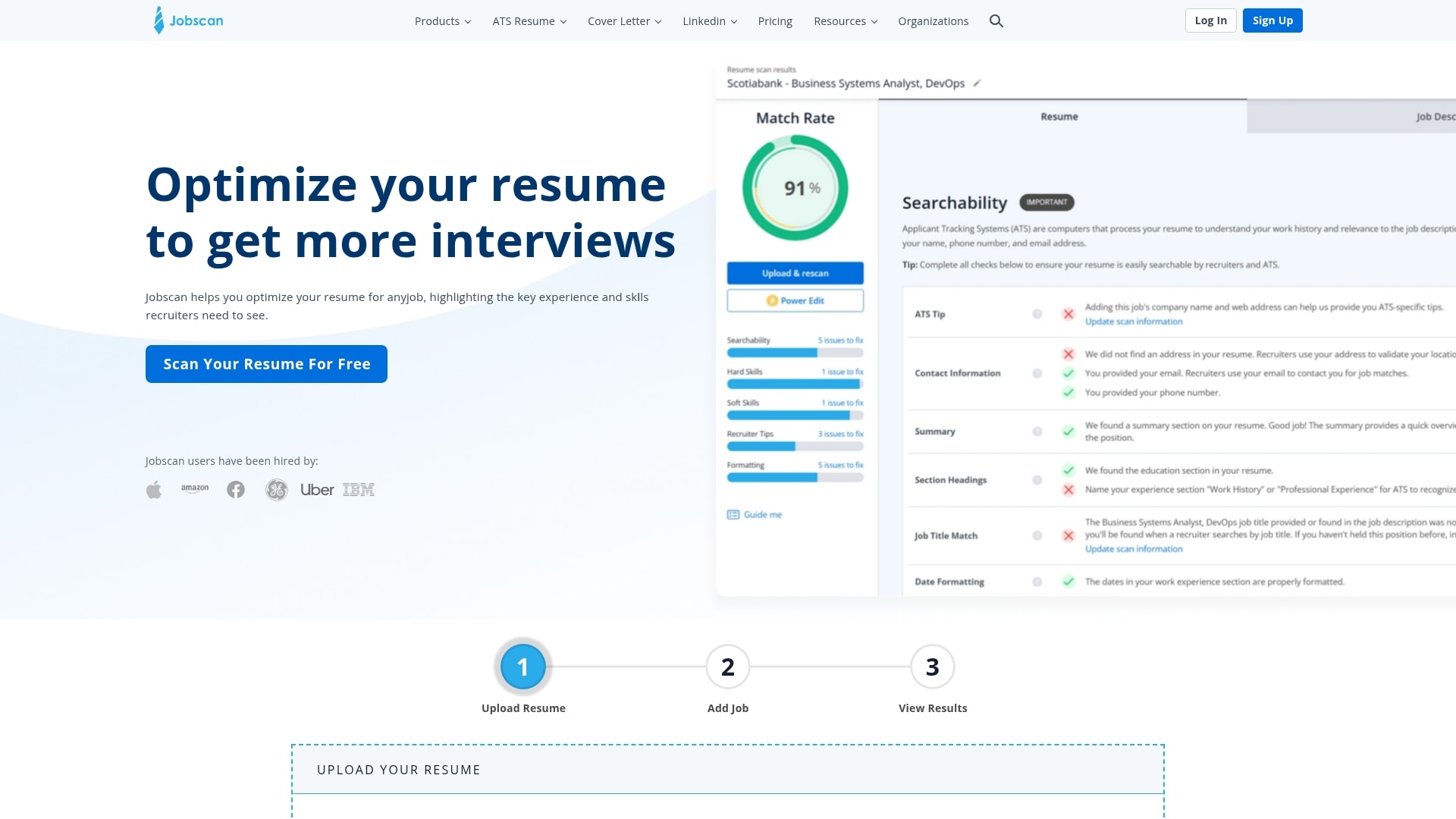
Use case: Jobscan is built to help job seekers optimize their resumes specifically for applicant tracking systems, delivering detailed match scores and actionable feedback to improve interview call-back rates.
Key features:
- ATS resume scanner: compares your resume against specific job descriptions and provides a compatibility match rate.
- Keyword optimization: identifies missing skills and terms that could boost your chances of getting noticed.
- LinkedIn optimization: tailors your professional profile to attract recruiters and hiring managers.
Pricing:
- Free plan: $0 forever with five resume scans monthly and basic features.
- Monthly plan: $49.95/month with unlimited scans and AI-powered optimization tools.
- Quarterly plan: $29.98/month (billed as $89.95 every three months) with two-week free trial.
Considerations:
- Premium pricing may feel steep for job seekers on a budget, especially if results don’t immediately translate to more interviews.
- The resume builder itself is fairly basic compared to competitors, focusing more on ATS compatibility than creative design options.
6. Enhancv
By framing resume building as a creative storytelling exercise, Enhancv helps professionals display their personality alongside their qualifications. The platform is known for its modern, visually striking templates and AI-powered content suggestions, which makes it a strong fit for creative professionals and job seekers in competitive markets who need to stand out.
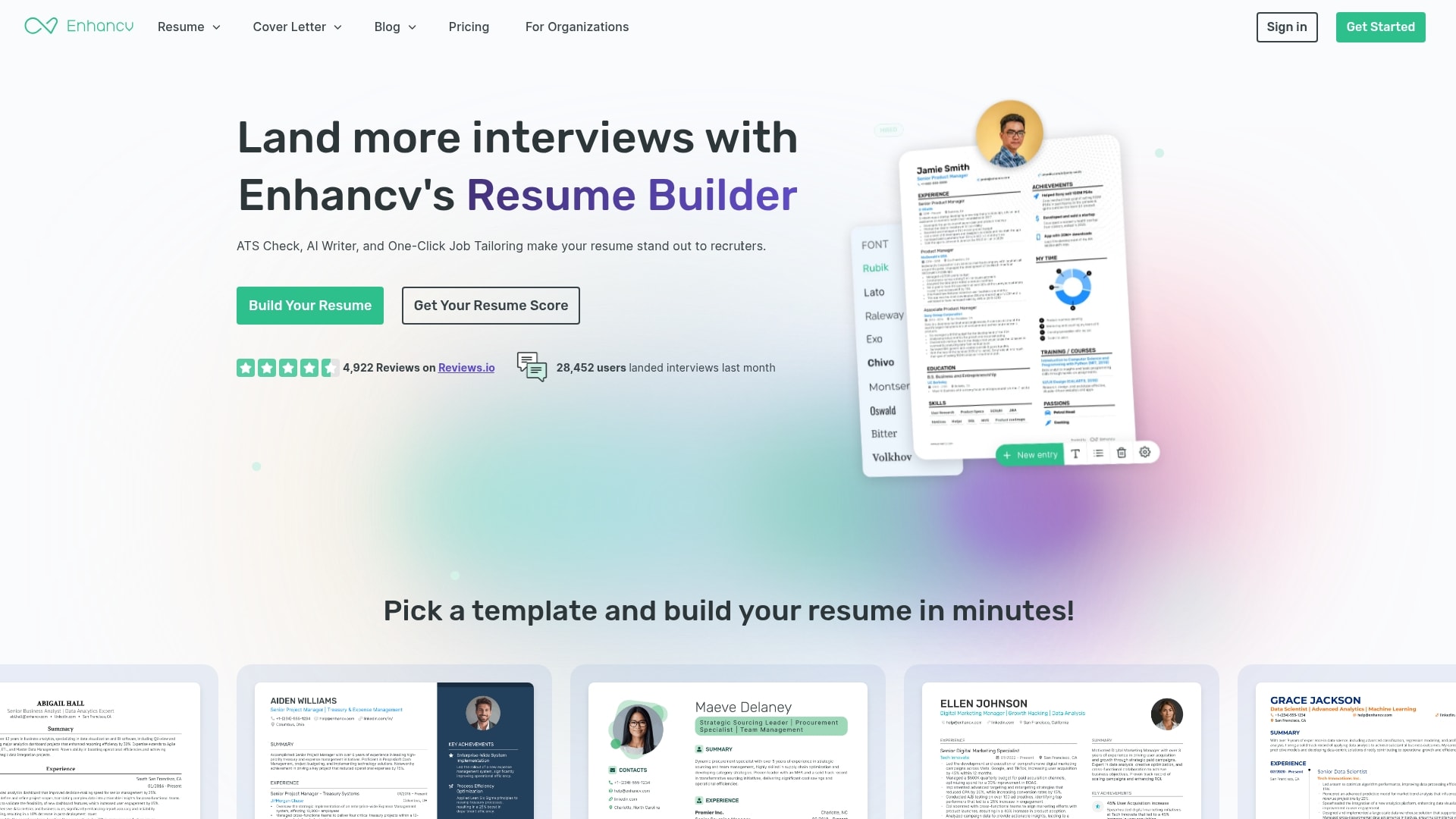
Use case: Enhancv is for job seekers who want to create visually distinctive resumes that balance ATS compatibility with human-centric design, enabling them to narrate their career story with confidence and flair.
Key features:
- AI-powered content generation: smart assistant helps rewrite resume content, create tailored summaries, and suggest relevant bullet points.
- Creative template library: eleven modern, customizable templates with drag-and-drop functionality and extensive design options.
- Job matching optimization: paste job descriptions to highlight matching skills and receive ATS compatibility feedback.
Pricing:
- Free plan: $0 for seven days with basic features and Enhancv branding.
- Pro quarterly plan: $19.67/month (billed as $59 every three months) with unlimited resumes, no branding, and advanced features.
Considerations:
- Free version includes Enhancv branding on downloaded resumes, which may not look professional for job applications.
- Creative templates may not suit conservative industries like law or finance where traditional formats are preferred.
7. ResumeBuild.ai
ResumeBuild.ai provides an AI-driven resume building experience using GPT technology and a comprehensive scoring system across 23 distinct criteria. The platform is aimed at job seekers who require meticulously optimized resumes for ATS, blending real-time content analysis with keyword targeting to boost interview callbacks.
Use case: the primary function of ResumeBuild.ai is to assist job seekers in creating ATS-optimized documents through AI-powered content generation and real-time analysis, thereby improving interview call-back rates.
Key features:
- GPT-powered content generation: creates tailored bullet points and professional summaries based on your job title and experience.
- Resume scoring system: evaluates your resume across 23 criteria with specific optimization recommendations.
- ATS keyword targeting: analyzes job descriptions to identify and incorporate relevant keywords.
- Extensive template library: offers over 340 ATS-friendly templates.
- Helpful integrations: imports existing data from LinkedIn or Google Drive to get you started faster.
- Additional writing tools: generates cover letters and resignation letters to support your job search from start to finish.
Pricing:
- Free: basic features with one resume and three downloads.
- Pro: paid plans start at $7.99/month. A full-access plan is available for $29/month, offering unlimited AI features, resumes, and downloads.
- Lifetime: $129 one-time payment for lifetime access to all features.
Considerations:
- Some users report issues with the sign-up process and customer service responsiveness.
- AI-generated content may require manual refinement to add personal touches and avoid generic phrasing.
Free AI resume builder features vs paid plans
A free plan is the perfect way to get started, offering the essentials to organize your experience and shape a clean, professional resume. It’s a practical first step for anyone looking to build a strong foundation without the pressure of complex tools.
At this level, the focus is clarity and structure. You get a simple framework and guided suggestions that help turn your background into a polished first draft.
Stepping up to a paid plan unlocks the next layer of refinement. Advanced features like ATS analysis, premium templates, and keyword optimization transform a basic resume into one built to compete. It’s the natural upgrade for those ready to take their job search from preparation to performance.
Should you use ChatGPT as an AI resume writing assistant?
ChatGPT can be a useful tool when you need help getting words on the page. It works well for drafting sections, refining tone, and turning rough notes into more polished resume bullet points.
That said, it’s important to understand where its role ends. ChatGPT is a general-purpose writing assistant, not a resume-specific system.
It’s best used for:
- Drafting and rewriting experience into clearer, more confident language.
- Improving phrasing so accomplishments sound results-driven.
- Helping you overcome writer’s block at the start of the process.
Where it falls short is in handling the structure and repetition of a real job search. It doesn’t automatically optimize resumes for applicant tracking systems (ATS), apply consistent formatting, or manage multiple tailored versions over time.
Platforms like Teal address those gaps by supporting task-driven workflows. Instead of starting from scratch with every prompt, you can rely on agents to handle recurring work such as analyzing job descriptions, aligning language for ATS, and updating resumes across applications.
How to optimize your AI resume for ATS success
Your AI resume builder is a powerful instrument, but its effectiveness depends on your guidance. It cannot intuit the specific requirements of every Applicant Tracking System (ATS), so your role is to provide the correct inputs. You don’t need to be a technical expert to make your resume ATS-friendly; you just need to be strategic.
Whether you’re using a straightforward builder or a more complex AI agent, the core principles remain the same. The following five tactics will help your resume get past the digital gatekeepers and into human hands:
1. Strategic keyword placement
The job description is effectively a blueprint provided by the hiring manager. Your first task is to extract every essential skill, technology, and qualification mentioned. These are the precise terms the company’s ATS is programmed to search for.
Avoid simply listing them in a separate section. The most effective strategy is to weave these keywords naturally into the narrative of your experience and summary. Instruct your AI tool to rephrase accomplishments using these specific terms, making your expertise undeniable to the system.
2. ATS-friendly formatting
An Applicant Tracking System (ATS) reads resumes very differently from humans, so design choices that look great to you might appear unreadable to software. The key is to keep things simple and structured.
- Stick to standard fonts: use clean, easy-to-read options like Arial, Calibri, or Helvetica.
- Choose a single-column layout: multi-column designs or text boxes often confuse ATS parsing.
- Use clear headers and plain bullet points: avoid icons, symbols, or decorative graphics.
- Save creativity for later: keep this version straightforward for machines, then use a more visually designed version when sending resumes directly to recruiters.
Clarity always wins over complexity when it comes to getting past automated filters.
3. Industry-specific customization
A generic resume is an overlooked resume. You must guide your AI assistant to adopt the specific language of your industry. A marketing resume should emphasize metrics related to growth, while an engineering resume must showcase technical execution and project delivery.
Provide the AI with examples from your field and direct it to adjust the tone and terminology accordingly. For a finance role, have it highlight risk management. For a healthcare position, instruct it to focus on patient outcomes. This process ensures your resume reads as if it were written by an industry insider.
4. Skills section optimization
Your skills section should be a targeted list, not an exhaustive inventory. Prioritize the hard skills (software, programming languages, and certifications) that are a direct match for the job description. Use the exact phrasing found in the posting to ensure an ATS match.
For soft skills, provide concrete examples. Instead of a generic term like “leadership,” prompt your AI to generate phrases such as “mentored three junior developers to promotion” or “led cross-functional project teams to 10% ahead-of-schedule completion.” This demonstrates application, not just assertion.
5. Achievement quantification
Descriptions inform, but data persuades. Your AI assistant is adept at transforming duties into achievements, but it requires quantitative input from you. Provide the raw numbers, and the AI will construct a compelling narrative around them.
Instead of stating you “managed a team,” supply the context: “grew a team from 3 to 10 members and reduced project delivery time by 25%.” Every role has measurable metrics, whether they relate to revenue, cost savings, time, or scope. Your responsibility is to identify them; your AI’s function is to make them impactful.
Streamline your job search with AI-powered tools
Landing a job takes more than just a polished resume. Between tracking applications, scheduling interviews, and sending follow-ups, the process can start to feel like managing a full-time project.
That’s where you can streamline systems and bring in AI-powered tools to handle the busywork. These tools act like your behind-the-scenes team, keeping everything organized while you focus on performance.
- Track applications automatically: use AI to monitor progress across multiple job boards and keep deadlines visible in one dashboard.
- Coordinate interviews effortlessly: let scheduling tools sync with your calendar and manage time zones for remote interviews.
- Research smarter: deploy AI assistants to analyze salary benchmarks, company insights, and recruiter feedback.
With automation managing the logistics, you’re free to focus on what matters most — preparing thoughtful answers, showing your personality, and leaving a lasting impression.
Frequently asked questions
Can employers detect AI-generated resumes?
It's unlikely, as long as you review and personalize the content. The goal is for the AI to assist you, not to invent your experience for you.
Which AI resume builder is completely free?
Most platforms offer a free plan with limitations, like watermarks or fewer templates. A fully-featured, completely free builder is rare.
Do AI resumes really pass ATS screening?
Yes, when created with clean formatting and relevant keywords, they are designed to pass through Applicant Tracking Systems. A good AI tool knows how to optimize for these systems.
How often should I update my AI-generated resume?
Update your resume whenever you gain a new skill, complete a major project, or change career goals. It should always reflect your most current professional story.
Can AI help with cover letters and LinkedIn profiles?
Yes, many AI resume builders also offer tools to draft compelling cover letters and optimize your LinkedIn profile. This creates consistency across your professional brand.
Are AI resume builders worth the investment?
They are worth it if your goal is to save time and create multiple, tailored resumes for different jobs quickly. The value lies in efficiency and professional presentation.

 Get started