


The idea of finding a single “best” AI for investing sounds appealing, but it’s rarely the smartest move. Financial markets evolve by the second, generating more data than even the most advanced algorithm can handle alone. Real success comes from building a system that works like a team, where each AI plays a defined role.
One agent can monitor trends across global markets, another can analyze your portfolio performance, and a third can help you manage risk and protect gains. Together, they give you a clearer view of your strategy and the confidence to make faster, smarter decisions.
This article explores how AI investment tools are reshaping the way people trade, analyze, and plan. You’ll see what separates a useful platform from an overhyped one and discover how to assemble your own AI-powered setup for 2026 and beyond.
Key takeaways
- AI works best as a system, not a single tool: successful AI investing relies on assembling multiple agents, each focused on research, monitoring, or risk management, rather than chasing one “perfect” platform.
- Always-on market awareness matters: modern AI investing platforms analyze real-time market data around the clock, helping you respond faster to volatility, trends, and emerging risks.
- Insights should reduce noise, not add to it: the most effective solutions translate complex financial data into clear, actionable signals you can actually use.
- Build custom investment workflows: instead of generic recommendations, create specialized AI agents for tasks like sentiment tracking, portfolio rebalancing, and risk alerts.
- Integration drives real value: the best AI investing setups connect directly to your existing brokerage, analytics, and data tools, creating a unified workflow rather than another disconnected dashboard.
Is AI essential for modern investing?
In today’s markets, information moves faster than any person can track. Prices shift in seconds, global events ripple instantly across sectors, and new data floods in around the clock. Trying to stay ahead manually is no longer realistic — and that’s where AI becomes essential.
AI investing tools act as tireless market analysts, scanning data, spotting patterns, and flagging risks long before they’re visible to the human eye. They don’t replace your instincts or experience; they strengthen them.
By delegating research, monitoring, and analysis to intelligent systems, you can focus on strategy while making smarter, faster decisions grounded in real-time insight rather than emotion.
Put your AI agents on round-the-clock market duty
Markets don’t pause, and neither does the data that drives them. Prices shift, sentiment changes, and signals appear long before most investors have time to react. That’s why relying on a single AI tool is limiting. A smarter approach is building a system of AI agents that monitor different parts of the market continuously, even when you’re offline.
Using a platform designed for multi-agent workflows, you can assign each AI agent a clearly defined role. Together, they operate as a coordinated monitoring team, scanning the market from multiple angles and surfacing insights when they matter most.
Common roles within an AI investing setup include:
- Gauge market sentiment: track news, earnings commentary, analyst updates, and social signals to understand how investors feel about specific stocks or sectors
- Spot recurring patterns: identify technical trends, volume anomalies, or historical behaviors that often precede market moves
- Monitor multiple asset classes: watch equities, bonds, ETFs, and crypto across regions so nothing slips through the cracks
Keep your portfolio balanced with automated portfolio optimization
Portfolio optimization is the ongoing process of maintaining the right balance between growth and risk as market conditions change. Doing this manually takes time, discipline, and constant attention—exactly the kind of work AI excels at.
With the right AI platform, you can set rules for allocation targets, risk tolerance, and rebalancing thresholds. Your AI agents then monitor performance continuously and flag when adjustments are needed, or rebalance automatically based on your preferences.
As volatility increases or new opportunities emerge, your strategy stays aligned without you having to constantly intervene.
Put an AI agent on risk watch
In investing, avoiding major losses can be just as powerful as finding winning trades. A dedicated risk-focused AI agent acts as an early warning system, scanning for signs of trouble before they become obvious.
These agents can monitor volatility spikes, correlation shifts, liquidity changes, or unusual price behavior that might indicate elevated risk. They can also detect when assets that are supposed to be diversified begin moving together — often a signal that broader market stress is building.
What to look for in your AI financial team
Selecting the right AI platform is more like scouting for a dream team than just shopping for an app. The ideal solution isn’t a single tool; it’s a crew of specialized helpers ready to give you an edge. You need to know what separates a genuine game-changer from just another app making noise.
Up-to-the-second intel
Your team is only as good as its information. The best AI helpers tap into real-time data, so you’re always acting on what’s happening now, not five minutes ago. Anything less is like getting the game plan after the final whistle has already blown.
Clarity, not clutter
Powerful AI shouldn’t require a decoder ring to understand. A great platform delivers direct, simple insights you can act on immediately, giving you the confidence to make your next move without getting lost in jargon.
A team that works for you
Generic advice is for everyone and no one. You need a team that gets your specific goals and risk tolerance, which is why you should be the one calling the plays.
With AI platforms you can build your own AI agents, each trained for a specific task that fits your playbook, not someone else’s.
Seamless connection
Your financial tools shouldn’t live on separate islands. A truly helpful AI team connects seamlessly with your brokerage accounts and other apps, so everything stays in sync without you lifting a finger. This is how your team goes from just providing insights to actually getting work done.
Top AI investment platforms compared
Most AI platforms promise to do everything for everyone, but that’s not how real results happen. In investing, just like in business, success comes from building a team with clearly defined roles — not relying on a single overworked assistant.
The goal isn’t to find the most feature-packed tool, but to assemble a mix of AI platforms that complement each other and fit the way you work. Some tools specialize in deep analysis, others excel at automation or strategy. The right setup depends on how you invest and what you want your AI team to achieve.
Here’s how the leading platforms stack up when you cut through the hype and focus on what actually helps you make smarter moves.
1. Magnifi
By focusing on conversational AI, Magnifi allows you to ask complex investment questions in plain English, removing the need to wrestle with financial jargon. The platform excels at natural language search and beginner-friendly portfolio analysis, making it ideal for DIY investors who want professional-grade insights without the intimidation factor.

Use case: Magnifi acts as an AI investing copilot that aggregates your portfolios from multiple brokerages and provides personalized guidance while keeping you in control of investment decisions.
Key features:
- Conversational AI assistant: ask investment questions in everyday language like “How should I invest $1,000?” or “What are the best green energy companies?”.
- Portfolio aggregation: connect accounts from over 200 brokerages including Robinhood, E*Trade, and Schwab for a unified view of your investments.
- Goal-based investing: create customized investment strategies for specific objectives like retirement, homeownership, or emergency funds.
Pricing:
- Monthly plan: $14/month with unlimited AI prompts and flexible monthly billing.
- Annual plan: $132/year (saves over 20% compared to monthly billing).
Considerations:
- AI responses can sometimes be basic or shallow for complex investment strategies.
- Limited to traditional brokerage accounts with no support for retirement accounts like IRAs.
2. TrendSpider
For active traders, TrendSpider offers AI-powered technical analysis automation designed to streamline market evaluation. The platform’s specialty is its automated chart pattern recognition and machine learning-driven strategy creation, which helps traders eliminate manual analysis while maintaining full control over their decisions.
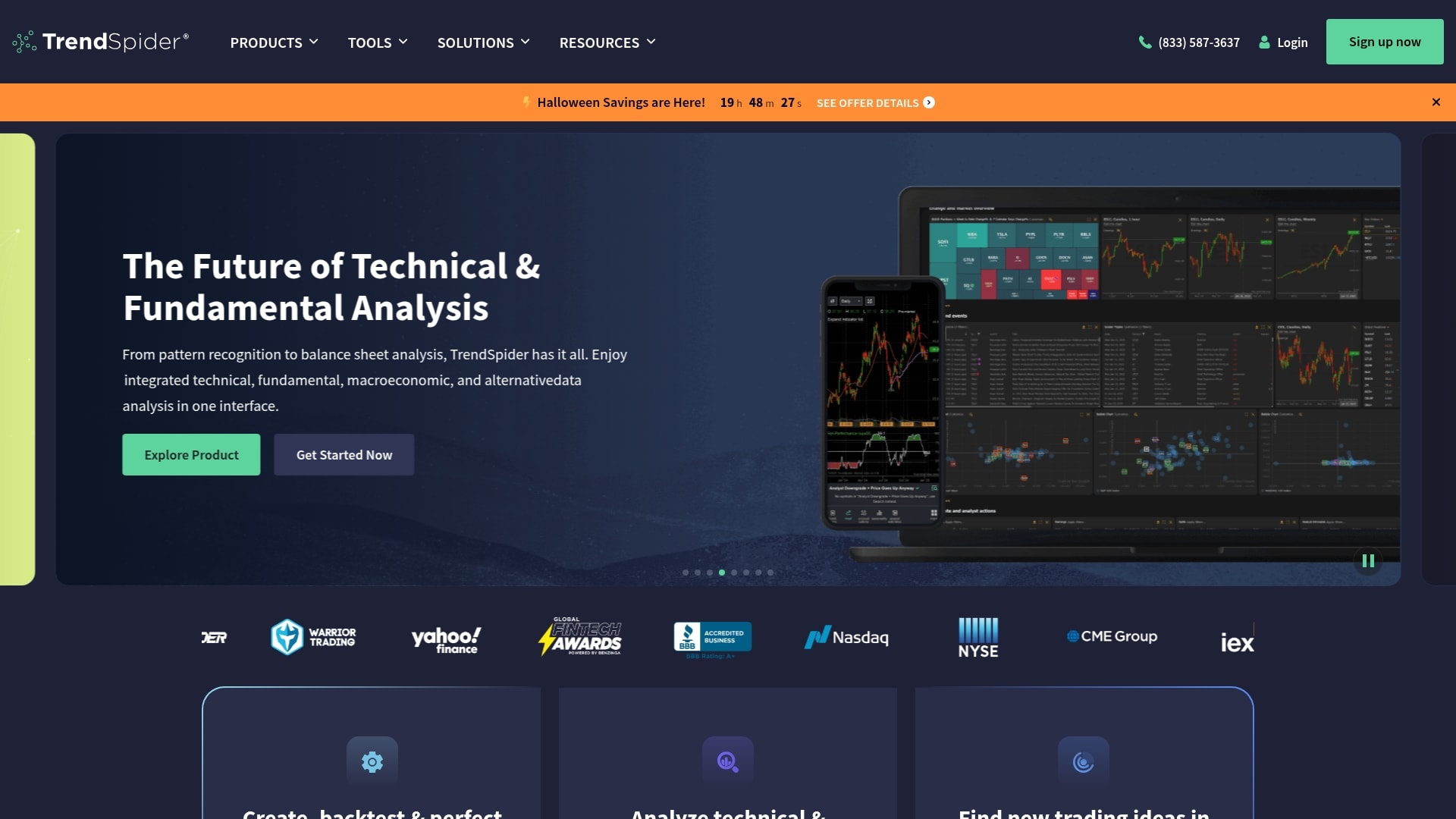
Use case: TrendSpider automates the tedious aspects of technical analysis while empowering traders to build custom AI-powered stock trading strategies without any coding knowledge.
Key features:
- AI Strategy Lab: create and deploy custom machine learning models using a no-code interface with multiple algorithms including Random Forest and K-nearest Neighbors.
- Sidekick AI assistant: natural language processing chatbot that analyzes your charts, retrieves market data, and provides contextual trading insights.
- Automated pattern recognition: automatically identifies and draws over 150 candlestick patterns, trendlines, and Fibonacci levels across multiple timeframes.
Pricing:
- Standard: $51.30 to $77.90/month (normally $54 to $89/month, up to 5% off first invoice).
- Premium: $52.78 to $79.46/month (normally $91 to $149/month, up to 42% off first invoice).
- Enhanced: $67.10 to $100.65/month (normally $122 to $199/month, up to 45% off first invoice).
- Advanced: $96.30 to $144.45/month (normally $214 to $349/month, up to 55% off first invoice).
- Trial: all plans include 14-day trial for $5 and 25 free Sidekick AI messages monthly.
- Additional Sidekick AI plans available from $49 to $349/month for increased message limits.
Considerations:
- Steep learning curve due to the extensive feature set, which can overwhelm new users initially.
- Premium pricing may not justify the cost for casual traders who only need basic charting functionality.
3. WarrenAI
Ever wish you could get investing advice from Warren Buffett himself? WarrenAI is the next best thing. This AI-powered research assistant, launching in April 2025, is designed for retail investors who admire Buffett’s legendary value investing philosophy.
It combines Investing.com’s massive database with an AI trained on fundamental analysis to help you find great companies at a fair price, all explained in plain English.
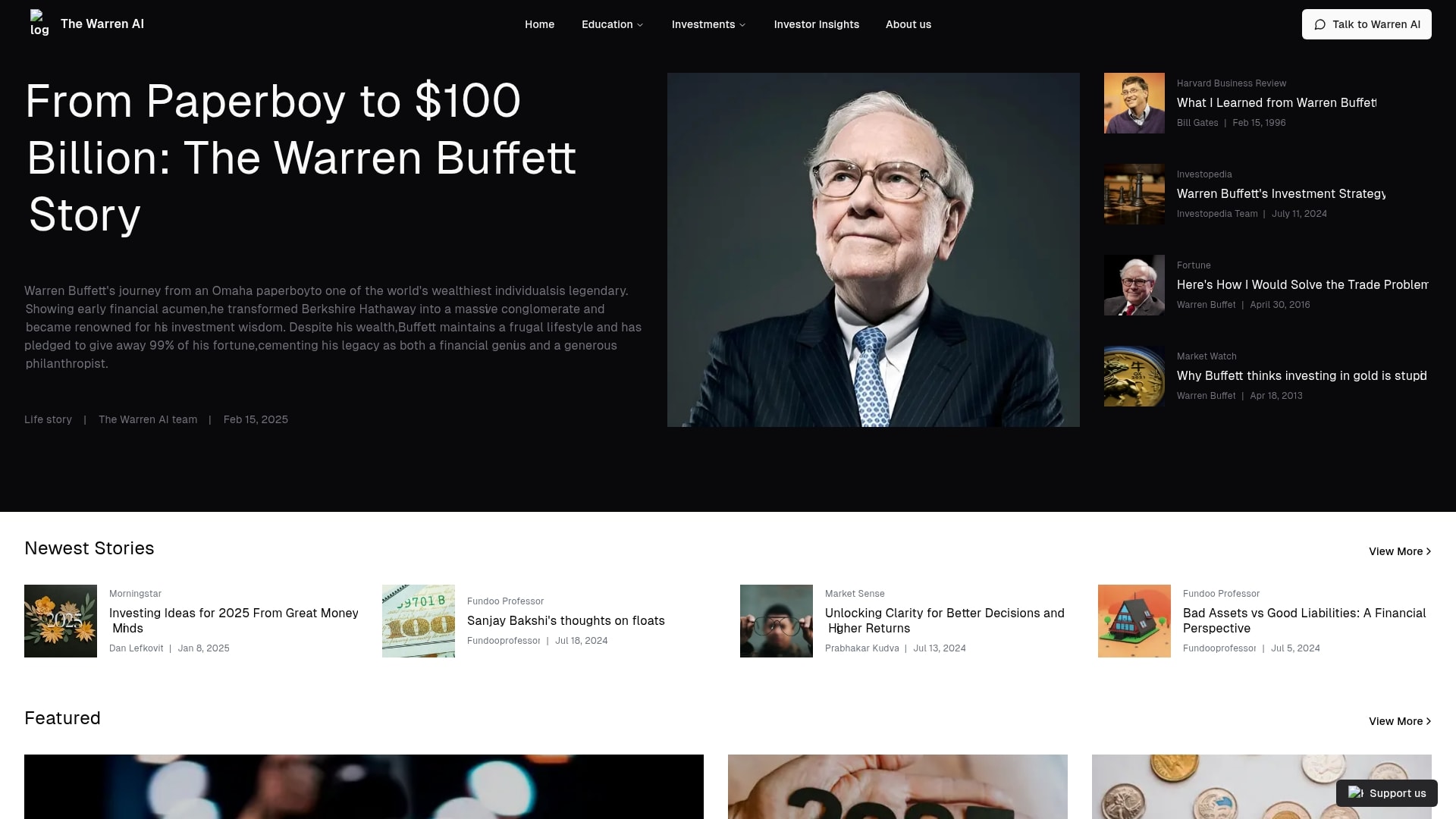
Use case: WarrenAI serves as your personal value investing guru, transforming complex financial data into actionable insights grounded in Warren Buffett’s time-tested principles.
Key features:
- ‘Talk to Warren AI’ chatbot: ask investing questions and get answers that emulate the wisdom and style of the Oracle of Omaha himself.
- Fundamental analysis tools: instantly generate SWOT analyses, investment cases, and other reports focused on long-term value.
- Educational resources: dive deep into the value investing mindset with access to Buffett’s annual letters, interviews, curated articles, and book recommendations.
- Real-time market intelligence: tap into vetted financial data and news summaries through an integration with InvestingPro.
Pricing:
- Free Plan: $0/month.
- Premium Plan: $19/month.
Considerations:
- The platform is built around a specific investment philosophy (value investing), which may not suit all trading styles.
- As with any AI tool, its insights are a powerful starting point but should always be paired with your own judgment and verification. You’re the boss, after all.
4. Composer
Users of Composer can turn complex trading strategies into visual, no-code symphonies that are easy to build and automate. The platform’s AI-powered strategy creation allows you to describe investment goals in plain English and watch as sophisticated algorithms come to life.
With over $200 million in daily trading volume, it’s become a go-to choice for retail investors who want institutional-grade tools without the coding complexity.

Use case: composer democratizes algorithmic trading by letting users create, backtest, and automate sophisticated investment strategies through an intuitive visual interface and natural language AI commands.
Key features:
- Trade With AI: describe your investment strategy in plain English and watch the AI generate executable trading algorithms in under 60 seconds.
- Visual strategy builder: create complex “symphonies” using drag-and-drop logic blocks without writing a single line of code.
- Community marketplace: access over 3,000 pre-built strategies from other users or share your own creations with the investing community.
Pricing:
- Promotional pricing: $5/month (88% off regular price).
- Pro subscription: $32/month for live trading capabilities.
- Free tier: unlimited backtesting with no live trading.
- Zero commissions: no management fees or trading commissions.
Considerations:
- Limited to one rebalance per day near market close, which may not suit high-frequency trading strategies.
- Platform is currently only available to US users, restricting international access.
5. Danelfin
An AI-powered scoring system is at the heart of Danelfin, which rates every US and European stock on a simple 1-10 scale. The platform’s strength is its explainable AI, showing exactly why each stock received its rating and making institutional-grade analytics accessible to retail investors.
With a proven track record of outperforming the S&P 500, it’s designed for data-driven investors who want transparency behind their decisions.
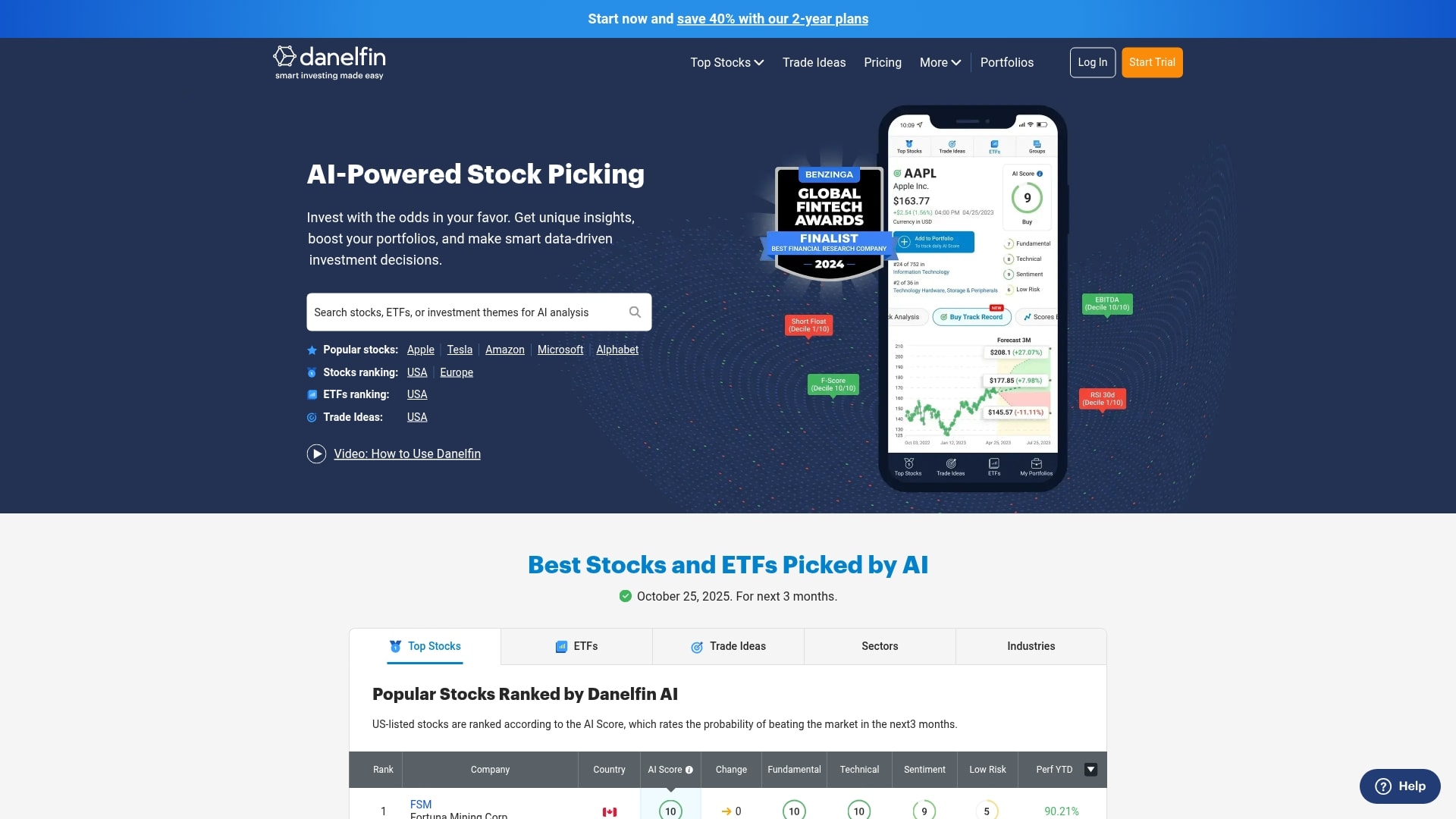
Use case: Danelfin democratizes sophisticated stock analysis by providing AI-driven probability scores that predict which stocks are most likely to outperform the market over the next three months.
Key features:
- AI Score system: simple 1-10 rating that indicates probability of beating market benchmarks over three-month periods.
- Explainable AI transparency: shows the specific fundamental, technical, and sentiment factors driving each stock’s rating.
- Trade ideas with proven track record: highlights potential trades with at least 60% historical win rates across different investment horizons.
Pricing:
- Free Plan: $0 forever (ten stock reports per month, top 10 rankings, one portfolio up to five stocks).
- Plus Plan: $22/month or $264/year (unlimited reports, up to five portfolios, top 25 trade ideas, broker sync).
- Pro Plan: $59/month or $708/year (unlimited portfolios, all trade ideas, historical data since 2017, CSV export).
- Discounts: 40% discount on 2-year plans and 30-day money-back guarantee available.
Considerations:
- Limited to US and European markets only, excluding other global investment opportunities.
- Relies heavily on backtested performance data, which may not guarantee future results in real-world trading conditions.
6. AInvest
Featuring an AI-powered assistant named Aime, AInvest functions as a personal financial analyst for its users. The platform integrates social trading features with community-driven insights, making it useful for both novice and experienced investors. Its unique ability to connect multiple brokerage accounts and provide real-time analysis consolidates fragmented investment workflows into one intelligent digital workspace.

Use case: AInvest democratizes investing by providing AI-powered tools that unify market research, portfolio analysis, and trading insights in a single platform accessible to investors of all experience levels.
Key features:
- Aime AI assistant: natural language interaction for stock analysis, news summaries, and personalized investment insights.
- Broker Connect: integrates with 20+ brokerages to provide consolidated portfolio analysis across all accounts.
- Options Block Monitor: tracks institutional options flow to reveal large-scale trading patterns and market sentiment.
Pricing:
- Free Plan: limited access to basic features
- Monthly Plan: $34.99/month (billed monthly)
- Annual Plan: $25.00/month (billed as $299.99 annually) with three-day free trial
Considerations:
- Desktop application experiences technical issues and login problems according to user feedback.
- Advanced features require premium subscription, which may not justify the cost for casual traders.
AI investing platforms pricing breakdown
Evaluating the cost of an AI investing platform requires you to determine if you’re paying for tangible results or just a sophisticated AI dashboard. The objective is to find tools that demonstrably boost your returns, not just ones that make you feel busy.
Most platforms offer a familiar three-part structure: a free tier for a sample, a premium plan for serious users, and enterprise solutions for financial teams.
The key is understanding the value at each level: some “free” plans are little more than simple scanners, while others deliver true AI insights from the start. Your best value is often in the middle tier, where you get powerful features without paying for extras you’ll never use.
How a platform charges reveals its core focus. Robo-advisors usually take a small percentage of your assets under management (AUM), whereas research platforms typically have a flat monthly subscription.
Your job is to match the pricing model to your own investment style, ensuring the tool works for you, not the other way around.
| Platform type | Free tier | Mid-Tier | Enterprise |
|---|---|---|---|
| AI robo-advisors | Limited portfolio tracking | 0.25-0.50% AUM fee | 0.10-0.25% AUM fee |
| Research platforms | Basic screeners | $50-150/month | Custom pricing |
| Trading assistants | Paper trading only | $25-100/month | Volume-based fees |
| Portfolio analytics | Three-month history | $30-200/month | $500+/month |
How to build your first AI team
Deciding where to invest your time in AI doesn’t have to be overwhelming. Forget the hype about finding one all-powerful assistant. The real victory comes from building a small, dedicated team of helpers that work for you, on your terms.
This process should feel like hiring your first specialist, not installing a complex piece of factory equipment. You want a helper that simplifies your workflow on day one, not one that requires a six-month training manual. The goal is to find a platform that empowers you to be the boss of your own AI team.
Pinpoint your biggest time sinks
Before you look at a single feature, get practical. What are the most tedious research tasks that clog up your investment process? Perhaps it’s sifting through earnings reports, monitoring obscure market indicators, or tracking sentiment on social media.
Your goal isn’t to find an AI that can “do everything.” It’s to build a specific helper for a specific job — one that gives you back five minutes here and ten minutes there. That’s where you’ll feel the immediate impact.
Start where you are
You’re busy, and you’re not looking to get a degree in AI engineering. A great platform meets you exactly where you are, letting you build your first simple helper in minutes without writing a single line of code.
The power isn’t in knowing complex jargon, it’s in knowing what you need help with. You’re the boss, and your AI team should be easy to manage. The platform should feel like a clever teammate, not a final exam.
Focus on the job, not the job title
It’s easy to get distracted by platforms that promise dozens of features. The smarter question is much simpler: can this tool reliably handle the one task you actually need help with?
A focused AI agent that consistently summarizes market news for your watchlist is far more useful than a complex system you never fully adopt. The goal isn’t sophistication for its own sake; it’s dependable execution.
When evaluating an AI platform, look for one that:
- Lets you define a clear, single responsibility for each agent.
- Stays out of your way once the task is set.
- Gives you flexibility to refine or replace agents as your strategy evolves.
Build your first helper
The fastest way to understand an AI platform’s value is to put it to work on a real problem. Skip the demos and dashboards and build one small helper that tackles a task you already find tedious.
Good starting points include:
- Alerts for unusual price movement or trading volume.
- A daily summary of news for a specific sector or watchlist.
- A weekly snapshot of portfolio performance against your benchmarks.
When that task starts running quietly in the background, the value becomes obvious. One solved problem is all you need to decide whether the platform earns a bigger role in your investing workflow.
How to get started with AI investing in 2026
Getting started with AI investing doesn’t need to feel technical or overwhelming. The aim isn’t to replace your judgment or instincts, but to reduce the manual work that slows you down so you can focus on better decisions.
The most effective approach is to start small. Begin with one focused AI helper that handles a single, repeatable task. As confidence grows, you can expand into a broader system of specialized agents that support different parts of your investing strategy.
Here’s a practical way to get started.
Step 1: define the first job to automate
Resist the urge to do everything at once. Your first AI agent should have one clear responsibility, not a long list of duties.
Good starting examples include:
- Tracking the performance of your top holdings.
- Monitoring a specific index or sector for price changes.
- Summarizing daily market news for a shortlist of assets.
When an agent does one thing well, results are easier to trust and improve over time.
Step 2: connect data safely and deliberately
AI investing tools are only as useful as the data they can access. Most modern platforms use read-only connections and bank-level encryption so agents can analyze information without ever moving funds.
You should always know:
- What data the agent can see.
- What sources it uses.
- What actions it is allowed to take.
Platforms that support transparent permissions make it easier to stay in control while still benefiting from automation.
Step 3: set rules, preferences, and clear goals
This is where AI becomes genuinely useful instead of generic. Define how you invest, not how you think you should invest.
Set clear goals around:
- Risk tolerance.
- Alert thresholds.
- Reporting frequency.
If volatility makes you uncomfortable, instruct agents to flag risk early. If you prefer long-term signals over short-term noise, say so. The system should adapt to your strategy, not the other way around.
Step 4: review, refine, and scale gradually
AI agents surface insights, but you remain the decision-maker. Review what your agents produce, adjust instructions when needed, and refine their scope as you learn what works.
Over time, you might add:
- A second agent focused on portfolio optimization.
- Another monitoring broader market risk.
- A separate helper for long-term planning or retirement assets.
This is how an AI investing setup grows sustainably: one well-defined role at a time. Platforms like Magnifi or WarrenAI are built around this incremental approach, making it easier to expand without losing clarity or control.
Frequently asked questions
How accurate are AI predictions for stock market performance?
AI can quickly analyze huge amounts of data to spot trends and patterns, making it a useful tool for identifying opportunities. However, its predictions aren’t guarantees of future results, since markets are affected by many unpredictable factors. The real value of AI lies in providing data-driven insights that help investors make smarter, faster decisions.
Can beginners use AI investing platforms effectively?
Yes, many platforms are designed for beginners, but they are most effective when paired with a basic understanding of investment principles. The AI acts as a powerful research assistant, while you remain in control of the final decisions.
Which AI platform is best for stock market analysis?
The "best" platform depends entirely on your personal investing style, experience, and goals. Focus on finding a tool that offers the specific features you need, rather than searching for a single top-rated option.
Do AI investment platforms integrate with existitng brokers?
Many platforms integrate with major brokers, but capabilities vary widely. Always confirm that a platform is compatible with your specific broker before signing up to ensure a seamless workflow.
What security measures protect financial data in AI platforms?
Reputable platforms like Magnifi or WarrenAI use bank-level encryption, two-factor authentication, and are often regulated by financial authorities. Legitimate services connect to your accounts via secure, read-only APIs and will never ask for your direct login credentials.

 Get started