


The market for AI writing assistants is more crowded than ever, yet most tools still take a one-size-fits-all approach. For creative writers, that poses a new problem: how to get real support without losing the unique voice, tone, and workflow that make your work distinct.
The goal isn’t to find a single, flawless ghostwriter — it’s to build the right mix of tools that amplify your strengths. The best AI companions don’t write for you; they help you write better, handling structure, research, or creative brainstorming while you stay in control of the story.
This detailed guide explores the best AI for creative writing in 2026. We’ll look at which platforms truly understand the creative process, compare general chatbots with specialized writing tools, and outline how to choose the perfect assistant for your genre: whether you’re crafting novels, poems, or screenplays.
Key takeaways
- AI supports the writing process, not the final voice: the best tools help with structure, research, and momentum while leaving style, tone, and creative decisions firmly in your hands.
- Creative control matters more than raw output: strong AI writing assistants adapt to your voice and genre instead of forcing generic prose that needs heavy cleanup.
- The smartest setup is a team, not a single tool: pairing different AI helpers for brainstorming, continuity, editing, and organization delivers better results than relying on one all-purpose assistant.
- Free tools are great for exploration, paid tools for depth: free platforms work well for ideation and early drafts, while premium options unlock long-form coherence and deeper customization.
- Custom agents unlock flexible workflows: platforms that let you assemble task-specific AI helpers make it easier to support your writing process without disrupting how you work.
What are AI platforms for creative writing?
Imagine a personal creative team, ready to jump in whenever you need them. You can deploy an agent to brainstorm plot points when you’re stuck or have another one polish dialogue until it sings. In this model, you are the director; these tools are your specialized crew, handling specific tasks so you can focus on the big picture.
These are not your old, clunky grammar checkers. Modern AI assistants are built to understand the art of storytelling. It’s possible to build and train them to develop character arcs, suggest surprising-yet-logical plot twists, and even generate scene outlines that align with your vision. Because you define their purpose, they adapt to your unique voice.
The objective is not replacement but collaboration. Your AI team can excel at the grunt work — generating fresh ideas on demand, offering alternative scene structures, or tracking character details for consistency.
This process frees you to do what only you can: bring your story to life.
Which is the best AI writing assistant for creative work?
Creative writing is an intensely personal act, and the right AI assistant understands this. It should integrate into your process without feeling like you’re wrestling a robot for the keyboard, amplifying your spark rather than replacing it.
This is less about finding one giant, all-knowing AI and more about building a team of focused helpers. One might excel at brainstorming plot twists, another at punching up dialogue, and a third at checking for consistency. The goal is to get support without ever losing control.
The difference between a good tool and a great one comes down to a few key questions.
Does it sound like you? Do you remain in charge? Does it work where you work, and does it collaborate instead of taking over?
It should sound like you, not a robot
A superior AI assistant learns your voice rather than just mimicking a generic human one. The output should feel like a natural extension of your own style, whether you’re crafting witty banter or a sombre monologue. You shouldn’t have to spend your time editing the “AI” out of AI-generated text.
This is where trust is built. A predictable, focused assistant that masters a specific tone delivers more reliable results than a generalist platform that often misses the mark. It becomes a partner trained to understand your world, not just the dictionary.
You’re the boss of your creative process
Your creative process is unique, and your tools must respect that. The best platforms grant you the power to customize everything, letting you train AI helpers on your own work or a specific character’s voice. You lead, and they assist.
This isn’t about finding a one-size-fits-all solution either: It’s really about building a system that adapts to your needs. You decide the degree of help you want and when, ensuring the technology serves your story — not the other way around.
It works where you work
Creative flow is fragile, and nothing breaks it faster than juggling multiple tools. The best AI assistants fit naturally into your process, helping you stay focused on writing—not on managing tabs.
- Seamless integration: connect your AI assistants directly to the platforms you already use, from writing apps to project dashboards.
- On-demand support: get help exactly where you’re working—whether drafting in a document, chatting through ideas, or organizing your next chapter.
- Stay in the flow: your assistants step in when needed and step back when you’re creating, keeping your rhythm uninterrupted.
A creative partner, not a ghostwriter
The aim is collaboration, not automation. A truly helpful AI acts as a tireless brainstorming partner, offering suggestions and exploring alternatives while always leaving you in the driver’s seat. It’s there to help you get unstuck, not to write the story for you.
This approach transforms AI from a mysterious black box into a reliable teammate. It provides the relief of knowing you have a creative partner on call 24/7, ready to help you find your way back to your own authentic voice.
The best AIs for creative writing compared
AI writing tools have evolved from simple grammar checkers into powerful creative partners. Each one offers a distinct kind of help — some excel at brainstorming ideas, others refine structure or sharpen your prose. The real question is which type of assistant fits your creative process best.
These platforms act as your extended creative team, supporting every stage of storytelling. One AI assistant might help you develop characters, another can polish dialogue, and a third can manage continuity across chapters. They take care of the technical work so you can stay focused on the story itself.
Below, we explore the leading AI assistants for creative writing in 2026, assessing their strengths and showing how each can help you write with more clarity, confidence, and control.
1. Sudowrite
Designed specifically for storytellers and novelists, Sudowrite offers a suite of AI-powered tools to enhance the writing craft. The platform specializes in creative assistance, with features like character development, plot brainstorming, and narrative expansion that help authors overcome writer’s block.
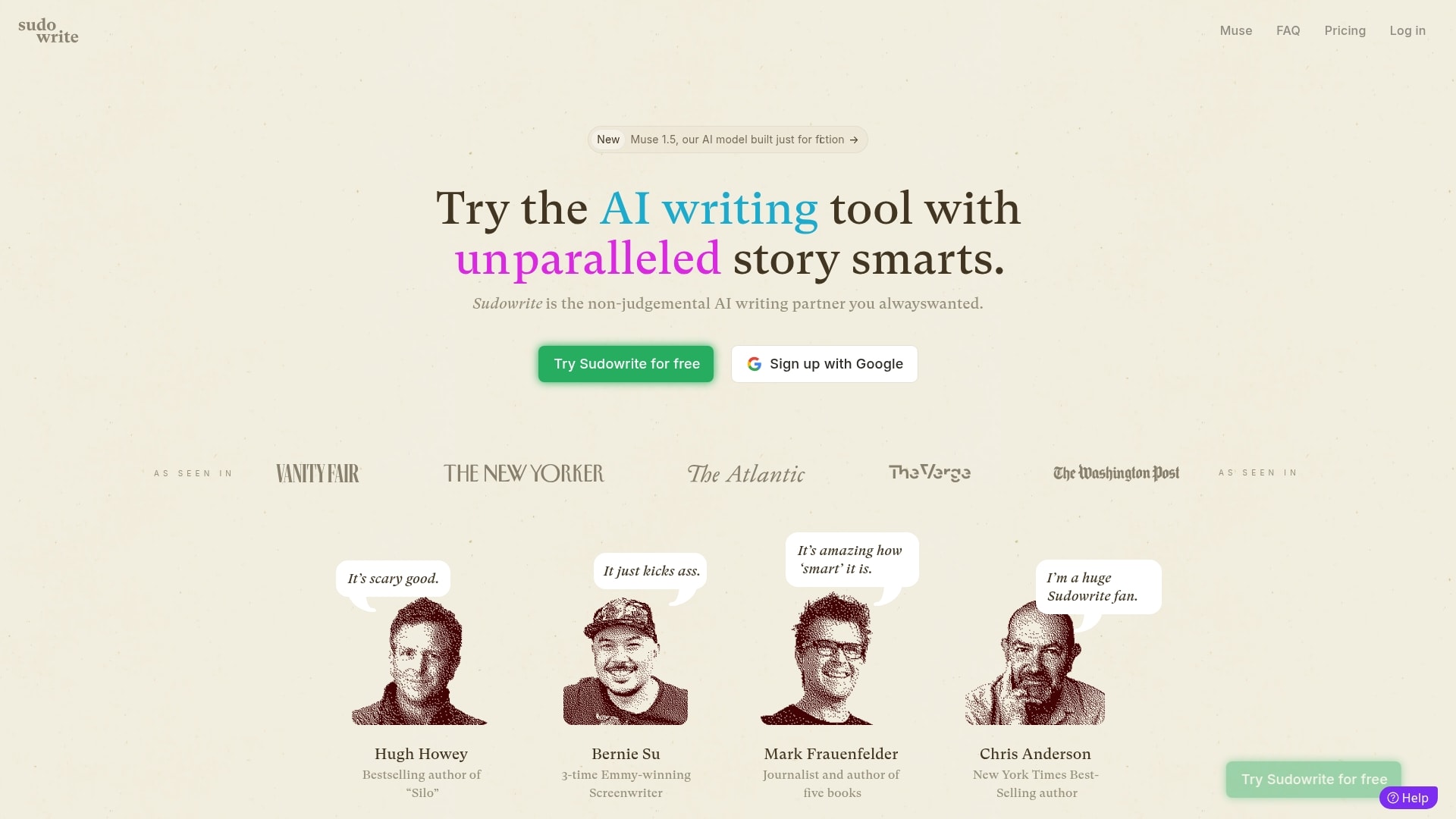
Use case: Sudowrite acts as a collaborative writing partner for fiction authors, helping generate ideas, expand scenes, and maintain story consistency throughout the creative process.
Key features
- Story Bible: maintains character profiles, plot details, and world-building elements to ensure narrative consistency across your manuscript.
- Muse AI model: proprietary language model trained specifically on fiction that produces natural dialogue and authentic storytelling prose.
- Rewrite tools: transform exposition into vivid scenes with “Show, Don’t Tell” functionality and expand content from 650 to 6,000 words.
Pricing
- Hobby & Student: $10/month with 225,000 credits per month.
- Professional: $22/month with 1,000,000 credits per month.
- Max: $44/month with 2,000,000 credits per month.
- Discount: yearly plans available with up to 50% discount.
- Free-trial: available with no credit card required.
Considerations
- Credit-based system can be confusing as different features consume varying amounts of credits.
- Higher price point compared to general AI writing tools may not suit casual writers or those on tight budgets.
2. NovelCrafter
NovelCrafter provides a comprehensive, AI-powered writing platform for long-form fiction authors. By combining robust organizational tools with flexible AI integration, it’s perfect for writers who want complete control over their creative process while leveraging artificial intelligence as a collaborative partner.

Use case: NovelCrafter serves as an all-in-one creative writing workspace that combines planning, drafting, world-building, and optional AI assistance to help fiction authors manage complex narratives from initial concept to final manuscript.
Key features
- The Codex system: a comprehensive story bible that tracks characters, locations, and lore while automatically providing context to AI features.
- Flexible AI integration: connect to multiple AI models (OpenAI, Anthropic, Google) with custom prompts and adjustable parameters.
- Visual organization tools: grid view for drag-and-drop scene arrangement and matrix view for complete story oversight.
Pricing
- Scribe: $4/month (unlimited books, series management, basic review features).
- Hobbyist: $8/month (includes AI integration with your own API key).
- Artisan: $14/month (adds chat features and advanced review tools).
- Specialist: $20/month (collaborative writing and team management).
- Savings: annual billing saves two months.
- Free-trial: 21-day free trial with all features unlocked, no credit card required.
Considerations
- Learning curve for advanced AI prompting features may overwhelm new users.
- Requires separate API accounts with third-party AI services, adding complexity to setup.
Learn more: The best AI for writing books
3. ChatGPT
As a versatile conversational AI, ChatGPT can assist with a wide range of creative writing tasks, from brainstorming story ideas to drafting entire scenes. Its flexibility makes it a go-to choice for writers who need an all-in-one assistant capable of handling everything from character development to AI marketing copy.

Use case: ChatGPT acts as a collaborative writing partner that helps authors overcome writer’s block, generate creative ideas, and refine their work through an interactive, conversational interface.
Key features
- Interactive brainstorming sessions that generate plot ideas, character backstories, and story twists based on your prompts.
- Style mimicking capabilities that let you experiment with different author voices and genre conventions.
- Real-time editing assistance for grammar, sentence structure, and narrative flow improvements.
Pricing
- Free: $0/month — basic access with limited messages, uploads, image generation, deep research, memory, and context.
- Plus: $20/month — includes expanded messaging and uploads, faster image creation, deep research, agent mode, memory, projects, custom GPTs, and limited access to features like the Sora 1 video generator and Codex agent.
- Pro: $200/month — everything in Plus, plus pro reasoning, unlimited messages and uploads, the fastest image creation, maximum deep research, expanded projects, extended Sora 1 access, an expanded Codex agent, and previews of new features.
- Business: $25/user/month (billed annually) — everything in Plus, plus unlimited GPT-5 messages, company knowledge features, admin controls, SAML SSO, and compliance support. Your business data isn’t used for training by default. (Minimum two users).
- Enterprise: contact sales for pricing — everything in Business, plus an expanded context window, enterprise-level security and privacy, 24/7 priority support, SLAs, custom legal terms, and access to AI advisors.
Considerations
- Creative output can feel formulaic or generic without detailed prompting and human editing.
- May struggle with maintaining consistent character voices and plot coherence across longer works.
4. Claude
Claude’s strength lies in its ability to produce thoughtful, nuanced responses while maintaining consistent character voices and narrative tone. The platform generates natural, literary-quality prose that feels genuinely human, making it ideal for authors working on long-form creative projects.
Its massive 200K context window also allows writers to maintain coherence across entire manuscripts.

Use case: Claude serves as a collaborative writing partner that helps authors overcome creative blocks while maintaining their unique voice throughout long-form projects.
Key features
- Massive context window: process up to 200,000 tokens, allowing you to work with entire manuscripts while maintaining consistency in plot, character development, and tone.
- Natural prose generation: produces human-quality writing that avoids the robotic, formulaic language common in other AI writing tools.
- Character voice consistency: excels at maintaining distinct character personalities and dialogue patterns throughout extended narratives.
Pricing
- Free: $0/month — basic chat functionality with limited usage.
- Pro: $20/month (monthly) or $17/month (annual) — increased usage limits, file uploads, and advanced features.
- Team: $30/month per person (monthly) or $25/month per person (annual) — collaboration features and admin controls.
- Enterprise: contact sales for pricing info — custom solutions with enhanced security and compliance features
Considerations
- Limited multimedia capabilities compared to competitors that offer image generation alongside text.
- Pro subscription costs can add up for individual writers who need extensive usage.
5. Jasper
Focused on brand consistency, Jasper provides AI-powered content creation with a strong emphasis on marketing-specific templates. The platform is built for structured creative writing workflows, making it ideal for businesses and content creators who need to produce on-brand stories at scale.

Use case: Jasper excels at helping marketing teams and content creators generate engaging stories while maintaining consistent brand voice across all creative writing projects.
Key features
- Creative Story template that guides users through plot development, character creation, and setting establishment with detailed input fields.
- Boss Mode long-form editor for interactive writing sessions where you can give direct commands and guide the narrative in real-time.
- Brand Voice integration that learns your company’s style guide and tone to ensure all generated content stays on-brand.
Pricing
- Pro Plan: $59/month per seat (billed annually) or $69/month (billed monthly).
- Business Plan: custom pricing (contact sales for quote).
- Free-trial: 7-day free trial available for Pro Plan.
- Non-profit discount: 20% off.
Considerations
- Premium pricing may be steep for individual writers or small creative projects focused solely on fiction.
- Output quality heavily depends on prompt quality, requiring users to learn effective prompting techniques for best results.
6. Writesonic
Writesonic bridges the gap between creative storytelling and commercial writing needs. The platform specializes in generating narrative content across multiple genres and languages, making it a strong choice for writers who need to overcome creative blocks and produce engaging stories quickly.

Use case: Writesonic’s AI Story Generator helps writers craft compelling short stories by transforming simple prompts into complete narratives across various genres like mystery, fantasy, and romance.
Key features
- One-click story generation that creates multiple unique story variations from user inputs including genre, keywords, and character details.
- Multi-language support for creating stories in 25+ languages, enabling writers to reach global audiences.
- Comprehensive writing suite with over 80 tools including script generators, SEO optimization, and AI chatbot builders.
Pricing
- Free-trial: 10,000 premium words available.
- Lite: $39/month (billed annually) or $49/month.
- Standard: $79/month (billed annually) or $99/month.
- Professional: $199/month (billed annually) or $249/month.
- Advanced: $399/month (billed annually) or $499/month.
- Enterprise: custom pricing available.
- Discount: 20% discount available for annual billing.
- Add-ons: additional users and projects available as add-ons.
Considerations
- Story quality heavily depends on the clarity and detail of user prompts, with vague inputs often producing generic content.
- Generated content can sometimes feel robotic and may require significant editing to add human emotional depth and nuance.
7. Rytr
For budget-conscious writers, Rytr offers affordable AI-powered creative assistance to help overcome blocks and generate engaging content quickly. The platform specializes in short-form creative content with over 40 use cases, making it ideal for those who need reliable inspiration and first drafts without a large investment.

Use case: Rytr excels at generating creative story plots, song lyrics, and poems. Paid plans unlock tone customization with over 20 pre-set options and a “Tone Match” feature to align with your narrative style.
Key features
- Story plot generator with customizable creativity levels.
- Built-in plagiarism checker for content verification (paid plans).
- Tone customization with 20+ pre-sets and “Tone Match” feature (paid plans).
- Rich text editor with “Continue Ryting” feature for expanding generated ideas.
Pricing
- Free: $0/month (10K characters/month, one language, no plagiarism checks, no tone customization).
- Unlimited: $9/month or $7.50/month billed yearly (unlimited generations, one language, 50 plagiarism checks/month).
- Premium: $29/month or $24.16/month billed yearly (unlimited generations, 35+ languages, 100 plagiarism checks/month, custom use cases).
Considerations
- Creative writing output can sometimes feel repetitive or generic, requiring significant human editing.
- Long-form content generation is less advanced compared to competitors like Jasper.
8. QuillBot
Rather than generating content from scratch, QuillBot focuses on refining what you’ve already written with AI-powered paraphrasing and rewriting tools. The platform is ideal for writers who want to polish their prose, explore different stylistic approaches, and overcome writer’s block by enhancing existing text.
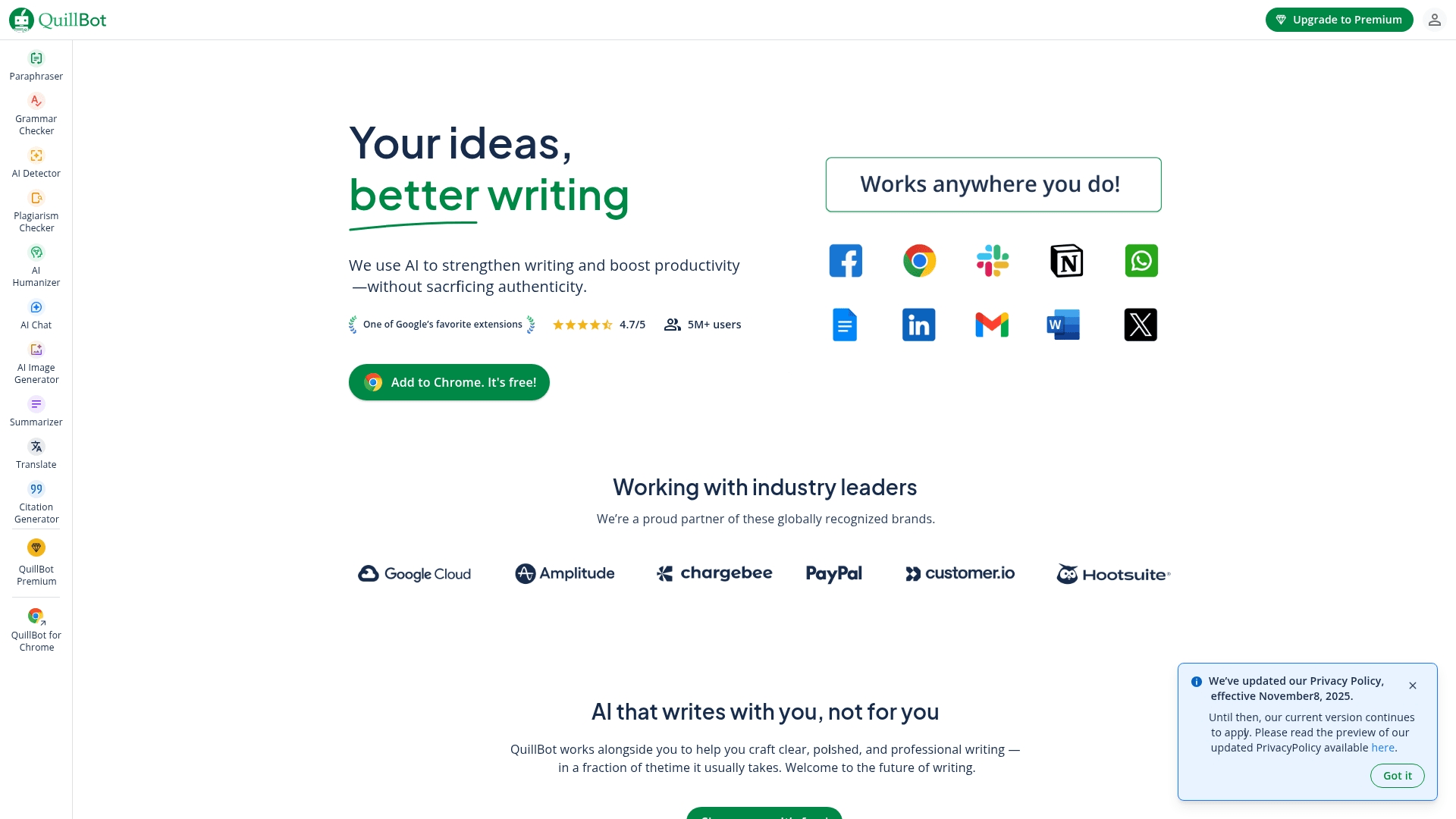
Use case: QuillBot serves as a collaborative writing partner that helps creative writers enhance their prose, find alternative word choices, and overcome creative blocks through intelligent paraphrasing and brainstorming tools.
Key features
- Creative mode paraphrasing: rewrites text with more expressive and imaginative language to add flair to your prose.
- AI Chat for brainstorming: generate plot ideas, develop characters, write dialogue, and explore creative themes.
- Co-Writer workspace: integrated environment for research, note-taking, and writing with AI-powered suggestions for text completion.
Pricing
- Free plan: basic paraphrasing with limited word count.
- Premium: $9.95/month (monthly billing) or $4.17/month (annual billing).
- Team plan: $7.50/month per user (annual billing).
Considerations
- Limited effectiveness for long-form creative projects like novels due to word count restrictions.
- Creative mode suggestions can sometimes sound robotic or lose the author’s unique voice, requiring careful review.
9. Grammarly
While known for its grammar checking, Grammarly’s AI-powered tools now offer style suggestions that help you catch errors while preserving your unique voice. The platform’s customizable writing domains make it useful for fiction writers who need polished prose without sacrificing creative freedom.

Use case: Grammarly serves as a comprehensive AI writing assistant that helps creative writers polish their manuscripts by catching grammar, spelling, and punctuation errors while offering style suggestions tailored to fiction writing.
Key features
- Creative domain setting that allows stylistic flexibility for fiction writing, including sentence fragments and informal language.
- Real-time grammar and spell checking with context-aware suggestions across 500,000+ applications and websites.
- Generative AI capabilities for brainstorming ideas, composing drafts, and refining creative content.
Pricing
- Free: $0/month with basic grammar checking, tone detection, and 100 AI prompts monthly.
- Pro: $12/month (billed annually) or $30/month with unlimited personalized suggestions, plagiarism detection, and 2,000 AI prompts.
- Enterprise: contact for custom pricing (features unlimited AI prompts, dedicated support, and advanced security).
Considerations
- Can lead to homogenized writing style that strips away the author’s unique voice.
- AI suggestions may make dialogue sound unnatural and don’t fully grasp creative context, tone, and subtext.
10. ProWritingAid
ProWritingAid acts as both a technical editor and a writing coach, delivering comprehensive analysis designed for creative writers who want to master their craft.
The platform goes beyond basic grammar checking to provide over 25 detailed reports that analyze everything from pacing and dialogue to narrative flow, making it a go-to choice for novelists and screenwriters who need developmental feedback.

Use case: ProWritingAid serves as both a technical editor and writing coach, helping creative writers polish their manuscripts while learning the principles of effective storytelling.
Key features
- 25+ specialized writing reports covering style, pacing, dialogue tags, overused words, and narrative structure.
- AI-powered Manuscript Analysis and Virtual Beta Reader for developmental feedback on plot and characterization.
- Seamless integrations with popular creative writing software like Scrivener, Google Docs, and Final Draft.
Pricing
- Free: $0 (500-word limit, two runs per report daily).
- Premium: $10/month (billed yearly) or $30/month (billed monthly).
- Premium Pro: $12/month (billed yearly) or $36/month (billed monthly).
- Lifetime Premium: $399 one-time payment.
- Lifetime Premium Pro: $699 one-time payment.
Considerations
- The extensive feature set can feel overwhelming for beginners who just need basic grammar checking.
- Some of the most powerful AI features like Manuscript Analysis require separate credit purchases, even for premium subscribers.
AI chatbots vs specialized writing software
Choosing an AI writing partner often comes down to a choice between a generalist and a specialist. Large chatbots are incredibly versatile, while focused writing tools are built to excel at one part of the job. The decision isn’t about which is best, but about building the right support system for your unique workflow.
Your creative work isn’t one-dimensional, so why should your AI support be? The real question is: do you need a single, adaptable assistant for a variety of tasks, or a dedicated expert for a specific one?
It’s wise to start with your biggest bottleneck and find the tool that solves that one thing first. Remember, you are in control of your creative process, and you can always add more tools to your arsenal as you go.
Choose ChatGPT for versatile creative writing
ChatGPT is the versatile player on your team, ready for any creative sprint. It’s fantastic for jumping between genres — from brainstorming sci-fi concepts to polishing a poem — without missing a beat.
Its strength is in the quick back-and-forth, making it a great conversational partner for exploring new ideas. This is the tool that’s always up for a brainstorm, ready to riff on whatever you throw at it.
Choose Claude for thoughtful storytelling
Claude plays a different role: the continuity expert for your narrative deep dives. It excels at tracking complex plot points and character arcs, remembering key details from chapters ago to keep your story straight.
It’s the specialist you bring in to untangle plot knots and strengthen character motivations. It acts as a sounding board, helping you think through the consequences of your creative choices, making it a powerful ally for ambitious projects.
How to write creatively with AI without sounding robotic
AI-generated text doesn’t have to sound like it was assembled by a committee of robots. The secret is learning to lead your AI assistants, not just take dictation from them. When you act as the creative director, your unique voice gets amplified, not replaced.
Think of AI as a brilliant but very literal teammate. It can handle the heavy lifting of structure and brainstorming, but you provide the soul, the stories, and the quirky insights that make writing feel human.
Assume the role of creative director
Your writing voice is your signature, so protect it. To keep your AI-assisted writing sounding like you, provide an airtight creative brief. Vague requests get vague results.
Instead of asking AI to “write about productivity,” try prompting it with a specific role and angle: “You’re my witty research assistant. Brainstorm three unconventional productivity tips for people who hate to-do lists.”
The more personality you put in, the better the starting point you’ll get back.
Treat AI output as a first draft
AI-generated content works best as a starting point, not a finished product. Just like any early draft, it gives you structure, momentum, and something to react to, but the real craft happens in revision. That’s where your voice, perspective, and judgment take over.
Use AI output to move past blank-page paralysis, then refine it deliberately. Replace generic phrasing with language that sounds like you, reshape sections to fit your narrative flow, and add the context or nuance only a human writer can provide.
You can go a step further by creating task-specific agents that support this editing phase. For example, one agent can review drafts for clarity and structure, while another tracks recurring edits or stylistic preferences across projects.
Use AI as your brainstorming crew
The smartest writers use AI as a creative partner to expand their thinking, not replace it. Your AI team is perfect for breaking through writer’s block, exploring new angles, or even playing devil’s advocate to strengthen your arguments.
Set up your AI agents to be tireless sparring partners: they can generate endless ideas, but you always have the final say on which ones make the cut. You lead, they help — a partnership that lets you create more efficiently while ensuring the final product is 100% you.
Free vs paid AI writing platforms for authors
Choosing your first AI writer is like making your first hire for a creative project. You don’t need a huge budget to get started; plenty of free tools are ready to audition for a role. The real decision isn’t about free vs. paid (it’s about knowing when your workflow demands a more specialized investment).
Starting on a budget
You don’t need a big budget to start experimenting with AI writing tools. Several free platforms give you a feel for how AI assistants can support your creative process without any commitment.
- ChatGPT (free version): a versatile option for brainstorming, outlining scenes, or polishing early drafts.
- Rytr: great for generating short-form content such as summaries, taglines, or snippets of dialogue.
- Free trials on premium tools: many platforms offer limited access to test advanced AI features before you upgrade.
Knowing when to level up
You’ll know it’s time to upgrade when you’re spending more time managing limitations than writing. Paid tools bring advanced skills for plot structuring and handling novel-length projects without breaking a sweat. You’re not just buying features — you’re buying back your time and focus, letting your tools handle the heavy lifting so you can stay in the creative driver’s seat.
How to choose the right AI for your creative writing style
Picking the right AI tool isn’t about finding one perfect assistant either; it’s about building a support system where each component has a specific job. Your writing style is unique, and the support you need should be too.
The key is to assemble a team of helpers, each one focused on a single task, so you can stop wrestling with technology and get back to creating. You wouldn’t ask your dialogue coach to also be your historical fact-checker, and the same principle applies to AI.
Best AI for fiction writers and novelists
Writing fiction means managing complexity over time. Characters evolve, timelines branch, and small inconsistencies can derail an entire narrative. The right AI support acts quietly in the background, helping you maintain structure while you focus on storytelling.
- Build custom assistants: create agents that track plotlines, character details, and world-building elements across chapters.
- Specialized support: assign one agent to monitor pacing, another to review dialogue consistency, and another to summarize chapters for easy reference.
- Stay in control: you make the creative decisions while your AI support handles structure and organization.
The best part is that these agents can evolve alongside your novel, adapting as your story grows more complex.
Best AI for poets and lyricists
Poetry is built on precision: rhythm, tone, and intention matter more than volume. While general AI tools can help spark ideas, much of a poet’s real work happens around the writing itself.
A flexible AI system can support the logistical side of poetry without interfering with the art. You might use one agent to organize fragments and drafts, another to track submission deadlines, and another to catalogue favorite words, themes, or references.
This kind of setup keeps inspiration close while removing the administrative friction that often breaks creative flow.
Best AI for screenwriters and playwrights
Screenwriting demands strict formatting and structural discipline. Minor errors in scene headings or dialogue layout can undermine otherwise strong work. AI support works best here when it focuses on process rather than prose.
You can create agents that act like a script supervisor: one checks formatting rules, another tracks character appearances, and another helps review dialogue for consistency across scenes. Each agent has a narrow responsibility, which makes the support dependable.
The result is fewer technical distractions and more energy for character, pacing, and dramatic tension.
Best AI for creative non-fiction
Creative non-fiction sits at the intersection of storytelling and accuracy. Managing sources, verifying facts, and maintaining a consistent narrative voice requires discipline and structure.
This is where a multi-agent approach shines. One agent can assist with gathering and organizing research, another can help verify claims, and another can review drafts for tonal consistency.
You remain the author and editor. Your AI agents simply ensure the foundation of your work is solid, consistent, and manageable.
Frequently asked questions
Can AI-generated creative writing be published legally?
Yes, you can legally publish creative writing generated with AI. Always review the terms of service for the specific platform you used and consider your industry’s standards for disclosure.
How do creative writers avoid AI detection in their work?
Avoid detection by using AI output as a starting point, not the final piece. Make the work authentically yours by heavily editing it and infusing your unique perspective and personal experiences.
Which AI writing platforms work without an internet connection?
Most AI writing platforms require an internet connection to function. While some locally-installed models offer limited offline features, the most powerful and reliable tools are cloud-based.
Will AI replace human creativity in writing?
No, AI is a tool designed to augment your creativity, not replace it. Think of it as a collaborator for overcoming blocks, while you remain the artist with the vision and voice.
What do AI writing assistants typically cost for creative writers?
Costs range from free basic tiers to premium platforms costing $10–$50 per month. Most specialized tools for creative writing fall within the $15–$30 monthly range.
How can writers maintain their unique voice when using AI tools?
Maintain your voice by treating AI output as raw material, not a finished draft. Your unique style emerges through the choices you make as you edit, rewrite, and refine the text.

 Get started