

HR encompasses every aspect of the employee lifecycle from talent acquisition through to offboarding, and beyond. And traditionally, it’s been seriously manual work. Spreadsheets, paper trails, and HRIS platforms have all been part and parcel of the typical day-to-day of an HR pro. That manual burden is exactly why AI HR software has become so appealing—it takes on the repetitive coordination work that consumes hours each day, giving HR teams room to focus on the judgment calls, relationship-building, and strategic decisions that improve the business.
This guide breaks down what AI for HR includes, how teams use it across recruiting, engagement, planning, and governance, and 15 platforms, including monday agents that each take different approaches to supercharging people ops.
Try monday agentsWhat is AI in HR?
AI in HR uses machine learning and conversational AI to automate recruiting, engagement monitoring, performance management, and workforce planning, giving HR teams more capacity for strategic work that requires human judgment. For example, an AI agent might screen 500 applications against your hiring criteria in minutes and identify the top 20 candidates. By doing so, your people have more time to focus on building candidate relationships.
15 best AI platforms for HR teams
Finding the right AI platform for HR management isn’t about picking a single tool for one task. If you did that, your HR tech stack would quickly turn into a mountain. A better approach is to choose a partner that fits how your team works. Some platforms will excel in narrow areas like sourcing or analytics. Others connect people operations to the broader business. The best choice depends on whether you want to solve a specific pain point or unify work across teams.
To make that comparison easier, we’ve reviewed 15 leading platforms. This guide compares each, from focused point solutions to fully integrated work platforms.
| Platform | Primary HR use case | Key differentiator | Ideal for |
|---|---|---|---|
| monday agents | Full recruiting workflow automation | Cross-department context across 225,000+ organizations | Mid-market to enterprise teams seeking unified AI adoption |
| Workday | Enterprise workforce analytics | Deep HCM integration with predictive planning | Large enterprises with existing Workday deployments |
| Lattice | Performance and engagement | Continuous feedback analysis | Mid-market companies prioritizing employee experience |
| IBM | Advanced talent analytics | Watson-powered custom model development | Enterprises requiring sophisticated AI customization |
| OpenAI | Flexible content and analysis | Natural language processing for ad-hoc tasks | Teams building custom HR workflows |
| Personio | European SMB administration | GDPR-native compliance automation | Small to mid-sized European businesses |
| Gloat | Internal talent mobility | AI-powered skills matching for career paths | Large organizations with internal mobility programs |
| Findem | Candidate sourcing | Attribute-based talent pipeline building | Recruiting teams focused on proactive sourcing |
| Eightfold AI | Skills-based talent decisions | Deep learning for skills inference | Enterprises transitioning to skills-based frameworks |
| HireVue | Video interview assessment | AI-scored structured interviewing | High-volume recruiting operations |
| Visier | People analytics | Predictive workforce modeling | Data-driven HR teams prioritizing analytics |
| Wisq | Employee sentiment | Real-time communication analysis | Organizations monitoring engagement continuously |
| Textio | Job posting optimization | Bias detection in written content | Recruiting teams improving posting effectiveness |
| BrightHire | Interview intelligence | Conversation analysis and coaching | Teams improving interview quality and consistency |
| Harver | Volume hiring | Automated candidate matching and assessment | Organizations with high-volume hourly hiring |
1. monday agents
For HR teams that need AI where work is already happening, monday agents offers an always-on layer for recruiting, engagement, and people operations. Integral to monday.com’s AI Work Platform, your teams can start with ready-made agents or create custom ones that take action inside existing workflows. As 250,000 organizations already run work on monday.com, adopting AI feels like an extension of the environment rather than a separate rollout.

Use case:
Mid-market and enterprise HR teams that want to automate high-volume recruiting and engagement workflows from one central location. It’s especially useful for organizations that need AI to work across hiring boards, docs, PDFs, approvals, and cross-department processes, rather than push work into a separate system.
Key features:
- End-to-end recruiting automation: HR teams can use dedicated agents for sourcing, screening, scheduling, and reference collection.
- Grounded execution in your HR context: Agents can use the docs, PDFs, and boards you define as context, so actions stay tied to your hiring guidelines, interview rubrics, and internal processes. Instead of generating generic outputs, they work from the same information your team already trusts.
- 24/7 support for recurring HR workflows: Because agents are designed for autonomous operation, they keep follow-ups, candidate coordination, summaries, and administrative work moving even when your team is focused elsewhere. This is especially valuable during high-volume recruiting cycles and across distributed teams.
- Proactive engagement monitoring: For post-hire workflows, the Pulse Survey Manager can run recurring employee engagement surveys, analyze trends, and spot sentiment shifts early. HR leaders get a practical way to identify retention signals and respond with context instead of guesswork.
- Cross-department workforce planning: monday agents work on top of monday.com’s shared work context across departments, so HR planning stays connected to the broader business context. Hiring plans, for example, can stay linked to sales pipeline changes, project demand, onboarding readiness, or operational capacity already tracked on monday.com.
Pricing:
- AI credits: monday.com’s AI Work Platform operates on a credit-based model for AI features. Credits are consumed when you use AI capabilities like agents, automations, or assistants. Each account receives a monthly allocation of AI credits based on the number of paid seats and plan tier.
Why it stands out:
- Governance built for HR: monday agents gives teams explicit control over what an agent can and cannot do, both on monday.com and across connected systems. You can define whether an agent can read, create, or edit information, validate actions in simulation mode before activation, and review an audit trail for every action. This is backed by enterprise protections including HIPAA support, SOC 2 Type II, ISO/IEC 27001, and ISO/IEC 27701.
- One platform, full context: Agents act where teams already manage hiring and people operations on monday.com, with related work visible across IT, legal, operations, and leadership. This keeps approvals, updates, and handoffs connected to the same workspace instead of splitting them across disconnected systems.
- Ready-made where you need speed, custom where you need fit: Teams can start with ready-made HR agents, then create their own if you need your agent to match a specific hiring or people process.
- Open ecosystem, familiar adoption path: Compatible AI assistants such as ChatGPT, Claude, Cursor, and Microsoft Copilot Studio can securely access and act on monday.com data. Each assistant only gets the access the connected account already has, so teams can expand AI usage without giving up control.
2. Workday
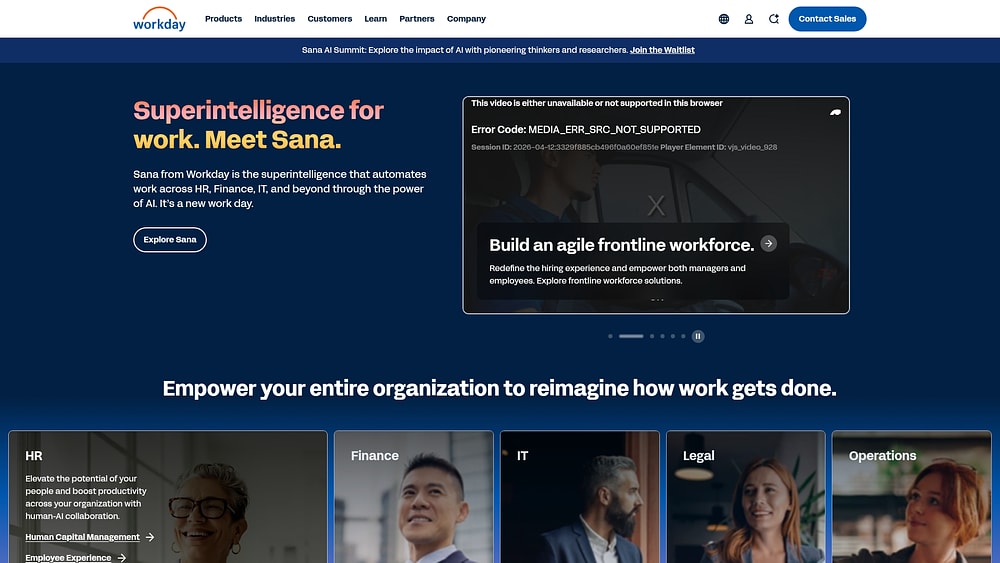
At enterprise scale, Workday positions AI inside the core of human capital management, not an add-on layer. The platform turns workforce data into decisions across hiring, talent development, and planning. Built for organizations that need AI-powered workforce analytics on top of a unified HR and finance data foundation, Workday uses its Illuminate engine to process context-rich data at scale. The result is explainable, governed AI that enterprise compliance teams can put under real scrutiny.
Use case:
Large enterprises already running Workday HCM that need AI-powered workforce analytics, skills intelligence, and predictive planning across the full employee lifecycle.
Key features:
- Skills intelligence: Workday’s Skills Cloud uses machine learning to map workforce skills, find gaps, and match people to internal opportunities, giving HR leaders a real-time picture of organizational capability without manual audits.
- Workforce planning predictions: Predictive models support headcount planning, succession decisions, and organizational design, helping executives anticipate talent needs before they become urgent.
- Compliance monitoring: Automated tracking and alerting across regulatory requirements and jurisdictions reduces the manual burden on HR and legal teams operating in complex, multi-region environments.
Pricing:
- Accurate pricing is available from the vendor on request.
Considerations:
- Workday requires significant implementation investment and dedicated HR technology resources, making it disproportionate for organizations without an existing Workday deployment or a team to manage it.
- AI performance depends heavily on data readiness; inconsistent or incomplete data can degrade outputs and increase compute costs, placing the burden of data quality on the customer’s implementation team.
3. Lattice
Lattice centers AI around the ongoing manager-employee relationship, not the once-a-year review cycle. Designed for mid-market organizations, it brings performance reviews, engagement surveys, goals, and development data into one suite. This makes it a strong option for HR teams replacing annual review rituals with a more continuous model. Its embedded AI Agent draws patterns from across that data, giving managers sharper context for coaching, retention, and employee development.

Use case:
Mid-market organizations looking for AI-enhanced performance management and continuous engagement monitoring without stitching together multiple platforms.
Key features:
- Performance insights: AI-generated summaries analyze goal progress, feedback patterns, and cross-functional inputs to help managers write higher-quality reviews faster, requiring a minimum of three feedback items to generate a summary.
- Sentiment analysis: Automated key-driver analysis and comment-theme detection find engagement trends from surveys, check-ins, and updates as soon as they close, so HR teams can act on risks before they escalate.
- AI Agent with Knowledge Vault: An embedded agent answers policy questions by referencing governed company documents synced from Google Drive, SharePoint, or OneDrive, with source citations included for every response.
Pricing:
- From $11 per seat/month, billed annually
Considerations:
- Lattice focuses on post-hire employee experience, covering performance, engagement, and development. Organizations that also need recruiting automation or workforce planning will require additional platforms alongside it.
- Admins must manually enable AI features and configure Knowledge Vault permissions, which adds setup overhead for smaller HR teams.
4. IBM
IBM approaches AI in HR through orchestration. While the broader Watson platform supports custom talent analytics and predictive modeling, watsonx Orchestrate is aimed at agentic AI for HR workflow automation. It coordinates work across onboarding, benefits, performance, and talent development, with a clear fit for large and mid-size enterprises in regulated environments.

Use case:
Large enterprises that need AI agents to automate HR workflows across multiple systems, with strong governance and compliance requirements built in.
Key features:
- Multi-agent orchestration: Coordinates a network of AI agents across HR systems, covering employee support, talent acquisition, learning and development, and performance, rather than relying on a single-app assistant.
- Prebuilt HR skills and integrations: Connects with 80+ enterprise applications out of the box, with a no-code Agent Builder and a growing catalog of prebuilt HR agent packs to accelerate deployment.
- Enterprise-grade governance: watsonx.governance provides risk assessment, lifecycle monitoring, and explainability across IBM and third-party AI models, supporting responsible AI use in compliance-sensitive HR environments.
Pricing:
- Free plan available
Considerations:
- Some HR agent capabilities remain in private preview or beta, which may affect feature availability and rollout timing for new customers.
- US list pricing for watsonx Orchestrate is not publicly available, and usage-based charges for tokens, text extraction, and GPU hosting can make total cost of ownership harder to forecast without a direct conversation with IBM sales.
5. OpenAI
OpenAI gives HR teams a flexible foundation, not a purpose-built HR application. Through ChatGPT Business and Enterprise, along with a customizable API, teams can apply GPT models to policy drafting, onboarding content, and employee-facing knowledge work. With more than 9 million paying business users, adoption is already widespread among organizations trying to speed up content creation and internal support. Its governed app ecosystem, including native connectors for HR-adjacent tools such as Gusto and Box, makes it especially practical for teams that already know how ChatGPT fits into everyday work.

Use case:
HR teams seeking a flexible, enterprise-governed AI assistant for policy drafting, onboarding content, employee Q&A, and benefits-related knowledge work — without committing to a purpose-built HR platform.
Key features:
- Company knowledge mode: Connects ChatGPT to internal sources like Slack, SharePoint, and Google Drive, so HR teams can find policy answers and onboarding materials with cited, permission-respecting responses rather than manual searches.
- Governed app integrations: Native connectors for platforms like Gusto (payroll and benefits Q&A) and Box (onboarding guide creation) give HR teams structured, admin-reviewed access to the data ChatGPT can act on.
- Enterprise-grade security and compliance: Business data is not used to train models by default, with AES-256 encryption, SOC 2 Type 2 certification, ISO/IEC alignment, and data residency across 10+ regions, supporting HR teams with strict compliance requirements.
Pricing:
- From $20/user/month
Considerations:
- OpenAI doesn’t offer a purpose-built HR product, so teams must design their own workflows, prompts, and governance processes — a meaningful investment compared to platforms with pre-configured HR agents.
- High-stakes HR decisions, such as employment determinations, cannot be fully automated under OpenAI’s usage policies, and generative models require human oversight to manage potential inaccuracies or bias in personnel-related outputs.
<
6. Personio
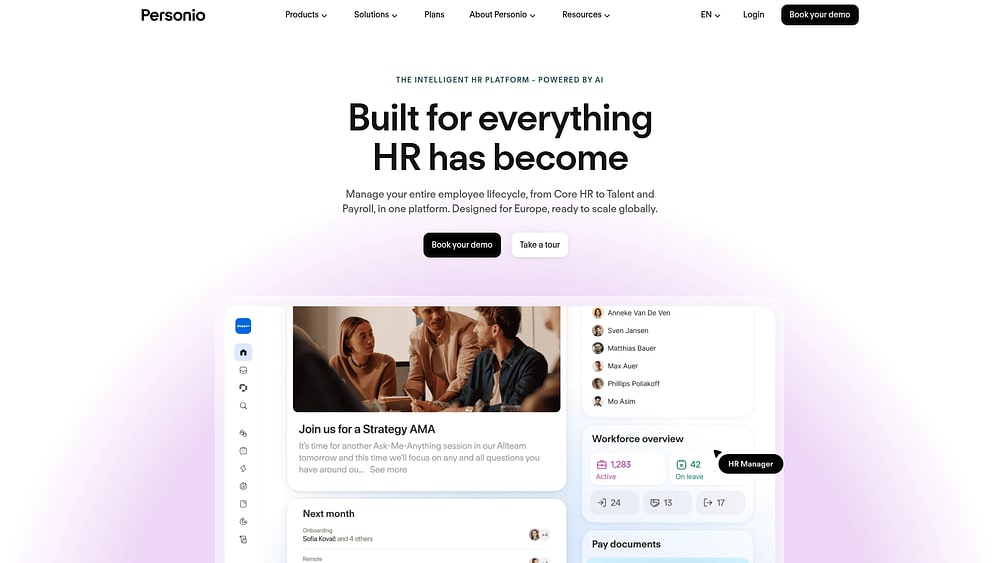
For European SMBs, Personio brings HR administration and AI-assisted workflows into one system built with regional requirements in mind. The platform combines people workflow automation with a permissions-aware assistant, making it well suited to organizations that want GDPR-compliant HR operations without managing a patchwork of disconnected tools. With data stored in Frankfurt and ISO 27001 certification, it offers a governed base for AI-supported work.
Use case:
European SMBs seeking an all-in-one HR platform with AI-assisted workflows, built-in compliance, and EU data residency.
Key features:
- Personio Assistant for HR analytics: A natural-language AI assistant that answers questions across people, time, compensation, and recruiting metrics, returning text summaries and downloadable charts grounded in your own HR data, without using that data to train models.
- AI-powered employee support: Personio Conversations uses AI to auto-answer routine employee questions submitted via Slack or Microsoft Teams, reducing repetitive requests to the HR team and giving employees faster access to the information they need.
- People workflow automation: Intelligent task sequencing handles onboarding, absence management, and document generation, so HR teams spend less time on administrative coordination and more time on strategic priorities.
Pricing:
- Quote-based pricing
Considerations:
- Personio is purpose-built for European markets, so organizations outside Europe may find that certain AI features, such as AI-powered payslip parsing, are only available for specific countries like Germany.
- The employee-facing AI assistant is in a phased rollout, meaning access may vary depending on your plan or region at the time of adoption.
7. Gloat
Internal mobility is where Gloat focuses its AI strategy. The platform uses AI to connect employees with roles, projects, and career paths already available inside the organization, turning talent mobility into a retention and workforce optimization lever. It’s designed for large enterprises that want to unlock existing capacity instead of relying only on external hiring. That governance-first approach also makes it a natural fit for organizations running Workday, SAP SuccessFactors, or Oracle HCM.

Use case:
Large enterprises prioritizing skills-based internal mobility and career development as a retention and workforce optimization strategy.
Key features:
- Skills-based matching: AI connects employees with internal roles, projects, mentorship opportunities, and learning experiences based on their skills, interests, and development goals — going beyond keyword matching to understand workforce semantics.
- Governance-aware AI agents: A built-in Governance Engine enforces approval chains, eligibility rules, and compliance policies before any AI action is taken, reducing rework and keeping every recommendation within enterprise guardrails.
- In-the-flow-of-work delivery: Agents spot career recommendations, staffing suggestions, and workforce insights directly in Microsoft Teams, Slack, and email — so employees engage without leaving the platforms they already use.
Pricing:
- Quote-only pricing available
Considerations:
- The platform is purpose-built for large, complex enterprises; mid-market organizations may find the implementation scope and governance requirements heavier than their needs require.
- Time to value depends significantly on data readiness and manager adoption — harmonizing skills data and driving behavioral change across teams requires dedicated change management investment.
8. Findem
Findem starts at the top of the hiring funnel, where sourcing volume and ambiguity tend to pile up fast. It converts billions of unstructured people data points into a structured, searchable talent graph that recruiting teams can use right away. The platform is aimed at enterprise talent acquisition leaders who want to build pipelines proactively instead of waiting for inbound applications. With agentic AI workflows for sourcing, screening, and scheduling, the goal isn’t a longer candidate list but a more hire-ready one.

Use case:
Recruiting teams at enterprise organizations that need AI-driven candidate sourcing, pipeline intelligence, and agentic workflows to reduce manual effort across the top of the hiring funnel.
Key features:
- Attribute-based search: Finds candidates based on verified skills, experience patterns, and expert-labeled “Success Signals” drawn from 100,000+ continuously refreshed data sources, moving well past keyword matching.
- Diversity sourcing: Proactively identifies candidates from underrepresented groups and tracks diversity metrics across pipeline stages, giving talent leaders visibility into representation before offers are made.
- Talent pool analytics and market intelligence: Finds insights into candidate availability, competitor hiring activity, and channel performance so recruiting leaders can make resourcing decisions grounded in real market data.
Pricing:
- Quote-based is available
Considerations:
- Findem focuses on the sourcing and top-of-funnel phases of recruiting, so teams need separate systems for interviewing, onboarding, and broader HR functions.
- Some team members report a learning curve with the platform’s UI and campaign workflows, and integration friction with certain ATS configurations has been noted in G2 reviews.
9. Eightfold AI
Eightfold AI is built around a skills-first view of talent. It applies deep learning to decisions across hiring, development, and workforce planning, making it especially relevant for enterprises and public-sector organizations moving away from rigid role-based models. The platform draws on a talent graph of more than 1.6 billion career trajectories and 1.6 million skills to match people and roles with precision.

Use case:
Enterprises transitioning from role-based to skills-based talent strategies who need a single AI-native platform spanning acquisition, development, and workforce planning.
Key features:
- Skills inference: Extracts and validates skills from resumes, profiles, and work history using deep-learning models, giving HR teams a richer, more accurate picture of workforce capabilities than job titles alone can provide.
- Career path predictions: Projects career trajectories and development needs using machine learning, helping organizations identify internal mobility opportunities before people start looking elsewhere.
- Bias reduction: Evaluates candidates based on content rather than appearance or tone, with a publicly posted NYC Local Law 144 bias audit summary supporting accountability in hiring decisions.
Pricing:
- Quote-based pricing is available
Considerations:
- Organizations that rely on traditional role-based hiring structures may face a significant change management effort before realizing full value from the platform.
- Pricing transparency is limited, and the enterprise sales motion means teams need to engage directly with Eightfold before understanding total cost of ownership.
10. HireVue
HireVue is designed for hiring environments where speed, structure, and auditability are importance. It applies science-backed AI to high-volume recruiting, turning interviews into a more repeatable and defensible evaluation process rather than a gut-feel exercise. Enterprise recruiting teams use it to assess hundreds or thousands of candidates while preserving consistency and compliance. With transcript-only AI scoring, validated assessments, and FedRAMP authorization, the platform is geared toward organizations that can’t afford fuzzy documentation.

Use case:
Enterprise and large mid-market recruiting teams requireing standardize candidate assessment at scale while maintaining compliance and defensible hiring decisions.
Key features:
- AI-scored video interviews: Analyzes only the text of candidate responses, rather than facial expressions or audio features, to pinpoint competency indicators and rank candidates against structured criteria.
- Assessment library: Spans game-based psychometrics, Virtual Job Tryouts®, coding tests, and language proficiency evaluations, with an Assessment Builder that generates validated, job-relevant assessments in minutes.
- Interview Insights: Delivers instant summaries, searchable transcripts, and competency tagging directly within Teams and Zoom integrations, so hiring managers spend less time reviewing recordings and more time making decisions.
Pricing:
- Quote-based pricing
Considerations:
- The platform is purpose-built for the assessment and interview phase, so organizations won’t need separate systems to cover sourcing, onboarding, and broader HR functions.
- Advanced configurations, such as AI-scored assessments with ATS integration, require meaningful change management investment, which can extend time to value for teams without dedicated implementation resources.
11. Visier
Where some platforms focus on automation, Visier specializes in making workforce data more useful for decision-making. It gives HR leaders predictive intelligence across the employee lifecycle and is aimed at mid-market and enterprise organizations that need cross-system people analytics. It’s a strong fit for teams ready to move beyond static reporting and act on live workforce signals instead. With over 65,000 companies and 36 million employee records on the platform, it brings significant scale to people analytics.

Use case:
HR teams seeking advanced workforce analytics and predictive modeling to inform headcount, retention, and compensation decisions at scale.
Key features:
- Predictive turnover analytics: Identifies attrition risk using organizational and individual factors, so HR leaders can act before talent walks out the door.
- Compensation benchmarking: AI-powered analysis draws on 2 billion+ compensation data points to identify pay equity gaps and market positioning across roles.
- Workforce planning models: Scenario planning for headcount, skills, and organizational design helps leaders model the impact of decisions before committing to them.
Pricing:
- Quote-based pricing
Considerations:
- Visier focuses on analytics and insights rather than workflow automation, so teams need a separate operational HR system alongside it to execute processes.
- Pricing requires a sales conversation to evaluate, which adds time to the procurement process for teams comparing options quickly.
12. Wisq
Wisq has evolved beyond employee communication and engagement into an agentic AI platform for HR operations. It now handles work ranging from policy questions to case triage with compliance-aware reasoning. The platform is aimed at mid-market and enterprise HR teams that need 24/7 employee support without increasing headcount, powered by HRLM, a large language model trained on HR regulations, policies, and best practices.

Use case:
Mid-market and enterprise HR teams seeking to automate high-volume employee support, policy administration, and case management across distributed workforces.
Key features:
- Agentic HR case handling: Harper, Wisq’s AI HR Generalist, triages, routes, and resolves routine HR cases autonomously, with traceable reasoning and policy citations so every response is audit-ready.
- Purpose-built HR reasoning: HRLM, Wisq’s domain-specific large language model, is trained on HR regulations, policies, and best practices, enabling policy-compliant answers across 98 languages with verifiable sourcing.
- Broad integration coverage: Connects with major HCM systems (Workday, UKG, SAP SuccessFactors, ADP, Dayforce), service platforms (ServiceNow, Jira, Zendesk), and communication channels like Slack, Microsoft Teams, and email, with dedicated apps for iOS and Android.
Pricing:
- Quote-based pricing
Considerations:
- Key performance metrics, including the 80% automation rate and SHRM-CP accuracy claims, are vendor-reported; independent validation is not publicly available.
- Wisq operates as an agentic HR operations layer, not a full HRIS or payroll system, so it relies on existing HCM integrations for system-of-record actions.
13. Textio
Textio focuses on one specific lever in HR and recruiting: the quality of written communication. It uses AI to help teams create more effective and inclusive job postings and performance feedback, making it a fit for talent acquisition and people management teams trying to reduce bias while improving clarity. Trained on more than 1 billion HR documents, Textio offers real-time guidance in the moment people are writing, not after the draft is already done.

Use case:
Recruiting and HR teams that want to improve job posting performance, reduce bias in written communications, and coach managers to write higher-quality performance feedback.
Key features:
- Real-time inclusive language guidance: Identifies language patterns that may discourage certain candidate groups and suggests alternatives as recruiters and hiring managers write, so every job posting reflects the organization’s inclusion goals.
- Textio Score: Predicts how a job posting will perform based on language choices, giving teams a measurable signal to act on before publishing — T-Mobile reduced time-to-fill by 5 days for roles with a high Textio Score.
- Performance feedback coaching: Guides managers through writing structured, evidence-based feedback with real-time guidance, risky-language detection, tone adjustment, and shortcut prompts.
Pricing:
- Quote-based pricing
Considerations:
- Quote-based pricing is available
14. BrightHire
BrightHire narrows in on the interview itself and tries to make it more structured, more useful, and easier to improve over time. The platform combines AI-generated notes, structured screening, and interviewer coaching for mid-market and enterprise talent acquisition teams that want stronger hiring signal with less bias. Acquired by Zoom in late 2025, it has built strong credibility among recruiting professionals.

Use case:
Talent acquisition teams at mid-market and enterprise organizations that want to improve interview consistency, reduce bias, and make faster, evidence-based hiring decisions.
Key features:
- AI interview notes and highlights: Automatically captures and structures interview content so interviewers can stay focused on the candidate, with key moments for faster debrief and feedback.
- BrightHire Screen (AI interviewer): Conducts asynchronous, rubric-based voice or video screens using company-defined criteria, then delivers transcripts, summaries, and scores directly into the ATS for review.
- Interviewer coaching insights: Analyzes question patterns and interviewer behavior at scale, flagging areas for improvement and helping organizations build more consistent, high-quality interview practices across teams.
Pricing:
- Quote-based pricing across three plan tiers
Considerations:
- AI-generated summaries, as with any automated note-taking platform, may occasionally miss nuance — a consideration worth factoring in for high-stakes or complex roles.
15. Harver
Harver is built for hiring environments where candidate volume is the defining constraint. It combines assessment, matching, and workflow automation to help organizations move faster without giving up rigor. The platform blends neuroscience-based evaluations with AI-powered scoring, making it especially relevant for teams that need to identify the right candidates quickly while preserving fairness and compliance. With 100+ million candidates processed across 1,300+ customers, its footprint is firmly enterprise-grade.

Use case:
Organizations with high-volume hiring needs, such as in retail, hospitality, BPO, and contact centers, that want to automate candidate matching, assessment, and workflow progression.
Key features:
- Gamified soft-skills assessments: 12+ neuroscience-based interactive assessments, completed in approximately 25 minutes, evaluate candidates on soft skills in a non-verbal format designed to reduce cultural and language bias across gender, ethnicity, and socioeconomic backgrounds.
- Predictive candidate matching: Over 450 assessments and 900+ job profiles generate fit predictions grounded in 35+ years of I-O and cognitive science, scoring candidates as a great, good, or poor match for a given role.
- Automated reference checking: A candidate-initiated, mobile-friendly workflow compiles reference reports and flags potential fraud using a proprietary algorithm, addressing a risk that affects an estimated 5% of reference submissions.
Pricing:
- Quote-only pricing
Considerations:
- Harver is purpose-built for volume hiring scenarios, which means it may be over-engineered for professional or executive recruiting where evaluation is more nuanced and candidate volume is lower.
- No transparent pricing is published, which can extend procurement timelines for teams benchmarking multiple platforms simultaneously.
How HR teams use AI across key functions
HR teams handle a wide span of responsibilities, from filling open roles and answering policy questions to shaping culture and planning headcount. The coordination of effort, volume, and timing is required to keep everything moving.
The strongest AI use cases in HR tend to be function-specific rather than broad and abstract. Map AI to the places where work bottlenecks appear, and the outcome is clearer: faster response times, more consistent execution, and more room for decisions that need human judgment.
- Talent acquisition and recruiting automation: AI handles sourcing, screening, and interview scheduling when application volume spikes, giving recruiters more time for candidate conversations and hiring manager alignment while candidates experience faster communication and more consistent evaluation.
- Employee engagement and sentiment analysis: AI spots sentiment shifts, recurring feedback themes, and department-level patterns from surveys and comments as they form, so HR can prioritize outreach and support managers with context before issues spread across the organization.
- Performance management and continuous feedback: AI tracks goal progress, feedback patterns, recognition moments, and collaboration signals, giving managers more context for coaching and more specific review inputs so performance conversations reflect actual contributions over time.
- Workforce planning and predictive analytics: AI forecasts upcoming role demand, attrition signals, skill gaps, and capacity pressure, helping leaders decide hiring priorities and internal mobility options sooner while aligning workforce plans with delivery needs and growth targets.
Learn more: AI HR software
How to choose the right AI platform for HR
Work through the following points to select an appropriate AI tool for your HR department.
Check connections to your HR systems
Your platform of choice has to work with the systems your team already depends on. Without that connection layer, even impressive AI features stay disconnected from the workflows that matter most. Before committing, ask:
- Does it offer ready-to-go connections for your HRIS, ATS, and communication platforms?
- Does information sync in near real time, or does it move in delayed batches?
- What support is available if a connection needs maintenance or troubleshooting?
Verify governance and data controls
AI in HR can shape hiring experiences, employee support, and how consistently policies are applied. Governance becomes the very structure that lets your team use AI confidently and show leadership how decisions are managedFocus your evaluation on:
- Compliance coverage: certifications such as SOC 2 Type II and ISO/IEC 27001.
- Permission structure: the ability to define who can access what, and what an agent is allowed to do.
- Auditability: action history, approval paths, and review records.
- Testing options: simulation mode or similar safeguards before live activation.
These controls are key when AI is handling sensitive work. They’re also one reason teams evaluating monday agents often prioritize governance early in the process.
Confirm your team can adopt it quickly
If only specialists can configure the platform, you have created a new bottleneck. The strongest options let recruiters, HR business partners, and operations leads set up useful automation without needing to write code.
Evaluate adoption with questions like:
- Can team members launch their first workflow without technical training?
- Are there ready-made agents for common HR processes?
- How quickly can someone test a workflow and inspect the result?
Simple adoption changes everything. It’s often the difference between an AI pilot that stalls and an AI operating model that spreads across the team.
Assess whether it sees the bigger picture
HR decisions are shaped by more than HR data alone. Sales forecasts, product timelines, operational capacity, and budget shifts all influence hiring and workforce planning. Look for a platform that can connect HR work to that broader context:
- Cross-functional visibility: access to information from sales, finance, operations, and other teams.
- Shared workflows: approvals and updates that stay connected across departments.
- Planning context: visibility into the business signals that drive headcount decisions.
A platform with broader organizational context can support better-informed recommendations. This is key when you want workforce planning to reflect live business demand rather than a static staffing spreadsheet.
Learn more: AI candidate matching agent
How monday agents helps HR teams scale impact
Recruiting and employee engagement are high-stakes areas, yet much of the work surrounding them is repetitive. Screening applications, coordinating interviews, collecting references, and summarizing meetings all take time. At volume, that work can pull HR away from the conversations that shape outcomes.
monday agents rebalances the equation. People remain at the heart of HR but agents handle the execution inside the same monday.com’s AI Work Platform where hiring and people workflows already run.
This shows up across the HR workflow in practical ways:
- Sourcing agent: finds and ranks candidates across multiple sources, then improves over time based on recruiter feedback.
- Screening agent: scores each application against your criteria, filters non-fits, and finds strong candidates quickly.
- Scheduling agent: coordinates interviews against live availability, then handles confirmations and reminders automatically.
- Reference Collector: schedules reference calls, captures feedback, summarizes the conversation, and centralizes candidate scoring.
- Pulse Survey Manager: runs recurring engagement surveys, analyzes trends, and helps HR spot sentiment shifts early.
Teams can start with ready-made agents, and when they need something more tailored, they can build a custom agent in 3 steps:
- Describe the role and triggers.
- Connect the right knowledge and tools.
- Test and refine before activation.
monday agents pulls from the knowledge sources you define, such as job descriptions, interview guides, approval workflows, and team boards, so the context is always spot-on. For HR teams managing complex recruiting processes, automation always remains in check with how decisions are made, not how a generic system thinks they should be.
The platform also keeps HR connected to the rest of the business. Hiring plans can stay linked to pipeline changes in sales, project timelines in delivery, or capacity signals in operations. When workforce decisions draw from live business context instead of static spreadsheets, HR becomes more responsive and easier to scale without losing consistency.
AI adoption for HR teams starts with one workflow
The strongest AI programs in HR rarely begin with an all-at-once transformation. More often, they start with one high-volume workflow. Recruiting coordination, resume screening, employee support, or engagement follow-up are strong first candidates because the volume is high and the impact is easy to measure.
From there, the next step is choosing a platform that pairs practical automation with the right controls. monday agents helps HR teams do that by uniting execution, governance, and cross-department context.
If you’re evaluating where to begin, start with one workflow, define decision rights, and measure outcomes over a few weeks. That gives your team a reliable path to expand AI adoption confidently while keeping people at the center of every decision. Get a free trial of monday agents today.
Try monday agentsFAQs about AI for HR
How long does it take to implement AI in HR?
With pre-built agents, teams can often launch AI in HR as quickly as tomorrow and begin seeing results within a few weeks. More customized enterprise deployments can take several months, especially when integrations, permissions, and governance reviews are part of the rollout.
What data foundation is required before deploying HR AI?
The strongest results of using AI in HR usually depend on dependable employee records, job descriptions, and historical hiring or engagement data. Platforms with built-in enrichment and grounded context can fill some gaps, but the more structured your source data is, the easier it is to launch with confidence.
Can small businesses benefit from AI in HR?
Absolutely. AI can help small HR teams manage more recruiting coordination, employee support, and administrative volume without adding headcount. In practice, that often gives a lean team the operating capacity of a larger department.
How do HR AI platforms handle employee data privacy?
Leading platforms support privacy through certifications, permissions, encryption, and controlled access. On monday.com, your organization retains ownership of its data, and that data is not used for third-party model training.
How does monday agents differ from general AI assistants for HR?
monday agents comes pre-built for specific HR workflows like sourcing, screening, scheduling, and engagement monitoring. As it operates on monday.com, where your workflows already live, teams can move faster without building every process from scratch.
What HR functions should teams automate with AI first?
HR teams can begin with high-volume workflows that follow repeatable rules and have measurable outcomes. Resume screening, interview scheduling, employee policy questions, and engagement follow-up are often the fastest places to demonstrate value and build internal confidence.
 Get started