


Hiring the right person shouldn’t feel like guesswork. Yet without a structured process, most interviews turn into free-flowing conversations that vary wildly from one interviewer to the next. The result? Inconsistent evaluations, missed red flags, and offers extended based on gut instinct rather than evidence. With 99% of Fortune 500 companies now using AI to filter applicants (SHRM, 2025), the gap between teams that use a structured interview template and those that don’t is widening fast.
The stakes are high. Research shows that 75% of employers have hired the wrong person for a role, costing organizations thousands in lost productivity, rehiring, and onboarding. Unstructured interviews also open the door to unconscious bias, inconsistent scoring, and legal risk. As skills-based hiring replaces credential-based screening, interviewers need a reliable framework for evaluating what candidates can actually do.
This guide covers everything you need to build a hiring process that’s consistent, fair, and scalable. You’ll learn what an interview template is, the key elements every template should include, how to create one from scratch, and how teams use monday AI Workspace to manage the entire interview workflow in one place.
Key takeaways
- An interview template is a standardized document that outlines questions, scoring criteria, and evaluation frameworks to keep every interview consistent and objective
- Five elements separate effective templates from basic question lists: role-specific questions, a scoring rubric, time allocation, interviewer notes, and a candidate comparison framework
- Creating your own template takes six steps, starting with defining core competencies and ending with testing and iterating based on interviewer feedback
- Five template types cover different scenarios, from standard job interviews and scorecards to exit interviews, stay interviews, and structured interview notes
- monday AI Workspace brings interview templates, AI-powered screening agents, automated scheduling, and real-time dashboards into a single hiring workspace
What is an interview template?
An interview template is a standardized document that outlines the structure, questions, scoring criteria, and evaluation framework for candidate interviews. It gives every interviewer the same playbook so candidates are assessed on the same competencies using the same scale. Think of it as the bridge between a and a hiring decision.
Templates fit into a broader hiring workflow that moves from sourcing to screening to interviewing to offer. Without a template at the interview stage, all the structure built upstream falls apart. Most templates include these core components:
- Interview questions: behavioral, situational, and technical questions tied to the role’s core competencies
- Scoring rubric: a numerical scale (typically 1 to 5) with defined anchors for each score level
- Time allocation: sections with designated time blocks for introductions, core questions, candidate questions, and closing
- Notes section: structured space for observations linked to specific competencies
- Candidate comparison fields: standardized data that enables side-by-side evaluation across applicants
Interview template vs. interview guide
An interview template and an interview guide template serve related but distinct purposes. A template is the working document that an interviewer fills out during the conversation. It includes questions, scoring fields, and notes sections. An interview guide, on the other hand, is a reference document that covers interview best practices, evaluation philosophy, and interviewer training. Teams that take hiring seriously use both.
Common interview formats include phone screens, video calls, panel interviews, behavioral interviews, and technical assessments. An interview template adapts to any of these formats by adjusting the question types, time allocations, and scoring criteria while keeping the evaluation framework consistent.
Why interview templates matter in 2026
The hiring landscape has shifted dramatically. AI-powered screening, skills-based evaluation, and distributed teams have changed what it takes to make a great hire. An interview template isn’t just a nice-to-have anymore. It’s the foundation of a hiring process that’s fast, fair, and legally defensible. Here are four reasons templates have become essential.
- AI is reshaping the interview process: With 40% of companies now using AI for screening interviews (iMocha, 2025), templates provide the structured data AI systems need to evaluate candidates effectively. AI agents can score responses against rubric criteria, but only when those criteria are documented in a consistent template
- Skills-based hiring demands structured evaluation: Nearly 50% of middle-skill roles have dropped degree requirements (Burning Glass Institute, 2025). When you’re evaluating competencies instead of credentials, you need an interview questions template that tests what candidates can actually do through behavioral scenarios and practical demonstrations
- Bias reduction is a legal and ethical imperative: Seventy-two percent of organizations now use structured interview processes, up from 66% in 2019 (Hays, 2025). Standardized questions and scoring rubrics are the most effective method for reducing unconscious bias and ensuring equitable assessment
- Consistency across distributed teams: Remote and hybrid hiring means multiple interviewers in different locations and time zones need the same playbook. Templates ensure that a candidate interviewed in London gets the same evaluation as one interviewed in New York
Are your interviewers evaluating candidates on instinct, or on evidence? The difference between the two often comes down to whether a structured template is in place. And as AI-powered hiring continues to accelerate, companies without templates are falling further behind in both speed and fairness.
Five key elements of an effective interview template
Not all templates are created equal. A basic list of questions won’t cut it when you’re evaluating multiple candidates across different interviewers. These five elements turn a simple question sheet into a structured evaluation framework that produces reliable, comparable data.
1. Role-specific interview questions
Every question should map directly to a core competency identified in the job description. Mix behavioral questions (using the STAR method to explore past behavior), situational questions (hypothetical scenarios), and technical questions specific to the role. Aim for two to three questions per competency to test each skill from multiple angles.
2. Scoring rubric or evaluation criteria
A standardized scoring scale removes subjectivity from the evaluation. A 1-to-5 scale works well when each number has a defined anchor. For instance, a “5” on communication might mean “articulated complex ideas with precision and adapted language to the audience,” while a “2” might mean “responses were difficult to follow and lacked structure.” Without these anchors, two interviewers using the same scale can reach very different scores for identical answers.
3. Interview structure and time allocation
Breaking the interview into timed sections keeps the conversation focused and ensures every topic is covered. A typical 45-minute interview might allocate five minutes for the introduction, 25-30 minutes for core questions, 10 minutes for candidate questions, and 5 minutes for closing. This structure prevents interviewers from spending 30 minutes on small talk and rushing through the evaluation.
4. Interviewer notes section
Free-form notes encourage interviewers to write whatever comes to mind, often resulting in subjective impressions rather than evidence. A structured notes section ties observations to specific competencies. Instead of “seemed confident,” an interviewer records “demonstrated communication competency by explaining a complex technical concept in non-technical language.” This makes post-interview calibration sessions far more productive.
5. Candidate comparison framework
The real value of a template emerges when you’re comparing candidates side by side. Standardized scores for the same competencies let you create a comparison matrix that highlights where people excel. This framework turns hiring decisions into data-driven conversations rather than debates about who made the strongest “impression.”
How to create an interview template in six steps
Building an effective interview template doesn’t require an HR certification. It does require intentional design. What separates a high-performing hiring team from an inconsistent one often comes down to how much thought went into the template before the first interview was scheduled. Follow these six steps to create a template your team can use immediately.
Step 1: Define the role’s core competencies
Work with the hiring manager to identify four to six must-have skills and behaviors for the role. Pull these directly from the job description. For a product manager, competencies might include strategic thinking, cross-functional collaboration, data analysis, and stakeholder communication. These competencies become the backbone of your interview questions template.
Step 2: Choose your interview format
Match the format to the role’s seniority and function. Entry-level positions might start with a phone screen followed by a behavioral interview. Senior roles might include a panel interview and a case study presentation. Your template should reflect the chosen format with appropriate question types and time allocations.
Step 3: Write standardized questions for each competency
Draft two to three questions per competency. Mix behavioral and situational formats. For example, a behavioral question for collaboration might be “Describe a time you had to align multiple stakeholders with conflicting priorities. What approach did you take, and what was the outcome?” A situational version: “If you discovered that two team leads had contradictory goals for a shared project, how would you handle it?”
Step 4: Build a scoring rubric
Create a 1-to-5 scale with specific anchors for each score level and each competency. Define what “excellent” looks like versus “adequate” versus “below expectations.” This is the most time-consuming step, but it’s what separates a useful interview scorecard template from a list of questions. Without anchors, scoring is subjective.
Step 5: Structure the interview flow with time blocks
Allocate specific minutes to each section: introduction (five minutes), core questions grouped by competency (25-30 minutes), candidate questions (10 minutes), and closing (5 minutes). Include a buffer for follow-up questions. Print time allocations on the template itself so interviewers stay on track.
What are the 5 P’s of an interview? They’re Preparation, Punctuality, Presentation, Positivity, and Professionalism. These apply to both sides of the table, and a well-structured template ensures that your interviewers consistently embody all five.
Step 6: Test, train, and iterate
Pilot the template with a small group of interviewers on three to five candidates. Gather feedback on question relevance, scoring difficulty, and time allocation. Train interviewers on consistent use, including how to score, where to take notes, and what not to do (such as asking illegal questions or making off-rubric evaluations). Review and update the template quarterly based on hiring outcomes.
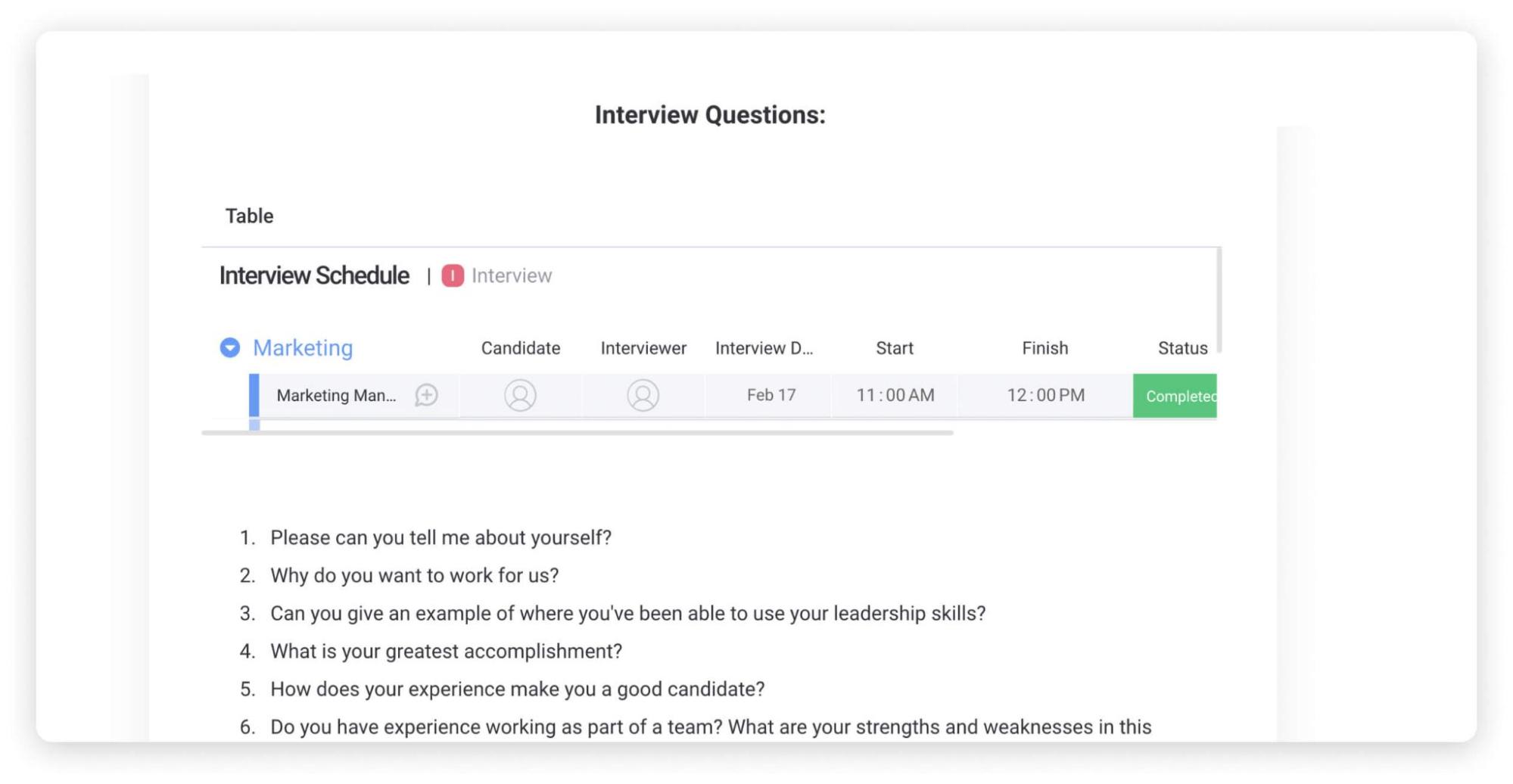
Five types of interview templates with examples
Different interview scenarios call for different templates. A standardized job interview template won’t work for an exit interview, and a scorecard template serves a different purpose than a notes template. Here are five types every HR team should have available, along with what to include in each.
1. Job interview template
This is the most common type. A job interview template covers a standard hiring interview with behavioral, situational, and technical questions organized by competency. Include a scoring rubric, time allocations, and space for interviewer notes. Tailor the questions for each role, but keep the structure and scoring framework consistent across positions.
A strong job interview template typically includes eight to 12 questions mapped to four to six core competencies, a 1-to-5 scoring scale with anchors, and a summary section for overall recommendation. It’s your first line of defense against inconsistent hiring and the template type you’ll use most frequently.
2. Interview scorecard template
A scorecard template focuses on quantitative evaluation. It includes weighted criteria for each competency, a numerical scoring system, and a summary section for overall candidate ranking. Use it when multiple interviewers need to produce comparable assessments. Scorecards work especially well for panel interviews where each interviewer evaluates different competencies and scores are aggregated afterward.
3. Exit interview template
Exit interviews capture feedback from departing employees about their experience, reasons for leaving, management quality, and suggestions for improvement. A structured exit interview template standardizes this data so you can identify retention patterns across departments and time periods.
Include questions about job satisfaction, growth opportunities, team dynamics, compensation, and what the company could do differently. Many teams also ask about the employee’s relationship with their direct manager and whether they’d consider returning in the future. Anonymous response options increase honesty and produce more actionable insights.
4. Stay interview template
Stay interviews are proactive retention conversations conducted with high-performing current employees. The goal is to understand what keeps them engaged, what might cause them to leave, and what changes would increase their commitment. Questions focus on job satisfaction, career aspirations, manager effectiveness, and workload balance.
Unlike exit interviews, stay interviews give you the chance to act before you lose someone. Typical questions include “What part of your job energizes you most?” and “If you could change one thing about your role, what would it be?” Schedule stay interviews quarterly or biannually with your top performers to build a data-driven retention strategy.
5. Interview notes template
An interview notes template provides structured documentation fields for interviewers to capture observations during or immediately after the conversation. Unlike free-form notes, this template ties every observation to a specific competency or evaluation criterion.
Include sections for observed strengths, identified development areas, cultural alignment indicators, and an overall recommendation with supporting rationale. Structured notes make post-interview debrief sessions significantly more productive because every participant can reference evidence-based observations rather than recall vague impressions from memory.
How to reduce hiring bias with structured interview templates
How confident are you that every interviewer on your team evaluates candidates the same way? Unconscious bias affects every stage of the hiring process, but the interview is where it does the most damage. Research from Harvard University shows that 70% of people exhibit unconscious biases that influence their decisions (Harvard, 2025). A structured interview template is one of the most effective countermeasures available.
Common interview biases
Before you can counteract bias, you need to recognize it. Here are the four most common types that surface during interviews:
- Affinity bias: favoring candidates who share your background, interests, or communication style
- Confirmation bias: asking questions that confirm an initial impression formed within the first few minutes
- Halo/horn effect: letting one strong (or weak) answer color the evaluation of all other responses
- Attribution bias: attributing a candidate’s success to external factors (“they got lucky”) or failure to internal ones (“they’re not smart enough”) based on demographic assumptions
How structured templates counteract bias
Templates address these biases through standardization. When every candidate answers the same questions, gets evaluated on the same rubric, and has their scores documented by trained interviewers, there’s far less room for gut-feel decisions. Predetermined scoring criteria force interviewers to evaluate what was said rather than how it felt.
Multiple evaluators calibrating their scores against the same rubric surface outlier assessments that might otherwise go unnoticed. If one interviewer consistently scores candidates from a particular background lower than other panelists, the data makes that pattern visible and addressable.
Practical tips for equitable interviews
What are the five C’s of an interview? They’re Competence, Character, Chemistry, Culture fit, and Career potential. A well-designed template evaluates all five through structured questions rather than leaving any of them to subjective impression. Beyond templates, consider these additional steps:
- Blind resume reviews: remove identifying information before the interview stage
- Diverse interview panels: include interviewers from different backgrounds and seniority levels
- Post-interview calibration: hold debrief sessions where interviewers compare scores and discuss discrepancies
- AI-assisted scoring review: use AI to flag inconsistent scoring patterns across candidates, but only when scoring is based on structured template data
How monday AI Workspace streamlines hiring workflows
Managing interview templates in spreadsheets and shared documents works until it doesn’t. As your team scales, the cracks show up fast: outdated templates floating in shared drives, interview feedback trapped in email threads, and no visibility into where candidates stand in the pipeline. monday AI Workspace brings templates, scheduling, screening, feedback collection, and pipeline tracking into a single workspace, replacing fragmented processes with connected workflows.
Customizable interview template boards
Build and share standardized interview templates across your entire hiring team. Adapt templates for each role, department, or interview stage, and ensure every interviewer has access to the latest version. Start with a fully customizable interview template and modify questions, scoring criteria, and workflows to match your hiring process.
AI-powered hiring agents
monday agents handle repetitive hiring workflows so your team can focus on candidate evaluation. The sourcing agent finds and ranks candidates based on your criteria. The screening agent scores applications against predefined requirements. The scheduling agent lets candidates self-book interview slots. And the reference collector agent centralizes reference feedback with structured scoring. Every agent works within your existing monday.com workspace.
monday vibe for custom interview apps
Need a custom interviewer assignment tracker or a candidate feedback portal? monday vibe lets you build custom hiring apps from natural language prompts. Describe what you need, and the AI-powered no-code builder creates it. No development resources required.
WorkForms, automations, and dashboards
WorkForms collects structured candidate information and interviewer feedback through customizable forms that map directly to your scoring rubrics. Automations move candidates through pipeline stages, notify interviewers of upcoming interviews, and trigger follow-up communications without manual coordination.
Dashboards give you real-time visibility into your hiring pipeline across all open roles, including time-to-hire metrics, interviewer completion rates, and candidate stage distribution. With 200+ integrations, you can connect your calendar, email, Slack, and MS Teams for seamless scheduling and communication. And with monday MCP, you can connect AI assistants like Claude, ChatGPT, or Copilot to your monday.com hiring data for cross-board analysis and automated task creation from meeting notes.
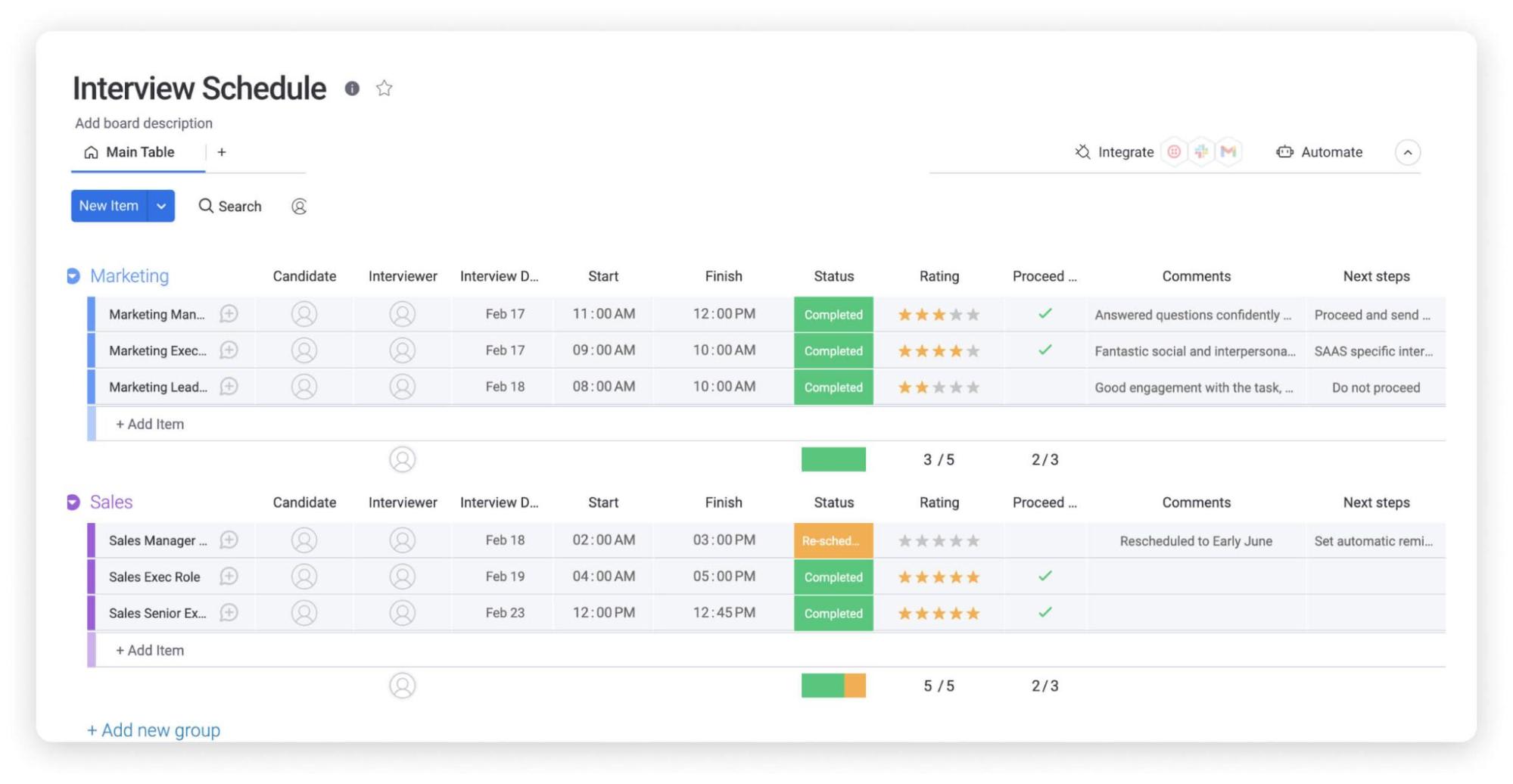 What would your hiring process look like if scheduling, screening, and feedback collection happened automatically?
Manual hiring vs. monday AI Workspace
| Process | Manual process | With monday AI Work Platform |
|---|---|---|
| Creating interview templates | Docs and spreadsheets scattered across drives | Centralized, customizable template boards |
| Scheduling interviews | Email back-and-forth | Scheduling agent with self-booking |
| Screening candidates | Manual resume review | AI screening agent scores against criteria |
| Collecting interviewer feedback | Verbal or ad hoc notes | Structured WorkForms with scoring rubrics |
| Tracking hiring pipeline | Spreadsheets updated manually | Real-time dashboards with automations |
| Coordinating with team | Slack threads, emails | 200+ integrations, automated notifications |
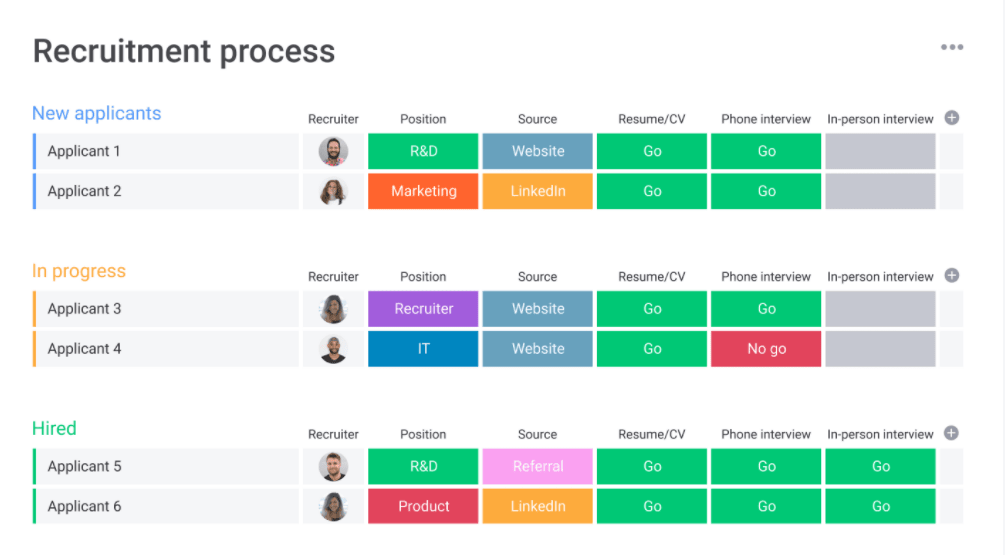
Related templates to get started
monday AI Workspace offers ready-made templates that integrate with your interview process:
- Recruitment process template: manage your entire hiring pipeline from job posting to offer letter
- Job application form: collect structured candidate information with customizable WorkForms
- New employee onboarding template: transition new hires from interview to productive team member
Building a consistent, scalable hiring process
Structured interview templates are the foundation of hiring that’s fast, fair, and repeatable. They reduce bias by standardizing evaluation criteria, save time by providing interviewers with a ready-made framework, and produce data that turn hiring decisions into evidence-based conversations. As AI-powered hiring becomes the norm, the teams that start with strong interview template foundations will be the ones that scale successfully.
The shift toward AI-augmented interviewing doesn’t replace human judgment. It amplifies it. Templates give AI systems the structured data they need to assist with screening and scoring, while keeping the final decision where it belongs: with your team. Whether you’re hiring for five roles or 500, a consistent interview template framework is the starting point for decisions you can stand behind.
Ready to bring your interview process into one connected workspace? Get started with monday AI Workspace and build a hiring workflow that grows with your team.
FAQs
What is an interview template?
An interview template is a standardized document that outlines the questions, scoring criteria, and evaluation framework interviewers use during candidate conversations. It ensures consistency across all interviews for a given role.
What are the 5 C’s of an interview?
The 5 C’s are Competence, Character, Chemistry, Culture fit, and Career potential. A structured interview template evaluates each of these through targeted questions and scoring criteria rather than subjective impressions.
What is the format for an interview?
Common interview formats include phone screens, video interviews, panel interviews, behavioral interviews, and technical assessments. An interview template standardizes whichever format you choose with consistent questions and evaluation criteria.
What is the 30-60-90 rule in an interview?
A 30-60-90 day plan outlines what a candidate intends to accomplish in their first three months on the job. Some interview templates include this as a final-round assessment component for senior roles.
What are the five P’s of an interview?
The five P’s are Preparation, Punctuality, Presentation, Positivity, and Professionalism. These principles apply to both interviewers and candidates and help ensure productive, respectful interview conversations.
How many questions should an interview template include?
A 45- to 60-minute interview typically requires eight to 12 questions, with two to three per core competency. Include a mix of behavioral and situational questions to evaluate each skill from multiple angles.
What’s the difference between a structured and an unstructured interview?
Structured interviews use predetermined questions and scoring rubrics applied consistently to every candidate. Unstructured interviews are conversational and ad hoc. Research consistently shows that structured interviews are stronger predictors of job performance.
Can I customize an interview template on monday AI Workspace?
Yes. monday AI Workspace offers fully customizable interview template boards where you can adapt questions, scoring criteria, and workflows per role. AI agents automate screening and scheduling within the same workspace.
 Get started