


Your existing customers hold untapped revenue potential that’s more cost-effective to unlock than acquiring new accounts. Cross-selling and upselling turn that potential into consistent growth by expanding relationships at exactly the right moments.
You’ll learn what separates cross-selling from upselling, how to spot the signals that tell you which strategy fits each customer, and how AI helps you act on opportunities before they pass. Plus, you’ll get practical strategies for building expansion into a repeatable system — with tools that help your team execute at scale.
Key takeaways
- Cross-selling offers complementary products while upselling encourages customers to upgrade to higher-value versions of what they’re already buying.
- Usage limits and feature requests point to upsell opportunities, while mentions of related workflows signal cross-sell potential.
- Both strategies expand revenue more efficiently than new customer acquisition, with existing customers converting faster and at lower cost.
- AI transforms expansion from reactive to proactive by detecting signals in real time, summarizing account context, and recommending personalized offers at scale.
- Teams can centralize expansion opportunities with AI-powered signal detection, automated workflows, and real-time dashboards in monday CRM that help spot and act on the right moments.
What is cross-selling?

Cross-selling is a sales strategy where you offer customers additional products or services that complement what they’re already purchasing. The goal is to solve related problems they didn’t know you could help with. A software company offering training services alongside its platform subscription is cross-selling — the training isn’t the same product, but it helps customers get more from what they bought.
Why cross-selling matters for account expansion
Cross-selling gives revenue teams real advantages when growing existing accounts:
- Expands customer relationship breadth: Cross-selling introduces customers to additional products, increasing touchpoints and deepening engagement across multiple areas of their business
- Increases lifetime value through diversification: Customers using multiple products generate more revenue over time and are less likely to churn
- Reveals adjacent customer needs: Cross-sell conversations uncover problems customers didn’t know you could solve
- Strengthens competitive positioning: Customers using multiple integrated solutions face higher switching costs
Cross-selling in action: Real-world examples
Cross-selling shows up everywhere — anytime a complementary product makes the main purchase better:
- B2B software: A CRM customer using basic contact management receives targeted outreach about adding marketing automation capabilities.
- Professional services: An accounting firm completing a client’s annual tax filing recommends quarterly bookkeeping services.
- Financial services: A banking customer with a checking account is offered a savings account with automatic transfers.
- Healthcare services: A patient receiving primary care is offered wellness programs or specialty services.
Customers who report both satisfaction and delight are significantly more likely to purchase additional products, with cross-sell rates increasing by as much as 30 percentage points in some industries (McKinsey)
What is upselling?
Upselling means moving customers to a higher-tier version of what they already use. It’s the same product, just a larger plan and higher value. When a SaaS company offers an Enterprise plan with advanced features to a customer on the Professional tier, that’s upselling.
Why upselling drives stronger customer outcomes
Upselling works when customers need more from what they already use:
- Increases revenue per customer: Upselling generates more value from existing relationships without acquisition costs.
- Aligns capabilities with customer growth: As needs expand, upselling ensures customers have the features and capacity to succeed.
- Reduces churn by preventing limitations: Customers who hit product limits without upgrade options often look elsewhere.
- Signals customer health: Willingness to upgrade demonstrates commitment and satisfaction.
Upselling in action: Real-world examples
Upselling opportunities show up when customers outgrow their plan or need more features:
- SaaS platforms: A customer on a Professional plan hitting user limits receives a recommendation to upgrade to Enterprise.
- Telecommunications: A customer consistently exceeding data allowances is offered an unlimited plan.
- Hospitality: A hotel guest booking a standard room is offered a suite upgrade with additional amenities.
- Retail technology: A business using basic POS software upgrades to include inventory management and analytics.
Cross-selling vs. upselling: The key differences
Both strategies grow revenue from your existing customer base, but they work differently and shine in different moments. Understanding when to use each one helps you make the right call for every customer situation.
| Aspect | Cross-selling | Upselling |
|---|---|---|
| What you offer | Complementary products or services | Higher-tier version of current product |
| Customer intent | Solving adjacent problems | Enhancing current solution |
| Revenue impact | Multiple revenue streams | Higher-value single product |
| Relationship effect | Broadens across touchpoints | Deepens commitment to solution |
| Best signal to trigger | Customer mentions related workflows | Customer approaches usage limits |
| Example | Adding marketing automation to CRM | Moving from Starter to Pro plan |
When to use cross-selling vs. upselling
Timing and context tell you which strategy to use. Let customer signals drive your decision, not arbitrary timelines. Here’s what to watch for with each strategy.
Signals that point to a cross-selling opportunity
Cross-selling works when customers are happy with what they have and trust your team. Look for these signals:
- Adjacent workflow mentions: Customer describes processes outside the current solution’s scope.
- Integration questions: Customer asks about connecting to related platforms.
- Manual workarounds: Customer handles related work in spreadsheets or disconnected systems.
- New initiatives: Customer launches projects your other products address.
- Stakeholder expansion: New departments or buyers enter the conversation.
Teams using monday CRM can track these signals in one timeline. When a customer mentions struggling with project management on a call, that signal gets logged with the deal — so cross-sell opportunities don’t disappear.
Try monday CRMSignals that point to an upselling opportunity
Upselling opportunities show up when customers are growing or hitting limits. Watch for these patterns:
- Usage approaching limits: Customer nears seat, storage, or feature caps.
- Feature requests: Customer asks about capabilities in higher tiers.
- Organizational growth: Team expansion creates need for more capacity.
- Performance frustration: Current plan creates friction or workarounds.
- Renewal approaching: Natural evaluation point for plan adequacy.
- Positive engagement: High usage and satisfaction indicate readiness.
The key: Respond to what’s actually happening with each customer. A customer hitting limits in month 2 may be ready for an upsell. A customer mentioning a related need in week one may be open to a cross-sell conversation.
Learn more: AI account signal agent
6 strategies for successful cross-selling and upselling

Expansion works when you spot opportunities, personalize outreach, and act at the right time. These strategies help teams get ahead of expansion instead of chasing it.
1. Use customer data to find expansion signals
Customer data shows you where to expand — if you know what to look for. The hard part: organizing and analyzing it all.
Track these data points:
- Usage metrics: Feature adoption, login frequency, seat utilization
- Engagement patterns: Support tickets, feature requests, training attendance
- Relationship indicators: Contract terms, health scores, stakeholder involvement
- Behavioral changes: Sudden usage spikes, new department adoption
Look for signs of growth or friction. A customer adding 5 new users while requesting advanced features signals upsell readiness. Multiple departments asking about integrations suggests cross-sell potential.
2. Match every offer to customer goals
Offers tied to customer goals convert better because they show you get it — you’re not just pushing products. Discover goals through regular business reviews, support conversations, and a strong VoC strategy.
Listen for new projects, growth plans, and day-to-day challenges. Write them down where everyone can see them.
Frame your offers around removing obstacles or adding features:
- Upsell framing: “Upgrading removes the user limits slowing your team’s adoption.”
- Cross-sell framing: “Adding marketing automation helps you convert the leads your CRM captures.”
3. Personalize recommendations using account context
Personalized offers land because they show you understand each customer’s situation — not just a generic sales pitch. Think about these things before reaching out:
- Industry and use case: Tailor examples to their specific business.
- Company size and growth stage: Match recommendations to their trajectory.
- Current product usage: Reference their actual workflows and patterns.
- Past conversations: Build on previous discussions and feedback.
Personalization works best when all customer interactions live in one place — account history, usage data, and past conversations together, so reps know the full context before they reach out.
4. Align sales and customer success teams around shared expansion goals
Expansion needs sales and customer success working together. Sales knows how to close; customer success knows the account.
Here’s how to align them:
- Define clear ownership for expansion conversations at different customer lifecycle stages.
- Establish handoff processes that preserve context between teams.
- Share customer insights through connected systems so both teams see the complete picture.
- Create shared targets that encourage collaboration over competition for credit.
When both teams win from expansion, they actually collaborate instead of competing.
5. Automate follow-ups and opportunity handoffs

Automated follow-ups keep every opportunity visible and on track. Automation helps teams scale outbound sales with automation tools while ensuring timely engagement and preserving personalization.
Build workflows that:
- Trigger when customers hit usage thresholds or show expansion signals.
- Create templates for common scenarios while leaving room for customization.
- Route opportunities to the right team member based on account ownership or expertise.
monday CRM creates expansion opportunities automatically when signals appear, assigns them to the right rep, and schedules follow-ups — so your team can focus on conversations instead of tracking.
6. Keep every recommendation customer-first
Only recommend expansion when it solves a real problem. Put customer success first, and revenue follows.
Start with discovery. Understand what the customer wants to achieve before suggesting solutions, and be willing to acknowledge when expansion isn’t the right fit yet. Build trust through honesty, because customers who feel supported instead of sold to will expand when the timing’s right.
How AI helps with cross-selling and upselling
Agentic AI in sales transforms expansion from manual and reactive to systematic and proactive. With AI, teams move beyond manual account reviews and surface signals at the right moment, allowing expansion to happen at scale and on time. With AI, expansion happens at scale and on time. Here’s how it works.
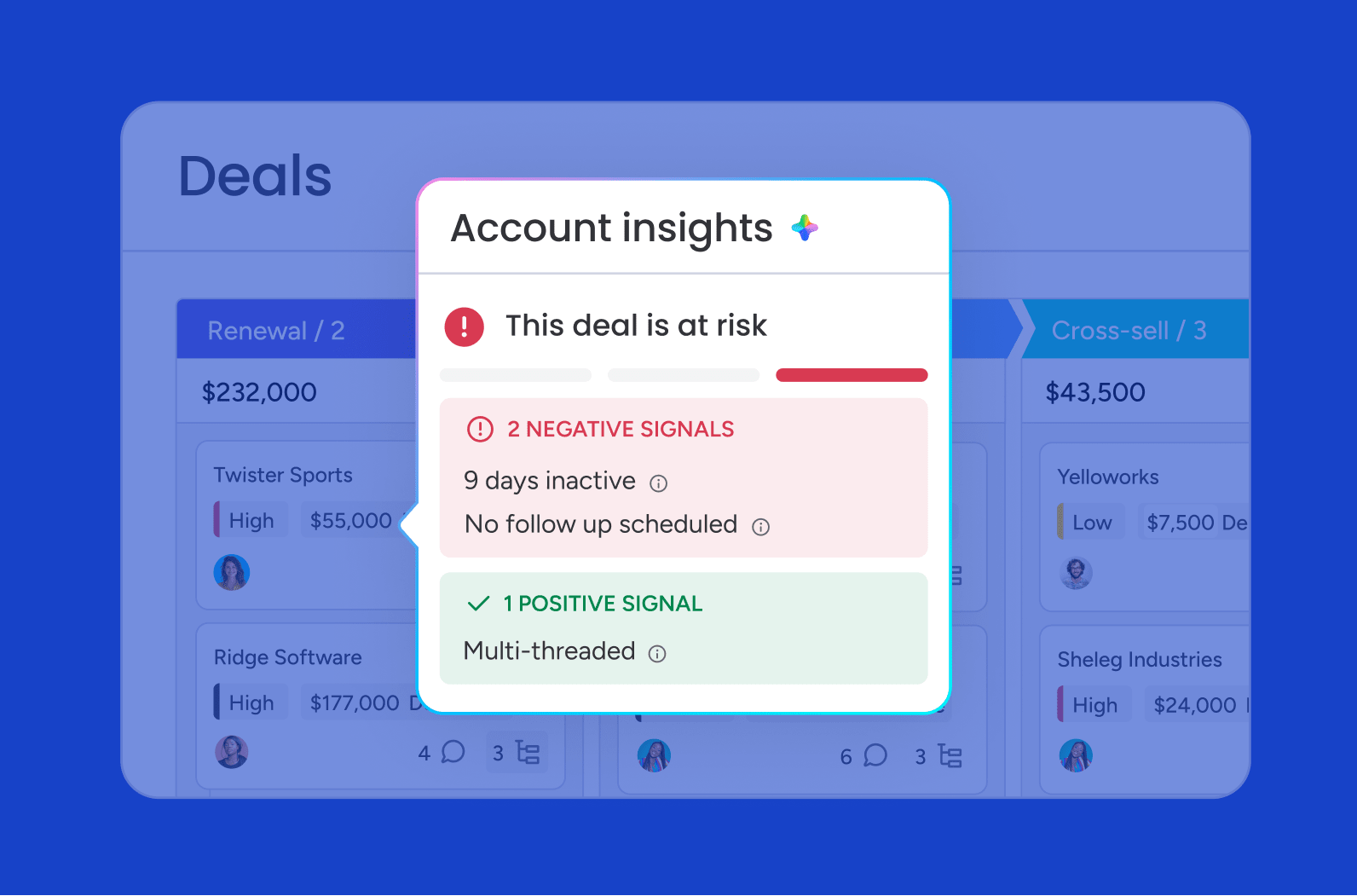
- Spotting expansion opportunities before you do: AI watches customer data across every account and spots patterns you’d miss manually. It scans usage, engagement, and behavior in real time. When customers hit limits, ask for features, or start growing fast, AI flags it right away. You see opportunities before customers get frustrated.
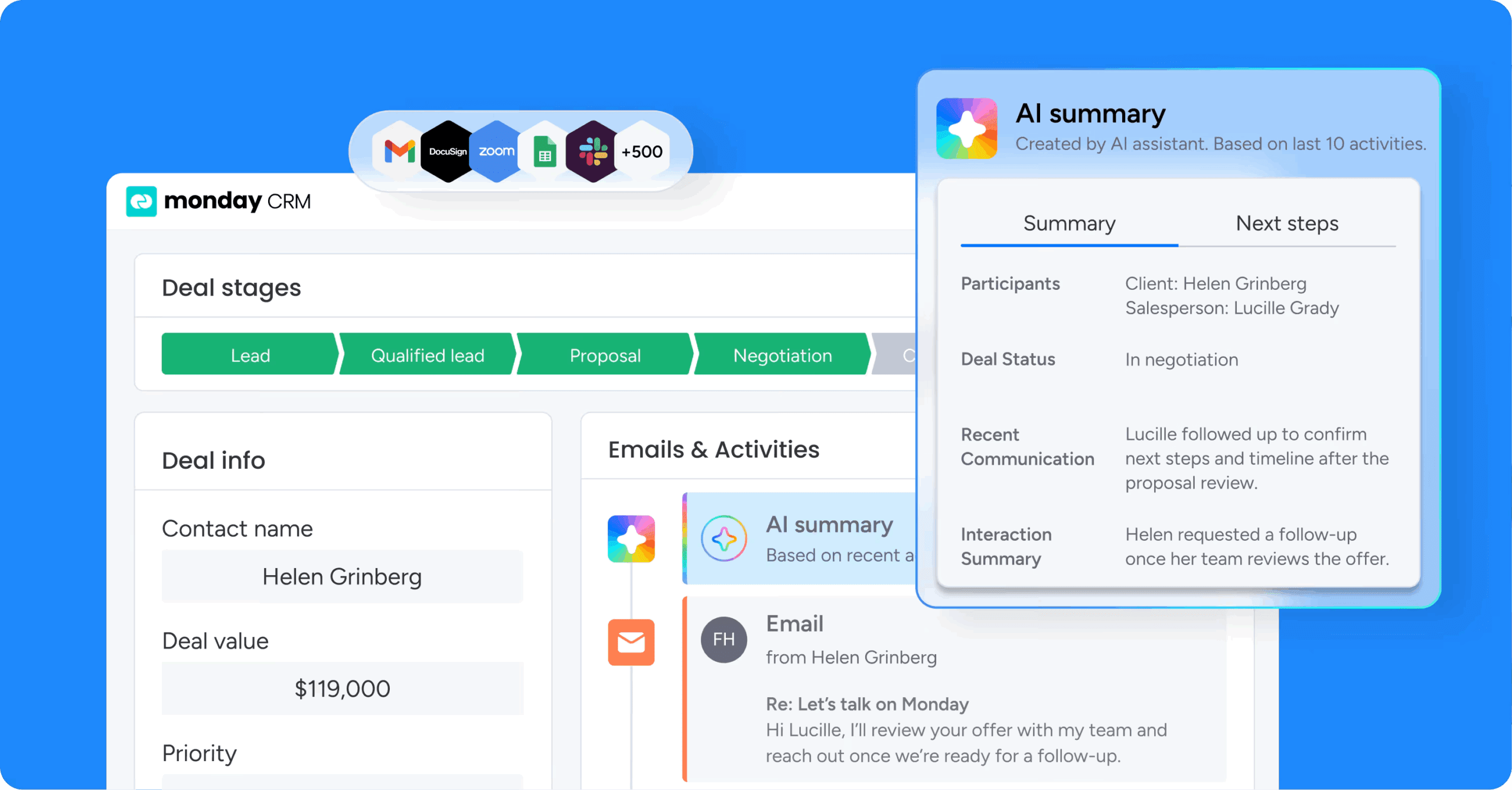
- Giving reps full context in seconds: Pull customer data from every system and creates summaries with the context reps need — so they show up prepared instead of scrambling. With AI, reps get current usage and adoption levels, recent feature requests or support interactions, and key pain points and account history. The AI condenses months of interactions into summaries reps can use — in seconds, not hours.
- Prioritizing what to do and when: Look at account data, past patterns, and success signals to recommend what to do next. AI tells you whether to upsell or cross-sell, ranks opportunities by close likelihood and value, and suggests timing based on readiness.
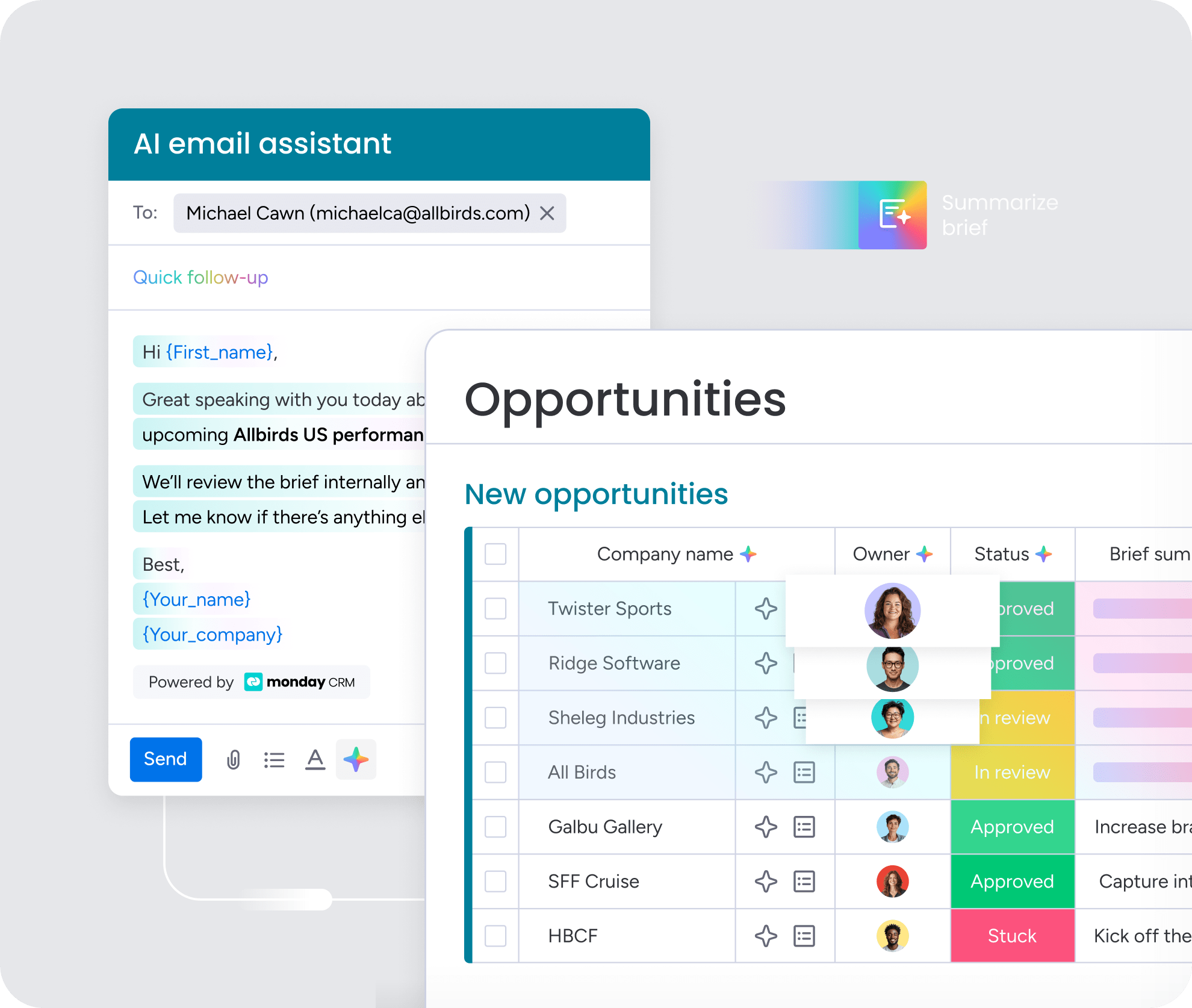
- Scaling what used to be manual: AI drafts outreach that references specific customer details and still sounds human. It pulls in usage patterns, goals, and past conversations. Reps review and tweak AI drafts before sending — fast, but still human.
How monday CRM helps teams scale cross-selling and upselling
monday CRM gives revenue teams a unified platform to spot expansion opportunities, act on them fast, and track every conversation in one place. Instead of juggling spreadsheets and disconnected tools, your team gets real-time visibility into customer signals — with AI surfacing the right moments to expand.
Here’s what makes expansion systematic instead of reactive:
- AI-powered signal detection: Automatically flags expansion opportunities based on usage patterns, sentiment shifts, and customer behavior — so your team sees upsell and cross-sell moments before they pass.
- Unified customer timeline: Every email, call, support ticket, and product interaction lives in one view, giving reps full context before they reach out.
- Smart account summaries: AI condenses months of customer history into actionable summaries — showing what matters in seconds, not hours of digging.
- Automated workflows: Trigger follow-ups, route opportunities to the right rep, and schedule next steps automatically when customers hit expansion signals.
- Personalized outreach at scale: AI drafts expansion emails with customer-specific context, so reps can personalize quickly without starting from scratch.
- Real-time expansion dashboards: Track pipeline value, opportunity stages, and team performance across all upsell and cross-sell motions in one place.
Teams using monday CRM turn expansion from guesswork into a repeatable system — with the visibility, automation, and AI tools that help every opportunity get the attention it deserves.

“With monday CRM, we’re finally able to adapt the platform to our needs — not the other way around. It gives us the flexibility to work smarter, cut costs, save time, and scale with confidence.”
Samuel Lobao | Contract Administrator & Special Projects, Strategix
“Now we have a lot less data, but it’s quality data. That change allows us to use AI confidently, without second-guessing the outputs.”
Elizabeth Gerbel | CEO
“Without monday CRM, we’d be chasing updates and fixing errors. Now we’re focused on growing the program — not just keeping up with it."
Quentin Williams | Head of Dropship, Freedom Furniture
“There’s probably about a 70% increase in efficiency in regards to the admin tasks that were removed and automated, which is a huge win for us.“
Kyle Dorman | Department Manager - Operations, Ray White
"monday CRM helps us make sure the right people have immediate visibility into the information they need so we're not wasting time."
Luca Pope | Global Client Solutions Manager at Black Mountain
“In a couple of weeks, all of the team members were using monday CRM fully. The automations and the many integrations, make monday CRM the best CRM in the market right now.”
Nuno Godinho | CIO at Velv
“monday.com provides developmental flexibility, operational efficiency, and data transparency — all in one place. We became a company that moved from chasing data to leading with it.”
Hyunghan Lee | Team Lead, Sandbox Network
"monday.com brought every part of our business into one connected space. The harmony between work management and CRM has become our operating system — giving us the clarity and confidence to scale.”
Jennifer Chinburg | Executive Vice President of Corporate Development & Brand, Chinburg Properties
“We just weren’t getting value from our old CRM. With monday.com, it's a thousand times better. Our sales teams are more informed, more consistent, and far more connected."
James Arnold | Chief Operating Officer, CenversaTurn expansion into a repeatable growth engine
Cross-selling and upselling work best as complementary strategies that fit different moments in the customer lifecycle. Teams that spot signals early, personalize intelligently, and keep every expansion opportunity visible turn growth into a repeatable system — one where revenue increases naturally by solving customer problems, not pushing products.
monday CRM gives your team the unified view to make this happen: all customer interactions, usage data, and opportunities in one place, with AI surfacing the right signals at the right time.
Try monday CRMFAQs
What's the difference between cross-selling and upselling?
Cross-selling offers complementary products that address adjacent needs, like adding training services to a software purchase. Upselling encourages customers to buy a higher-tier version of their current product, like upgrading from Professional to Enterprise plans.
When should you use cross-selling vs. upselling?
Use cross-selling when customers mention challenges outside your current product's scope or ask about integrations with related platforms. Use upselling when customers hit usage limits, request features in higher tiers, or show signs of organizational growth.
Which strategy has more impact on revenue?
Both strategies increase revenue, but impact depends on your business model and customer base. Upselling typically generates immediate revenue increases per customer, while cross-selling creates multiple revenue streams that compound over time.
How can AI identify the right expansion opportunity?
AI monitors customer data continuously, detecting signals like usage patterns, sentiment shifts, and feature requests. It then analyzes these signals against historical patterns to recommend whether to cross-sell or upsell, what to offer, and when to engage.
What CRM data do you need for effective expansion?
You need customer communication history, product usage metrics, support interactions, contract details, and stakeholder information. This data should be centralized and accessible to identify signals, personalize outreach, and track opportunities systematically.
When is the right time to pause expansion offers?
Avoid expansion offers when customers struggle with their current product, have unresolved issues, or explicitly indicate wrong timing. Wait until adoption is strong, sentiment is positive, and the customer shows readiness for additional investment.
