



Since Agile project planning differs fundamentally from traditional methodologies, its estimation techniques need to align with its adaptive, collaborative philosophy.
To set realistic expectations and boost delivery confidence, development teams rely on Agile estimation techniques — practical, team-driven methods explicitly designed for the structure and transparency of modern development projects.
In this guide, you’ll learn what Agile estimation is, why it’s so essential for software success, which techniques stand out, and how to make estimation easy for your team with monday dev’s flexible, AI-powered platform built for developers.
Try monday devKey takeaways
- Agile estimation techniques help teams plan, prioritize, and adapt by using collaborative, relative methods like story points and group-based sizing — not just hours or days.
- Choosing the right estimation technique depends on backlog size, team experience, work clarity, and the level of accuracy needed for your project.
- Combining techniques such as affinity mapping, planning poker, and analogy-based estimation helps teams handle different project needs and complexities.
- Following best practices — including regular calibration, teamwork, and breaking down tasks — significantly improves estimation accuracy and delivery success.
- Using monday dev provides AI-powered planning, real-time collaboration, and custom dashboards to make Agile estimation and sprint planning easier and more precise for every team.
What are Agile estimation techniques?
Agile estimation techniques are collaborative methods used by Agile teams to assess the effort, complexity, and resources needed for each task or user story in a project backlog. Rather than relying on absolute values like exact hours or days, these techniques use relative sizing and comparative analysis to help teams forecast work more accurately while adapting to change.
Unlike traditional “top-down” task estimation (using exact durations and fixed resource allocations), Agile estimation techniques emphasize team-based, iterative, and uncertainty-tolerant processes. The output is often in story points or relative categories rather than fixed time units, enabling better adaptability in dynamic environments.
Overall, Agile estimation techniques are more flexible, high-level, and focus on relative measures such as effort rather than hours. Popular Agile estimation methods include planning poker, affinity mapping, and T-shirt sizing. We’ll dive deeper into them elsewhere in this article, but first, let’s look into why development teams use Agile estimation techniques.
Why development teams use Agile estimation techniques
Development teams use Agile estimation techniques because they enable faster, more collaborative, and adaptable planning, ultimately improving both project outcomes and team dynamics. Here’s what Agile estimation does:
- Promotes realistic planning: Agile estimation helps set feasible goals and expectations by evaluating relative effort and complexity, therefore reducing the risk of underestimating or overcommitting.
- Improves resource allocation and risk management: Effective estimation lets teams assign resources more precisely, predict bottlenecks, and spot potential issues early, supporting informed decision-making and stakeholder confidence.
- Fosters team collaboration and accountability: Estimation sessions encourage discussion, shared ownership, and transparency, which strengthen team cohesion and ensure everyone’s input is valued.
- Enables flexibility in changing environments: Agile techniques are designed for evolving requirements; frequent estimation and planning reviews allow teams to regroup and adapt quickly when priorities shift.
- Boosts productivity and stakeholder trust: Transparent estimates, regular updating, and collective input build stakeholder trust and drive delivery against project milestones.
Story points vs. hours in Agile estimation
Story points and hours serve different purposes in Agile estimation: one measures relative effort, the other measures actual time. Both can coexist — but they shouldn’t be treated as interchangeable.
| Aspect | Story points | Hours |
|---|---|---|
| What it measures | Relative effort, complexity, and risk | Specific, fixed duration of work |
| Level of abstraction | Abstract, not tied to time | Concrete measurement of time |
| Who estimates | Team as a group, consensus-driven | Individual or group |
| Accuracy | Better for uncertainty and complexity | Good for well-defined, repeatable tasks |
| Velocity tracking | Enables velocity-based planning and forecasting | Difficult to track productivity trends |
| Adaptability | Adapts to team’s changing speed and process | Rigid, less forgiving to change |
| Learning curve | May be confusing for non-Agile stakeholders | Familiar and easy to communicate |
| Use case | Long-term planning, Agile projects, cross-functional | Precise scheduling, hourly reporting needs |
Can teams use both?
Yes. Many Agile teams use story points for sprint-level and roadmap planning, then break stories into hour-based tasks for daily execution. The key is not converting story points to hours; each serves a different purpose.
Takeaway: Story points help Agile teams estimate relative effort and manage uncertainty, while hours offer precision for short-term planning.
8 proven Agile estimation methods
These widely used Agile estimation methods address a range of needs, from highly collaborative planning (planning poker) to scaling estimation for large roadmaps (bucket system, affinity mapping, relative mass evaluation) and leveraging past insights (analogy-based estimation).
Each technique helps teams collaboratively estimate effort and complexity, supporting better planning and prioritization. Here’s a quick look at each method followed by more details below the table:
| Technique | Best for | Team situation/use case |
|---|---|---|
| Planning poker | Small–medium backlogs; sprint estimation | When collaboration and consensus matter |
| Affinity mapping | Large unestimated backlogs | When you need rapid high-level grouping |
| T-shirt sizing | Early-stage or roadmap planning | When details are unclear, fast sizing needed |
| Bucket system | Large backlogs; release planning | When many items need sizing at once |
| Three-point estimation | High-risk or uncertain work | When variance (best/worst/likely) is important |
| Dot voting | Large groups; prioritization | When identifying high-effort or high-attention items quickly |
| Relative mass evaluation | Large backlogs; consistency | When comparing many items at once |
| Analogy-based estimation | Mature teams with historical data | When similar past work exists |
Planning poker
Planning poker is a consensus-driven, gamified technique in which team members use cards with numbers (often the Fibonacci sequence) to privately estimate the effort required for a user story. All estimates are revealed at once, leading to a group discussion and a repeat vote until teams reach a consensus. This method encourages conversation, reduces bias, and leverages team expertise for more accurate estimates.
Affinity mapping
Affinity mapping groups or sorts user stories by relative complexity or size. Team members silently organize work items, then discuss and revise groupings into agreed-upon categories. This technique is fast, promotes collaboration, and helps teams align quickly on relative sizing, which is especially valuable for large backlogs.
T-shirt sizing
T-shirt sizing uses simple categories (XS, S, M, L, XL) to estimate tasks or user stories by effort or complexity. Team members assign a size to each item, focusing on broad comparisons instead of precision. This method is ideal for roadmap planning and early estimation phases when little detail is available.
Bucket system
The bucket system divides work into “buckets” (e.g., 1, 2, 3, 5, 8, 13 story points or custom ranges). Items are rapidly discussed and placed into consensus-based buckets, enabling quick estimation of multiple items. This method is particularly effective for estimating large volumes of work with bigger teams.
Three-point estimation
Three-point estimation calculates an average estimate using three values for each item: optimistic, most likely, and pessimistic. The formula provides a balanced estimate that accounts for best- and worst-case scenarios, improving accuracy when there’s uncertainty.
Dot voting
Dot voting (dotmocracy) is a participatory approach in which team members distribute votes (stickers/dots) across items to indicate which tasks are larger or more complex. The most-voted items are considered higher effort. This method is rapid and visual, making it ideal for large groups or prioritization sessions.
Relative mass evaluation
Relative mass evaluation (also called mass valuation or estimation) involves comparing all items to each other and ordering them from smallest to largest. Items are then grouped into categories based on size relationship. This approach helps teams efficiently estimate a large backlog and ensures consistent, relative sizing.
Analogy-based estimation
Analogy-based estimation uses historical data — teams compare new tasks or stories to previously completed work of known size or complexity. This comparative approach works well when similar efforts exist and helps ground estimates in real experience, supporting triangulation and increased accuracy.
How to select the right estimation technique
Selecting the right Agile estimation technique depends on backlog size, task complexity, team experience, required accuracy, and collaboration style. Here are some key factors to consider:
- Backlog size: For huge backlogs, use quick group-based methods, such as affinity mapping or the bucket system, to rapidly categorize many items.
- Task complexity and uncertainty: For complex or high-risk stories, three-point estimation is practical because it captures uncertainty and drives discussion about best, worst, and likely outcomes.
- Team experience: Newer teams may prefer simple frameworks like T-shirt sizing or dot voting. In contrast, experienced Agile teams can use more nuanced approaches, such as planning poker or analogy-based estimation.
- Desired accuracy: If precision is crucial, such as near-term sprint planning, consensus-driven methods like planning poker or three-point estimation work well.
- Collaboration style: Teams that thrive on discussion benefit from planning poker, while distributed teams might prefer affinity mapping or the bucket system for speed and remote suitability.
Steps to select the best Agile estimation technique
To make the right choice, follow these steps:
- Clarify estimation goals: Are you planning at a high level or sprint-by-sprint? Choose methods based on strategic or tactical needs.
- Assess backlog volume: For many items, use quick visual methods; for fewer, more detailed tasks, select a consensus technique.
- Review work item clarity: If requirements are ambiguous, start with broad sizing; for well-defined items, use detailed techniques.
- Gather team preferences: Discuss previous experiences — what’s worked, were there any challenges? Teams often refine their techniques over time for the best fit.
- Leverage historical data: When possible, use analogy-based methods to anchor new estimates to relevant past work for more consistency.
5 best practices for estimation accuracy
Agile estimation accuracy improves through calibration, collaboration, work decomposition, reflection, and clear communication, making forecasting and delivery more predictable over time. Here are 5 best practices for improving estimation accuracy in Agile teams.
1. Use reference stories and calibration regularly
Begin each estimation session by reviewing real, completed backlog items as benchmarks — these help anchor the team’s understanding of story sizes, reducing subjectivity and “estimate drift” over time. Periodically recalibrate using recent sprints to ensure reference points stay relevant as the team’s speed or context changes.
2. Embrace collaborative, consensus-based estimation
Involve the entire team to leverage diverse perspectives, uncover hidden risks, and ensure collective buy-in. Techniques like planning poker or affinity mapping reduce bias, encourage discussion, and improve overall precision through agreement.
3. Break down extensive or ambiguous work
Split big features or vague stories into smaller, well-defined tasks before estimating. Smaller items are easier to size accurately, helping teams spot uncertainties or blockers earlier in the process.
4. Review outcomes and adjust for continuous improvement
After each sprint, compare estimated versus actual effort, and discuss discrepancies during retrospectives. Use these insights to refine estimation approaches and identify habitual under- or overestimation tendencies.
5. Prioritize open discussion and transparency about assumptions
Encourage team members to raise questions, clarify potential risks, and document the reasoning behind complex or high-risk estimates. Recording assumptions helps future reviews and improves the accuracy of contingency planning.
Avoiding common estimation pitfalls
Here are some common pitfalls and challenges to avoid in Agile estimation, along with actions teams can take to maintain accuracy and effectiveness.
Challenge: Treating story points as a measure of productivity or business value
Story points reflect effort and complexity, not team performance or task value. Comparing teams by points or equating more points with higher productivity leads to misleading metrics and poor decision-making.
Solution: Use story points only as a relative metric within a single team. Reinforce this in retros and dashboards, and avoid cross-team comparisons.
Challenge: Equating story points with hours or days
Translating points directly into hours undermines the benefits of relative sizing and makes adaptation harder. Story points are meant to compare effort—not build fixed timelines.
Solution: Keep points strictly relative. Use hours only after breaking work into tasks if needed. Let velocity trends emerge naturally over time rather than enforcing a conversion.
Challenge: Not involving the entire delivery team in estimation
When estimation is driven only by managers or a subset of roles, teams miss hidden complexity, lose buy-in, and fall into optimistic forecasting.
Solution: Include everyone who will contribute to the work — developers, QA, designers, etc. Broader input improves accuracy and transparency.
Challenge: Anchoring to unrealistic expectations and external pressure
Letting stakeholders or pre-existing commitments dictate estimates (instead of evidence-based sizing) leads to overcommitment, missed deadlines, and lower morale.
Solution: Base estimates on team experience, historical data, and real complexity. Push back respectfully when pressure skews the numbers.
Challenge: Failing to revisit and update estimates
If teams never revisit estimates as new information emerges, outdated assumptions lead to inaccurate forecasts and missed goals.
Solution: Recalibrate estimates during backlog refinement and after each sprint. Use retrospective insights to adjust future sizing.
Challenge: Ignoring dependencies, blockers, or unknowns
Teams sometimes underestimate cross-team dependencies, technical debt, or unclear requirements, introducing hidden risk.
Solution: Identify and surface dependencies early. Call out unknowns and document assumptions so risks can be managed rather than overlooked.
How monday dev enhances Agile estimation
Built on monday.com WorkOS, monday dev empowers Agile teams to estimate, plan, and deliver high-quality software faster, while leveraging actionable AI for smarter forecasting and workflows. Here are 5 unique features that help manage your team’s needs, from Agile estimation and story point allocations to streamlined sprint planning.
1. AI-powered sprint planning and risk analysis
Built-in AI automatically analyzes team capacity, reviews backlog health, and suggests optimal sprint scopes — helping Scrum masters and product owners plan sprints, identify risky overcommitments, and avoid bottlenecks efficiently.
2. Custom automations and AI-driven updates
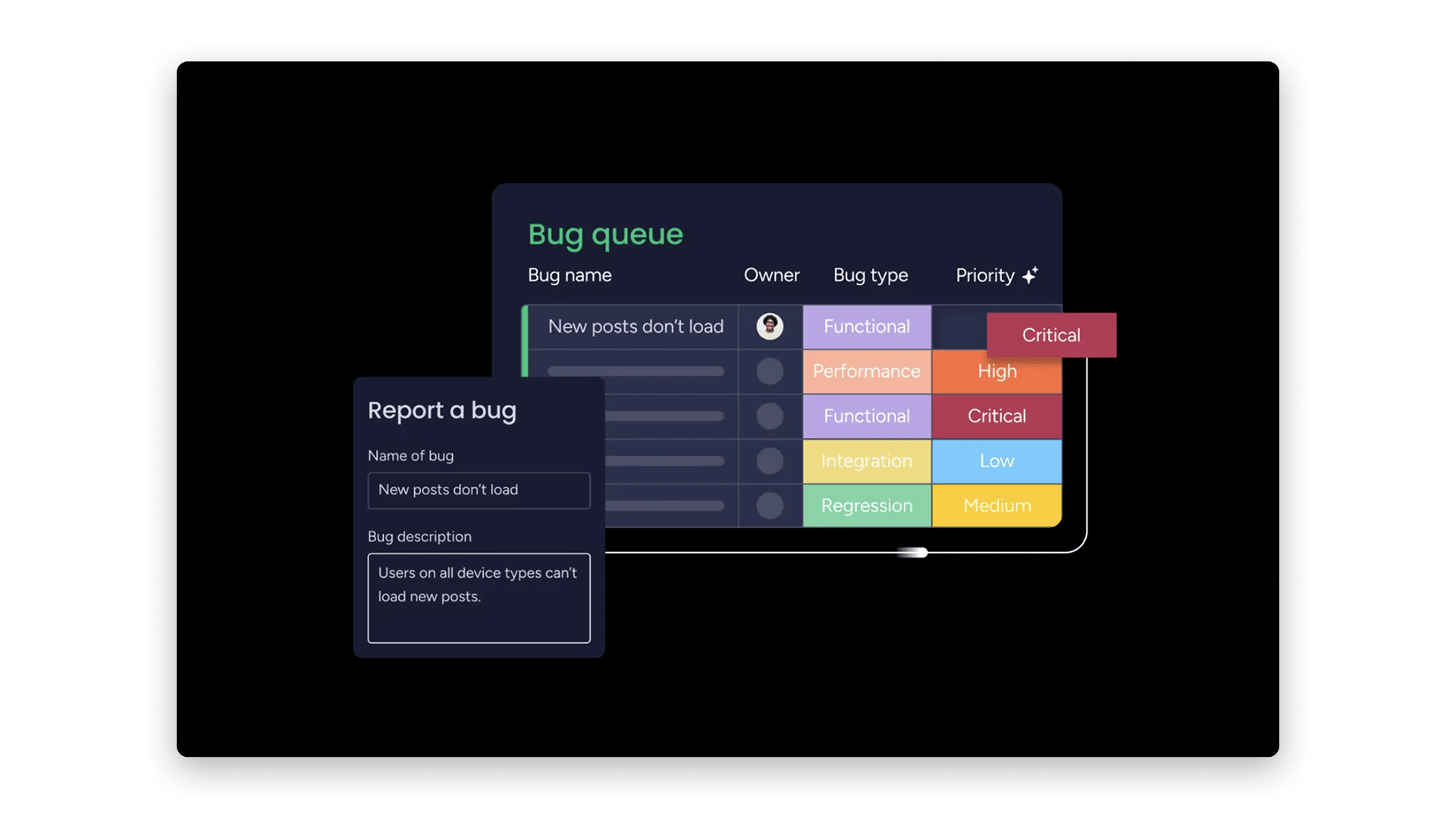
Custom automations and AI auto-triage accelerate estimation and assignment and streamline bug scoring and ticket routing — saving time and reducing manual operational overhead for developers and QA specialists.
3. Multi-view dashboards
Built-in dashboards offer burndown charts, velocity tracking, and planned-vs-unplanned breakdowns so Scrum masters and engineering leads can instantly visualize estimation accuracy, retrospective trends, and team pacing.
4. Real-time collaboration and dynamic backlog management
Collaborative estimation boards, reference stories, task dependencies, and real-time updates ensure seamless communication, making it easy for all team members to align quickly and update estimates collectively.
Native GitHub integration and AI-assisted documentation
Ticket syncing, automatic progress updates, and AI-generated product summaries connect code history directly to estimation data, supporting better retrospectives and technical handovers for developers and QA leads.
With these features, monday dev supports product owners, Scrum masters, QA specialists, and developers alike, delivering more accurate forecasts, less manual overhead, and instant visibility across all Agile estimation activities.
Ready to enable faster, more accurate Agile estimations? Get started with monday dev and leverage AI-powered story points, custom dashboards, and risk analysis — built for modern dev teams.
Try monday devFAQs
Who is involved in the Agile estimation process?
Everyone responsible for delivering the work — developers, testers, designers — should take part in the estimation process. Involving the whole team promotes shared understanding, surfaces hidden complexity, and leads to more accurate forecasts.
What is the best Agile estimation method for my project?
The ideal technique depends on backlog size, team experience, and task clarity. For large or vague backlogs, use affinity mapping or T-shirt sizing. For detailed sprint planning, try planning poker or three-point estimation.
What are some tips for effective story point estimation in Agile?
Start with reference stories. Break down large items. Involve the entire team. Avoid equating points to hours. Recalibrate regularly to learn and adapt. Use platforms like monday dev to track velocity and improve estimates across sprints
How many hours equal one story point?
There’s no direct or universal conversion between story points and hours in Agile. Story points measure relative complexity and effort, which varies by team. With monday dev, you can define your own velocity and learn over time how your team’s points translate to actual delivery.
What is the difference between relative and absolute estimation?
Relative estimation compares tasks by effort and complexity — like story points or T-shirt sizing. Absolute estimation assigns fixed durations or costs, such as hours or dollars. Relative estimation speeds up planning and adapts better to uncertainty, while absolute methods are more rigid and precise.
Can teams combine multiple estimation techniques?
Yes, Agile teams often combine methods to fit context. For example, using affinity mapping for high-level backlog sizing, then planning poker for sprint details. With monday dev, you can mix techniques and refine your approach over time.
How often should teams recalibrate their estimates?
Teams should recalibrate estimates after every sprint — during retrospectives or backlog grooming. Regular calibration helps align future velocity, adjust for surprises, and improve accuracy as conditions change.
What role does the product owner play in estimation?
The product owner prioritizes the backlog, clarifies requirements, and provides business context during estimation. While not responsible for technical sizing, their input helps ensure alignment with user needs and business goals.
Is estimation necessary for all Agile teams?
Estimation isn’t mandatory for every Agile team, but it’s useful for planning, prioritization, and capacity management. Some teams use lightweight or alternative approaches if detailed estimation feels unnecessary.
