


Notion and Trello offer distinctly different takes on productivity and project management, so deciding between them isn’t easy. While Notion began life as a note-taking tool, it’s since grown into a powerful all-in-one workspace. On the other hand, Trello offers signature Kanban-style boards for those who prefer a visual overview of their projects and workflows.
To help you make up your mind between Notion vs. Trello, this guide pits both tools head to head, with detailed comparisons of their features, pricing, customer support, usability, and more. And if neither is the right fit for your needs, we also introduce monday.com’s AI Work Platform as a flexible and powerful alternative.
Get startedKey takeaways
- Notion excels at docs, wikis, and knowledge management but lacks structured project management features like Gantt charts, resource management, and native automations
- Trello is ideal for simple Kanban-style task tracking but becomes limited as teams scale, with key features like timeline views and advanced automation locked behind premium tiers
- AI agents, enterprise-grade data infrastructure, and real-time portfolio reporting are critical capabilities for growing organizations
- monday.com’s AI Work Platform combines task management, project planning, AI-powered automation, and real-time reporting in a single place
- All three tools offer free plans, but monday.com includes access to multiple views, automations, and integrations across every paid tier
What is Notion?
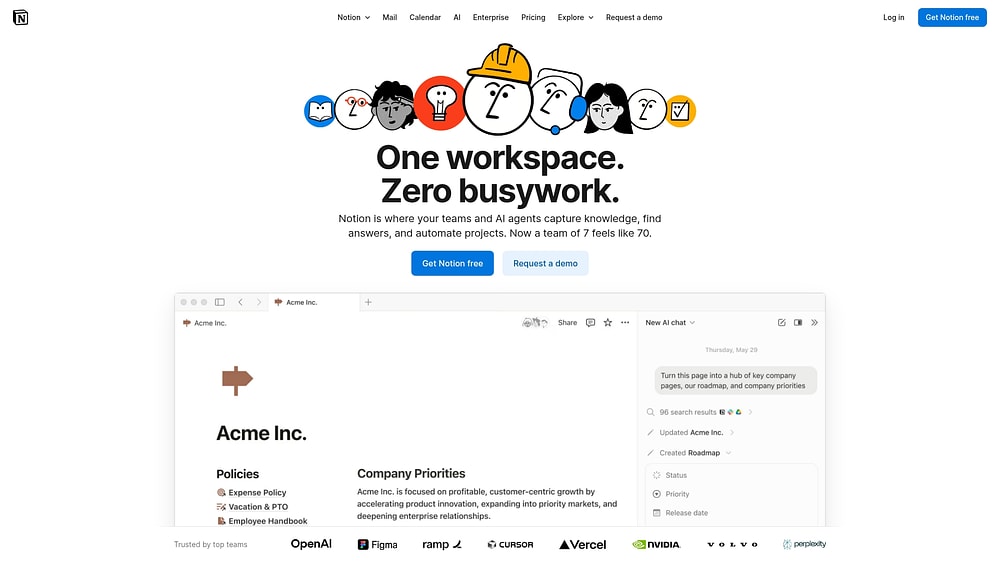
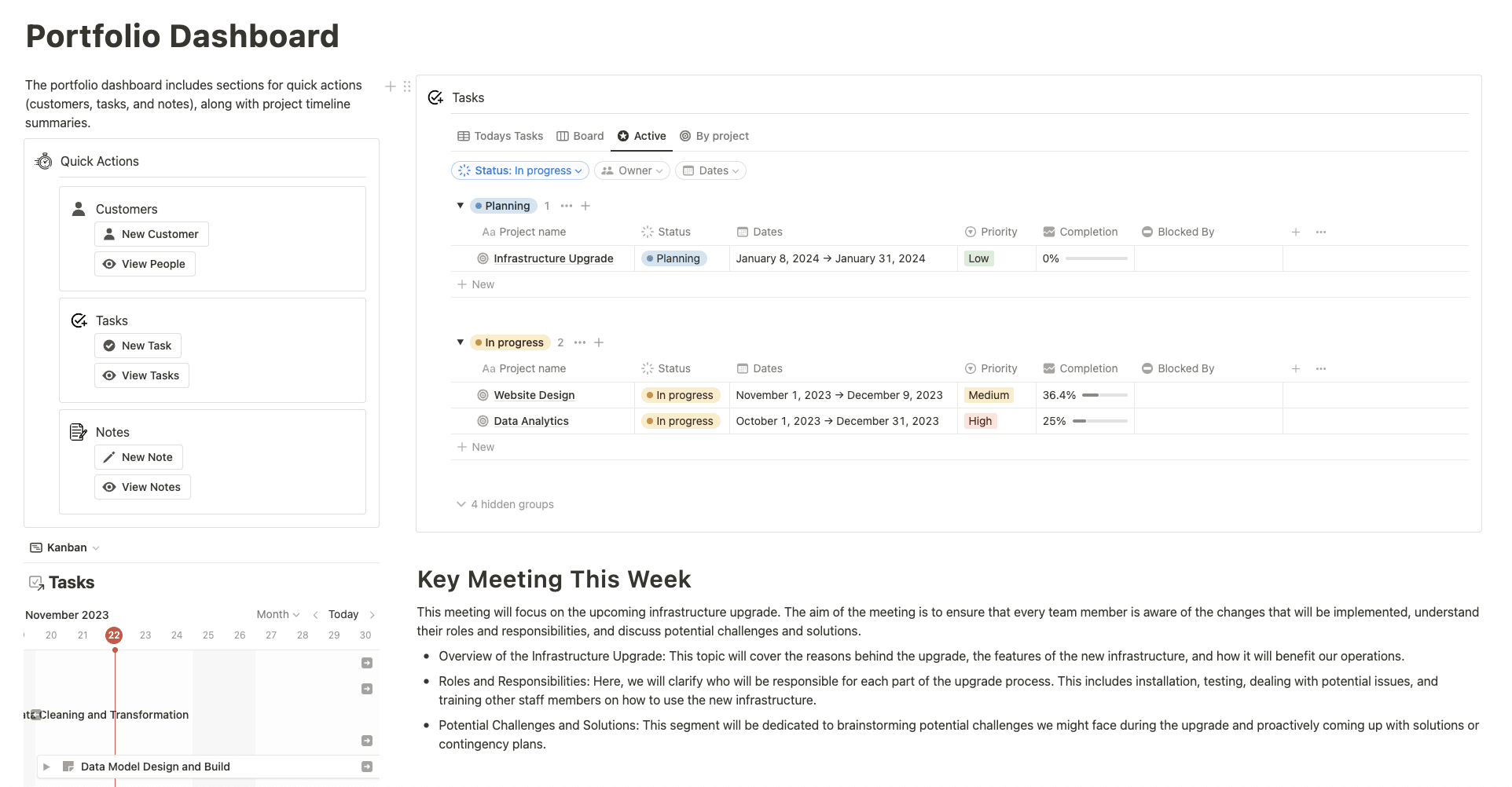
Notion is an all-in-one workspace built around flexible documents and databases. At its core, it’s a tool for creating wikis, knowledge bases, notes, and structured databases, all within a modular, block-based editor. Users can build pages from scratch or start with templates, and Notion’s relational databases allow teams to connect information across projects, tasks, and reference materials.
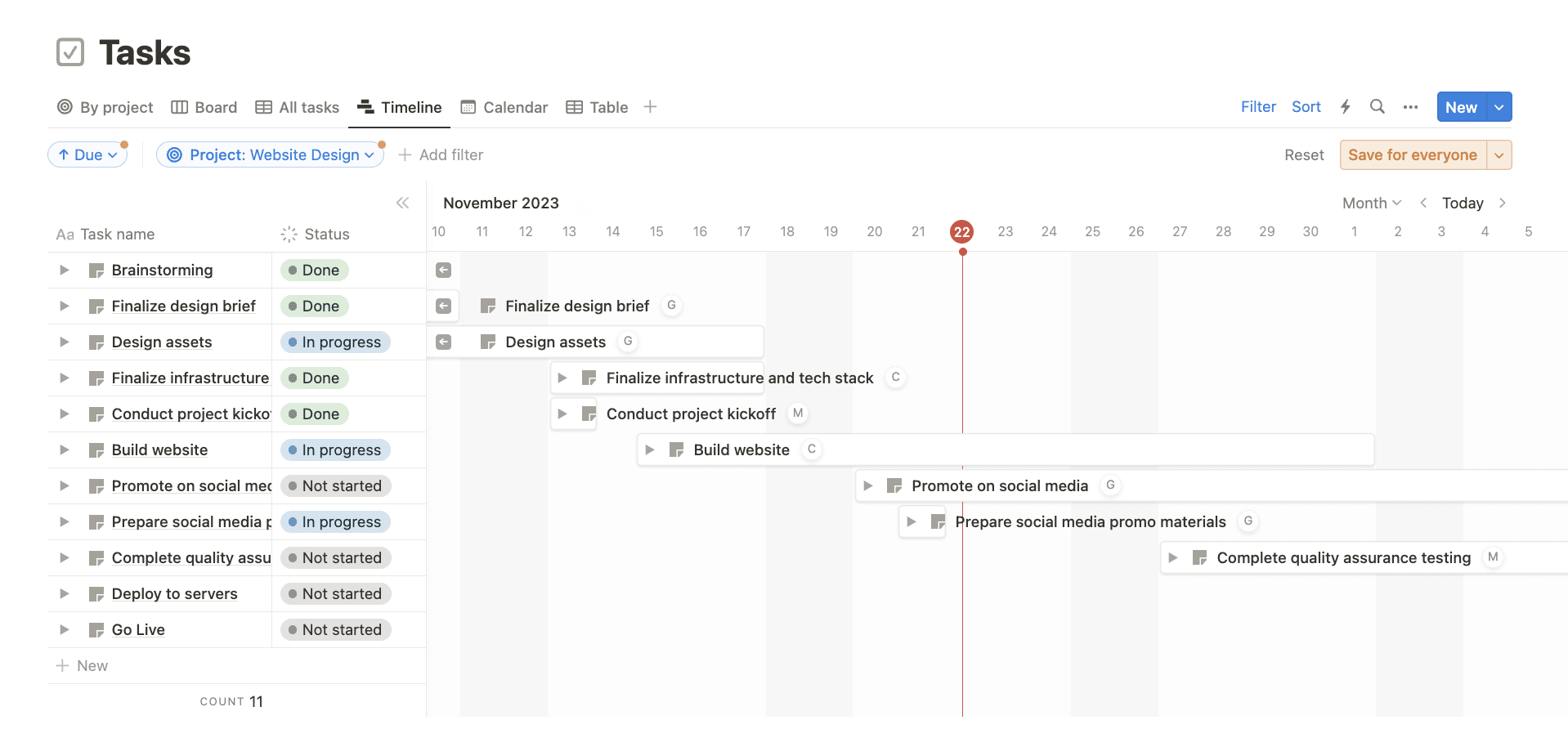
Since its early days as a docs tool, Notion has added project management features including timeline views, sprints, and Notion AI for content generation and workspace Q&A. These additions make Notion a capable tool for knowledge-heavy teams, but it remains docs-centric by design. Because of this, it’s not purpose-built for structured project management with dependencies, resource allocation, or cross-team reporting. For teams exploring alternatives, this guide to Notion alternatives covers several options worth considering.
Looking for a different approach? monday.com’s AI Work Platform was designed from the ground up as a work OS with native task tracking, automation, and AI capabilities like monday sidekick and monday agents that go beyond organizing work and execute it too.
What is Trello?
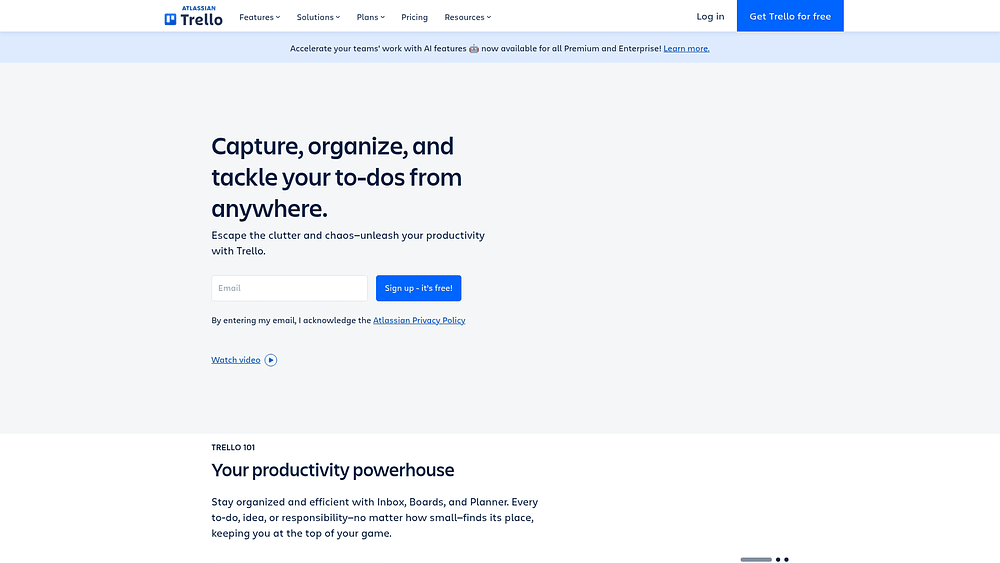
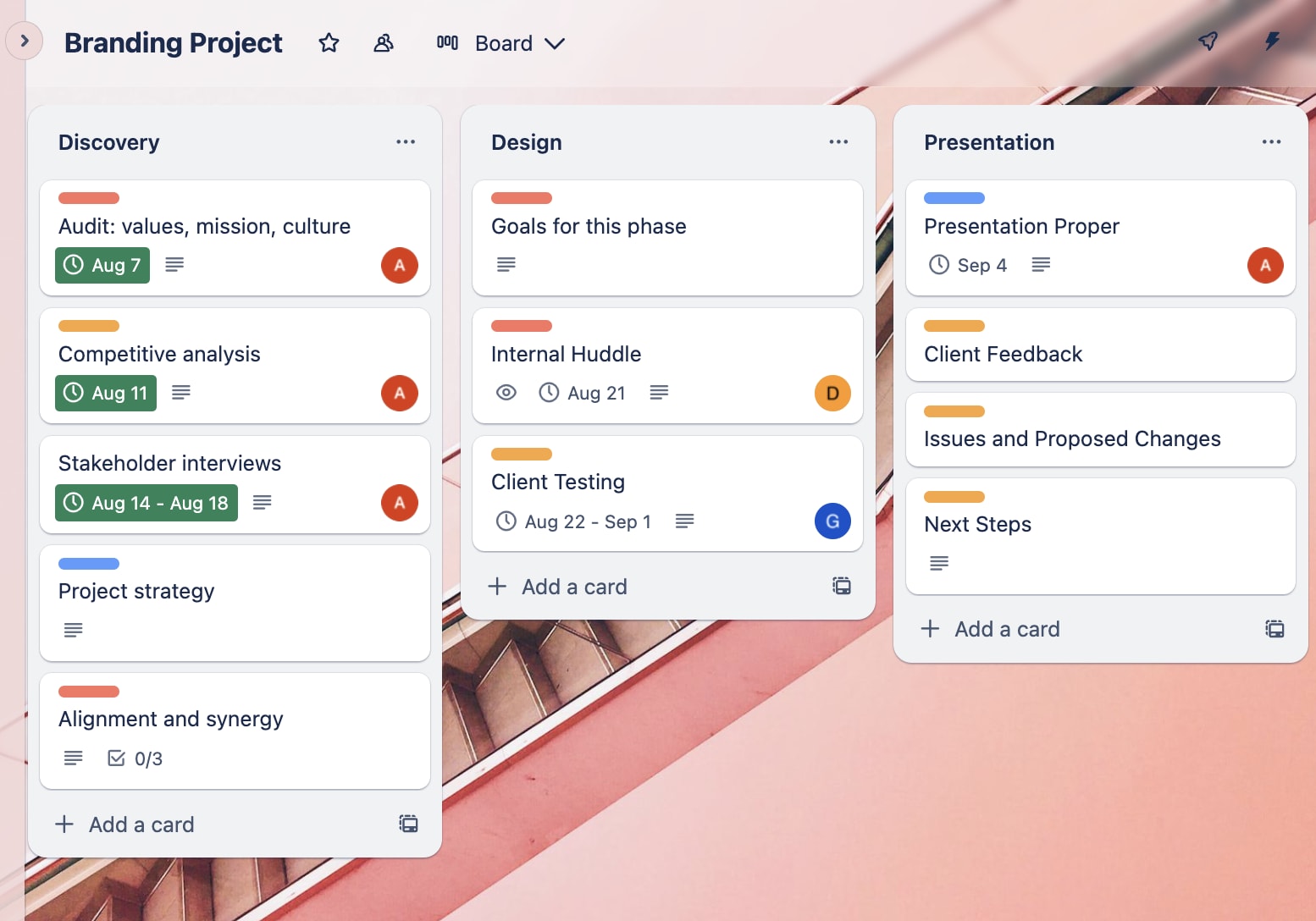
Trello is a visual project management tool built around the Kanban board. As work is organized into boards, lists, and cards, this structure is immediately intuitive for individuals and small teams tracking tasks. Trello’s drag-and-drop interface requires almost no onboarding, and its Butler automation engine lets users create rule-based triggers, scheduled commands, and card buttons without code.
Over the past few years, Trello has expanded beyond Kanban with timeline, table, calendar, and dashboard views, though these are only available on Premium and Enterprise plans. Power-Ups extend Trello’s features through third-party integrations, and Atlassian Intelligence is bringing AI capabilities across the Atlassian product family.
Still, Trello remains limited for teams that need anything advanced like reporting or enterprise-scale automation.
In contrast, monday.com’s AI Work Platform offers 15+ views, including Kanban, Gantt, Timeline, Calendar, and Workload, without requiring a premium upgrade. Combined with 200+ integrations and no-code automations, the platform goes far beyond what a board-based tool can provide.
Compare more: Airtable vs Trello
Notion vs. Trello: At a glance
Need a quick feature comparison? Here’s the gist of what Notion vs. Trello offer.
| Feature | Notion | Trello |
|---|---|---|
| Task management | Database items with customizable properties | Cards on Kanban boards with checklists and labels |
| Project views | Table, board, timeline, calendar, gallery | Board, timeline, table, calendar, dashboard (Premium+) |
| Docs and wiki | Full block-based editor with nested pages and wikis | Card descriptions and attachments only |
| Automation | Basic database automations | Butler automation (rules, buttons, scheduled commands) |
| Integrations | Native integrations + API | 200+ Power-Ups + API |
| Reporting | Basic page analytics only | Dashboard view (Premium+ only) |
| AI features | Notion AI (writing, Q&A, autofill) | Atlassian Intelligence (rolling out) |
| Free plan starting point | Unlimited blocks for individuals | Up to 10 boards per workspace |
As you can see, Notion leads in documentation flexibility — its block-based editor and relational databases give teams a powerful canvas for building knowledge bases and internal wikis.
Trello leads in visual simplicity — its Kanban boards are among the most intuitive in the market, and Butler automation handles rule-based workflows without code.
Where both tools fall short is in structured project management, enterprise reporting, and AI. monday.com’s AI Work Platform covers all these categories natively — from Kanban boards and Gantt charts to docs (Workdocs), automations with 250+ templates, dashboards with 25+ widgets, and AI-powered features like monday sidekick and monday agents, without requiring add-ons or third-party tools.
Notion vs. Trello: Features
When choosing the must-have features in your chosen platform, keep in mind that they should align with the needs of your project. For example, collaborative features could be a draw if your project spans multiple teams, while flexibility could be a priority if you expect your headcount to change or your workflows to become more complex. Here are some of the top features that Notion and Trello offer.
Notion features
Notion’s greatest strength is its customizability, with multiple features you can use to create the workspace you need:
- Templates and pre-built blocks: The Notion community provides 5,000+ templates as the foundation of your projects. For example, users might use these to quickly whip up a pitch deck or plan an event without starting from scratch.
- Note-taking: Notion provides a space for capturing and organizing ideas. Live document editing also enables team members to collaborate on the same notes in real-time.
- Notion AI: This premium add-on allows Notion users to generate copy, such as blog posts or emails, at speed.
- Synced blocks: Update your content across pages by editing it once and watching the changes be applied elsewhere.
- Analytics: Understand how your users engage with content by displaying page views and edits.
Learn more: Notion alternatives
Trello features
Trello is a minimalistic project management tool that is best for streamlining your work. Here are some of its features:
- Boards, lists, and cards: The Kanban-style visualization makes up the basic structure of Trello. A board represents a project or workflow, with lists representing stages or categories within the project and cards representing individual tasks within each list.
- Labels: Categorize and organize tasks in Trello using the labels view, which allows you to see all cards with a specific label from across multiple boards.
- Checklists: This feature lets you break down larger tasks into smaller, more manageable subtasks.
- Due dates: Assign deadlines to your tasks and receive notifications before they’re due.
- Butler automation: This feature allows you to create automated commands and workflows within Trello to save time and streamline processes.
Notion vs. Trello: Integrations
Integrations allow you to create seamless workflows between one tool and the next to avoid hopping around windows and logging into multiple platforms. By setting up integrations with other tools you already know and love, you’ll maximize the functionality of your project management platform. Here’s what you can partner Notion and Trello with:
Notion integrations
Notion has expanded its integration ecosystem significantly, now offering native connections to tools like Slack, Google Drive, GitHub, Figma, and Jira, along with a public API for custom integrations. However, Notion’s integrations tend to be surface-level — pulling data into Notion pages rather than enabling deep, automated workflows between systems.
Trello integrations
Trello benefits from Atlassian’s broader ecosystem and offers 200+ Power-Ups — third-party add-ons that extend board features with tools like time tracking, custom fields, and calendar sync. Trello’s API is mature and well-documented, making it a solid option for teams with development resources to build custom integrations.
monday.com’s AI Work Platform offers 200+ native integrations with tools like Slack, Microsoft Teams, Gmail, Jira, Salesforce, HubSpot, GitHub, and Zoom. Integration actions combine with automations and monday workflows for connected, automated processes across your entire tech stack — not just data syncing, but triggered actions that keep work moving.
Get startedNotion vs. Trello: Pricing
Trello and Notion both offer a free forever plan, which is great for budget-conscious individuals and small teams, or those who want to try before they buy. However, upgrading to one of the paid tiers will give you more functionality. Here’s what each platform provides at each price point.
| Tier | Notion | Trello |
|---|---|---|
| Free | $0 — unlimited blocks for individuals, limited for teams | $0 — up to 10 boards per workspace |
| Standard / Plus | Plus: $10/user/mo (billed annually) | Standard: $5/user/mo |
| Business / Premium | Business: $15/user/mo (billed annually) | Premium: $10/user/mo |
| Enterprise | Custom pricing | $17.50/user/mo (minimum 50 |
Notion’s pricing
Notion’s free plan works well for individuals with unlimited blocks, but team collaboration features — including admin tools and bulk export — require the Plus plan, which recently increased from $8 to $10/user/mo.
Trello’s pricing
Trello’s free plan caps workspaces at 10 boards, which growing teams hit quickly. Its Standard plan at $5/user/mo is one of the most affordable paid tiers in the market, but timeline views, dashboard views, and advanced automation require Premium at $10/user/mo. Trello Enterprise also requires a minimum of 50 users, putting it out of reach for mid-size organizations.
Both platforms charge per user, which means costs scale linearly as teams grow — a factor worth considering when evaluating long-term total cost of ownership.
As an alternative, monday.com offers a free plan for up to two seats, with paid plans starting at $9/seat/mo (billed annually). Every plan includes access to 200+ templates, automations, integrations, and multiple views — features that Notion and Trello reserve for premium tiers.
Notion vs. Trello: Automation
Automation eliminates repetitive manual work by triggering actions based on rules, events, or schedules — letting teams focus on higher-value tasks instead of routine updates. In work management platforms, automation can handle everything from status changes and notifications to multi-step workflows that connect tasks, boards, and external tools.
Notion automations
Notion’s automation capabilities remain limited. The platform supports basic database automations — triggering actions when database properties change — and Notion AI handles content generation, Q&A, and autofill. But there’s no visual workflow builder, no cross-database automation triggers, and no way to create multi-step automated processes within Notion alone.
Trello’s automations
Trello’s Butler is a more capable automation engine. Users can create rules (when X happens, do Y), scheduled commands, card buttons, and board buttons — all without code. Butler handles repetitive task management well within Trello, but it’s limited to Trello-internal actions. You can’t trigger actions in external tools, build conditional branching workflows, or chain automations across multiple boards without workarounds.
monday.com automations include 250+ no-code templates, cross-board triggers, time-based and event-based rules, and AI Blocks that bring intelligence into automated workflows. monday Agents take automation further — they plan, coordinate, and execute multi-step tasks autonomously across your workflows, handling complexity that rule-based automation can’t.

Notion vs. Trello: Ease of Use
Adopting a new platform can involve a learning curve as users get to grips with the tool’s new navigation, features, and potential. But how quickly can you expect to pick up the details in Notion and Trello?
Notion ease of use
G2’s software user community scores Notion 8.3 out of 10 in the Ease of Use category, slightly lower than Trello’s score. Notion’s scope for customization can be overwhelming if you’re new to setting up project management software; however, small business user Kit B. mentions that templates are a great workaround to save time.
“Notion is a software that can be just about anything you need it to be. It gives you the canvas and tools to build whatever pages, databases, wikis, or boards you need to organize your life or business. And if you’re not a do-it-yourselfer, there are hundreds of pre-built templates from fellow Notion users.”
Trello ease of use
Trello scores 9.0 out of 10 for Ease of Use from G2 users, 0.6 higher than Notion. It also scores high in the Ease of Setup category with 9.1 out of 10 compared to Notion’s 8.4. With an intuitive interface, it’s straightforward for Trello users to pick up the visual layout, which analyst Neil Max N. agrees with:
“Trello’s best feature is its ability to simplify task and project management. The Kanban-style dashboard interface is highly visual and allows you to organize tasks into custom columns. This is extremely useful for prioritizing, assigning responsibilities, and tracking the progress of a project. In addition, the ability to attach files, add comments, and set deadlines provides effective real-time communication. Without a doubt, these features are essential in a work environment where collaboration and efficiency are key.”
Notion vs. Trello: Support
Whether you have an onboarding question, a bug in the system, or want some advice on your upgrade options, it’s always reassuring to speak to a technician with the expertise you need. Trello and Notion offer a variety of support options, depending on your pricing tier.
Notion customer support
Notion scores 8.5 out of 10 for Quality of Support with the G2 user community. Free tier customers cannot access the platform’s Priority Support, which is available for Plus, Business, and Enterprise customers, by clicking “?” on your desktop or “Help and Feedback” from mobile devices. Enterprise customers can also access a team of Customer Success managers.
Trello customer support
G2 users score Trello 8.5 out of 10 for Quality of Support, with widely varying options available at each price level. Free plan users can access community support, Standard users can contact customer support during local business hours, Premium users have 24/5 access, and Enterprise users have 24/7 access.
Notion vs. Trello: Customer reviews
Trying to decide between two project management platforms can sometimes boil down to exploring other users’ experiences of them. Customer reviews provide insights into various use cases, hitches, selling points, and what happens behind–the–scenes when you commit to a specific tool.
Notion customer reviews
Notion users think highly of the platform, with more than 5k users rating it 4.6 out of 5 in the G2 community. Andrea Maie R., a chargeback associate, provides a fair review of the Notion’s pros and cons.
“Notion, an all-in-one workspace, redefines productivity and collaboration by offering a versatile platform that seamlessly integrates note-taking, task management, database organization, and team collaboration. It’s a robust, customizable tool that adapts to various workflows and individual preferences. Despite its strengths, there are areas where Notion might fall short. For instance, while flexibility is a boon, it might also lead to a slightly steeper learning curve for new users. Understanding the full potential of Notion and customizing it to individual needs might take some time and exploration.”
Trello customer reviews
Trello receives an overall score of 4.4 out of 5, which is 0.3 lower than Notion, according to 13k G2 users. Its intuitive interface suits workflows and projects that require simple, visual organization, as highlighted by Founder and CTO Mohamed W’s review:
“What I appreciate most about Trello is its user-friendliness. It enabled us to work together with our team members and complete our tasks efficiently. Since our team was working in shifts, it was challenging for each technician to transfer and explain their completed work to the upcoming technicians. However, after using Trello, this process became much easier, and we were able to save a lot of time. Although we did not find many of the plugin integrations useful, all the other features were really helpful.”
Trello vs. Notion: Security
A single security gap can expose a business to data breaches, regulatory penalties, and reputational damage, making security features non-negotiable when evaluating work management tools at scale.
Trello’s approach to security
Trello provides SSO on Premium and Enterprise plans, two-factor authentication across all tiers, and relies on Atlassian Guard (formerly Atlassian Access) for centralized admin controls, data policies, and threat detection. Trello holds SOC2 compliance through Atlassian’s security infrastructure. However, neither Notion nor Trello offers BYOK encryption or advanced data residency controls in their standard plans — a gap that matters for highly regulated industries.
Notion’s approach to security
Notion offers SSO on Business plans and above, audit logs on Enterprise, SCIM provisioning for user management, and SOC 2 Type II compliance. These are solid foundations, but advanced features like audit logs and admin analytics require the highest-priced tier.
As an alternative, monday.com provides IP restrictions, two-factor authentication, multiple SSO options, BYOK encryption, tenant-level encryption, SOC 2 Type II, HIPAA compliance, and advanced admin controls.
Trello vs. Notion: Which is the right tool for you?
Deciding between Trello or Notion comes down to what you value most from a project management software, whether features, affordability, simplicity, integrations, or something unique to your organization.
- Choose Trello if you value a platform that excels in simplicity and ease of use, with its visual Kanban boards serving as an effective method for managing tasks and projects.
- Choose Notion if you prefer its highly customizable interface and tools for a more intricate and detailed project management approach.
While both tools are strong contenders, it’s important to acknowledge the broad spectrum of project management tools available in the market. We recommend considering your organization’s specific needs and trying out several platforms before deciding.
Get startedWhy monday.com's AI Work Platform is a strong alternative
Both Notion and Trello solve specific problems well. But for teams that need more than a docs workspace or a Kanban board, monday.com’s AI Work Platform provides a unified platform built for how work happens in 2026.
Here are some of the features that set it apart from the rest.
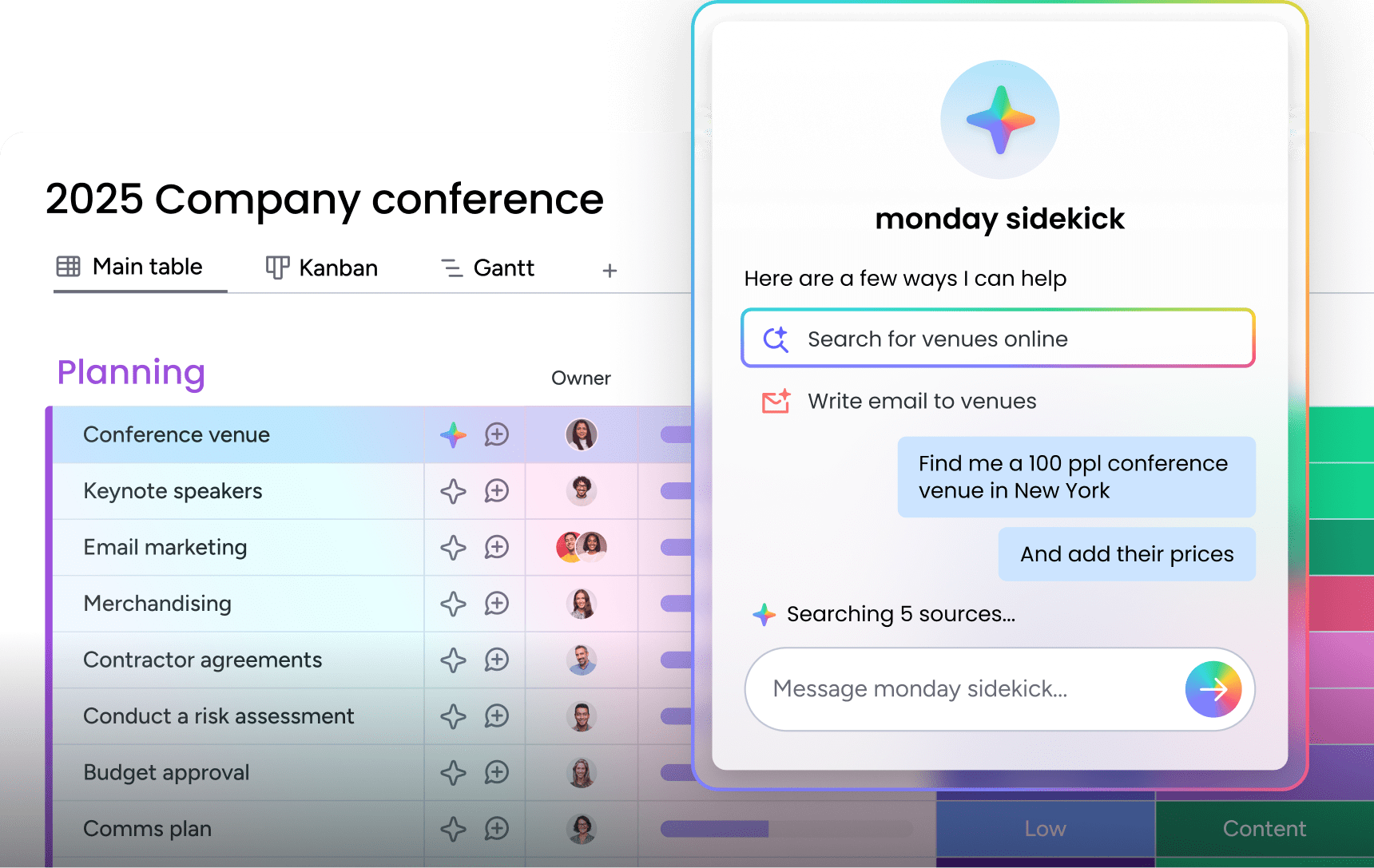
- AI that works with you — and for you. monday sidekick is a context-aware AI assistant that generates content, analyzes data, suggests next steps, and takes action directly within your workspace. monday agents go further — they’re autonomous AI workers that plan, coordinate, and execute multi-step tasks across your workflows without requiring human intervention at every step. And with monday vibe, any team member can build custom apps with AI, no coding required. These aren’t experimental add-ons. They’re embedded capabilities that make the platform smarter the more your team uses it.
- A complete work OS, not a single-purpose tool. monday.com includes 15+ views (Kanban, Gantt, Timeline, Calendar, Workload, and more), 200+ integrations, no-code automations with 250+ templates, dashboards with 25+ customizable widgets, and Workdocs for collaborative documents connected to live project data. Resource management and portfolio management are built in — not bolted on. For a detailed comparison with Trello specifically, see our Trello vs monday.com breakdown.

- Enterprise infrastructure that scales. mondayDB supports 10M+ items per board, giving organizations a single source of truth that doesn’t break under enterprise data volumes. Security includes IP restrictions, two-factor authentication, multiple SSO options, BYOK encryption, tenant-level encryption, SOC 2 Type II, and HIPAA compliance. And with monday MCP, external AI tools like Claude, ChatGPT, Cursor, and Copilot can connect to your monday.com data securely — making the platform the hub for your entire AI ecosystem.
What do users think?
monday.com’s AI Work Platform receives 4.7 out of 5 from the G2 user community and also achieves higher than both Notion and Trello in the following areas:
- Ease of use: 9.1 out of 10 (0.1 higher than Trello, 0.8 higher than Notion)
- Quality of support: 8.9 out of 10 (0.4 higher than both Trello and Notion)
- Ease of admin: 9.0 out of 10 (0.1 higher than Trello, 0.6 higher than Notion)
Here’s why Director of Project Management Emily A. thinks it’s the best.
Having used monday over the past few years in varying capacities, I can say without a doubt it is the most robust software you can find. It allows for transparency across all departments and projects, and ensures clarity of ownership and next steps so nothing gets lost in translation.
Choose the right platform for your work
The outcome of the Notion vs Trello debate boils down to what kind of tool your team needs most.
- If your work revolves around documentation, wikis, and knowledge management, Notion gives you a flexible canvas to build on.
- If you need a simple, visual way to track tasks on a Kanban board, Trello delivers that with minimal setup.
But most teams don’t just need docs or boards. They need structured project management, real-time reporting, AI-powered automation, cross-team visibility, and the ability to scale without switching platforms every time requirements grow. That’s where monday.com’s AI Work Platform fits — a unified work OS that gives you the flexibility of Notion, the visual clarity of Trello, and the depth, intelligence, and enterprise infrastructure synonymous with monday.com.
Whether you’re a small team getting started or an enterprise managing thousands of workflows, the AI Work Platform adapts to how your team works — and grows with you.
Get started
 Get started