


Choosing between ClickUp and Trello is one of those decisions that sounds simple until you’re three tabs deep in comparison charts. Both platforms manage projects, both have free plans, and both promise to make your team more productive. So what actually separates them?
The core tension comes down to depth versus simplicity. ClickUp packs in hundreds of configurable features across nested hierarchies, while Trello keeps things visual and fast with its Kanban-first design. Neither approach is universally right, and the wrong fit can slow your team down instead of speeding it up.
This ClickUp vs Trello comparison breaks down features, pricing, integrations, and more. We’ll also explore how monday.com’s AI Work Platform offers a third path for teams that want enterprise-grade power without the steep learning curve.
Key takeaways
- Customization vs. simplicity: ClickUp wins on feature depth and granular configuration, while Trello wins on speed-to-value and ease of adoption for small teams.
- AI is the biggest gap: ClickUp Brain offers workspace-wide AI at $9/user/month, while Trello’s AI remains limited to basic Atlassian Intelligence writing assistance.
- Pricing looks similar, but hidden costs differ: Trello’s Power-Up dependency and ClickUp’s setup complexity both add to total cost of ownership beyond the subscription price.
- Reporting separates the two fast: ClickUp includes native dashboards and goal tracking, while Trello requires third-party add-ons for anything beyond basic board views.
- A third option bridges the gap: monday.com’s AI Work Platform combines enterprise-grade AI, 15+ views, and an intuitive visual interface.
ClickUp vs Trello: at a glance
Before diving into each category, here’s a high-level snapshot of how ClickUp and Trello compare across the dimensions that matter most. This table gives you a quick read on where each platform leads and where it falls short.
| Category | ClickUp | Trello |
|---|---|---|
| Best for | Technical teams needing deep customization | Small teams needing fast visual organization |
| Starting price (paid) | $7/user/month (Unlimited) | $5/user/month (Standard) |
| Free plan | Yes (100MB storage, limited features) | Yes (unlimited cards, 10 boards) |
| AI capabilities | ClickUp Brain ($9/user/month add-on) | Basic Atlassian Intelligence (Premium+) |
| Views | 15+ (List, Board, Gantt, Box, and more) | Kanban boards, Timeline, Calendar, Table |
| Integrations | 1,000+ (native + Zapier) | 200+ Power-Ups (Atlassian ecosystem) |
| Security certifications | SOC 2 Type II, GDPR | SOC 2 Type II, GDPR (via Atlassian) |
ClickUp vs Trello: Key features
How does the feature set of each platform actually shape day-to-day work? The answer depends on whether your team needs a flexible workspace they can configure from scratch or a focused environment that works right out of the box. Here’s how ClickUp and Trello compare on the capabilities teams rely on most.
ClickUp key features
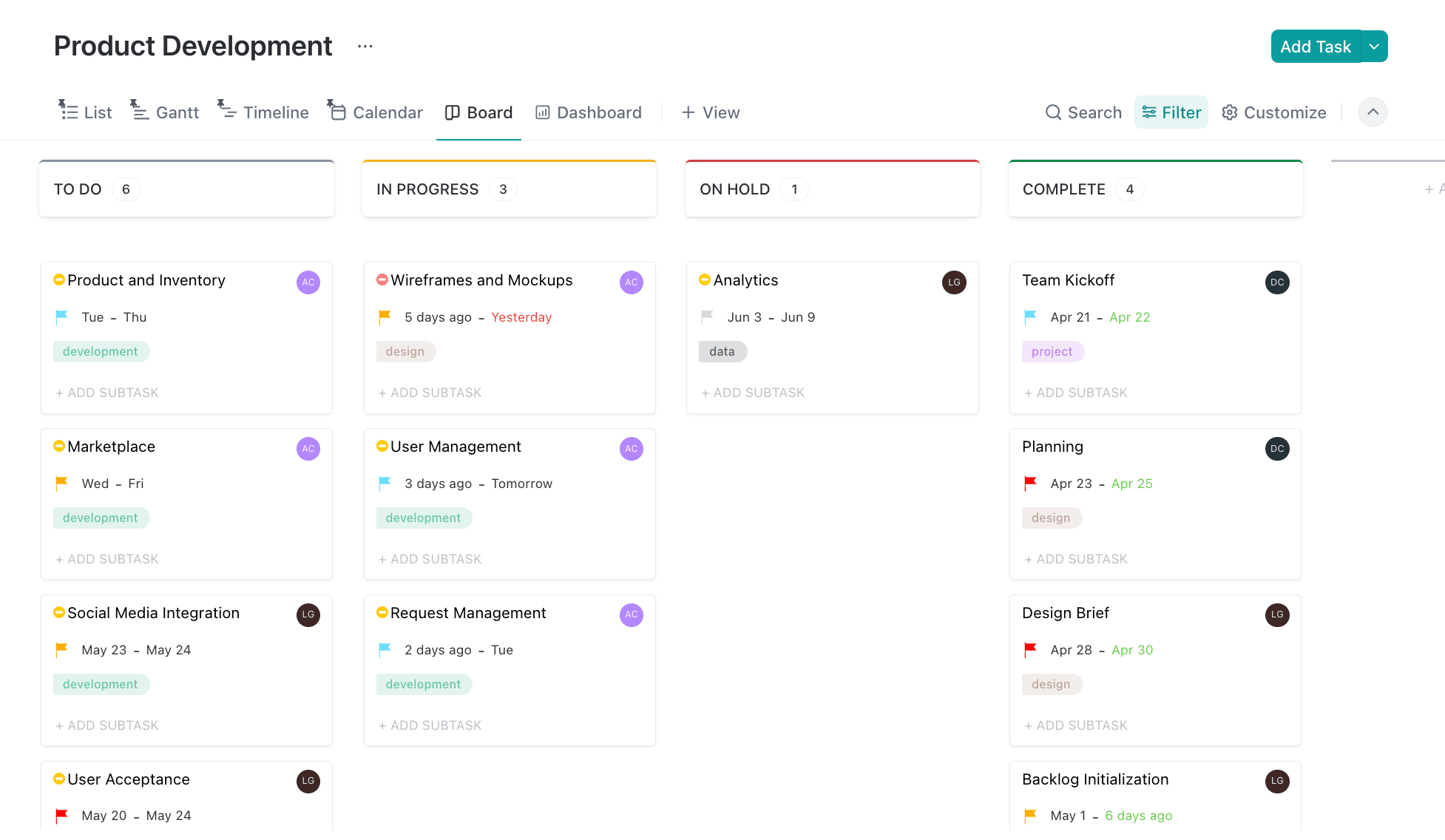
ClickUp’s strength is feature density. The platform organizes work through a nested hierarchy of spaces, folders, and lists, giving teams granular control over how projects are structured. You get 15+ views (including List, Board, Gantt, Timeline, and Box), native docs with ClickUp Docs, collaborative whiteboards, custom fields, and built-in goal tracking.
ClickUp Brain adds workspace-wide AI for knowledge retrieval, writing assistance, and Super Agents that automate multi-step processes. For teams that want maximum configurability, ClickUp delivers.
Trello key features
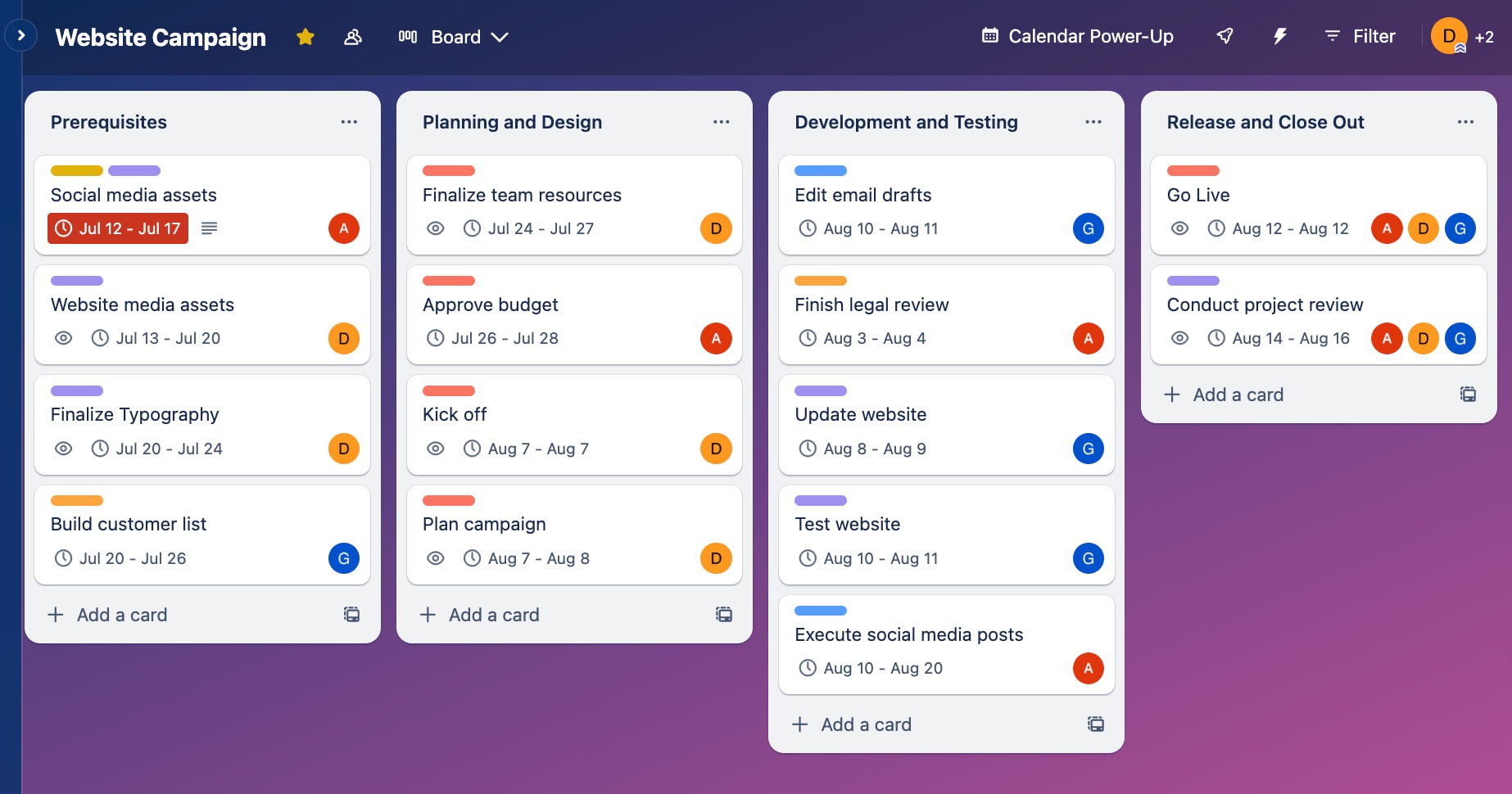
Trello takes the opposite approach. Everything revolves around Kanban boards, cards, and lists. The drag-and-drop interface is intuitive from the first minute, and card-based workflows handle creative pipelines, content calendars, and simple sprint tracking with minimal setup. Trello’s Power-Ups extend functionality with third-party add-ons for calendars, voting, custom fields, and reporting. The trade-off is that Trello relies on those Power-Ups for capabilities that ClickUp includes natively, which fragments the experience as your needs grow.
Beyond the high-level differences, specific features define each platform’s strengths and weaknesses. These are the capabilities that matter most when you’re evaluating ClickUp vs Trello for daily work:
- Hierarchy and structure: ClickUp’s spaces/folders/lists model supports complex project breakdowns, while Trello’s flat board structure works for linear workflows but struggles with multi-layered initiatives.
- Native views: ClickUp includes Gantt, Timeline, Workload, and Box views out of the box. Trello offers Kanban, Timeline, Calendar, and Table, with additional views requiring Power-Ups.
- AI capabilities: ClickUp Brain provides workspace-wide knowledge retrieval and multi-model AI support. Trello’s Atlassian Intelligence handles basic writing assistance and Butler automation descriptions.
- Docs and whiteboards: ClickUp offers native document editing and collaborative whiteboards. Trello users need to connect external apps for similar functionality.
For teams evaluating work management platforms beyond ClickUp and Trello, monday.com’s AI Work Platform offers 15+ views with a building-block architecture that lets non-technical users build complex workflows without code. Teams get ClickUp-level depth with Trello-level onboarding speed.
ClickUp vs Trello: Integrations
Your project management platform doesn’t exist in isolation. It needs to connect with CRMs, communication apps, design systems, and development environments. How well each platform integrates with your existing stack can make or break the experience.
ClickUp integrations
ClickUp offers over 1,000 integrations through a combination of native connectors and Zapier-powered workflows. Native integrations cover popular apps like Slack, GitHub, Google Drive, and Figma, while the ClickUp API enables custom connections for teams with development resources. The breadth is impressive, though the depth of some native integrations varies, and complex two-way sync scenarios often require Zapier as a middleman.
Trello integrations
Trello leans on the Atlassian ecosystem and its Power-Up marketplace. You get strong native connections with Jira, Confluence, and Bitbucket, plus 200+ third-party Power-Ups covering everything from Slack to Google Calendar. The Atlassian advantage matters if your organization already runs on Jira for development workflows. The limitation is that many Power-Ups are built and maintained by third parties, which means uneven quality, update frequency, and support.
monday.com’s AI Work Platform takes a different approach with 200+ native, deep integrations that support two-way data sync with platforms like Salesforce, Jira, HubSpot, and the Microsoft and Google ecosystems. The open API and monday MCP (Model Context Protocol) also enable teams to connect external AI systems securely to their workspace, keeping data flowing between platforms without manual handoffs.
ClickUp vs Trello: Ease of use
What good are powerful features if your team can’t adopt them? Ease of use determines how quickly a platform delivers value and how broadly it gets adopted across departments. This is where ClickUp and Trello diverge most sharply.
Trello ease of use
Trello is one of the simplest project management platforms on the market. New users can create a board, add cards, and start coordinating work within minutes. The drag-and-drop Kanban interface feels natural, and there’s almost no onboarding required for basic workflows. That simplicity has a ceiling, though. Once teams need custom fields, cross-board reporting, or multi-step automations, Trello’s ease of use starts working against them because the workarounds aren’t intuitive.
ClickUp ease of use
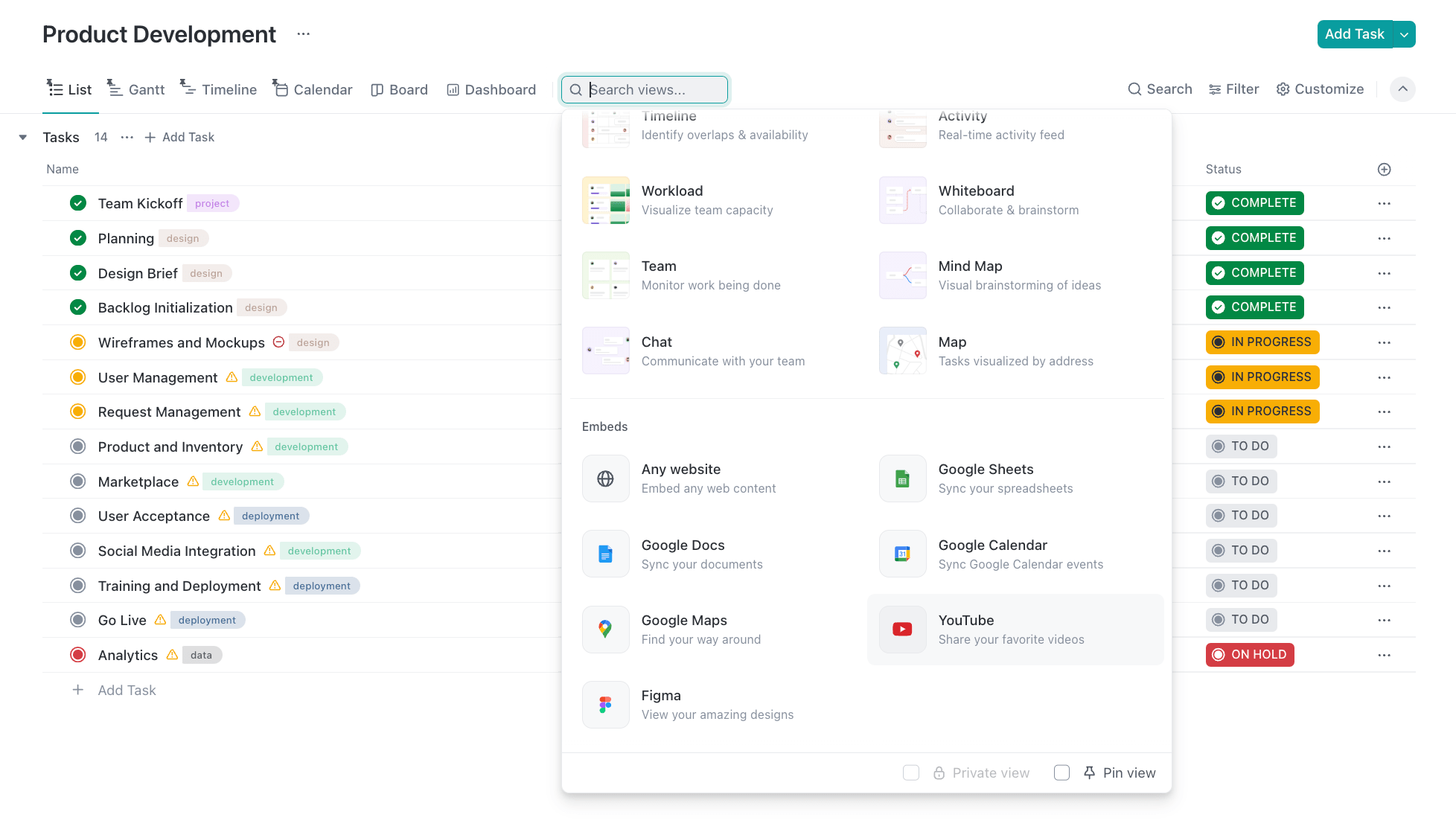
ClickUp is powerful but overwhelming. The maze of spaces, folders, and lists gives teams granular control, but it also creates a steep learning curve that slows adoption. G2 users rate ClickUp’s Ease of Use at 8.1, reflecting the complexity tax that comes with deep configurability. Most organizations need a dedicated admin to maintain workspace consistency, and rolling out ClickUp across non-technical departments often requires formal training programs.
monday.com’s AI Work Platform is both easy to use and set up according to users, proving that enterprise depth doesn’t require enterprise complexity. Teams across departments adopt it quickly because the visual interface is intuitive enough for non-technical users while still supporting the structured workflows that operations, IT, and leadership teams need.
ClickUp vs Trello: Pricing
Pricing tables only tell part of the story. The real cost of a project management platform includes setup time, add-on dependencies, and the productivity impact of a steep learning curve. Here’s how ClickUp and Trello stack up on paper and in practice.
| Plan tier | ClickUp | Trello |
|---|---|---|
| Free | Free (100MB storage, limited) | Free (unlimited cards, 10 boards) |
| Mid-tier | Unlimited: $7/user/month | Standard: $5/user/month |
| Business | Business: $12/user/month | Premium: $10/user/month |
| Enterprise | Custom pricing | $17.50/user/month |
| AI add-on | ClickUp Brain: $9/user/month | Included in Premium+ (basic) |
On sticker price, Trello edges ahead at the mid-tier level ($5 vs. $7 per user/month). But sticker price doesn’t tell the full story.
Trello pricing considerations
Trello’s hidden costs come from Power-Up dependency. Reporting, Gantt charts, advanced automations, and custom fields all require paid Power-Ups or Premium-tier upgrades. A team of 20 that starts on Trello Standard at $5/month can quickly find themselves on Premium at $10/month once they need anything beyond basic Kanban. The “simplicity premium” means you pay less upfront but add costs incrementally as your needs grow.
ClickUp pricing considerations
ClickUp’s hidden costs are time-based. The platform includes more features natively, which keeps the subscription cost competitive. But the setup tax is real: configuring spaces, folders, custom statuses, and automation rules across departments takes weeks. Factor in the training hours needed to get non-technical teams comfortable with ClickUp’s dense interface, and the productivity dip during adoption becomes a significant line item.
Both platforms offer aggressive free tiers, but free plans hit their limits fast in team environments. ClickUp’s free plan caps storage at 100MB. Trello’s free plan limits you to 10 boards and one Power-Up per board.
monday.com’s AI Work Platform includes AI capabilities natively across all paid plans, with no per-user AI add-on required. Pricing starts at $9/seat/month (Basic), $12/seat/month (Standard), and $19/seat/month (Pro), with a free plan for up to 2 seats. The seat-based model keeps costs transparent, and teams avoid the add-on fragmentation that increases total cost of ownership on other platforms.
ClickUp vs Trello: Reporting and analytics
Can your team answer the question “how are we tracking?” without exporting data to a spreadsheet? Reporting and analytics capabilities determine whether a platform helps leadership make informed decisions or leaves them guessing.
ClickUp reporting and analytics
ClickUp includes native dashboards, custom reporting widgets, goal tracking, and workload views. Teams can build dashboards that pull data from multiple lists and folders, track time against estimates, and monitor goal progress at the portfolio level. The reporting depth is strong for a platform at this price point, though configuring dashboards to show exactly what you need requires time and familiarity with ClickUp’s data model.
Trello reporting and analytics
Trello’s native reporting is minimal. The platform offers basic board activity logs and card aging, but anything resembling a dashboard requires third-party Power-Ups like Screenful or Corrello. These add-ons introduce recurring costs and create data silos, since the reporting layer sits outside the platform itself. For teams tracking initiatives across multiple boards, Trello’s reporting gap becomes a significant limitation.
monday.com’s AI Work Platform provides 50+ dashboard widgets, AI-powered Portfolio Risk Insights, and automated reporting that connects operational data to executive oversight. Teams build live dashboards without third-party add-ons, and leadership gets real-time visibility across every initiative in a single view.
ClickUp vs Trello: Productivity
Automation, templates, and AI assistance define how much repetitive work a platform absorbs so your team can focus on higher-value activities. Which platform actually saves more time in practice?
ClickUp productivity
ClickUp offers a robust automation engine with complex, logic-based triggers that support multi-step workflows across lists and folders. The platform includes 100+ templates, native time tracking, and ClickUp Brain for AI-assisted writing, summarization, and knowledge retrieval. For teams with technical users who can configure these automations, ClickUp delivers meaningful productivity gains. The trade-off is that building those automations takes expertise, and maintaining them across a growing workspace requires ongoing attention.
Trello productivity
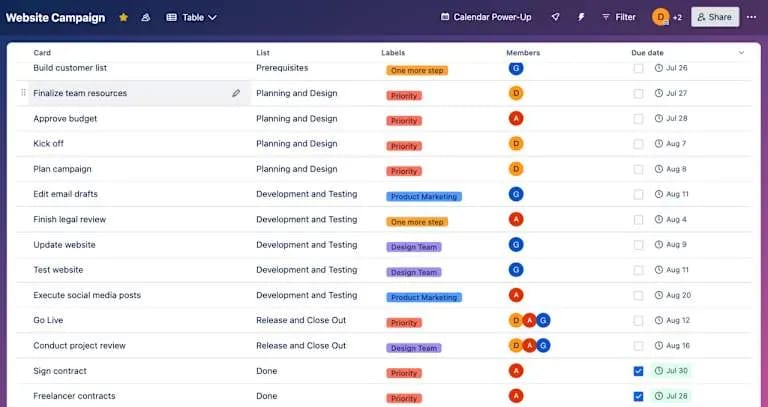
Trello’s Butler automation handles rule-based triggers well for individual boards. You can set up “when X happens, do Y” rules quickly, and the visual interface makes simple automations accessible to anyone. Board templates help teams replicate proven workflows. The ceiling appears when you need cross-board logic, conditional branching, or automations that span departments. Butler wasn’t built for that complexity, so teams often hit a wall as their processes mature.
monday.com’s AI Work Platform’s visual automation builder lets non-technical users create multi-step, cross-board automations in seconds using a sentence-builder interface. Combined with monday agents that autonomously execute workflows across project execution and reporting, teams automate entire processes rather than individual triggers.
ClickUp vs Trello: Security
Enterprise security requirements go beyond basic authentication. Compliance certifications, permission granularity, and data governance controls determine whether a platform can serve regulated industries and large organizations.
ClickUp security
ClickUp holds SOC 2 Type II certification, supports GDPR compliance, and offers two-factor authentication across all plans. SSO and advanced permissions become available on the Business plan and above, with custom roles and guest access controls for enterprise teams. The permission model is flexible but requires careful configuration to avoid gaps in access control.
Trello security
Trello inherits Atlassian’s security infrastructure, including SOC 2 Type II certification, GDPR compliance, and enterprise-grade features through Atlassian Guard. Premium and Enterprise plans unlock SSO, organization-visible boards, and enhanced admin controls. The Atlassian ecosystem benefits large organizations already invested in Jira and Confluence, as security policies apply consistently across products.
monday.com’s AI Work Platform meets enterprise security standards with SOC 2 Type II, HIPAA, ISO 27001, and GDPR compliance. Granular multi-level permissions control access at the account, workspace, board, and column level, while SSO and audit logs give IT teams the governance visibility they need without slowing down business users.
ClickUp vs Trello: Customer support
When something breaks or a team needs help configuring a workflow, how quickly can you get a real answer? Support quality directly affects time-to-value and ongoing satisfaction.
ClickUp customer support
ClickUp provides 24/7 chat support, an extensive knowledge base, and ClickUp University for self-serve training. Enterprise customers get dedicated customer success managers and priority support. The challenge is that the platform’s complexity means support requests often involve nuanced configuration questions that take longer to resolve.
Trello customer support
Trello relies on Atlassian’s support infrastructure, which includes community forums, email-based support, and help documentation. Premium and Enterprise customers access enhanced support tiers with faster response times. The community is active and helpful for common questions, but complex issues sometimes require escalation through Atlassian’s larger support system, which can feel slow compared to dedicated vendor support.
monday.com’s AI Work Platform offers 24/7 support across all plans, a comprehensive knowledge base, and dedicated customer success managers for growing teams.
ClickUp vs Trello: Customer reviews
What do actual users say after months of daily use? G2 ratings aggregate thousands of verified reviews and provide a useful signal for how each platform performs across dimensions that matter to real teams.
ClickUp customer reviews
G2 rating: 4.6/5
ClickUp reviewers consistently praise the platform’s feature breadth and customization options. The most common criticism is complexity: users report that getting full value from ClickUp requires significant investment in setup and training. Teams with dedicated administrators tend to rate it highest.
Trello customer reviews
G2 rating: 4.4/5
Trello reviewers highlight the simplicity and fast onboarding experience. The most frequent frustration is the feature ceiling: users outgrow Trello’s native capabilities and find themselves managing a patchwork of Power-Ups to fill gaps that other platforms handle natively.
On G2, monday.com’s AI Work Platform earns a 4.7/5 overall rating. Users consistently describe it as the platform that delivers enterprise capabilities without requiring a dedicated admin to keep it running.
Learn more: Airtable vs Trello
ClickUp vs Trello: Which is right for you?
After comparing 10 categories, the right choice depends on your team’s size, technical comfort, and how much your workflows will grow over the next 12 to 24 months. Here’s a direct framework for deciding.
Go with ClickUp if:
- You need deep customization and granular control over every workflow element
- Your team has a dedicated administrator or “productivity ops” person to manage configuration
- Technical teams (engineering, product, DevOps) are the primary users
- You’re willing to invest weeks in setup to get a highly specific environment
Opt for Trello if:
- You need fast, visual organization with minimal setup time
- Your team runs simple Kanban workflows (content pipelines, creative reviews, basic sprints)
- Small teams (under 20) that value speed-to-value over feature depth
- You’re comfortable adding Power-Ups as needs grow
Consider monday.com’s AI Work Platform if:
- You need cross-department visibility without sacrificing ease of use
- AI-powered workflows, automation, and reporting are priorities, not add-ons
- Your organization is scaling and needs a platform that grows without increasing complexity
- You want ClickUp-level depth with Trello-level onboarding speed
For teams that want ClickUp’s power without its complexity or Trello’s simplicity without its ceiling, the AI Work Platform bridges both worlds with an intuitive interface backed by enterprise-grade AI.
How monday.com's AI Work Platform transforms work management
While ClickUp and Trello focus on organizing existing work, monday.com’s AI Work Platform redefines what a project management platform can do. It functions as the orchestration layer between humans and AI agents, connecting strategy to execution across every department in a single workspace.
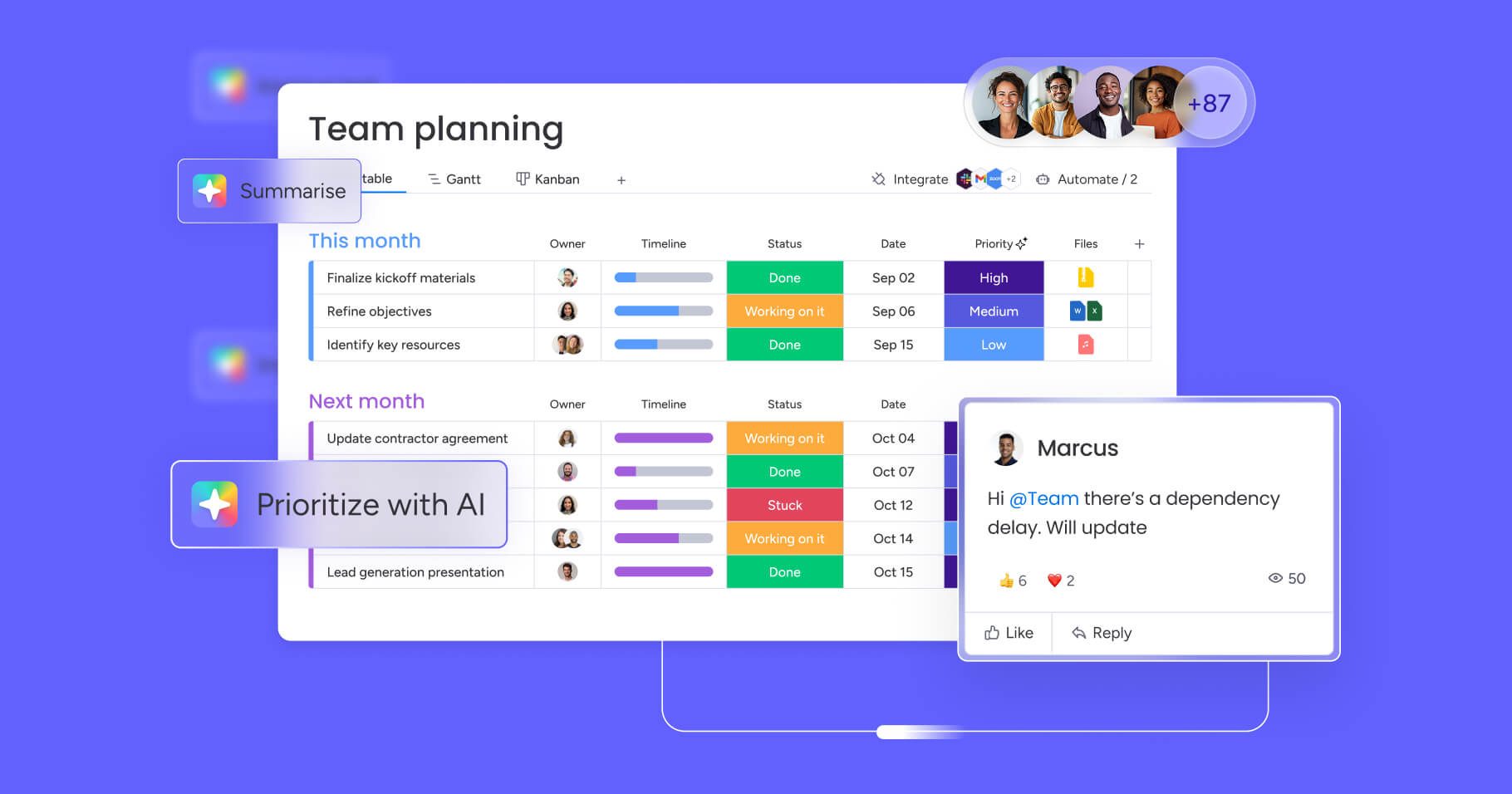
What sets the platform apart isn’t one feature. It’s how AI, automation, and visual workflows come together to help teams work faster without adding complexity. Here are the capabilities driving that shift.
- monday sidekick: A context-aware AI assistant that understands your entire workspace. Sidekick drafts status updates, answers questions about project health, and surfaces insights across boards without forcing you to switch contexts or dig through data manually.
- monday vibe: Build any business application in minutes by describing what you need. Vibe generates a working app, from project trackers to client portals, using natural language instructions. The entire process requires no coding, no templates, and no IT involvement.
- monday agents: An AI workforce that executes autonomously. Project Analyzer flags at-risk initiatives before delays happen. Campaign Manager optimizes marketing workflows. Sales Advisor surfaces deal insights. These agents work across your data to handle the repetitive cognitive labor that slows teams down.
- monday MCP (Model Context Protocol): Connect external AI systems securely to your workspace. MCP enables seamless data flow between your AI stack and the AI Work Platform, keeping everything connected without manual imports or exports.
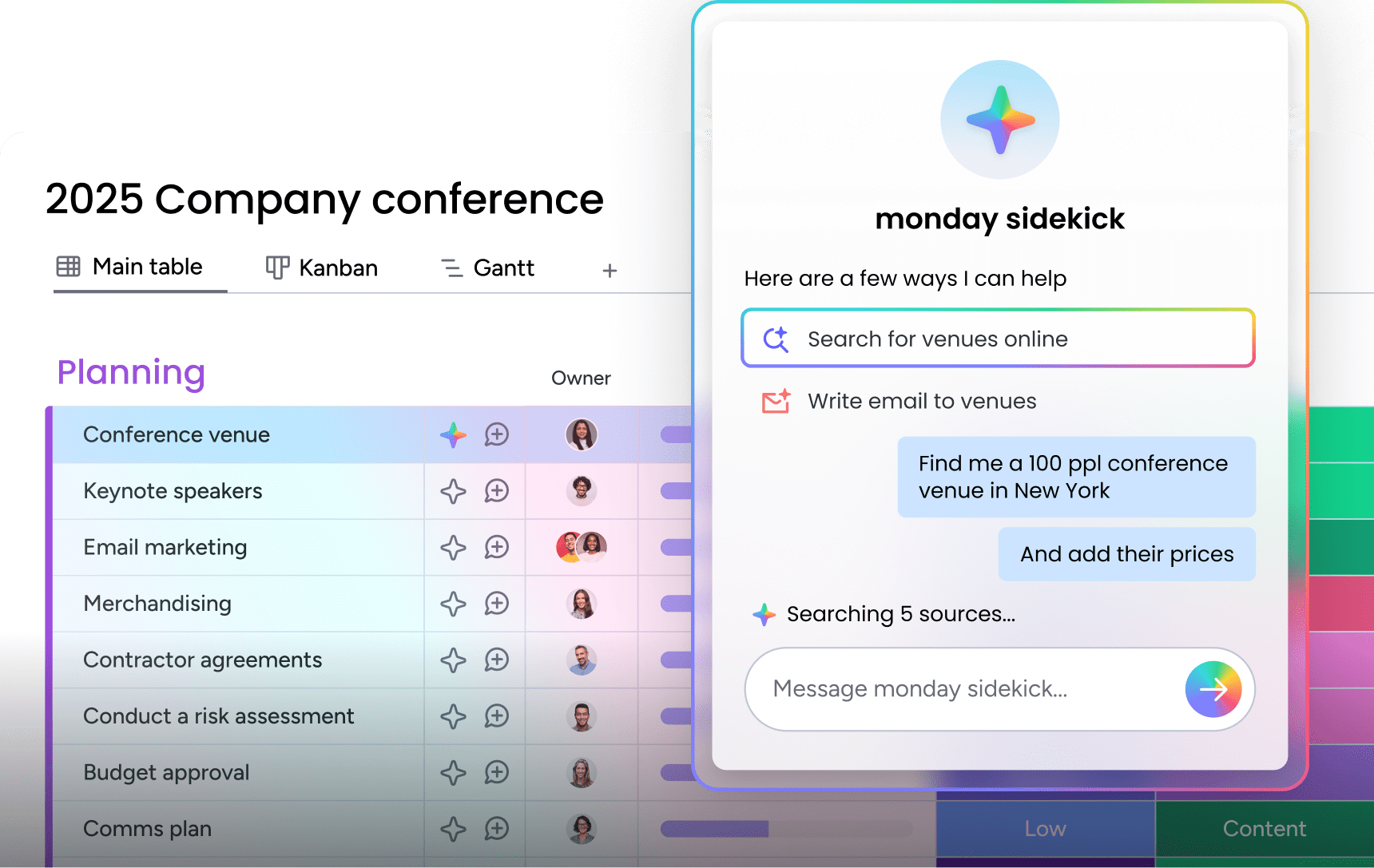
The platform’s building-block architecture supports 15+ views, 200+ native integrations, 50+ dashboard widgets, and a visual automation builder that non-technical users master in minutes. Teams handling portfolio management across departments get real-time visibility without configuring a single report manually.
| Capability | monday.com's AI Work Platform | ClickUp |
|---|---|---|
| AI agents | Project Analyzer, Campaign Manager, Sales Advisor, and more | ClickUp Brain Super Agents ($9/user/month) |
| Native AI | Included in all paid plans | $9/user/month add-on |
| Views | 15+ | 15+ |
| Integrations | 200+ native (two-way sync) | 1,000+ (native + Zapier) |
| Dashboard widgets | 50+ | Custom widgets |
| Security | SOC 2, HIPAA, ISO 27001, GDPR | SOC 2, GDPR |
Finding the right project management platform for your team
The ClickUp vs Trello decision isn’t about which platform is objectively superior. It’s about which one matches how your team actually works today and how you need to work 12 months from now. ClickUp suits technical teams that want maximum control and have the resources to configure and maintain a complex environment. Trello suits small, fast-moving teams that prioritize visual simplicity and don’t need deep reporting or cross-board automation. monday.com’s AI Work Platform serves organizations that want both depth and ease of use, with AI-native workflows that scale alongside the business.
AI is reshaping how teams coordinate work, make decisions, and execute at scale. The platform you choose today determines whether your team leads that shift or plays catch-up. Whichever direction you go, pick the platform that grows with you, not the one you’ll outgrow.
FAQs
Is ClickUp better than Trello?
Whether ClickUp is better than Trello depends entirely on your team's needs and how you work. ClickUp offers significantly more features and granular customization options, making it ideal for technical teams that need deep configurability and don't mind investing time in setup. Trello, on the other hand, is easier to learn and faster to set up, which makes it the better choice for small teams that prioritize visual simplicity and want to start organizing work immediately without a learning curve.
How do ClickUp and Trello compare on pricing?
ClickUp and Trello pricing starts at similar levels, with Trello at $5/user/month and ClickUp at $7/user/month. ClickUp includes more features natively, while Trello relies on paid Power-Ups that increase total cost as needs grow.
Does ClickUp or Trello have more advanced AI features?
When it comes to AI features, ClickUp Brain is significantly more advanced, offering workspace-wide retrieval and Super Agents. Trello's AI is limited to basic Atlassian Intelligence writing assistance included in Premium plans.
Can Trello handle complex project management?
Trello can handle simple Kanban workflows, but it struggles with complex project management. It lacks the hierarchy, native reporting, and cross-board automation logic that multi-team projects require.
What makes monday.com's AI Work Platform different from ClickUp and Trello?
What makes the AI Work Platform different from ClickUp and Trello is its combination of enterprise-grade AI (sidekick, vibe, agents, MCP) with an intuitive visual interface.
Can I migrate from Trello or ClickUp to monday.com's AI Work Platform?
Yes, you can migrate from Trello or ClickUp to the AI Work Platform. The platform supports direct imports from Trello and CSV-based migration from ClickUp, with most teams completing the transition within a week.

 Get started