


Teams that delivered three major projects last quarter often find themselves further behind than when they started. Calendars remain packed, emails accumulate faster than responses can be drafted, and strategic initiatives continuously shift to “next week.” The paradox is clear: increased effort frequently generates increased work.
Working smarter not harder means applying systems, technology, and strategic thinking to multiply the impact of every hour invested. Rather than adding more effort to existing processes, intelligent work redesigns those processes to eliminate friction, automate repetition, and direct human energy toward activities that genuinely advance business objectives.
Explore 15 practical strategies, from immediate wins like AI automation and time blocking to deeper structural shifts such as cross-functional collaboration and results-based measurement. You’ll learn how to spot when effort alone isn’t enough, build systems that scale with your ambitions, and create a culture where efficiency fuels sustainable growth.
Key takeaways
- Focus on outcomes, not hours: measure results like features shipped or revenue generated instead of time spent at your desk to drive real business impact.
- Automate repetitive work with AI: use intelligent automation to handle data entry, categorization, and reporting so your team focuses on strategy and creative problem-solving.
- Build visual workflows for transparency: create intuitive process maps and dashboards so everyone sees bottlenecks instantly and eliminates constant status update meetings.
- Unify work in one platform: connecting all teams, data, and communication in a single workspace like monday.com eliminates tool switching and information silos that slow execution.
- Eliminate low-value activities ruthlessly: say no to unnecessary meetings, manual reporting, and approval bottlenecks that steal time from strategic initiatives that move the needle.
What does working smarter not harder mean?
While working harder increases effort, working smarter increases impact. One adds hours; the other multiplies results. Working harder is linear: more time equals more output. Working smarter is exponential: better systems, clearer priorities, and smarter workflows amplify what each hour produces.
Three core principles drive this shift. Each one moves the focus away from tracking activity and toward creating measurable results.
1. Focus on outcomes over hours
Traditional work culture equates desk time with dedication. In contrast, outcome-focused thinking inverts this metric, valuing the result achieved regardless of time invested. It means that a project finished in 20 focused hours beats one that drags through 60 hours of meetings.
Smart leaders stop counting emails and start counting outcomes. Features shipped, revenue generated, or problems solved become the true measures of success. When organizations connect daily work to strategic objectives through a unified platform, every team member understands how their contributions drive business results.
2. Leverage systems and technology
Individual effort has natural limits, while well-designed systems scale consistently. Working smarter involves leveraging technology to handle routine cognitive tasks. Automation platforms and work operating systems serve as force multipliers, managing repetitive work such as data entry, status updates, and notifications.
When technology handles admin work, people can focus on strategy, creativity, and solving hard problems. Therefore, organizations that build workflows with automations and templates save valuable time and get new projects started faster by automating crucial elements of their work.
3. Eliminate wasteful activities
Waste in the modern workplace often hides behind “necessary” communication. Every hour wasted in a pointless meeting or hunting for files is an hour you can’t spend on what actually matters.
Eliminating waste involves identifying and removing low-value activities:
- Context switching: jumping between tasks destroys cognitive momentum.
- Manual reporting: time spent compiling data that could be automated.
- Approval bottlenecks: unnecessary sign-offs that slow execution.
The objective is to create capacity for focused work that delivers measurable business outcomes.
Why does working smarter not harder matter more than ever?
The modern business environment demands speed, precision, and adaptability. Effort alone is no longer enough. Organizations must produce more value with fewer resources, tighter budgets, and greater complexity. Working smarter has shifted from a productivity tactic to a survival strategy.
The pressure is coming from multiple directions:
- Rising complexity: hybrid work and distributed teams have fragmented communication, creating silos that slow decision-making and execution.
- Information overload: teams have access to more data than ever, but without systems to structure it, insight gets lost and action stalls.
- Accelerating markets: faster competitive cycles require scalable processes, not individual heroics.
- Permanent budget pressure: hiring is scrutinized, meaning teams must increase output without increasing headcount.
- Operational drag: disconnected tools and manual workflows quietly drain time, money, and momentum.
- Workflow interdependence: as projects grow more complex, visibility across teams becomes essential to manage risk and maintain alignment.
In this environment, efficiency isn’t a bonus — it’s foundational. Organizations that connect work streams, automate repetitive tasks, and build integrated systems gain clarity, reduce friction, and make faster, data-driven decisions.

7 signs you need to work smarter not harder
Recognizing you need to change is the first step. These symptoms mean you’ve hit the ceiling of what hard work alone can do. How many of these patterns show up in your organization?
The following indicators suggest that effort alone is insufficient:
- You’re always busy but never productive: your calendar’s packed, but nothing important moves forward. You spend the whole day reacting to fires instead of working on what matters.
- Deadlines slip despite long hours: your team works nights and weekends, but projects still launch late. That means the process is broken and overtime won’t fix it.
- Your team experiences frequent burnout: high turnover and burnout are operational problems. When talented people battle broken workflows every day, morale tanks.
- The same problems keep recurring: same errors, questions and fires week after week. You’re treating symptoms instead of fixing the real problem.
- Manual work dominates your day: your highest-paid people spend hours copying data between spreadsheets. That’s a waste of talent and slows everything down.
- Information lives in silos: marketing doesn’t know what sales promised. Product has no idea what customers are saying. When systems don’t talk to each other, you get duplicate work and miscommunication.
- You can’t scale without adding people: if you need twice the people to produce twice the output, your process doesn’t scale. Efficient workflows let you grow output faster than headcount. This principle is validated by research showing that fewer than 100 ‘standout’ firms accounted for two-thirds of productivity growth across thousands of large firms, demonstrating how scalable systems create outsized returns.
15 ways to work smarter not harder
These strategies start with quick wins and build toward bigger changes. They start with personal habits and scale to team-wide systems that create lasting impact. Each approach builds on the last to create a complete system for efficiency.
1. Automate repetitive work with AI
Automation is the easiest productivity win. AI goes beyond simple automation to handle complex, variable tasks. It can now categorize support tickets, draft contextual email responses, and summarize meetings.
Organizations using platforms like monday.com add AI blocks directly into workflows. These ready-made actions let teams categorize data at scale, extract information from documents, and summarize complex topics into actionable insights. Automate data entry and scheduling, and you’ll get hours back every week.
2. Batch similar activities together
Protecting your focus is essential, as switching between tasks can drain your mental energy. Research shows it takes an average of 23 minutes to regain focus after an interruption. This cognitive cost becomes even more significant when considering that today’s technologies could automate about 57% of current US work hours, allowing people to focus on higher-value outcomes instead of routine tasks that break concentration. Batch similar tasks into dedicated blocks to save mental energy for deep work.
Effective batching strategies include:
- Email processing: handle all emails in two 30-minute blocks instead of checking constantly throughout the day.
- Approval reviews: review all approvals at once rather than interrupting deep work for individual requests.
- Meeting scheduling: stack meetings into specific days to preserve uninterrupted focus time on others.
This protects the uninterrupted time you need to solve complex problems and think creatively.
3. Create visual workflows for transparency
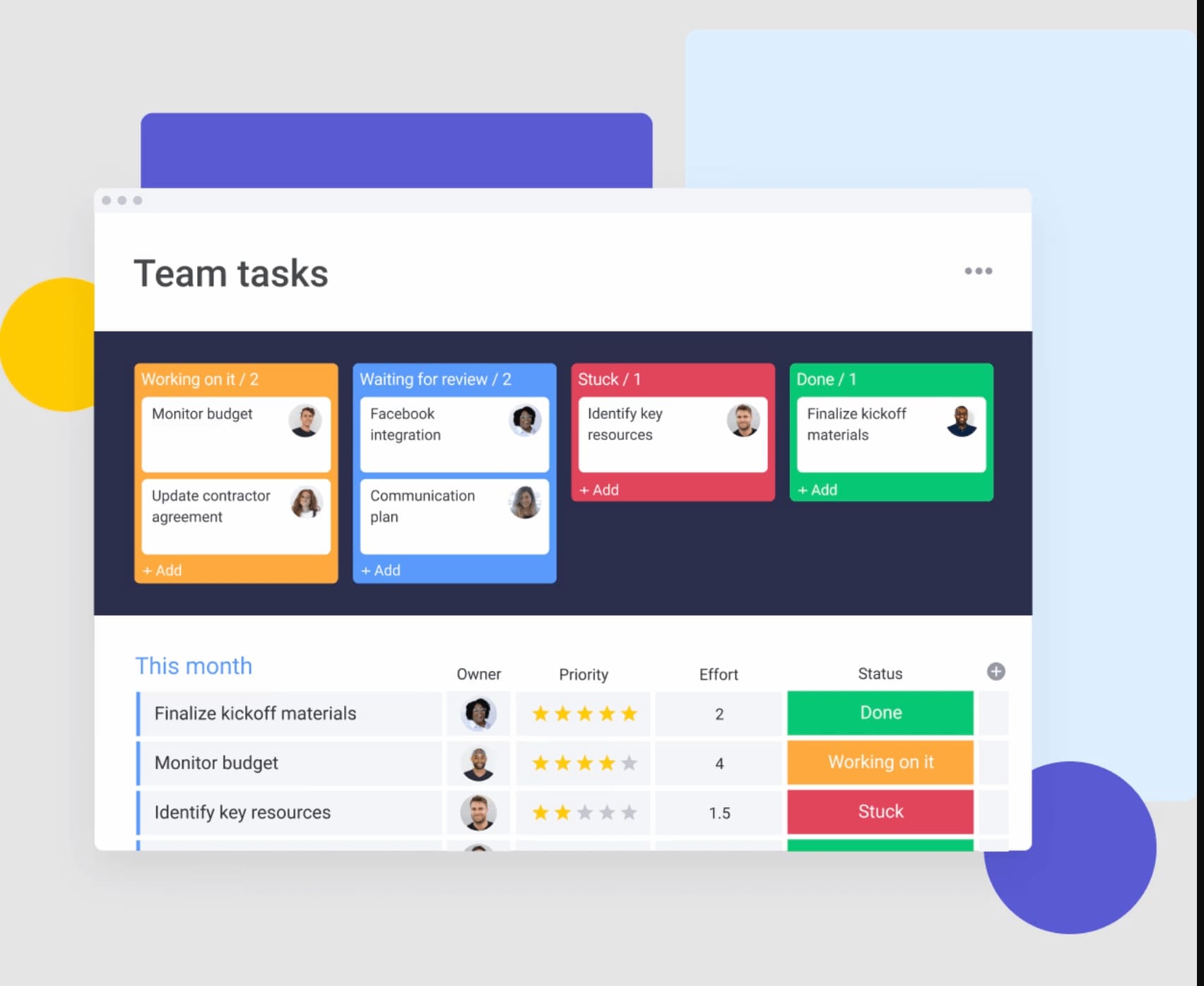
Effective work management requires visibility into processes and progress. Visual process maps transform ambiguous task lists into structured pipelines with clear stages and dependencies.
For example, Kanban boards and Gantt charts enable teams to identify bottlenecks immediately through visual workflows, providing precise insight into where work accumulates and requires attention.
Teams using solutions like monday.com can visualize their data and project plans through 15+ board views. Visual workflows ensure all stakeholders understand processes and progress without requiring frequent status meetings or manual updates.
4. Set priorities using data
Urgent requests often mask low-value work. Without data, teams tend to prioritize whatever arrived in their inbox last. Use objective metrics to rank work by:
- Revenue potential: direct impact on business growth.
- Customer impact: effect on user experience and satisfaction.
- Strategic alignment: connection to long-term organizational goals.
This ensures effort goes to what drives results, not just what’s loudest.
5. Build reusable templates and processes
Starting every project from scratch wastes energy on structure rather than content. Standards eliminate unnecessary decisions. By building a library of templates for project plans, onboarding, and creative briefs, you ensure consistency and speed.
Advanced platforms like monday.com allow you to pair these templates with automations, reducing setup time so new initiatives start instantly.
6. Master the art of strategic delegation
Effective delegation extends beyond task redistribution. Strategic delegation serves as a developmental tool that matches work assignments to individual capabilities and growth opportunities rather than simply distributing tasks based on availability.
Successful delegation requires clearly defined outcomes while providing autonomy in execution methods. This approach enables leaders to concentrate on strategic initiatives while simultaneously developing team capabilities and expertise.
7. Implement time blocking for deep work
Deep work is the ability to focus without distraction on cognitively demanding activity. It’s where your best work happens. Time blocking means scheduling non-negotiable focus time for yourself.
Remember to protect these blocks from meetings and interruptions as that’s when you solve hard problems and do your best work. Imagine if your team had two uninterrupted hours every day for deep work.
8. Use dashboards for real-time decisions
Organizations that rely on monthly reports to understand performance operate reactively rather than strategically. In contrast, real-time dashboards provide continuous visibility into business operations and performance metrics.
Dashboards within solutions like monday.com automatically display live high-level project data, delivering insights on budget allocation, goal progress, schedule adherence, and resource utilization. Visual metrics enable immediate course correction and informed decision-making without waiting for periodic reports.
9. Streamline communication channels
Too much communication kills productivity. Define exactly which channel serves which purpose:
- Status updates: belong in the project management platform, not email.
- Urgent issues: go to chat for immediate response.
- Strategic discussions: happen in meetings or documents for depth.
Cut the noise and people will actually see what matters.
10. Say no to low-impact activities
Each commitment to low-value work represents an opportunity cost that prevents focus on high-impact initiatives. High-performing professionals maintain disciplined boundaries around their time and priorities.
Evaluate incoming requests against strategic objectives before accepting new commitments. Declining requests that don’t align with core goals is a necessary practice for maintaining focus on activities that drive meaningful business outcomes.
11. Leverage cross-functional collaboration
Silos create duplicate work and conflicting priorities. Cross-functional collaboration tears down these walls by using shared workspaces where insights from one department instantly reach another. This allows teams to reach shared goals at scale without the friction of isolated communication.
Advanced platforms like monday.com enable organizations to build cross-departmental workflows, allowing teams to focus on achieving efficient work processes and reach shared goals at scale.
12. Track progress not just activity
Metrics like calls made or code written reward busywork. In contrast, metrics like milestones hit or problems solved reward real progress.
When you focus on progress, teams stop trying to look busy and start focusing on finishing work. Progress bars and milestone tracking keep the finish line in sight for everyone.
13. Optimize meetings with defined outcomes
Meetings represent a significant organizational cost. A single one-hour meeting with eight participants consumes eight hours of collective company time. Keeping that in mind, without a defined agenda and clear objectives, meetings should not be scheduled.
Every meeting requires a specific purpose and measurable outcome. Organizations should replace routine status meetings with asynchronous updates where appropriate. Eliminating one recurring meeting can reveal substantial time savings across the team.
14. Invest in continuous learning
Outdated skills slow you down. And outdated methods mean working harder for the same results your competitors get easily.
Strategic skill building, such as mastering new software, learning data analysis, or understanding AI prompting, is an investment that pays dividends in future speed and capability.
15. Measure results not hours worked
The most important shift is cultural. Measuring results rather than desk time creates a results-only environment. This rewards efficiency and innovation, empowering employees to manage their own energy. It discourages a “face-time” culture that breeds burnout and refocuses the organization on what actually gets delivered.

How does AI transform working smarter not harder?
Artificial intelligence acts as the ultimate force multiplier for smart work strategies. Unlike traditional automation, which follows rigid rules, AI adapts, learns, and generates. This makes it uniquely suited to the variability of knowledge work.
AI transforms how teams approach routine tasks, strategic planning, and resource management. The technology shifts organizations from reactive problem-solving to predictive optimization, creating sustainable competitive advantages.
| Work activity | Traditional approach | AI-powered approach |
|---|---|---|
| Data categorization | Manual sorting and labeling | AI assigns labels at scale based on type, urgency, or sentiment |
| Document processing | Reading and extracting information by hand | AI extracts details from PDFs, images, and documents automatically |
| Meeting follow-up | Manual note-taking and action item creation | AI summarizes meetings and suggests action items |
| Resource allocation | Spreadsheet-based capacity planning | AI assigns the right people to the right projects based on skills and availability |
| Risk identification | Periodic manual reviews | AI scans projects and flags potential risks by severity in real-time |
- AI-powered automation: AI drafts content, generates code, and synthesizes research in seconds. Unlike basic automation, it understands intent. monday.com’s AI Blocks provide ready-made capabilities, while the Custom Block generates exact actions from simple descriptions.
- Intelligent resource allocation: AI optimizes resource management by analyzing team capacity, skills, and timelines in real-time. The Workload View instantly shows over- and under-utilized resources, helping you maximize efficiency and adapt to changing priorities.
- Predictive analytics for planning: AI analyzes historical data to forecast risks, budget overruns, and delays before they happen. Portfolio Risk Insights scans all boards and flags potential issues by severity, enabling data-backed decisions that prevent expensive problems.
- Digital workers that scale with you: AI agents autonomously handle complete workflows like client onboarding or invoice processing. They scale instantly with demand, keeping your team lean and focused on high-value work without adding headcount.

Building a work smarter culture across teams
Tactics fail without cultural support. Building a culture of efficiency requires a shift in mindset from leadership down. It moves the organization from valuing heroism (staying late to fix problems) to valuing engineering (building systems so problems don’t occur).
Cultural transformation requires intentional design and consistent reinforcement. Leaders must model the behaviors they want to see and create systems that reward efficiency over activity.
Create transparent workflows
Transparency is the antidote to duplication. When work is visible to everyone, coordination improves naturally. Shared digital workspaces where all project data is accessible eliminate the who-is-doing-what confusion.
Transparency builds trust, as team members see how their individual contributions connect to broader organizational goals. Executives gain full visibility into the data they need to make the best decisions for their business.
Align teams around shared goals
Friction often arises from conflicting priorities, such as when sales pushes for speed while engineering prioritizes stability. Implementing goal alignment frameworks, such as OKRs (Objectives and Key Results), ensures every department pulls in the same direction.
Flexible platforms like monday.com help organizations identify and strategize company and team-level goals, and create a detailed action plan to achieve them. Cascading goals from the executive level down to individual contributors shows how daily work impacts the bottom line.
Foster continuous improvement
A work smarter culture is never finished, as it requires a mindset of continuous improvement. Teams should regularly conduct retrospectives not just on what they built, but how they built it.
Encouraging employees to challenge the status quo and suggest process improvements prevents stagnation. This ensures the organization adapts to changing conditions and continuously raises its performance ceiling.
Celebrate efficiency wins
Recognition strategies that reinforce smart work:
- Process automation: teams that eliminate manual work.
- Meeting optimization: groups that reduce unnecessary gatherings.
- Early delivery: projects completed ahead of schedule through planning.
Recognizing these behaviors reinforces the mindset that drives sustainable efficiency.
Start working smarter with the right foundation
Working smarter requires more than individual tactics; it demands organizational infrastructure that supports efficiency at scale. The most successful teams combine smart strategies with platforms designed to eliminate friction and amplify human capability.
As the operational backbone for organizations ready to institutionalize these strategies, monday.com is more than just a project management platform; it’s a Work OS that unifies work, data, and communication into a single environment. By eliminating the friction of switching between applications and the blindness of data silos, it provides the infrastructure necessary to work smarter at scale.
The platform democratizes the power of AI and automation. Through AI blocks, teams categorize data at scale, summarize complex topics, and extract actionable insights from any document. Automations handle the repetitive logic of work, moving items, notifying stakeholders, and updating statuses without a single line of code.
| Feature | Traditional approaches | Point solutions | monday work management |
|---|---|---|---|
| Centralization | Fragmented; data lives in isolated files and threads | Disconnected; requires constant context switching | Unified; all work, data, and communication in one place |
| Automation | Non-existent; relies on manual human effort | Limited; restricted to specific functions | Robust; cross-functional automation without code |
| AI integration | None | Bolt-on; often limited to text generation | Native; AI embedded into workflows and analysis |
| Visibility | Low; requires manual reporting and assembly | Partial; limited to specific department | High; real-time dashboards across the organization |
| Scalability | Low; processes break as volume increases | Medium; costs and complexity rise with seats | High; adapts to enterprise complexity and volume |
For implementation, monday.com scales from simple project tracking to complex portfolio management. It allows teams to build visual workflows that map perfectly to their unique processes, ensuring the software adapts to the team, not the other way around.
Frequently asked questions
Who originally said work smarter not harder?
The phrase "work smarter, not harder" was originally coined by Allen F. Morgenstern, an industrial engineer, in the 1930s to describe his work simplification programs.
What is the difference between working hard and working smart?
Working hard focuses on the quantity of effort and time invested, while working smart focuses on the quality of method and leverage of systems to maximize output per unit of effort.
Can you work smarter and harder at the same time?
Yes, high-performance periods often require both intensity and strategy, but combining them is sustainable only for short sprints. Long-term success relies on smart systems to prevent burnout.
How do you measure working smarter not harder?
Success is measured by output per hour or value generated per resource, including project cycle times, error rates, and revenue per employee, rather than hours logged.
What are examples of working smarter not harder?
Examples include automating invoice processing to save ten hours weekly, using templates to launch projects 50% faster, or replacing a weekly status meeting with a real-time dashboard.
Is working smarter not harder good advice?
It's essential advice for long-term career sustainability and organizational health. Without focus on efficiency and leverage, individuals and companies eventually hit a ceiling where more effort cannot produce more results.

 Get started