



Agility starts small — one focused team, one clear goal, one sprint at a time. But success creates its own challenge. As products expand and teams multiply, coordination gets harder, dependencies multiply, and the fast, iterative rhythm that once worked so well begins to slow.
Scrum at Scale tackles this head-on. It extends the principles that make small teams effective — autonomy, transparency, and continuous improvement — to the entire organization. The result is a scalable system where dozens of teams move with the same clarity and speed as one.
In this guide, you’ll learn how to implement Scrum at Scale step by step: from understanding its core components and key roles to overcoming common adoption hurdles and selecting tools that keep every team aligned and accountable..
Key takeaways
- Scale based on need: scale your implementation when a team approaches 10 members or faces chronic dependency delays. Scaling prematurely introduces complexity that inhibits agility.
- Adopt modular coordination: start with minimal coordination (like Scrum of Scrums meetings) and add complexity gradually, expanding structures only when teams demonstrate a proven need for more process.
- Ensure foundational maturity: strengthen existing core Scrum practices before scaling up. Teams that cannot deliver value consistently alone will struggle significantly with added coordination overhead.
- Prioritize business outcomes: focus on measurable results like faster delivery and increased customer satisfaction, rather than achieving process perfection. Continuously simplify any coordination mechanism that does not add tangible value.
- Achieve enterprise visibility: Modern platforms including monday dev provide real-time visibility across all teams while preserving individual team autonomy. This critical capability automates dependency tracking and eliminates the need for manual status meetings.
What is Scrum at scale?
Scrum at scale is a framework developed by Dr. Jeff Sutherland that extends Scrum principles across multiple teams working together on large products or projects. This means you’re coordinating several Scrum teams, each with their own product owner, Scrum master, and developers, while maintaining the agility and transparency that makes Scrum effective.
To visualize the difference: if regular Scrum is a single band playing music, Scrum at scale is an orchestra. Each section plays independently but coordinates to create something bigger than any single group could achieve alone.
The framework introduces new coordination layers to manage dependencies between teams. You’ll see additional roles like the Scrum of Scrums Master and events like MetaScrum meetings that help teams stay aligned without losing their autonomy.
Why do enterprises need scaling Scrum?
When your product grows beyond what one team can handle, you need a way to coordinate multiple teams without creating chaos. That’s where scaling Scrum becomes essential, as agile organizations are 1.5 times more likely to report financial outperformance relative to their peers.
Modern software products require diverse expertise that no single team possesses. You might need mobile developers, backend engineers, data scientists, and UX designers all working toward the same goal. These specialists can’t all fit on one Scrum team and remain effective.
These are the core business drivers compelling enterprises to adopt scaled Scrum frameworks:
- Speed to market: customers expect rapid feature delivery that single teams can’t match.
- Product complexity: enterprise software touches multiple systems and requires specialized knowledge.
- Geographic distribution: teams spread across time zones need coordination mechanisms.
- Risk management: large investments require visibility across all development efforts.
A failure to scale properly results in significant organizational friction, characterized by feature overlap, the development of incompatible components, and substantial delays caused by unmanaged dependencies. Advanced platforms like monday dev counter these risks by promoting smoother collaboration through real-time visibility and automated dependency tracking.
Core components of scaled Scrum frameworks
Scaled Scrum frameworks add specific structures to coordinate multiple teams effectively. These components work together to maintain alignment while preserving team independence.
Scrum of Scrums (SoS)
The Scrum of Scrums is your primary coordination mechanism. Representatives from each team meet regularly — usually daily — to share progress and identify dependencies.
Each team sends someone who can speak to their current work and upcoming needs. This person shares what their team completed, what they’re working on next, and any impediments affecting other teams.
MetaScrum
MetaScrum coordinates product ownership across teams. This group includes individual team product owners plus key stakeholders who make product-level decisions.
The MetaScrum maintains overall product vision and ensures individual team backlogs align with business priorities. They resolve conflicts when teams have competing priorities and manage the release planning process.
Executive action team (EAT)
The EAT removes organizational impediments that teams can’t solve themselves. Think of them as the Scrum Master for the entire scaled organization.
This leadership group has authority to change policies, allocate resources, and modify organizational structures. They meet regularly to address systemic issues blocking team progress.
Executive MetaScrum team (EMT)
The EMT aligns scaled development with business strategy. They ensure that product development supports organizational goals and stakeholder needs.
This strategic layer connects development efforts to market opportunities and business objectives. They make decisions about product direction and resource allocation at the highest level.
Essential roles in scaling Scrum
Effective scaled Scrum requires dedicated roles to manage coordination and product alignment across multiple teams.
- Scrum of Scrums Master: this role facilitates coordination between teams, running the SoS meetings and working to remove impediments that affect multiple teams. This individual requires a deep understanding of how different teams’ work connects to proactively identify and prevent system-level problems before they impact delivery.
- Chief Product Owner: the Chief Product Owner maintains product coherence across all teams by ensuring individual team priorities collectively support the overall product vision. Working directly with the MetaScrum, they balance competing demands, make key trade-off decisions, and translate high-level business strategy into actionable backlogs for every development team.
- Executive Sponsors: these leaders champion the scaled implementation at the highest organizational level. They commit necessary resources, drive the cultural changes required for scaling success, and provide essential organizational support to remove systemic barriers that the teams cannot address.
When to scale your Scrum implementation?
Timing is a critical factor in successful Scrum scaling. Implementing the framework prematurely introduces counterproductive complexity, whereas delaying the transition inevitably leads to pervasive coordination failures and stalled progress.
Look for these clear indicators that validate the need to transition to scaled Scrum:
- Team size limits: your team approaches ten members and adding more would hurt effectiveness.
- Product scope: the product requires expertise beyond what one team possesses.
- Delivery pressure: market demands exceed single-team capacity.
- Dependency pain: teams constantly wait for each other’s work.
Before scaling, ensure your foundation is solid. Your existing Scrum team should deliver consistently and demonstrate strong Scrum practices. Leadership must support the organizational changes scaling requires.
5 steps to implement Scrum at scale
Implementing Scrum at scale requires careful planning and gradual rollout. Here’s how to approach it systematically.
Step 1: assess organizational readiness
- Evaluate current state: review how well existing teams follow the Scrum guide and consistently deliver measurable value.
- Audit technical infrastructure: verify that systems can support multiple teams working on shared codebases, including automated testing and robust deployment pipelines.
- Identify pain points: interview team members about existing challenges to ensure scaling solutions address real, operational problems rather than theoretical ones.
Step 2: design your scaling strategy
- Choose contextual approach: select your scaling strategy based on your specific team locations, product architecture, and organizational culture.
- Minimize dependencies: design team structures that inherently minimize cross-team dependencies (e.g., teams owning separate product areas).
- Plan coordination mechanisms: clearly define which scaled events will be implemented, their frequency, and the expectations for participation.
Step 3: build cross-team coordination
- Launch coordination gradually: begin with essential mechanisms, such as Scrum of Scrums meetings, focusing on teams that have immediate dependencies.
- Define communication protocols: establish clear rules for what information teams must share and how high-priority impediments should be escalated.
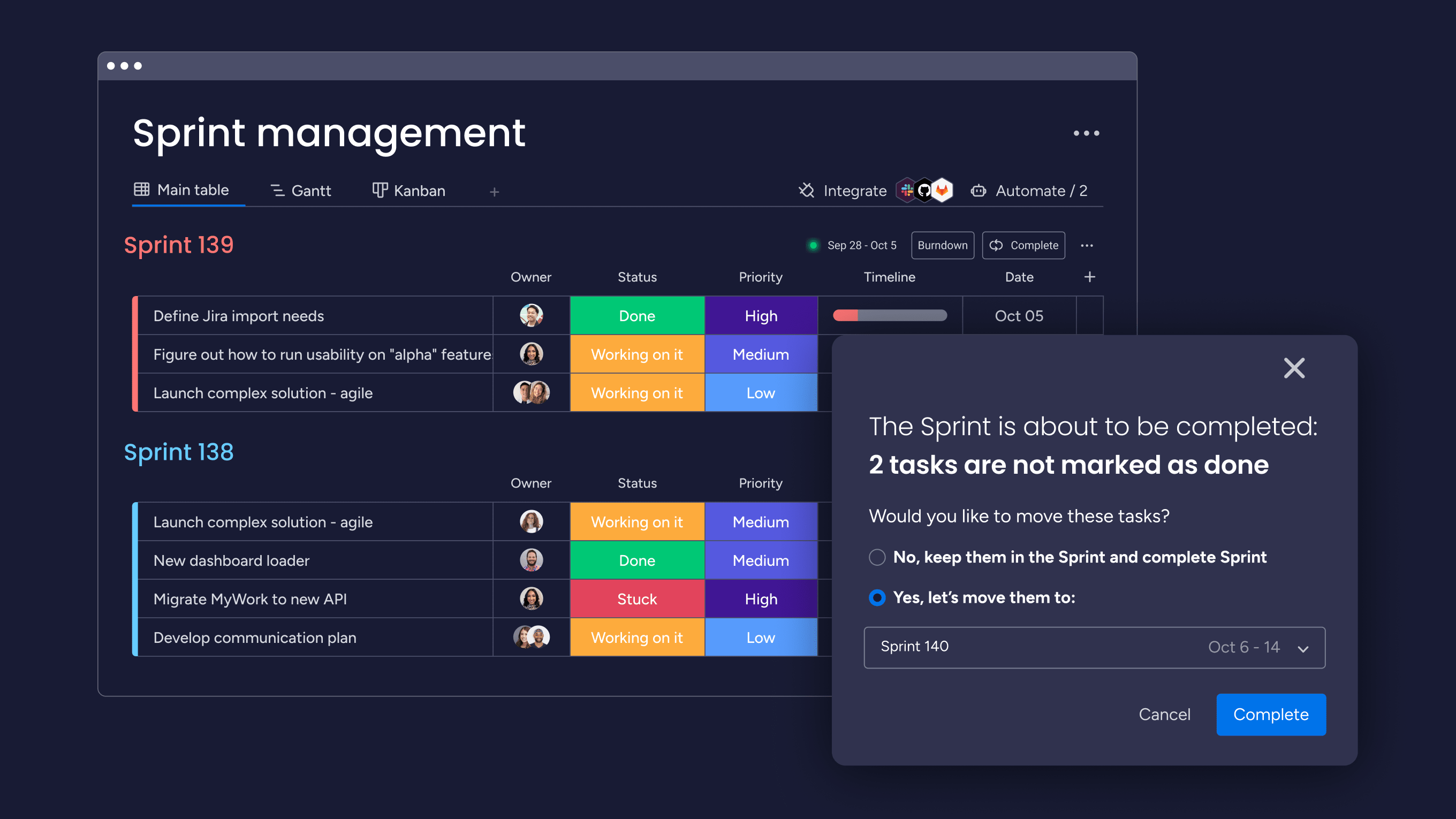
- Create shared visibility: use centralized Scrum board and dashboards to show unified progress and dependencies across all teams at the scaled level.
Step 4: establish continuous feedback
- Implement feedback loops: build cycles where local team retrospectives inform wider scaled retrospectives to address cross-team coordination issues.
- Focus on outcome metrics: implement Scrum metrics that measure value delivery and cycle time rather than internal indicators like velocity or story points.
- Cultivate psychological safety: ensure teams feel comfortable providing honest feedback about coordination problems without fear of blame.
Step 5: measure and optimize
- Track business outcomes: measure scaling success by tracking tangible results, such as faster time-to-market and quantifiable increases in customer satisfaction.
- Refine continuously: be prepared to continuously refine your scaling framework based on empirical data and lessons learned from past iterations.
- Be willing to simplify: eliminate any coordination mechanism or process that is found to be overhead rather than a contributor to effective delivery.
Overcoming common scaling Scrum challenges
Scaling Scrum isn’t just about adding more teams — it’s about keeping collaboration, clarity, and agility intact as you grow. The bigger the organization, the easier it is for dependencies, decision delays, and misaligned visions to creep in.
Here’s how to address the most common challenges teams face when scaling Scrum effectively:
Managing cross-team dependencies
Dependencies between teams create delays and frustration. You’ll need systematic approaches to identify and manage them.
Start by mapping dependencies during planning. Visual tools help teams see connections and plan accordingly. Schedule dependent work to minimize waiting time.
Regular dependency review meetings keep issues visible. Teams can adjust plans before dependencies become blockers. monday dev’s dependency tracking features automate much of this coordination work.
Maintaining enterprise agility
Adding coordination layers can slow decision-making. You must balance necessary alignment with team autonomy.
Keep coordination lightweight. Only coordinate what truly requires alignment. Let teams make independent decisions whenever possible.
Define clear decision boundaries. Teams should know what they can decide alone versus what requires coordination. This clarity speeds up daily work.
Aligning multiple product visions
Different interpretations of product direction waste effort and confuse customers. You need mechanisms to maintain coherent vision across teams.
Regular vision workshops bring teams together around shared understanding. Visual roadmaps show how individual team work supports larger goals.
Create living documentation of product vision. Update it regularly and ensure all teams can access current information. This prevents drift over time.

"monday dev empowered us to optimize our GTM approach, resulting in faster, more dependable deliveries"
Steven Hamrell | Director of Product Management
"monday dev empowers us to manage the entire development process on one platform so we can speed up product delivery and improve customer satisfaction"
Mitchel Hudson | Head of Technology
"We're operating in an open, deep trusting, transparent environment with no silos of information. It's about completely opening access to everyone who needs it."
Alan Schmoll | Executive Vice President, Vistra PlatformScrum at scale vs other enterprise frameworks
No single scaling framework fits every organization. Each has its own philosophy for balancing structure, autonomy, and coordination. Understanding these differences helps you choose the right approach for your teams and business goals.
Below, we’ll look at how Scrum at Scale compares with two other popular frameworks — SAFe and LeSS — and what to consider when deciding which model fits your organization best.
Comparing with SAFe
The Scaled Agile Framework provides comprehensive guidance with defined roles, ceremonies, and practices. It works well for organizations wanting detailed prescriptions.
Scrum at scale offers more flexibility. You adopt only the coordination mechanisms you need. This modularity appeals to organizations that value simplicity.
Consider SAFe when you need extensive guidance and have limited Agile experience. Choose Scrum at scale when you want to preserve team autonomy while adding coordination.
Comparing with LeSS
LeSS (Large Scale Scrum) emphasizes radical simplicity. It adds minimal structure to basic Scrum, making it suitable for smaller scale needs.
Scrum at scale provides more explicit coordination mechanisms. This structure helps when dealing with complex products or many teams.
LeSS works best with strong Scrum teams and simple products. Scrum at scale handles greater complexity and provides clearer scaling guidance.
Making the right choice
Your context determines the best framework. Consider these factors when choosing:
- Organizational size: larger organizations often need more structure.
- Product complexity: complex products require more coordination mechanisms.
- Team distribution: distributed teams benefit from explicit coordination.
- Cultural fit: some frameworks align better with existing culture.
Remember you can adapt any framework to your needs. Start simple and evolve based on experience.
Tools that enable scaled Scrum success
Effective scaling requires Scrum tools that support coordination without creating overhead. Here’s what to look for:
Key platform capabilities
Your scaling platform needs specific features to support multi-team coordination effectively. Real-time visibility across teams prevents surprises and enables proactive problem-solving.
Look for these essential capabilities:
- Cross-team dashboards: aggregate views showing progress across all teams.
- Dependency visualization: clear display of inter-team connections.
- Automated reporting: real-time metrics without manual compilation.
- Flexible workflows: teams can work their way while maintaining visibility.
Integration requirements
Scaling platforms must connect with your existing development ecosystem. Seamless integration prevents duplicate data entry and maintains single sources of truth.
Critical integrations include version control systems, CI/CD pipelines, and communication platforms. APIs enable custom integrations for unique needs.
Visibility and analytics
Real-time analytics help identify patterns across teams. You can spot systemic impediments before they impact delivery.
Effective platforms provide both high-level executive views and detailed team-level information. Different stakeholders need different perspectives on the same data.
How monday dev powers Scrum at scale
Scaling Scrum takes more than coordination — it requires a shared system that connects every team while preserving the autonomy that makes Agile work. monday dev provides that foundation.
Built on the monday Work OS, it brings structure and flexibility together in one platform. Teams can work in the ways that suit them best while leadership gains real-time visibility across the entire organization.
From customizable workflows and automated reporting to advanced dependency tracking and tool integrations, monday dev gives you everything needed to run Scrum at Scale efficiently — without adding complexity.
Flexible workflows for every team
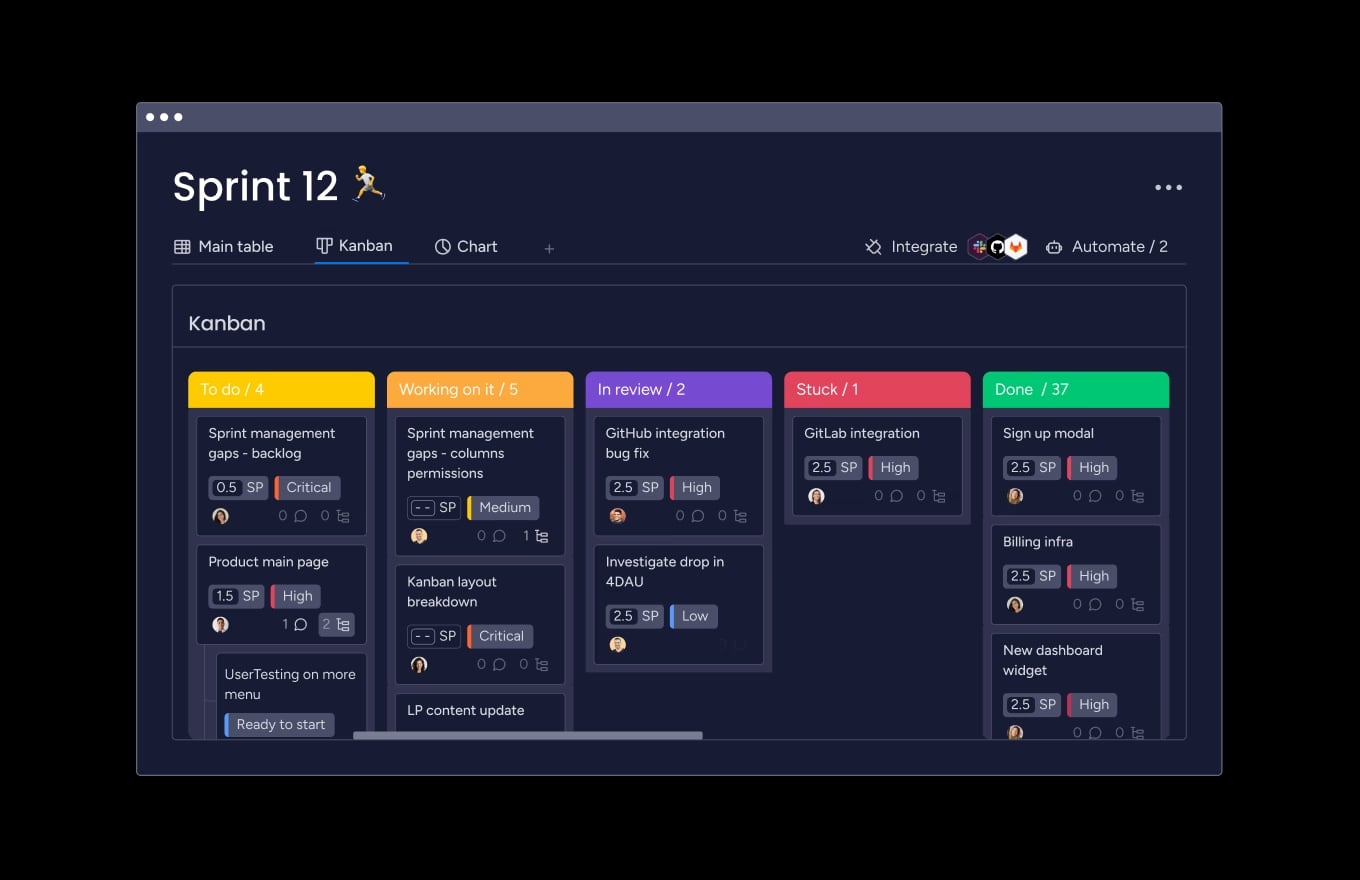
Teams can customize their workflows within the scaled framework using monday dev’s flexible board structures and column types. Sprint boards, Kanban views, and custom automations adapt to each team’s unique process without forcing rigid standardization.
Each team designs boards matching their specific needs using customizable templates, status columns, and priority fields. Yet all teams contribute to unified visibility at the portfolio level through rollup views and cross-board connections. This balance maintains autonomy while enabling coordination.
Enterprise-wide transparency
Real-time dashboards aggregate information across teams automatically using monday dev’s portfolio management capabilities. Managers see progress through sprint burndown charts, velocity tracking, and capacity planning views without interrupting team flow or requiring status meetings.
Customizable views serve different stakeholder needs through role-based dashboards and filtered perspectives. Executives see strategic progress via high-level roadmaps and release tracking while team members focus on tactical execution through sprint boards and task lists. Everyone works from the same underlying data with real-time synchronization.
Advanced dependency management
To visualize cross-team connections and automatically flag blocking issues, leverage the powerful dependency tracking features within monday dev. This robust functionality allows teams to precisely map dependencies between epics, features, and tasks, ensuring automated notifications are received when upstream work completes or delays occur.
The platform’s timeline and Gantt views show how team schedules interconnect, helping Scrum of Scrums identify potential conflicts before they impact delivery. Dependency columns and automations ensure teams stay informed about work affecting their progress.
Seamless tool integration
Flexible solutions like monday dev connect with tools teams already use through 200+ native integrations and a robust API. GitHub, GitLab, Jira, Slack, and other platforms integrate naturally into scaled workflows, syncing code commits, pull requests, and deployment status directly to sprint boards.
This integration eliminates duplicate work and ensures information accuracy through bi-directional sync capabilities. Teams continue using preferred development tools while contributing to organizational visibility. CI/CD pipeline integrations provide real-time build and deployment tracking across all teams.
Automated reporting and metrics
Built-in analytics and reporting features track key Scrum metrics across scaled implementations. Velocity trends, cycle time analysis, and sprint health indicators aggregate automatically at team and portfolio levels, providing insights without manual data compilation.
Custom dashboards combine data from multiple teams to show organizational-level progress. Automated reports can be scheduled and shared with stakeholders, ensuring everyone stays informed about delivery progress and potential impediments.
Start your scaled Scrum transformation
Beginning your scaling journey requires commitment and patience.: it’s vital to focus on building strong foundations before adding complexity.
Strengthen existing Scrum practices first. Ensure teams deliver value consistently before introducing coordination overhead. Get leadership support for necessary organizational changes.
Start with minimal coordination and expand gradually. Monitor value delivery and adjust based on results. Remember that scaling aims to deliver more value, not follow perfect processes.
monday dev provides the visibility, flexibility, and coordination capabilities you need to scale successfully. The platform grows with your organization, supporting everything from initial Scrum of Scrums coordination to full enterprise-wide scaled implementations.
Frequently asked questions
How long does implementing Scrum at scale typically take for most organizations?
Implementing Scrum at Scale typically takes 6 to 18 months. For organizations with mature Scrum teams, basic coordination can be achieved in three to six months. Those needing significant cultural or technical changes may require 12-18 months for a full implementation.
What's the difference between Scrum at Scale and other scaled Scrum approaches?
Scrum at Scale is a modular framework created by Scrum co-creator Jeff Sutherland that lets you scale incrementally by adding only needed components. Unlike SAFe's prescriptive structure or LeSS's minimal approach, Scrum at Scale provides a middle ground with specific scaling patterns you can adopt selectively based on your organization's needs.
Do all team members need Scrum at scale training before implementation?
All team members don't need comprehensive Scrum at scale training before implementation. Key roles like Scrum Masters, Product Owners, and coordination representatives need specific training on scaled practices, while individual developers can continue with their existing Scrum knowledge and learn scaled elements as needed.
How many teams can effectively coordinate using Scrum at scale methods?
Organizations can effectively coordinate three to 50+ teams using Scrum at scale methods. The Scrum of Scrums typically handles five to nine teams directly, with additional coordination layers added for larger numbers — successful coordination depends more on clear communication protocols and dependency management — not the absolute team count.
Can distributed remote teams successfully implement Scrum at scale?
Distributed remote teams can successfully implement Scrum at scale with proper digital collaboration platforms and adjusted coordination practices. The keys are establishing clear communication protocols, using tools like monday dev for shared visibility, and scheduling coordination meetings that accommodate time zones while maintaining regular synchronization.
What organizational changes are required when scaling Scrum beyond development teams?
Scaling Scrum beyond development teams requires adjusting budgeting from annual to incremental funding, aligning business planning cycles with development iterations, and modifying stakeholder engagement patterns. Organizations must also redistribute decision-making authority to enable faster responses and create new feedback loops between business and development functions.

 Get started