

Managing multiple projects while deadlines shift and leadership requests frequent updates can quickly become overwhelming. Some professionals seem to navigate complex initiatives with ease, often due to formal project management training that converts planning into systematic execution.
Project management training provides the skills to take initiatives from concept to delivery on time, within budget, and with minimal disruption. It covers scheduling, budgeting, resource allocation, and stakeholder management through structured methodologies such as PMP, Agile, and PRINCE2. Modern programs also incorporate tools and workflows for distributed teams, along with AI-assisted planning and risk assessment, preparing project managers to operate effectively in both traditional and innovative environments.
This guide presents the seven major project management certifications, highlights which certification aligns with different career stages, and demonstrates how acquired knowledge can enhance daily project execution. It also explores methods for measuring the ROI of training investments and translating certification skills into operational excellence through structured workflows and technology-enabled solutions.
Key takeaways
- Match certification to career stage and industry: entry-level professionals benefit from CAPM or Scrum Master credentials, while mid-career managers gain more from PMP or PMI-ACP certifications.
- Project management training builds transferable skills: strategic planning, risk assessment, stakeholder communication, and change management strengthen performance across roles and industries.
- Consider format, time, and cost when choosing training: online courses offer flexibility and affordability, while in-person or hybrid programs provide deeper skill application and networking opportunities.
- ROI of certification is measurable: track career advancement, salary increases, project success rates, and team efficiency to evaluate the impact of PM training.
- Bridge theory to practice with work management platforms: tools like monday work management help operationalize PM methodologies through dashboards, automated workflows, and resource optimization.
Project management training is structured education designed to develop the skills needed to guide projects from concept to delivery. It emphasizes practical execution — scheduling, budgeting, resource allocation, and stakeholder management.
Modern training programs go beyond traditional Waterfall methods. They now include Agile frameworks, digital collaboration strategies, and AI-assisted decision-making to reflect how teams work in distributed environments. This approach matters because organizations need project managers who can navigate legacy systems and emerging technologies seamlessly.
This training provides a comprehensive skill set that changes how professionals plan and execute work. It emphasizes three core areas that build a foundation for systematic execution and leadership.
- Technical proficiency: master scheduling, budgeting, and scope definition. Learn to calculate critical paths and identify activities that could delay projects.
- Strategic leadership: build negotiation skills and influence without direct authority. Develop conflict resolution techniques essential for cross-functional teams.
- Digital fluency: configure and leverage work management platforms to automate routine activities and maintain visibility across projects.
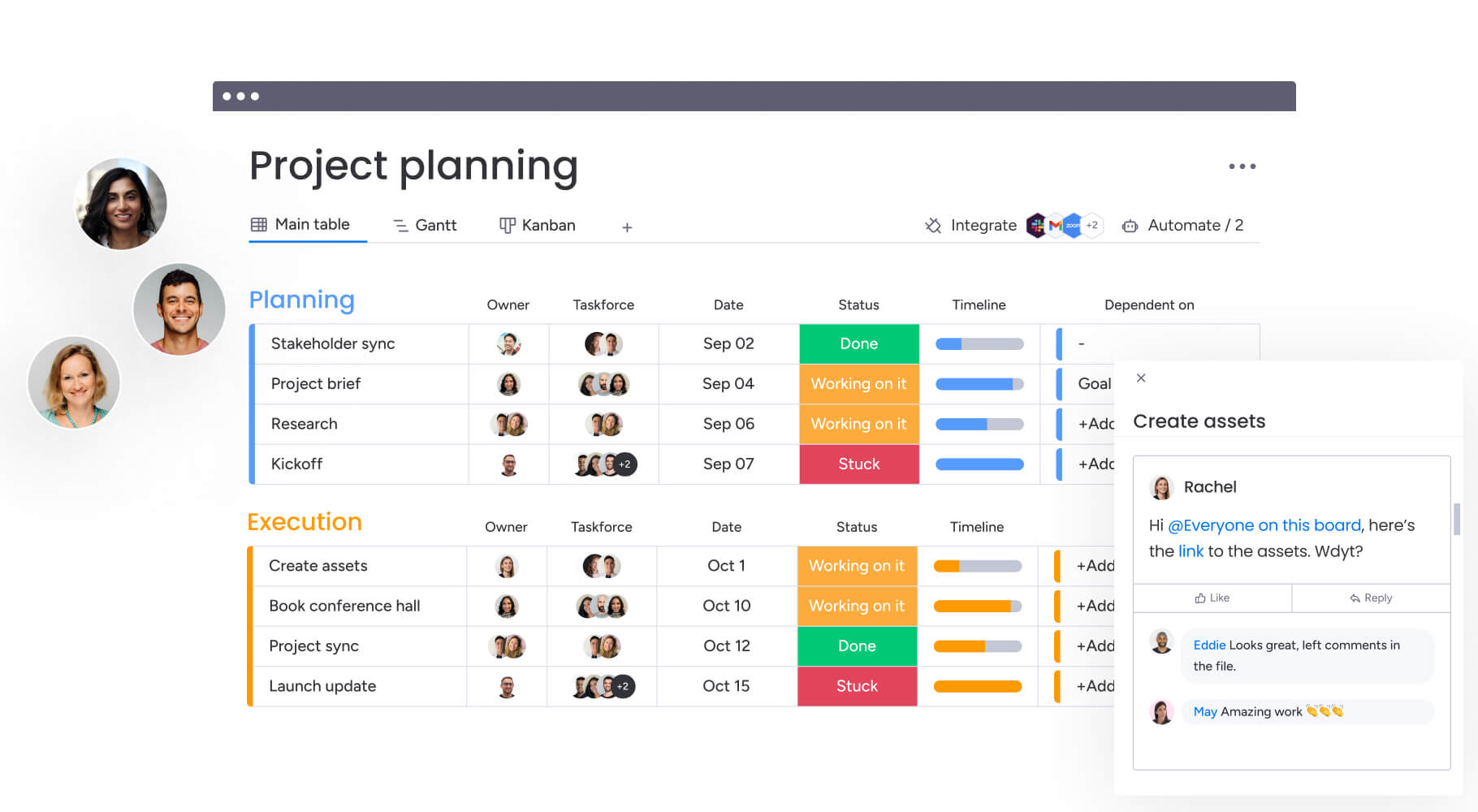
With these skills, project managers can design workflows that align cross-functional teams. Trained professionals translate these concepts into visual boards, automations, and dashboards that keep teams coordinated while enforcing methodology.
7 types of project management certifications
Understanding available certifications helps professionals select the credential that fits their career goals and industry. Each certification supports a different career path, and your current experience level can determine which delivers the most value.
| Certification | Best for | Experience required | Key focus |
|---|---|---|---|
| PMP | Mid-career professionals | 36-60 months | Comprehensive project leadership |
| CAPM | Entry-level or career changers | None | Foundational PM knowledge |
| PMI-ACP | Agile practitioners | 1,500+ agile hours | Agile principles and practices |
| PRINCE2 | Government and public sector | Varies by level | Process-driven methodology |
| Scrum Master | Software and product teams | Varies | Scrum framework mastery |
| Six Sigma | Operations and manufacturing | Varies by belt level | Process improvement |
| AI/Sustainability | Forward-looking professionals | Varies | Emerging specializations |
PMP (Project Management Professional)
The Project Management Professional validates the ability to manage people, processes, and priorities across industries, from construction to healthcare. It remains the most recognized project management credential globally.
Prerequisites and requirements:
- Education and experience: four-year degree with 36 months of project leadership experience, or 60 months without a degree.
- Training: 35 hours of project management education.
- Exam focus: three domains — People (42%), Process (50%), Business Environment (8%).
- Maintenance: earn 60 professional development units every three years.
CAPM (Certified Associate in Project Management)
The CAPM is suitable for recent graduates or career changers. It covers project management basics, terminology, core processes, and foundational concepts.
Key requirements:
- Education: secondary degree.
- Training: 23 hours of project management education.
- Experience: no prior project experience required.
- Benefit: signals to employers that candidates understand global project management standards.
PMI-ACP (Agile Certified Practitioner)
This certification demonstrates expertise in Agile, covering Scrum, Kanban, Lean, extreme programming, and test-driven development.
Prerequisites include:
- Training: 21 contact hours of agile education.
- Experience: 2,000 hours of general project experience plus 1,500 hours on Agile teams.
PRINCE2 certification
PRINCE2 emphasizes business cases and project team structure. It is widely recognized in the UK, Europe, and Australia, particularly in government and public sector work.
Two certification levels:
- Foundation level: confirms you understand the PRINCE2 method well enough to work effectively with project teams.
- Practitioner level: validates your ability to apply and tailor the method across different project environments and scenarios.
Scrum Master certifications
Scrum certifications focus on the widely adopted Agile framework and are essential for software and product teams.
- Certified ScrumMaster (CSM): covers Scrum basics and the Scrum Master role.
- Professional Scrum Master (PSM): rigorous assessment of Scrum knowledge without mandatory training.
- SAFe Scrum Master: applies Scrum within Scaled Agile Framework enterprise environments.
Six Sigma for project managers
Six Sigma emphasizes quality improvement and consistent processes using the DMAIC framework: define, measure, analyze, improve, control.
Certification structure:
- Yellow to Master Black Belt: guides progression from foundational knowledge to leading complex cross-functional projects.
- Applications: valuable in manufacturing, healthcare, finance, and operations where quality control is essential.
Emerging AI and sustainability certifications
New certifications reflect industry trends. AI certifications focus on predictive analytics, resource optimization, and administrative automation. Green Project Management emphasizes sustainable practices, ensuring projects deliver social, environmental, and financial value.
Try monday work managementOnline vs in-person project management courses
Choosing the right format affects retention and professional networking. Understanding the benefits of each option helps professionals select what suits their learning style and career goals.
Benefits of online PM training
Online training works for people who can’t hit pause on their jobs to go back to school. The advantages make this format particularly attractive for those balancing multiple responsibilities:
- Flexibility and pacing: complete coursework at your own speed, accommodating work and personal commitments.
- Cost-effectiveness: lower tuition combined with no travel expenses makes this option budget-friendly.
- Resource accessibility: lifetime access to recorded lectures, templates, and simulation exercises for ongoing reference.
- Global instructor access: learn from industry experts regardless of location.
When in-person training delivers more value
In-person training still wins for deep skill-building and making real connections. Being there in person pays off in a few key ways:
- Collaborative workshops: hands-on exercises help teams internalize Agile and other methodologies.
- Immediate feedback: instructors provide real-time corrections and guidance.
- Networking opportunities: cohorts foster meaningful professional connections that support future collaboration.
- Focused immersion: physical presence reduces distractions, allowing deep engagement with material.
Hybrid learning approaches
Hybrid models combine online theory with hands-on practice. Bootcamps often include weeks of online preparation followed by intensive in-person workshops to apply concepts. Organizations may also use hybrid programs where teams learn theory individually and convene for guided exercises on real company projects.
Modern platforms like monday work management integrate learning outcomes into daily workflows, enabling visibility, collaboration, and project alignment while applying concepts from certifications or training programs.
How to choose the right PM training program
Choosing the right project management training program requires aligning your career goals with industry expectations and budget considerations. Selecting the right certification can accelerate career growth, increase earning potential, and ensure the time and money you invest deliver measurable returns.
Match training to your career stage
Your career stage determines which certification will deliver the most value. Consider the following targets:
- Entry-level (zero to three years): Focus on CAPM or Certified ScrumMaster. These certifications require minimal experience and build foundational knowledge for junior project management roles.
- Mid-career (three to seven years): Aim for PMP or PMI-ACP. You likely meet the experience requirements, and these certifications unlock higher salaries and senior positions.
- Senior leadership (eight or more years): Explore Program Management Professional or Portfolio Management Professional. These programs emphasize strategic alignment and managing multiple interrelated projects.
Assess industry-specific requirements
Different industries favor particular methodologies. Choosing a certification that aligns with your field ensures the training delivers maximum value.
| Industry | Preferred methodology | Recommended certification | Key focus areas |
|---|---|---|---|
| Construction/engineering | Waterfall/predictive | PMP | Risk management, procurement, safety compliance |
| Software development | Agile/Scrum | PMI-ACP, CSM, PSM | Iterative delivery, sprint planning, backlog management |
| Manufacturing/operations | Lean/Six Sigma | Six Sigma Green/Black Belt | Process improvement, defect reduction, quality control |
| Government/public sector | PRINCE2/Waterfall | PRINCE2 Practitioner, PMP | Governance, formal documentation, compliance |
| Marketing/creative | Hybrid/Kanban | Kanban Management Professional | Workflow visualization, WIP limits, continuous delivery |
Evaluate prerequisites and time commitments
Before enrolling, confirm you meet certification requirements and plan for study time realistically:
- Experience documentation: check whether your degree level affects required project hours.
- Project leadership hours: track specific hours leading projects, as audits are common.
- Study time planning: a PMP typically requires 150–200 hours of preparation. With five hours of study weekly, expect six to eight months for completion. Proper planning reduces stress and increases the likelihood of passing.
Project management training costs and timelines
Understanding cost and duration helps set realistic expectations. Costs vary based on certification and training approach.
Certification investment breakdown
| Certification | Exam fee (member/non-member) | Training course cost | Renewal cycle | Total first-year investment |
|---|---|---|---|---|
| PMP | $405/$555 | $1,000-$3,000 | 3 years | $1,500-$3,600 |
| CAPM | $225/$300 | $300-$1,000 | 3 years | $600-$1,400 |
| CSM | Included in course | $400-$1,200 | 2 years | $400-$1,200 |
| PRINCE2 | $300-$500 | $500-$1,500 | 3 years | $800-$2,000 |
| Six Sigma Green Belt | $200-$400 | $1,500-$4,000 | Varies | $1,700-$4,500 |
Realistic timeline expectations
Certifications differ in preparation time:
- PMP preparation: typically three to six months for professionals balancing full-time work.
- Intensive bootcamps: deliver content over four to five full-time days, with two to three weeks of pre-reading and post-course study.
- Agile certifications: often completed in a single weekend workshop followed immediately by the exam.
Maximizing your training budget
Several strategies can help you make the most of your investment:
- Professional development budgets: highlight how certification improves project delivery or reduces waste.
- Group discounts: training providers often offer reduced pricing for multiple participants.
- PMI membership: joining the Project Management Institute can save you more than the difference between member and non-member exam fees.
Effective project management training combines strategic selection, realistic planning, and cost-conscious decision-making. Modern platforms like monday work management can help keep projects and certification goals organized, providing visibility into timelines, budgets, and progress while supporting collaboration across teams.
Project management training provides skills that are applicable across roles and industries. When paired with a platform that translates knowledge into actionable workflows, these skills become even more powerful.
1. Strategic planning and execution
Project management training teaches how to translate organizational goals into actionable roadmaps. You learn to define project scope, set achievable milestones, and map dependencies between activities. This approach shifts teams from reactive problem-solving to proactive planning, accounting for every critical milestone.
2. Risk assessment and mitigation
Formal project management education introduces systematic frameworks for identifying risks before they escalate. You assess risks based on probability and impact and develop mitigation strategies for each scenario. This structured approach replaces uncertainty with organized, documented plans.
Portfolio Risk Insights on monday work management can scan project boards to flag potential risks by severity, helping trained project managers address challenges before they grow.
3. Resource optimization
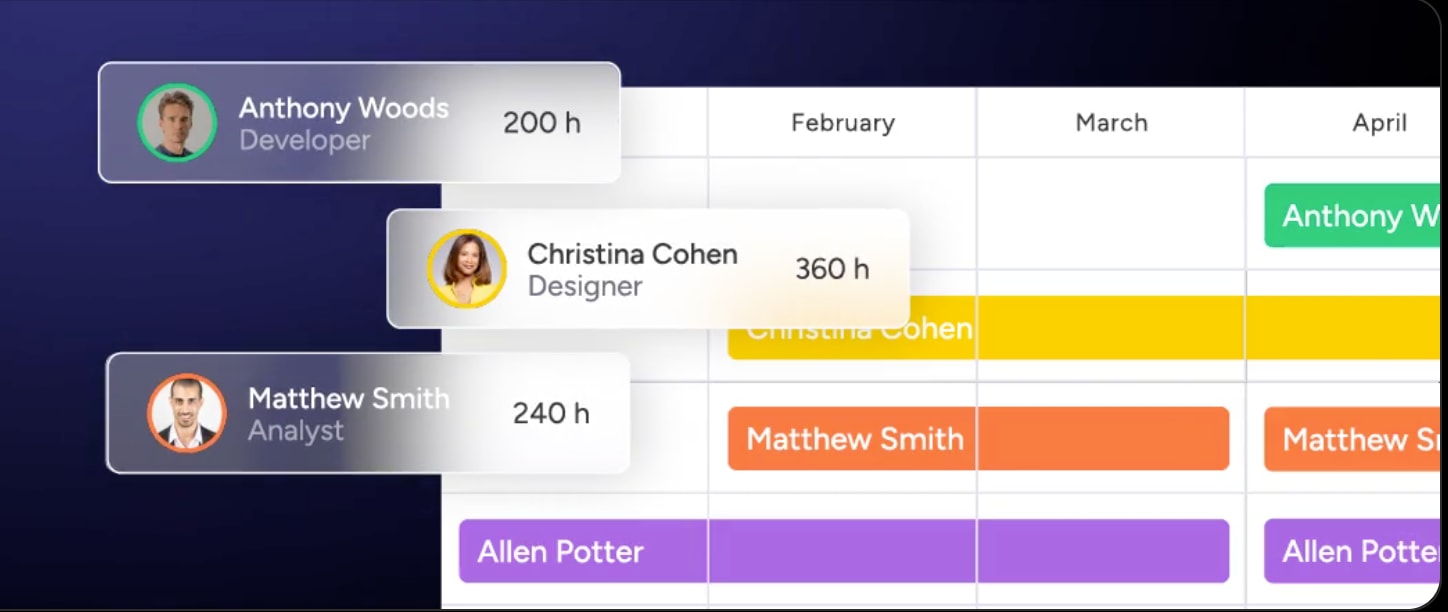
Learning capacity planning ensures teams are not overworked while projects stay on track. Training covers effort estimation, workload balancing, and budget constraints, helping managers distribute resources efficiently.
The Workload View on monday work management brings these concepts to life, allowing managers to visualize team capacity and redistribute work to prevent bottlenecks.
4. Stakeholder communication
Project managers learn to map stakeholders by influence and interest, tailoring communication to each group. You master status reporting, sharing the right information with executives versus technical teams.
5. Data-driven decision making
PM certification emphasizes metrics and key performance indicators to measure project health. Concepts like Earned Value Management help objectively assess progress against plans, allowing decisions based on trends and data rather than intuition.
Tracking these metrics within the monday.com Work OS ensures project decisions are grounded in real-time insights and historical performance.
6. Change management leadership
Scope creep can derail projects if not managed effectively. Training provides frameworks for reviewing change requests, assessing impacts on timelines and budgets, and guiding teams through transitions. You also learn strategies to overcome resistance and align teams with new workflows.
Platforms like monday work management support structured change management by documenting requests, approvals, and impact analyses in one connected environment.
Combining methodology with technology amplifies the value of project management training. AI and automation reduce repetitive tasks, freeing teams to focus on strategic priorities.
AI-enhanced project planning
AI accelerates planning by analyzing past projects and recommending realistic timelines and resource allocation. It can draft initial project structures, highlight potential dependencies, and transform unstructured data into actionable insights.
Teams leverage AI Blocks on monday work management to categorize data at scale, summarize meeting notes instantly, and extract key actions from any document, improving decision-making and speed.
Automating PM best practices
Automation ensures teams follow established methods without manual oversight. Workflows can trigger risk assessments when deadlines slip or require specific documentation before phase completion. Integrating these processes into daily work guarantees adherence to PMP or PRINCE2 standards.
Automations on monday work management save time by managing repetitive activities, including creating templated project boards and sending approval notifications automatically.
Building scalable team workflows
Training provides the knowledge to design efficient processes, while platforms enable teams to deploy them organization-wide. Standardized workflow templates that incorporate best practices ensure consistent execution across all teams, regardless of individual experience levels.
This approach supports rapid onboarding, structured processes, and adherence to methodology, reducing chaos and improving outcomes across projects.
Measuring ROI of project management training programs
Demonstrating training ROI focuses on measurable results for individuals and the organization. Tracking ROI shifts attention from costs to tangible benefits.
Tracking individual career advancement
For individuals, ROI manifests as faster promotions and higher compensation. Certified PMP holders report earning significantly more than non-certified peers.
Key metrics to track:
- Promotion rates and timeline acceleration: evaluate how quickly employees move up.
- Size of budgets managed and project complexity: quantify growth in responsibility.
- Salary increases and bonus opportunities: measure compensation gains.
- Leadership responsibilities and team size: track increased managerial influence.
Documenting these achievements builds compelling cases for performance reviews and career advancement.
Quantifying organizational impact
Organizations see value when teams execute more efficiently. Before training, record baseline project success rates, on-time delivery, and budget adherence. After training, compare improvements.
Organizational metrics include:
- Project success rates and on-time delivery: measure completed projects against planned milestones.
- Budget variance reduction: monitor improved financial control.
- Team satisfaction and retention rates: evaluate workforce engagement.
- Process standardization adoption: track methodology consistency across teams.
Certified project managers typically deliver smoother, less chaotic projects, reducing burnout and boosting team satisfaction.
Creating continuous learning cycles
Project management is iterative. Use the momentum from initial certification to address specialized gaps in areas like risk management or agile scaling.
Modern platforms like monday work management provide sandboxes for testing new techniques, turning every project into a learning opportunity that strengthens organizational capability.

“monday.com has been a life-changer. It gives us transparency, accountability, and a centralized place to manage projects across the globe".
Kendra Seier | Project Manager
“monday.com is the link that holds our business together — connecting our support office and stores with the visibility to move fast, stay consistent, and understand the impact on revenue.”
Duncan McHugh | Chief Operations OfficerTransform your PM expertise into operational excellence
Training equips you with knowledge, but applying it daily requires the right tools. The most effective project managers combine certification knowledge with platforms that operationalize best practices across all projects.
Bridge theory to practice
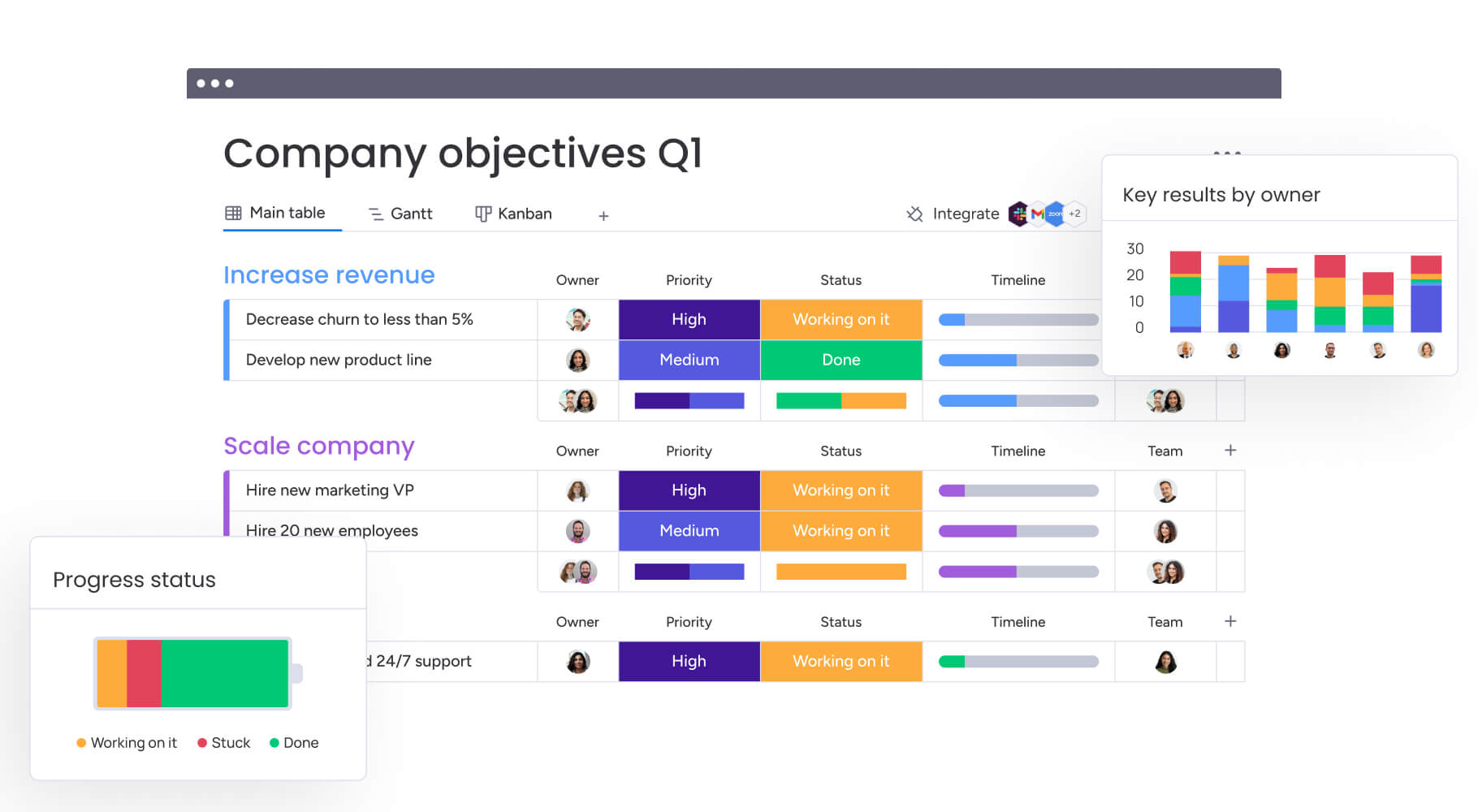
Gantt charts and dependency columns allow certified managers to visualize critical paths with precision. Program-level dashboards provide portfolio visibility for strategic resource allocation. Workload views support resource optimization, while AI-powered features and Portfolio Risk Insights highlight potential delays and budget risks. Automated status updates and guest views eliminate manual reporting, ensuring stakeholders receive timely information.
Build methodology into your workflows
Trained project managers translate knowledge into robust templates. A Project Initiation template can mandate Project Charters and Stakeholder Registers before activities begin, embedding PMP best practices. Automation rules notify steering committees when budgets exceed thresholds.
Data-driven decision-making becomes native. Customizable dashboards track Earned Value, Schedule Variance, and advanced KPIs in real-time. Managers access instant health metrics instead of compiling monthly spreadsheets, enabling proactive project management.
| Feature | Traditional approaches | monday work management |
|---|---|---|
| Methodology support | Rigid (Waterfall OR Agile) | Flexible (Waterfall, Agile, Hybrid support) |
| Process enforcement | Manual handbooks/policies | Automated workflows and required fields |
| Visibility | Siloed by project file | Portfolio-level dashboards across all teams |
| Resource planning | Static spreadsheets | Dynamic workload balancing |
| Scalability | Hard to replicate success | One-click template deployment |
Frequently asked questions
How quickly can I complete PMP certification while working full-time?
Most professionals complete PMP certification within three to six months by dedicating ten to fifteen hours per week to study and practice exams. A consistent study schedule ensures mastery of key concepts and exam readiness.
Which project management certification has the highest ROI?
The PMP certification typically offers the highest return, with certified professionals earning significantly higher salaries than non-certified peers. Industry specifics can affect ROI, but PMP remains widely recognized and valued.
Do I need work experience for project management certifications?
Requirements vary by certification. PMP mandates documented project management experience, whereas CAPM is designed for professionals with little or no prior project experience.
Can project management training help me switch careers?
Project management skills transfer across industries. Certification provides verified credentials that can help professionals transition into new sectors more confidently.
What's the difference between PMP and PMI-ACP certifications?
PMP emphasizes broad project management principles applicable to multiple methodologies. PMI-ACP focuses specifically on agile and iterative development practices, preparing professionals for fast-paced project environments.
How does monday work management support project managers who complete formal training?
Platforms like monday work management enable trained project managers to immediately apply their knowledge by creating templates, dashboards, and automations. This helps enforce learned methodologies, track progress, and maintain consistency across projects.

 Get started