

Project management is more than planning; it’s about turning strategy into action. At the heart of every successful project lies the project management task — the smallest unit of work that drives progress. Without clearly defined tasks, even the most detailed roadmap can stall. Tasks give projects structure by specifying who is responsible for what, when it’s due, and what success looks like.
A project management task is actionable, time-bound, and measurable. It transforms abstract goals into concrete steps, enabling teams to track progress, identify bottlenecks, and maintain momentum. From planning and execution to review and delivery, well-structured tasks are what make complex projects manageable and predictable.
In this guide, we’ll explore the anatomy of effective project management tasks, how to prioritize them for maximum impact, and practical strategies to ensure they consistently drive results in 2026 and beyond. Whether managing a single initiative or coordinating across multiple teams, mastering tasks is the key to delivering projects on time and within scope.
Key takeaways
- Tasks are the foundation of project execution: breaking projects into well-defined, actionable tasks ensures clarity, accountability, and measurable progress.
- Effective tasks require five core components: ownership, deadlines, success criteria, dependencies, and resource allocation create structure and prevent delays.
- Task sizing and hierarchy matter: right-sized tasks (4–40 hours) organized logically within a work breakdown structure improve tracking and maintain workflow efficiency.
- Prioritization drives impact: using frameworks like value-based scoring, the Eisenhower Matrix, or strategic alignment ensures teams focus on high-value work that supports business goals.
- Work management platforms enhance visibility and coordination: centralized task tracking, cross-project dependencies, and AI-powered insights help teams manage resources, detect risks, and maintain progress across multiple initiatives.
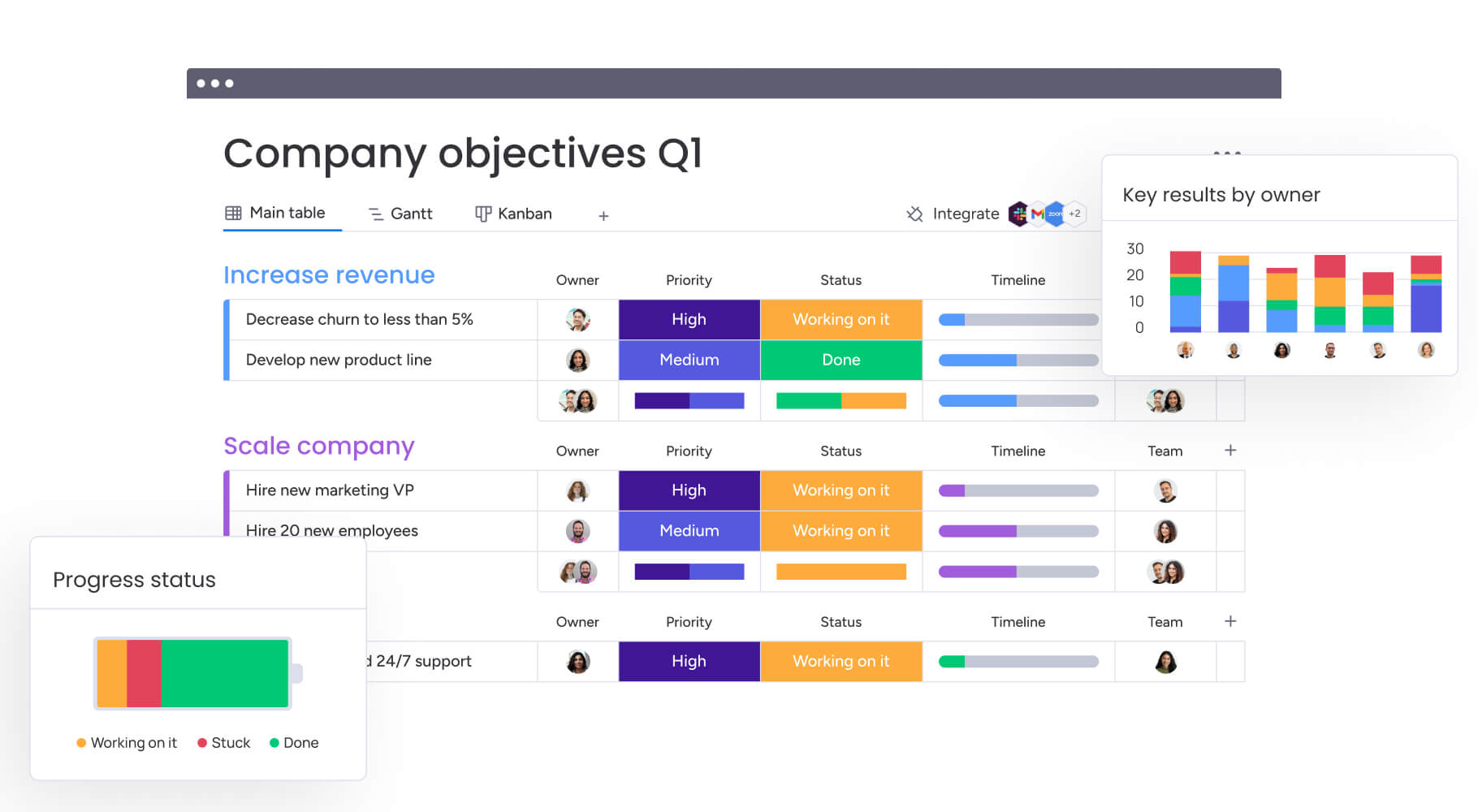
A task in project management is the smallest actionable unit of work within a project: a clearly defined activity with ownership, deadlines, and measurable outcomes. Unlike ongoing responsibilities, tasks have clear boundaries. They start, they finish, and a specific individual is responsible for delivering them.
Key characteristics of effective tasks:
- Actionable: clear work that can be started and completed.
- Trackable: progress can be monitored and measured.
- Finite: has a definitive beginning and end point.
Tasks are what turn project goals into actual work: without them, execution stalls. Each task represents a commitment — a specific person delivering a specific outcome by a defined deadline.
Organizations move these fundamental units out of static spreadsheets and into dynamic workflows using platforms like monday work management, where ownership, deadlines, and progress are visible to everyone involved. This level of visibility changes everything. Teams can quickly see who is responsible for what, identify blockers, and focus on the next priorities to keep projects on track.
Breaking work into manageable pieces creates a clear roadmap that teams can follow confidently. When leaders understand tasks, they can allocate resources more effectively, assign accountability, and track measurable progress. On monday work management, this breakdown appears on a project board, providing an instant overview of resource allocation and overall progress.
Tasks connect planning to execution. They are the mechanism by which strategy transforms into real work. Without clearly defined tasks, complex projects remain ambiguous. They cannot be tracked, measured, or assessed for true progress.
Breaking work into smaller, actionable units ensures teams know exactly what to do next. Leaders gain clarity, enabling smarter resource allocation, unambiguous accountability, and tangible progress measurement.
Why tasks are critical for organizational success:
- Granular control: you cannot manage a large initiative like digital transformation directly, but you can manage the individual tasks that comprise it. Detailed oversight allows leaders to allocate resources accurately and establish realistic timelines.
- Accountability: specificity drives execution. Without clear ownership, work stalls. Assigning a task to a named individual removes ambiguity and prevents the bystander effect where everyone assumes someone else is handling the work.
- Progress visibility: tasks act as checkpoints — either completed or not. This generates measurable data on project health and helps leaders identify bottlenecks before they delay timelines.
How often do projects fail simply because no one knew who was responsible for that critical first step?
How tasks connect to business outcomes
Individual tasks do not exist in isolation. Each task contributes to larger goals across the organization. A completed task represents progress toward a project, a successful project supports a program, and a strong program drives strategic objectives.
When teams see how their work connects to broader goals, they are more engaged. They understand the purpose behind their daily efforts. For example, tasks focused on SEO keyword optimization directly impact organic traffic growth(project), which supports lead generation (program), ultimately contributing to Q4 revenue targets (strategic goal).
Executives rely on this visibility to guide decisions. Tracking task completion across initiatives provides early insight into whether strategic targets will be met. This enables decisions driven by data rather than intuition.
Tasks in today’s work management platforms
Task management has evolved from sticky notes and spreadsheets into collaborative, cloud-based platforms. Modern work management focuses on context, collaboration, and connecting all pieces of work.
Traditional vs. modern task management approaches:
Traditional methods relied on:
- Scattered email threads: disconnected conversations and notes.
- Knowledge silos: information stored individually.
- Manual updates: constant status checks and notifications.
Modern work management platforms provide:
- Centralized data: attachments, conversations, and project information in one place.
- Workflow automation: automatic triggers that reduce manual effort.
- Integration: seamless connection with CRMs, repositories, and communication tools.
- Real-time visibility: insights across teams and departments.
AI enhances this process by not only organizing tasks but also helping create and manage them. Platforms like monday work management allow teams to extract action items from meeting notes, categorize requests by urgency, and suggest next steps based on project context.
Confusing tasks, projects, and sub-items can lead to scope creep and wasted resources. Clarifying the distinctions ensures the right allocation of time, effort, and people.
Scope and timeline distinctions
Understanding the difference between tasks, projects, and sub-items helps teams plan with more precision and avoid common mistakes. Each level serves a distinct purpose in the work hierarchy:
| Feature | Task | Project | Subtask |
|---|---|---|---|
| Scope | Single unit of work with one output | Collection of tasks aimed at a major goal | A step required to complete a task |
| Timeline | Short-term (hours to days) | Long-term (weeks to months) | Very short-term (minutes to hours) |
| Complexity | Low to medium | High with many moving parts | Low |
| Deliverable | A specific asset or action | A comprehensive result | A component of an asset |
For example, a project could be launch new corporate website. A task within that project might be write copy for the About Us page, with a supporting sub-item such as interview the CEO for background information.
Resource requirements
Resource needs vary depending on whether the work is a project, task, or sub-item. Misaligning resources, such as assigning an entire team to a single task, leads to inefficiency and wasted time. Proper planning ensures teams are working at the right level, with the right effort applied.
Here’s how resource allocation breaks down at each level:
Project-level resources:
- Cross-functional team: with diverse skill sets to cover all aspects of the project.
- Dedicated budget allocation: ensures financial resources support project goals.
- Project manager: responsible for coordination, oversight, and overall progress.
Task-level resources:
- Primary owner: supported by one to two contributors for review and feedback.
- Resource cost: calculated in hours rather than weeks to reflect precise effort.
- Skill requirements: focused on specialized expertise needed for task completion.
Subtask-level resources:
- Individual contributor: handling work independently with minimal equipment needs.
- Checklist items: managed without separate budget allocation.
- Execution timeframe: designed for quick and efficient completion.
Hierarchy and dependencies
Work flows through a hierarchy similar to a tree: the project is the trunk, tasks are the branches, and subtasks are the leaves. Dependencies determine the order in which work must occur, preventing delays and bottlenecks.
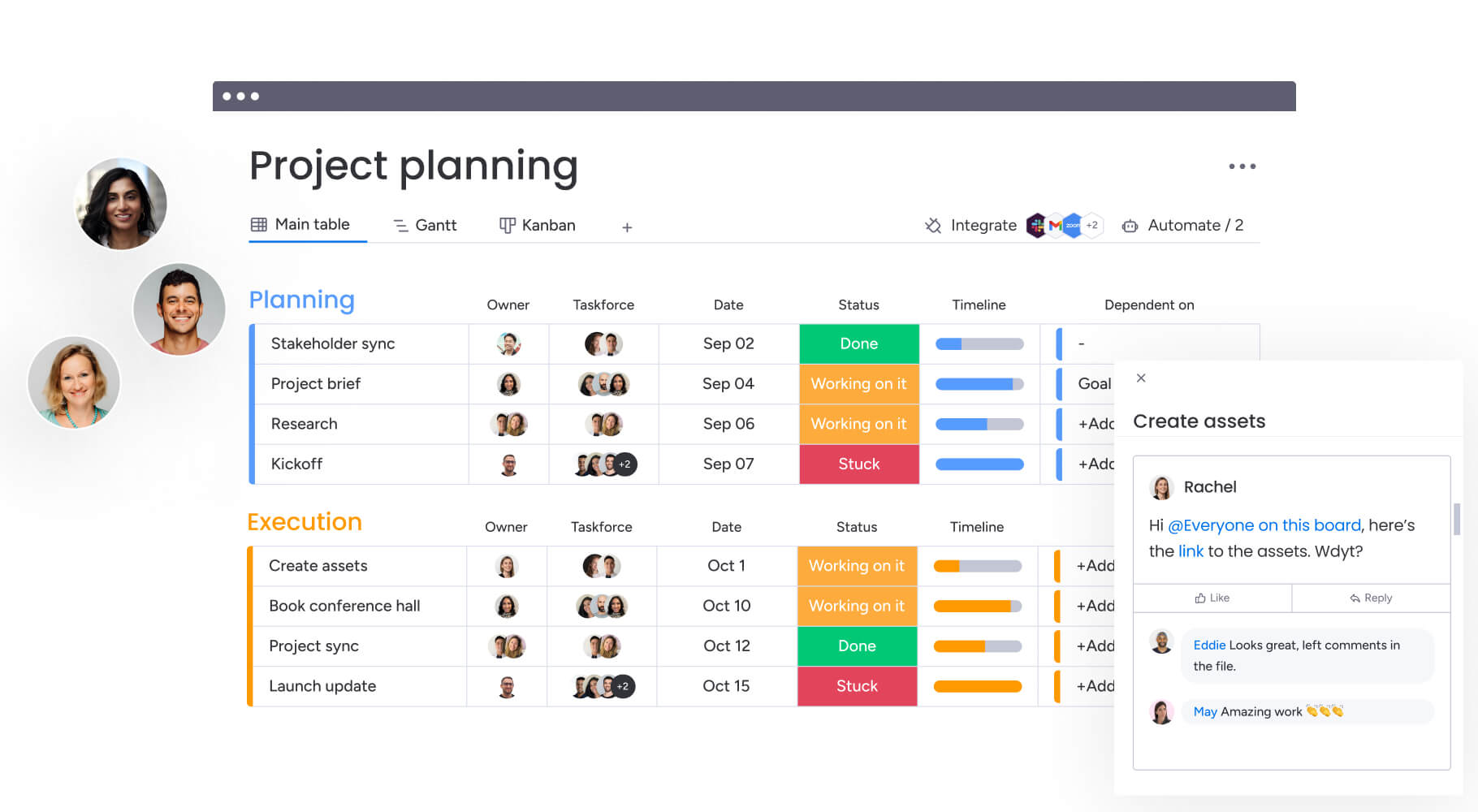
Modern platforms like monday work management visualize these dependencies and send alerts when prerequisite work falls behind, helping teams maintain momentum.
Dependency types at each level:
- Project dependencies: high-level relationships where one phase cannot start until another is complete.
- Task dependencies: direct blocking relationships between specific work items.
- Subtask sequencing: logical order managed by the task owner to maintain quality and efficiency.
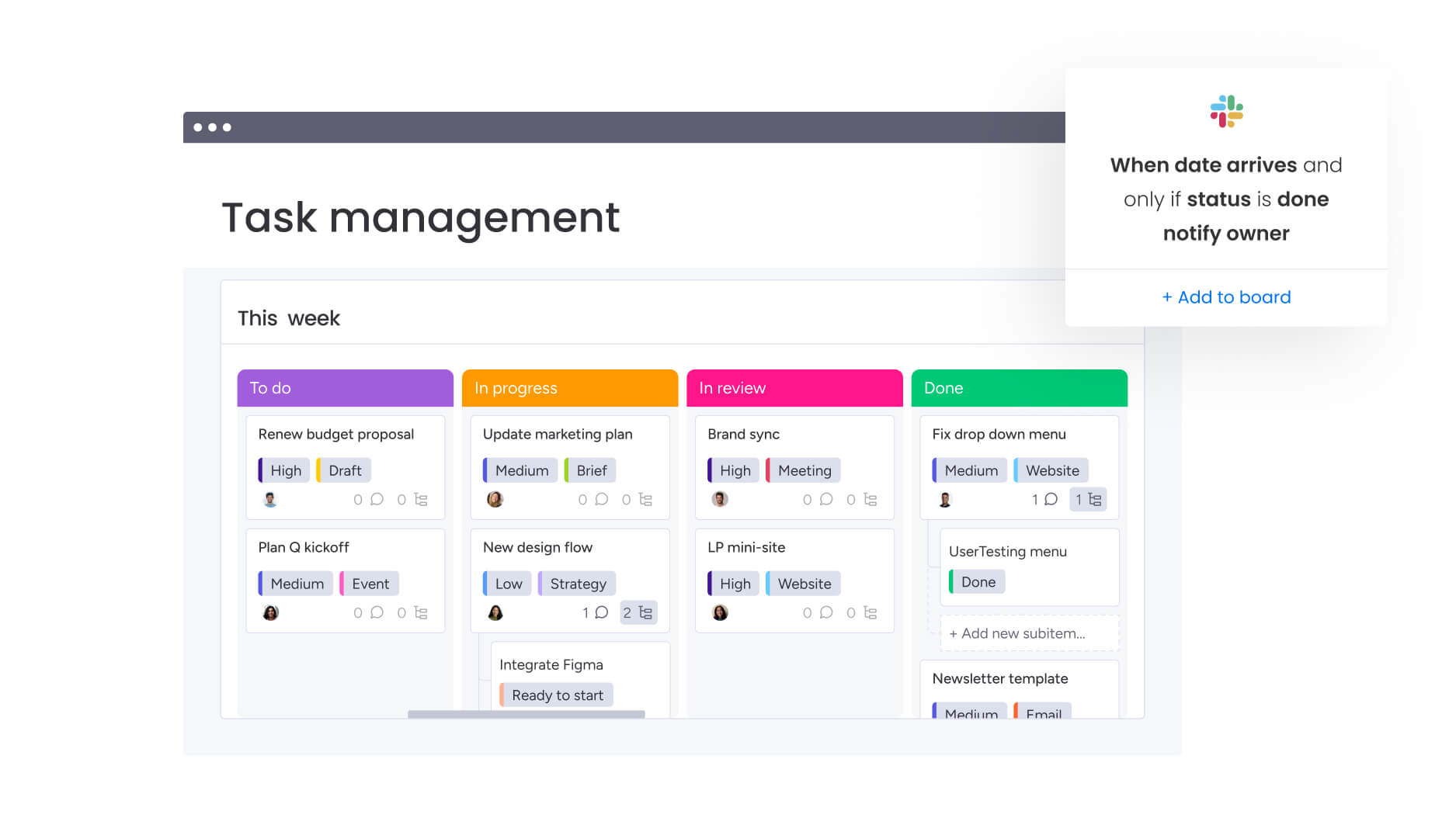
What is task management?
Task management is a structured approach to planning, organizing, tracking, and completing work items to meet project and business objectives. It combines process and technology to ensure work flows smoothly from start to finish.
Beyond simple to-do lists
While a to-do list is a static collection of reminders, professional task management is a dynamic system designed for team execution. The difference matters: organizations require accountability, prioritization, and lifecycle tracking that personal lists cannot provide.
Professional task management offers advantages beyond basic lists:
- Contextualization: provides details on why, how, and with whom work is done, including attachments, briefs, and conversation history.
- Prioritization logic: allows multi-dimensional prioritization based on deadlines, impact, and effort.
- Collaborative execution: makes work visible to the entire team, enabling load balancing and preventing duplicate efforts.
- Lifecycle tracking: monitors each task from backlog to completion, offering insights into cycle times and potential bottlenecks.
Task management vs. project management
Task management and project management are distinct disciplines, yet they complement each other. Task management focuses on micro-level execution, while project management ensures macro-level delivery aligns with organizational goals.
| Feature | Task management | Project management |
|---|---|---|
| Focus area | Individual work items and personal efficiency | The collective goal and team alignment |
| Scope | Granular execution details | Strategic planning, risk, and budget |
| Timeline | Daily and weekly horizons | Quarterly or annual horizons |
| Responsibility | Individual contributors and team leads | Project managers and program directors |
The strategic value of effective task management
When teams execute task management well, the benefits extend to the organizational level. It shifts teams from reactive firefighting to proactive execution.
Teams with strong task management consistently meet deadlines. They can forecast project timelines using past performance, and resource allocation improves as managers gain visibility into workloads and capacity.
The cost of missed deadlines is staggering. A McKinsey study of 300+ billion-dollar megaprojects found average cost overruns of about 80% and schedule delays around 50%, demonstrating the significant impact of poor task-level planning and accountability.
Try monday work management5 core components of effective project tasks
A task is only as useful as its definition. Vague tasks create confusion and slow progress. Well-defined tasks prevent miscommunication, streamline workflows, and help teams stay on schedule. Every well-structured task includes five core components that set it up for success.
1. Ownership and accountability
Every task should have a single primary owner. While multiple team members may contribute, only one person is accountable for completion.
This distinction prevents diffusion of responsibility, where work stalls because no one feels personally responsible. Effective task management clearly separates the owner — the person ensuring the work gets done — from contributors, who provide support and expertise.
2. Specific deadlines and milestones
Tasks must have clear, time-bound deadlines to drive action. A task without a date is unlikely to be completed. Effective deadlines are realistic, agreed upon by the owner, and visible to the team.
Consider different types of deadlines when planning:
- Hard deadlines: non-negotiable dates driven by external factors.
- Target dates: internal goals that guide progress but allow flexibility.
- Buffer time: planned periods around deadlines to accommodate unexpected delays.
3. Measurable success criteria
Each task needs a clear definition of done to prevent debate over whether it is complete. Success criteria should be objective and measurable.
For example, instead of “Improve website performance,” a precise task states, “Reduce homepage load time to under two seconds.” Clear metrics prevent scope creep and ensure quality before moving to the next stage.
4. Dependencies and prerequisites
Most tasks rely on prior work. Identifying dependencies — what must happen before or after a task — is critical for scheduling.
Common dependency types include:
- Finish-to-start: task B cannot begin until Task A is complete.
- Start-to-start: task B can begin once Task A has started.
Documenting these relationships avoids bottlenecks where team members are left waiting for work that is not ready.
5. Resource allocation
Every task consumes resources, such as time, budget, or equipment. Defining these needs upfront allows for accurate capacity planning.
This involves estimating effort (total hours required) versus duration (calendar time). Modern platforms like monday work management help visualize resource allocation, highlighting potential conflicts before they disrupt timelines.
Breaking down projects into tasks that drive results
Dividing a large project into actionable tasks requires both big-picture thinking and attention to detail. A clear structure ensures nothing is overlooked and keeps work manageable.
Work breakdown structure (WBS) fundamentals
A Work Breakdown Structure (WBS) hierarchically decomposes the total scope of work. It starts with the final deliverable and breaks it into smaller components until reaching the task level.
Example WBS hierarchy:
- Project: organize industry conference
- Phase: venue management
- Work package: catering
- Task: select lunch menu options
This approach captures the full scope, making even complex projects manageable and providing a framework for tracking progress.
Task sizing for maximum efficiency
Tasks should be “right-sized” for efficiency. Oversized tasks are difficult to monitor, while overly small tasks create unnecessary tracking overhead.
Guidelines for task sizing include:
- Ideal range: four to forty hours to complete.
- Too large: break down tasks exceeding forty hours.
- Too small: combine tasks under four hours into checklists.
Creating logical task hierarchies
Tasks should follow a sequence that supports workflow. Grouping related tasks by phase or function reduces context switching and improves focus.
Identifying the “Critical Path” — the sequence of tasks determining the shortest possible project duration — enables managers to prioritize tasks that directly impact the final deadline. Platforms like monday work management make it easier to visualize dependencies, timelines, and workloads, helping teams stay aligned and efficient.
How AI is revolutionizing task management
Artificial intelligence is transforming task management from a system of record into a system of intelligence. Beyond tracking past activities, AI enables teams to anticipate outcomes and automates administrative work, freeing up time for strategic efforts.
Automated task creation and smart assignment
AI can analyze project briefs or meeting transcripts and automatically generate a detailed list of tasks required to complete work. It can also recommend the most suitable team member for each task based on their skills, past performance, and current availability.
Features such as the “Suggest action items” AI Block in monday work management allow teams to convert unstructured notes into structured, assigned tasks instantly. This reduces project setup time and accelerates team alignment.
Predictive analytics for on-time delivery
By evaluating historical data from thousands of tasks, AI can predict completion times with high accuracy. This functions as an early warning system for project managers.
For instance, if a task is marked “On Track” but AI detects that similar tasks often take three days longer than scheduled, it can flag a potential risk. Teams can then adjust timelines or allocate resources proactively to avoid missed deadlines.
Real-time risk detection at task level
AI continuously monitors task progress, detecting subtle indicators of risk. This includes frequent deadline changes, lack of updates in comments, or sentiment analysis of team communications signaling frustration or blockage.
Platforms like monday work management use Portfolio Risk Insights to scan project boards and highlight potential issues by severity. Managers can then intervene precisely where support is most needed.
7 task prioritization methods that actually work
Not all tasks carry the same importance. In resource-limited environments, deciding what not to do is as critical as deciding what to prioritize. The following methods provide structured approaches for making these decisions.
1. Value-based prioritization
Rank workflows based on their direct contribution to business value or ROI. Teams evaluate each workflow by asking whether it directly advances core objectives. High-value initiatives are prioritized over lower-value administrative work, ensuring effort is focused where it matters most.
2. The Eisenhower matrix
Categorize workflows into four quadrants based on urgency and importance:
- Do first: urgent and important items, such as crises and deadlines.
- Schedule: important but not urgent work, like strategic planning.
- Delegate: urgent but not important interruptions.
- Delete: neither urgent nor important time wasters.
This framework helps teams quickly identify what to tackle immediately and what can be deferred or removed.
3. MoSCoW method
Commonly used in software development and product management, this method categorizes workflows to manage scope effectively:
- Must-have: critical for delivery.
- Should-have: important but not essential.
- Could-have: desirable but optional.
- Won’t-have: out of scope for this cycle.
By classifying workflows this way, teams maintain focus on essential work while managing expectations around optional or postponed items.
4. Weighted shortest job first (WSJF)
A quantitative approach used in agile frameworks, WSJF calculates the cost of delay divided by job size. Workflows that deliver the highest value in the shortest amount of time are prioritized. This method ensures teams achieve maximum impact efficiently and reduces wasted effort on lower-value work.
5. Risk-impact analysis
Prioritize workflows based on the potential risk they pose to a project. High-risk initiatives are addressed early, allowing teams to pivot quickly if challenges arise. This proactive approach prevents delays and resource wastage while keeping projects on track.
6. Resource availability matrix
Sometimes workflow priority is dictated by who is available to complete it. This method prioritizes work according to team availability. For instance, if a designer is only available this week, design-heavy workflows are scheduled first, regardless of theoretical urgency.
7. Strategic alignment scoring
Assign numerical scores to workflows based on how closely they support company OKRs. Workflows that contribute to multiple objectives receive higher priority than those with minimal alignment. This ensures daily work is connected to broader strategic goals and maximizes organizational impact.
Try monday work managementIn matrix organizations, team members rarely focus on a single project. Coordinating work across multiple initiatives requires strategies that provide visibility beyond individual boards. This ensures alignment across teams and keeps critical deadlines on track.
Mastering cross-functional dependencies
Cross-functional work often creates complex webs of dependency. A marketing campaign launch may rely on product features, which depend on engineering sprints. Mapping these dependencies explicitly allows teams to anticipate delays.
When engineering encounters a setback, the marketing team must be informed immediately to adjust timelines. Platforms with automated notifications can trigger alerts when dependent workflows are delayed, keeping all stakeholders informed.
Portfolio-level task visibility
Executives require a high-level view of task progress across the organization. Portfolio dashboards aggregate data from multiple boards, providing a single source of truth for leaders.
This visibility highlights discrepancies, such as Project A being on track while Project B is behind with 40% of critical workflows overdue. Leaders can then intervene quickly, reallocating resources where they are most needed.
Balancing resources across concurrent projects
Shared resources are a frequent bottleneck. A specialist working across five projects may be unintentionally allocated 200% of their capacity.
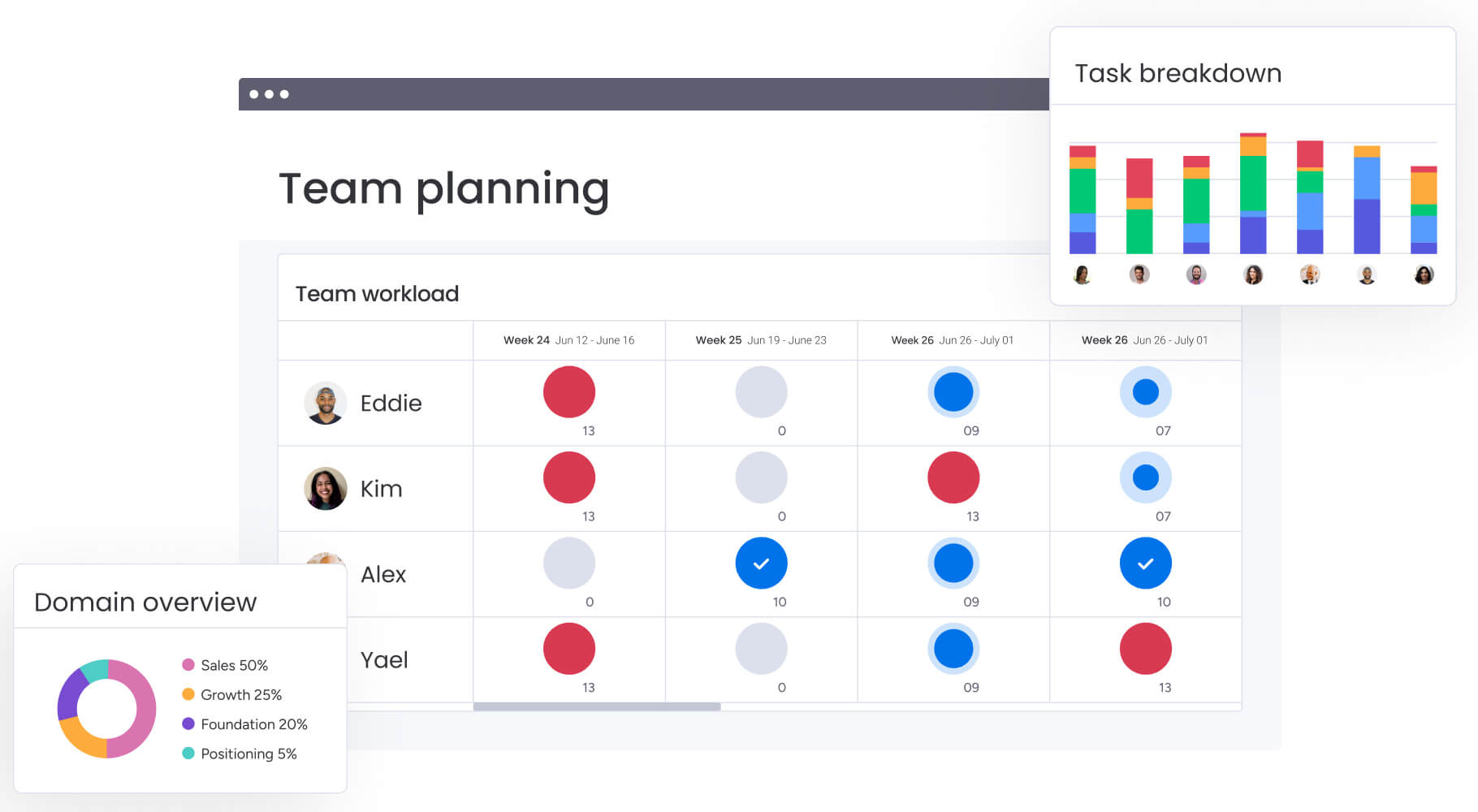
Workload management views allow managers to see total allocation per person across projects. This encourages realistic planning and supports requests for additional headcount when necessary.
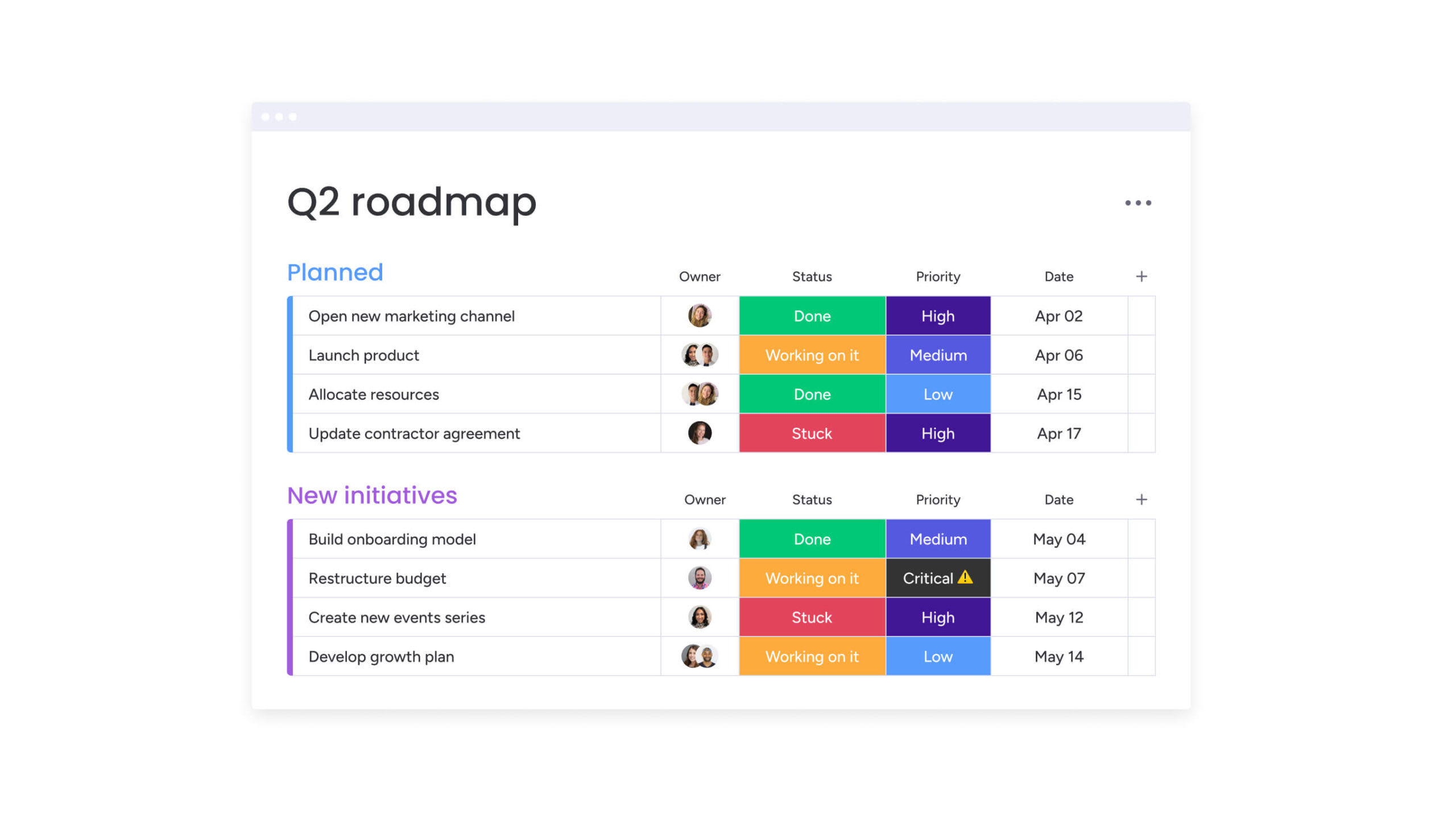
Overcoming common task management challenges
Even the most thorough plans encounter friction. Recognizing warning signs early helps teams course-correct before productivity suffers.
Eliminating task overload
Task overload arises when the volume of work exceeds team capacity, leading to burnout and lower quality.
Warning signs of overload include:
- Missed deadlines becoming frequent: deadlines are consistently not met.
- Increased error rates in deliverables: mistakes occur more often than usual.
- Decreased team morale and engagement: energy and focus levels drop.
Preventing overload requires enforcing Work In Progress (WIP) limits and prioritizing requests. Workload views provide visibility into team capacity, supporting informed decisions about taking on new workflows.
Bridging communication gaps
Confusion about assignments often signals a broken system. Gaps appear when discussions happen in siloed channels such as email or chat, separate from the workflow itself.
Centralizing communication within the workflow ensures context, history, and decisions travel with the work. Platforms that allow @mentions in workflow updates help teams notify the right colleagues at the right time.
Resolving resource conflicts
Conflicts occur when multiple high-priority workflows compete for the same person or asset. Prevention relies on forward-looking capacity planning.
When conflicts arise, a standardized prioritization framework ensures the most valuable work takes precedence. Resource management views support data-driven decisions, making it easier to resolve conflicts objectively.
Must-have features in task management software
Selecting the right platform is a strategic decision. Software should adapt to a team’s processes, rather than forcing the team to adapt to the software.
Real-time collaboration features
Essential capabilities include @mentions to notify team members, threaded comments to organize discussions, and file proofing to review assets within the platform. These features reduce email clutter while keeping feedback actionable and documented.
Visual management views
Stakeholders benefit from different perspectives. Designers may prefer Kanban boards, project managers rely on Gantt charts, and content leads use Calendar views.
Modern platforms allow teams to toggle between views on the same underlying data, offering flexible insights without duplicating effort.
AI and automation capabilities
Automation scales operations by handling routine logic automatically. For example, when a status changes to “done,” notifications are sent and workflows are archived.
AI can extend this functionality by generating text updates, categorizing workflows intelligently, and predicting timelines. AI Blocks summarize documents, extract key information, and suggest next steps based on workflow context.
Advanced analytics and reporting
You cannot improve what you do not measure. Effective platforms provide deep insights into team performance, turning raw data into actionable intelligence.
Essential reporting capabilities:
- Cycle time reports: show how long workflows take from start to finish.
- Velocity charts: display how much work is completed per sprint.
- Resource utilization heatmaps: identify overloaded and underutilized team members.
Transform your task management with monday work management
Modern work environments are complex, and scattered tasks can slow progress. A robust work management system transforms fragmented workflows into a unified system that aligns daily execution with strategic objectives.
From individual tasks to enterprise insights
The platform scales from a single team’s process to a complex enterprise portfolio. Its flexible architecture allows teams to build workflows that meet their exact requirements rather than forcing rigid templates.
Key capabilities that improve workflow management:
- Customizable boards: add columns for status, priority, timeline, people, and custom data fields.
- Multiple project views: enter data once and view it as a Kanban board, Gantt chart, calendar, or workload view.
- Real-time dashboards: aggregate data from fifty different boards to provide a real-time view of organizational health.
- Cross-project dependencies: link workflows across boards so delays in one department automatically update dependent timelines.
AI-powered task optimization in action
Intelligent platforms integrate AI into workflows to enhance productivity. AI blocks such as “Suggest action items” analyze meeting notes and generate assigned tasks instantly. The “Categorize” block organizes unstructured backlogs into defined groups efficiently.
Product power-ups analyze workflow data to flag potential issues before they escalate. Resource management power-ups optimize allocation to prevent burnout. The digital workforce includes the Project Analyzer, acting as a proactive team member that monitors boards for stuck items or missing information.
Connecting every task to strategic goals
No task should be busy work. Connected boards and dashboards link individual workflows to key results and objectives.
For example, a developer working on a “database migration workflow” can see how it contributes to the “infrastructure reliability” objective. This visibility ensures strategic alignment and helps teams focus on work that delivers measurable business outcomes.

“monday.com has been a life-changer. It gives us transparency, accountability, and a centralized place to manage projects across the globe".
Kendra Seier | Project Manager
“monday.com is the link that holds our business together — connecting our support office and stores with the visibility to move fast, stay consistent, and understand the impact on revenue.”
Duncan McHugh | Chief Operations OfficerBuild a task management system that drives results
Effective workflow management goes beyond checking boxes. When organizations define tasks precisely, prioritize them strategically, and use the right platforms, they unlock operational advantages.
Teams become faster, more agile, and consistently deliver value. Leaders gain the visibility needed to make informed decisions and allocate resources where they have the greatest impact.
Understanding workflow anatomy and leveraging intelligent platforms transforms chaos into coordinated action, turning ambitious goals into achieved results. Investments in proper workflow management pay dividends across projects, quarters, and strategic initiatives.
Try monday work managementFrequently asked questions
What are the main types of tasks in project management?
Tasks in project management typically fall into four categories: planning tasks: research and scheduling, execution tasks: designing, coding, and writing, monitoring tasks: quality assurance, review, and reporting, and closing tasks: handover and archiving. Each type serves a distinct purpose in the project lifecycle and requires specific skills and resources.
How many tasks should a typical project include?
There is no fixed number of tasks for a project, as it depends entirely on the project scope and complexity. Tasks should be sized to remain manageable, generally four to forty hours each. Projects with only three large tasks lack sufficient detail, while projects with three thousand micro-tasks create unnecessary administrative overhead.
What is the difference between a task and a milestone?
A task is a unit of work that requires time and effort to complete, such as "Write report." A milestone is a zero-duration point in time that marks a major achievement or phase completion, such as "Report approved." Milestones act as checkpoints, while tasks represent the actual work needed to reach them.
Who should be responsible for assigning tasks in project management?
In traditional project environments, the project manager assigns tasks. In agile or collaborative teams, tasks are often self-assigned from a prioritized backlog or allocated by functional team leads who understand capacity. The key is ensuring clear ownership, regardless of how tasks are assigned.
How does AI improve task completion rates in project management?
AI improves completion rates by optimizing planning through predictive scheduling, identifying risks early via pattern recognition, and automating administrative work so teams can focus on execution. AI can anticipate delays, recommend resource reallocation, and automatically generate tasks from meeting notes or project briefs.
What's the best way to track task dependencies in project management?
The most effective method is using a Gantt chart or timeline view within a project management platform. These tools visualize task links and automatically adjust downstream dates if a predecessor task is delayed, preventing bottlenecks and keeping projects on schedule.

 Get started