

Teams often rush into execution mode without defining the specific issue they are trying to fix. This misalignment leads to expensive solutions that solve superficial symptoms rather than root causes, leaving stakeholders frustrated and resources wasted.
A problem statement template provides a navigational anchor that forces teams to pause and validate the real challenge before starting work. By shifting from subjective complaints to objective facts, this framework aligns cross-functional groups on what success actually looks like.
This article provides a comprehensive guide to creating problem statements that drive measurable results. You will find a six-step process to transform vague issues into actionable foundations, real-world examples across different industries, and strategies for integrating these definitions into a digital work platform.
Key takeaways
- Define problems before jumping to solutions: Use structured templates to transform vague complaints into specific, measurable challenges that teams can actually solve.
- Align cross-functional teams with evidence-based problem statements: Replace subjective opinions with objective data to get everyone solving the same verified business challenge.
- Convert problem statements into trackable workflows: Transform static problem definitions into dynamic project boards with real-time progress tracking and automated success metrics using platforms like monday work management.
- Include four essential components in every problem statement: Document current state, desired future state, measurable success indicators, and stakeholder impact to create actionable project foundations.
- Validate problems with key stakeholders before starting work: Get buy-in from affected teams to ensure your problem statement reflects reality and prevents costly rework later.
Header: What is a problem statement template?
A problem statement template is a fill-in-the-blank framework that walks teams through defining, documenting, and communicating business challenges. It turns vague complaints into specific, solvable problems by forcing you to document scope, impact, and context. This ensures you capture all critical details when kicking off a project.
A problem statement template serves as a navigational anchor for project teams. During project initiation, the template ensures teams pause to validate the challenge they are addressing before developing solutions.
It shifts conversations from subjective assessments (“This process feels slow”) to objective, measurable facts (“This process takes 48 hours, resulting in a 15% decline in client satisfaction”).
Understanding problem statement basics
Problem statements are short, fact-based descriptions of issues you need to fix or conditions you want to improve. They focus on defining the problem’s boundaries, ensuring the solution fits the challenge.
When you write these statements consistently, leadership can compare initiatives and decide where to put resources. A well-constructed statement acts as a contract between your project team and stakeholders, confirming everyone’s solving the right problem.
Specific, measurable language transforms abstract concerns into actionable definitions:
- Customer service: “Average customer wait times exceed ten minutes during peak hours (ten a.m. to two p.m.), resulting in a 15% call abandonment rate and monthly revenue loss of $25,000.”.
- Supply chain: “Inventory discrepancies in the northeast warehouse have reached 8% variance, delaying shipments by two days and increasing expedited shipping costs by 12% quarter-over-quarter.”.
- Internal IT: “The employee onboarding process requires manual entry across four disconnected systems, taking five days to provision full access and delaying new hire productivity.”.
Problem statement vs hypothesis
Problem statements and hypotheses do different jobs in your project. While a problem statement defines what’s broken right now, backed by evidence, a hypothesis guesses at what might work if you try something specific.
| Feature | Problem statement | Hypothesis |
|---|---|---|
| Purpose | Defines the challenge to solve | Proposes a potential solution to test |
| Time orientation | Focuses on past and present | Focuses on future outcomes |
| Evidence basis | Built on observed facts and data | Built on assumptions and educated guesses |
| Structure | "The problem is X, causing impact Y" | "If you do X, then Y will happen" |
| Example | "Checkout errors have increased by 5%" | "Simplifying the form will reduce errors by 5%" |
When your team needs a problem statement
Understanding when to write down a problem is just as important as solving it. Teams often rush into execution without knowing what they’re aiming for, which leads to scope creep and a burned budget. Problem statements become essential in these organizational scenarios:
- Project kickoffs: Aligns core teams and stakeholders on the primary objective.
- Process improvement initiatives: Isolates specific bottlenecks rather than condemning entire processes.
- Cross-departmental friction: Provides neutral, data-backed definitions when departments perceive issues differently.
- Strategic planning: Helps executives identify which issues pose the greatest risk to business goals.
- Post-mortem reviews: Determines whether teams solved the wrong problem when projects fail to deliver.
Benefits of using problem statement templates
Solving problems on the fly usually leads to quick fixes that treat symptoms instead of root causes. In contrast, using a standard template forces discipline: every initiative has to connect to a real business need. Defining problems with structure changes how teams tackle challenges and spend resources.
Align teams around defined challenges
Misalignment burns more money than most teams realize. Without written problem statements, stakeholders make up their own version of what’s wrong. Marketing might believe dropping conversions stem from lead quality, while sales attributes them to slow follow-up times.
Templates force disparate groups to agree on a single narrative before work begins. This approach gives cross-functional teams a few key advantages:
- Unified vocabulary: Establishes shared language, preventing confusion from vague terms.
- Stakeholder buy-in: Gives affected parties chances to validate issues before resources are committed.
- Conflict reduction: Focuses on objective data rather than subjective opinions, depersonalizing problems.
Accelerate solution development
Defining problems upfront speeds up the solution process. Skip this step, and teams waste weeks building solutions that don’t fit and then burn even more time fixing them. A defined problem statement acts as a filter — teams can quickly toss ideas that don’t address the core issue.
Consider a logistics team planning to purchase new vehicles for delivery delays. With a structured problem statement, they identified inefficient route planning software as the root cause, not vehicle shortage. They implemented a software update in two weeks, saving months of procurement time and significant capital expenditure.
Prevent costly missteps
One of the most significant project risks is solving the wrong problem effectively. Templates mitigate this risk by requiring evidence and impact assessment upfront — a critical need highlighted by McKinsey’s review of 300+ billion-dollar megaprojects showing average cost overruns of ~80% due to poorly framed problems and weak scope control.
This structured approach prevents solution bias, where teams implement familiar technologies based on comfort rather than strategic fit.
Common missteps templates help avoid include:
- Technology for process problems: Buying expensive automation for broken processes only automates inefficiency.
- Scope creep: Tackling massive, undefined issues instead of specific, manageable components.
- Resource drain: Assigning high-value talent to low-impact problems without vetting business value.
Essential components of problem statements
Effective problem statements are structured arguments from four key pieces that turn vague complaints into solvable challenges. Mastering these components will turn your problem statements into the foundation for successful projects.
Current state description
The current state describes objectively, what’s happening right now. This section relies on observable facts and data, avoiding emotional language or speculation about causes.
To illustrate the difference between vague and actionable current state descriptions, compare these two approaches:
- Weak: “The finance team is taking too long to close the books”.
- Strong: “The monthly financial close process takes twelve business days, requiring 40 hours of overtime per employee”.
Desired future state
The desired future state describes what success looks like — without naming specific solutions, focusing on results, not deliverables.
- Solution-focused (avoid): “We need to implement an ERP system to speed up reporting”.
- Outcome-focused (preferred): “The monthly financial close completes in five business days with zero required overtime”.
Measurable success indicators
Success indicators are specific, measurable metrics that tell you whether you’ve solved the problem. These metrics connect where you are now to where you want to be:
- Efficiency: Reduce processing time from 48 hours to twelve hours.
- Quality: Decrease error rate from 5% to less than 1%.
- Financial: Reduce operational costs by 15% within Q3.
- Experience: Increase Net Promoter Score from 30 to 50.
Stakeholder impact assessment
Because understanding stakeholder impact helps you decide if this problem matters more than others, this part names who’s affected by the problem and how badly.
- Primary: Customer support team dealing with high call volume and stress.
- Secondary: Sales team losing upsell opportunities due to long wait times.
- Indirect: Brand reputation suffering from negative reviews affecting market position.
Header: 6 steps to create your problem statement
Creating a problem statement is a step-by-step process that turns raw observations into strategic tools. These six steps make sure your final statement is solid, backed by data, and ready for executive review. Follow this approach to avoid common mistakes and write statements that actually lead to action.
Step 1: define the specific challenge
Start by narrowing big, vague issues into specific problems you can solve. Broad challenges like “revenue is down” are too vague to act upon. Use scoping to set boundaries and separate symptoms from root causes.
- Broad: “The software is buggy”.
- Specific: “The mobile app crashes on launch for 12% of Android users following the v4.0 update”.
Step 2: gather supporting evidence
Data turns assumptions into facts. Therefore, grab both hard numbers (metrics, logs, financial reports) and soft evidence (user feedback, observations, interviews). For example, teams using a central work platform can pull data from connected systems and drop evidence directly into project boards.
Evidence types to gather:
- Quantitative: Server logs showing latency, sales reports showing quarterly drops.
- Qualitative: Customer support tickets citing navigation frustration, exit interviews mentioning training gaps.
Step 3: identify affected stakeholders
Identifying stakeholders systematically reveals the problem’s full scope. Map everyone who touches the process — including teams you might forget, like downstream departments or external partners.
Step 4: calculate business impact
Quantifying the cost of inaction transforms abstract problems into business-critical priorities. Attach concrete numbers — lost revenue, wasted hours, missed opportunities — to create urgency for executive buy-in. Then, calculate financial drain, operational impact, and strategic consequences:
- Financial: “This inefficiency costs $4,000 weekly in wasted labor”.
- Strategic: “This delay prevents Asian market entry until Q4”.
- Risk: “This security gap exposes 10,000 customer records to potential breach”.
Step 5: establish success metrics
Formalize SMART criteria (Specific, Measurable, Achievable, Relevant, Time-bound) for your project. These metrics serve as your “definition of done” and connect directly to the measurable indicators identified earlier.
Step 6: validate with key stakeholders
Finally, show the draft to key stakeholders so they can correct it and sign off. This review makes sure it’s accurate and matches what they’re actually seeing. Teams can speed up validation with collaborative platforms where stakeholders give feedback in real time.
Problem statement templates for different needs
The core pieces stay the same, but the focus shifts depending on context. Different departments need templates that speak their language and track their specific metrics. These specialized templates make sure problem statements land with the right audience without losing their structure.
Business process improvement template
Built for operational efficiency problems, this template zeroes in on bottlenecks, cycle times, and how you’re using resources:
- Process name: Specific workflow under review (invoice approval).
- Current cycle time: Average time from start to finish.
- Bottleneck location: Specific step causing delay.
- Operational impact: Effect on downstream processes or capacity.
Customer experience problem template
This template tackles customer-facing problems by focusing on satisfaction, sentiment, and friction points in the journey:
- Touchpoint: Where the issue occurs (checkout, onboarding).
- Customer sentiment: Qualitative feedback themes (confusing, frustrating).
- Behavioral impact: Churn rate, abandonment rate, ticket volume.
Project problem statement format
This template plugs into project management workflows and focuses on constraints and delivery risks. Organizations using monday work management connect problem statements directly to project boards, ensuring defined challenges drive task creation and resource allocation:
- Project constraint: Limitations in budget, time, or scope.
- Resource gap: Missing skills or capacity for delivery.
- Delivery risk: Potential threats to timeline or quality.

“monday.com has been a life-changer. It gives us transparency, accountability, and a centralized place to manage projects across the globe".
Kendra Seier | Project Manager
“monday.com is the link that holds our business together — connecting our support office and stores with the visibility to move fast, stay consistent, and understand the impact on revenue.”
Duncan McHugh | Chief Operations OfficerProblem statement examples that drive results
Real examples show how these abstract pieces come together into clear stories. These examples show how solid problem statements lead to successful projects. Study these cases to see the difference between statements that spark action and ones that sit in a drawer.
Operations efficiency problem example
A manufacturing company struggles with raw material shortages.
- Current state: “Raw material procurement relies on manual email updates from suppliers, resulting in 48-hour inventory data lag. This causes production stoppages three times monthly.”
- Desired state: “Inventory data updates in real-time via API integration, reducing data lag to under five minutes and eliminating data-related production stoppages.”
- Impact: “Each stoppage costs $15,000 in idle labor and delayed shipments.”
Team collaboration challenge example
A remote software team consistently misses deadlines.
- Current state: “Development and QA teams communicate through sporadic chat messages, leading to undocumented requirements. This results in 25% rework rate due to misunderstood specifications.”
- Desired state: “All requirements and feedback centralized in a single system of record, reducing rework to less than 5%.”
- Impact: “Rework delays feature releases by ten days average, affecting competitive positioning.”
The problem statement highlighted communication channels as the root cause, leading to structured work management platform adoption rather than hiring more developers.
5 problem statement mistakes teams make
Even with the best intentions, teams sabotage themselves by falling into common traps. Spot these mistakes early, and you can turn them into lessons instead of failures. Avoid these pitfalls, and your problem statements will drive real change instead of becoming paperwork.
1. Starting with solutions instead of problems
Solution bias represents the most prevalent error in problem statement development. This occurs when teams frame statements to justify predetermined solutions. Effective statements concentrate on documented performance gaps rather than assumed technology deficits.
2. Creating vague problem descriptions
Vague statements undermine alignment. Statements like “Communication is poor” are open to interpretation. Add specific metrics, timeframes, and locations so everyone sees the same problem.
3. Omitting measurable success criteria
Without metrics, problems are just opinions. Skip success criteria, and teams never know if they’ve won. Projects drag on forever because there’s no finish line.
4. Ignoring cross-functional input
Problems rarely exist in isolation. Write statements from one department’s view, and you’ll miss what’s happening upstream or downstream. A “sales problem” might actually be a “marketing lead quality problem.”
5. Forgetting to define the scope
Scope creep starts with vague problem statements. If statements don’t say what’s out of scope, projects balloon and eat unlimited resources.

Header: Change problems into projects with monday work management
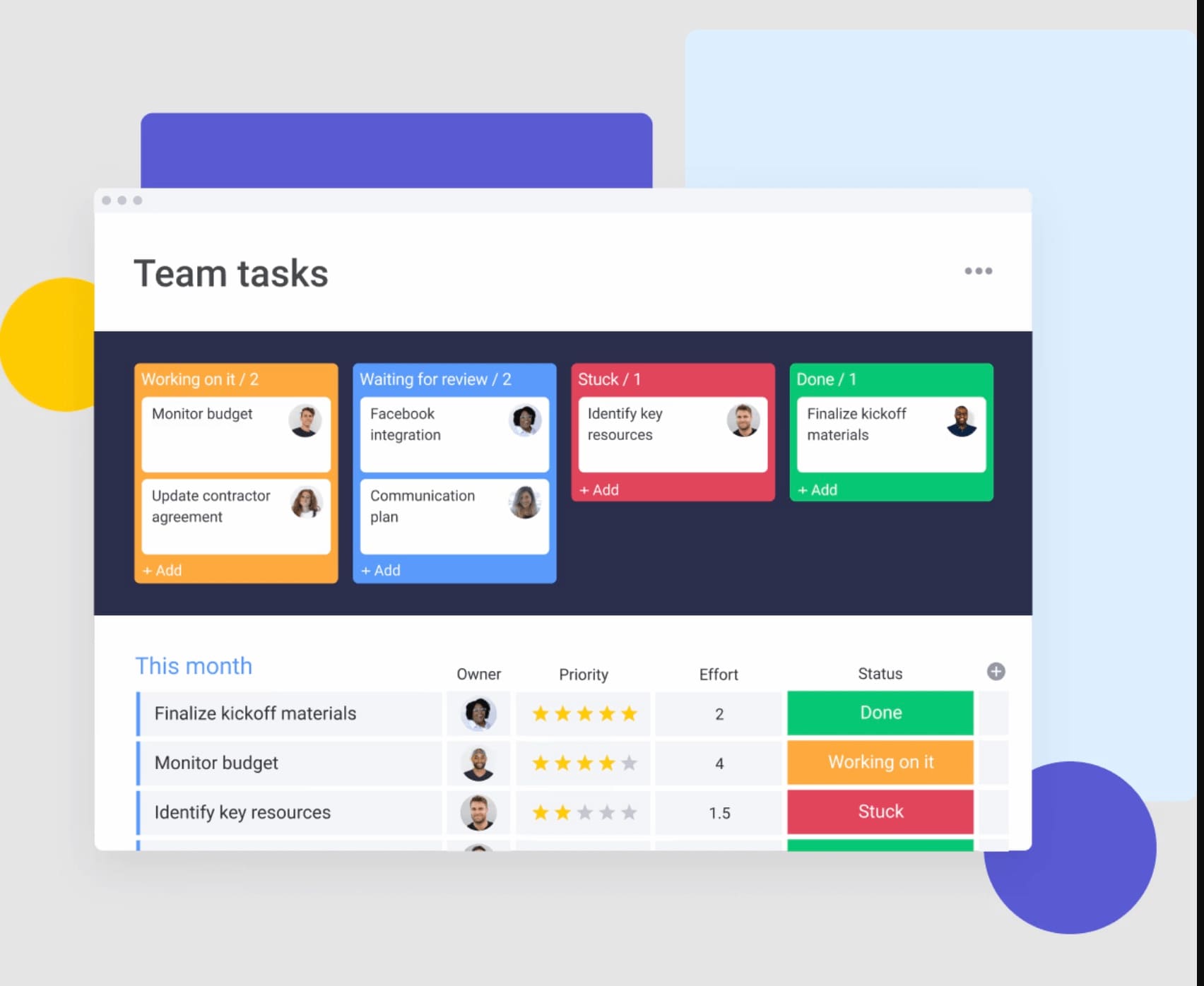
Problem statements function as blueprints while project execution represents construction. monday work management bridges this gap by transforming static problem definitions into live, trackable workflows. This connection converts problem statements into dynamic documentation that guides teams from identifying the issue to implementing solutions.
Convert problem statements to active workflows
Teams drop problem statement pieces straight into project boards on monday work management. Customizable templates mirror problem statement fields, ensuring “Current State” and “Desired State” remain visible to every team member. Automated workflows initiate processes based on the problem’s severity.
Track resolution progress in real-time
While static docs hide progress, live dashboards show it. The platform shows your progress from current state to future state. Success metrics from your problem statement track through live widgets, and Portfolio Risk Insights flag obstacles that could derail you.
Enable cross-team problem solving
Complex problems need teams from different functions working together. Breaking down silos becomes possible with monday work management. Stakeholders identified in problem statements get tagged directly in updates, ensuring continuous validation. Integration capabilities connect solutions used by different departments, pulling data into central views.
| Feature | monday work management | Spreadsheets | Document platforms |
|---|---|---|---|
| Template flexibility | High; customizable columns, automations, views | High; requires manual formatting | Low; static text only |
| Stakeholder collaboration | Integrated; @mentions, updates, guest access | Limited; buried comments | Moderate; lacks workflow context |
| Progress tracking | Real-time; visual dashboards, status automations | Manual; requires constant updating | None; static document |
| Success measurement | Automated; connects tasks to reporting widgets | Manual; requires complex formulas | None |
monday work management bridges execution gaps by transforming static problem definitions into live, trackable workflows.
Turn problem definition into execution success
Well-crafted problem statements serve as the foundation for every successful project initiative. They turn organizational confusion into focused action, ensuring teams solve the right challenges with measurable outcomes. This structured approach prevents costly missteps while accelerating the path from identifying a gap to delivering a solution.
Organizations that implement standardized problem statement templates experience improved alignment, reduced rework, and faster project delivery. Teams spend less time debating what to build and more time focusing on solutions that move the needle. This initial investment in definition pays dividends throughout the entire project lifecycle.
By moving your definitions into monday work management, you ensure your “desired future state” is never lost in a static document. The platform turns your problem statement into a living project, tracking real-time progress against your success metrics.
Frequently asked questions
What is the ideal length of a problem statement?
A problem statement should be concise enough to read in under two minutes but detailed enough to cover the current state, impact, and gap. Most effective statements range from 150 to 300 words.
How often should problem statements be updated?
Problem statements should be reviewed at key project milestones or when new data significantly alters understanding of the root cause. Regular reviews ensure the statement remains relevant as conditions change.
Can you have multiple problem statements for one project?
Yes, complex programs often require a high-level master problem statement supported by smaller, specific statements for individual workstreams. Each should link back to the master statement.
What is the difference between a problem statement and a project charter?
A problem statement focuses exclusively on the issue to be solved. A project charter is broader, including team structure, budget, timeline, and deliverables alongside the problem definition.
How do you validate a problem statement is worth solving?
Validation involves assessing business impact against estimated solution cost. If the calculated problem cost exceeds the investment required to fix it, the problem is generally worth solving.
Who should be involved in creating a problem statement?
Creating a problem statement should involve the project lead, primary process owner, and representatives from teams experiencing the problem directly. This ensures multiple perspectives validate the issue.

 Get started