


Most organizations juggle multiple initiatives at once. Marketing campaigns overlap with system upgrades. Product launches run alongside operational improvements. Even when individual projects are executed well, it’s not always clear whether the overall mix of work is moving the business in the right direction.
That tension highlights the difference between project management and portfolio management. Project management focuses on delivering defined initiatives successfully. Portfolio management looks at the bigger picture, deciding which initiatives deserve investment and how they align with long-term strategy.
This article clarifies how the two disciplines differ, how program management fits between them, what skills each role requires, and how to connect strategic priorities to day-to-day execution more effectively.
Key takeaways
- Strategic focus vs tactical execution: Portfolio management prioritizes initiatives based on organizational goals and ROI, while project management ensures individual projects are completed efficiently, on time, and within scope.
- Resource management at different levels: Portfolio managers optimize capacity across the organization and resolve conflicts between competing initiatives, whereas project managers assign specific tasks to team members within a single project.
- Measuring success differently: Portfolio success is evaluated by benefits realization and long-term value, while project success is measured by meeting deadlines, budgets, and quality standards.
- Importance of cross-project visibility: Managing dependencies and dynamic priorities across multiple initiatives is critical to prevent bottlenecks and ensure overall portfolio alignment.
- Integration with digital management tools: Unified platforms like monday.com help connect strategic objectives to daily project activities, providing real-time visibility and insights that support both portfolio and project-level decision-making.
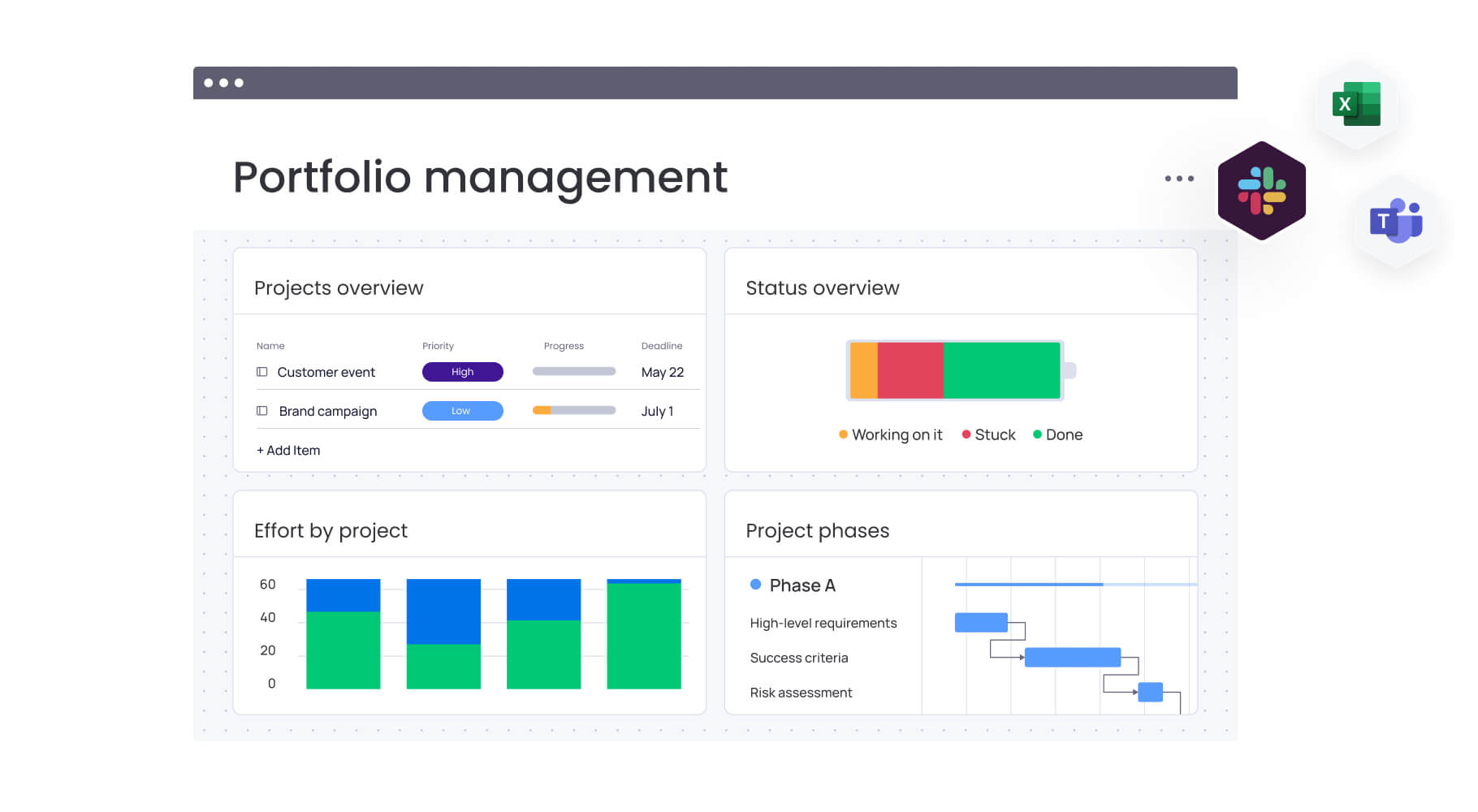
What is portfolio management?
Portfolio management is the process of overseeing all projects, programs, and initiatives to achieve an organization’s strategic goals: it’s a continuous practice that ensures work aligns with long-term priorities and maximizes the value of every investment.
Unlike project management, which focuses on initiatives with defined start and end dates, portfolio management operates at a strategic level.
Portfolio managers assess whether the current mix of projects meets business objectives, shifting resources toward higher-value opportunities as priorities evolve. They select the right work, rank it by importance, and monitor whether it delivers measurable impact.
Strategic business alignment
The biggest goal of portfolio management is to ensure each project supports a strategic objective. For example, if a retail organization aims to increase digital revenue by 20%, a portfolio manager may prioritize e-commerce infrastructure projects over physical store renovations.
This approach prevents “zombie projects”, initiatives that consume resources without contributing to business outcomes. Portfolio managers continually review the portfolio to ensure it aligns with current priorities rather than outdated objectives, adapting the portfolio as conditions change.
Value maximization across initiatives
Portfolio management evaluates total value across all initiatives, not just individual project success. This may involve making difficult decisions, such as reallocating resources from a successful project to one that offers greater business impact.
For instance, a portfolio manager might pause a software upgrade to assign developers to a product launch, responding to competitor activity. The aim is to optimize return on investment across the entire portfolio, balancing high-impact initiatives with ongoing improvements.
Benefits realization focus
While projects are measured by time, budget, and scope, portfolios are evaluated by the business results they produce. Portfolio managers track whether completed projects deliver anticipated benefits, such as increased market share, cost savings, or improved customer satisfaction.
Measurement continues beyond project closure, often months or years afterward. Success metrics are defined at the outset and monitored to confirm that outcomes align with strategic objectives.

What is project management?
Project management involves applying knowledge, skills, and techniques to execute specific work. Projects are unique, time-bound, and constrained by defined parameters. While portfolio management selects initiatives, project management ensures their successful delivery.
Project management also provides structure, discipline, and leadership to convert ideas into tangible results on time and within scope. The project manager operates within established boundaries, working toward a defined finish line.
Tactical execution excellence
Project management is all about hands-on execution. It’s about breaking big goals into smaller tasks, scheduling them in the right order, and making sure teams have what they need to move forward.
Project managers navigate the constraints of scope, time, and cost. They excel by managing risks, clearing blockers, and keeping quality high, all while preventing projects from going off the rails.
Deliverable-focused approach
Project managers concentrate on completing a defined output, whether a product, service, or campaign. The emphasis is on quality delivery within agreed timelines. Unlike portfolio management, which is ongoing, a project concludes once stakeholders approve deliverables.
Team coordination
Project managers handle the day-to-day coordination of their teams. That means assigning work, resolving conflicts, and keeping stakeholders updated on project status.
They run the workflows that keep teams moving, stand-ups, sprint planning, status reviews. Project managers protect teams from distractions and scope creep so they can focus on the work.
Try monday.com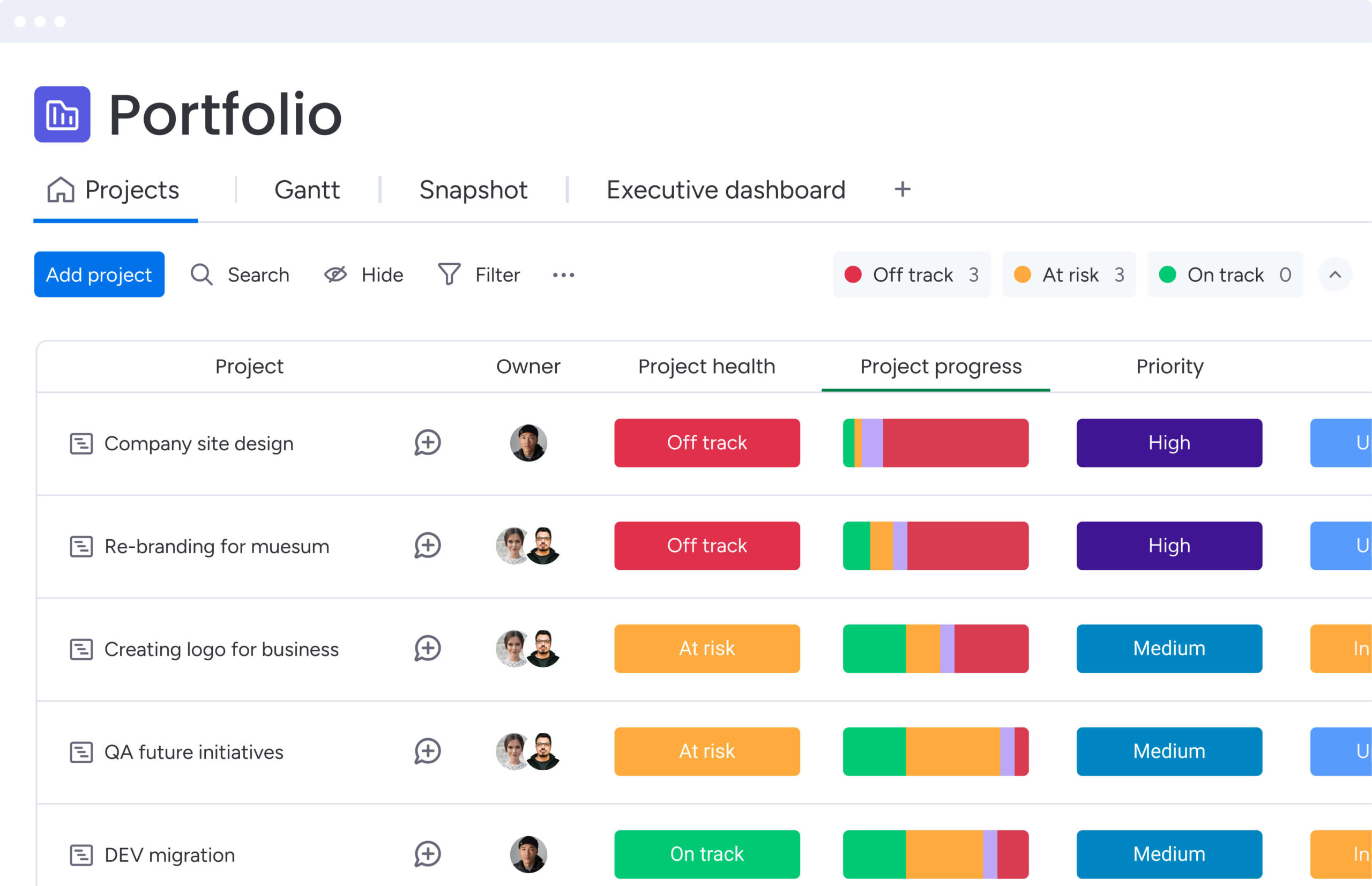
Portfolio management vs project management: 5 key differences
The difference between portfolio and project management comes down to scope, focus, and how you define success. They complement each other well, but they need different mindsets and approaches.
Here’s a quick comparison before diving into each difference in a bit more detail:
| Aspect | Portfolio management | Project management |
|---|---|---|
| Focus | Strategic goals and ROI | Tactical deliverables |
| Resources | Optimization across organization | Allocation within the project |
| Success metric | Benefits realization over time | On-time, on-budget delivery |
| Scope | Cross-project dependencies | Single project focus |
| Approach | Dynamic prioritization | Fixed scope management |
1. Strategic goals vs tactical deliverables
Portfolio management operates at the strategic level; it’s all about why you’re doing the work and which work you should pick to hit business goals. Project management works at the tactical level, focusing on how and when the work gets done.
Consider these perspectives in action:
- Portfolio perspective: Evaluates if a proposed mobile app aligns with the five year digital transformation strategy.
- Project perspective: Focuses on coding mobile app features without bugs and launching by Q3.
A portfolio manager might cancel a project because the market shifted, even if the project manager was doing everything right. The strategic context changed, and suddenly that project wasn’t worth doing anymore.
2. Resource optimization vs resource allocation
Portfolio managers look at resource capacity across the whole organization, figuring out long-term hiring needs and where skill gaps exist. Project managers assign specific people to tasks within their project.
Here’s how each role approaches resources:
- Portfolio perspective: Determines that the IT department needs 20% more data scientists to support the upcoming year’s roadmap.
- Project perspective: Assigns Sarah to the database migration activity for the next three weeks.
Portfolio managers resolve conflicts when two critical projects need the same specialist, usually by adjusting start dates. A centralized resource planning view allows leaders to see capacity across all projects and make these calls in real time.
3. Benefits realization vs project completion
Portfolio management measures success by long-term business impact, such as ROI or revenue growth. Project management evaluates adherence to time, budget, and scope.
The difference becomes really obvious in outcomes:
- Portfolio perspective: Tracks if the new CRM system increased sales velocity by 15% one year after launch.
- Project perspective: Celebrates that the CRM system was installed and users were trained by the deadline.
Keep in mind that a project can run late and over budget, yet still fail, but still generate massive revenue (which makes it a portfolio win). On the flip side, a project can ship on time, a project success, but if no one uses it, that’s a portfolio failure.
4. Cross-project dependencies vs single project focus
Portfolio managers handle dependencies between multiple projects and programs. Project managers handle dependencies between tasks within their own project.
Each role handles dependencies differently:
- Portfolio perspective: Identifies that Project A cannot launch until Project B upgrades the server infrastructure.
- Project perspective: Identifies that the design phase must finish before the development phase begins.
Portfolio managers use roadmaps to stagger launches and prevent operational overload, visualizing dependencies to minimize conflict.
5. Dynamic prioritization vs fixed scope
Portfolio management is dynamic; priorities shift as the business changes. Project management aims for stability; scope changes get managed carefully to prevent creep.
The approaches differ significantly:
- Portfolio perspective: Re-ranks the entire portfolio quarterly based on new competitor data or financial constraints.
- Project perspective: Uses change request forms to control any deviations from the original project plan.
During an economic downturn, a portfolio manager halts three R&D projects to fund a cost-saving automation initiative. The project managers on those R&D projects were executing well, but the strategic context demanded reallocation.
Portfolio manager vs project manager: key responsibilities
Both roles are essential, but they operate at different levels and require different strengths. Portfolio managers focus on strategic alignment, resource optimization, and long-term value. Project managers concentrate on execution, coordination, and delivering quality outcomes within defined constraints.
Understanding these differences makes it easier to assign the right responsibilities to the right leaders, keeping strategy and day-to-day operations aligned instead of working at cross purposes.
Portfolio manager core functions
- Strategic planning: Translating organizational strategy into a roadmap of initiatives.
- Governance and oversight: Establishing frameworks, standards, and stage-gates for project approval and execution.
- Demand management: Evaluating and prioritizing incoming project requests against available capacity.
- Portfolio balancing: Ensuring the right mix of high-risk/high-reward and low-risk/steady-state projects.
- Executive reporting: Communicating portfolio health, risks, and ROI to C-suite and stakeholders.
Project manager core functions
- Project planning: Defining scope, schedule, and budget baselines.
- Team leadership: Motivating teams and assigning daily activities.
- Risk management: Identifying and mitigating risks specific to project deliverables.
- Quality control: Ensuring deliverables meet acceptance criteria.
- Status reporting: Providing regular updates on progress, spend, and blockers to stakeholders.
Skills required for each role
Because portfolio and project managers operate at different levels, the skills that define success in each role are not the same. One requires strategic thinking, financial judgment, and executive communication. The other demands precision, coordination, and strong day-to-day leadership.
The comparison below highlights how the required capabilities shift depending on whether the focus is long-term value creation or successful project delivery.
| Skill category | Portfolio manager | Project manager |
|---|---|---|
| Primary focus | Strategic alignment and ROI | Execution and delivery |
| Financial | Investment analysis, CAPEX/OPEX budgeting | Budget tracking, cost variance analysis |
| Communication | Executive negotiation, persuasion | Team motivation, stakeholder updates |
| Risk | Systemic and market risk | Project and activity risk |
| Scope | Organizational capacity | Project requirements |
Where program management fits in your organization
Program management connects high-level strategy with on-the-ground execution. It coordinates related projects so they deliver a combined outcome that would not be possible if each were managed in isolation.
Seeing where program management fits makes it much easier to structure complex initiatives that span teams, timelines, and deliverables, ensuring individual projects contribute to a larger, unified objective.
Bridging projects and portfolios
A program is a collection of related projects managed in a coordinated way. While a portfolio might contain unrelated initiatives like “All IT Projects,” a program focuses on specific outcomes like “Digital Transformation Program.”
Program managers make sure the outputs from individual projects fit together. For instance, a “New Product Launch Program” coordinates the R&D project, marketing project, and supply chain project, ensuring they all align with the launch date.
Program manager unique value
Program managers add value by managing the gaps between projects. They resolve conflicts when two projects need the same resources or when one project’s delay affects another’s timeline.
They focus on aggregate program benefits like “Market Entry” rather than just completion of constituent projects. This role breaks down silos and makes sure project outputs add up to a complete business solution.

“monday.com has been a life-changer. It gives us transparency, accountability, and a centralized place to manage projects across the globe".
Kendra Seier | Project Manager
“monday.com is the link that holds our business together — connecting our support office and stores with the visibility to move fast, stay consistent, and understand the impact on revenue.”
Duncan McHugh | Chief Operations OfficerHow portfolio and project management work together
Smart organizations don’t choose between portfolio and project management, they integrate them both. The portfolio sets direction. Projects create momentum. Together, they create a feedback loop that keeps strategy and execution in sync.
Creating strategic alignment
Portfolio managers set the destination by selecting the right initiatives. Project managers get you there. This relationship depends on two-way communication.
Portfolio managers share the strategic context so project teams know why their work matters. Project managers give reality checks on what’s feasible and how things are going, so portfolio managers can adjust strategy when execution hits roadblocks.
This keeps organizations agile and ready to respond when things change.
Implementing governance frameworks
Organizations build governance frameworks that standardize how projects move through the portfolio lifecycle. This usually involves stage gates where projects must hit specific criteria (approved business case, finalized design) before getting funded for the next phase.
Portfolio management sets these gates. Project management prepares the documentation and deliverables to pass through them. By utilizing managed templates on monday.com, you can standardize processes across hundreds of projects while giving teams flexibility to adapt workflows.
Enabling benefits tracking
Project-level tracking feeds directly into portfolio-level results. Data collected by project managers (costs, milestones, quality metrics) rolls up into the portfolio dashboard.
This allows leadership to see if the portfolio is on track to deliver the expected ROI.
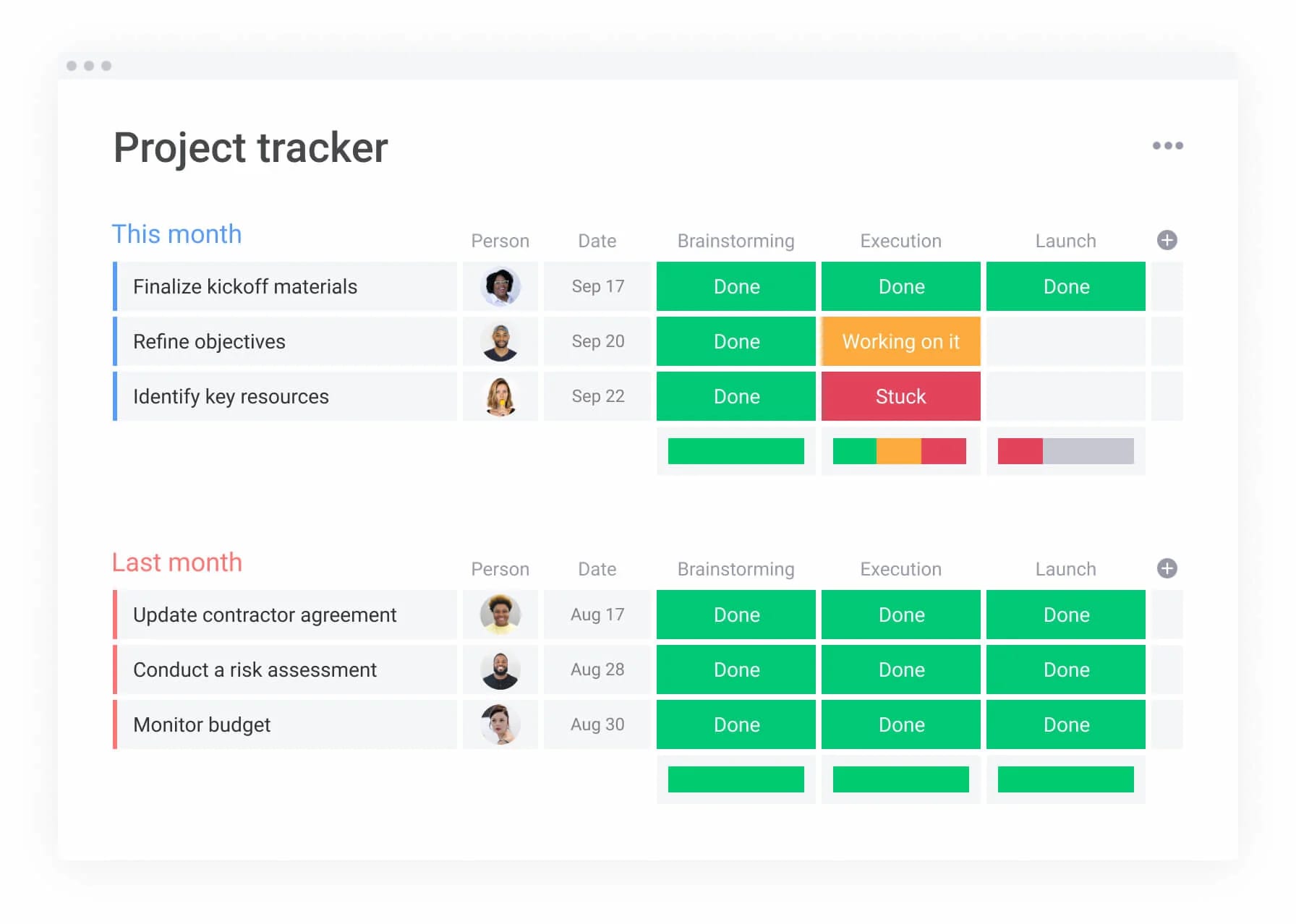
Without accurate project data, portfolio decisions are based on guesswork. monday.com helps by rolling up activity-level data into high-level portfolio views automatically, giving executives real-time visibility without manual reporting.
4 steps to transition from project manager to portfolio manager
For project managers looking to elevate their career, moving into portfolio management requires a shift in mindset from “how” to “why.”
The following steps provide a roadmap for this transition, helping you develop the strategic perspective and skills needed for portfolio-level responsibilities.
Step 1: Develop strategic thinking skills
Project managers must learn to look beyond immediate deadlines and understand broader business context. This involves asking questions about how projects impact the company’s bottom line, market position, or long-term goals.
Aspiring portfolio managers should:
- Seek to understand organizational strategic pillars and evaluate current projects against them.
- Shadow senior leaders or participate in strategy planning sessions to build this perspective.
- Practice connecting project outcomes to business metrics and strategic objectives.
Step 2: Master cross-project dependencies
Experience managing relationships and dependencies between multiple projects is crucial. Project managers can gain this by volunteering to lead programs or complex initiatives with multiple workstreams.
This requires:
- Negotiating with other project managers and resolving resource conflicts.
- Understanding how delays in one area ripple across others.
- Moving focus from controlling a single timeline to orchestrating a network of timelines.
Step 3: Build financial acumen
Portfolio management is deeply rooted in finance. Project managers typically manage budgets, but portfolio managers manage investments. Developing skills in business case development, ROI analysis, Net Present Value, and CAPEX/OPEX management is essential.
Key areas to develop include:
- Understanding how to justify investments to a CFO.
- Learning how to reallocate funds to maximize portfolio value.
- Mastering investment analysis and portfolio optimization techniques.
Step 4: Gain portfolio certification
Finally. formal training validates expertise and provides structured frameworks for portfolio management. Certifications such as Portfolio Management Professional (PMP) from PMI or Management of Portfolios (MoP) from Axelos are industry-recognized credentials.
These programs teach:
- Standard methodologies and governance structures.
- Risk management techniques used by enterprise portfolio managers globally.
- Best practices for portfolio optimization and strategic alignment.
AI-powered portfolio management for organizations
Artificial intelligence is transforming portfolio management from reactive reporting to proactive strategic engines. By analyzing vast amounts of data across organizations, AI provides insights that human analysis cannot match at scale.
The following capabilities show how AI enhances portfolio management decision-making and execution.
Risk detection across hundreds of projects
Manual risk assessment across a portfolio of 50+ projects is slow and prone to oversight. AI algorithms scan project boards, communication logs, and timeline updates in real time to identify patterns indicating risk.
AI can flag that five different critical projects all depend on a single vendor with a history of delays, a correlation humans might miss. Portfolio Risk Insights on monday.com can even scan connected project boards for potential issues, categorizing risks by severity so portfolio managers focus attention where it’s needed most.
Resource optimization with AI
AI enhances resource management by analyzing historical velocity and current availability to suggest optimal allocations. Instead of relying on static spreadsheets, AI analyzes team capacity dynamically.
It also predicts bottlenecks weeks in advance and suggests reallocations to balance workload. This ensures high-priority strategic initiatives are always staffed with necessary talent without burning out teams.
Predictive benefits realization
AI enables earlier visibility into whether initiatives are likely to deliver expected value. By analyzing patterns from previous initiatives, predictive models highlight indicators that often precede benefit erosion.
Signals such as expanding scope or declining engagement can be identified earlier, allowing portfolio leaders to intervene sooner. This proactive approach helps preserve capital and redirect investment toward initiatives with stronger expected outcomes.
Try monday.com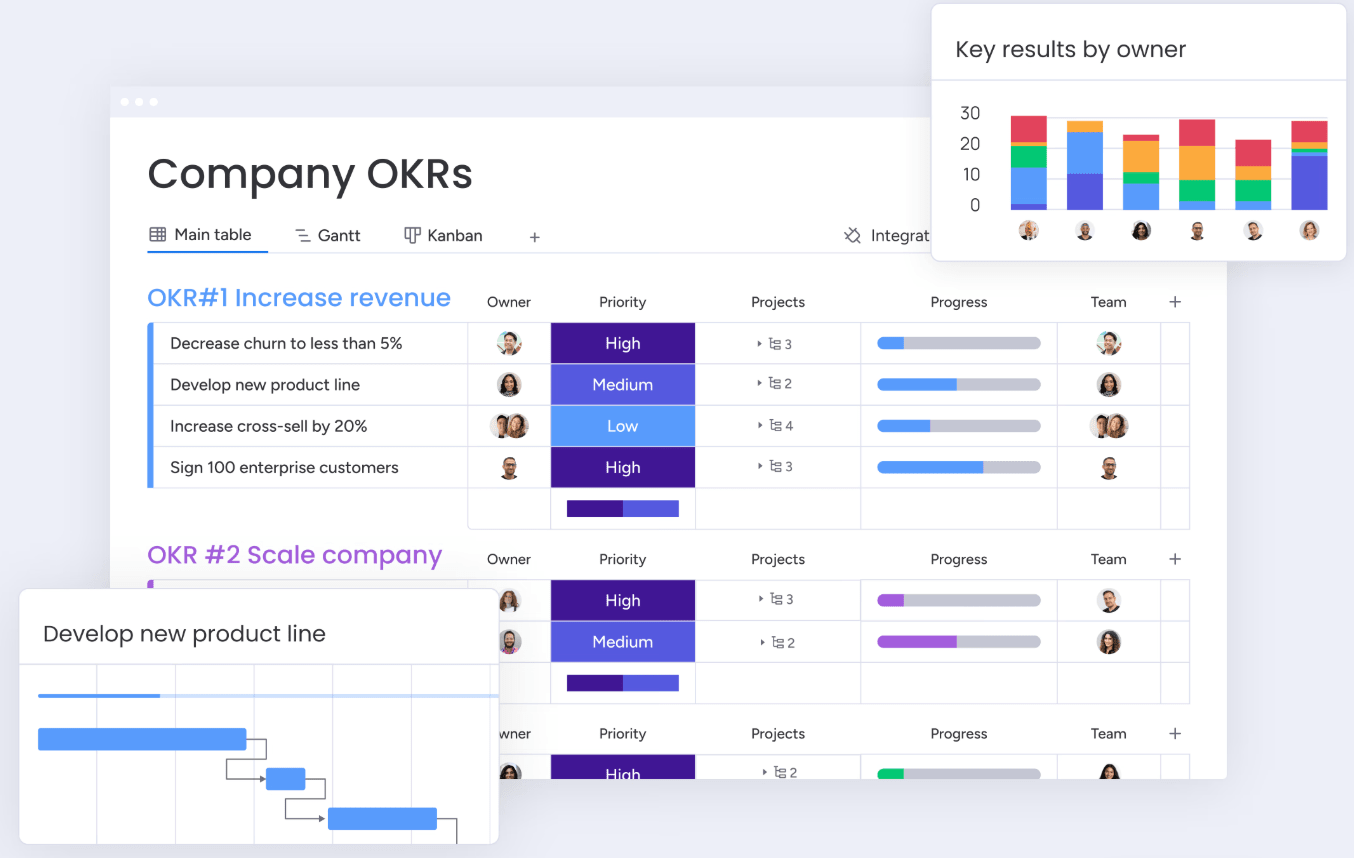
Unify portfolio strategy and project execution with monday.com
Managing multiple initiatives at once creates predictable friction. Visibility fades across projects. Priorities compete. Resources collide. Leadership struggles to see whether collective effort is delivering measurable business value.
Even well-run projects can fall short when they operate in isolation or when portfolio oversight depends on static reports and fragmented data.
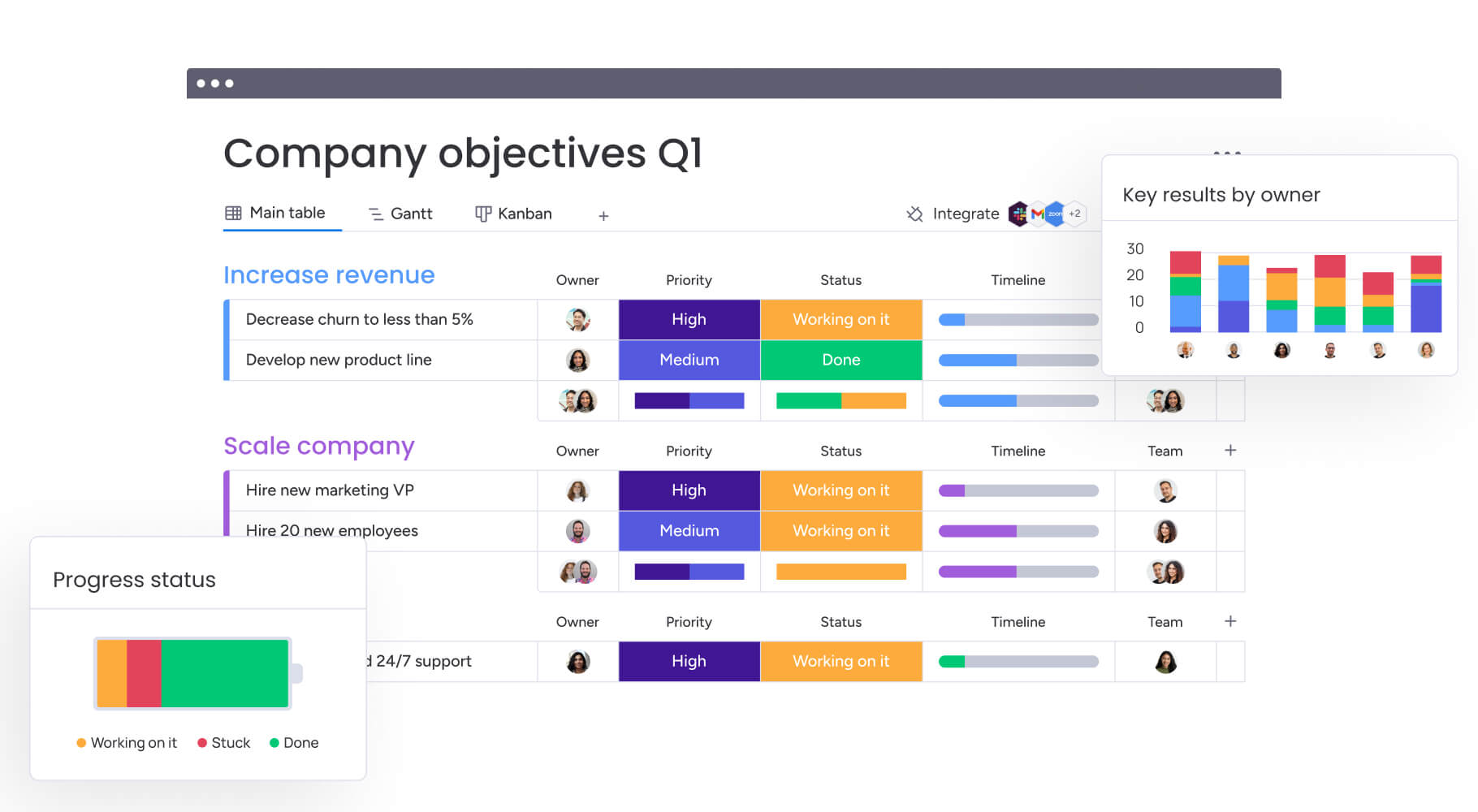
monday.com brings portfolio strategy and project execution into a single, connected workspace. Teams align goals, initiatives, and daily execution in real time without sacrificing control or clarity.
Key benefits include:
- End-to-end visibility: Connect high-level goals and OKRs directly to project boards so daily work reflects strategic priorities.
- Smarter decision-making: Use AI-powered portfolio risk insights to identify issues early and focus attention where it matters most.
- Efficient resource optimization: View capacity across teams and initiatives to reduce conflicts and support high-impact work.
- Consistent governance at scale: Apply standardized templates and workflows while preserving team-level flexibility.
- Real-time performance tracking: Roll up project data automatically into executive-ready dashboards without manual reporting.
By centralizing strategy, execution, and insight, monday.com enables teams to operate with greater clarity, stronger alignment, and measurable impact without added complexity.
Frequently asked questions
Is a portfolio manager higher than a project manager?
A portfolio manager typically sits higher in the organizational hierarchy as they oversee multiple projects and report directly to executive leadership, but both roles are essential for success.
Can a project manager become a portfolio manager?
Project managers often advance to portfolio management by developing strategic thinking skills, financial acumen, and experience with cross-project dependencies.
What goal distinguishes project management and portfolio management?
Project management aims for successful delivery of a specific output (efficiency), while portfolio management aims for maximization of organizational value and ROI (effectiveness).
What is the difference between program management and portfolio management?
Program management coordinates a group of related projects to achieve a specific combined benefit, whereas portfolio management oversees all projects and programs to align them with strategic business goals.
Can you do both project and portfolio management?
In smaller organizations, a single individual may handle both, but as complexity grows, separating the roles is necessary to ensure neither strategic alignment nor tactical execution suffers.
What skills are needed for portfolio management vs project management?
Portfolio management requires strategic planning, financial analysis, and executive communication, while project management requires team leadership, scheduling, and detailed coordination.

 Get started