

Managing multiple projects, urgent requests, and last-minute stakeholder demands is the reality for most project leaders. Teams frequently require guidance on conflicting priorities, while critical deadlines sometimes pass unnoticed, creating pressure on project delivery and overall outcomes.
Effective project management extends beyond mastering methodologies or memorizing frameworks. It relies on practical skills that help navigate complexity, influence without formal authority, and achieve results even under uncertainty. High-performing project managers combine strategic thinking with empathy, using data to guide decisions while building trust and alignment across teams.
This guide highlights eight essential skills and strategies that differentiate effective project managers from task coordinators. It covers methods for strategic communication, influence-based leadership, flexible planning, resource optimization, risk management, and the use of technology and analytics to drive meaningful outcomes.
These competencies provide a roadmap for successfully leading projects well into 2026 and beyond.
Key takeaways
- Effective project managers communicate strategically: Tailor messages for executives, teams, and clients, using visual updates to keep stakeholders aligned and informed.
- Lead through influence and empathy: Build trust by delivering consistently, create psychological safety, and connect individual work to meaningful organizational purpose.
- Plan with structure but remain flexible: Align projects with business goals, use milestones as decision gates, and incorporate buffers to adapt to changing circumstances.
- Leverage technology and automation: Use platforms like monday work management to automate workflows, integrate tools, and apply AI-driven insights for predictive decision-making.
- Manage risks proactively and data-driven: Identify potential threats early, track meaningful KPIs, and use dashboards to make informed decisions before small issues become major problems.
Master strategic communication and stakeholder management
First, focus on communication.
Before you refine processes or introduce new tools, you need alignment. When stakeholders are unclear on priorities, timelines, or risks, even strong execution starts to slip.
Being a good project manager begins with how you communicate. Not longer updates or more meetings, but clear, focused messages that help each audience understand what matters to them and what happens next.
Adapt your message for different audiences
Effective communication requires tailoring format, depth, and focus based on who is receiving the message. A single project update often needs three distinct versions — one size does not fit all. Understanding these differences separates merely informing from truly influencing.
- Executive leadership: Focus on high-level outcomes, budget status, and strategic risks. Provide reassurance and request decisions without getting lost in operational details.
- Project teams: Require detailed information on workflows, dependencies, and immediate deadlines. Give direction on next steps and remove blockers.
- External clients: Highlight progress toward milestones and value delivered. Build confidence and manage expectations regarding timelines.
Build transparency with visual project updates
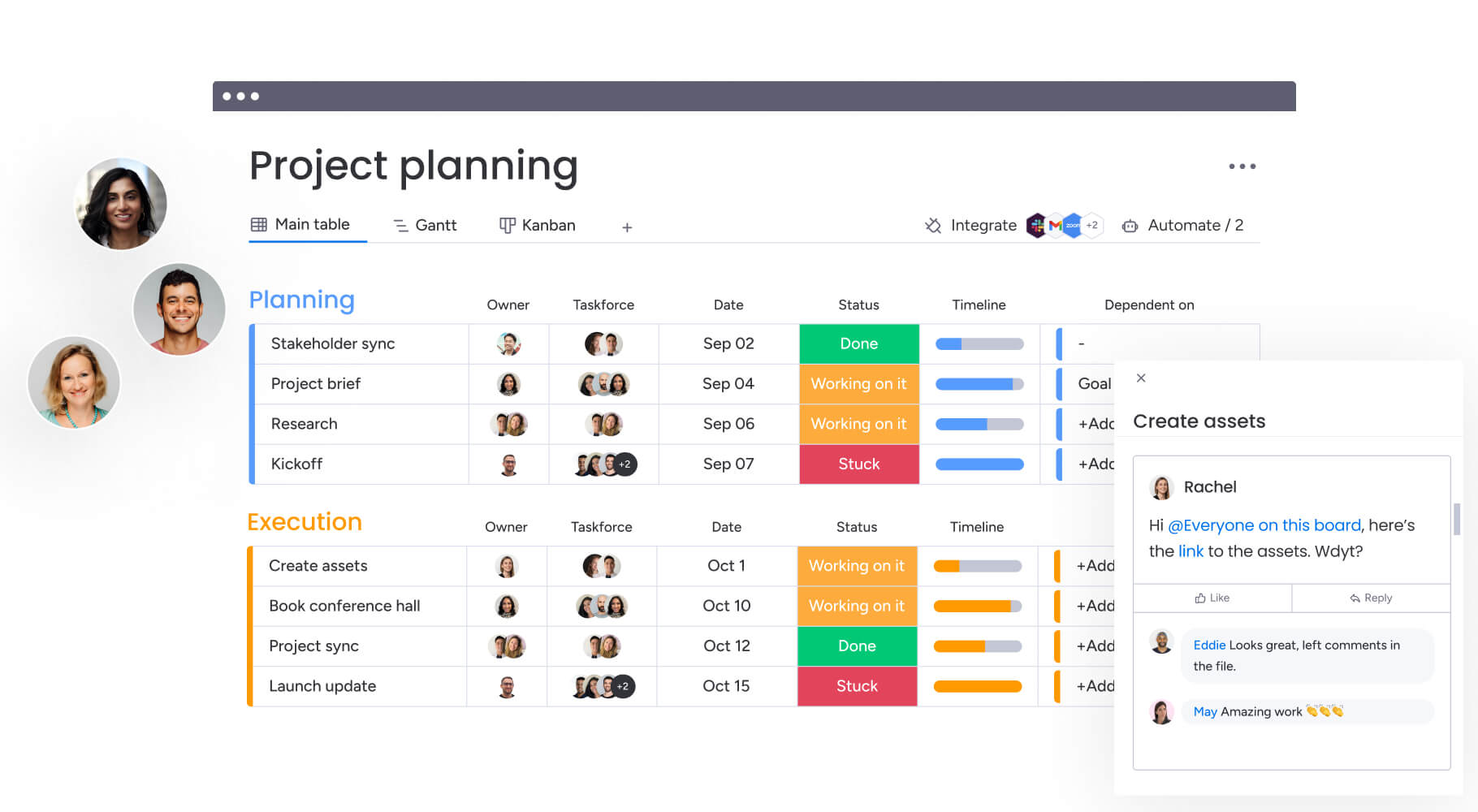
Visuals communicate faster than text and help stakeholders stay engaged. Text-heavy status reports are often ignored, leaving teams out of sync. Visual elements allow stakeholders to understand project health at a glance.
- Gantt charts: Show timeline progression and dependency impacts immediately.
- Progress bars: Provide instant feedback on deliverable completion rates.
- Workload heatmaps: Demonstrate resource constraints without complex spreadsheets.
Modern platforms offer multiple views, including Kanban and Gantt charts, so teams can visualize project plans and data the way they need.
Navigate upward communication successfully
Managing up goes beyond reporting good news. It involves presenting reality to leadership in a way that drives decisions. Successful project managers frame problems alongside proposed solutions, rather than delivering raw complaints — a skill often evaluated in project manager interviews. Timing matters: escalate risks early to preserve trust.
Effective communication requires tailoring format, depth, and focus based on who is receiving the message. A single project update often needs three distinct versions — one size does not fit all.
Lead teams without formal authority
Next, it’s vital to focus on influence.
Most project managers do not have formal authority over the people doing the work. You cannot rely on job titles to move projects forward. You rely on trust.
Leading without authority means earning credibility through your actions, building genuine relationships, and removing obstacles so your team can perform at their best.
Earn trust through reliable execution
Trust is earned by keeping commitments consistently. Following up on action items, clearing blockers, and protecting the team from scope creep establishes credibility. Three behaviors strengthen trust:
- Consistency: Delivering on small promises builds a foundation for trusting bigger decisions.
- Transparency: Admitting unknowns or delays immediately prevents surprises that erode trust.
- Protection: Shielding the team from external political noise lets them focus on execution.
Inspire teams with meaningful purpose
Motivation drives progress during challenges. Teams perform better when they see how their work connects to a larger mission. Linking a coding task to customer experience or a compliance check to brand reputation makes work feel meaningful.
Create psychological safety for innovation
Psychological safety allows team members to share ideas, concerns, or mistakes without fear. This environment encourages risk reporting and creative problem-solving:
- Early risk reporting: Team members report solvable risks before they escalate.
- Creative problem-solving: Ideas emerge that would otherwise be suppressed in fear-based cultures.
Plan strategically while staying flexible
Rigid plans fail in dynamic environments. The best project managers build structured plans that remain adaptable. Strategic flexibility balances direction with adaptability, keeping momentum even amid uncertainty.
Align project goals with business strategy
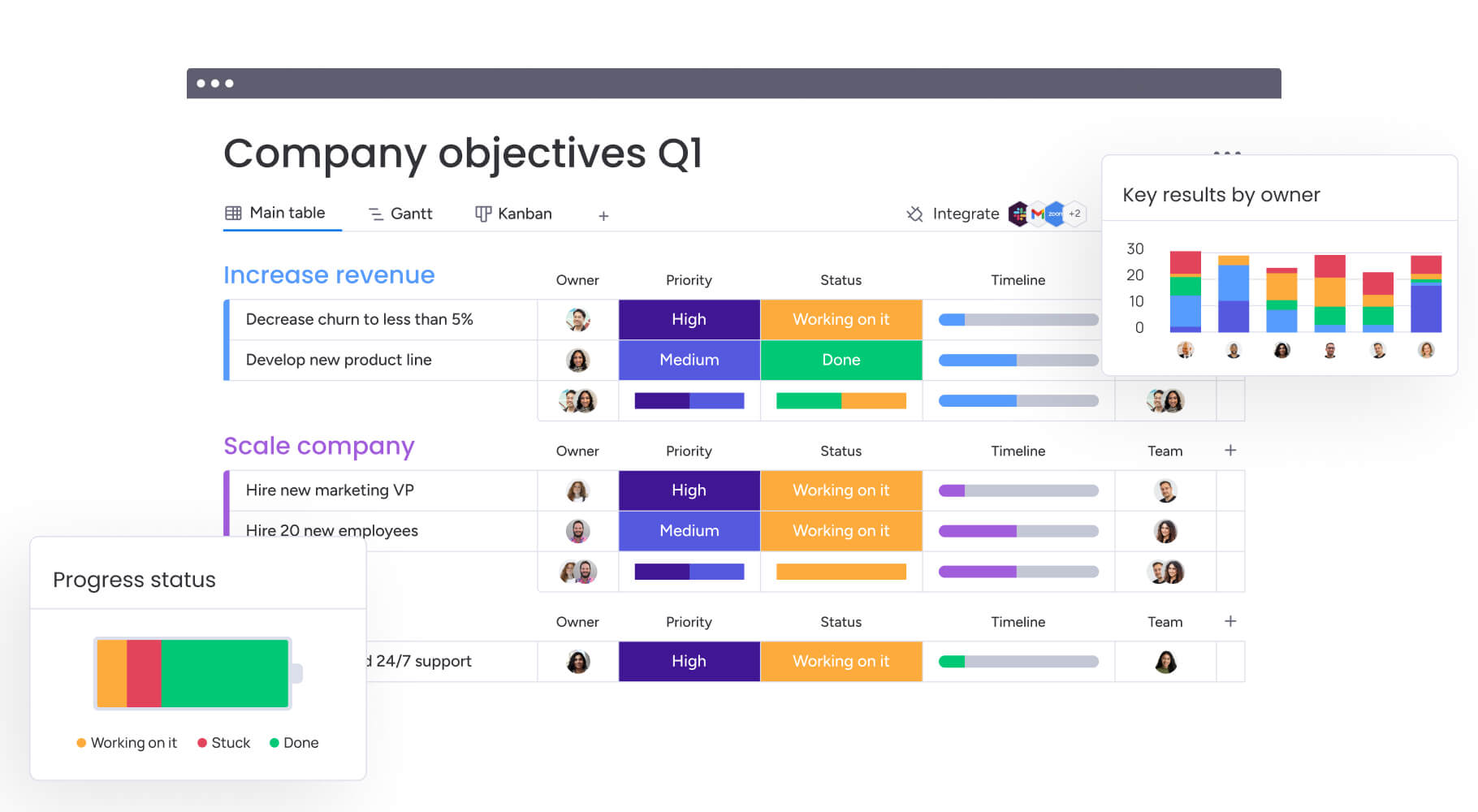
Every project supports a business objective. Strategic alignment ensures projects deliver tangible value. Translating high-level OKRs into actionable deliverables connects work to strategy. When priorities shift, scope is adjusted to stay aligned rather than blindly executing an outdated plan. Teams track progress using Goals & OKRs features on modern platforms.
Build adaptability into every timeline
Timelines based on best-case scenarios often fail. Adaptive planning assumes friction will occur. Methods to build resilience include:
- Buffer management: Add time buffers around critical tasks to absorb minor delays.
- Scenario planning: Create alternative options for high-risk phases to enable rapid pivots.
- Modular design: Divide projects into independent modules so work can continue even if one area is blocked.
Use milestone frameworks for enhanced control
Milestones are more than dates on a timeline. They are structured decision points that help you pause, assess, and choose the right next move. When used intentionally, milestones create control without locking you into rigid plans.
Not all milestones serve the same purpose either. Some confirm delivery, others trigger review cycles, and some validate whether the project is delivering real value. Understanding the distinction helps you respond appropriately at each stage instead of treating every checkpoint the same.
The table below outlines three common milestone types, what they are designed to validate, and the kind of decision each one should prompt.
| Milestone type | Purpose | Decision outcome |
|---|---|---|
| Deliverable-based | Validates completion of a tangible asset | Approval to move to the next production phase |
| Time-based | Reviews progress at set intervals | Reallocation of resources or budget adjustments |
| Value-based | Confirms a specific benefit has been realized | Validation of project strategy or pivot requirement |
Optimize team performance and resources
Even the strongest plan falls apart if the right people are not available at the right time.
Resource management connects strategy to execution. It means balancing workload, skills, and priorities in a way that keeps projects moving while protecting your team’s capacity. When you have clear visibility into who is doing what and how much they can realistically handle, you prevent bottlenecks before they slow everything down.
Balance workloads to maximize productivity
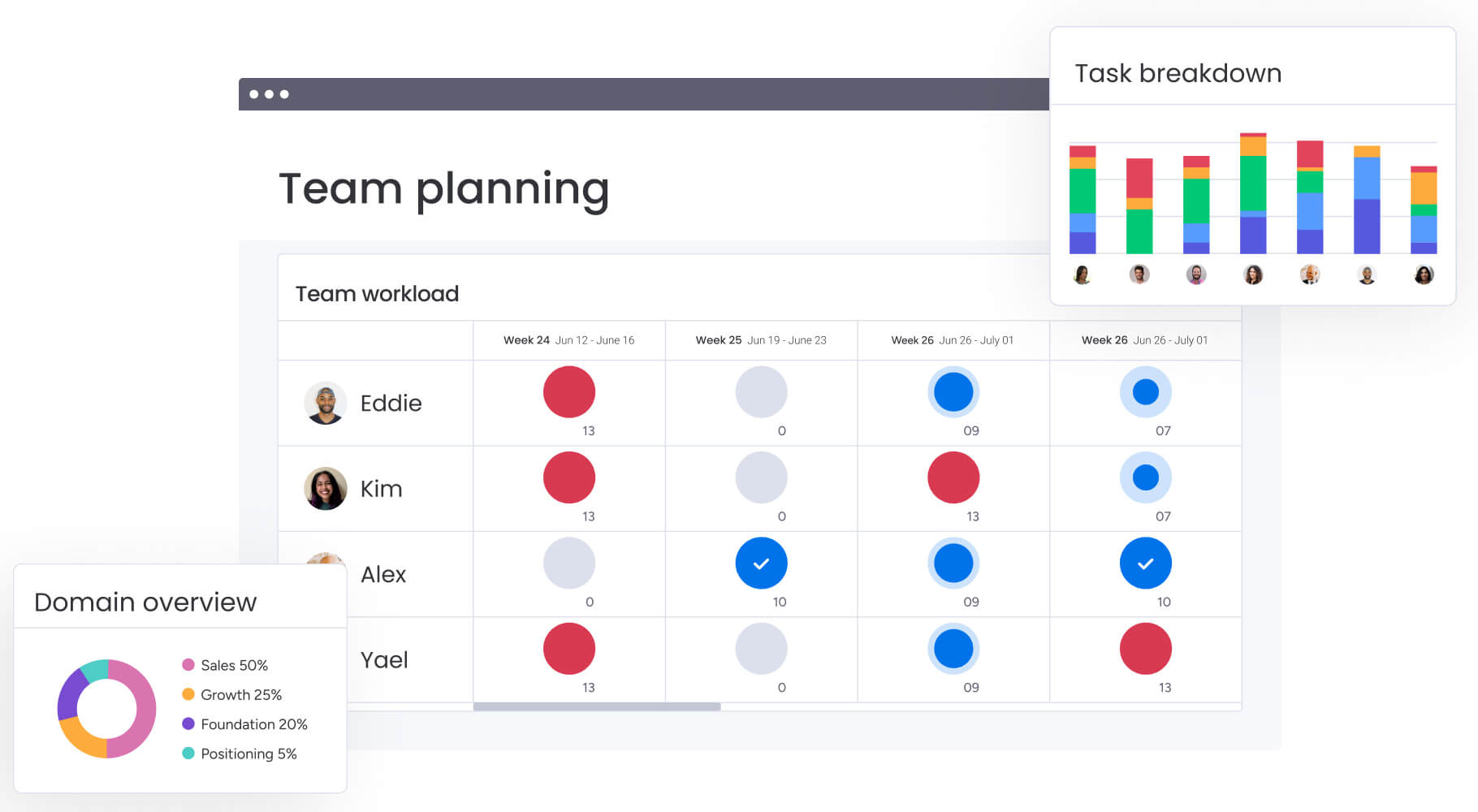
Overloaded teams deliver lower-quality work and risk missing deadlines. Balancing workloads requires seeing total capacity across all projects — not just one. Visualizing team capacity prevents bottlenecks before a single person slows down the entire workflow.
- Capacity planning: Identifying available hours before assigning work prevents immediate overcommitment.
- Conflict resolution: Spotting when key resources are double-booked across multiple projects allows for proactive rescheduling.
- Burnout prevention: Monitoring sustained high utilization rates triggers scope adjustments or additional resource requests.
Views like the Workload View on monday work management allow project managers to balance resources effectively, plan schedules, and adapt to changing priorities while estimating current team capacity.
Match team skills to project requirements
Teams achieve better results when work aligns with both capability and interest — not just availability. Effective managers track current strengths and growth areas, assign stretch assignments for development, and provide stable tasks for those who prefer consistency.
Establish ownership and accountability
Unclear ownership causes most project delays. Clear accountability ensures everyone knows exactly what they are responsible for.
Clear accountability depends on three elements:
- RACI models: Defining who is responsible, accountable, consulted, and informed prevents confusion.
- Explicit deliverables: Defining what “done” means avoids scope creep and endless revision cycles.
- Transparent tracking: Using shared platforms where ownership is visible creates social accountability without micromanagement.
Solve complex problems analytically
Problems will occur, but systematic problem solving distinguishes experienced project managers from beginners. Analytical methods replace intuition with structured inquiry and data, shifting focus from firefighting to prevention.
Apply structured problem-solving frameworks
Relying solely on intuition creates bias and recurring issues. Structured frameworks examine problems thoroughly and identify root causes:
- Root cause analysis (5 Whys): Asking “why” five times uncovers the underlying process failure.
- Fishbone diagrams: Visualizing cause-and-effect relationships identifies contributing factors across people, processes, and technology.
- Impact/effort matrix: Prioritizing solutions based on effort versus value ensures resources focus on the most effective fixes.
Identify patterns through data analysis
Historical project data reveals trends that help predict future risks. If a process consistently runs late, managers can adjust future estimates. AI-powered analytics on monday work management surface trends automatically, highlighting vendors or work types that frequently impact quality.
Learn more: Pareto charts (how they work and when to use them)
Generate creative solutions systematically
Creativity in project management thrives within constraints. Brainstorming with boundaries produces practical, innovative solutions. Managers define the framework so teams can ideate effectively while keeping solutions feasible.
Try monday work management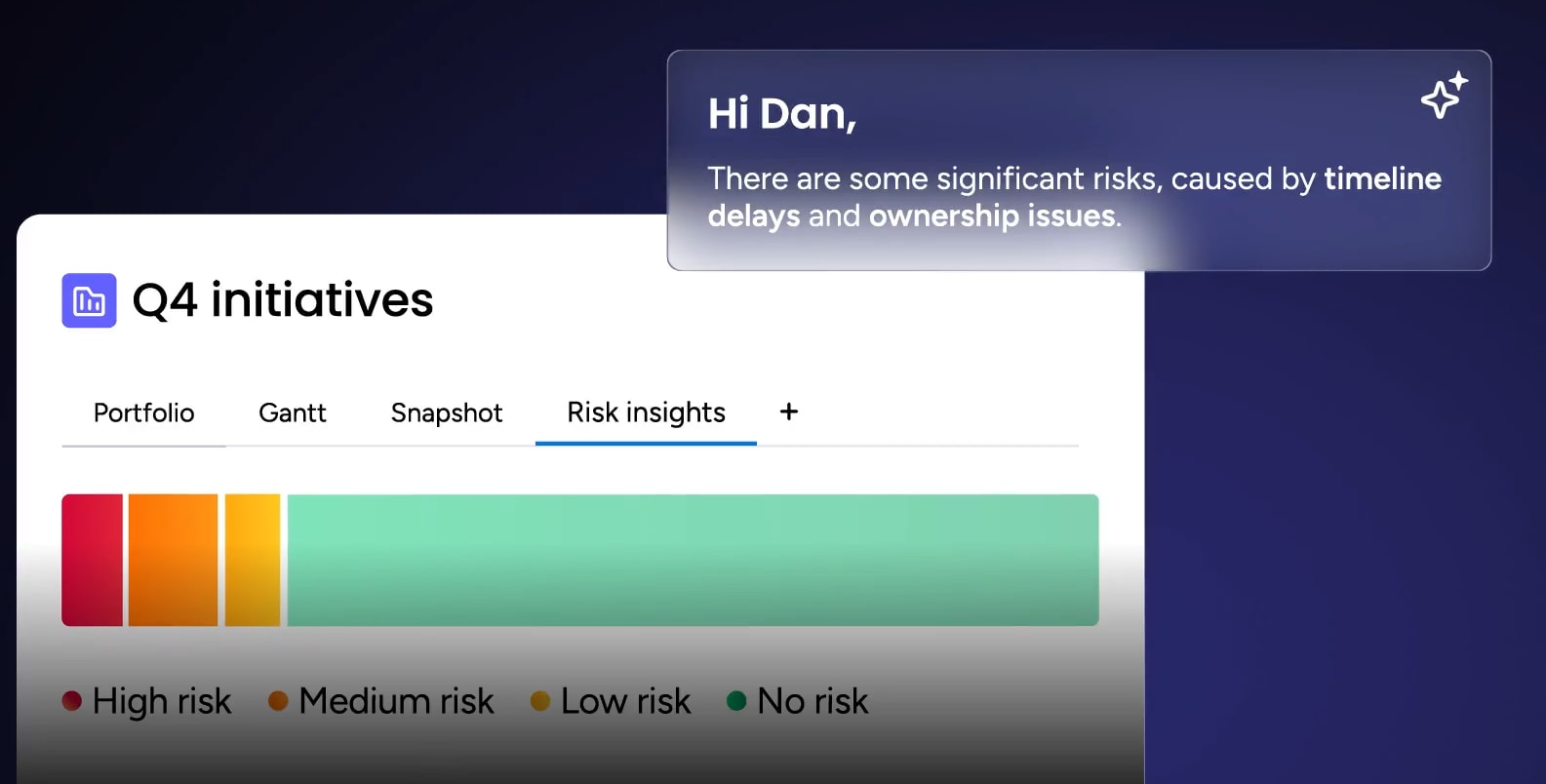
Manage risks before they become issues
Risk management also involves spotting threats before they turn into issues. Risks are potential events; issues are events that have occurred. Keeping risks visible allows organizations to turn uncertainty into a competitive advantage.
Build proactive risk detection systems
Detecting risks requires active monitoring. Regular risk workshops with teams and stakeholders help identify emerging threats.
- Assumption testing: Regularly challenge the assumptions underlying the project plan.
- Pre-mortems: Imagine project failure and work backward to identify potential causes.
- Early warning indicators: Establish metrics that trigger automatic risk reviews.
Portfolio Risk Insights on monday work management scans project boards, flagging potential risks by severity so managers can act quickly without manually reviewing data.
Transform threats into opportunities
Some risks present opportunities. For example, a dependent project delay may free up resources for backlog tasks, or a technology shift could enable faster, cheaper solutions. Effective managers identify these upsides to balance challenges elsewhere.
Create living risk management plans
Risk registers must be continuously updated. Review risks at every status meeting, adjust probabilities and impacts, close mitigated or expired risks, and add new ones as they emerge.
Harness technology and automation
Technology is more than support — it acts as a team member. Automation handles repetitive, low-value work that once consumed a project manager’s day, freeing time for leadership and strategy. Thoughtful technology integration elevates project management from administrative coordination to strategic orchestration.
Automate manual project processes
Routine administrative tasks limit strategic thinking. Automation workflows handle these consistently and instantly. The following areas benefit most from automation:
- Status reporting: Automated data collection compiles progress into reports without manual input.
- Dependency notifications: When one item is complete, the owner of the next item is automatically notified to begin.
- Deadline reminders: Automated nudges alert owners of upcoming due dates, reducing the need for manual follow-ups.
Automations and templates on monday work management save time and accelerate project launches by automating critical work, including templated project boards, approval notifications, reminders, and more.
Integrate platforms for seamless workflows
Silos create friction and errors. An integrated technology ecosystem ensures data flows freely between systems. For example, when a CRM communicates with a project management platform, a closed sale automatically triggers a project launch. When a code repository connects to a work board, commits update status in real time.
Integrations on monday work management connect tools teams already use, such as Microsoft Teams, Gmail, Slack, Jira, and Salesforce, enabling powerful workflows without switching tabs.
Use AI to predict and prevent issues
Artificial Intelligence acts as a predictive engine for project management. AI analyzes historical performance to forecast completion dates more accurately than human estimation. It flags potential resource conflicts in advance and identifies scope creep by analyzing communication patterns.

Make faster decisions with real-time data
Speed and accuracy provide competitive advantages. Relying on gut instinct or outdated spreadsheets increases risk. Real-time data delivers the visibility needed to make confident decisions in the moment. Data-driven decision making shifts project management from reactive problem-solving to proactive opportunity capture.
Define and track meaningful KPIs
Key Performance Indicators (KPIs) must drive actionable insight. Vanity metrics obscure reality, while meaningful KPIs focus on outcomes and health:
- Schedule variance (SV): Measures exactly how far ahead or behind schedule the project is.
- Cost performance index (CPI): Indicates the cost efficiency of completed work.
- Resource utilization rate: Tracks whether the team is over- or under-capacity, signaling burnout or inefficiency.
Build dashboards that drive action
Dashboards act as a cockpit for the project. They provide an at-a-glance view of health and highlight areas needing attention. Effective dashboards use visual hierarchy to draw the eye to exceptions, such as red risk indicators or downward budget trends, allowing project managers to manage by exception rather than reviewing every detail.
Dashboards on monday work management are customizable with 10+ drag-and-drop widgets, enabling teams to view data in ways that support faster, sharper decision making.
Apply predictive analytics for enhanced outcomes
Predictive analytics uses current trends to forecast future states. Instead of asking, “Where are we today?”, it answers, “Where will we be in a month if nothing changes?” This allows managers to intervene before deadlines are missed. For instance, if current velocity predicts a two-week delay at project end, managers can adjust scope or allocate resources while options are still available.

“monday.com has been a life-changer. It gives us transparency, accountability, and a centralized place to manage projects across the globe".
Kendra Seier | Project Manager
“monday.com is the link that holds our business together — connecting our support office and stores with the visibility to move fast, stay consistent, and understand the impact on revenue.”
Duncan McHugh | Chief Operations OfficerLead projects with clarity and impact
Strong project management changes how work gets done across an organization.
When you combine strategic communication, influence, structured problem solving, and the right technology, projects run with fewer surprises and stronger results. Teams understand priorities. Stakeholders stay aligned. Decisions rely on data instead of assumptions.
Improvement comes from deliberate focus. Identify the skill that will create the biggest impact in your current environment and develop it consistently. Use automation to reduce repetitive work so you can concentrate on planning, alignment, and risk prevention.
Organizations that build these capabilities across their project managers see faster delivery, higher quality outcomes, and stronger team engagement. Project leaders who align people, processes, and data will continue to drive results as complexity increases.
Try monday work managementFrequently asked questions
What are the 5 C's of project management?
The 5 C's are Complexity, Criticality, Compliance, Culture, and Compassion. They help project managers evaluate the project environment and determine how much structure is needed and how to lead the team effectively.
What is the 80/20 rule in project management?
The 80/20 rule, or Pareto Principle, states that 80% of project value comes from 20% of the work. It helps managers prioritize the vital few activities that drive most progress.
What certifications help you become a project manager?
Certifications vary by methodology. The PMP (Project Management Professional) is widely recognized for traditional approaches, while the CSM (Certified ScrumMaster) or PMI-ACP are valuable for agile environments.
How long does it take to become a good project manager?
Basic competency typically takes one to two years of active project leadership. Mastering strategic and soft skills for senior roles often takes five or more years.
What's the difference between a project manager and a project coordinator?
A project coordinator focuses on administrative support and logistics under supervision. A project manager is accountable for project success, makes strategic decisions, and leads the team.
Can you be a good project manager without technical skills?
Yes. While technical fluency helps estimate effort, identify risks, and ask the right questions, deep technical skills are not required to succeed in project management.

 Get started