


Marketing teams at financial institutions face unique operational challenges. Managing 50–100+ people across content, creative, acquisition, and events requires more than basic project tracking. Leaders need visibility into who is working on what, the ability to balance workloads, and clear reporting to demonstrate impact.
Large-scale marketing operations in finance also demand compliance workflows that don’t slow execution. Multi-stage approvals, regulatory audits, and cross-department coordination create complexity that spreadsheets and simple project trackers can’t handle. Without a centralized system, campaigns risk delays, bottlenecks, and missed KPIs.
Advanced work management solutions provide centralized campaign visibility, automated approval workflows, and real-time insights into team capacity and performance. These platforms help marketing leaders maintain momentum while staying compliant and aligned with strategic objectives.
Key takeaways
Marketing operations in financial services face unique challenges that require visibility, compliance, and cross-team coordination. The following insights summarize the critical factors for managing large-scale marketing teams effectively:
- Centralized visibility improves decision-making: having a single source of truth for campaigns, team workloads, and performance metrics reduces manual tracking and enables faster, more informed decisions.
- Resource planning prevents team burnout: monitoring capacity and strategically balancing workloads ensures that marketing teams can handle multiple campaigns without overcommitment or stress.
- Compliance workflows maintain speed and accuracy: automated multi-stage approval processes with audit trails allow teams to meet regulatory requirements without delaying campaign execution.
- Real-time reporting drives accountability: live dashboards that track campaign ROI, budget utilization, and team performance provide actionable insights for leadership and improve operational transparency.
- Work management platforms transform operations: implementing tools designed for complex marketing teams, such as monday work management, supports centralized planning, automated workflows, and seamless collaboration across functions.
What makes heads of marketing choose monday work management for marketing operations in finance?
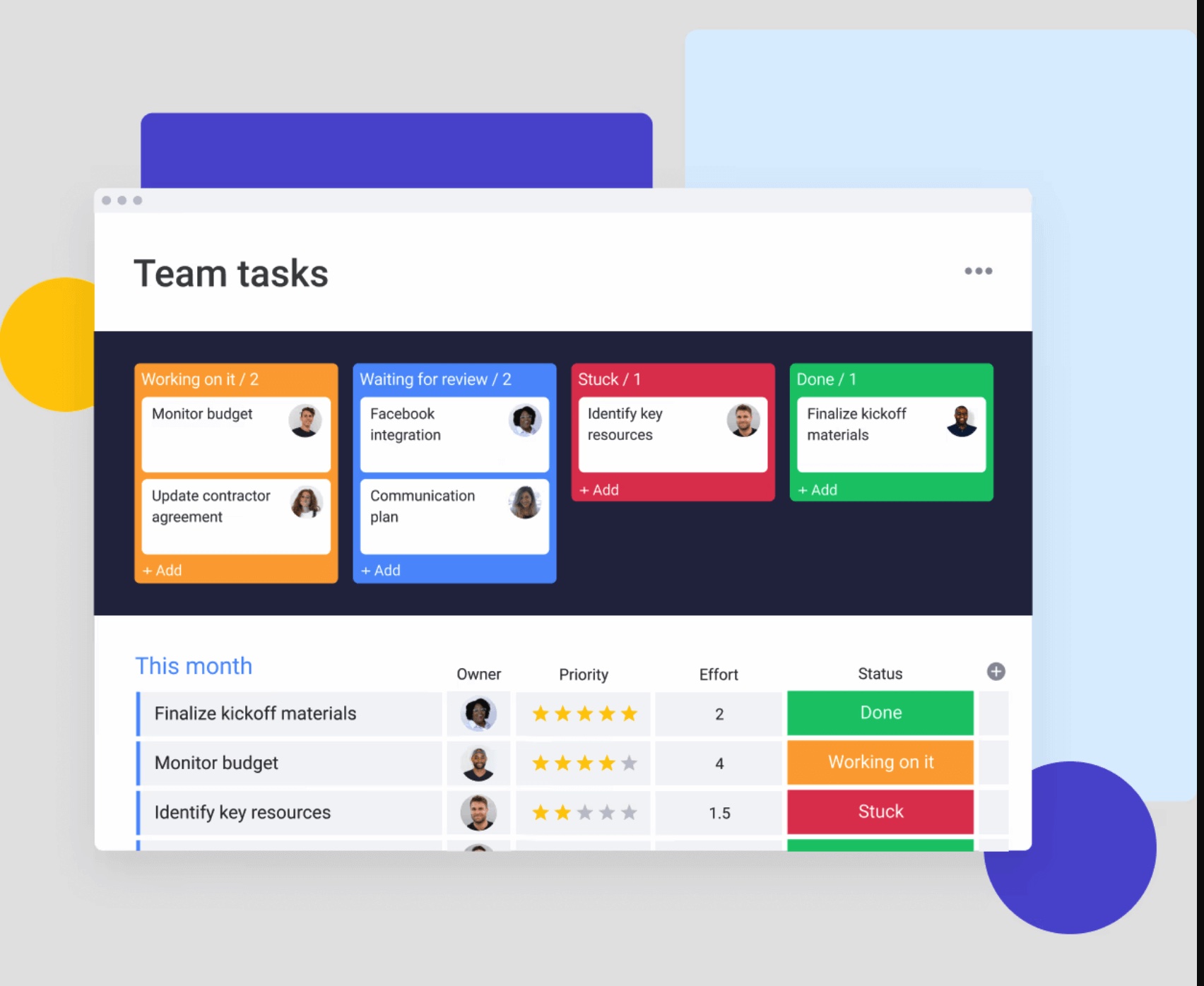
Managing a 50–100+ person marketing team at a financial institution requires balancing compliance requirements, multi-stage approval processes, and the pressure to deliver measurable results quickly. Teams coordinate across content, creative, acquisition, events, and operations while maintaining the standards that financial services demand.
The challenge goes beyond managing projects, it is about gaining visibility across the entire marketing organization. When work is scattered across spreadsheets and disconnected systems, it is difficult to see who is overloaded, which campaigns require attention, or how to communicate marketing’s impact to leadership. A platform that provides real-time insight becomes essential.
Financial services marketing leaders need more than basic project management. They need a centralized solution that standardizes workflows, ensures compliance, and maintains operational speed. Companies such as Genpact have transformed their marketing operations using monday work management, improving cross-team collaboration by 40% and eliminating spreadsheets entirely.
monday work management top features for marketing operations in finance
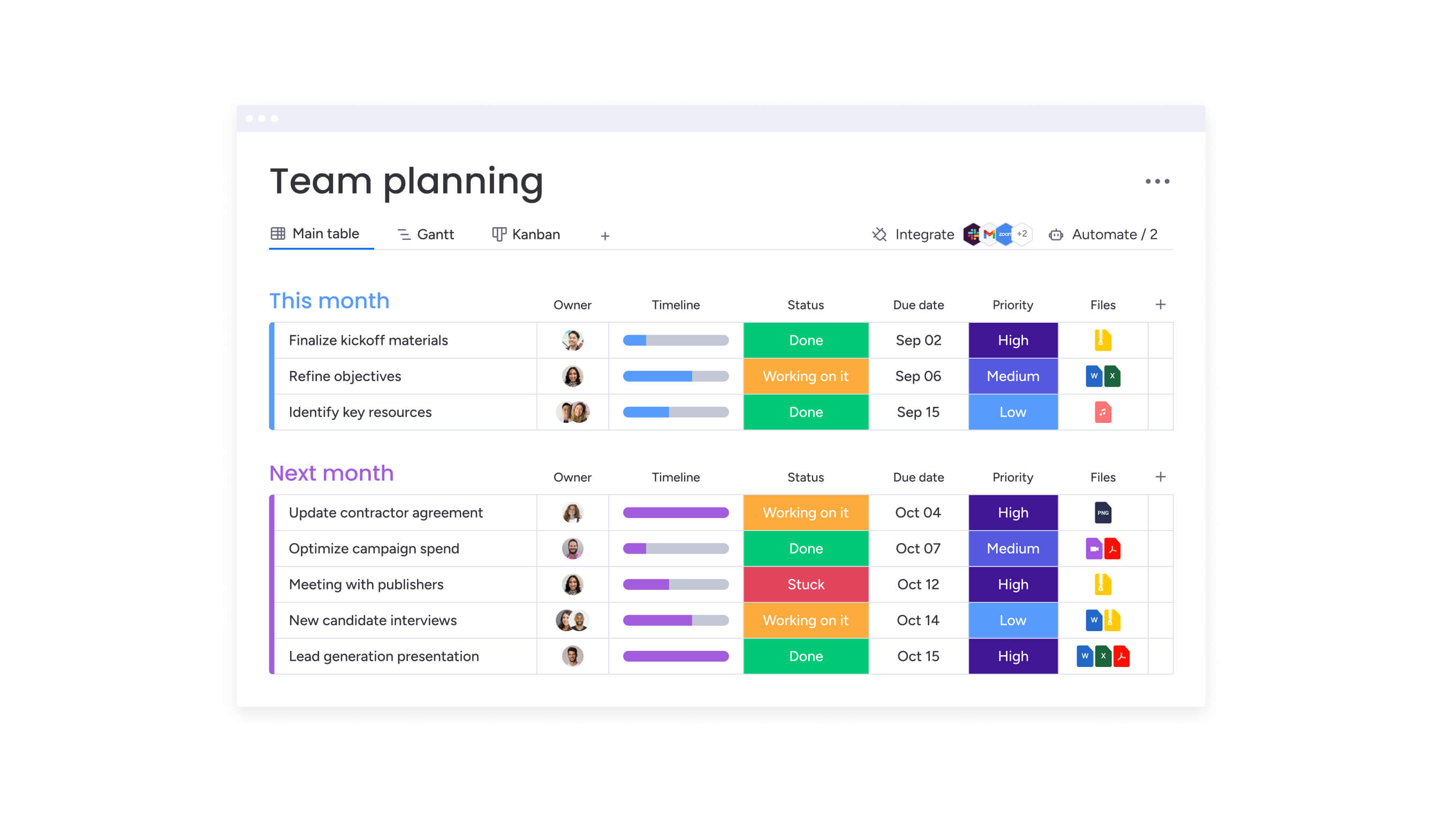
These capabilities address the core challenges of running marketing in financial services, delivering measurable improvements in visibility, compliance, and team performance.
Campaign management
Running 20+ campaigns simultaneously across multiple channels requires more than spreadsheets. Leaders need a single source of truth to track progress, budgets, and ROI.
Platforms like monday work management provide a centralized view to monitor campaign progress, measure KPIs, and report insights to executives automatically. Marketing teams can:
- Track MQL-to-Customer rates across all campaigns.
- Monitor campaign ROI in real-time.
- Provide executive leadership with data-driven insights.
- Access all campaign information from a single source of truth.
Resource management and workload balancing
Understanding who’s working on what, and whether they have capacity for new requests. is essential when managing large marketing teams, which often requires a guide to task management to optimize resource allocation. Without visibility into team bandwidth, you risk burnout on one side and underutilization on the other.
The Workload view in monday work management shows exactly who’s over capacity and where bottlenecks are forming across your organization. This real-time visibility enables strategic resource allocation, helping you balance workloads across content, creative, and acquisition teams while ensuring critical campaigns get the resources they need.
Marketing leaders use these capabilities to prevent the burnout that comes from poor resource planning. Key benefits include:
- Capacity visibility: see each team member’s current assignments and availability.
- Early warning system: flag capacity issues before they impact deadlines.
- Strategic allocation: make informed decisions about new project assignments.
- Burnout prevention: ensure teams deliver without overcommitting.
Compliance and approval workflow automation
Financial services marketing requires multiple approval stages, from legal and compliance reviews to executive sign-offs. These approval chains often become bottlenecks that delay campaign launches and frustrate teams trying to move at market speed.
monday work management enables you to build automated approval workflows that meet regulatory requirements while maintaining momentum. Multi-stage approval processes include clear ownership, automated notifications, and complete audit trails that satisfy compliance needs without manual tracking.
The platform’s forms and automation features formalize brief submission and approval processes. When new requests come in:
- The right stakeholders receive notifications automatically.
- Reviewers can see where requests stand in the queue.
- Teams understand realistic turnaround times.
- Complete audit trails maintain compliance documentation.
This provides full transparency into approval workflows while maintaining the rigor financial services requires.
Dashboards and real-time reporting
Demonstrating marketing’s contribution to business goals requires more than monthly reports cobbled together from multiple systems. You need real-time insights into campaign performance, resource utilization, and strategic alignment.
monday work management’s dashboards connect data from across your marketing organization, providing both pre-built and custom views of what matters most. Track campaign ROI, monitor CAC trends, measure team productivity, and analyze time-to-launch metrics, all with live data that updates automatically.
This changes the game when you’re presenting to the C-suite:
- Automated reporting: no more hours spent building monthly reports.
- Portfolio insights: show marketing’s impact on revenue and customer acquisition.
- Trend analysis: filter data to uncover patterns and identify bottlenecks.
- Strategic decisions: make data-driven choices based on real performance metrics.
Cross-functional collaboration tools
Marketing in financial services requires constant coordination with legal, product, compliance, and finance teams. When these interactions happen through email chains and disconnected systems, work slows down and visibility disappears.
The platform’s collaboration features, including shared documents, mentions, comment threads, and file sharing, keep all stakeholders aligned without endless meetings. Teams can work together on briefs, provide feedback on creative assets, and track approvals in one centralized workspace.
This unified approach solves the challenge of siloed teams and unclear ownership:
- Clear responsibility: everyone can see who’s responsible for what.
- Status visibility: track where work stands in real-time.
- Connected workflows: understand how individual pieces connect to broader campaigns.
- Improved satisfaction: faster execution with fewer misunderstandings.
Marketing operations and process standardization
Scaling marketing operations across teams requires consistency without rigidity. Standardized workflows allow teams to adapt processes without starting from scratch.
monday work management provides templates, automations, and governance tools that standardize workflows while maintaining agility. Create templated project boards for campaign types, automate recurring activities, and establish best practices that scale across your organization.
Marketing leaders use these capabilities to drive operational efficiency without creating rigid processes that slow teams down:
- Template library: standardize repeatable work like creative requests and campaign planning.
- Automated workflows: reduce manual process work.
- Scalable practices: establish best practices that work across teams.
- Strategic focus: spend more time on strategy and creativity, less on process.
How a head of marketing in finance benefits from monday work management
Implementing monday work management delivers immediate and long-term advantages. Teams save time by reducing manual updates and email follow-ups. Resource allocation becomes more efficient, eliminating redundant tools and improving ROI.
Compliance is simplified through automated workflows and audit trails, allowing marketing teams to meet regulatory requirements without slowing down campaigns. Productivity gains are measurable: cross-team collaboration improves by 40%, project timelines drop by 25%, and output quality increases as teams focus on high-value work.
Visibility into campaigns, team capacity, and budgets enables leaders to make strategic, data-driven decisions. With enhanced oversight, financial services marketing teams can deliver more campaigns with consistent quality while clearly demonstrating marketing’s impact to executives.
How to manage marketing operations in finance with monday work management
Rolling out monday work management across a financial marketing team requires careful planning, especially when balancing regulatory compliance, team scalability, and cross-team collaboration. The roadmap below demonstrates how marketing operations can be transformed while maintaining the rigorous standards the finance industry demands.
Step 1: centralize all campaigns and marketing initiatives
Begin with a master marketing calendar that consolidates campaigns, activations, and initiatives across the organization. This calendar serves as the single source of truth for all marketing efforts.
Use hierarchy views to show how programs, campaigns, and individual activations relate. Leadership gains a high-level perspective for strategic decisions, while teams can access the detailed information needed for execution.
Key implementation actions:
- Build a comprehensive campaign calendar with all marketing activities.
- Configure hierarchy views for different stakeholder needs.
- Establish naming conventions and categorization standards.
- Connect related campaigns and initiatives for portfolio visibility.
This centralized approach immediately improves visibility and reduces the time spent in status meetings.
Step 2: standardize compliance and approval workflows
Financial services marketing can’t compromise on compliance, but that doesn’t mean accepting slow approval processes. Build your approval workflows using forms and automation to create a standardized process that works at scale.
Configure multi-stage approvals that route requests to the right stakeholders automatically. Each person in the chain receives notifications when action is needed, can see the full context of the request, and understands where it sits in the queue.
Implementation steps:
- Map your current approval processes and identify bottlenecks.
- Design automated workflows that route to appropriate stakeholders.
- Configure notifications and status updates for transparency.
- Build audit trails that satisfy compliance documentation requirements.
This transparency eliminates the guesswork around approval timelines while maintaining the audit trails compliance requires.
Step 3: implement resource planning and workload management
Use the Workload feature to track capacity across teams and individuals. This ensures critical work is resourced appropriately and prevents overloading team members.
Set automated alerts to notify when capacity limits are approaching. This allows leaders to redistribute work proactively and make informed decisions about priorities.
Key configuration elements:
- Capacity tracking: set realistic capacity limits for each team member.
- Alert systems: configure notifications when teams approach limits.
- Rebalancing workflows: create processes for redistributing work.
- Reporting dashboards: track utilization trends and patterns.
The result is more predictable delivery and happier teams.
Step 4: connect your martech stack and financial systems
Marketing and financial systems hold critical data that must be integrated. Use monday work management’s native integrations to link CRM, marketing automation, analytics, and financial reporting platforms.
Automate workflows to sync data across systems, eliminating manual entry and ensuring consistent information. Campaign performance flows seamlessly from execution to reporting dashboards, freeing time for strategic analysis.
Integration priorities:
- CRM systems: sync lead and customer data for campaign tracking.
- Marketing automation: connect campaign execution with planning.
- Analytics platforms: automate performance data collection.
- Financial systems: link budget and spend tracking.
Step 5: build executive dashboards for leadership reporting
Create dashboards that track metrics important to executive leadership. Focus on campaign ROI, customer acquisition cost, MQL-to-customer conversion rates, and budget utilization to demonstrate marketing impact.
Set dashboards to update automatically and provide insights on a leadership-friendly schedule. This reduces the need to compile manual reports or justify marketing spend without data.
Dashboard components:
- Campaign performance: ROI, conversion rates, and attribution metrics.
- Resource utilization: team capacity and productivity indicators.
- Budget tracking: spend vs. plan across campaigns and channels.
- Strategic alignment: progress against marketing objectives and KPIs.
The platform provides the evidence you need to show marketing’s contribution to business goals.
Step 6: scale with templates and continuous optimization
Develop templates for recurring campaign types, creative requests, and reporting needs. Templates improve consistency while allowing customization for unique requirements.
Regularly refine templates and workflows based on performance data and team feedback. Adjustments help maintain efficiency as market conditions and channels evolve.
Optimization framework:
- Template development: create standardized workflows for common activities.
- Performance monitoring: track efficiency and effectiveness metrics.
- Feedback collection: gather input from teams using the workflows.
- Iterative improvement: refine processes based on data and feedback.
The platform’s flexibility means you can iterate without disrupting ongoing work.
Comparison table: monday work management vs. competing platforms for marketing operations in finance
| Feature | monday work management | Asana | Wrike |
|---|---|---|---|
| Campaign management views | Kanban, Gantt, Calendar, Timeline, Workload, Dashboard | Board, List, Timeline, Calendar | Board, Table, Gantt, Calendar |
| Compliance workflow automation | Advanced multi-stage approvals with audit trails | Basic approval workflows | Custom request forms with approvals |
| Resource management | Built-in Workload view with capacity planning | Workload (Business+ only) | Resource management (add-on) |
| Financial services integrations | 200+ native integrations including financial systems | 100+ native integrations | 400+ integrations |
| Real-time dashboards | Unlimited custom dashboards with AI-powered insights | Limited dashboards (Business+ only) | Custom dashboards (higher tiers) |
| Price per user/month | $12-$24 (Standard to Pro) | $13.49-$30.49 | $10-$24.80 |
| Implementation time | Less than four months | two to four months typical | three to six months typical |
| G2 rating | 4.7/five (12K+ reviews) | 4.3/5 | 4.2/5 |
| Team size support | Unlimited users, optimized for 50-100+ teams | Best for smaller teams | Scales well for enterprise |
| Compliance features | Enterprise-grade security, SOC 2, GDPR, audit logs | SOC 2, GDPR compliant | SOC 2, GDPR, HIPAA |
How Genpact's global marketing team transformed their campaign operations
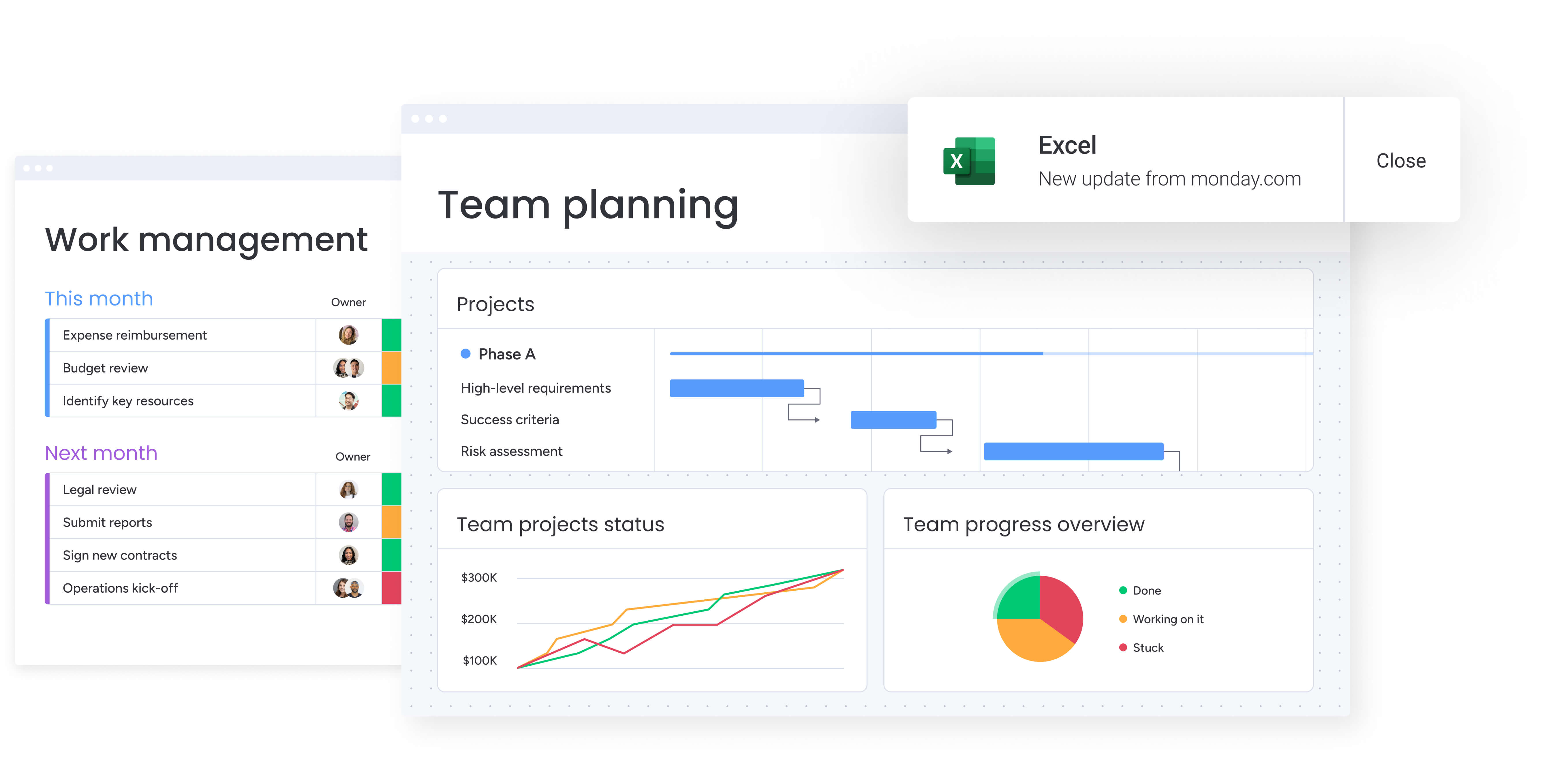
Genpact manages 24 large-scale campaigns with multiple cross-channel activations. Previously, spreadsheets, emails, and SharePoint folders fragmented visibility, making it difficult to track campaign progress.
The solution involved creating a unified platform for campaign planning and execution. Workflows defined the full activation process for each channel, tracking target and actual completion dates. Forms and automation standardized brief submission and approvals, providing team members and managers with complete visibility into request status.
The results were significant:
- 40% improvement in cross-team collaboration.
- Complete elimination of spreadsheets from marketing operations.
- 25% reduction in email exchanges.
- Real-time visibility into campaign timelines and bottlenecks.
Teams can now accurately track campaign progress and identify areas needing adjustment, capabilities impossible under the previous fragmented system.
Ready to transform your marketing operations?
Marketing in financial services is complex: large teams, multiple campaigns, strict compliance requirements, and cross-functional coordination. Traditional project management tools struggle to keep pace. monday work management provides a unified platform that centralizes campaign management, automates compliance workflows, and gives real-time visibility into team capacity and performance.
With monday work management, heads of marketing can:
- Gain full organizational visibility: track campaigns, team workloads, and performance metrics from a single platform.
- Prevent burnout: balance workloads across 50–100+ team members using strategic resource planning.
- Automate compliance: create multi-stage approval workflows with audit trails that satisfy financial regulations without slowing execution.
- Demonstrate ROI to leadership: dashboards provide data-driven insights into campaign impact, resource utilization, and budget adherence.
- Unify your martech stack: integrate CRM, analytics, and financial reporting systems for seamless operations.
Organizations like Genpact have seen measurable results, including a 40% improvement in cross-team collaboration, complete elimination of spreadsheets, and real-time visibility into campaign timelines. monday work management doesn’t just track work — it transforms marketing operations, enabling teams to execute efficiently, stay compliant, and demonstrate clear business impact.
Frequently asked questions
How does monday work management handle financial compliance requirements?
monday work management provides enterprise-grade security protocols including SOC two Type II certification, GDPR compliance, IP restrictions, and two-factor authentication. The platform maintains detailed audit trails for all approval workflows, enabling you to demonstrate compliance with financial services regulations. You can configure custom approval chains that route through legal, compliance, and finance teams with automated notifications and complete documentation.
What is the typical implementation timeline for a 50-100+ person marketing team?
According to Forrester's Total Economic Impact™ study, organizations achieve value from monday work management in less than four months. Marketing teams specifically report becoming comfortable with the platform within two weeks to one month. The intuitive interface and pre-built marketing templates accelerate adoption, while dedicated customer success support helps larger teams roll out standardized workflows efficiently.
Can monday work management integrate with financial reporting systems?
Yes, monday work management offers 200+ native integrations and an open API for connecting with financial reporting systems, ERP platforms, and martech tools. You can integrate with Salesforce, HubSpot, Google Workspace, Microsoft Teams, and build custom connections for proprietary financial systems. These integrations enable automated workflows that sync campaign data, budget information, and performance metrics across your technology stack.
How do you measure ROI from marketing work management software?
Organizations track ROI through multiple metrics including time savings (like Genpact's 25% reduction in email exchanges), cost savings (FARFETCH saves $118K monthly), and productivity improvements (40% better collaboration). The platform's dashboards track campaign ROI, CAC, MQL-to-Customer rates, budget adherence, and team productivity, providing the data needed to demonstrate marketing's contribution to business goals.
What security certifications should finance companies look for?
Financial services organizations should require SOC two Type II certification, GDPR compliance, ISO 27001 certification, and industry-specific compliance capabilities. monday work management provides all of these, plus IP restrictions, multiple SSO options, tenant-level encryption, and granular permission controls. The platform also offers dedicated security support and regular audits to meet financial institution requirements.
How much does enterprise task management software cost for marketing teams?
monday work management pricing ranges from $12 to $24 per user per month for Standard and Pro plans when billed annually. For a 50-person marketing team, this translates to $600-$1,200 monthly. Enterprise plans with advanced security features and custom implementations are available with tailored pricing. The platform delivers 346% ROI over three years according to Forrester, with no hidden fees for essential features like automations or dashboards.

 Get started