


Imagine unifying 50+ marketing professionals into a single, high-impact force. While your teams in content, creative, and acquisition excel at their craft, the real challenge is orchestrating their efforts to deliver the clear ROI metrics your CFO demands (all while navigating complex compliance requirements).
The challenge isn’t strategy or talent. It’s coordination. Marketing leaders in finance need platforms that connect scattered teams into unified execution while providing the visibility and control that executive leadership expects. The best project management software for marketing heads in finance goes beyond work tracking to enable resource optimization, standardized workflows, and real-time performance measurement across all marketing functions.
Let’s dig into what actually works for large marketing teams in financial services. We’ll cover the essentials — from campaign management to resource planning — and share how leading companies completely transformed their global marketing operations by bringing everything under one roof.
Key takeaways
- Unified visibility: marketing leaders gain a single source of truth that connects campaigns, creative work, and performance data.
- Resource optimization: teams balance workloads and assign work based on skills and availability to improve delivery quality.
- Compliance-ready workflows: standardized processes and approval paths reduce risk and maintain regulatory alignment.
- Real-time performance insight: dashboards track CAC, ROI, and conversion metrics to support data-driven decisions.monday work management impact: the platform unifies teams, automates workflows, and provides the enterprise controls finance organizations require.
Why do marketing leaders in finance trust monday work management?
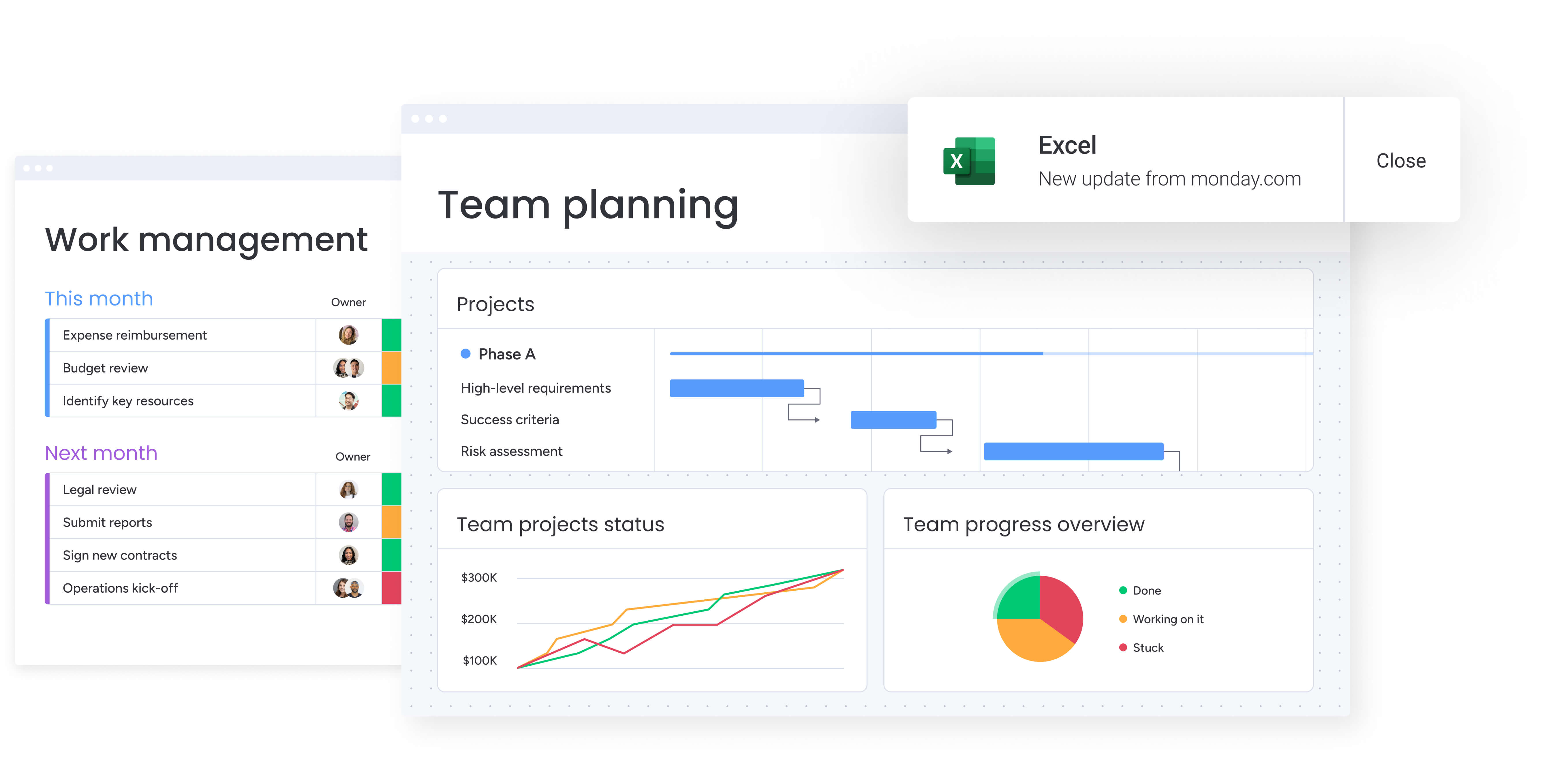
Marketing leaders in finance juggle incredible complexity. You’ve got 50 to 100+ team members spread across content, creative, acquisition, events, and operations. Each group has their own tools and priorities, creating a coordination nightmare.
The result? Disconnected execution and project management challenges that make it nearly impossible to track campaign ROI or demonstrate marketing’s impact to finance-focused leadership.
Sophisticated platforms like monday work management solve this fundamental challenge by connecting siloed teams into one unified workspace. Instead of teams reinventing workflows and operating in isolation, the platform provides three core capabilities that transform marketing operations:
- Standardized templates and automation: scale best practices across all marketing functions while maintaining flexibility for unique team needs.
- Real-time visibility: track campaign progress, resource allocation, and performance metrics from a single source of truth.
- Defined ownership and accountability: define who owns what at every stage, from creative briefs to campaign launches.
What also sets the platform apart is how it connects execution to strategy. Marketing leaders can track campaign ROI, CAC, and conversion rates through customizable dashboards that translate activity into executive-ready insights.
There’s a reason Gartner® named monday as a leader in their 2024 Magic Quadrant™ for Marketing Work Management: the platform is built to handle the rigorous demands of enterprise teams.
monday work management top features for enterprise marketing operations
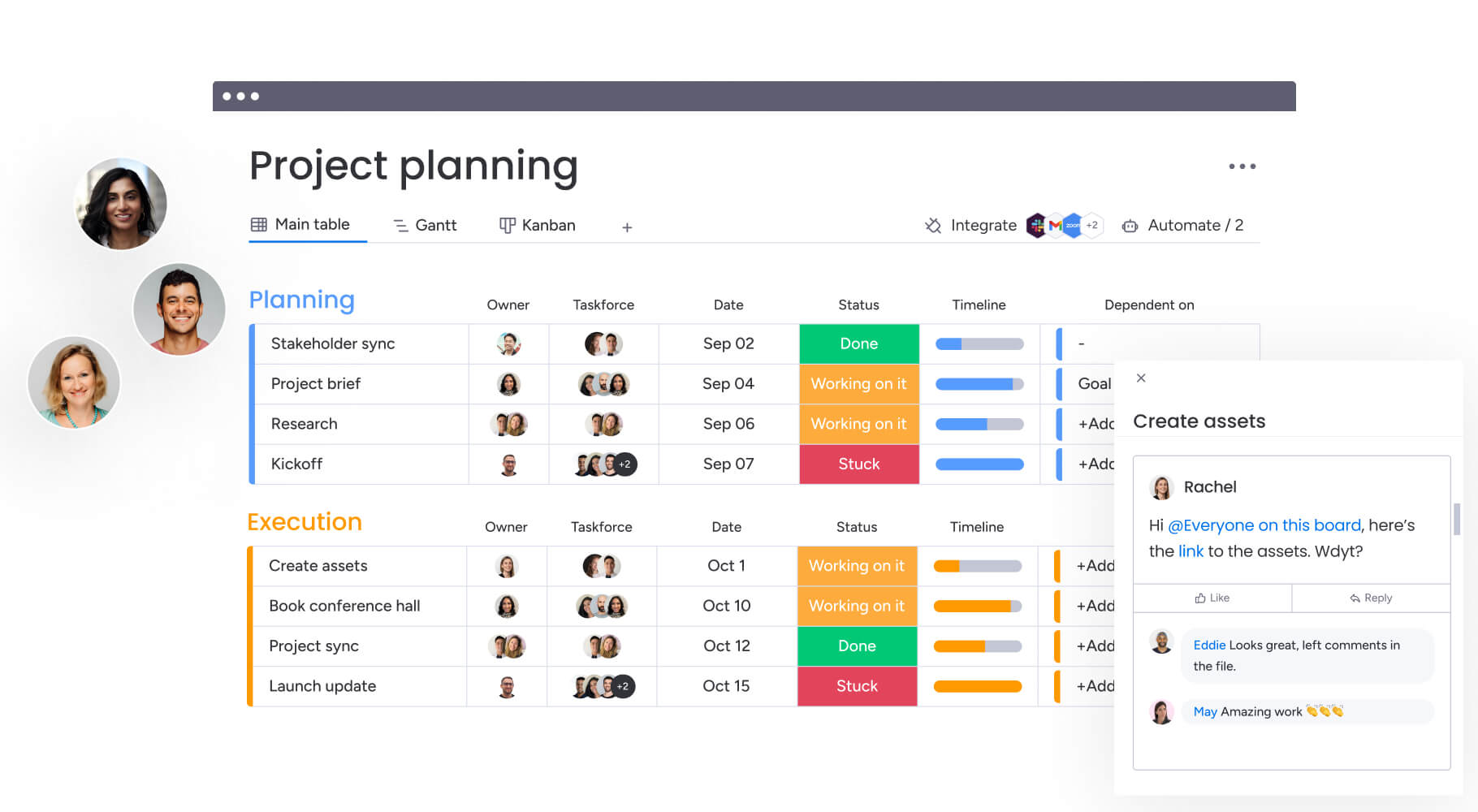
These six features touched on below solve the daily headaches of running a large marketing team in finance: from keeping everyone aligned to proving your department’s value to the C-suite.
Campaign management
Campaign management turns scattered marketing activities into a clear, coordinated plan of action. Teams can make a WBS to break down tasks, then plan, execute, and track campaigns across regions from one centralized location. Visual calendars and timelines reveal what’s in flight, what’s coming next, and where dependencies may slow progress.
For marketing leaders in finance, this level of visibility is transformative. You can move from high-level planning to execution with confidence by monitoring every stage in real time and ensuring no work falls through the cracks.
Key advantages include:
- Lifecycle clarity: see campaigns from initial planning through execution with full transparency.
- Dependency tracking: understand how creative, content, and acquisition timelines impact one another.
- Deadline awareness: monitor progress and identify risks before they affect delivery.
The real breakthrough is understanding how each campaign drives business results. Campaigns connect directly to company goals, allowing you to show exactly how marketing contributes to revenue and growth. This alignment supports faster, more informed decisions about resource allocation and shifting priorities as market conditions evolve.
Resource planning and workload management
Resource planning becomes manageable when you can see everything in one place, especially with the help of resource management software. The Workload View displays team capacity at individual and team levels, making it immediately obvious who’s overloaded and who has bandwidth for new projects. This visibility extends across all marketing functions — from creative production to event coordination.
The platform’s Resource Planner goes deeper, allowing you to assign work based on skills, roles, and availability. You’re not just balancing workloads; you’re optimizing talent allocation to ensure the right people work on the right priorities. This strategic approach to resource management prevents the burnout and missed deadlines that plague large marketing departments.
For finance-sector marketing teams, where compliance and accuracy are critical, proper resource allocation ensures quality doesn’t suffer under pressure. Teams maintain consistent delivery even during peak periods like product launches or regulatory announcements, often aided by complementary product management software to streamline cross-functional coordination.
Dashboards and reporting
Dashboards cut through the noise and highlight the metrics that matter most for proving marketing impact. Build custom views that track ROI, CAC, MQL-to-Customer rates, budget adherence, and team productivity — all updated in real time.
Key advantages include:
- Live performance visibility: see campaign progress and financial impact as work moves forward.
- Custom metrics: track the KPIs that matter to your marketing and finance teams.
- Trend awareness: spot shifts in performance early and adjust plans proactively.
AI-powered portfolio reports elevate this further by generating executive summaries with trends, risks, and recommendations. Leaders can filter data, catch early warnings, and make decisions that optimize spend and outcomes.
Automations and templates
Standardization at scale happens through managed templates and intelligent automation. Create templated project boards for recurring campaign types — product launches, webinars, content series — complete with predefined stages, approval workflows, and automated notifications.
Further, when you update a template, those changes can cascade across hundreds of active projects.
Automation recipes eliminate manual coordination by handling repetitive tasks:
- Status change triggers: automatically move tasks through stages and notify stakeholders.
- Deadline alerts: send reminders before due dates to prevent delays.
- Approval requests: route assets to reviewers without manual intervention.
These capabilities are especially valuable for marketing teams in finance, where consistency and compliance matter. Templates ensure every campaign follows approved processes, while automations maintain audit trails and approval chains without slowing execution.
Creative production and approval workflows
Creative production flows smoothly when everyone knows their role. The platform’s intake forms capture creative requests with all necessary details, automatically creating work items in the creative queue with defined priorities and deadlines. This structured approach eliminates the chaos of email requests and unclear briefs.
Approval workflows route assets to the right reviewers at the right time. Track feedback, maintain version history, and ensure nothing launches without proper sign-off. This transparency means campaign managers always know the precise status of their creative assets and where each request stands in the queue.
For marketing teams in financial services, where every piece of content requires compliance review, these workflows provide the structure and documentation needed to maintain standards while moving quickly.
Cross-functional collaboration
Marketing doesn’t work in isolation, especially in finance. The platform’s collaboration features enable seamless coordination with legal, product, and finance teams through shared workspaces and real-time updates, making robust project management software essential for enterprise workflows. Everyone sees the same information, comments stay in context, and decisions move faster.
Cross-project dependencies make these connections visible. See how a product delay affects your launch campaign, or how legal review timelines impact content publication. This visibility helps you proactively adjust plans and set realistic expectations with stakeholders.
The platform breaks down silos by giving all stakeholders — internal and external — visibility into marketing plans and progress. This transparency accelerates approvals, reduces miscommunication, and ensures marketing moves forward with full organizational alignment.
How a head of marketing in finance benefits from monday work management
Teams that bring their marketing operations onto our platform see real, tangible results in weeks, not months. These benefits directly address the challenges marketing leaders face when managing complex operations while proving value to finance-focused executives:
- Time savings: teams eliminate thousands of hours monthly through automation and streamlined workflows, reducing email exchanges and manual coordination.
- Cost efficiency: organizations document ROI ranging from 6x to 8x, with monthly savings between $50K and $118K through improved resource utilization.
- Compliance accuracy: standardized workflows and audit trails ensure marketing materials meet regulatory requirements while maintaining speed.
- Productivity gains: teams increase campaign output, improve cross-team collaboration, and reduce time-to-market for critical initiatives.
- Quality improvements: creative teams achieve higher output with faster turnaround times through clear workflows and ownership.
- Strategic visibility: real-time dashboards provide instant insights into campaign performance, team workloads, and budget adherence
The bigger your team gets, the more value you’ll see: enterprise features (like AI that flags potential problems) keep you in control no matter how complex your marketing operation becomes.
Try monday work management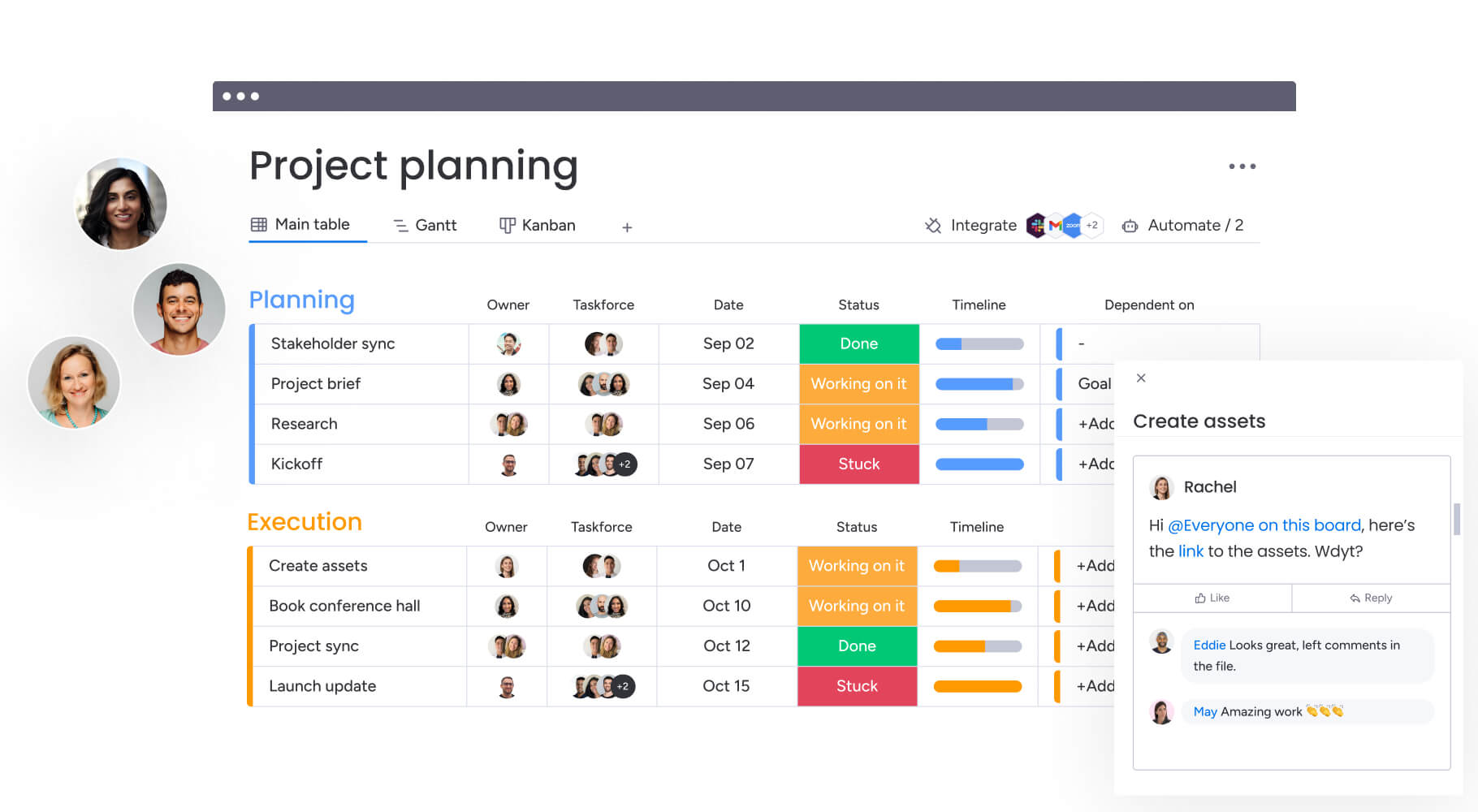
A step-by-step framework for scaling marketing operations in finance
With a platform like monday work management supporting your team, marketing leaders gain the clarity and control needed to manage complex, cross-functional work. The steps below outline how to centralize planning, standardize execution, streamline collaboration, and link every initiative to measurable outcomes.
Step 1: centralize campaign planning across all marketing functions
Build a master marketing calendar that consolidates campaigns, content, events, and initiatives into one unified view. Use timeline and calendar views to visualize schedules, identify conflicts, and ensure coordinated execution. This centralization becomes your single source of truth for all marketing activities.
Step 2: standardize workflows with templates and automation
Create managed templates for recurring campaign types that include standardized stages, approval checkpoints, and automated notifications. Configure automation recipes to trigger task assignments, send reminders, and update stakeholders based on campaign progress.
These templates can be updated centrally and applied across hundreds of active projects.
Step 3: implement creative request and approval processes
Set up intake forms that capture creative brief requirements and automatically route requests to appropriate teams. Build approval workflows that move assets through review stages with clear ownership and version tracking. This structure eliminates bottlenecks and provides visibility into creative pipeline status.
Step 4: connect marketing goals to execution
Link campaign boards to company-level OKRs and strategic goals. Use the Goals feature to track progress toward objectives and demonstrate marketing’s contribution to revenue growth. This alignment ensures every marketing initiative has clear purpose and measurable impact.
Step 5: enable resource visibility and capacity planning
Activate the Workload View and Resource Planner to monitor team capacity across all marketing functions. Set up resource allocation processes that assign work based on skills, availability, and strategic priorities. This prevents burnout while ensuring optimal talent utilization.
Step 6: build executive dashboards for ROI reporting
Create customizable dashboards that track campaign ROI, CAC, conversion rates, budget adherence, and team productivity. Configure AI-powered portfolio reports that deliver performance insights to executive leadership automatically. These dashboards translate marketing activities into business metrics that resonate with finance-focused stakeholders.
Comparison table: monday work management vs competing platforms for enterprise marketing operations
When marketing operations scale, platform capabilities become more important than feature checklists. This table shows how top solutions perform in real scenarios.
| Feature | monday work management | Asana | Wrike |
|---|---|---|---|
| Marketing templates | 200+ including campaigns, creative, events | 100+ with limited marketing focus | Available but less comprehensive |
| Resource management | Built-in Workload View with capacity planning | Requires Business tier ($24.99/user/month) | Included in Business tier ($24.80/user/month) |
| Campaign ROI dashboards | Customizable with real-time metrics | Limited customization in lower tiers | Available in Business tier |
| Approval workflows | Native with version tracking and audit trails | Proofing requires Business tier | Included in Business tier |
| Price per user/month | From $12 (Standard plan) | From $13.49 (Starter plan) | From $10 (Team plan) |
| Implementation time | 2 weeks to 1 month | 2-4 weeks typical | 4-6 weeks typical |
| G2 rating | 4.7/5 (12,000+ reviews) | 4.3/5 (9,000+ reviews) | 4.2/5 (3,000+ reviews) |
How Genpact transformed their global marketing operations
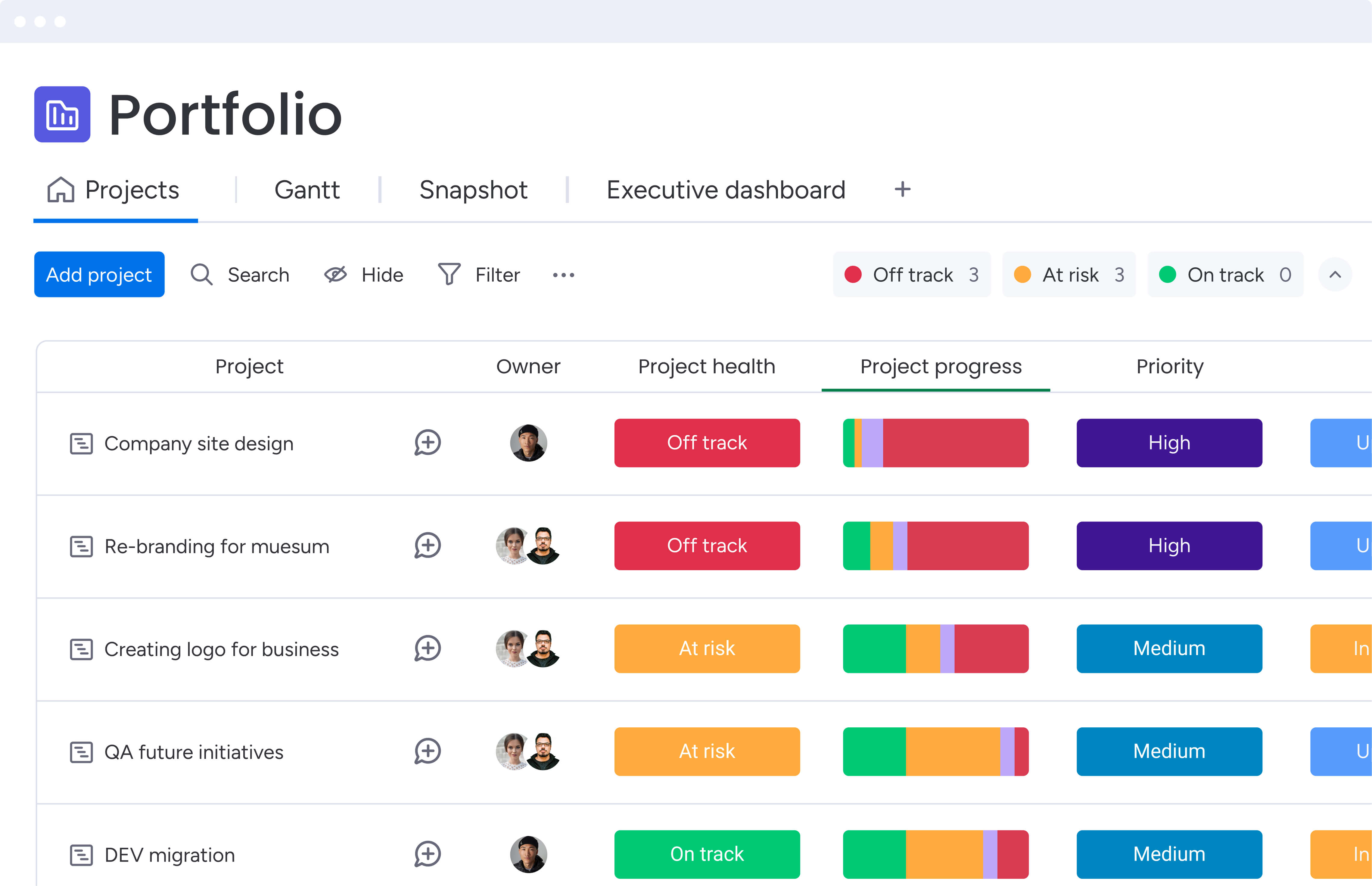
Genpact’s globally distributed marketing department faced a critical challenge: managing 24 large-scale campaigns simultaneously across multiple channels and regions. The team relied on spreadsheets, emails, and SharePoint folders — creating version control nightmares and making it impossible to track campaign status or identify bottlenecks.
The marketing team implemented monday work management to create a centralized platform for campaign planning and execution. They built workflow apps outlining the entire activation process for each channel, leveraging a WBS creation tool with columns tracking target dates versus actual timelines. Timeline views and dashboards provided drill-down visibility into weekly and monthly activities.
The team formalized their campaign brief submission and approval processes using forms, creating automated notification workflows that serve as request queues. This structured approach eliminated the chaos of ad-hoc requests and unclear priorities.
The transformation delivered measurable results across all aspects of marketing operations:
- 40% improvement: in cross-team collaboration for campaign planning and execution.
- 100% elimination: of spreadsheets from the campaign management process.
- 25% reduction: in email exchanges through centralized communication.
- Real-time visibility: into campaign turnaround times and bottlenecks.
The platform enabled proactive prioritization and resource allocation, transforming how Genpact’s marketing team operates at global scale. Teams now have complete visibility into who owns what, when deliverables are due, and where potential delays might occur — enabling them to course-correct before issues impact campaign launches.
Ready to transform your enterprise marketing operations?
Let’s be honest — spreadsheets and email chains break down when you’re running a marketing team of 50+ people. You need a system that brings everything together, especially when your leadership team wants clear ROI on every dollar spent.
With intelligent solutions like monday work management, all the infrastructure marketing leaders need to unify teams, standardize execution, and demonstrate measurable impact are there. The platform brings together everything required for enterprise marketing success: centralized campaign visibility, automated workflows, resource optimization, and executive-ready reporting.
With proven results from organizations like Genpact and FARFETCH, monday work management transforms how marketing departments operate at scale.
Join 245,000+ organizations already using monday work management to connect teams, streamline execution, and prove marketing ROI.
The content in this article is provided for informational purposes only and, to the best of monday.com’s knowledge, the information provided in this article is accurate and up-to-date at the time of publication. That said, monday.com encourages readers to verify all information directly.
Frequently asked questions
How long does it take to implement monday work management for a large marketing team?
The time it takes to implement monday work management for a large marketing team is typically two weeks to one month from initial setup to full adoption. This timeline includes configuring campaign templates, setting up approval workflows, integrating with your existing martech stack, and training team champions. Organizations achieve successful adoption within this timeframe by creating custom rollout plans, building base structures that teams can immediately use, and providing ongoing support through internal and external resources.
What security certifications does monday work management have for financial services?
monday work management provides enterprise-grade security protocols required for financial institutions, including SOC 2 Type II certification, ISO 27001 compliance, GDPR compliance, and HIPAA compliance options. The platform offers IP restrictions, two-factor authentication, multiple SSO options, BYOK encryption, and tenant-level encryption to ensure marketing data and customer information meet stringent financial services requirements.
Can monday work management integrate with our existing marketing technology stack?
Yes, monday work management integrates with 200+ marketing and business applications including HubSpot, Salesforce, Marketo, Google Analytics, Slack, Microsoft Teams, Adobe Creative Cloud, and major social media platforms. The platform also provides an open API for custom integrations with proprietary systems, enabling automated workflows that span multiple tools and ensure seamless data flow between campaign planning, execution, and measurement systems.
How do we calculate ROI for marketing work management platforms?
Calculate ROI by measuring time savings from reduced manual coordination, cost savings from improved resource utilization, and revenue impact from faster campaign launches and improved performance tracking. Key metrics include hours saved per month, reduction in email and meeting time, improvement in campaign delivery speed, and cost savings from eliminating redundant tools. Organizations typically see 6x to 8x ROI within the first year.
What's the difference between project management and work management for marketing teams?
Project management focuses on delivering specific campaigns or initiatives with defined start and end dates, while work management encompasses the full spectrum of marketing operations including ongoing processes, resource allocation, strategic planning, and cross-functional collaboration.
How can we ensure our marketing team adopts the new platform successfully?
Ensure adoption by creating a structured rollout plan that includes building base templates teams can immediately use, identifying and training team champions, and providing ongoing support through the first 90 days. Start by demonstrating immediate value to each team function rather than forcing a one-size-fits-all approach. Make post-implementation reviews a habit and update process documentation so improvements carry forward across the entire marketing organization.

 Get started