


Marketing teams at mid-to-large organizations face a complex operational reality. Campaigns span multiple channels, departments coordinate across time zones, and leadership expects measurable ROI from every initiative. Yet many teams still manage this complexity through scattered spreadsheets, disconnected platforms, and manual status updates that consume hours each week.
The best marketing strategy software transforms this fragmented approach into unified operations. These clever platforms connect campaign planning to execution, provide real-time visibility into team capacity and performance, and enable data-driven decisions that keep initiatives on track. For marketing leaders managing 100+ person teams, the right platform becomes the operational backbone that scales coordination without adding administrative overhead.
Let’s dig into what actually works for enterprise marketing teams, the specific features that deliver real ROI, and the dramatic time savings organizations are seeing. Check out our guide below and you’ll learn how to choose the right platform, implement it successfully, and see exactly how other teams have transformed their marketing operations.
Key takeaways
Marketing platforms have come a long way from basic task lists. Today’s best platforms link your big-picture strategy directly to day-to-day execution, even when your team spans continents. A robust marketing planning software transforms how marketing leaders at mid-to-large organizations plan campaigns, allocate resources, and demonstrate ROI to executive leadership.
For heads of marketing managing 100+ person teams across multiple channels and locations, these platforms address critical operational challenges:
- Centralize fragmented marketing operations: unify campaign planning, creative production, and performance tracking in one platform to eliminate silos and give teams real-time visibility across all locations and channels.
- Scale seasonal campaigns while maintaining team well-being: use workload views and capacity planning to balance resources during peak periods like Black Friday, ensuring sustainable delivery without overcommitting your people.
- Connect marketing strategy directly to execution: a unified platform provides shared calendars, automated workflows, and cross-functional collaboration that transforms scattered spreadsheets into coordinated campaign delivery.
- Demonstrate clear ROI to leadership: real-time dashboards track campaign performance, budget adherence, and team productivity without manual data compilation, giving executives the insights they need.
- Reduce operational overhead by thousands of hours: organizations like FARFETCH save 3,500 hours monthly and achieve 6x ROI by eliminating manual coordination and status updates across distributed teams.
What makes heads of marketing choose monday work management for retail marketing operations?
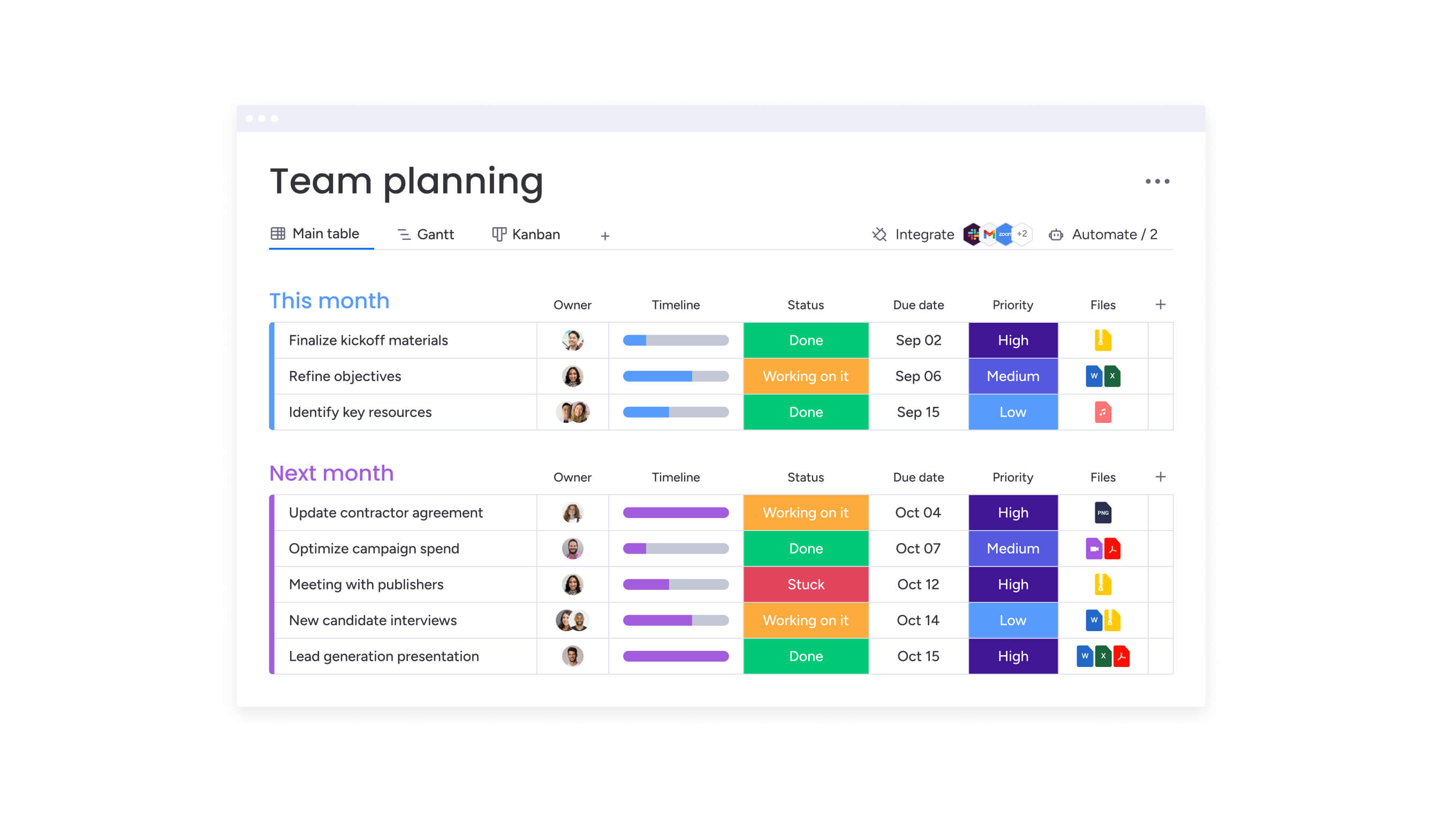
Heads of marketing in retail face unique pressures that generic project management platforms can’t address. They need to coordinate campaigns across store locations, manage seasonal peaks like Black Friday, and align inventory-driven promotions with brand initiatives — all while reporting clear ROI to leadership.
The core challenge is disconnected execution, where marketing teams operate in silos using five to ten different platforms for planning, creative production, and performance tracking. This fragmentation creates blind spots in capacity planning, duplicates effort across regions, and makes it impossible to answer basic questions like “What’s our team working on?” or “Are we on track for Q4 goals?”
Advances platforms like monday work management fixes this with one central digital workspace where your entire marketing operation lives. Your campaign strategy connects directly to the day-to-day work, so your content, creative, acquisition, events, and ops teams can actually work together without jumping between a dozen different tools.
What sets monday work management apart for retail marketing leaders:
- Centralized visibility: real-time dashboards track campaign ROI, customer acquisition costs, and budget adherence across all locations.
- Capacity planning: workload views prevent team burnout during seasonal peaks by showing exactly who’s overloaded and who has bandwidth.
- Standardized flexibility: templates ensure consistent processes across regions while allowing customization for local market needs.
- Cross-functional alignment: connect marketing workflows with merchandising, supply chain, and store operations in one platform.
FARFETCH, a leading retail platform, demonstrates the power of adopting the platform. After consolidating 400 people from 40 teams onto monday work management, they saved 3,500 hours monthly and achieved 6x ROI.
monday work management top features for retail marketing operations
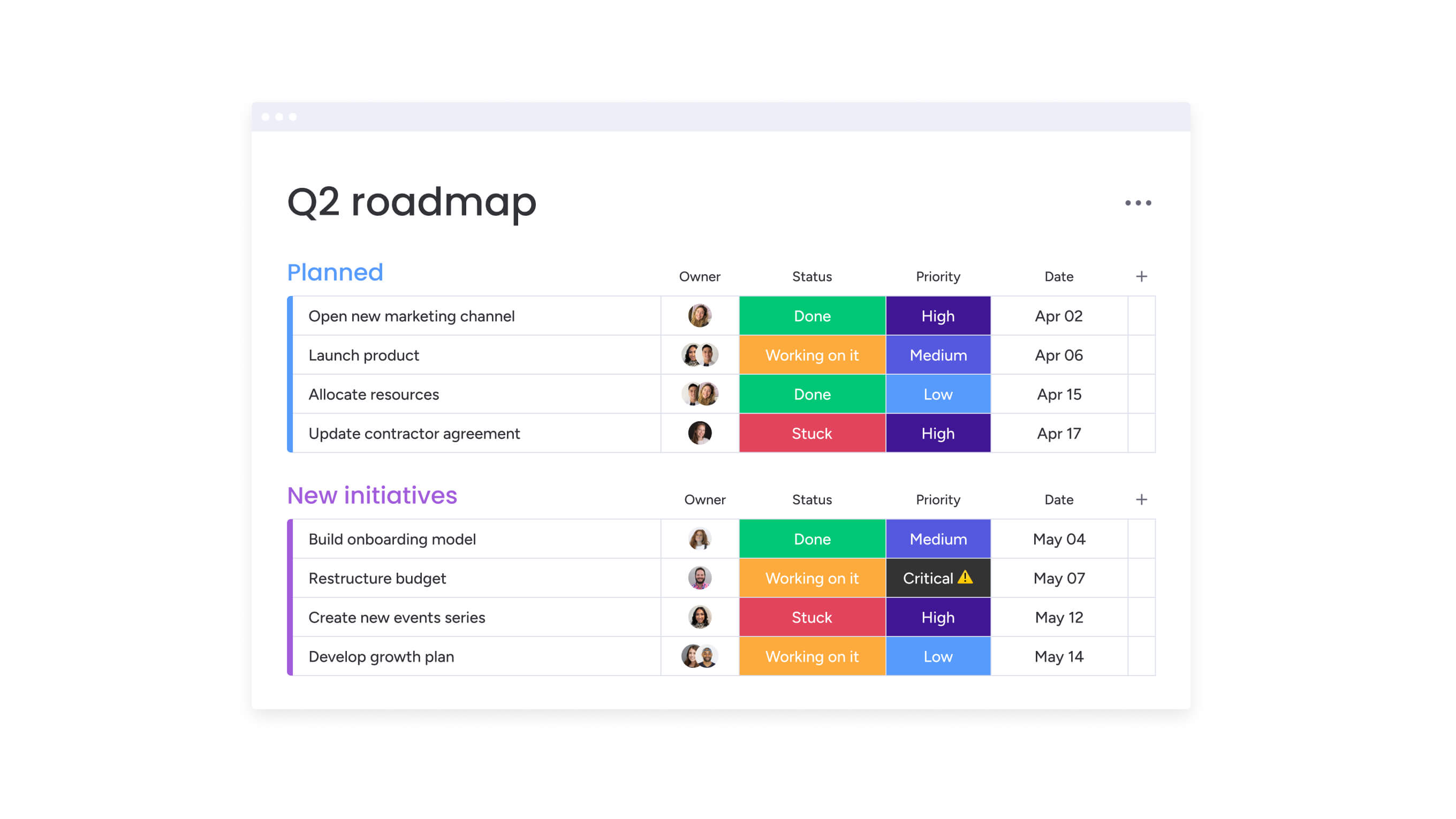
The following features transform how retail marketing teams plan, execute, and measure campaigns across multiple locations and channels. Each capability addresses specific operational challenges that heads of marketing face when coordinating complex, cross-functional initiatives.
Campaign management
Think of monday’s campaign management as your retail marketing control room. Your team gets calendars, timelines, and dashboards that make sense of even your most complex promotions — whether you’re launching products across 50 stores or running Black Friday deals across every channel.
For heads of marketing managing distributed teams, this eliminates the chaos of scattered spreadsheets and email chains. The platform provides:
- Master content calendars: house all key dates, milestones, and campaign dependencies in one view.
- Real-time performance tracking: monitor campaign metrics without manual data aggregation.
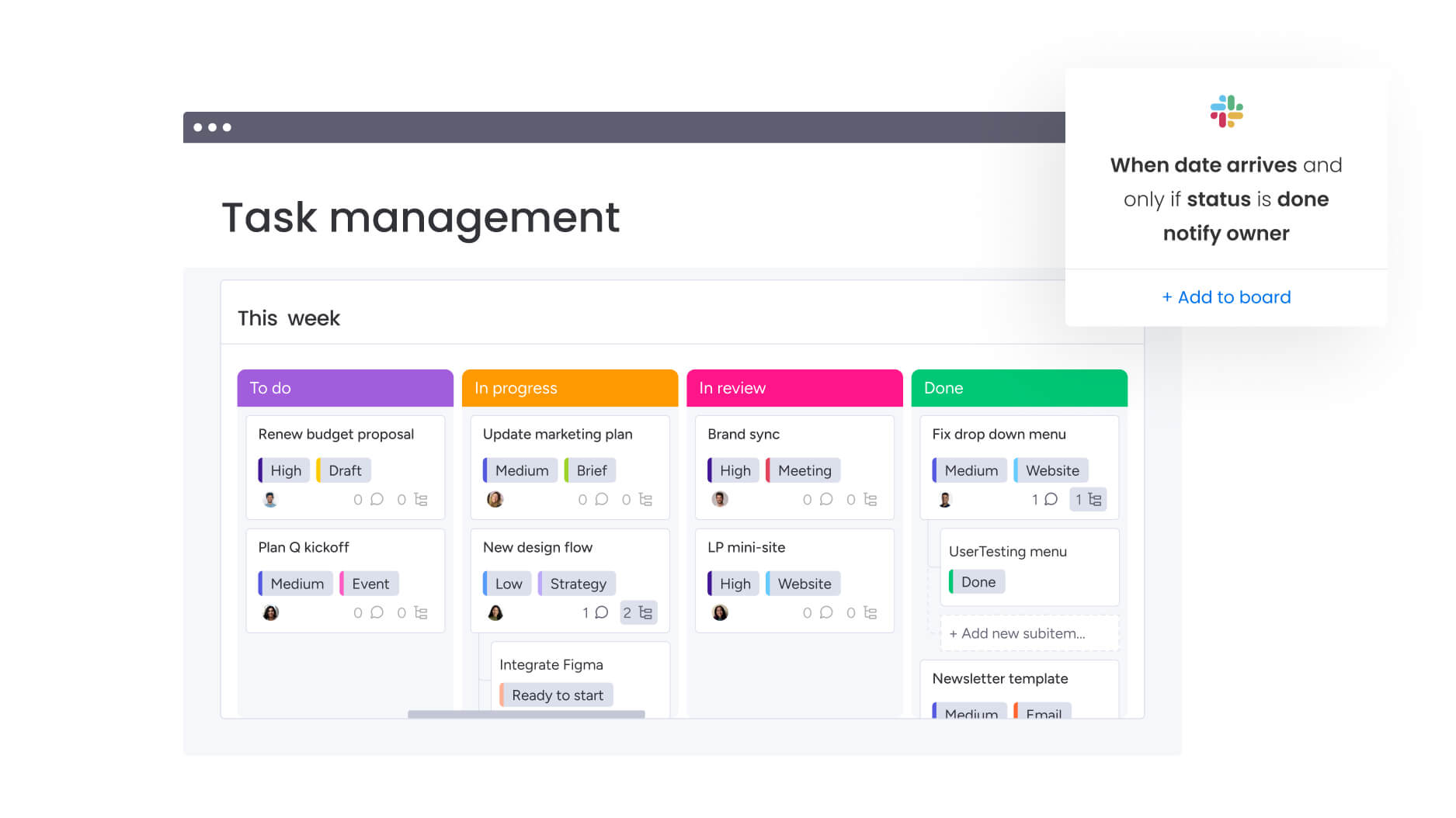
- Automated workflows: trigger notifications when timelines shift or approvals are needed.
The impact is immediate. Teams prevent duplicated efforts across regions, ensure consistent messaging across channels, and make faster decisions when seasonal demands require rapid pivots.
Resource management
The Workload view provides instant visibility into your team’s capacity. You’ll see exactly who is fully committed and who has bandwidth to take on more, enabling you to allocate resources effectively in real time and ensure designers and copywriters are balanced.
This directly addresses the resource challenges retail marketing teams face during peak seasons:
- Visual capacity planning: see who’s overloaded before burnout occurs.
- Skills-based allocation: match team members to projects based on expertise, not just availability.
- Proactive rebalancing: redistribute work to maintain sustainable delivery pace.
Dashboards and reporting
Automate your reporting process and reclaim your weekends. These dashboards turn your marketing data into insights your C-suite will actually use. Pull numbers from any campaign, visualize performance trends, and showcase your team’s productivity — all automatically updated and ready for your monday morning meetings.
Key capabilities for retail marketing leaders include:
- Pre-built and custom widgets: choose from 30+ visualization options to display exactly what matters.
- Filtered views by location: track performance across store locations, regions, or campaign types.
- Automated reporting: generate daily or weekly reports that highlight trends and risks.
These dashboards eliminate the manual report preparation that typically consumes hours each week. Visual, color-coded systems make it easy for stakeholders at all levels to understand campaign performance at a glance.
Automations
Automation capabilities scale marketing operations without adding headcount or complexity. Teams create templated project boards, set approval workflows, and configure automated reminders that keep campaigns moving forward without manual intervention.
The platform enables marketing leaders to:
- Standardize recurring activities: use templates for seasonal promotions and product launches.
- Automate task assignments: automatically route work based on team member skills and availability.
- Trigger smart notifications: alert stakeholders when deadlines approach or budgets exceed thresholds.
Genpact reduced email exchanges by 25% after implementing automated workflows. Automated reminder notifications and alerts kept everyone on track, prevented last-minute surprises, and stopped tasks from falling through the cracks.
Goals and OKRs
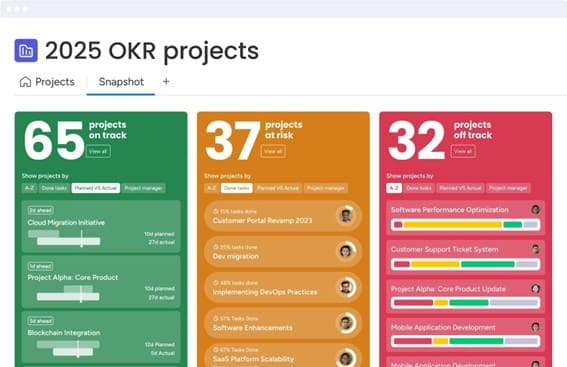
The Goals and OKRs functionality connects marketing activities to company-level objectives, providing transparency into how daily work contributes to organizational success. Marketing leaders set measurable objectives, define key results, and monitor achievement across all teams and regions from centralized dashboards.
This feature ensures strategic alignment by:
- Linking campaigns to business goals: show exactly how marketing initiatives support company OKRs.
- Tracking progress in real time: monitor goal achievement without manual status updates.
- Securing executive buy-in: demonstrate marketing’s contribution to revenue with data-driven reporting.
Teams gain focus on priorities, reducing the confusion that occurs when marketing operates in silos. The platform verifies where projects fit into company goals by matching them with relevant OKRs, maintaining strategic focus across all marketing activities.
Cross-functional collaboration
Cross-functional collaboration features break down silos between marketing, merchandising, supply chain, and store operations. The platform provides a shared workspace where all departments coordinate on campaigns, with centralized communication, files, and feedback eliminating the need for multiple disconnected platforms.
This capability addresses the friction retail marketing leaders identify as a major pain point:
- Unified communication: tag stakeholders and share updates directly on marketing assets.
- Connected workflows: link marketing campaigns to inventory availability and merchandising plans.
- Transparent access: give all teams visibility into the information they need.
How heads of marketing in retail benefit from monday work management
Retail marketing teams using monday work management achieve measurable improvements in operational efficiency, cost savings, and team productivity.
These outcomes directly address the challenges of managing large, distributed marketing teams across multiple store locations and seasonal peaks.
Time savings
Marketing teams reclaim thousands of hours by eliminating manual coordination and status updates. The impact compounds across organizations:
- FARFETCH: saves 3,500 hours monthly through automated workflows and centralized communication.
- VML: reduces 7,000 hours per account monthly by streamlining creative production.
- Officeworks: eliminates 635+ working spreadsheets and reduces 10,000+ emails.
These time savings translate directly into faster campaign delivery and more strategic work. Teams spend less time in status meetings and more time on creative strategy and optimization.
Cost efficiency
Organizations achieve significant ROI through reduced administrative overhead and improved resource utilization:
- FARFETCH: realizes 6x ROI and saves $118,000 monthly.
- Reduced hiring needs: optimize existing talent instead of adding headcount.
- Lower operational costs: eliminate redundant platforms and manual processes.
The financial impact extends beyond direct savings. Teams redirect budgets from administrative tasks to strategic initiatives that drive growth.
Productivity improvements
Marketing teams accelerate delivery and increase output through streamlined workflows:
- Campaign velocity: deliver campaigns 2x faster with automated workflows.
- Creative output: increase production by 3x through reduced context-switching.
- Cross-team collaboration: achieve 40% improvement in collaboration (Genpact).
- Weekly campaign volume: produce 142% more campaigns while maintaining quality.
These productivity gains come from eliminating friction in everyday work. Teams focus on high-impact activities instead of administrative tasks.
Visibility and tracking improvements
Real-time dashboards provide instant insights without manual data collection:
- Campaign performance: track ROI, conversion rates, and budget burn in real time.
- Team capacity: monitor workload distribution and prevent burnout.
- Stakeholder satisfaction: measure and improve internal collaboration metrics.
- Risk identification: spot potential delays before they impact delivery.
Leaders make data-driven decisions faster, optimize marketing operations continuously, and demonstrate clear value to executive stakeholders.
How to manage retail marketing operations with monday work management
Here is your six-step roadmap to create a fully coordinated and predictable marketing operation:
Step 1: centralize your marketing calendar
Start by creating a master content calendar that consolidates all campaigns, promotions, and events across store locations. Import existing campaign data from spreadsheets and connect it to your retail calendar.
This gives all teams visibility into upcoming launches and seasonal peaks, preventing duplicate efforts and ensuring coordinated execution.
Step 2: map cross-functional workflows
Define standardized processes for recurring activities like seasonal promotions, product launches, and inventory-driven campaigns. Build templates that connect marketing, merchandising, and operations teams.
Establish clear ownership and approval paths for each campaign type to eliminate confusion and delays.
Step 3: configure resource allocation views
Set up Workload views to visualize team capacity across content, creative, acquisition, events, and operations functions. Define team member skills and availability to enable strategic resource allocation.
This prevents burnout during peak periods and ensures the right people work on the right projects.
Step 4: build executive dashboards
Create custom dashboards that track campaign ROI, customer acquisition costs, MQL-to-customer rates, budget adherence, and team productivity metrics. Configure automated reports that deliver insights to C-suite stakeholders without manual data compilation.
Use visual indicators to highlight performance trends and risks at a glance.
Step 5: automate campaign workflows
Implement automation recipes that trigger notifications, assign tasks, and update statuses as campaigns progress through stages. Set up approval workflows for creative assets and promotional materials to maintain brand consistency across locations.
These automations reduce manual coordination and keep campaigns moving forward.
Step 6: connect your marketing tech stack
Integrate monday work management with your existing retail systems including POS, inventory management, CRM, and analytics platforms to leverage CRM marketing more effectively. Use the open API or 200+ pre-built integrations to create a unified marketing ecosystem.
This eliminates data silos and enables automated workflows based on real-time business data.
Comparison: monday work management vs competing platforms for retail marketing
When evaluating marketing strategy software, retail marketing leaders need platforms that handle multi-location complexity, seasonal demand spikes, and cross-functional coordination. Here’s how monday work management compares to alternatives:
| Feature | monday work management | Wrike | Smartsheet |
|---|---|---|---|
| Campaign management | Native multi-channel boards | Project-based tracking | Grid-based planning |
| Resource management | Built-in Workload View | Add-on required | Higher tiers only |
| Automations | 200+ no-code recipes | Custom rules | Limited on lower tiers |
| Dashboards | Unlimited custom views | Plan-based limits | Business plan+ only |
| Creative approvals | Built-in proofing | Higher tiers only | Enterprise only |
| Implementation time | Under 4 months | 2-3 months typical | 3-4 months typical |
| User adoption | Highest-rated on G2 | Moderate learning curve | Spreadsheet-familiar |
The key differentiator is monday work management’s ability to scale complexity without sacrificing usability, while competitors require extensive configuration or add-ons for enterprise features,
How FARFETCH transformed their retail marketing operations
FARFETCH faced a common challenge for global retail brands: 400 people across 40 teams operated in silos, with campaigns housed in countless Google Docs and Sheets across numerous folders. The Marketing Planning team spent hours chasing updates and last-minute changes, with no single source of truth for campaign status or progression.
Coordinating complex, multi-team activations was a significant challenge due to disconnected information silos. for brand partnerships and customer experiences. Teams couldn’t see dependencies between initiatives, leading to duplicated work and missed opportunities for collaboration.
Implementation approach
FARFETCH implemented monday work management with a structured rollout plan. They started with their master content calendar to house all key dates and milestones, then expanded to content production processes, CRM workflows, and cross-channel campaign management.
The platform’s dependencies, automations, and integrations brought each team’s work together effortlessly in one place.
Measurable results
The transformation delivered immediate, measurable results:
- 6x ROI achieved through consolidated operations.
- $118,000 saved monthly in operational costs.
- 3,500 hours saved monthly across marketing teams.
- 100% elimination of scattered Google Sheets and folders.
- Real-time visibility into campaigns across 40 different teams.
The content calendar became their top priority because it connected previously disconnected teams. Commercial teams, fashion teams, and editorial — groups from very different worlds — now collaborate in one place with common workflows.
Ready to deliver retail campaigns faster and smarter?
We’ve come a long way from simple project trackers. If you’re running marketing across multiple locations, you need more than a task list — you need a true command hub that turns your strategy into action while giving you the control to deliver big results without the chaos.
Advanced solutions like monday work management address the unique challenges of retail marketing — from coordinating seasonal campaigns across store locations to aligning inventory-driven promotions with brand initiatives. The platform’s combination of centralized visibility, intelligent automation, and cross-functional collaboration capabilities enables marketing teams to move faster, work smarter, and demonstrate clear ROI to leadership.
The transformation stories speak for themselves. Organizations like FARFETCH achieve 6x ROI while saving thousands of hours monthly. Teams deliver campaigns twice as fast, increase creative output by 3x, and improve cross-team collaboration by 40%.
Join 152,000+ marketing teams who trust monday work management to centralize operations, eliminate silos, and maximize ROI across all channels and store locations.
The content in this article is provided for informational purposes only and, to the best of monday.com‘s knowledge, the information provided in this article is accurate and up-to-date at the time of publication. That said, monday.com encourages readers to verify all information directly.
Frequently asked questions
How does monday work management handle seasonal workforce scaling for retail marketing teams?
monday work management supports seasonal workforce scaling through flexible user permissions and guest access that allow you to bring on contractors and temporary team members without purchasing full licenses. You can create specific boards for seasonal campaigns with controlled access levels, ensuring external contributors can collaborate on relevant projects while protecting sensitive business data.
Can monday work management integrate with retail POS systems and inventory management platforms?
Yes, monday work management integrates with retail-specific systems through its open API and 200+ pre-built integrations. You can connect POS systems, inventory management platforms, and CRM tools to create automated workflows that trigger marketing actions based on inventory levels or sales data. For example, you can set up automations that alert marketing teams when inventory reaches promotional thresholds, or sync customer data from your CRM to inform campaign targeting and personalization strategies.
How quickly can a 100+ person marketing team implement monday work management?
Implementation timelines for enterprise retail marketing teams typically range from two weeks to one month for full adoption. The platform's intuitive interface enables rapid onboarding, with most users becoming comfortable within the first week. The key to successful adoption is creating a structured rollout plan, building base templates that reflect your team's workflows, and providing ongoing support during the transition period.
What's the difference between marketing strategy software and marketing automation platforms?
Here's the key difference: monday work management helps you plan and manage your entire marketing operation and team. Tools like HubSpot or Marketo handle the automated customer-facing stuff — your emails, lead scoring, and triggered messages. Think of strategy software as running your marketing team, while automation tools run your marketing campaigns. While automation tools execute specific marketing tactics, strategy software orchestrates the entire marketing operation, connecting strategy to execution across all channels and teams.
How does monday work management support franchise or multi-brand retail management?
monday work management supports franchise and multi-brand management through hierarchical board structures that maintain brand consistency while allowing location-specific customization. You can create master brand boards that cascade to individual franchise or store location boards, ensuring corporate marketing guidelines are followed while giving local teams flexibility to execute region-specific promotions.
What security features should retail marketing leaders prioritize when selecting software?
Retail marketing leaders should prioritize enterprise-grade security protocols including data encryption, role-based access controls, and compliance with regulations like GDPR and SOC 2. monday work management provides IP restrictions, two-factor authentication, multiple SSO options, BYOK (Bring Your Own Key), and tenant-level encryption to protect sensitive campaign data, customer information, and financial metrics.

 Get started