


Today’s marketing teams juggle dozens of campaigns, multi-million dollar budgets, and an expanding maze of channels. The result is a painful gap between what the C-suite expects and what teams can actually deliver.
Teams work in silos, campaign data lives in disconnected systems, and resource allocation happens through guesswork rather than strategic planning.
The challenge isn’t finding the best marketing automation software for email campaigns or lead nurturing. Those platforms handle channel execution well. The real gap is the operational foundation. Marketing leaders need comprehensive work management that connects strategy, execution, creative production, and performance measurement in one unified platform.
Here’s what truly separates powerful marketing automation software from those basic campaign platforms that no longer meet the demands of modern marketing. This guide examines the operational capabilities that enable marketing teams to scale effectively, the features that drive measurable business impact, and how comprehensive work management platforms bridge the gap between strategic planning and tactical execution across enterprise marketing organizations.
Key takeaways
Marketing automation has evolved far beyond email campaigns and lead nurturing. Today’s marketing leaders need comprehensive work management that connects strategy, execution, creative production, and performance measurement in one unified platform, enhanced by a marketing automation platform.
The right marketing automation software stands apart through these key capabilities:
- Bridge the gap between marketing strategy and execution: connect high-level marketing goals to daily campaign work so teams understand how their efforts drive business results and executive leadership sees marketing’s strategic value.
- Gain real-time visibility across all marketing activities: stop chasing status updates and eliminate spreadsheet chaos by centralizing campaign progress, team workloads, and performance metrics in one accessible workspace with monday.com.
- Prevent team burnout through proactive resource management: monitor workload distribution across your marketing organization to identify over-capacity team members before burnout occurs and redistribute work strategically.
- Transform marketing operations with AI-powered efficiency at scale: intelligent automation goes beyond basic work automation to provide campaign planning assistance, risk identification, and continuous optimization.
- Standardize processes without sacrificing creativity: create reusable templates and automation for recurring marketing workflows while preserving the customization needed for innovative campaigns and creative production.
What makes heads of marketing choose monday.com for marketing automation?
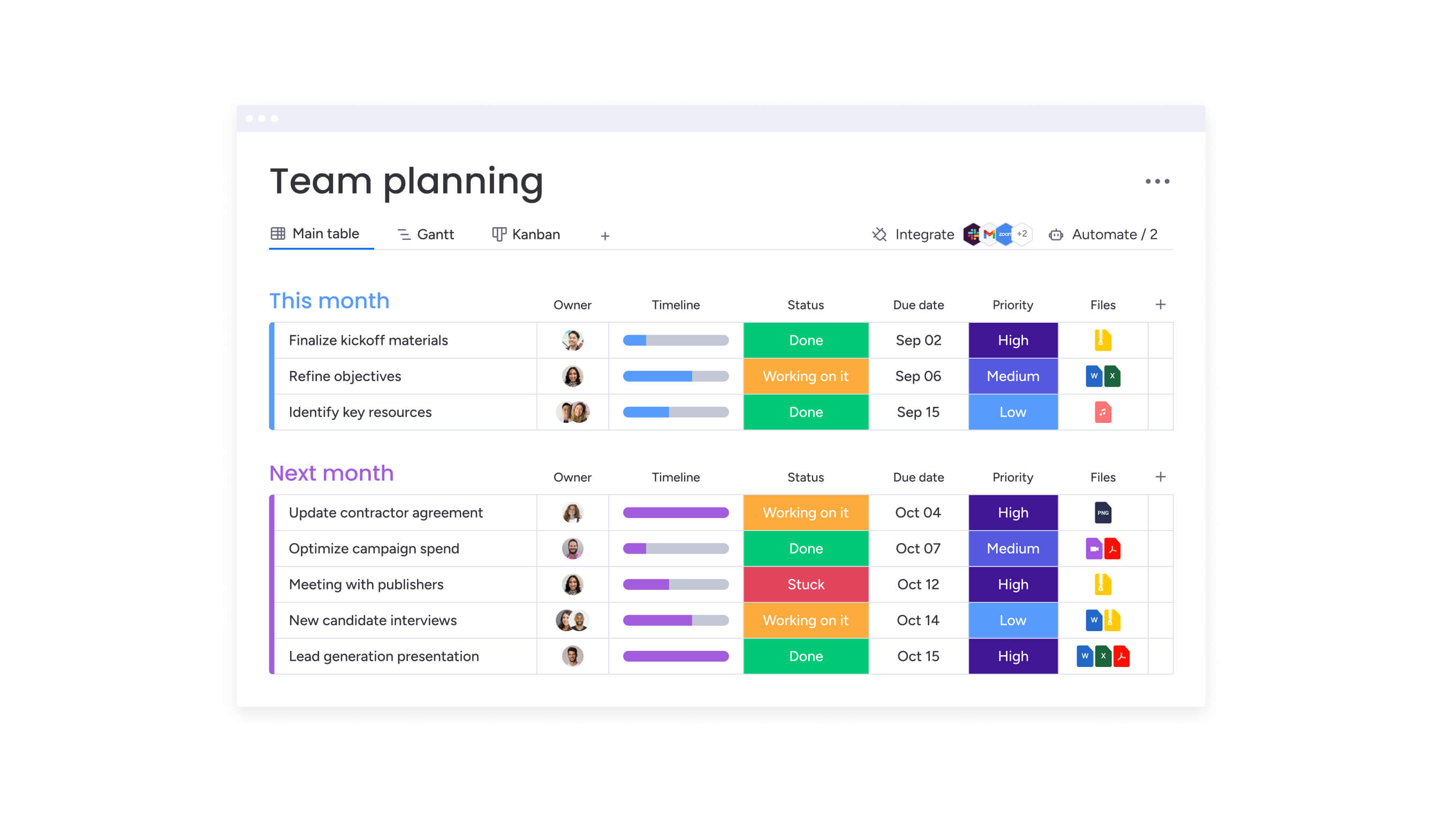
Heads of marketing at enterprise tech companies face a unique challenge. Traditional automation software handles campaign execution across channels like email, SMS, and social media. But it doesn’t provide the operational foundation needed to coordinate large teams, manage cross-functional dependencies, and maintain strategic alignment.
This operational gap is solved by monday.com, which provides centralized visibility into all campaigns, performance metrics, and team workloads. This addresses the core pain point of disconnected execution where siloed teams create duplicative processes without clarity on ownership. For marketing leaders seeking advanced marketing automation platforms, this platform standardizes essential workflows.
For marketing leaders managing teams across content, creative, acquisition, events, and operations, this visibility is essential. The platform delivers three critical capabilities:
- Prevents resource burnout: through real-time workload monitoring.
- Ensures on-time delivery: with automated progress tracking.
- Proves marketing impact: to executive leadership through comprehensive reporting.
The platform also connects your high-level strategy directly to the day-to-day campaign work, ensuring every detail is tracked and accounted for. It enables heads of marketing to align marketing strategy with company goals through OKR tracking while managing the operational details of campaign execution, creative production workflows, and resource planning. By integrating with automation software systems, marketing teams can streamline manual overhead.
This dual capability makes monday.com the essential complement to marketing automation software. The platform standardizes processes through templates and automation while maintaining the flexibility needed for creative, data-driven work that defines modern tech marketing organizations. Combined with automation software capabilities, marketing teams can scale effectively.
Learn more: Marketing automation software that scales
monday.com top features for marketing automation
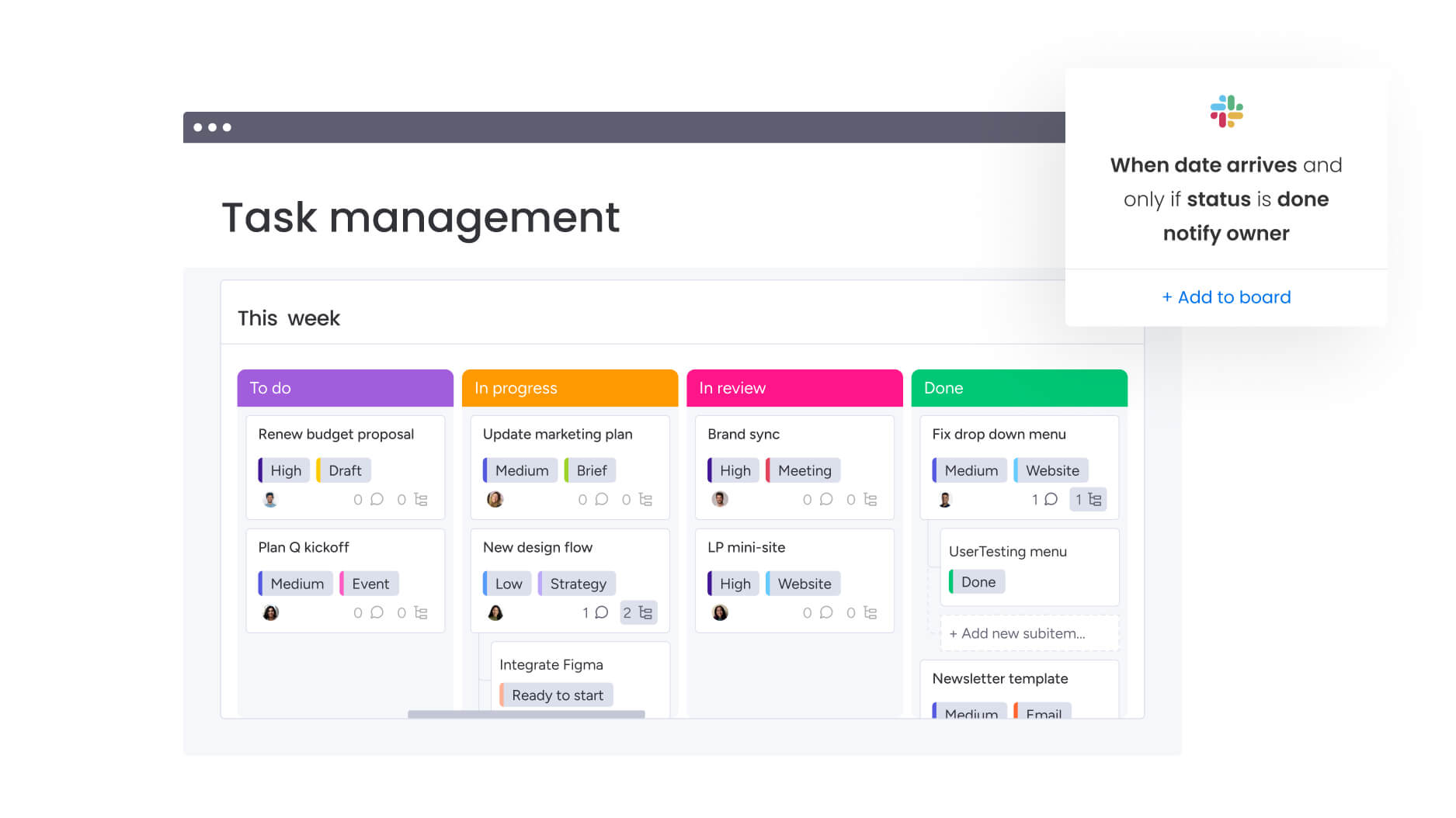
The following six features address critical operational challenges in marketing planning, execution, and measurement. Each capability is designed to solve specific pain points that marketing leaders encounter when managing complex campaigns across distributed teams.
Campaign management and orchestration
Every element of your marketing operations is centralized in one intelligent workspace with monday.com. The platform delivers complete visibility and control across your entire marketing operation:
- End-to-end campaign visibility: track everything from campaign brief submission to final performance analysis including creative assets, approval workflows, launch timelines, and real-time metrics across all channels, teams, and deliverables.
- Flexible views for every workflow: choose the view that works best for your needs like calendar layouts for content scheduling, timeline views for dependency mapping, or Gantt charts for complex multi-phase campaigns.
- Operational command center: for marketing leaders using specialized marketing automation strategies, the platform connects automation tools to campaign planning, resource allocation, and cross-functional collaboration so nothing falls through the cracks.
- Real-time insights at scale: for heads of marketing managing 100+ person teams, gain instant insight into which campaigns are on track, which are at risk, and where bottlenecks exist across your portfolio.
The platform transforms how teams coordinate complex campaigns. Genpact’s global marketing team leveraged these capabilities to achieve complete removal of spreadsheets from their workflow. Their implementation includes a workflow app outlining the entire end-to-end activation process for each channel, with columns tracking target dates and actual time frames that reveal trends and identify bottlenecks causing delays.
Resource management and capacity planning
Stop wondering if your team is overloaded or has capacity to take on that urgent campaign. Resource management shows you exactly who’s working on what and when, across every function in your marketing org. Use advanced marketing automation workflows to coordinate resource allocation more effectively. The Workload view shows exactly who is working on what and when, making it easy to identify team members who are over-capacity or have availability for new initiatives.
This feature directly addresses poor resource utilization that leads to burnout, misalignment, and missed deadlines in large marketing organizations. For marketing leaders managing teams of 50-100+ people across multiple functions, strategic resource allocation based on skills and availability ensures efficiency for every business unit.
Key benefits include:
- Proactive capacity planning: identify resource constraints before they impact deadlines.
- Skills-based allocation: match team members to projects based on expertise and availability.
- Burnout prevention: monitor workload distribution to maintain team health.
ThoughtWorks transformed their global marketing operations using these capabilities. The platform enabled the team to budget time and efforts more scientifically, leading to measurably increased operational efficiency across their marketing organization.
Workflow automation and standardization
Marketing teams can standardize and automate workflows through customizable templates, automation recipes, and integration capabilities with monday.com. The platform provides pre-built automation templates for common marketing scenarios while allowing teams to create custom automations using a no-code interface.
These workflow tools address the challenge of inconsistent processes across teams by enabling standardization at scale. Marketing leaders create standardized templates for recurring processes like campaign launches, event management, and content production, ensuring best practices are followed consistently across all teams and regions.
FARFETCH implemented workflow automation to streamline their complex digital and creative processes, saving 3.5K hours per month and achieving a 6x ROI. The automation helped formalize campaign brief submission and approval processes, with specific team members receiving automated notifications through the workflow app.
Dashboards and reporting for executive visibility
Customizable dashboards aggregate data from multiple projects and workflows into a single view, enabling marketing leaders to track key performance indicators, campaign ROI, and team productivity metrics. Dashboards can be configured to show real-time data on campaign performance, budget adherence, resource utilization, and progress toward OKRs.
This feature enables heads of marketing to report impact to executive leadership with clear, data-driven insights. The platform demonstrates the connection between marketing activities and business outcomes through comprehensive metrics:
- Campaign performance: ROI, conversion rates, and attribution data.
- Resource efficiency: team productivity and capacity utilization.
- Strategic alignment: progress toward OKRs and company goals.
Genpact’s marketing leadership maintains visibility across global operations using these dashboards. The team implemented a high-level GTM calendar that displays marketing programs, campaigns, and activations across the organization, providing leadership with an accessible snapshot of all marketing activities at any given time. This additional layer of visibility enables strategic decision-making based on real-time campaign data.
Cross-functional collaboration and alignment
Seamless collaboration across marketing and non-marketing teams happens through shared boards, @mentions, comment threads, and file sharing capabilities in monday.com. The platform enables marketing teams to work effectively with legal, product, finance, and other departments by providing a centralized space where all stakeholders can see project status, provide input, and track approvals.
For heads of marketing managing large-scale operations requiring coordination with multiple departments, this feature addresses the pain point of silos across teams that scatter marketing impact. By breaking down departmental barriers, the platform creates aligned teams with clear visibility into work.
FARFETCH used collaboration features to connect 400 people from 40 different teams across commercial, fashion, and editorial departments. The content calendar became a central hub where teams from vastly different functional areas could establish common workflows and work more effectively together. This unified approach broke down silos between departments that traditionally operated in separate worlds, enabling seamless coordination across the entire marketing organization.
Goals and OKR tracking
The platform provides dedicated capabilities for setting, tracking, and reporting on company-level goals and objectives. Marketing leaders create goal hierarchies that connect individual tasks and campaigns to department-level OKRs and company-wide strategic initiatives, providing clear line-of-sight from daily work to business outcomes.
You’ll be able to show exactly how each campaign connects to your company’s strategic goals — giving you the ammunition you need when defending budgets or demonstrating marketing’s impact. The platform shows executive stakeholders exactly how marketing initiatives support strategic objectives, making it easier to secure resources and demonstrate marketing’s strategic value.
Try monday.comHow a head of marketing in tech benefits from monday.com
When marketing leaders switch to monday.com, the results speak for themselves. Teams deliver more campaigns on time, resources get allocated where they’ll have the biggest impact, and executives finally see the direct line between marketing work and business results.
Operational efficiency gains
Your marketing operations get streamlined in three fundamental ways with monday.com:
- Time savings through automation and standardization: automation capabilities reduce time spent on repetitive tasks like status updates, approval requests, and progress tracking. Marketing leaders report saving 10-15 hours per week on administrative tasks.
- Cost efficiency through resource optimization: clear visibility into workload distribution and resource availability ensures teams work on highest-impact activities. This optimization translates directly to cost savings through improved productivity.
- Improved accuracy in forecasting and reporting: real-time data on campaign performance, budget adherence, and team productivity enables more precise forecasting. The platform’s dashboards eliminate manual data collection that often leads to errors.
Performance and quality improvements
Beyond efficiency, the platform elevates the quality and impact of your marketing output:
- Increased productivity across marketing functions: the combination of visibility, automation, and collaboration features drives measurable productivity improvements. Teams deliver more campaigns and content with the same resources.
- Enhanced output quality through standardization: standardized workflows and templates ensure marketing deliverables consistently meet quality standards. Approval workflows and checklist capabilities help teams catch errors before they reach customers.
- Superior visibility across the marketing organization: unprecedented visibility into all marketing activities enables marketing leaders to identify risks early, make data-driven decisions about resource allocation, and provide accurate status updates without time-consuming meetings.
How to manage marketing automation with monday.com
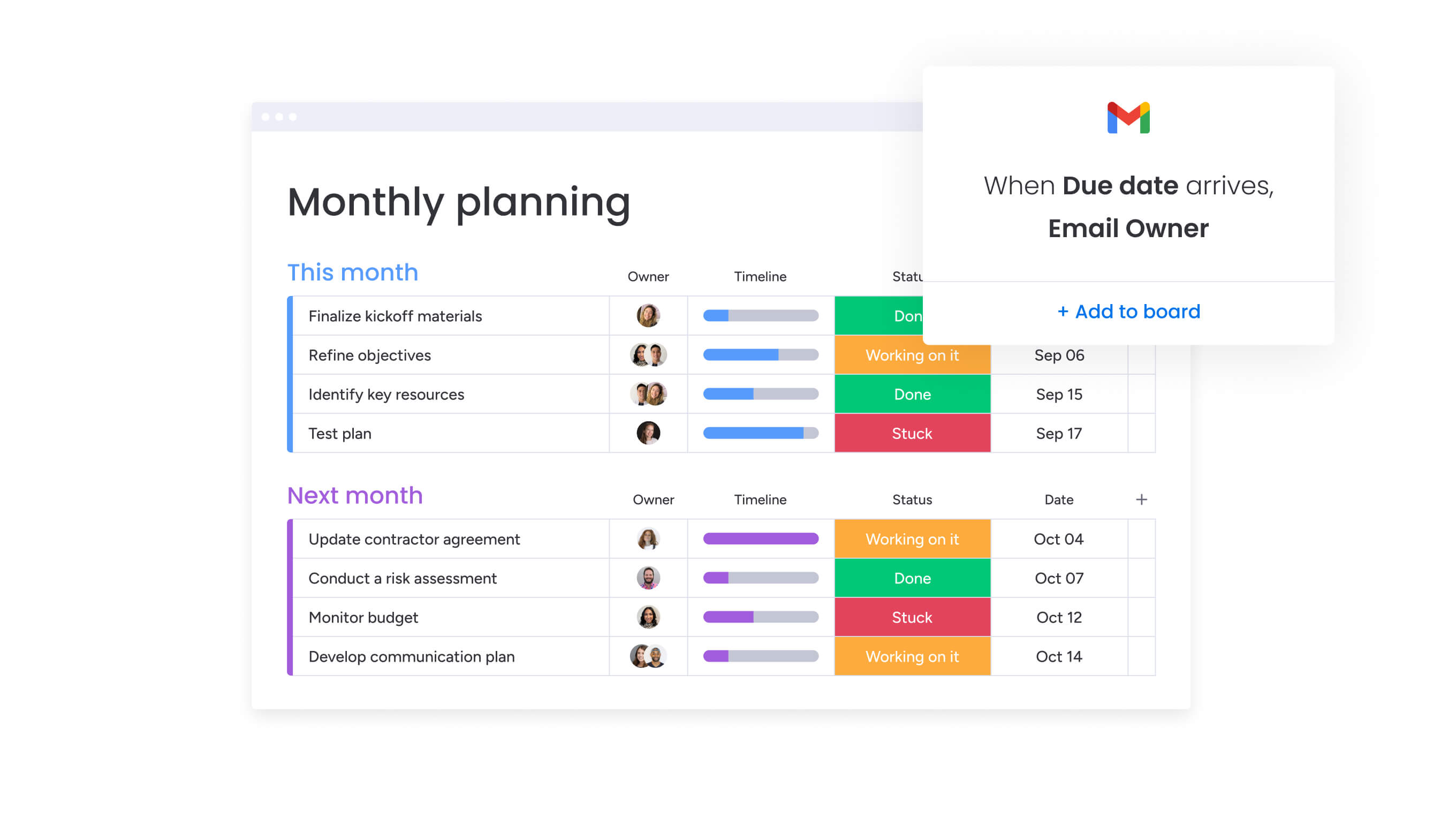
The following six-step framework provides a structured approach to implementing monday.com while maintaining continuity with existing marketing processes. This methodology ensures successful adoption across your marketing organization and enables teams to leverage the platform’s full capabilities.
Step 1: establish your marketing command center
Create a centralized workspace in monday.com that serves as the single source of truth for all marketing activities. Set up boards for campaign management, content calendars, creative requests, and resource planning. Configure dashboards that provide real-time visibility into campaign status, team workload, and performance metrics.
Step 2: map your marketing automation workflows
Document your current marketing automation processes and identify touchpoints where work management is needed. Map out how campaigns move from planning through execution, including approval gates, handoffs between teams, and dependencies on external stakeholders. Configure monday.com boards that mirror your actual workflows.
Step 3: integrate your marketing automation tools
Connect monday.com to your marketing automation platforms using native integrations or Zapier. Set up two-way data flows that ensure campaign information, performance metrics, and status updates are synchronized between systems. This integration enables your team to work primarily in monday.com while leveraging specialized capabilities of your marketing automation tools.
Step 4: standardize processes with templates and automation
Create reusable templates for common marketing scenarios like campaign launches, event management, and content production. Build automation recipes that eliminate manual tasks like status updates, approval notifications, and deadline reminders. Standardize processes across teams and regions to ensure consistency while maintaining flexibility.
Step 5: implement resource planning and capacity management
Set up workload views and resource planning boards that provide visibility into team capacity across all marketing functions. Establish processes for reviewing resource allocation weekly or bi-weekly. Use the platform’s capacity planning features to forecast resource needs for upcoming campaigns.
Step 6: establish reporting and continuous improvement
Configure dashboards that track the metrics most important to your organization. Schedule regular reviews of these metrics with your team and executive stakeholders. Continuously refine your workflows, templates, and automation based on what you learn.
Try monday.comComparison: monday.com vs. competing platforms
The following comparison shows how monday.com stacks up against other platforms you might be considering, highlighting key differences in capabilities, implementation, and cost structure.
| Feature | monday work management | HubSpot Marketing Hub | Salesforce Marketing Cloud |
|---|---|---|---|
| Campaign management | Visual boards with unlimited customization | Built-in campaign tools with templates | Journey Builder for complex campaigns |
| Resource management | Native workload views and capacity planning | Limited resource management | Requires third-party tools |
| Cross-functional collaboration | Shared boards with real-time updates | Limited to marketing team | Siloed within Salesforce ecosystem |
| Workflow automation | No-code automation builder with 200+ recipes | Marketing-specific automation | Complex automation requiring technical expertise |
| Integration capabilities | 200+ native integrations plus open API | 1,000+ integrations via marketplace | Not included |
| Customization | Fully customizable boards, views, and workflows | Template-based with limited customization | Not included |
| Price per user/month | From $10/user (Standard plan) | From $890/month for three users (Professional) | Not included |
| Implementation time | One to two weeks for basic setup | Four to eight weeks with onboarding | Not included |
| Feature | monday.com | HubSpot Marketing Hub | Salesforce Marketing Cloud | | — | — | — | — | | Campaign management | Visual boards with unlimited customization | Built-in campaign tools with templates | Journey Builder for complex campaigns | | Resource management | Native workload views and capacity planning | Limited resource management | Requires third-party tools | | Cross-functional collaboration | Shared boards with real-time updates | Limited to marketing team | Siloed within Salesforce ecosystem | | Workflow automation | No-code automation builder with 200+ recipes | Marketing-specific automation | Complex automation requiring technical expertise | | Integration capabilities | 200+ native integrations plus open API | 1,000+ integrations via marketplace | | Customization | Fully customizable boards, views, and workflows | Template-based with limited customization | | Price per user/month | From $10/user (Standard plan) | From $890/month for three users (Professional) | | Implementation time | One to two weeks for basic setup | Four to eight weeks with onboarding |
How Genpact transformed their global marketing operations
Genpact’s global marketing department faced significant operational challenges managing 24 ongoing large-scale marketing campaigns simultaneously across a distributed team. Campaign managers relied heavily on spreadsheets saved across personal desktops, emails, and SharePoint folders, making it nearly impossible to track campaign status or identify the latest version of planning documents.
The implementation approach
The team implemented monday.com to create a centralized platform for end-to-end campaign planning and execution. They built workflow apps outlining the entire activation process for each channel, with columns tracking both target dates and actual time frames to identify trends and bottlenecks. The platform’s forms and automation capabilities formalized the campaign brief submission and approval process.
Measurable results
The transformation delivered remarkable results:
- 40% improvement: in cross-team collaboration for successful campaign planning.
- 100% removal: of spreadsheets from marketing workflows.
- 25% decrease: in email exchanges across the marketing department.
Since adopting monday.com, Genpact’s global marketing department achieved a 40% improvement in cross-team collaboration for successful end-to-end campaign planning and execution. This transformation enabled the team to coordinate complex campaigns more effectively while maintaining visibility across all marketing activities.
Transform your marketing operations with monday.com
Marketing automation has evolved beyond basic email campaigns to encompass comprehensive work management that drives operational excellence. The right platform unifies marketing operations, provides visibility across teams, and scales with organizational growth while maintaining the flexibility needed for creative, data-driven work.
The operational gap that traditional marketing automation platforms leave unfilledis addressed by monday.com. By providing centralized visibility, resource optimization, and cross-functional collaboration capabilities, the platform enables marketing leaders to bridge the gap between strategic planning and tactical execution.
What does this mean for you? Your team delivers more campaigns without burning out, the quality of your marketing improves dramatically, and you can finally show your CEO exactly how marketing drives revenue. With AI-powered insights, customizable workflows, and enterprise-grade flexibility, marketing teams gain the operational foundation needed to deliver exceptional results at scale.
Ready to transform your marketing operations?
Marketing automation has evolved beyond basic email campaigns to encompass comprehensive work management that drives operational excellence. The right platform unifies marketing operations, provides visibility across teams, and scales with organizational growth.
Campaign planning, resource optimization, and cross-functional collaboration come together in one platform with monday.com. With AI-powered insights, customizable workflows, and enterprise-grade flexibility, marketing teams gain the operational foundation needed to deliver exceptional results at scale.
The content in this article is provided for informational purposes only and, to the best of monday.com‘s knowledge, the information provided in this article is accurate and up-to-date at the time of publication. That said, monday.com encourages readers to verify all information directly.
Frequently asked questions
How does monday.com integrate with existing marketing automation platforms?
Through native integrations and Zapier connections,monday.com integrates with marketing automation platforms, enabling two-way data synchronization between systems. The platform connects with major marketing automation tools including HubSpot, Marketo, Salesforce Marketing Cloud, and ActiveCampaign.
Can monday.com replace our marketing automation software?
Designed to complement, not replace, marketing automation software, monday.com provides the work management layer needed to plan campaigns, manage resources, coordinate cross-functional teams, and track performance against strategic objectives.While marketing automation platforms focus on executing campaigns across channels like email, SMS, and social media, monday.com fills the operational gap.
How long does it take to implement monday.com for a large marketing team?
Implementation timelines for enterprise marketing teams typically range from two to four weeks for basic setup to two to three months for comprehensive deployment across all marketing functions. The platform's intuitive interface and pre-built templates enable quick initial setup, with teams often seeing value within the first week.
What level of technical expertise is required to manage the platform?
Designed for business users, monday.com requires no coding or technical expertise for day-to-day use. Marketing leaders and team members can create boards, build automations, and configure workflows using the platform's no-code, drag-and-drop interface.
How does monday.com help prevent team burnout in large marketing organizations?
Through real-time visibility into workload distribution and capacity planning features that enable proactive resource management, the platform prevents team burnout. Marketing leaders use workload views to identify team members who are over-capacity and redistribute work before burnout occurs.
What metrics can marketing leaders track to demonstrate ROI to executive leadership?
With monday.com, marketing leaders can track comprehensive metrics including campaign ROI, customer acquisition cost, MQL-to-customer conversion rates, campaign volume and performance, budget adherence and forecasting accuracy, team productivity and resource utilization, time-to-launch and on-time delivery rates, and stakeholder satisfaction scores.

 Get started