

Marketing teams in services organizations often set ambitious objectives, yet translating these goals into measurable outcomes remains a persistent challenge. Goals frequently reside in static documents, while daily work unfolds across multiple disconnected platforms, creating gaps between strategy and execution. This disconnect makes it difficult to track campaign impact, allocate resources effectively, and demonstrate ROI to stakeholders.
This guide explores how enterprise goal tracking software can bridge that gap, providing centralized visibility, automated progress updates, and structured workflows. It will cover key capabilities such as cascading OKRs, resource management, automated reporting, and workflow standardization. By the end, marketing leaders will understand how to connect strategic objectives to day-to-day operations while improving efficiency, alignment, and measurable business impact.
Key takeaways
Marketing leaders in services organizations need goal tracking systems that bring structure, visibility, and accountability to complex, cross-functional operations. The following takeaways summarize the core insights from this guide and what matters most when selecting and implementing goal tracking software at scale.
- Strategy and execution must live in the same system: effective goal tracking connects high-level marketing objectives directly to campaigns, projects, and daily work to eliminate execution gaps.
- Manual reporting creates blind spots: automated progress updates and real-time dashboards are essential for maintaining accurate visibility across large, distributed marketing teams.
- Resource planning directly impacts performance: workload visibility and capacity management help prevent burnout while protecting delivery timelines and campaign quality.
- Scalable goal frameworks drive alignment: platforms like monday work management support cascading OKRs, dashboards, and resource management in a unified workspace built for complex marketing organizations.
- Measurable impact strengthens marketing credibility: centralized data and reporting enable marketing leaders to clearly demonstrate ROI, productivity gains, and strategic contribution to the business.
What makes monday work management the right choice for marketing goal tracking?
.jpg) Goal management software enables organizations to set, monitor, and achieve strategic objectives across teams and departments. For marketing leaders in services organizations, this requires a platform that connects long-term strategy with daily execution, ensures teams understand how their work supports business priorities, and delivers real-time visibility without relying on constant status meetings.
Goal management software enables organizations to set, monitor, and achieve strategic objectives across teams and departments. For marketing leaders in services organizations, this requires a platform that connects long-term strategy with daily execution, ensures teams understand how their work supports business priorities, and delivers real-time visibility without relying on constant status meetings.
Marketing teams often struggle with fragmented goal-setting spread across spreadsheets, disconnected systems, and siloed updates. Modern platforms like monday work management bring these elements together into a single, cohesive environment where marketing goals, campaigns, and operational workflows stay connected.
By linking marketing initiatives directly to revenue targets and operational projects to customer satisfaction metrics, teams gain clear context around priorities. Goals live alongside campaigns, projects, and workflows, helping teams understand not only what needs to be delivered, but why it matters to the organization.
Goals & OKRs framework
monday work management’s Goals & OKRs feature provides dedicated frameworks for setting company-level objectives and tracking progress toward strategic marketing initiatives. The platform creates hierarchical goal structures that cascade from organizational priorities down to departmental and individual targets, with automatic progress updates based on connected work items.
Key capabilities that support goal alignment:
- Hierarchical structures: create cascading goals from company to team to individual level.
- Automatic updates: progress syncs based on completed work items.
- Real-time dashboards: display goal completion percentages and timeline adherence.
For marketing teams serving industries such as technology, financial services, or professional services, this structure removes the alignment gaps that make impact difficult to measure. Campaigns, creative assets, and acquisition initiatives are directly tied to strategic objectives, making it easier to demonstrate marketing contribution to executive stakeholders.
Resource management capabilities
Effective goal tracking depends on having clear visibility into team capacity. With resource management features in monday work management, marketing leaders can see how work is distributed across teams and individuals, making informed allocation decisions based on availability and skills.
The Workload View provides visual insight into assigned workflows, estimated effort, and capacity limits. This makes over-allocation easy to identify and resolve before it affects delivery timelines or team performance.
Resource optimization capabilities include:
- Workload visualization: see team capacity at department, team, or individual level.
- Skill-based filtering: allocate based on expertise and availability.
- Drag-and-drop reallocation: instantly adjust when priorities shift.
With real-time visibility into who works on what and when, marketing leaders strategically allocate resources based on skills and availability rather than assumptions. The platform’s capacity planning capabilities help forecast resource needs for upcoming campaigns and identify bottlenecks before they impact delivery timelines.
Dashboards and reporting
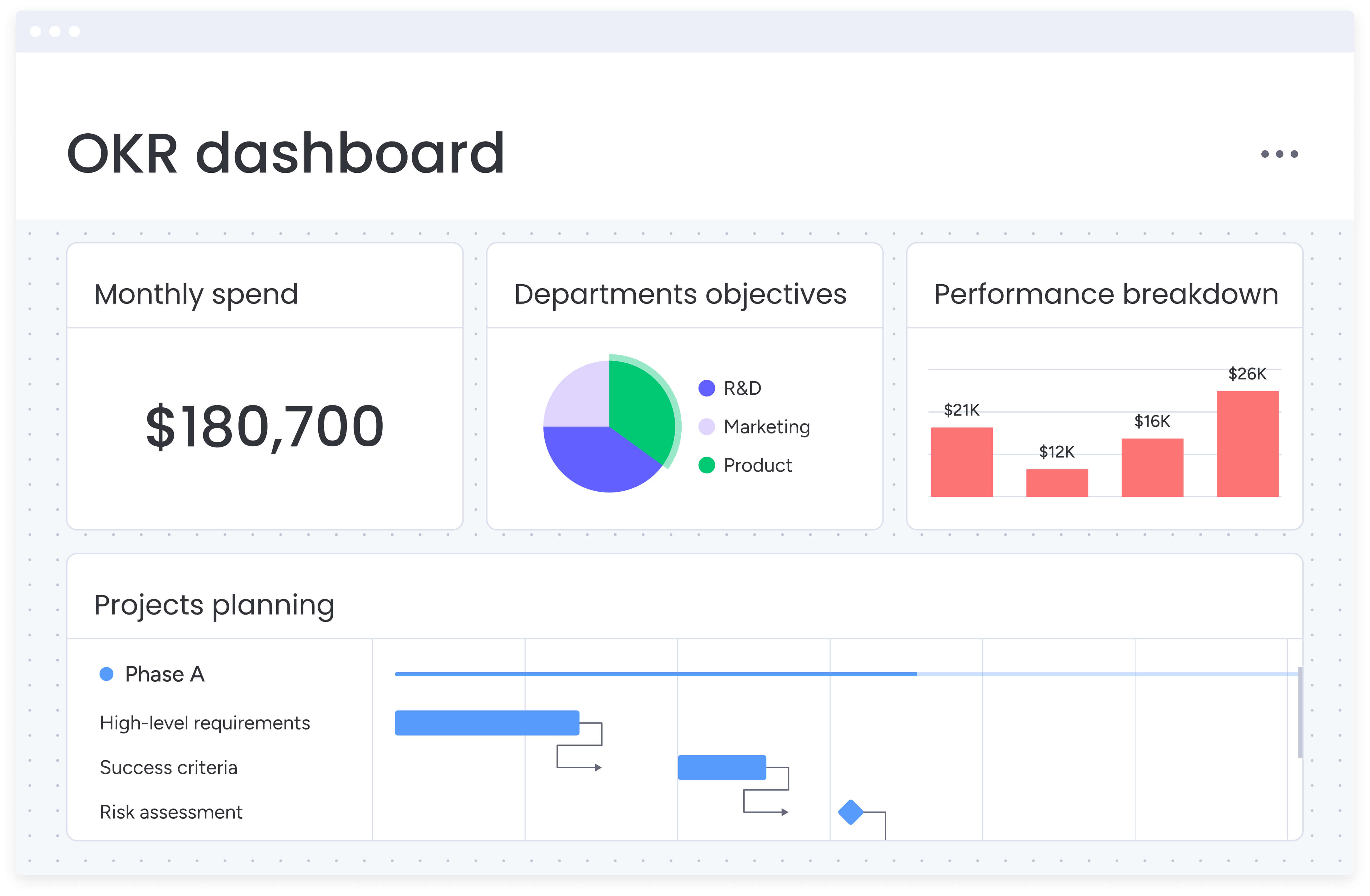
monday work management’s dashboards transform scattered marketing data into centralized, visual insights demonstrating ROI and campaign performance to executive stakeholders. The platform offers pre-built dashboard widgets for tracking KPIs like campaign ROI, CAC, MQL-to-customer conversion rates, budget adherence, and team productivity metrics.
Dashboard capabilities that drive visibility:
- Multi-board aggregation: combine data from multiple boards into executive views.
- Custom filtering: analyze performance by channel, region, or campaign type.
- Automated delivery: schedule report distribution to stakeholders.
Instead of spending hours preparing quarterly business reviews, marketing leaders provide real-time access to dashboards showing volume and performance of content campaigns, budget forecasting accuracy, time-to-launch metrics, and stakeholder satisfaction scores.
Automation and workflow standardization
The Automations feature eliminates repetitive manual workflows through no-code automation connecting people to the right information at the right time. With over 250,000 automations and integrations available on Enterprise plans, teams create sophisticated workflows triggering notifications when campaign milestones are reached, automatically moving workflows through approval stages, and updating goal progress based on completed work.
Automation benefits for goal tracking:
- Progress notifications: alert stakeholders when milestones are reached.
- Approval workflows: move work through stages automatically.
- Status reporting: send updates without manual intervention.
By automating routine processes, marketing teams spend less time on administration and more time on strategic planning and execution.
How marketing leaders in services benefit from monday work management
Marketing organizations using monday work management for goal tracking achieve measurable improvements in operational efficiency and team alignment. The platform delivers specific benefits addressing the unique challenges of managing 50-100+ person teams across multiple marketing functions. These benefits translate into tangible business outcomes that justify investment in goal tracking software.
Time and efficiency gains
Marketing leaders save hours each week by automating status reports and centralizing team communication. Teams experience 55% reduction in email exchanges and 41% decrease in conference calls through platform-driven efficiency. Manual status reporting that previously consumed hours weekly becomes automated, freeing leadership to focus on strategic decisions rather than chasing updates.
Cost and ROI improvements
Organizations achieve substantial financial returns through optimized resource utilization and reduced administrative overhead. Marketing teams report $118K saved monthly through elimination of redundant platforms and spreadsheet-based processes. The platform delivers 6x ROI by streamlining workflows and improving resource allocation accuracy.
Enhanced team productivity
Teams experience 40% improvement in cross-team collaboration and 62% improvement in assets and approvals processes. Marketing organizations achieve 3x creative output and 142% more weekly campaigns by reducing bottlenecks in creative production, content development, and approval processes. Streamlined workflows and ownership transparency drive 2x faster delivery of marketing initiatives.
Visibility and tracking improvements
Real-time dashboards provide instant visibility into campaign progress, team workloads, and goal achievement across all marketing functions. Leaders gain proactive capacity planning capabilities preventing burnout while maintaining velocity. The single source of truth eliminates scattered information across spreadsheets and disconnected systems.
6 steps to implement goal tracking with monday work management
Implementing effective goal tracking requires a structured approach connecting strategic objectives to daily execution. The following steps provide a proven framework for establishing goal tracking that scales across your marketing organization. Each step builds on the previous one to create a comprehensive goal management system.
Step 1: establish goal hierarchy and OKR framework
Create dedicated Goals boards defining company-level marketing objectives and key results for the quarter or year. Use cascading goals features connecting departmental goals for content, creative, acquisition, events, and operations to top-level objectives. This ensures every team understands how their work contributes to strategic priorities.
Step 2: connect goals to campaign execution boards
Link existing campaign management, creative production, and event coordination boards to relevant goals using board connections. This creates automatic progress tracking where goal completion percentages update in real-time as teams complete workflows, eliminating manual status reporting.
Step 3: configure resource management and capacity tracking
Set up Workload views displaying team capacity across all goal-related initiatives. Define each team member’s weekly capacity, assign workflows with time estimates, and use color-coded indicators identifying over-allocation. This prevents burnout while ensuring adequate resources for goal achievement.
Step 4: build executive dashboards for goal visibility
Create customized dashboards aggregating goal progress, campaign performance metrics including ROI, CAC, and MQL-to-customer rates, budget utilization, and team productivity indicators. Configure automated delivery of these dashboards to executive leadership on your preferred schedule.
Step 5: implement automation for goal tracking workflows
Set up automations notifying stakeholders when goals reach specific completion thresholds, sending weekly progress summaries to team leads, escalating at-risk goals to leadership, and triggering celebrations when teams achieve key milestones. This maintains accountability without administrative burden.
Step 6: establish regular goal review and optimization cycles
Schedule quarterly goal review sessions using the platform’s historical data and analytics evaluating what worked, identifying process improvements, and refining your goal-setting approach. Use goal setting templates standardizing this review process across all marketing teams for consistent continuous improvement.
Comparison: monday work management vs. competing platforms
When evaluating goal tracking software for marketing teams, key differences emerge between platforms. This comparison highlights distinctions important for managing 100+ person teams across multiple marketing functions. Understanding these differences helps marketing leaders select the platform that best supports their specific operational requirements.
| Feature | monday work management | Asana | ClickUp |
|---|---|---|---|
| Cascading goals & OKRs | All plans | Advanced plan+ | Unlimited plan+ |
| Resource management & workload view | Standard plan+ | Business plan+ | Business plan+ |
| Real-time dashboards | Standard plan+ | Advanced plan+ | Business plan+ |
| Marketing-specific templates | 200+ templates | 50+ templates | 100+ templates |
| Automations per month | Up to 250,000 (Enterprise) | Up to 25,000 (Enterprise) | Unlimited (Business+) |
| AI-powered risk identification | Included | Enterprise only | Business plan+ |
| Implementation time | 2 weeks to one month | two to four weeks | one to three weeks |
How Genpact transformed global marketing operations
Genpact’s globally distributed marketing organization managed 24 large-scale campaigns at the same time across multiple programs, industries, and solutions. Campaign planning relied on spreadsheets stored across personal devices, email threads, and Microsoft SharePoint folders, limiting visibility and consistency.
With numerous contributors involved in cross-channel activations, tracking campaign status and key information became increasingly difficult across regions and teams.
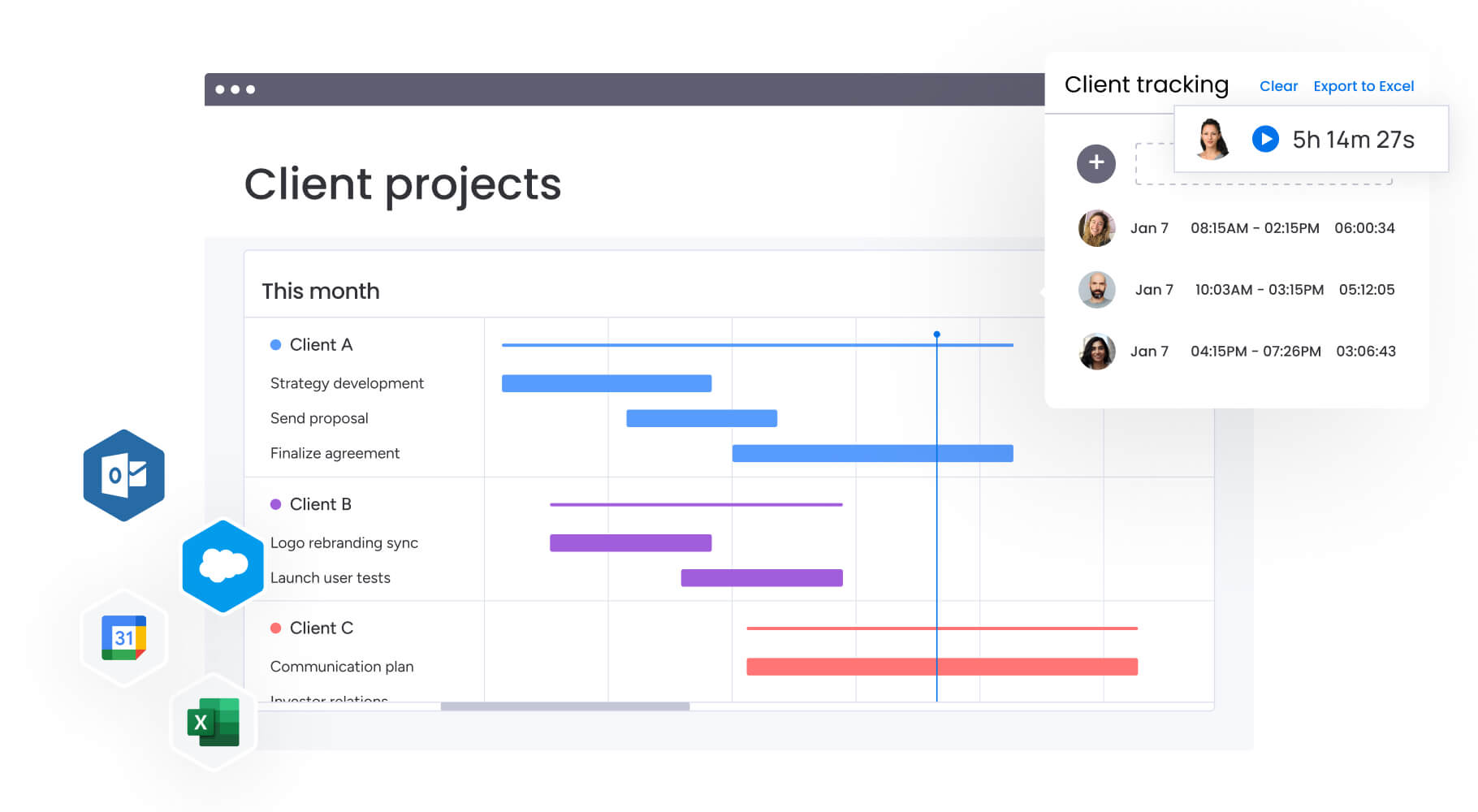
To address this challenge, the organization implemented monday work management to standardize end-to-end campaign planning and execution. Workflow applications were created to map activation processes for each channel, with columns tracking target dates and actual delivery timelines.
Timeline Views and dashboards provided visibility into weekly and monthly activities, enabling leaders to identify risks early and adjust plans proactively.
Results achieved through implementation:
- 40% improvement in cross-team collaboration for campaign planning and execution.
- 100% removal of spreadsheets from marketing workflow.
- 25% decrease in email exchanges across global marketing department.
The platform’s forms feature formalized campaign brief submission and approval processes, providing campaign managers visibility into request queues and turnaround times. When the pandemic forced rapid pivots from in-person to virtual events, the flexible platform allowed immediate restructuring of event boards tracking cancellations, postponements, and contract renegotiations.
Transform your marketing goal management
For heads of marketing in services organizations, goal tracking often breaks down when strategy lives in one place and execution happens somewhere else. Disconnected systems, manual reporting, and limited visibility make it difficult to prove impact, allocate resources effectively, and keep teams aligned as priorities shift.
Modern platforms like monday work management help close this gap by connecting strategic objectives directly to daily workflows. Goals, campaigns, resources, and performance data live in one coordinated environment, giving marketing leaders the clarity and control needed to operate at scale.
With monday work management, marketing teams benefit from:
- Cascading goals and OKRs: link company objectives to campaigns, projects, and ongoing workflows.
- Real-time dashboards and automated reporting: replace manual updates and provide continuous visibility into progress and ROI.
- Resource and workload management: balances team capacity, protects delivery timelines, and supports sustainable performance.
- Workflow automation and standardization: reduce administrative effort while maintaining accountability across teams.
- Scalable templates and integrations: adapt to complex services marketing operations without adding friction.
The result is a goal tracking approach that improves efficiency, strengthens alignment, and elevates marketing’s strategic impact across the organization. By using monday work management to connect daily execution with long-term objectives, services marketing leaders gain measurable results without increasing operational complexity.
Frequently asked questions
How long does it take to implement goal tracking software for large marketing teams?
The time it takes to implement goal tracking software for large marketing teams is typically two to four weeks. monday work management's intuitive interface requires minimal training monday work management's intuitive interface requires minimal training, with most team members becoming comfortable within the first two weeks. For complex implementations involving multiple departments and custom workflows, organizations leverage dedicated onboarding services, consulting, and change management support accelerating adoption across content, creative, acquisition, events, and operations teams.
Can goal tracking software integrate with Salesforce and marketing automation platforms?
Yes, goal tracking software offers native integrations with Salesforce, HubSpot, Marketo, and other leading marketing automation platforms. monday work management enables automatic syncing of campaign data, lead information, and performance metrics directly into goal tracking dashboards. The platform provides open API for building custom integrations with proprietary systems and offers 200+ pre-built integrations with popular marketing platforms through its app marketplace.
What's the typical ROI timeline for goal tracking software in services companies?
Services organizations typically see measurable ROI within four months of implementing goal tracking software. Marketing teams report immediate time savings from reduced email communication, fewer status meetings, and elimination of manual reporting processes. Financial ROI manifests through improved resource utilization, reduced administrative overhead, and increased campaign output driving revenue growth without proportional headcount increases.
How do you prevent goal tracking from becoming administrative overhead?
Goal tracking software prevents administrative burden through automation eliminating manual status updates and reporting. monday work management automatically updates goal progress based on completed workflows, sends scheduled progress summaries to stakeholders, and triggers notifications only when intervention is required. Marketing leaders configure automation recipes handling routine goal-tracking activities like weekly check-ins, milestone celebrations, and risk escalations without requiring team members to update spreadsheets or attend status meetings.
Should marketing teams use OKRs or KPIs for goal setting?
Marketing teams in services organizations benefit from using both OKRs and KPIs in combination. OKRs work best for ambitious, time-bound strategic goals like entering new markets, launching major campaigns, or achieving significant growth milestones. KPIs are ideal for ongoing operational metrics like campaign ROI, CAC, MQL-to-customer rates, content volume, and budget adherence requiring continuous monitoring. monday work management supports both frameworks, allowing teams to track strategic OKRs alongside operational KPIs in unified dashboards providing comprehensive visibility into marketing performance.
What security features are essential for enterprise goal management?
Enterprise marketing organizations require goal management platforms with SSO integration, role-based access controls, data encryption at rest and in transit, SOC 2 Type II compliance, GDPR compliance, and audit logging capabilities. monday work management provides these security features on Enterprise plans, including IP restrictions, two-factor authentication, multiple SSO options, BYOK encryption, and tenant-level encryption protecting strategic marketing goals, campaign performance data, and competitive intelligence while maintaining accessibility for cross-functional collaboration.

 Get started