


Finance marketing leaders manage complex campaigns across multiple channels while coordinating large, distributed teams. Strategic objectives often live in spreadsheets or siloed systems, while day-to-day execution occurs in disconnected tools. This gap makes it difficult to measure ROI, track progress, and maintain alignment across functions.
Great goal tracking software bridges strategy and execution by embedding objectives directly into workflows. Centralized dashboards, automated updates, and resource visibility transform fragmented processes into coordinated execution.
This guide explores how enterprise goal tracking software empowers finance marketing teams to align objectives, monitor performance, and optimize resources. It covers essential features, implementation strategies, platform comparisons, and real-world examples that demonstrate measurable business impact.
Key takeaways
Enterprise marketing teams in finance face complex challenges managing distributed teams, multi-channel campaigns, and siloed processes, making centralized goal tracking essential for measurable results.
- Unified visibility across campaigns: real-time dashboards connect strategy to execution, allowing leadership to monitor ROI, team capacity, and budget adherence without manual reporting.
- Automated progress tracking: integrations and workflow automations reduce reporting burden by 20-30%, ensuring that goal updates reflect actual project completion.
- Cross-functional alignment: shared workflows break down silos between content, creative, acquisition, and operations teams, improving collaboration and minimizing duplicated efforts.
- Resource optimization: workload views and capacity planning help allocate talent effectively, prevent bottlenecks, and maintain team wellbeing across large marketing operations.
- Platform integration and scalability: goal tracking systems like monday work management embed objectives directly into daily workflows, supporting compliance, automation, and AI-driven insights to enhance strategic decision-making.
What makes heads of marketing choose monday work management for goal tracking?
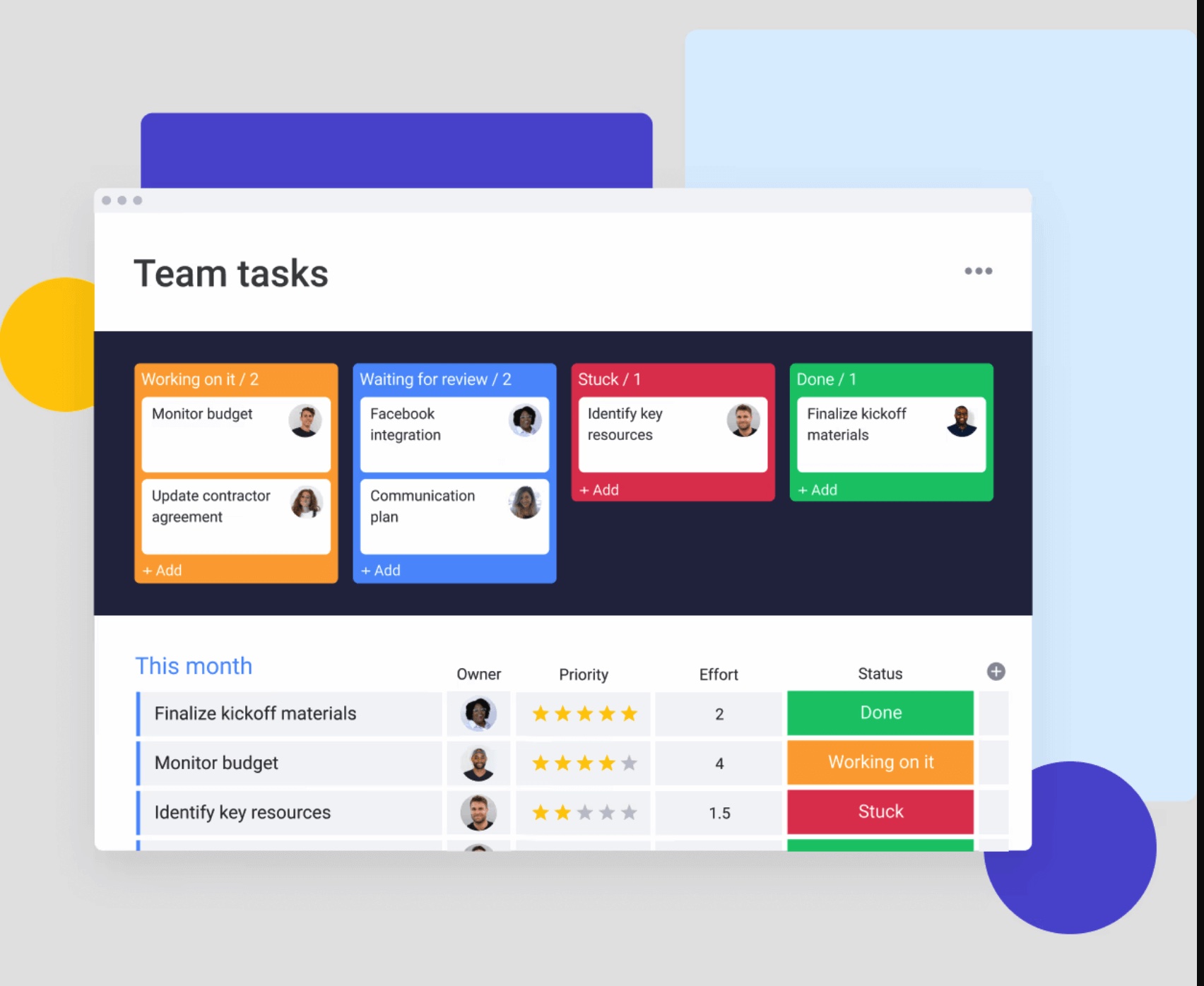
Goal tracking platforms serve as the connective tissue between marketing strategy and daily execution. For heads of marketing overseeing distributed teams across multiple functions, the solution provides a single source of truth where campaign ROI, team capacity, and budget adherence are visible in real time.
Tracking goals alone is not the challenge. The difficulty lies in linking those goals to the work teams do every day. When OKRs and execution are disconnected, it becomes hard to determine what drives meaningful results.
Key problems this creates:
- Teams duplicate efforts and miss critical dependencies.
- Countless hours spent compiling reports instead of driving campaigns forward.
- Lack of real-time visibility into campaign performance and resource allocation.
Modern platforms like monday work management bridge this gap by putting goals where the work happens. Unlike complex enterprise solutions that require weeks of training and external consultants, it adapts to how marketing teams already operate. Whether managing multi-channel campaigns, coordinating with legal and finance teams, or tracking MQL-to-customer conversion rates across regions, the solution provides the flexibility and governance enterprise teams require.
monday work management top features for goal tracking
.jpg)
These capabilities help align high-level strategy with daily projects while keeping teams across locations and functions coordinated. Each feature addresses a specific challenge that can slow marketing performance.
Goals & OKRs
The Goals & OKRs feature allows setting company-level objectives and cascading them to departmental and individual targets. It supports multiple goal-setting frameworks, including OKRs, SMART goals, and KPIs, with metrics in numbers, percentages, or currency values that update automatically as connected work progresses.
For marketing leaders in finance, this capability ensures distributed teams are aligned around shared outcomes. Content production, creative timelines, and acquisition campaigns can be linked directly to measurable business objectives. Real-time progress tracking eliminates manual status reporting, allowing strategic focus instead of data aggregation.
Dashboards & reporting
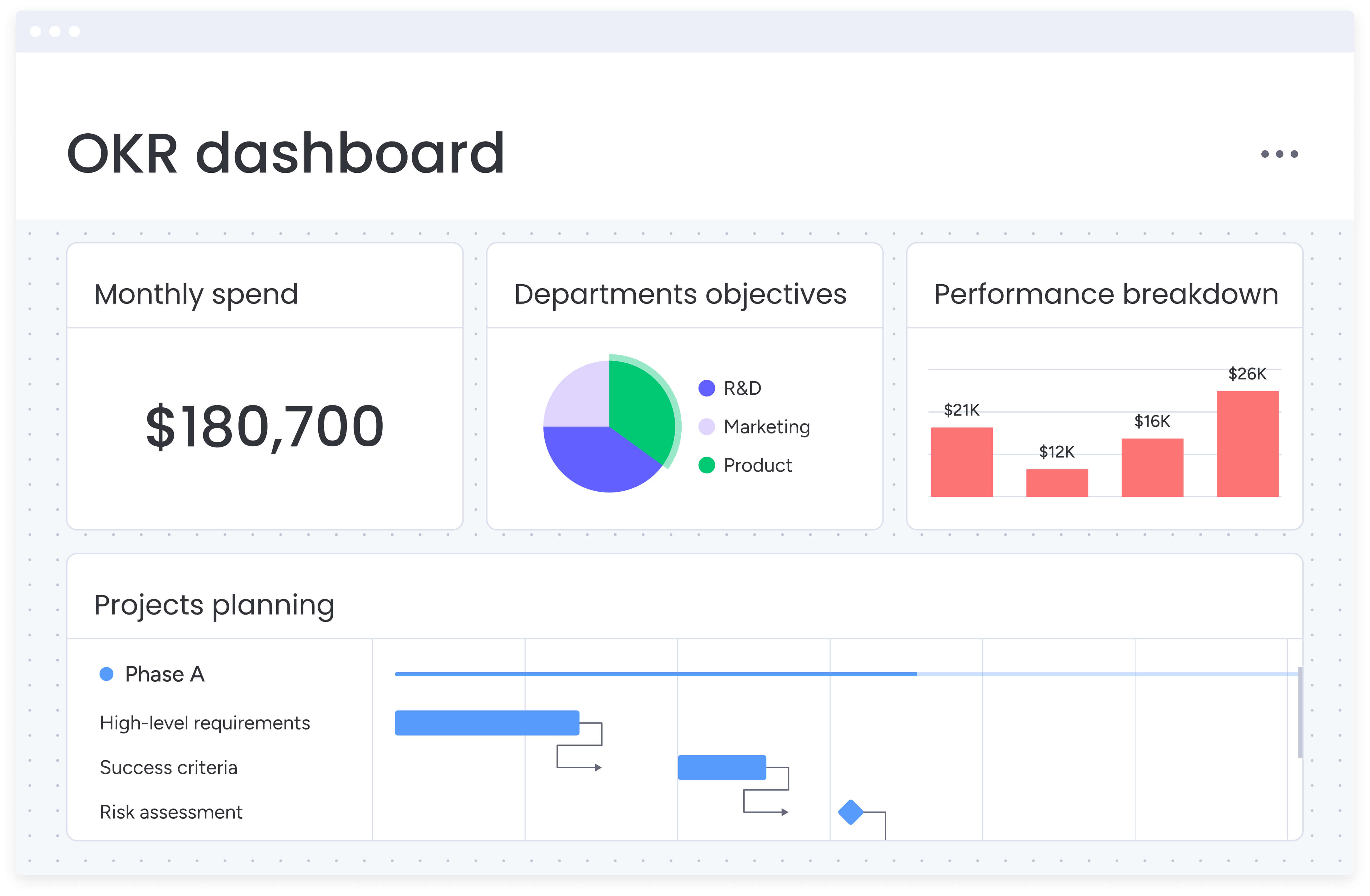
Customizable dashboards combine data from multiple projects and boards, delivering real-time insights into campaign performance, budget adherence, and team productivity. Teams can build pre-configured or fully custom dashboards using more than 30 widget types, including charts, timelines, battery indicators, and numerical summaries that update automatically.
This solves the challenge of limited visibility into ROI and resource utilization. Marketing leaders can create executive-ready dashboards showing CAC, MQL-to-customer rates, and budget forecasting accuracy without manual consolidation.
Key dashboard capabilities:
- Filter data by team, campaign type, or time period.
- Drill down into performance metrics while maintaining portfolio-level view.
- Generate stakeholder reports automatically.
Resource management
Built-in resource management integrates directly into workflows, enabling planning, assignment, and adjustments at the project level. The Workload view shows team capacity across projects, highlighting over- or under-allocation based on assignments and estimated hours.
Large marketing teams can maintain alignment and protect team wellbeing. Capacity issues are identified before they disrupt timelines, work is distributed evenly across content and design teams, and top-priority campaigns receive the talent they require.
Resource management benefits:
- Capacity planning: identify constraints before they cause delays.
- Workload balancing: distribute assignments across content creators and designers.
- Talent matching: resource directory consolidates department, job roles, and expertise data.
Automations
Enterprise customers get a whopping 250,000 automations and integrations monthly, all without writing a single line of code. Build your own automation recipes or grab ready-made templates for the stuff marketers actually need: deadline reminders, approval chains, and status updates.
Automation directly tackles the inefficient processes that plague marketing operations in large organizations. By automating campaign brief submissions, creative review cycles, and cross-functional approval chains, you reduce email exchanges and meeting overhead. The time saved can be redirected toward strategic initiatives that drive growth.
AI-powered capabilities
monday work management includes AI features that analyze org-wide data to flag risks early, provide strategic recommendations for resource allocation, and accelerate project planning. The AI identifies potential roadblocks across your marketing portfolio, suggests optimal workload distribution, and generates detailed project plans with suggested phases based on your objectives.
For marketing leaders who must demonstrate ROI while managing compliance requirements, AI-powered risk identification provides early warning of campaign delays, budget overruns, or resource constraints. The predictive capabilities help you course-correct before issues impact delivery timelines or stakeholder satisfaction.
AI capabilities include:
- Risk identification: early warning of campaign delays and budget overruns.
- Resource optimization: intelligent allocation recommendations based on capacity and priorities.
- Project acceleration: generate detailed plans with suggested phases for new campaigns.
Integrations
The platform integrates with 200+ business applications including Slack, Microsoft Teams, Google Workspace, Salesforce, and financial systems, creating a unified ecosystem where marketing data flows seamlessly between platforms. The open API enables custom integrations that pull goal-related data from any system.
Unify your disconnected martech and finance systems into a single ecosystem. Pull campaign data straight from your CRM, grab budget numbers from your financial platforms, and access legal compliance docs, all in the same place where you’re already tracking goals and managing projects.
Customizable views
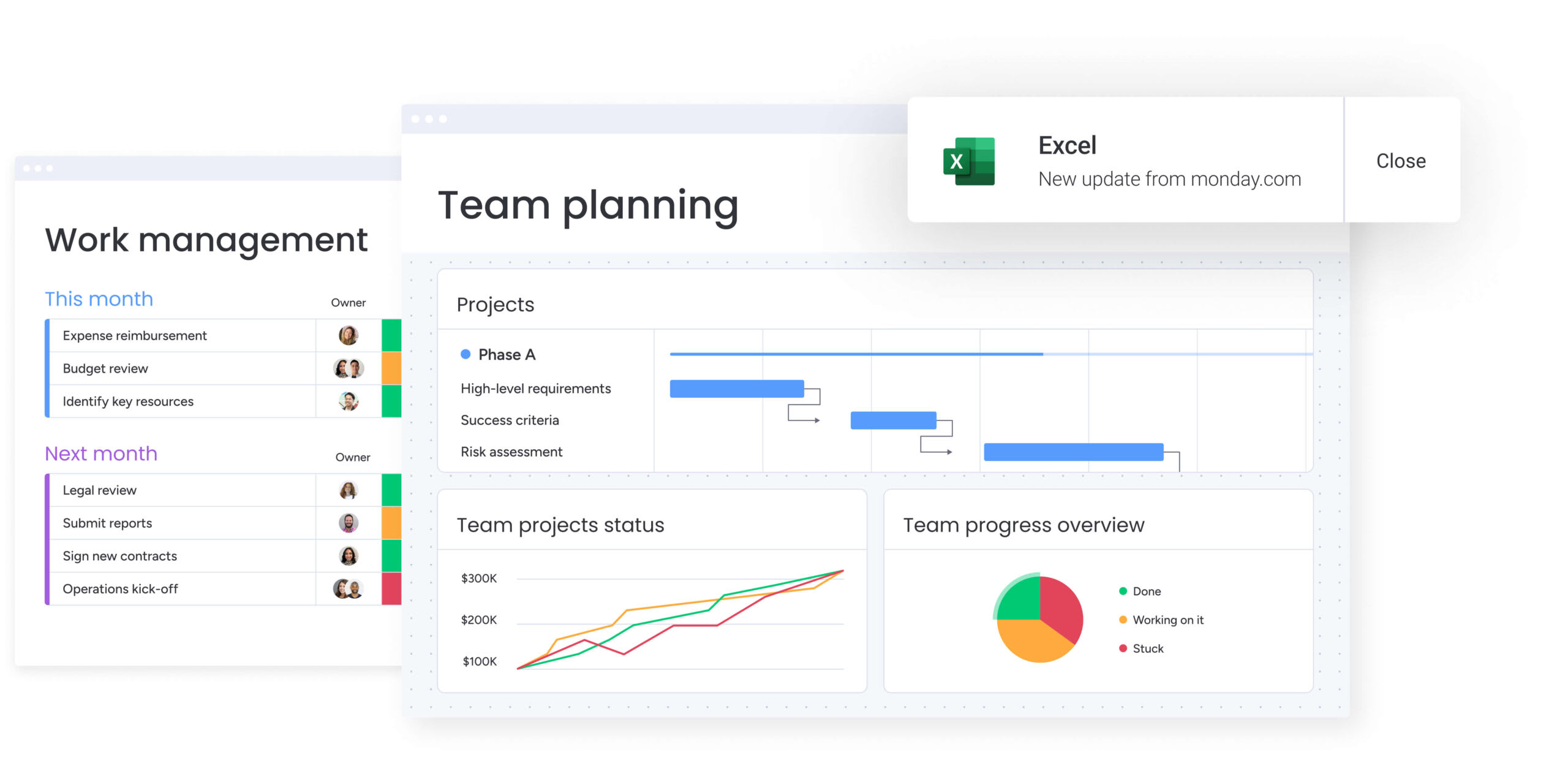
Multiple visualization options, including Board, Timeline, Gantt, Calendar, Kanban, and Workload views, allow teams to see work in the most suitable format. Views can be switched instantly, and different members can use different perspectives of the same board.
This flexibility addresses diverse marketing needs. Editorial teams can use Calendar views, PMOs track campaign dependencies via Gantt charts, and creative directors manage production workflows with Kanban boards.
View options by team function:
- Content teams: calendar view for editorial planning.
- PMO: Gantt charts for campaign dependencies.
- Creative directors: Kanban boards for asset production workflows.
- Leadership: dashboard view for portfolio oversight.
How a head of marketing in finance benefits from monday work management
Finance marketing leaders experience measurable improvements after adopting monday work management. The platform addresses the challenges of managing large teams in regulated industries while delivering quantifiable outcomes.
The platform delivers quantifiable improvements across six key areas:
- Time savings: marketing teams save 3,500-7,000 hours monthly by eliminating manual status reporting and reducing email exchanges by 25%.
- Cost efficiency: organizations achieve six to 8x ROI through reduced platform sprawl and optimized resource allocation.
- Compliance & accuracy: centralized documentation and automated approval workflows ensure marketing initiatives meet financial regulatory requirements.
- Productivity improvements: teams experience 40% improvement in cross-team collaboration and 2x faster delivery timelines.
- Output quality improvements: marketing organizations achieve 3x creative output and 66% increase in campaign planning capacity.
- Visibility & tracking improvements: real-time dashboards provide instant visibility into campaign ROI, team capacity, and goal progress.
How to track marketing goals effectively with monday work management
To track marketing goals effectively, you need a plan that links big-picture strategy to day-to-day execution. Follow these six steps to keep your entire marketing team aligned while delivering measurable results:
Step 1: define strategic marketing objectives aligned with company OKRs
Start by establishing top-level marketing goals within monday work management. These objectives may focus on brand awareness, lead generation, or customer acquisition. Use the Goals feature to define specific, measurable targets with clear timeframes, assigning ownership to ensure accountability across marketing leadership.
Key actions for this step:
- Set company-level marketing objectives using the Goals feature.
- Define specific, measurable targets with clear timeframes.
- Assign ownership to marketing leadership team members.
- Align goals with broader company OKRs.
Step 2: cascade goals to departmental and individual levels
Break down organizational objectives into team-specific goals for content, creative, acquisition, events, and operations. Create sub-goals that connect individual contributor work to departmental targets, ensuring every team member understands how their daily activities contribute to broader marketing strategy.
Step 3: connect goals to active campaigns and projects
Integrate marketing boards, campaign calendars, creative requests, and event planning, with corresponding goals. Progress updates reflect real-time work completion automatically, reducing manual reporting and providing visibility into which initiatives contribute to goal achievement.
Step 4: configure automated progress tracking and reporting
Set up automation recipes that update goal status based on completed workflows, send notifications when milestones are reached, and alert stakeholders when goals are at risk. Build custom dashboards that aggregate goal progress across all marketing functions for executive reporting.
Step 5: establish regular goal review cadences
Create recurring check-in workflows using monday work management’s timeline and calendar features to review goal progress weekly with team leads and monthly with executive stakeholders. Use the platform’s commenting and collaboration features to document decisions and adjustments.
Step 6: optimize resource allocation based on goal priorities
Leverage the Workload view to ensure your team’s capacity is allocated to highest-priority goals. Use time tracking data to improve future goal planning and resource estimation accuracy.
Comparison table: monday work management vs. competing platforms for marketing goal tracking
When evaluating goal tracking software for enterprise marketing teams, understanding the key differences between platforms helps inform strategic decisions. This comparison highlights how monday work management, Asana, and ClickUp stack up across critical features that matter most to marketing leaders in finance.
| Feature | monday work management | Asana | ClickUp |
|---|---|---|---|
| Goals & OKRs | Unlimited goals with cascading hierarchy, auto-progress tracking | Available on Advanced plan ($24.99/user/month) only | Included in Unlimited plan ($7/user/month) |
| Marketing-specific templates | 200+ templates including campaign management, content calendars | Limited marketing templates | Extensive template library |
| Resource management | Built-in workload view, capacity planning, resource directory | Available on Business plan and above | Basic resource management |
| Compliance & security | Enterprise-grade security, SOC 2, GDPR, HIPAA, tenant-level encryption | SOC 2, GDPR compliant | SOC 2, GDPR compliant |
| Automations per month | Up to 250,000 (Enterprise plan) | Limited automation actions | Unlimited automations (paid plans) |
| Price per user/month | $12 (Standard) - $19 (Pro) | $24.99 (Advanced with Goals) | $7 (Unlimited) - $12 (Business) |
| Implementation time | two weeks to one month typical adoption | two to four weeks | one to three weeks |
| G2 rating | 4.7/five (12,000+ reviews) | 4.4/5 | 4.7/5 |
How Genpact transformed their global marketing operations
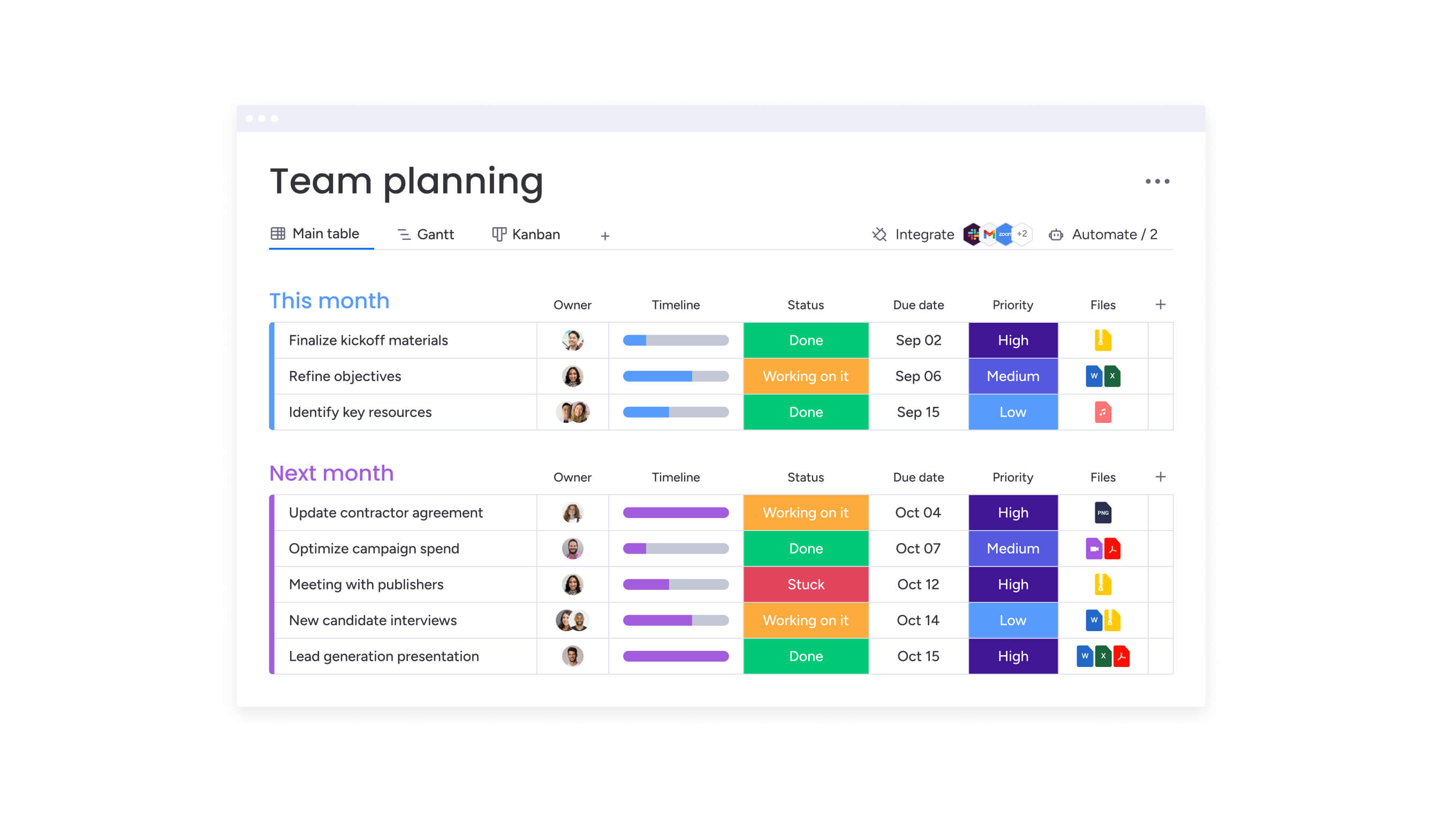
Genpact’s marketing team, distributed globally, managed 24 large-scale campaigns with multiple cross-channel activations. Teams relied on spreadsheets, emails, and SharePoint, limiting visibility and coordination.
The challenge
Genpact’s globally distributed marketing team managed 24 ongoing large-scale campaigns simultaneously, each with multiple cross-channel activations involving numerous stakeholders. Campaign managers relied heavily on spreadsheets saved across personal desktops, emails, and SharePoint folders, making it nearly impossible to track campaign status or identify bottlenecks.
The team faced several key challenges:
- Lacked centralized visibility into campaign status.
- Inability to identify bottlenecks across 24 simultaneous campaigns.
- Fragmented data across spreadsheets, emails, and SharePoint.
- Lack of coordination between cross-channel activations.
The solution
Genpact standardized campaign planning and execution by integrating monday work management. Workflow apps mapped complete activation processes for each channel. Columns tracked target dates versus actual completion, and a high-level GTM calendar with sub-items showed program hierarchies. Leadership gained instant visibility into campaign progress.
The results
The implementation delivered immediate, measurable improvements:
- 40% improvement: cross-team collaboration for end-to-end campaign planning.
- 100% removal: complete elimination of spreadsheets from marketing operations.
- 25% decrease: reduction in email exchanges through centralized communication.
Transform your marketing operations with centralized goal tracking
Marketing leaders in financial services face complex challenges: managing distributed teams, coordinating multi-channel campaigns, navigating regulatory requirements, and ensuring every activity contributes to measurable business outcomes. Without centralized visibility and integrated workflows, campaigns risk delays, duplicated effort, and reduced ROI.
monday work management helps bridge this gap by connecting daily execution directly to strategic objectives, delivering measurable benefits:
- Unified visibility: real-time dashboards provide complete insight into campaign performance, team capacity, and budget adherence.
- Automated progress tracking: goal updates reflect actual work completion, reducing reporting burdens by up to 30%.
- Cross-functional alignment: shared workflows break down silos across content, creative, acquisition, and operations teams.
- Resource optimization: workload and capacity planning ensure talent is allocated effectively, preventing bottlenecks and supporting team wellbeing.
- AI-powered insights: predictive recommendations identify risks, optimize resource allocation, and accelerate project planning.
By embedding goals directly into workflows, monday work management transforms fragmented marketing operations into coordinated execution. Teams gain efficiency, alignment, and strategic impact, without added complexity, allowing leaders to focus on driving growth, demonstrating ROI, and achieving business objectives.
Frequently asked questions
How does monday work management integrate with financial compliance systems?
monday work management offers enterprise-grade security features including SOC two Type II certification, GDPR compliance, HIPAA compliance, and tenant-level encryption that meet financial services regulatory requirements. The platform provides IP restrictions, two-factor authentication, multiple SSO options, and BYOK (Bring Your Own Key) capabilities. You can configure custom permission levels to control who can view, edit, or approve marketing materials, ensuring compliance with financial industry data governance policies.
What's the typical ROI timeline for marketing teams in financial services?
Marketing teams in financial services typically see measurable ROI within two to four months of implementing monday work management. The Total Economic Impact™ Forrester study reports less than four month payback period. Immediate benefits include time savings from automation, reduced platform costs from consolidation, and improved campaign delivery speed. Longer-term ROI comes from resource optimization, increased campaign output, and improved marketing attribution.
Can monday work management track both marketing and financial KPIs simultaneously?
Yes, monday work management supports tracking diverse KPI types including marketing metrics (CAC, MQL-to-customer rate, campaign ROI) and financial metrics (budget adherence, forecasting accuracy, cost per acquisition) within the same platform. You can create custom fields for any metric type, numerical, currency, percentage, or formula-based, and build dashboards that combine marketing performance data with financial outcomes.
How long does implementation take for a 100+ person marketing team?
Implementation for a 100+ person marketing team typically takes two weeks to one month for comfortable adoption. Successful rollouts follow a phased approach: start with a pilot team, build base structures and templates, provide ongoing support, then expand across departments.
What security certifications should goal tracking software have for financial institutions?
Goal tracking software for financial institutions should maintain SOC two Type II certification, ISO 27001 compliance, GDPR compliance, and HIPAA compliance as baseline requirements. monday work management meets all these standards and offers additional enterprise security features including tenant-level encryption, BYOK, IP restrictions, advanced admin controls, and comprehensive audit logging.
How does AI enhance goal tracking for marketing teams?
AI in monday work management analyzes org-wide data to identify risks across your marketing portfolio before they impact goal timelines. The AI provides intelligent resource allocation recommendations based on team capacity, project priorities, and historical performance data. It can generate detailed project plans with suggested phases when you create new campaigns, accelerating setup time and ensuring alignment with strategic objectives.

 Get started