

Managing content across multiple channels while coordinating 50-100+ team members isn’t just about publishing schedules. Financial services marketing leaders face the complex challenge of orchestrating campaigns that require legal approvals, compliance reviews, and executive sign-offs while maintaining momentum across content, creative, acquisition, and events teams.
When content calendars live in scattered spreadsheets and approval workflows happen through email chains, even well-planned campaigns can miss deadlines or fail to meet regulatory requirements.
The best content calendar software for enterprise marketing teams transcends basic scheduling to provide the infrastructure needed for large-scale coordination. These platforms centralize campaign visibility, automate compliance workflows, and connect content initiatives to measurable business outcomes.
Let’s get into what actually makes content calendar software work for enterprise marketing teams, the must-have features for compliance and scale, and a step-by-step implementation approach designed for real-world success.
Key takeaways
- Centralize all marketing activities: eliminate scattered spreadsheets and siloed teams by bringing content, campaigns, and approvals into a unified platform for instant visibility.
- Build automated compliance workflows that scale: create customizable approval processes that route content through legal, product, and finance teams while maintaining complete audit trails required for financial services regulations.
- Transform resource management with data-driven insights: use real-time workload visibility to prevent team burnout, allocate tasks based on skills and availability, and ensure consistent content delivery across 50-100+ team members.
- Connect content strategy to measurable business outcomes: link every campaign and content piece to company OKRs through integrated goal tracking and executive dashboards that demonstrate marketing ROI to leadership.
- Leverage monday work management’s AI-powered risk identification: automatically flag campaigns at risk of missing deadlines, optimize scheduling based on team capacity, and receive proactive insights that prevent bottlenecks before they impact delivery.
What makes monday work management the choice for enterprise content calendar management?
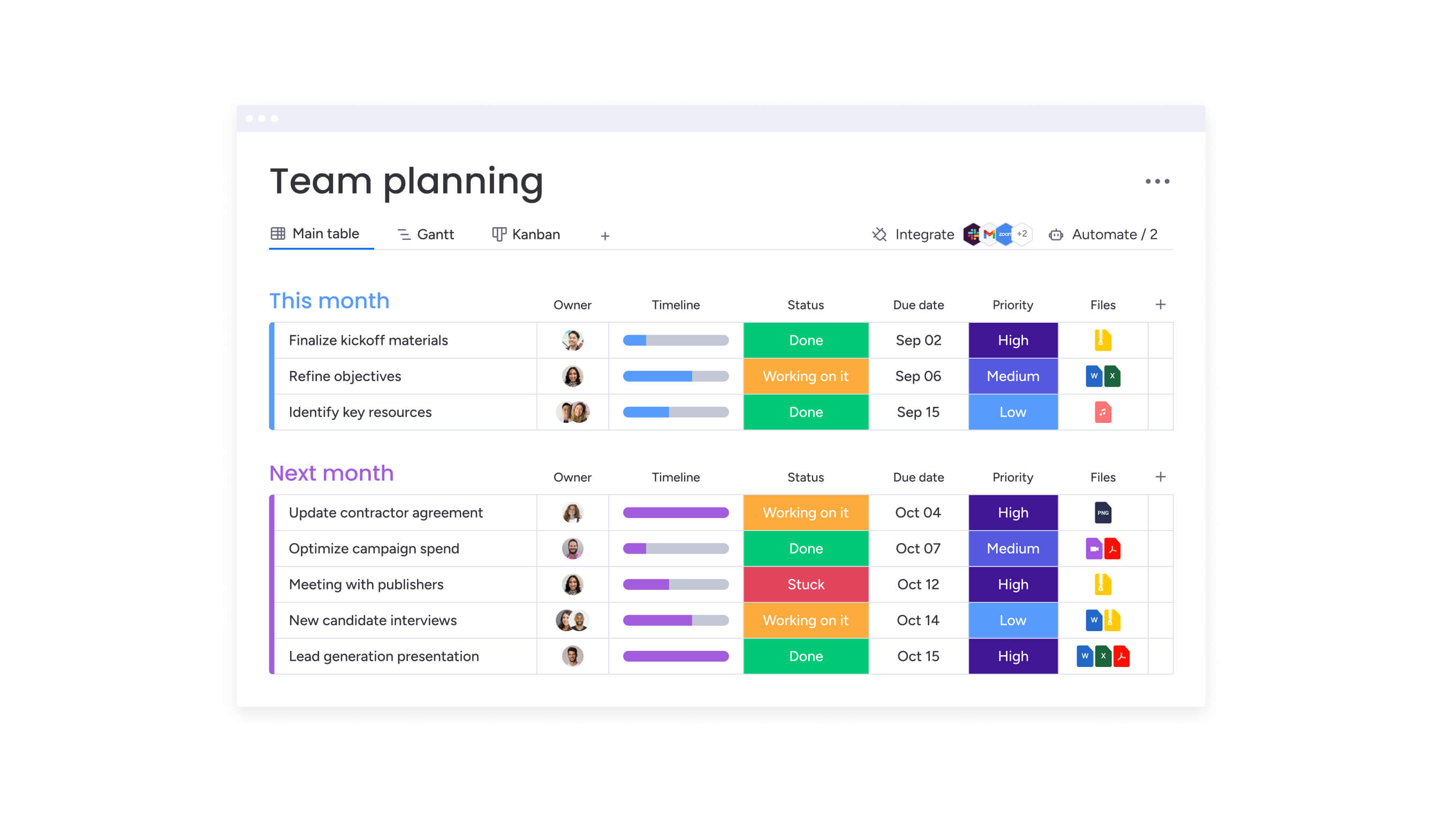
If you’re leading a marketing team of 50-100+ people spanning content, creative, acquisition, events, and operations, monday work management doesn’t just change your planning process — it completely rebuilds how your financial services team delivers and measures content strategy results.
The platform essentially tackles the headaches you’re actually facing: teams working in isolation, inconsistent processes that vary by department, and the constant struggle to show real-time progress and ROI to leadership.
By bringing all marketing activities — from blog posts and social media to email campaigns and events — into one unified workspace, the platform eliminates duplicative processes and unclear ownership that lead to burnout and missed deadlines.
You can even customize workflows to match your team’s unique processes while maintaining the standardization and compliance controls required in regulated industries. This means your content calendar becomes the strategic hub that aligns marketing initiatives with business goals, manages resource allocation across your large team, and provides the executive-level reporting needed to demonstrate marketing ROI to leadership.
Top features for enterprise content calendar management
Here’s exactly how the connected platform solves the unique challenges faced by enterprise marketing teams in finance. T
hese aren’t just nice-to-have features — they’re built specifically to scale while meeting the strict compliance and visibility demands of regulated industries.
Campaign management and content calendar views
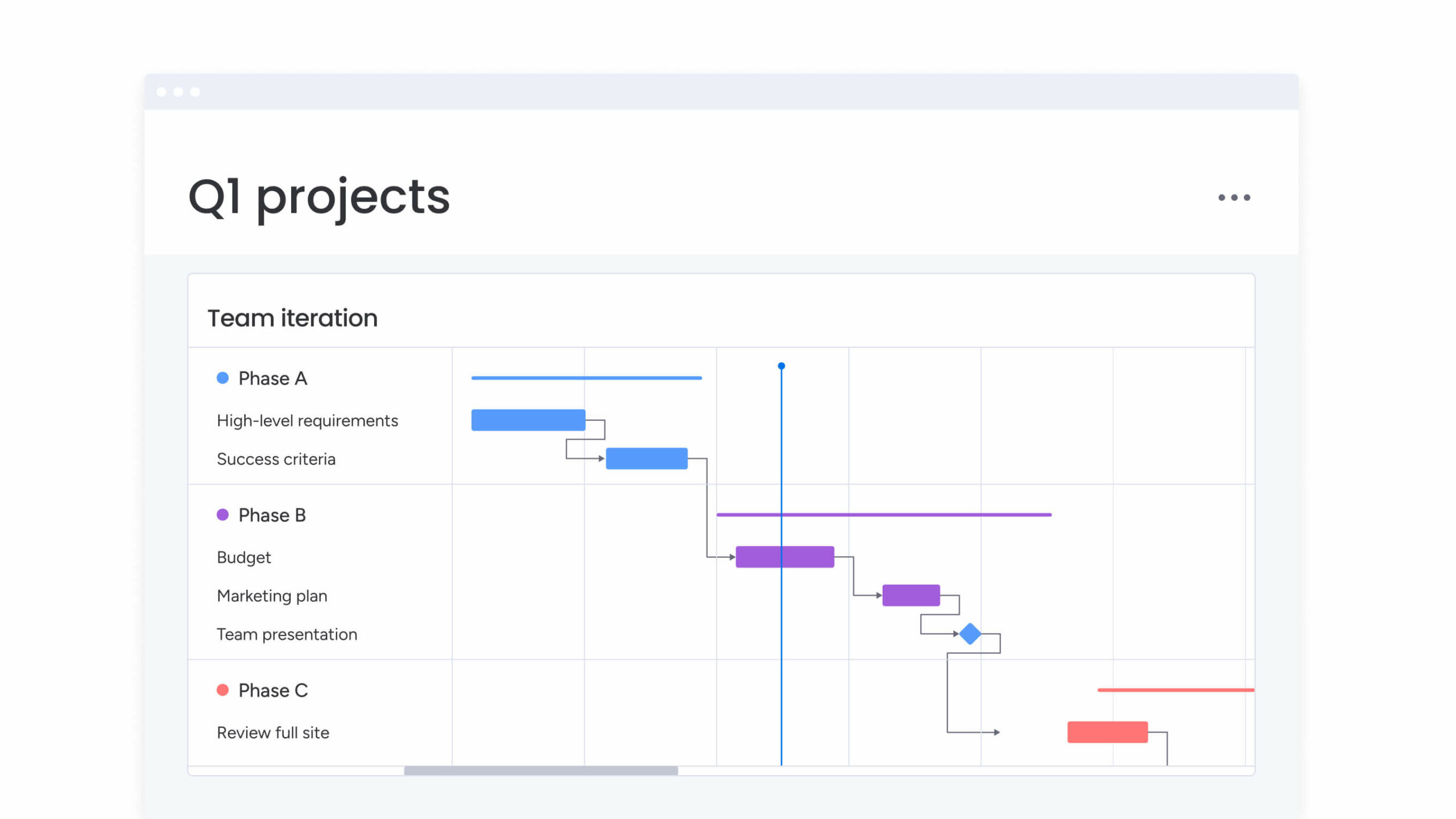
monday work management provides multiple calendar views — Calendar, Timeline, and Gantt — that allow you to visualize your entire content strategy at a glance. You can see all campaigns, content pieces, and activations across teams and regions in one centralized view, with the ability to drill down into specific channels, content types, or team workloads.
The drag-and-drop interface makes it simple to adjust schedules, while dependencies ensure that when one deadline shifts, all related tasks automatically update. For Heads of Marketing in finance managing multi-channel campaigns with regulatory requirements, a project management calendar is transformative.
Key benefits include:
- Unified visibility: instantly see how blog content aligns with email campaigns and when social media posts support product launches.
- Bottleneck identification: quickly spot potential issues in your approval workflows before they impact delivery.
- Role-based filtering: enable your 100+ person marketing organization to see exactly what’s relevant to their role, ensuring focus and clarity.
Automated approval workflows for regulated content
The platform’s customizable automation capabilities allow you to build sophisticated approval workflows that route content through the necessary stakeholders — legal, compliance, product teams, and executive leadership — based on content type, channel, or risk level.
You can even set up automated notifications when content enters review stages, escalation rules for items stuck in approval, and automatic status updates when approvals are granted.
You’ll get a complete audit trail that satisfies regulators, making it simple to keep content compliant through an efficient, timely approval process.
Essential workflow features:
- Automated routing: product-related content automatically notifies legal and compliance teams.
- Escalation management: flag content stuck in approval for more than 48 hours.
- Complete transparency: campaign managers see exactly which pieces are awaiting legal review.
- Efficiency tracking: generate reports showing average approval times to identify process improvements.
Resource management and workload planning
With the Workload view, you’ll instantly see which team members are over capacity, who can take on more work, and exactly where to shift resources to maintain project timelines. You can assign content creation, design work, and campaign management tasks based on actual availability and skills, preventing burnout while ensuring consistent delivery of marketing plans and ad hoc requests.
For marketing leaders managing large teams across multiple functions — content, creative, acquisition, events, and operations — this capability transforms how you allocate resources strategically. Instead of relying on spreadsheets or gut instinct to distribute work, you have data-driven insights into team productivity and resource utilization.
Core resource management capabilities:
- Resource Directory: centralizes all team member information including skills, roles, and location.
- Capacity Manager: provides live visibility across projects and portfolios.
- Proactive planning: identify when specific teams are over capacity and prioritize accordingly.
- Skills-based assignment: match tasks to team members based on expertise and availability.
Custom dashboards for executive reporting
The intelligent platform’s dashboard capabilities allow you to create custom, real-time reports that track the metrics that matter to executive leadership. These dashboards aggregate data to show campaign performance, team productivity, and strategic alignment without requiring manual compilation.
Essential metrics tracked include:
- Campaign ROI and CAC: track return on investment and customer acquisition costs.
- MQL-to-customer rates: monitor lead quality and conversion effectiveness.
- Content volume and performance: measure output across channels and campaigns.
- Budget adherence: track spending against forecasts with accuracy.
- Team productivity metrics: monitor time-to-launch and delivery rates.
- Stakeholder satisfaction scores: measure internal collaboration effectiveness.
You can also pull data from across all your marketing boards to create portfolio-level views that show how marketing initiatives contribute to company goals. I
nstead of spending hours compiling data from disparate systems into PowerPoint presentations, you can share live dashboards that automatically update as campaigns progress.
AI-powered content planning and risk identification
The platform’s AI capabilities analyze your content calendar data to identify potential risks, suggest optimal scheduling, and flag campaigns that may miss deadlines based on current progress. AI Blocks can categorize incoming content requests at scale, assign labels automatically, and even suggest task assignments based on team members’ skills and availability.
When you’re juggling campaigns across a dozen channels, our AI proactively flags potential risks before they escalate and suggests more effective ways to deploy your team.
AI-driven insights include:
- Risk identification: scan project updates to surface risks with urgency levels, owners, and mitigation options.
- Timeline optimization: alert you when campaign timelines look unrealistic given current team capacity.
- Performance-based scheduling: suggest when to publish content based on historical performance data.
- Process improvement: identify patterns in bottlenecks that indicate optimization opportunities.
Integration with financial services tech stack
monday work management integrates with 200+ tools commonly used in financial services marketing, ensuring your content calendar connects seamlessly with your existing technology ecosystem. This integration capability is critical for enterprise marketing teams that need to maintain data flow across multiple systems without manual data entry or switching between platforms.
Key integrations include:
- CRM platforms: salesforce for lead and customer data synchronization.
- Marketing automation: hubSpot for campaign coordination.
- Communication tools: slack and Microsoft Teams for real-time collaboration.
- Asset management: google Drive and SharePoint for content storage.
- Analytics platforms: performance tracking and ROI measurement tools.
The open API allows you to build custom integrations with proprietary financial reporting systems. Your content calendar can automatically pull in lead data from your CRM to inform content strategy, sync with your email marketing platform to coordinate messaging, and push performance data to financial reporting systems to demonstrate marketing ROI.
Templates and standardization for operational efficiency
The platform offers Managed Templates that standardize entire workspaces — including projects, automations, and workflows — at scale. You can create template boards that include your approval workflows, standard task lists, and required fields, then deploy them across teams to ensure consistency in how work gets done.
This standardization capability directly addresses the inefficient processes that plague large marketing organizations where teams reinvent workflows and lack clarity on ownership.
Template benefits include:
- Consistent processes: whether your content team is planning a blog series, your social team is scheduling posts, or your events team is coordinating a webinar, they follow proven processes.
- Organization-wide updates: apply changes across hundreds or thousands of template instances without manual intervention.
- Reduced setup time: eliminate the hours spent recreating workflows for each new project.
- Error reduction: minimize mistakes from inconsistent processes across teams.
How a head of marketing in finance benefits from monday work management
The following benefits demonstrate how monday work management transforms marketing operations for financial services organizations, directly addressing the challenges of managing large, distributed teams while maintaining compliance and driving measurable business impact.
- Time savings: eliminate thousands of hours monthly through automated workflows, standardized templates, and streamlined approval processes that reduce manual coordination and email chasing.
- Cost efficiency: achieve significant ROI through improved resource utilization, reduced tool sprawl by consolidating multiple systems into one platform, and enhanced budget adherence with real-time tracking.
- Compliance and accuracy: maintain complete audit trails with automated approval workflows, ensure regulatory requirements are met through customizable governance controls, and eliminate error-prone spreadsheets.
- Productivity improvements: boost cross-team collaboration with centralized visibility, reduce email exchanges through in-platform communication, and accelerate time-to-launch with clear ownership and dependencies.
- Output quality improvements: increase creative output through efficient resource allocation, improve on-time delivery rates with proactive capacity planning, and enhance stakeholder satisfaction with transparent progress tracking.
- Visibility and tracking improvements: gain real-time insights into all campaigns, performance, and team workloads through customizable dashboards, track progress toward OKRs with integrated goal management, and make data-driven decisions with portfolio-level reporting.
How to manage content calendars at scale with monday work management
Managing content calendars for enterprise marketing teams requires a systematic approach that balances flexibility with standardization. The following implementation strategy ensures your team can scale efficiently while maintaining the compliance and visibility requirements essential for financial services organizations.
This step-by-step approach has been proven with enterprise marketing teams managing 50-100+ team members across multiple functions and channels.
Step 1: centralize all content planning in one workspace
Create a master content calendar board that houses all marketing content across channels — blogs, social media, email campaigns, events, and paid media. Use custom fields to capture essential information like content type, channel, target audience, campaign alignment, and approval status.
This single source of truth eliminates the scattered spreadsheets and SharePoint folders that make it impossible to see your complete content strategy. Configure your workspace to include all necessary data points while maintaining clean, scannable views for different team roles.
Step 2: build automated approval workflows for compliance
Set up automation recipes that route content through required approvals based on type and risk level. For example, product-related content automatically notifies legal and compliance teams, while thought leadership pieces route through subject matter experts.
Configure escalation rules that flag content stuck in approval for more than 48 hours, ensuring nothing falls through the cracks while maintaining regulatory requirements. This automation creates the audit trails essential for financial services compliance while eliminating manual tracking.
Step 3: connect content calendar to campaign management
Link your content calendar board to campaign boards using mirror columns and dependencies, so every piece of content connects to its parent campaign. This allows you to see how individual blog posts, social updates, and emails contribute to integrated campaigns, track campaign performance holistically, and ensure content aligns with campaign timelines and messaging.
The cross-project dependencies feature ensures that delays in one area automatically update related timelines, preventing coordination issues that plague large marketing teams.
Step 4: implement resource planning and capacity management
Use the Workload view and Resource Planner to visualize team capacity across content creators, designers, and campaign managers. Assign content tasks based on actual availability and skills, set realistic deadlines that account for approval time, and proactively rebalance workloads when teams approach capacity limits.
This prevents burnout while ensuring consistent content delivery across your 50-100+ person team. The data-driven approach to resource allocation eliminates guesswork and provides clear visibility into team productivity.
Step 5: create executive dashboards for performance tracking
Build custom dashboards that aggregate data from your content calendar to show metrics leadership cares about: content volume by channel, on-time delivery rates, approval cycle times, campaign performance, and how content initiatives map to OKRs.
Share these dashboards with stakeholders so they have real-time visibility without requiring manual reports. The AI-powered portfolio report feature can generate instant executive summaries with trends and insights, eliminating hours of manual report compilation.
Step 6: integrate with your marketing technology stack
Connect monday work management to your CRM, marketing automation platform, analytics tools, and communication systems. This ensures content performance data flows back into your calendar, campaign insights inform future content planning, and your team can work seamlessly without switching between platforms.
With 200+ integrations and an open API, you’ll finally stop copying data between systems. Your CRM talks to your content calendar, your analytics feed performance metrics back to your planning tools, and you make decisions based on complete information, not fragments.
Comparison: monday work management vs competing platforms
Don’t waste time comparing features that look good on paper but fall apart in practice. The following comparison highlights the key differences between monday work management and competing platforms across the features most critical for financial services marketing teams.
This analysis focuses on the capabilities that directly impact your ability to manage 50-100+ team members while maintaining compliance and driving measurable business results.
| Feature | monday work management | Asana | CoSchedule |
|---|---|---|---|
| Multi-channel content calendar | ✓ Unified view across all channels | ✓ Basic calendar view | ✓ Specialized for content |
| Compliance approval workflows | ✓ Customizable multi-stage approvals with audit trails | ○ Basic approval tasks | ○ Limited approval features |
| Resource management & capacity planning | ✓ Built-in Workload view with skills-based allocation | ○ Workload available in premium tiers | ✗ Not available |
| Executive dashboards & reporting | ✓ Fully customizable real-time dashboards with AI insights | ○ Limited dashboard customization | ○ Basic reporting |
| Integration with financial systems | ✓ 200+ integrations + open API | ○ 100+ integrations | ○ 30+ integrations |
| AI-powered risk identification | ✓ AI flags risks and suggests optimizations | ○ Limited AI features | ✗ Not available |
| Enterprise security & compliance | ✓ SOC 2, GDPR, HIPAA, tenant-level encryption | ✓ Enterprise security features | ○ Basic security |
| Team size scalability | ✓ Proven with 100+ person teams | ✓ Scales well | ○ Optimized for smaller teams |
| Implementation time | 2-4 weeks with dedicated support | 4-6 weeks | 2-3 weeks |
| Price per user/month | From $10.99 (scales with features) | From $10.99 | From $19 |
How Genpact transformed their global marketing operations
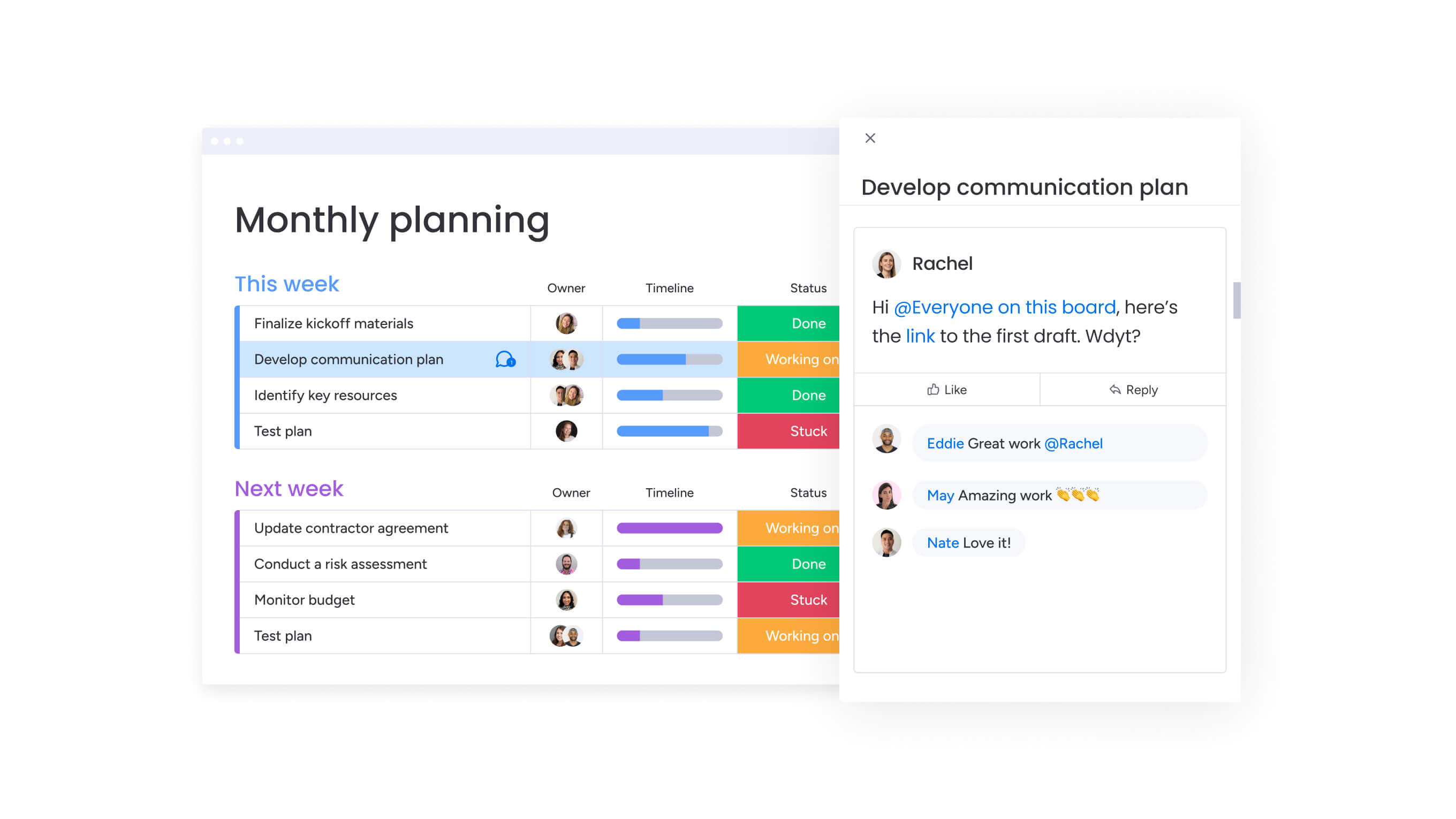
Genpact’s globally distributed marketing team faced significant challenges managing 24 ongoing large-scale marketing campaigns simultaneously, each with multiple cross-channel activations involving numerous stakeholders.
Campaign managers relied heavily on spreadsheets saved across personal desktops, emails, and SharePoint folders, making it nearly impossible to track campaign status or find the latest version.
The team implemented monday work management to create a unified platform for end-to-end campaign planning and execution. They built workflow apps outlining the complete activation process for each channel, with columns tracking target dates versus actual timelines to identify bottlenecks.
The platform’s flexibility allowed them to quickly adapt when the pandemic forced event calendar restructuring, maintaining full visibility while adjusting plans in real time. This adaptability proved crucial for maintaining marketing momentum during unprecedented business disruption.
The results speak for themselves:
- 40% improvement in cross-team collaboration for successful campaign planning and execution.
- 100% removal of spreadsheets, eliminating version control issues and data silos.
- 25% decrease in email exchanges through centralized in-platform communication.
- Complete visibility into campaign status, turnaround times, and resource allocation.
Transform your content calendar operations with monday work management
In 2026, the reality is that marketing teams in financial services deal with hurdles other industries don’t even think about.
Off-the-shelf solutions just don’t cut it when you’re facing compliance reviews, legal approvals, and regulatory audits: which is why monday work management provides the unified platform, compliance capabilities, and scalability needed to manage content calendars across 50-100+ team members.
By combining workflows you can actually customize, automatic compliance checks, and AI that spots issues before they become problems, we turn what used to be your biggest headache — coordinating content — into your team’s competitive edge.
With real-time dashboards, resource management capabilities, and seamless integrations, your marketing team can focus on creating impactful content rather than managing administrative overhead.
Ready to experience the difference unified work management makes for your content calendar operations? Join 245,000+ customers who trust monday work management to centralize their marketing operations, eliminate silos, and drive measurable impact.
The content in this article is provided for informational purposes only and, to the best of monday.com’s knowledge, the information provided in this article is accurate and up-to-date at the time of publication. That said, monday.com encourages readers to verify all information directly.
Frequently asked questions
How does monday work management handle financial services compliance requirements?
monday work management provides enterprise-grade security and compliance features specifically designed for regulated industries. The platform is SOC two Type II certified, GDPR compliant, and supports HIPAA requirements with tenant-level encryption, IP restrictions, two-factor authentication, and multiple SSO options.
What's the typical implementation timeline for a 100+ person marketing team?
Implementation for enterprise marketing teams typically takes two to four weeks with monday work management's dedicated onboarding support. Week one involves discovery sessions to map current workflows, Week two focuses on building content calendar structure and approval workflows, Week three includes pilot rollout with a core team, and Week four covers full team rollout with training. The platform's intuitive interface means most team members become comfortable within two to four weeks of regular use.
Can monday work management integrate with financial reporting systems?
Yes, monday work management offers robust integration capabilities including 200+ pre-built integrations and an open API for custom connections to proprietary financial systems. You can integrate with QuickBooks, Salesforce for revenue attribution, and analytics platforms like Tableau, pushing marketing performance data directly into financial reporting systems to demonstrate ROI in the language finance teams understand.
How do I calculate ROI for content calendar software in financial services?
Calculate ROI by measuring time savings from eliminating spreadsheet management and automating approval workflows, cost reductions from consolidating multiple tools and improving resource utilization, and performance improvements in content volume and on-time delivery rates. Compare these benefits against platform costs to determine payback period, which typically averages less than four months for enterprise implementations.
What security certifications should finance companies look for?
Financial services companies should prioritize platforms with SOC two Type II certification, GDPR compliance, ISO 27001 certification, HIPAA compliance if handling health-related data, and relevant industry-specific certifications. monday work management maintains these certifications and provides tenant-level encryption, IP restrictions, granular role-based permissions, comprehensive audit logs, and data residency options.
How does AI enhance content calendar management for large teams?
AI in monday work management enhances content calendar management through risk identification that flags campaigns at risk of missing deadlines, smart categorization that automatically analyzes and routes content requests, intelligent scheduling that suggests optimal publishing times, and resource optimization that recommends task assignments based on skills and availability. These AI capabilities provide proactive intelligence to prevent problems before they impact delivery.

 Get started