


Your marketing team sends hundreds of emails every month, but only a handful actually drive revenue. Prospects open them, maybe click a link, and then forget them. Meanwhile, they slip through the cracks because they received generic content that didn’t match where they were in their buying journey.Sales funnel emails change this dynamic by delivering the right message at the right time. Instead of broadcasting the same content to everyone, these automated sequences guide prospects through each stage of their decision-making process, from initial awareness to final purchase.
Here’s how to build sales funnel emails that actually convert prospects into customers. You’ll see the 5 essential funnel stages, learn how to write emails that resonate at each one, and get automation strategies that scale without hiring. We’ll also look at how solutions like monday campaigns make it easy to set up these sequences and track what’s working.
Key takeaways
- Map emails to buyer questions at each stage: Send awareness content to new prospects, comparison guides to evaluators, and urgency-driven messages to decision-makers for higher conversion rates.
- Use behavioral triggers instead of scheduled blasts: Automate sequences based on prospect actions like email opens, website visits, or demo requests to deliver timely, relevant messages.
- Track revenue impact, not just open rates: Measure pipeline influenced, deals closed, and email ROI to understand which sequences actually drive business results.
- Connect email automation to CRM data: Track every interaction from first email to closed deal, measure real revenue impact, and optimize sequences based on what drives results.
- Design emails for mobile scanning: Use short paragraphs, descriptive headlines, single calls-to-action, and plenty of white space so busy prospects can quickly understand your message.
What are sales funnel emails?
Sales funnel emails are automated sequences that guide prospects through each stage of the buyer’s journey, from initial awareness to final purchase and beyond.
Unlike one-off promotional emails that blast everyone the same message, funnel emails send targeted content based on where each prospect is in their decisionprocess.
Someone who just discovered your brand needs different information than someone comparing you to competitors. A prospect evaluating pricing has different questions than a new customer figuring out how to get started. Funnel emails meet people where they arein their journey, delivering content that actually matters to them at that specificmoment.
The difference between regular emails and funnel emails
The difference between regular emails and funnel emails isn’t just semantic. It’s the difference between broadcasting and conversing. Regular emails treat your entire list as a monolithic audience, and with the average worker receiving 117 emails per day, broadcast-style messages face intense competition for attention. Funnel emails treat each prospect as an individual on a specific journey.
| Attribute | Regular emails | Sales funnel emails |
|---|---|---|
| Purpose | Broad announcements and promotional blasts | Stage-specific nurturing designed to move prospects toward conversion |
| Timing | Scheduled broadcasts sent regardless of recipient behavior | Behavior-triggered sequences that respond to prospect actions |
| Personalization | Segment-based using demographic data | Individual journey-based using behavioral signals and CRM data |
| Measurement | Open rates and click rates as primary metrics | Conversion rates by stage and revenue attribution |
How email funnels guide prospects to purchase
Email funnels work by mapping content to the buyer’s journey. At the awareness stage, prospects are just recognizing they have a problem. During consideration, they’re evaluating potential solutions. At the decision stage, they’re choosing between specific options.
Each stage needs its own messaging, proof points, and calls-to-action. Behavioral triggers make this journey responsive rather than rigid:
- Interest signals: When a prospect opens three emails in a row, that triggers the next sequence
- Consideration indicators: When someone clicks a pricing link, that prompts a comparison email
- Progressive value delivery: Each email builds on the previous one, addressing evolving questions
Done right, it feels like a conversation instead of a campaign. The first email might introduce a problem, the second provides a framework for solving it, and the third shows how others have solved it.
Why sales funnel emails generate more revenue
Sales funnel emails outperform generic campaigns because they match content to where prospects actually are in their buying journey. Three things drive the revenue impact: stage-specific messaging that resonates, automation that scales without hiring, and clear visibility into what’s actually closing deals.
Increase conversions with stage-specific messaging
Generic emails make prospects do the work of figuring out what’s relevant. Stage-specific messaging does that work for them, which is why it drives higher conversion rates.
When an awareness-stage prospect receives educational content about their problem, they engage because it addresses what they’re actually thinking about. When a consideration-stage prospect receives a comparison guide, they engage because it helps them make the decision they’re already trying to make. Personalization tuned to a customer’s current journey stage can significantly improve marketing ROI, while poorly timed personalization can increase the likelihood of purchase regret.
Here’s what stage-specific messaging looks like:
- Awareness stage: Educational content that helps prospects recognize and understand their problem, such as industry reports or diagnostic assessments
- Consideration stage: Comparison content that helps prospects evaluate solutions, such as case studies with measurable outcomes or ROI calculators
- Decision stage: Conversion content that helps prospects commit, such as implementation guides or personalized proposals
Automate sequences while you focus on strategy
Manual email sends don’t scale. If your team’s copying and pasting follow-ups, they’re not optimizing messaging or analyzing what works. An automated sales funnel changes that equation.
A single automated sequence can nurture hundreds of leads simultaneously, sending the right follow-up at the right time without anyone clicking “send.” What used to take hours of manual work now runs in the background, around the clock. Every lead receives timely follow-up, regardless of how busy your team is.
This frees marketers to focus on email marketing strategy instead of execution. Instead of sending emails, they’re optimizing messaging, analyzing performance, and identifying new opportunities, a shift already underway: 67% of organizations now use AI-enabled sales and marketing tools, reflecting how automation has become a mainstream part of modern marketing stacks.
Gain direct visibility into email-to-revenue impact
Traditional email metrics show inbox activity, not pipeline impact. Open rates and click rates are fine, but they don’t answer what matters: did this email help close deals?
When a prospect receives 15 emails over three months before becoming a customer, which emails actually influenced the decision? Without end-to-end tracking, marketers are guessing. And guessing doesn’t optimize anything.
Funnel emails fix this by tracking prospects from first touch to closed deal. Every email engagement links to a contact record, then to an opportunity, then to revenue. The path from “opened awareness email” to “signed contract” becomes visible.
5 essential stages of revenue-driving email funnels
Effective sales funnel emails match the buyer’s journey, delivering stage-specific content that addresses their evolving questions and objections. These stages aren’t arbitrary marketing constructs, but reflect how people actually make purchasing decisions.Each stage of your sales funnel requires different messaging, proof points, and calls-to-action. When you’re creating a sales funnel, understanding these stages helps you map the right email content to each step.
Stage 1: Awareness emails that attract ideal prospects
Awareness-stage emails reach prospects who are just starting to recognize they have a problem. Send these after a prospect subscribes to a newsletter, downloads a lead magnet, or visits your site for the first time.
At this stage, focus on education, not selling. Prospects aren’t ready to hear about your product. They’re still figuring out whether they have a problem worth solving.
Key email types include:
- Welcome emails: Set expectations for what subscribers will receive
- Educational content: Address common pain points in your industry
- Problem awareness emails: Use data or diagnostic questions to help prospects recognize their challenges
Stage 2: Interest emails that build engagement
Interest-stage emails build on engagement with prospects who’ve shown initial curiosity. Trigger these emails when a prospect engages with awareness content: opening multiple emails, clicking links, or returning to your site.
The messaging shifts from problem education to showing value. Prospects at this stage know they have a problem. Now they want to understand how solutions work.
Effective email types include:
- Real-world examples: Show how customers solve specific problems
- Multi-part educational series: Break complex topics into digestible pieces
- Social proof: Highlight customer testimonials and success stories
Stage 3: Consideration emails that address objections
Consideration-stage emails help prospects compare your solution to alternatives. Trigger these when a prospect requests a demo, downloads a pricing guide, or shows other high-intent behaviors.
The messaging focuses on what makes you different and how to handle objections. Prospects at this stage are actively comparing options. They need evidence that your solution is the right fit.
Core email types include:
- Comparison emails: Position your solution against alternatives
- Detailed case studies: Provide measurable outcomes and ROI data
- FAQ emails: Address common concerns and objections
Stage 4: Decision emails that close deals
Decision-stage emails close deals with prospects who are ready to buy. Send these when a prospect completes a demo, requests a proposal, or finishes a trial.
The messaging creates urgency, offers incentives, and removes final barriers. Prospects at this stage have done their research. They need a compelling reason to act now.
Essential email types include:
- Limited-time offers: Create urgency with deadlines or bonuses
- Proposal follow-ups: Address questions from sales conversations
- Trial or demo invitations: Remove risk with hands-on experience
Stage 5: Retention emails that maximize lifetime value
Retention-stage emails onboard new customers, boost product adoption, and encourage repeat purchases. The sale isn’t the end of the journey. It’s the beginning of a relationship.
Key email types include:
- Onboarding series: Guide new customers through setup and initial success
- Feature adoption emails: Highlight underutilized capabilities
- Upsell emails: Recommend complementary products based on usage patterns
How to write sales funnel emails that convert
The best funnel strategy fails without compelling email content. High-converting sales funnel emails combine sharp messaging, attention-grabbing subject lines, behavioral personalization, and scannable design. Here’s how to create emails that move prospects through your funnel.
Step 1: Map content to specific buyer questions
Prospects at each funnel stage have specific questions they’re trying to answer. Emails that answer those questions directly convert better than emails that talk about what you want to say.
| Funnel stage | Buyer question | Email content approach |
|---|---|---|
| Awareness | "Do I have a problem worth solving?" | Educational content that helps prospects recognize their challenge |
| Interest | "What approaches exist to solve this?" | Frameworks showing different ways to address the problem |
| Consideration | "Is this the right solution for me?" | Comparison content and objection-handling |
| Decision | "Why should I buy now?" | Urgency, incentives, and risk-reduction |
| Retention | "How do I get maximum value?" | Onboarding and success tips |
Step 2: Craft subject lines that demand attention
Subject lines decide whether your email gets read or ignored. With open rates around 20-25%, the subject line is often the most important line you write. AI tools can help you test and optimize subject lines based on what resonates with your audience. High-performing subject line formulas include:
- Question format: “Are you making this common email mistake?”
- Number format: “5 ways to double your conversion rate”
- Urgency format: “Last chance: 20% off ends tonight”
- Personalization format: Use dynamic fields and behavioral data
Step 3: Personalize using behavioral triggers
Behavioral personalization goes beyond inserting someone’s name. It means sending the right content based on what prospects actually do. This creates relevance that generic segmentation can’t match. Data sources for behavioral personalization include:
- Email engagement patterns: Open rates, click behavior, and sequence completion
- Website activity: Page visits, time spent, and content downloads
- CRM data: Sales conversation notes and interaction history
- Purchase history: Previous buying behavior and product usage
Step 4: Design for quick scanning and action
Email design directly affects conversion. Readers decide in seconds whether to engage or delete. Your design should make it easy to engage. Key design principles include:
- Short paragraphs: 2-3 sentences maximum
- Strategic white space: Between elements for visual breathing room
- Visual hierarchy: Use headlines and bold text to guide the eye
- Single primary call-to-action: Don’t confuse readers with multiple options
- Mobile optimization: Most people read emails on mobile devices.
Automating email sequences that run themselves

Manual email sends don’t scale. Automated sequences ensure every prospect gets timely, relevant messages based on their behavior, without constant oversight. AI-powered sales funnels take this further by learning from prospect behavior and optimizing sequences automatically. Here’s how to build email automation that works.
Set up behavior-based triggers
Behavior-based triggers power responsive email automation. Instead of sending emails on a schedule, triggers launch sequences when prospects take specific actions.
Common trigger types include:
- Form submissions: Newsletter signups, content downloads, demo requests
- Email engagement: Opens, clicks, or sequence completion
- Website behavior: Page visits, time spent, or return visits
- CRM updates: Lead scoring changes or sales stage progression
Build dynamic segmentation
Dynamic segmentation groups prospects automatically based on changing attributes and behaviors. Static segments become outdated quickly. Dynamic segments update automatically as prospect behavior changes, keeping your targeting accurate.
Effective segmentation criteria include:
- Engagement level: High, medium, or low based on recent activity
- Funnel stage: Where prospects are in their buying journey
- Industry or company size: For tailored messaging
- Product interest: Based on content consumption or feature usage
Create multi-step workflows
Multi-step workflows combine triggers, conditions, delays, and actions into sequences that adapt to prospect behavior over time. These workflows handle complex buyer journeys.
A sample awareness-to-interest workflow might include:
- Entry trigger: Prospect downloads a guide
- Immediate welcome email: Thank them and set expectations
- 3-day delay: Allow time to consume the content
- Condition check: Did they open the welcome email?
- Branching: Engaged prospects get educational content; non-engaged get re-engagement emails
Measuring email funnel performance

Effective measurement links email activity to business outcomes. Vanity metrics like open rates matter less than conversion metrics that show real revenue impact. Here’s how to track what matters.
Each funnel stage needs its own success metrics. Know which metrics matter at each stage so you can optimize for the right outcomes:
- Awareness stage: Open rate and list growth
- Interest stage: Click-through rate and content engagement
- Consideration stage: Demo requests and pricing page visits
- Decision stage: Conversion rate and deal velocity
- Retention stage: Product adoption and expansion revenue
The real measure of funnel email success is revenue impact. Key revenue metrics include:
- Pipeline influenced: Total pipeline value from email-engaged prospects
- Revenue influenced: Closed deals from email-engaged prospects
- Email ROI: Revenue attributed to email divided by program costs
Build smarter email funnels with monday campaigns
Email funnels work best when they’re connected to real customer data and powered by intelligent automation. monday campaigns gives marketing teams a unified sales funnel platform to create, automate, and optimize email sequences that actually drive revenue, not just engagement metrics.
The platform combines intuitive workflow builders with AI-powered capabilities, so you can set up sophisticated funnel sequences without technical expertise. Track every prospect interaction, measure what drives conversions, and let automation handle the repetitive work while you focus on strategy.
AI-powered email creation and optimization
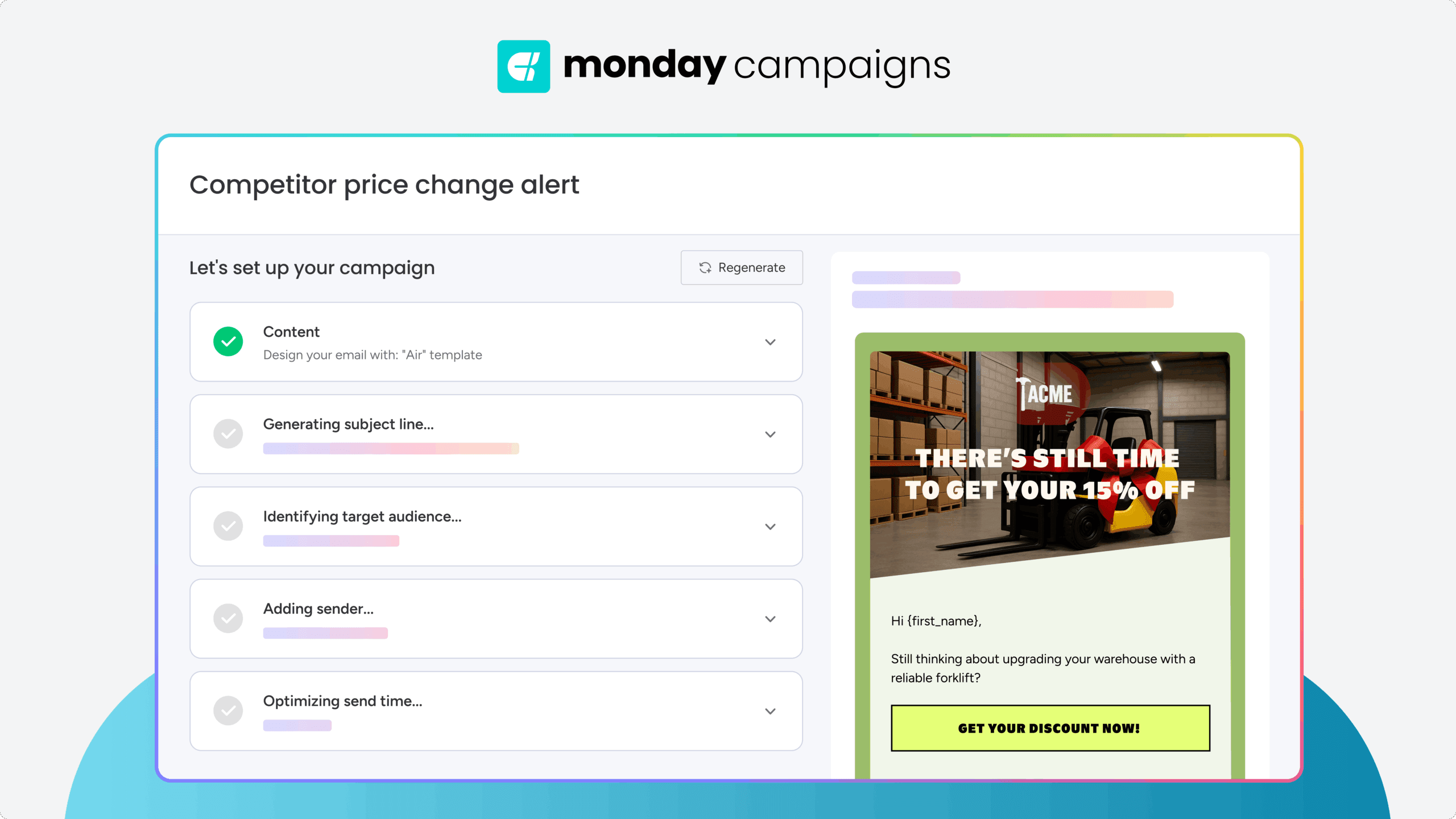
Generate high-converting email content with AI assistance that understands your brand voice and funnel stage. The AI analyzes your best-performing emails and suggests subject lines, body copy, and calls-to-action tailored to each segment. Optimize send times automatically based on when individual prospects are most likely to engage, increasing open rates without manual testing. monday campaigns’ AI learns from your data to continuously improve email performance over time.
Behavioral triggers that respond in real-time
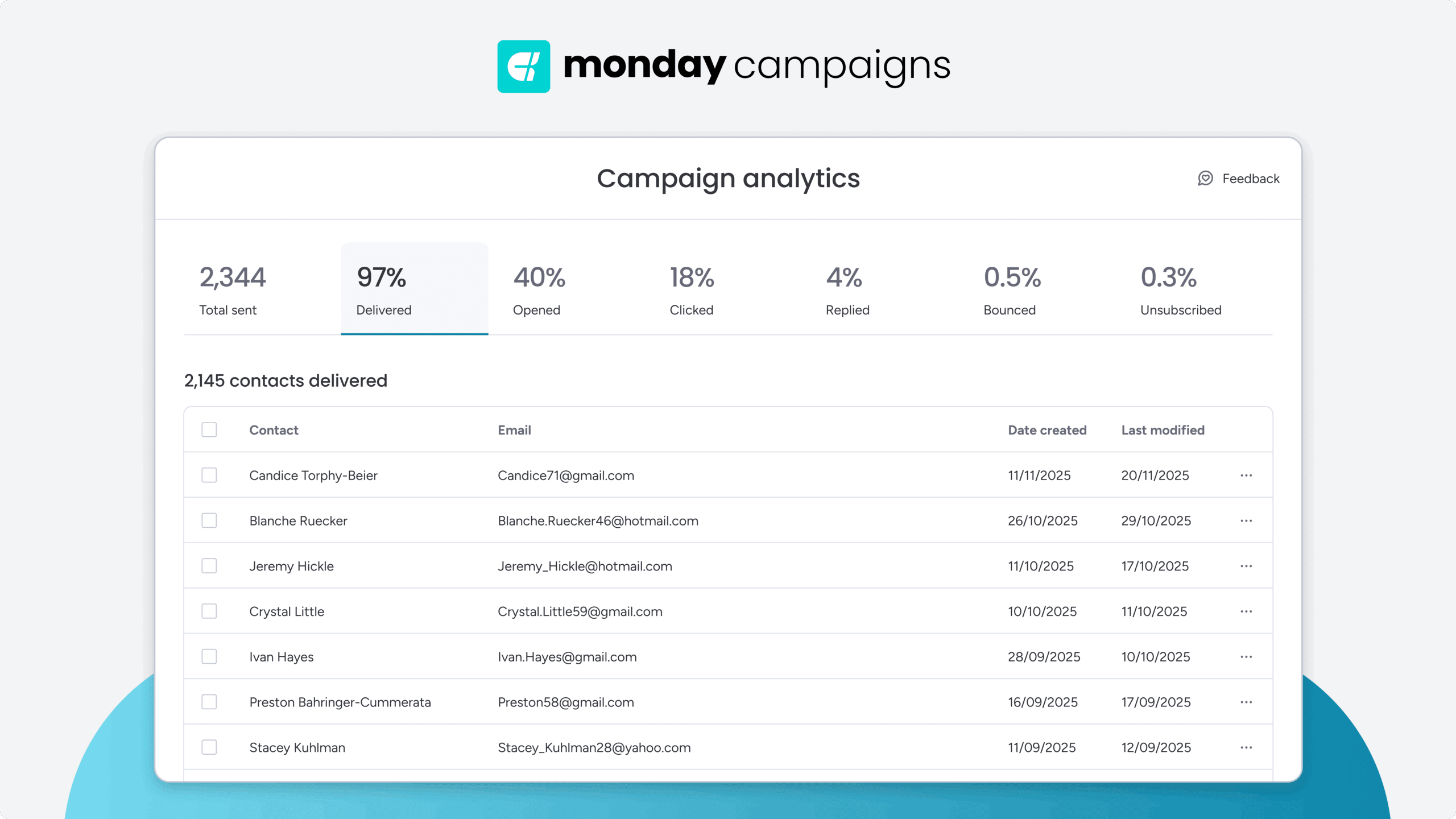
Launch email sequences automatically based on prospect actions like form submissions, link clicks, or website visits. Set up complex conditional logic that adapts your messaging based on engagement patterns, so prospects who click pricing links get different follow-ups than those who download educational content. The system monitors behavior continuously and adjusts sequences without manual intervention.
CRM integration for complete visibility
Connect email activity directly to your CRM data to track the full journey from first touch to closed deal. Every email open, click, and reply syncs automatically with contact records, giving sales teams complete context for their conversations. Measure which email sequences actually influence pipeline and revenue, not just vanity metrics like open rates.
Dynamic segmentation that updates automatically
Create audience segments that refresh in real-time as prospect behavior and attributes change. Tag contacts automatically based on engagement level, funnel stage, or product interest without manual list management. Segments stay accurate as prospects move through your funnel, ensuring everyone receives relevant content at the right time.
Building email funnels that drive consistent revenue
Sales funnel emails change how marketing teams generate and nurture revenue. By matching messages to buyer stage, automated sequences create consistent pipeline growth without constant manual effort. Success comes from understanding your buyer’s journey and mapping relevant content to each stage. When prospects get emails that address their specific questions and concerns, engagement and conversion rates go up.
monday campaigns connects email automation directly to your CRM data, making this process seamless. Track every interaction from first email to closed deal, measure true revenue impact, and optimize sequences based on what actually drives results. Start building email funnels that turn prospects into customers.
Try monday campaignsFAQs
What is the difference between a sales funnel and an email funnel?
The difference between a sales funnel and an email funnel is that a sales funnel is the overall journey prospects take from awareness to purchase, including all touchpoints like website visits and sales conversations. An email funnel is the specific sequence of emails that guides prospects through that journey using automated, targeted messages at each stage.
How many emails should be in a sales funnel sequence?
The right number varies by funnel stage and sales cycle length. Awareness sequences typically include 3-5 emails over 2-4 weeks. Consideration sequences often have 4-7 emails over 2-6 weeks. Decision sequences are usually shorter, with 2-4 emails over 1-2 weeks.
How long should I wait between funnel emails?
Email timing depends on funnel stage and how urgent the buying decision is. Awareness-stage emails typically space 3-5 days apart. Consideration-stage emails can be 2-4 days apart. Decision-stage emails may be 1-2 days apart when urgency is appropriate.
What metrics should I track for sales funnel emails?
Track metrics that link to revenue: open rate and click rate for individual emails, sequence completion rate for overall flow, stage conversion rate for funnel progression, and revenue attribution for business results.
How do I know if my email funnel is working?
An effective email funnel shows better stage-to-stage conversion rates, shorter time to conversion, and clear revenue attribution. If prospects are moving through stages and converting at healthy rates, the funnel's working. If they're dropping off at specific stages, sales funnel analysis can show which sequences need optimization.
Can I use the same email funnel for different customer segments?
The overall funnel structure can be similar, but tailor content to different segments. A startup founder and an enterprise procurement manager face different pain points and use different decision criteria. Create variations of key emails

 Get started