

Marketing used to rely on a lot of guesswork. You’d build a campaign, launch it, and hope the numbers moved in the right direction. AI changes that. Instead of reacting to what already happened, you can understand what’s likely to happen next — and adjust campaigns in real time based on actual customer behavior.
This guide shows you how to use AI in digital marketing to personalize emails, generate on-brand content quickly, and turn customer data into strategies that drive revenue. And here’s the part many teams overlook: AI delivers the biggest impact when it connects directly to your CRM and workflows. With shared data, every campaign becomes measurable, trackable, and tied to real business outcomes.
Try monday campaignsKey takeaways
- AI marketing delivers measurable ROI by increasing conversion rates, reducing customer acquisition costs, and boosting lifetime value through continuous optimization.
- Start with one focused AI campaign using clean customer data and defined success metrics before expanding to more complex implementations.
- AI excels at data processing and automation but requires human oversight for strategy, creativity, and maintaining authentic brand voice.
- Most businesses see initial AI marketing results within 2–4 weeks, with basic customer data like email addresses and engagement metrics sufficient to begin.
- Software like monday campaigns combines AI-powered email creation, audience segmentation, and campaign optimization with native CRM integration for complete marketing-sales alignment.
How do marketers use AI in digital marketing?
AI for sales and marketing uses artificial intelligence technologies to automate tasks, personalize customer experiences, and optimize campaign performance at scale. This means marketers can process vast amounts of data, predict customer behavior, and deliver the right message to the right person at the right time — all far less manual work.
Think of AI as your marketing team’s smartest assistant. It learns from every interaction, improves with each campaign, and makes decisions based on data patterns humans might miss.
How AI transforms marketing ROI
AI improves marketing ROI by helping teams make smarter decisions faster. Among organizations using AI in marketing and sales, 67% reported a revenue increase in the past 12 months. The reason is simple: AI surfaces performance changes earlier, helping teams adjust campaigns sooner, so teams optimize earlier and more often instead of waiting for the end-of-month review.
Here are the biggest ways AI drives ROI:
-
Targeting high-intent audiences: AI analyzes engagement and behavior data to identify prospects most likely to convert, reducing wasted spend.
-
Optimizing spend and reducing CAC: Real-time adjustments help teams shift budget toward channels and tactics that deliver the highest return.
-
Scaling personalization: AI updates segments continuously and tailors messaging, timing, and offers to each person’s behavior — something impossible to do manually.
-
Accelerating content production: AI generates drafts, subject lines, and variations quickly so teams can test more ideas and improve performance faster.
This combination of data-driven decision-making and continuous optimization leads to higher conversion rates, improved customer experiences, and a clearer connection between marketing activities and revenue impact.
AI vs. traditional marketing automation
Traditional automation follows fixed rules you create: If X happens, send Y. Those rules stay in place until someone updates them.
AI-powered marketing goes further by analyzing behavior, identifying patterns, and surfacing opportunities to improve campaigns. It can personalize content for each person, predict likely outcomes, and recommend changes based on what’s actually working. Automation executes the plan; AI helps improve it.
How marketers are using AI
Marketing teams use AI for 4 primary functions that address their biggest challenges. Each application solves specific problems that traditionally required hours of manual work or resulted in missed opportunities.
1. Content creation and copywriting
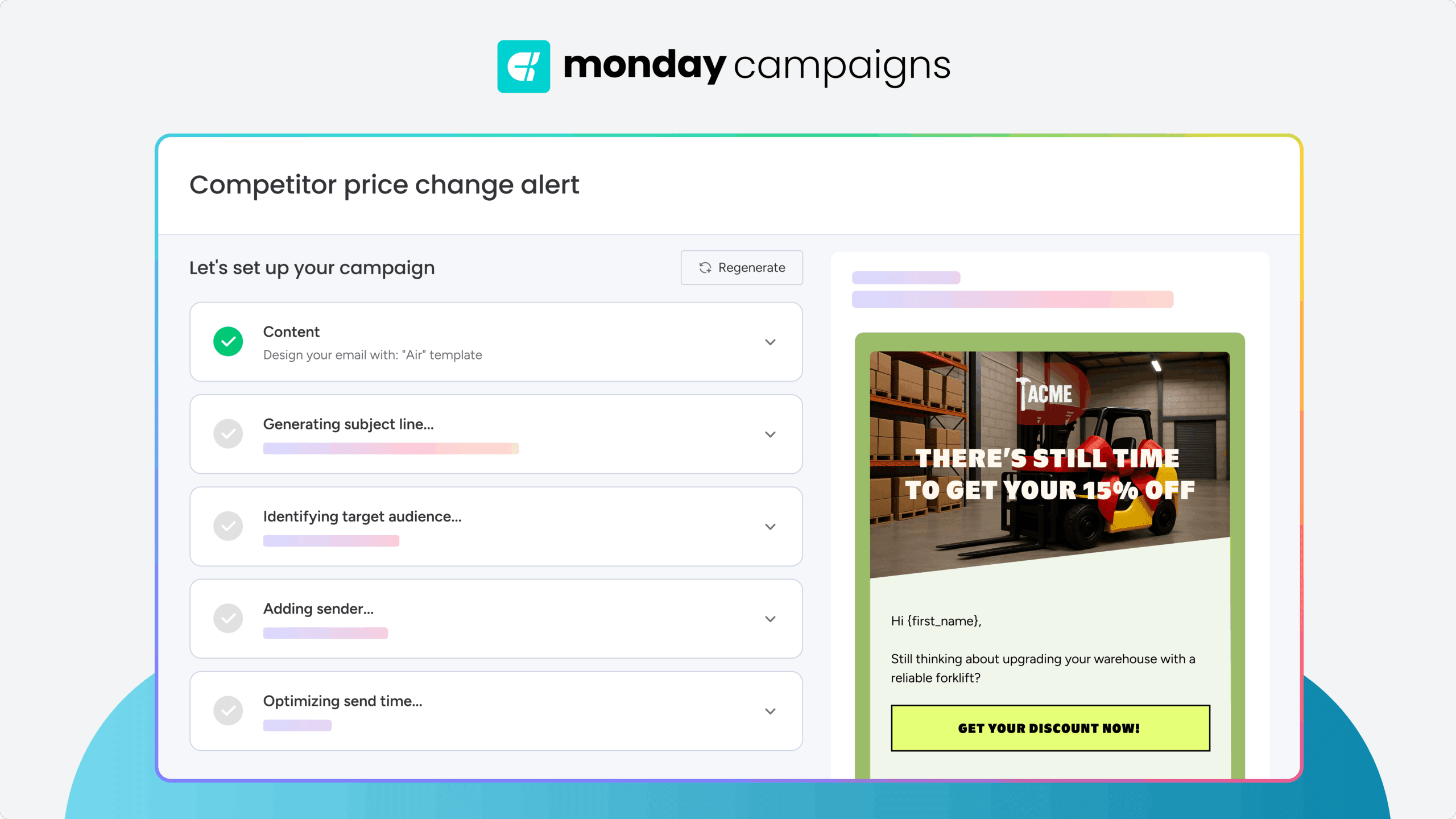
AI generates email subject lines, social media posts, and ad copy in seconds. You provide the brief, and AI creates multiple variations optimized for engagement. The key is maintaining your brand voice — AI generates the drafts, but humans ensure the message aligns with your brand personality.
2. Customer service automation
AI chatbots handle initial customer interactions, qualifying leads before they reach your sales team. These systems answer common questions, capture contact information, and route qualified prospects to the right person. Your team focuses on high-value conversations while AI manages routine inquiries.
3. Data analysis and insights
AI processes campaign data to surface actionable insights. Instead of manually reviewing spreadsheets, you get automatic alerts about trends and opportunities. AI might identify that Tuesday morning emails convert best or that video content drives higher engagement with specific segments.
4. Campaign optimization
AI helps teams optimize campaigns by analyzing performance trends and highlighting opportunities to improve results. It can suggest bid or targeting adjustments, identify high-performing creative elements, and surface segments that are responding well. As new data comes in, AI gives marketers earlier insight into what’s working so they can make informed updates faster and with far less manual effort.
7 essential AI applications in marketing
Master these seven AI applications to transform your marketing effectiveness. Each addresses specific challenges that slow teams down or limit campaign impact.
1. Personalized email campaigns
AI personalizes every aspect of email marketing — from content to timing. It analyzes subscriber behavior to determine what content resonates, when to send messages, and how often to communicate. Dynamic content insertion means each subscriber sees offers and recommendations tailored to their interests.
According to research, deploying an AI-powered “next best experience” engine has delivered 5–8% revenue uplift, 15–20% increases in customer satisfaction, and 20–30% reductions in cost to serve.
Example: A retail brand might send each customer a different version of a promotional email. One shopper sees product recommendations based on past purchases, another receives content tailored to browsing history, and a third gets an early-access offer because AI predicts a high likelihood to buy this week.
2. Dynamic content generation
AI creates and adapts content based on user behavior. Website visitors see different content based on their browsing history. Product recommendations change based on past purchases. Landing pages adjust messaging for different audience segments. This real-time adaptation happens automatically.
3. Predictive customer segmentation
AI identifies customer segments by analyzing behavior patterns and predicting future actions. Instead of basic demographic groups, you get dynamic segments like “likely to purchase this week” or “at risk of churning.” These segments update automatically as customer behavior changes.
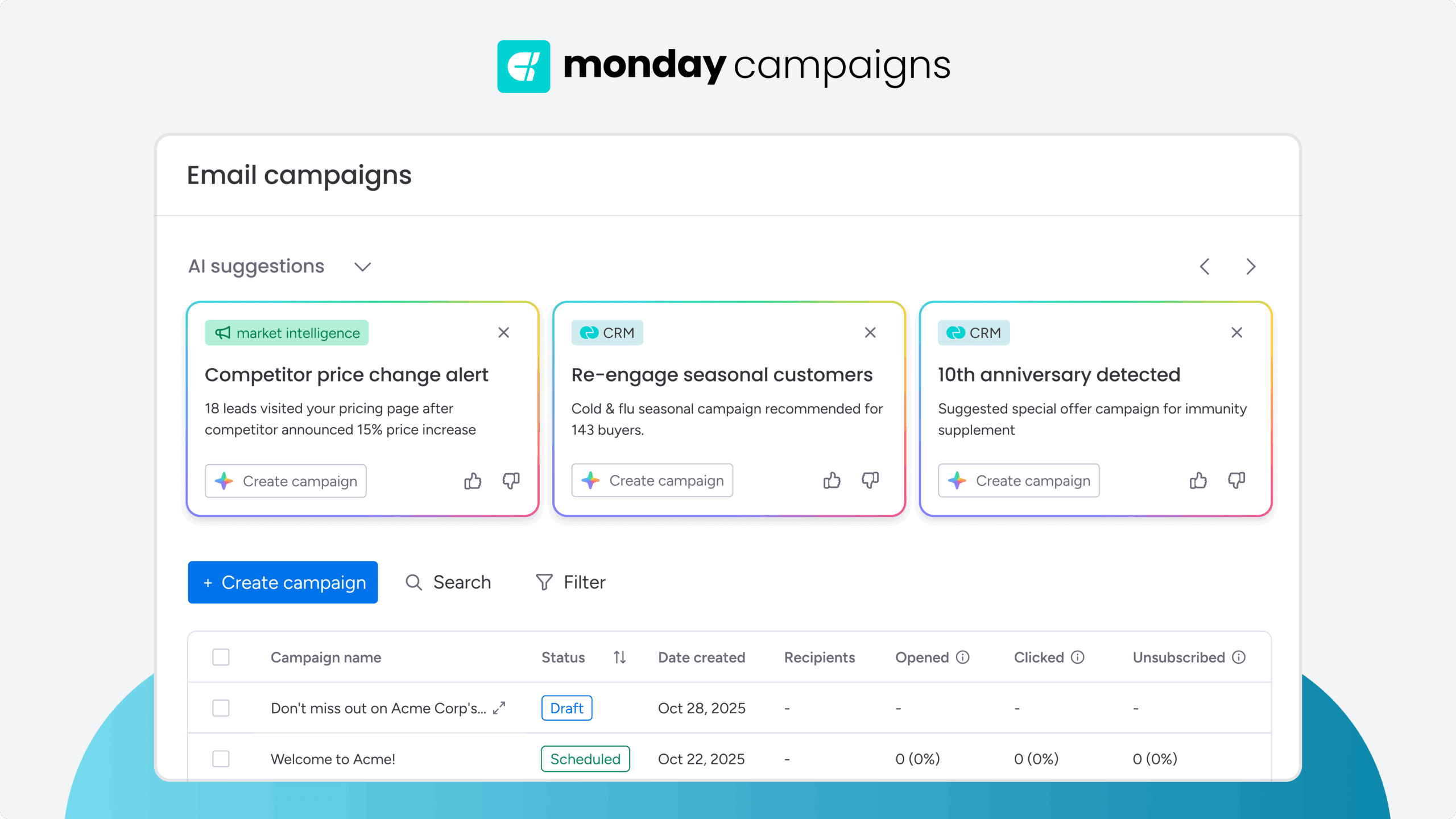
With monday campaigns, AI uses your CRM data to build precise audience segments and personalize messaging at scale. The platform identifies high-value prospects and helps teams build targeted campaigns for each segment.
4. Real-time ad optimization
AI supports advertising performance by adjusting bids, testing variations, and refining targeting based on real-time results. It identifies which ad variations perform best and scales successful elements. Budget allocation happens dynamically, moving spend to the most effective placements.
5. Social media management
AI optimizes social media by identifying optimal posting times, suggesting hashtags, and monitoring brand mentions. Social listening capabilities track sentiment and alert you to emerging opportunities or potential issues requiring immediate attention.
6. Lead scoring and qualification
AI evaluates leads based on behavior, demographics, and engagement patterns. Each lead receives a score indicating their likelihood to convert. Sales teams focus on high-scoring leads while marketing nurtures those needing more engagement.
7. Marketing analytics and reporting
AI automates reporting and provides predictive insights. Instead of building reports manually, you get automated analysis of what’s working and recommendations for improvement. Predictive analytics forecast future performance based on current trends.
Try monday campaigns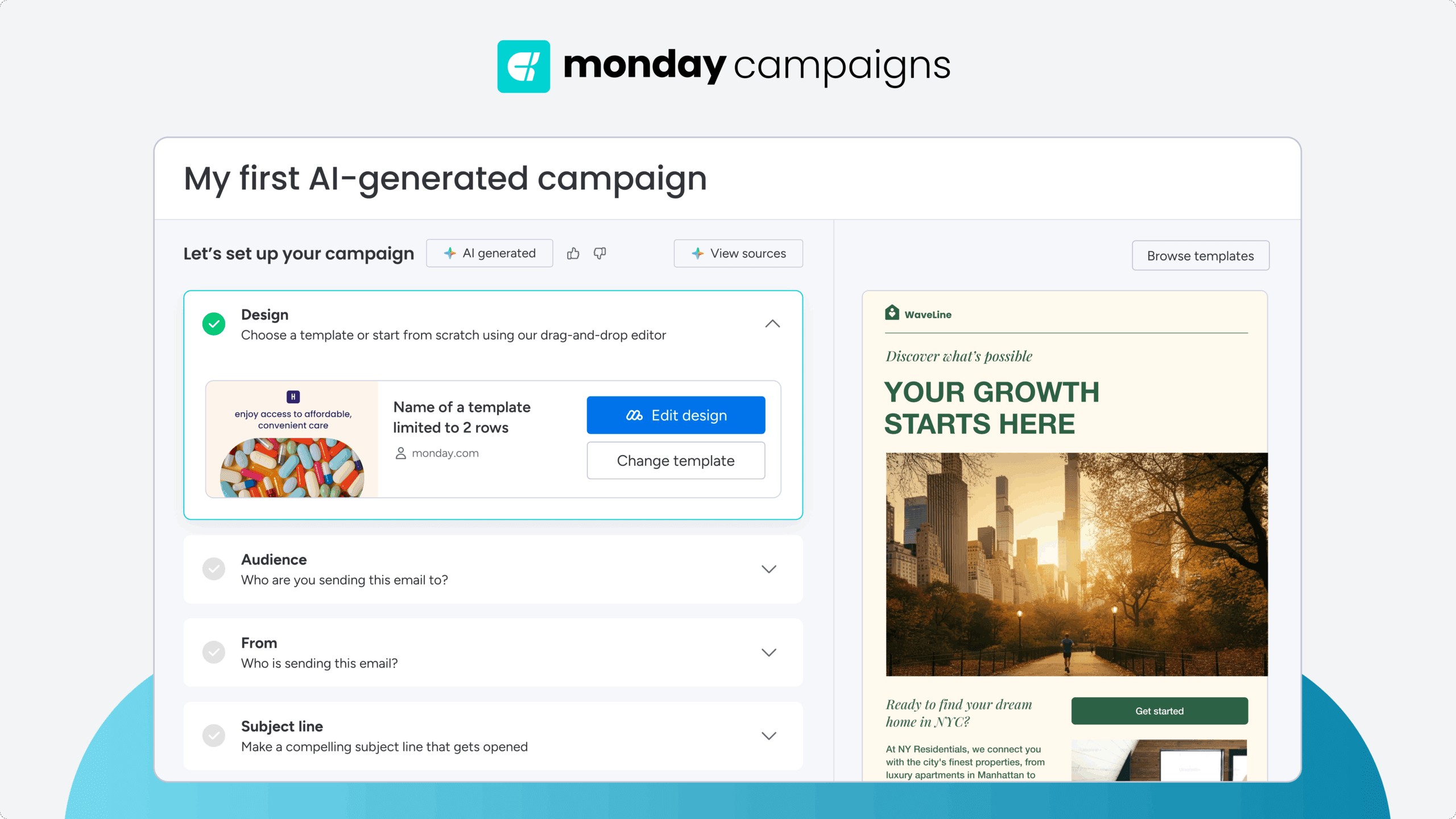
Types of AI-powered platforms for marketing teams
Choosing the right AI platforms requires understanding your specific needs and how different solutions work together. The most effective approach builds a connected ecosystem where platforms share data and insights.
Content marketing software
AI content platforms help teams generate, optimize, and manage content efficiently. Look for these capabilities:
- Writing assistance: Generate and refine copy while maintaining brand voice
- SEO optimization: Analyze content performance and suggest improvements
- Visual creation: Produce graphics and videos from text prompts
Email marketing platforms
Email platforms provide advanced personalization and campaign optimization. monday campaigns stands out by integrating AI capabilities with comprehensive campaign management. The platform analyzes CRM data to segment audiences, generate copy, and optimize send times — all while maintaining native integration with your sales data.
Social media software
Social platforms manage content creation, scheduling, and performance analysis. Essential features include optimal timing recommendations, hashtag suggestions, and sentiment analysis. The best solutions integrate with your content calendar to ensure alignment with broader campaigns.
SEO and SEM platforms
Search platforms automate keyword research, content optimization, and bid management. They analyze competitor strategies and identify content gaps while continuously adjusting paid search campaigns for optimal ROI.
Analytics and attribution solutions
Analytics platforms connect marketing activities to revenue through advanced attribution modeling. They map customer journeys across touchpoints and identify which channels drive conversions, helping you allocate budget more effectively.
How to get started with AI in marketing
Success with AI in marketing starts with careful planning and realistic expectations. Here are 4 steps to get you started:
Step 1: Assess your AI readiness
Evaluate your organization’s preparedness:
- Data quality: Is your customer data accurate, complete, and accessible?
- Team skills: Does your team understand basic AI concepts and data analysis?
- Technology infrastructure: Can your current systems integrate with AI platforms?
- Budget allocation: Do you have resources for platforms, training, and implementation?
Address any gaps before investing heavily in AI platforms. Clean data and basic training create a stronger foundation than expensive technology on shaky infrastructure.
Step 2: Choose the right AI platform
Platform selection depends on your needs, technical capabilities, and growth plans. All-in-1 solutions offer broad functionality with easier implementation. Specialized platforms provide deeper capabilities for specific channels. Enterprise platforms suit complex organizations with dedicated resources.
Consider integration capabilities and ease of use over feature lists. A platform that connects seamlessly with existing systems delivers value faster than a feature-rich solution that’s too complex to implement.
Step 3: Build your first AI campaign
Start with a focused campaign where AI can deliver clear improvements. Follow these steps:
- Define objectives: Set specific goals and success metrics.
- Configure platform: Set up your chosen AI platform with proper integrations.
- Prepare data: Clean and organize customer data for AI processing.
- Launch campaign: Deploy with AI features active.
- Optimize results: Review insights and scale successful strategies.
Document everything. This helps refine future campaigns and demonstrates AI’s value to stakeholders.
Example: A B2B software company might begin with one AI-powered nurture sequence for new leads. They define a single goal — booking a demo — upload clean CRM data, and let AI generate copy variations and optimize send times. After the first two weeks, they review engagement trends and expand the approach to other segments.
Step 4: Integrate AI with your tech stack
Successful integration requires platforms designed to work together. monday campaigns addresses this through native connections to monday CRM and work management. Marketing and sales data flows seamlessly, eliminating complex middleware or custom development.
Try monday campaignsMeasuring AI marketing ROI
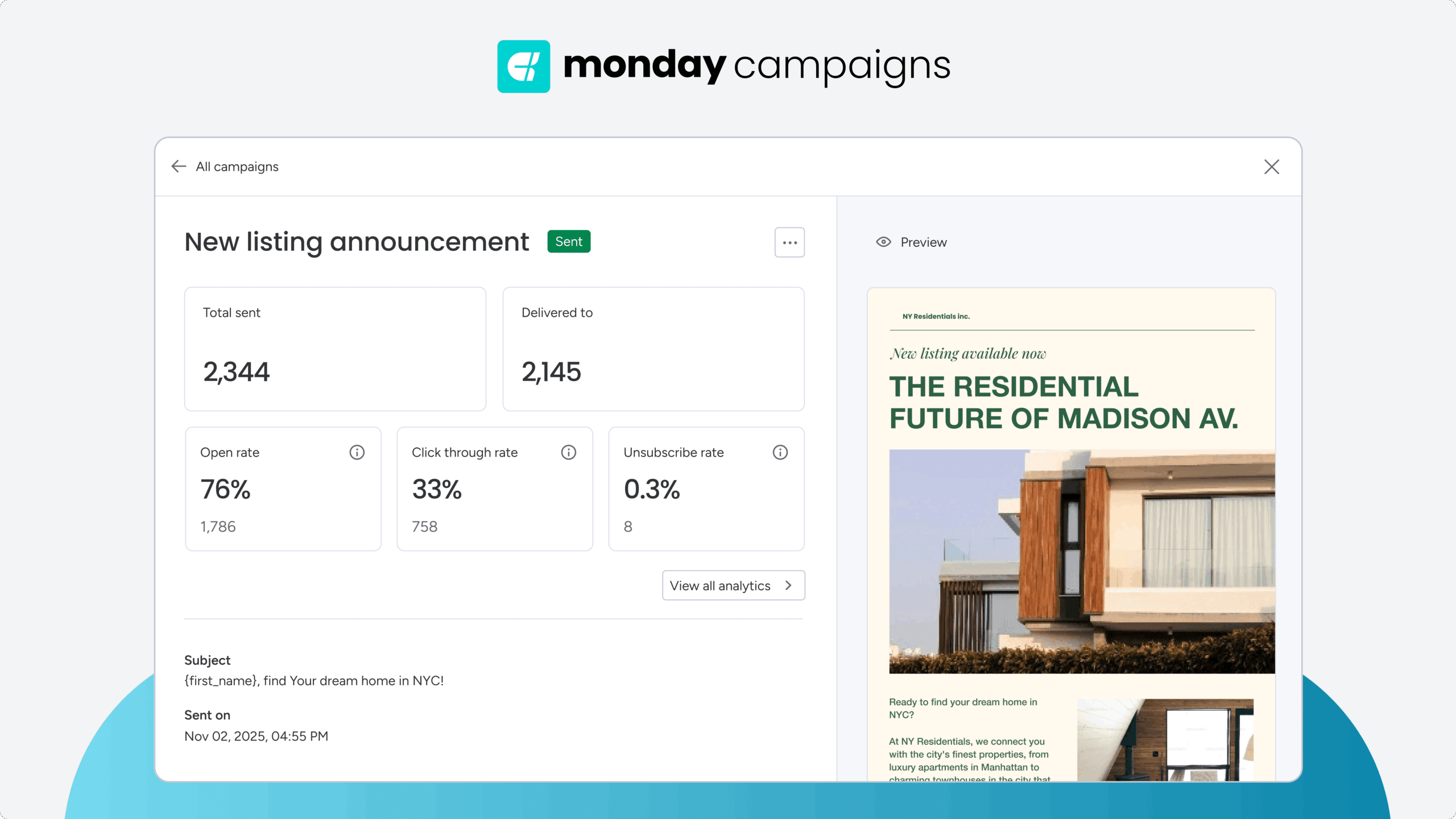
Measuring AI’s impact means looking beyond efficiency gains and tracking how campaigns contribute to revenue. AI surfaces insights earlier in the campaign cycle, helping teams make optimizations that directly influence results.
Predictive analytics plays a major role here: AI can forecast likely performance, identify high-value segments, and flag campaigns that may underperform. Instead of waiting for a post-mortem, marketers can refine targeting, shift budgets, and adjust messaging while campaigns are still live — increasing ROI in real time.
Connecting campaigns to revenue
Track campaigns through to revenue using integrated analytics with monday campaigns, which syncs marketing engagement with monday CRM, giving teams clearer visibility into how campaigns contribute to pipeline and sales activity.
Key AI performance metrics
Monitor these metrics to understand AI’s contribution to business outcomes:
- Conversion rate: Actions completed after seeing a campaign
- Customer lifetime value: Total expected revenue per customer
- Automation efficiency: Time saved through AI automation
- Personalization effectiveness: Engagement lift from tailored content
Building real-time dashboards
Real-time dashboards surface trends faster than manual reporting, giving teams immediate visibility into what’s working. Tactical views help marketing teams optimize, while executive summaries highlight ROI and revenue impact.
AI marketing best practices
Follow these practices for sustainable AI success. They apply regardless of platform choice or marketing channels.
- Data quality and preparation: High-quality data powers effective AI. Clean, organize, and maintain your data regularly. Poor data leads to poor AI performance, regardless of platform sophistication.
- Responsible AI implementation: Prioritize transparency and privacy. Explain how you use AI. Secure customer data properly. Audit algorithms regularly for bias. Building trust ensures long-term success.
- Team training and adoption: Invest in team education. Basic AI understanding helps everyone contribute effectively. Regular training keeps skills current as technology evolves.
- Governance and compliance: Establish clear policies for AI use. Document processes and accountability. Regular reviews ensure ongoing compliance and ethical use.
The future of AI in digital marketing
AI capabilities continue expanding rapidly. New technologies enable more sophisticated personalization, automation, and optimization.
- Emerging AI technologies: Advanced language models enable more natural conversations. Improved computer vision analyzes visual content. Voice AI creates new interaction channels. These technologies will reshape how brands engage customers.
- Multimodal marketing experiences: AI will power experiences combining text, images, audio, and video. Personalized video messages, interactive demos, and AI-generated podcasts will become standard. Marketing becomes more immersive and engaging.
- Autonomous campaign management: Fully autonomous campaigns are approaching. AI will handle planning, execution, and optimization with minimal human input. Marketers set objectives and guardrails while AI manages details.
Why marketers choose monday campaigns for AI-driven marketing
AI delivers the strongest results when it’s connected to the systems your team already uses, and monday campaigns was built with this in mind — pairing AI automation with monday CRM so every campaign is aligned, trackable, and revenue-connected.
Here’s what makes monday campaigns different:
- Native CRM integration: Marketing and sales share the same data, so you can attribute every email, segment, and campaign directly to pipeline impact.
- AI-powered email creation: Generate on-brand copy based on your guidelines and past performance insights.
- Audience segmentation from CRM data: Build precise, dynamic segments without exporting or manual filtering.
- Optimized send times: AI recommends when each contact is most likely to engage.
- One connected workflow: Campaign performance, sales follow-up, and team tasks live in the same platform — no more juggling tools.
For teams that want measurable ROI from their AI investment, this alignment between marketing and sales becomes a major competitive advantage.
Launch AI-powered campaigns that drive revenue with monday campaigns
AI isn’t just another marketing trend — it’s becoming the foundation of how modern teams plan, execute, and optimize campaigns. When used strategically, AI reduces manual work, improves personalization, and gives marketers clearer insight into what drives revenue.
The key is starting small, focusing on clean data, and choosing tools that integrate with your existing workflows. As your models learn and your team becomes more comfortable with AI-powered processes, the benefits compound quickly.
With platforms like monday campaigns — where AI, automation, and CRM data all work together — teams can build smarter campaigns, measure real business impact, and scale their marketing efforts with confidence.
Try monday campaignsFAQs
Can AI completely replace human marketers?
AI cannot completely replace human marketers because it lacks strategic thinking, creativity, and relationship-building abilities. AI excels at data processing, automation, and optimization, but humans provide the vision, emotional intelligence, and brand storytelling that create meaningful connections with customers.
What are the 4 types of AI in marketing?
The 4 types of AI used in marketing are:
- Machine learning (predictive analytics): Identifies patterns in customer behavior to forecast performance and personalize campaigns.
- Natural language processing (NLP): Powers chatbots, sentiment analysis, and tools that understand or generate human-like text.
- Computer vision: Analyzes images and videos for brand safety, visual search, UGC tagging, and creative optimization.
- Generative AI: Creates new content — like copy, images, segments, or campaigns — and accelerates production workflows.
How much of digital marketing can be automated with AI?
AI can automate a significant amount of routine, data-heavy marketing tasks — such as segmentation, reporting, content generation, and campaign optimization. Some teams follow a general guideline suggesting that AI can handle around 30% of the workload, especially repetitive tasks, while humans focus on the strategic, creative, and relationship-building work that drives long-term growth. It’s not a strict rule, but a framework teams use to balance efficiency with human oversight.
How much does AI marketing technology cost?
AI marketing technology costs vary widely based on features, scale, and platform type. Basic AI platforms start at a few hundred dollars monthly, while enterprise solutions can reach thousands. Many platforms offer tiered pricing to accommodate different business sizes and needs.
Is AI marketing effective for small businesses?
AI marketing is highly effective for small businesses by automating time-consuming activities and improving targeting precision. Many AI platforms now offer affordable, user-friendly options specifically designed for smaller teams, making advanced capabilities accessible regardless of company size.
How quickly can I see results from AI marketing?
AI marketing typically shows initial results within 2-4 weeks for basic implementations like email optimization or ad targeting. More sophisticated applications such as predictive analytics or complex personalization may require 2-3 months to demonstrate full impact as AI models learn from your data.
What data do I need to implement AI marketing?
Implementing AI marketing requires basic customer data including contact information, interaction history, and campaign performance metrics. While more data improves AI performance, you can start with minimal datasets — even just email addresses and basic engagement metrics — then expand as you grow.

 Get started