


Every contact in your database — from the buyer who toured homes last spring to the past client who closed 2 years ago — represents real revenue waiting to happen. The challenge? Staying relevant to hundreds of people across different journey stages without spending every spare hour on manual follow-ups.
This guide shows you how to build a real estate email strategy that moves deals forward automatically. You’ll learn how to grow a high-quality contact list, segment by buyer readiness, pick campaigns that get opened, and automate follow-up so you can focus on showings and negotiations. When your email platform and CRM share the same data, that system gets sharper with every interaction.
Key takeaways
- Segment your list and divide contacts by buyer timeline, price range, and property type so every email feels relevant — not generic.
- Automate follow-up by setting up lifecycle-based workflows that send the right message at the right stage, from new lead to past client.
- Past clients and personal contacts are most likely to refer business, and consistent email touchpoints keep you top of mind.
- monday campaigns links directly to monday CRM, so engagement signals automatically update contact records and every lead stays accounted for.
- Measure what drives closings, including open rates, click rates, and conversions, to see which emails move contacts closer to a deal.
Why email marketing closes more real estate deals

Real estate has a unique sales cycle that makes email marketing work. Retail and e-commerce move fast. Real estate? Months or even years. A buyer who attends your open house in January might not be ready to make an offer until September. A homeowner curious about their property value today might not list for another two years.
Email bridges this gap by keeping you in touch throughout the entire journey, without requiring manual outreach to hundreds of contacts every week.
Build trust across the full buyer and seller journey
The typical real estate journey has 4 phases: awareness, consideration, decision, and advocacy. Each phase needs different messaging, and email lets you deliver it when it matters.
| Journey phase | Buyer email strategy | Seller email strategy |
|---|---|---|
| Awareness | Monthly market trends, neighborhood spotlights | Home value updates, equity growth reports |
| Consideration | New listing alerts, buyer guides, financing education | Seller preparation checklists, staging tips |
| Decision | Personalized property recommendations, showing confirmations | Listing presentation follow-ups, comparable sales data |
| Advocacy | Home anniversary messages, maintenance tips | Move-in resources, referral requests |
Trust-building emails that perform well across all phases include:
- Monthly market reports: Share recent sales and price trends to keep contacts informed.
- Neighborhood guides: Cover schools, local amenities, and community events.
- Seasonal home maintenance tips: Provide value without asking for anything in return.
The key is providing value consistently, without requiring immediate action from the reader. This matters more than ever: Only 17% of U.S. adults rated real estate agents’ honesty and ethics as “high” or “very high” in a Gallup survey, making sustained, value-driven communication essential to earning trust.
Stay top of mind with past clients and your sphere
Here’s the reality: The vast majority of real estate transactions come from referrals, repeat clients, or sphere of influence contacts. Yet most agents fail to stay in consistent contact with the people most likely to send them business.
Your sphere of influence includes everyone who knows you personally. These people already trust you — they just need to remember you when someone mentions they’re thinking about buying or selling.
Email automation keeps you consistent without the manual effort. The following touchpoints keep you visible while showing you care about contacts as people, not just transactions:
- Birthday emails
- Home anniversary messages
- Seasonal market updates
- Holiday greetings
Measure the ROI of your real estate email marketing
Traditional real estate marketing has a fundamental problem: You can’t measure what works. You might spend $2,000 on postcards and have no idea if a single person read them — and with U.S. postage costs rising 14.5% year-over-year according to the Bureau of Labor Statistics, that blind spend is getting more expensive.
Email provides complete visibility into what’s working and what’s not:
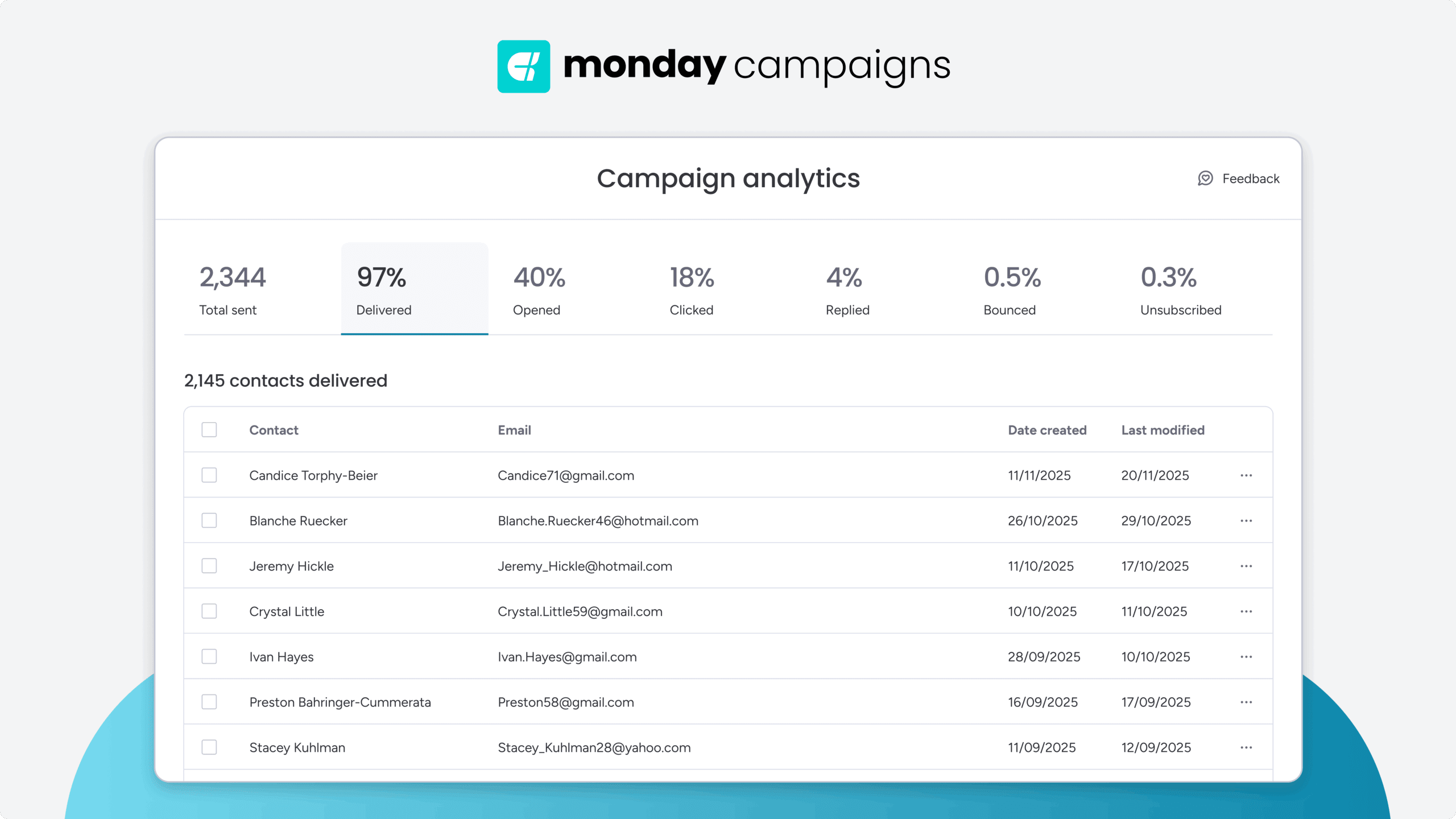
- Open rates: Tell you who’s engaged with your emails.
- Click rates: Reveal who’s interested enough to take action.
- Reply rates: Identify who’s ready to have a conversation.
- Conversion rates: Show who booked a showing or consultation.
How to grow a real estate email list and drive closings
The quality of those contacts determines whether your emails get opened, clicked, and acted on, or ignored and marked as spam.
Permission-based contacts deliver significantly higher engagement than purchased lists. Permission-based lists keep your sender reputation strong by ensuring contacts are current, interested, and engaged. Here’s how to grow a list that actually converts.
Capture leads from open houses and sign-in sheets
Open houses are perfect for growing your email list with warm, qualified leads. Everyone who walks through the door has already shown interest in real estate, making them far more valuable than a cold contact.
Digital sign-in captures contact info more reliably than paper sheets. Plus, you can automatically add contacts to your email system with tags like buyer, seller, investor, or timeline.
Offering something valuable in exchange for contact info boosts sign-up rates:
- Comparative market analysis: “Get a free CMA for your home — enter your email and I’ll send it within 24 hours.”
- Neighborhood guide: “Want the complete guide to this neighborhood? I’ll email it to you right now.”
- New listing alerts: “Be the first to know about new listings in this price range.”
Offer lead magnets like buyer guides and market reports
Lead magnets are valuable resources you offer in exchange for contact info. They work because they provide immediate value and position you as an expert worth following.
| Lead magnet type | Best for | Example title |
|---|---|---|
| Buyer guide | First-time buyers, relocating buyers | The complete first-time buyer's roadmap |
| Seller guide | Homeowners considering selling | 10 things every seller should know before listing |
| Neighborhood report | Buyers interested in specific areas | The ultimate guide to living in [Neighborhood] |
| Home valuation | Potential sellers, curious homeowners | What's your home worth? Get your free estimate |
How to segment your real estate database for higher engagement

Tailoring emails to specific groups in your database boosts engagement and unlocks more opportunities. A first-time buyer looking for a $250K condo doesn’t need to see your $1.5M luxury listing. A seller ready to list next month doesn’t need your 12-month buyer education series.
Segmentation is simple: divide your contact list into smaller groups based on shared characteristics. Then send more relevant, personalized messages. The 2 best ways to segment your real estate database: buyer readiness and dynamic CRM status.
Learn more: Real estate agent CRM software
Segment buyers by timeline, price range, and property type
Buyer leads vary widely in readiness, budget, and preferences. Segment by these factors and you can send targeted content that matches each buyer’s stage.
Timeline segments work particularly well for real estate:
- Active buyers (0–3 months): Ready to purchase now. Send new listing alerts immediately and time-sensitive opportunities.
- Planning buyers (3–6 months): Preparing to buy soon. Send market education, financing tips, and neighborhood comparisons.
- Researching buyers (6–12+ months): Early in the process. Send long-term market trends and homeownership education.
Use dynamic segments that update with every CRM change
Dynamic segments save the manual upkeep that static lists demand. When a contact’s status changes, someone has to move them to a new list. Dynamic segments update automatically based on real-time data changes. Contacts always get relevant emails without manual list management.
How does this work in practice?
- A lead tagged as “researching” automatically moves to “active buyer” when they request a showing.
- A past client who moves out of state automatically exits your local market update segment.
When email campaigns and CRM data live together, you spend less time reconciling lists, leaving you with more time to engage contacts showing real buying or selling intent. monday campaigns connects to monday CRM, so engagement signals feed directly into sales conversations instead of getting lost in a separate system.
Try monday campaigns7 types of real estate email campaigns that convert

A strong email strategy mixes automated campaigns with one-time broadcasts. These 7 campaign types cover the full spectrum of real estate email marketing, from the moment a lead opts in to years after a deal closes.
1. Welcome series for new leads
A welcome series is an automated sequence of 3–5 emails that goes out immediately after someone joins your list. Welcome emails get the highest engagement rates because new subscribers are most interested right after they opt in.
2. Hyperlocal market update newsletters
Hyperlocal market updates make you the neighborhood expert and keep contacts engaged with timely, relevant data. “Hyperlocal” means focusing on specific neighborhoods or ZIP codes — not citywide statistics that don’t help anyone make decisions.
3. Just-listed and open house announcements
Just-listed and open house emails get immediate interest and drive traffic to new listings. To make them work:
- Lead with visuals: Use your best exterior or interior shot — large enough to see on mobile.
- Include key details: Highlight unique features that set the property apart.
- Keep it focused: Use a single, clear call-to-action.
4. Drip campaigns for long-term nurture
Drip campaigns are automated email sequences that nurture leads over weeks or months. Drip campaigns are longer and more educational than welcome series. They build expertise and trust over time.
Learn more: Designing drip email campaigns
5. Home valuation and equity update emails
Home valuation emails engage potential sellers by showing them how much their home is worth and how much equity they’ve gained. Send past clients quarterly “Your home equity update” emails showing estimated current value and equity gained.
6. Anniversary, birthday, and holiday touches
Personal milestone emails keep you top of mind with past clients and strengthen those relationships. These aren’t sales emails. They’re relationship maintenance that generates referrals and repeat business over time.
7. Referral requests and review asks
Referral and review emails generate new business from satisfied clients. Send referral requests 30–60 days after closing, when clients have settled in and are still excited about their experience.
How to automate real estate email follow-up without losing the personal touch
Many agents wonder how to keep automated emails feeling personal and human. The opposite is true when you implement automation correctly. Automation handles repetitive follow-up so you can focus on high-value personal interactions like phone calls, showings, and negotiations — a real advantage given that 66% of AI users report spending more time on high-value work when automation handles routine tasks, according to Microsoft’s 2026 Work Trend Index.
Here’s how to set up automation that feels human at every stage.
Step 1: Set up new lead welcome workflows
New lead welcome workflows nurture contacts automatically from the moment they join your list. When a contact subscribes, they automatically get a pre-built email sequence that:
- Delivers your introduction and establishes credibility.
- Provides immediate value — a guide, report, or market update.
- Invites next steps without any manual intervention.
Step 2: Implement lifecycle-based automation that adapts to contact status
The best email automation adapts to each contact’s stage, automatically adjusting messaging as their status changes. Here’s how that looks across the lifecycle:
| Contact stage | Automated email type |
|---|---|
| New lead | Welcome series |
| Nurturing lead | Monthly market updates |
| Active buyer | New listing alerts |
| Past client | Anniversary emails and referral requests |
This level of automation requires a CRM with email marketing integration between your email platform and CRM.
Why monday campaigns is built for real estate email marketing
Real estate agents need an email platform that understands the complexity of their sales cycle — long timelines, multiple touchpoints, and the need to stay organized across hundreds of contacts at different stages.
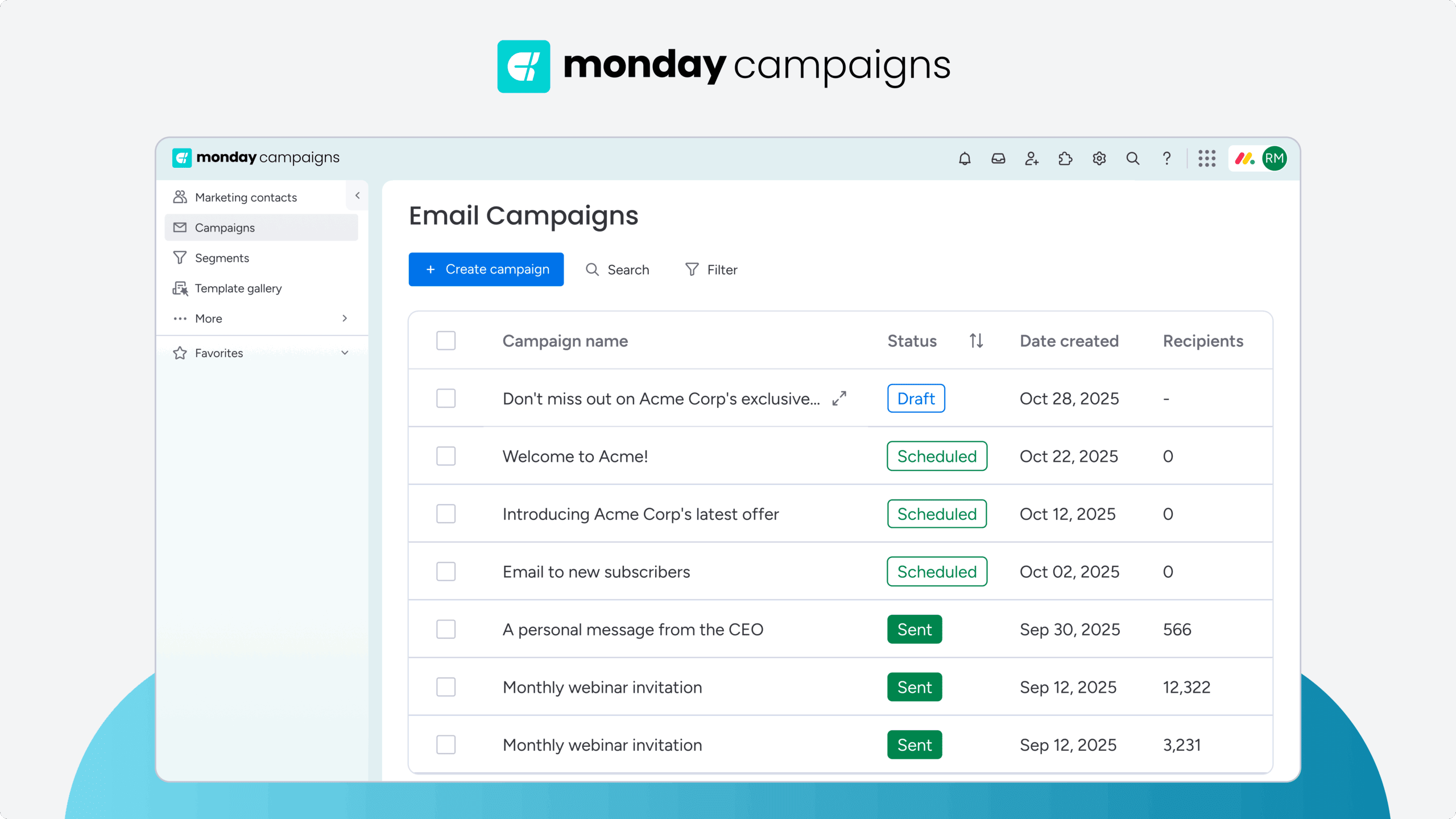
monday campaigns is designed to handle exactly that, with native CRM integration, intelligent automation, and AI-powered features that make personalization scalable. Here’s how:
- Native CRM integration: monday CRM and monday campaigns share the same database, so every email open, click, and reply automatically updates contact records without manual data entry.
- Dynamic segmentation: Create segments that update in real time based on CRM status changes — when a lead moves from “researching” to “active buyer,” they automatically receive the right emails.
- AI-powered email generation: Use monday AI to draft subject lines, personalize email copy, and optimize send times based on engagement patterns.
- Lifecycle automation workflows: Set up trigger-based sequences that adapt to each contact’s journey stage, from new lead welcome series to post-closing anniversary emails.
- Visual campaign builder: Design and launch campaigns using an intuitive drag-and-drop interface that doesn’t require technical expertise.
- Performance analytics: Track open rates, click rates, and conversions in real time, with insights that connect email engagement directly to closed deals.
Because monday campaigns lives inside the same platform as your CRM, you eliminate the friction of switching between tools, exporting lists, or wondering whether your email data is synced. Every interaction feeds into a single source of truth, making your follow-up smarter and your pipeline more predictable.

"With monday campaigns, we can launch professional emails in minutes and instantly see who engaged. Our sales team follows up directly with those showing interest - making outreach faster and more effective."
Michael Fitzpatrick | National Workplace Training ManagerTurn your contact database into a steady stream of closings
Email marketing works in real estate because it matches the pace of the industry: consistent, relationship-driven, and built for the long game. The strategies in this article — from list building and segmentation to automation and campaign types — give you a repeatable system that compounds over time, turning every open house sign-in and lead magnet download into a contact who moves through your pipeline automatically.
When your email platform and CRM share the same data, that system gets even sharper. Ready to turn your contact database into a steady stream of closings? Get started with monday campaigns today.
Try monday campaignsFAQs
How often should real estate agents send marketing emails?
The best email frequency depends on the content type and audience segment. For general market updates, monthly or bi-weekly sends work well. For active buyers, you can send new listing alerts as frequently as daily or weekly. For past clients, monthly touchpoints plus milestone emails maintain relationships without feeling excessive.
What is the best email marketing platform for real estate agents?
The best email marketing platform for real estate agents integrates directly with your CRM, supports automation workflows, and makes it easy to segment by buyer/seller status, price range, and location preferences. Platforms that connect email marketing with contact management eliminate manual data entry. Your emails always reflect current contact information.
How do I grow my real estate email list quickly?
Growing a real estate email list requires consistent lead capture across multiple touchpoints. Offer valuable lead magnets on your website and social media. Use digital sign-in at open houses. Add opt-in forms to every listing page. And systematically ask past clients for permission to add them to your list.
What should I include in a real estate email newsletter?
Effective real estate email newsletters include hyperlocal market data, new listing highlights that match the recipient's interests, educational content, local community news, and a single call-to-action.
How do I write real estate emails that get opened?
Real estate emails get opened when the subject line is specific, relevant, and creates curiosity or urgency. Keep subject lines under 50 characters so they display fully on mobile devices. Use personalization when relevant and avoid spam triggers like ALL CAPS or excessive punctuation.
Can I automate my real estate email marketing?
Yes, you can automate your real estate email marketing for consistency at scale. Automation handles welcome sequences, birthday and anniversary emails, market update newsletters, and post-showing follow-ups. Automation handles welcome sequences, birthday and anniversary emails, market update newsletters, and post-showing outreach — freeing you to focus on showings and negotiations. The key to effective automation is personalization through dynamic fields and behavioral triggers.

 Get started