

The most successful marketing teams are turning automated drip campaigns into predictable revenue engines. By delivering personalized messages at exactly the right moment in each prospect’s journey, they’re converting more leads while spending less time on manual follow-up.
This guide reveals the strategy behind high-performing drip campaigns that drive real revenue. You’ll discover the 7 essential campaign types that generate the most conversions, plus learn how to build, launch, and measure campaigns using AI-powered tools that automate the entire process in minutes.
Try monday campaignsKey takeaways
- Drip campaigns deliver 5x higher ROI than regular email blasts by sending the right message at the right time based on customer behavior and interests.
- Focus on revenue metrics like conversion rates and cost per customer instead of vanity metrics like open rates to prove real business impact.
- Seven proven campaign types drive the most revenue: welcome series, cart recovery, lead nurturing, upsells, re-engagement, trial conversion, and retention campaigns.
- Connect your email campaigns directly to your CRM to track the complete customer journey from first email to closed deal and prove marketing’s true value.
- Using AI and automation, monday campaigns lets you build smart segments, produce personalized copy, and optimize send times — turning hours of work into minutes.
What are drip campaigns?
Drip campaigns are automated email sequences that send targeted messages based on triggers or timelines. This means you set up a series of emails once, and they automatically send to the right people at the right time.
When someone downloads your guide, they get a welcome email. Three days later, they receive helpful tips. A week after that, you share a customer success story. Each message builds on the last, guiding prospects toward a purchase decision.
Common triggers include signing up for a newsletter, abandoning a shopping cart, or requesting a demo. Once triggered, the campaign sends pre-written emails at specific intervals. You control the timing, content, and conditions for each message. The automation handles the rest, ensuring consistent follow-up without manual work.
Drip campaigns vs. traditional email marketing: Why automation drives more revenue
Traditional email marketing sends one message to your entire list at a single point in time. Drip campaigns deliver a sequence of automated emails triggered by behavior, timing, or lifecycle stage.
Instead of blasting the same content to everyone, drip campaigns adapt to where each contact is in their buyer journey. Someone who just subscribed receives educational content, while someone who abandoned a cart receives a reminder. This behavioral, automated approach drives higher engagement and more predictable revenue because it aligns messaging with intent.
Here’s how drip campaigns compare to traditional email marketing at a glance:
| Feature | Drip campaigns | Traditional email marketing |
|---|---|---|
| Triggered by behavior | Yes (form fills, clicks, page visits) | No (manual send) |
| Personalization depth | High (dynamic content, segmentation) | Low to moderate |
| Timing | Automated and sequential | One-time blast |
| Customer journey alignment | Lifecycle-based and intent-driven | Broad audience messaging |
| Revenue attribution | Multi-touch tracking | Often single-touch |
| Scalability | Continuous automation | Manual scheduling |
5 revenue benefits of drip campaigns
Smart marketers use drip campaigns because they deliver predictable, measurable results. Here’s what makes them so effective for driving revenue growth.
- Automated lead nurturing increases conversion rates: Prospects need multiple touchpoints before buying, and the automation maintains momentum even when your team is busy. Leads stay warm, your brand stays visible, and conversions happen naturally as prospects move through their decision process.
- Personalization at scale drives higher engagement: Personalizing thousands of emails manually is impossible. Drip campaigns use data and behavior triggers to customize messages automatically. According to McKinsey, AI-powered next-best-experience capabilities — which rely on advanced personalization — can boost customer satisfaction by 15–20%, increase revenue by 5–8%, and reduce cost to serve by 20–30%.
- Behavioral triggers capture revenue at the right moment: Drip campaigns respond instantly when prospects show buying signals. Did someone visit your pricing page 3 times? Send them a comparison guide. Did they abandon their cart? Remind them what they’re missing. These timely responses capture revenue when interest peaks.
- Multi-touch attribution shows true marketing impact: Single emails rarely drive purchases alone. Drip campaigns track the entire journey, showing how each touchpoint contributes to revenue. This visibility helps you optimize sales campaigns and prove marketing’s value.
- Reduced manual work means more strategic focus: Automation handles the repetitive tasks — sending emails, updating lists, tracking opens. Your team focuses on strategy, creative development, and optimization. More time for high-impact work means stronger campaigns and faster growth.
Essential components of high-converting drip campaigns
Every successful drip email marketing campaign shares key elements that drive results. Understanding these components helps you build sequences that convert consistently:
- Trigger events: Actions that start your campaign, like form fills or link clicks
- Segmentation: Grouping contacts by behavior, industry, or interests for targeted messaging
- Personalization: Using contact data to customize content and timing
- Clear calls-to-action: Specific next steps in every email
- Performance tracking: Metrics that show what’s working and what needs adjustment
7 types of drip campaigns that generate revenue
Different campaigns serve different purposes in your revenue strategy. Here are the most effective types to include in your marketing mix.
1. Welcome series to convert new subscribers

(Source)
First impressions matter. Welcome series introduce your brand and guide new subscribers toward their first purchase. Start with an immediate welcome that sets expectations, and follow with your company story, helpful resources, and social proof. End with a soft product introduction that feels natural, not pushy.
2. Abandoned cart recovery sequences
Cart abandonment happens constantly. Recovery sequences bring shoppers back to complete their purchase. Send a reminder within hours, and address common concerns like shipping costs or return policies. Create urgency with limited-time offers.
Pro tip: These campaigns often deliver the highest ROI because recipients already showed purchase intent.
3. Lead nurturing campaigns for long sales cycles
Complex purchases take time, especially for companies implementing email marketing for startups. Lead nurturing campaigns build relationships over weeks or months with educational content and gradual product introductions.
Mix industry insights, case studies, and helpful resources to show value before selling. This patience pays off with higher close rates and larger deal sizes.
4. Post-purchase upsell and cross-sell campaigns
Existing customers buy more readily than new prospects. Post-purchase campaigns maximize lifetime value by suggesting complementary products or upgrades. Thank them first. Help them succeed with their purchase. Then introduce relevant additions that enhance their experience.
5. Re-engagement campaigns for inactive contacts
Some subscribers go quiet. Re-engagement campaigns wake them up or clean your list. Acknowledge the silence. Offer something valuable. Make it easy to update preferences or unsubscribe. A clean, engaged list performs far better than a large, inactive one.
6. Free trial to paid conversion sequences
Trial users need guidance to see full value. Conversion sequences provide onboarding support, feature highlights, and success stories. Time these carefully. Send helpful tips early, showcase advanced features midway, and create urgency before the trial ends.
7. Customer retention and loyalty campaigns
Keeping customers costs less than finding new ones. Retention campaigns maintain relationships with exclusive offers, product updates, and success stories. Make customers feel valued, and show them new ways to succeed. Build community around your brand.
Example: SaaS free trial drip campaign
Here’s what a simple 5-email free trial drip campaign might look like:
| Day | Trigger | Email focus | Goal |
|---|---|---|---|
| Day 0 | User signs up for free trial | Welcome + quick-start guide | Activate user |
| Day 2 | No feature usage | Highlight key feature | Increase engagement |
| Day 5 | Feature used once | Case study + advanced tip | Build confidence |
| Day 10 | Trial halfway complete | ROI calculator + comparison | Reinforce value |
| Day 13 | Trial ending soon | Upgrade reminder + incentive | Drive conversion |
Each message builds on user behavior and timing, moving the prospect closer to a purchase without manual follow-up.
How to launch revenue-focused drip campaigns in minutes
Modern software makes campaign creation simple. Here’s how to build drip campaigns that drive real revenue, fast.
- Map your customer journey to revenue goals: Start by getting to know how prospects become customers. What steps do they take? What questions arise at each stage? Create a simple flowchart showing key touchpoints. Identify what information helps prospects move forward. This map becomes your campaign blueprint.
- Build smart segments using CRM data: Effective campaigns start with smart segmentation. Group contacts by behavior, industry, company size, or engagement level.
- Create email content that drives action: Great emails combine compelling copy with a specific, direct call to action. Focus on subject lines that make people want to open and messaging that matters to your buyer. Offer social proof and a single, clear CTA.
- Set up behavioral triggers and automation rules: Define which actions trigger which campaigns. Common triggers include form submissions, link clicks, page visits, lead score changes, and purchase completions.
- Test and activate your campaign: Before launching, test everything. Check email rendering across devices, verify triggers work correctly, and review your sequence timing. Start with a small test group, monitor initial results, and adjust based on data. Then? Scale with confidence.
With monday campaigns, this entire process is simplified using intuitive workflows and AI-powered guidance at every step. From mapping customer journeys to activating campaigns, the platform handles technical complexity so you can focus on strategy and results.
Try monday campaignsMeasuring and maximizing drip campaign ROI
What gets measured gets improved. Track the right metrics to optimize your campaigns for maximum revenue impact.
Track revenue metrics that matter
Focus on metrics tied directly to revenue, not vanity numbers that look good but don’t drive business results. These core metrics help measure the true revenue impact of drip campaigns:
| Metric | What it measures | Why it matters |
|---|---|---|
| Conversion rate | % of recipients who complete desired action | Shows direct revenue impact |
| Revenue per email | Average revenue generated per send | Connects email to financial performance |
| Customer lifetime value (CLV) | Total revenue from a customer over time | Measures long-term impact of nurturing |
| Cost per acquisition (CPA) | Marketing spend per new customer | Evaluates efficiency |
| Email attribution | Revenue tied to specific touchpoints | Proves campaign effectiveness |
A/B test your way to higher conversions
Small improvements compound into big results. Test one element at a time: subject lines, send times, email copy, CTA placement, and personalization depth. Form a hypothesis, run the a/b test, measure significance, implement winners, and repeat continuously.
Use analytics to identify optimization opportunities
Analytics reveal where prospects engage and where they drop off. Look for patterns in high-performing content and optimal sending frequencies.
Transform marketing into a revenue engine with monday campaigns
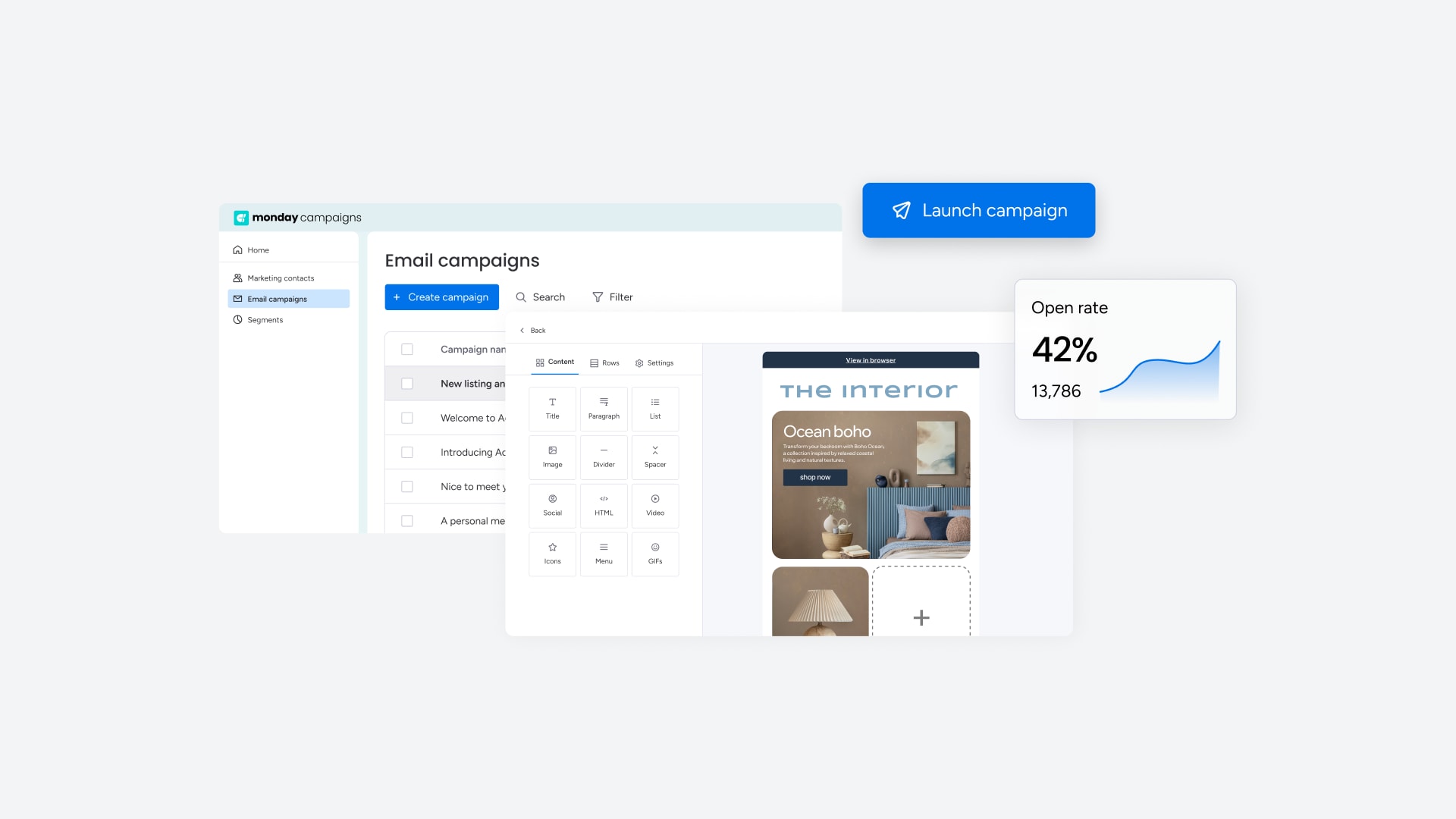
Seamlessly integrated with monday CRM and your existing workflows, monday campaigns combines intuitive design with AI-powered automation to make sophisticated drip campaigns accessible to every marketer — while keeping your entire revenue engine in one place.
Launch your first campaign fast
Intuitive design and pre-built templates mean you’re sending campaigns in minutes, not days. No technical expertise required.
The platform guides you through setup, suggests best practices, and helps avoid common mistakes. AI-powered templates prevent predictable errors that sink most campaigns. Focus on strategy while automation handles execution.
Connect every touch to pipeline impact
Real-time dashboards show how campaigns drive revenue by tracking lead progression, campaign performance, and ROI in one unified view. This visibility lets you make data-driven decisions quickly and adjust campaigns based on actual results, not assumptions.
Scale personalization with built-in AI
AI enables sophisticated personalization without complexity. The platform analyzes recipient behavior to optimize automatically — subject lines, send times, and content adjust based on what works. You see improved results without manual testing.
Predictive sending identifies when each person engages most and delivers messages accordingly. Your emails arrive when recipients are ready to read. Open rates increase. Conversions follow.
As you grow, the platform scales with you. Same personalization quality whether you have hundreds or hundreds of thousands of contacts.
Get started with your first revenue-driving drip campaign
Drip campaigns deliver higher ROI than traditional email blasts by sending the right message at the right time. The 7 campaign types covered here — from welcome series to retention sequences — give you a proven framework for converting more leads while spending less time on manual follow-up. Connect your campaigns to your CRM, track revenue metrics that matter, and let AI handle the optimization.
With monday campaigns, it becomes simpler to launch revenue-focused drip campaigns in minutes, not days. Build smart segments, create personalized content with AI assistance, and track every touchpoint’s impact on your pipeline — all in one intuitive platform.
Try monday campaignsFAQs
How many emails should be in a drip campaign?
The ideal drip campaign length depends on your sales cycle and goals. Welcome series typically include 3-5 emails, while B2B nurturing campaigns might extend to 10+ emails over several months.
What is the best day and time to send drip emails?
While Tuesday through Thursday mornings often perform well, the best timing varies by audience. AI-powered platforms like monday campaigns analyze individual behavior to send when each recipient is most likely to engage.
Can drip campaigns work for both B2B and B2C companies?
Yes, drip campaigns work for both B2B and B2C companies with different approaches. B2B campaigns focus on education and relationship building over longer periods, while B2C campaigns emphasize promotions and faster purchase decisions.
How quickly can drip campaigns impact revenue?
Well-designed drip campaigns typically show revenue impact within 30-60 days of launch. Full optimization usually takes 3-6 months, depending on your sales cycle length and testing velocity.
What is the difference between drip campaigns and marketing automation?
Drip campaigns are email sequences within marketing automation. Marketing automation includes all automated marketing activities across channels — email, social media, ads, and more.
How do I avoid email fatigue in longer drip sequences?
Prevent email fatigue by spacing messages appropriately (every 3-7 days), delivering genuine value in each email, and monitoring engagement metrics. Reduce frequency for less engaged subscribers and always provide easy unsubscribe options.

 Get started