


Email still delivers one of the best returns you’ll find in marketing. But the platform you use matters more than most people realize. It goes beyond design or deliverability. It’s about how well your campaigns connect to the rest of your business. Most small businesses run into the same problem: their email platform and CRM rarely connect, leaving teams to bridge the gap manually. You’re stuck exporting contact data, updating it manually, and reconciling everything after the fact. By the time your sales team sees who clicked what, the moment has passed.
This guide covers 15 platforms worth considering, what separates them, and which features matter most for small teams. We’ll look at automation depth, segmentation, pricing, and how well each platform connects campaign activity to real customer data, including monday campaigns, which connects natively to monday CRM so your marketing and sales data live in the same place.
Try monday campaignsWhat is email marketing software and why small businesses need it
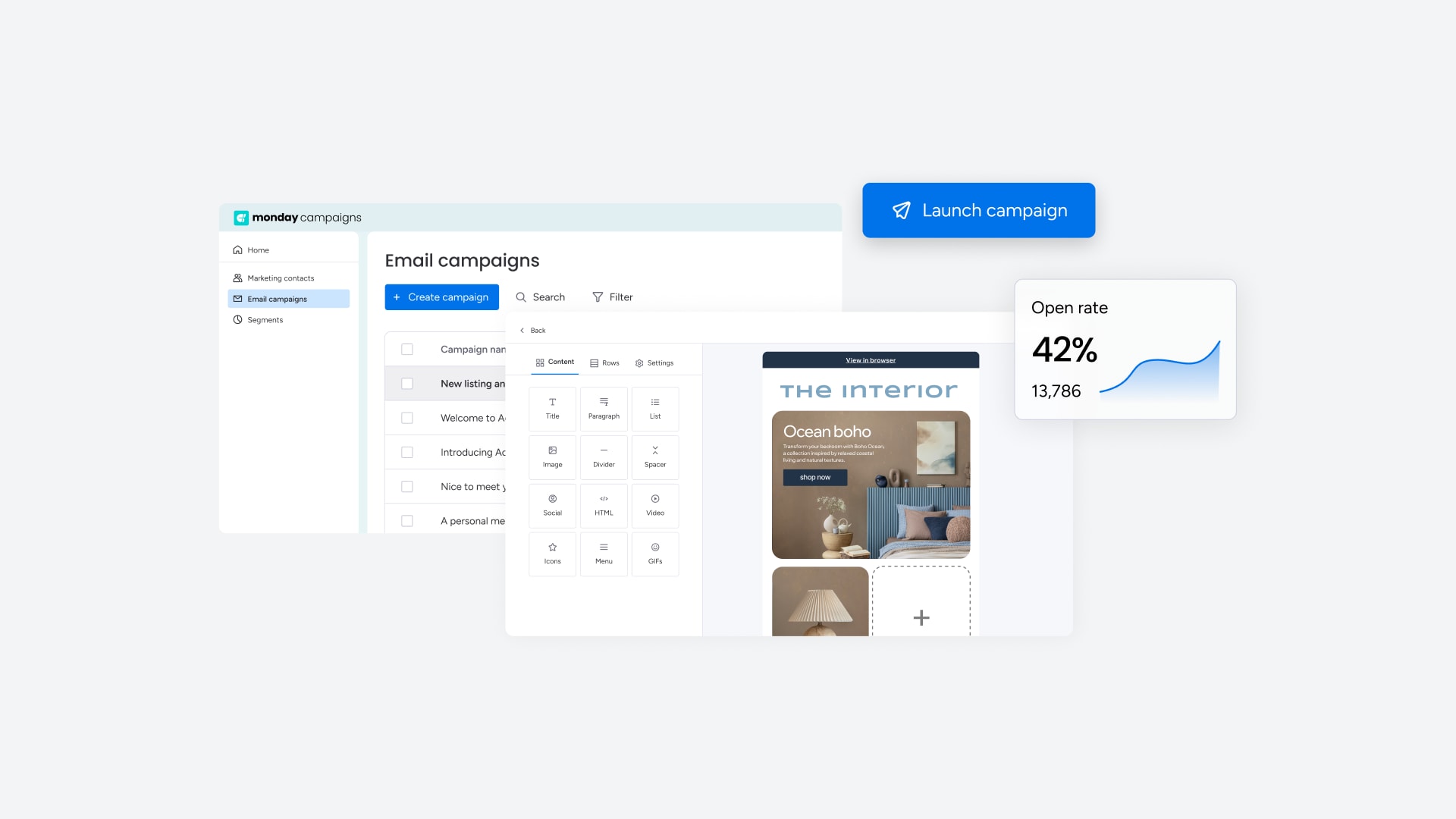
Email marketing software lets you design, send, and track campaigns across your entire audience. You can replace messy spreadsheet exports and manual contact updates with a single streamlined workflow. It puts your messaging directly in front of new leads and loyal customers, turning repetitive busywork into results you can track.
For small businesses, a well-timed email is still one of the best ways to drive steady revenue.
Here’s where the real value emerges: success depends on how well your email platform and CRM work together.
Marketing teams want to spend their time acting on insights, not downloading contact lists and manually logging clicks back into a database. By the time you reconcile that disconnected data, your hottest leads have already moved on. In this guide, we’ll cover the top platforms available, what features actually matter, and how AI helps you tie campaign activity directly to revenue.
Learn more: Email marketing examples
15 best email marketing platforms for small businesses
These platforms don’t all share the same priorities. Some focus on beautiful templates and simple interfaces. Others connect your campaign performance directly to CRM data and actual revenue. Are you just trying to send emails, or are you trying to grow your business?
We evaluated 15 platforms based on what matters most to small businesses. We looked at how easy they are to set up and how well they connect to your existing workflows. And we checked if they show you real campaign impact, not just basic open rates.
| Platform | Best For | Starting Price | CRM Integration |
|---|---|---|---|
| monday campaigns | AI-powered campaigns with native CRM | See pricing page | Native (monday CRM) |
| Mailchimp | All-in-one with broad features | $13/month | Salesforce, HubSpot |
| HubSpot Marketing Hub | Full CRM ecosystem | $20/month | Native (HubSpot CRM) |
| ActiveCampaign | Advanced automation | $15/month | Built-in CRM + integrations |
| Klaviyo | E-commerce businesses | $20/month | Third-party connectors |
| Brevo | Multi-channel on a budget | $25/month | Built-in lightweight CRM |
| Constant Contact | Ease of use and support | $12/month | Third-party integrations |
| GetResponse | Email + webinars | $19/month | Basic contact management |
| Drip | E-commerce automation | $39/month | API/third-party connectors |
| Kit (ConvertKit) | Creators and digital products | $25/month | Zapier required |
| Omnisend | Multi-channel e-commerce | $16/month | Third-party connectors |
| Moosend | Cost-effective automation | $9/month | Zapier + direct connectors |
| AWeber | Reliability and deliverability | $15/month | Zapier + direct connectors |
| Zoho Campaigns | Zoho ecosystem users | $4/month | Native (Zoho CRM) |
| Campaigner | Advanced segmentation | $59/month | API + third-party connectors |
1. monday campaigns
Best for: Small businesses that want AI-powered campaign creation natively connected to their CRM and sales pipeline.
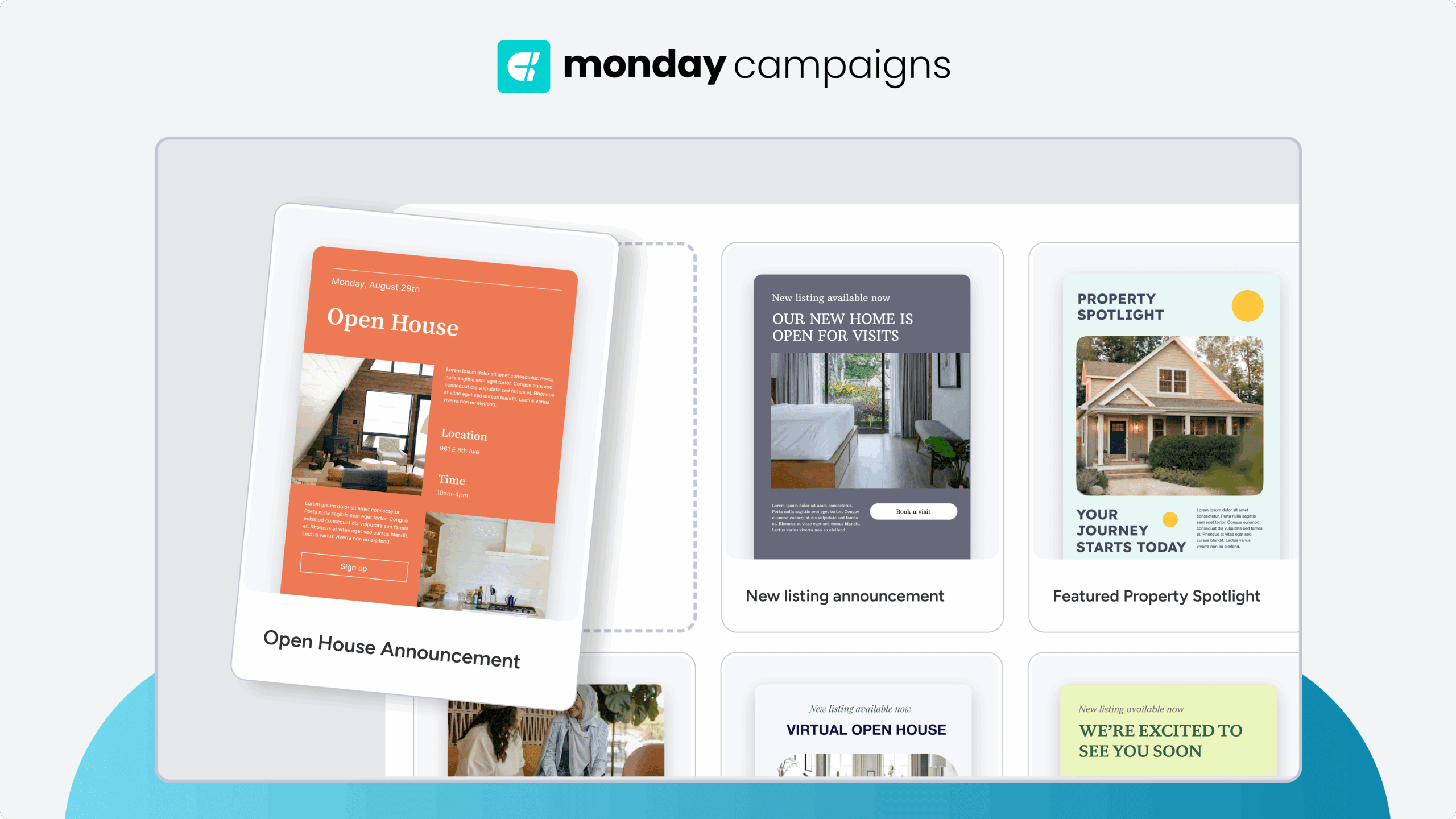
monday campaigns is built directly into the monday CRM suite. This means your marketing and sales data live in the exact same place. Everything stays connected by default, with a single source of truth across marketing and sales. You get the kind of visibility expected from customer tracking software, from initial lead to loyal customer.
The platform pulls real-time lead data, so you can create and optimize campaigns in minutes. You can connect daily tasks to bigger goals, keeping everyone aligned and tracking what actually matters.
Key features:
- AI-powered email builder: Generate on-brand campaign copy and validate brand consistency right within the editor.
- Dynamic segmentation: Keep your audience lists relevant as segments update automatically based on CRM data.
- Native CRM connection: Sales gets full context on every lead’s journey, with data flowing directly between monday campaigns and monday CRM.
- Campaign performance tracking: Monitor open rates and unsubscribes, then apply those insights to improve future sends.
- Unified contact management: Store all contacts in a single database that both marketing and sales can see and act on.
Pricing: monday campaigns comes as a $50/month add-on to monday CRM plans.
CRM integration: Native. The platform connects directly to monday CRM, so data flows continuously from campaign reporting to lead conversion tracking.
Try monday campaigns2. Mailchimp
Best for: Small businesses looking for an all-in-one email marketing platform with a broad feature set and a recognizable free tier.

Mailchimp is one of the most popular email marketing platforms for small businesses. It’s easy to get started, and the template library is huge — perfect for teams new to email marketing. You can create campaigns, segment audiences, and set up basic automations without much hassle.
Key features:
- Drag-and-drop email builder: Choose from a huge library of pre-built templates to get campaigns out fast.
- Audience segmentation: Target users based on tags, behavior, and purchase history.
- Marketing automations: Set up welcome sequences, abandoned cart emails, and re-engagement flows.
- Basic analytics: Track open rates, click rates, and revenue per campaign.
- Landing page builder: Create simple forms and pages included in most plans.
Pricing: Free plan available for up to 500 contacts. Paid plans start at $13/month.
CRM integration: Includes a basic built-in audience database. Mailchimp integrates natively with Salesforce and HubSpot, but you’ll need a paid plan to set them up properly.
3. HubSpot Marketing Hub
Best for: Small businesses that want email marketing tightly connected to a full CRM and are planning to scale their marketing operations.

HubSpot’s Marketing Hub is part of a full CRM ecosystem, which is a big advantage if you want all your data in one place. The free tier actually works, and the platform grows with your team. Costs scale as you adopt more advanced features.
Key features:
- Email marketing: Run A/B testing and use smart content personalization.
- Contact segmentation: Filter audiences based on CRM properties, lifecycle stage, and behavior.
- Marketing automation workflows: Build sequences with branching logic and CRM triggers.
- Campaign reporting: You can tie email performance directly to contact and deal activity in the CRM.
- Lead capture tools: Use forms, landing pages, and ad management across plans.
Pricing: Free plan available with limited features. Starter plans begin at $20/month, while Professional plans start at $890/month.
CRM integration: Native. HubSpot Marketing Hub connects directly to HubSpot CRM, sharing contact records and deal data across both products.
4. ActiveCampaign
Best for: Small businesses with more complex automation needs and a focus on lifecycle marketing and lead nurturing.
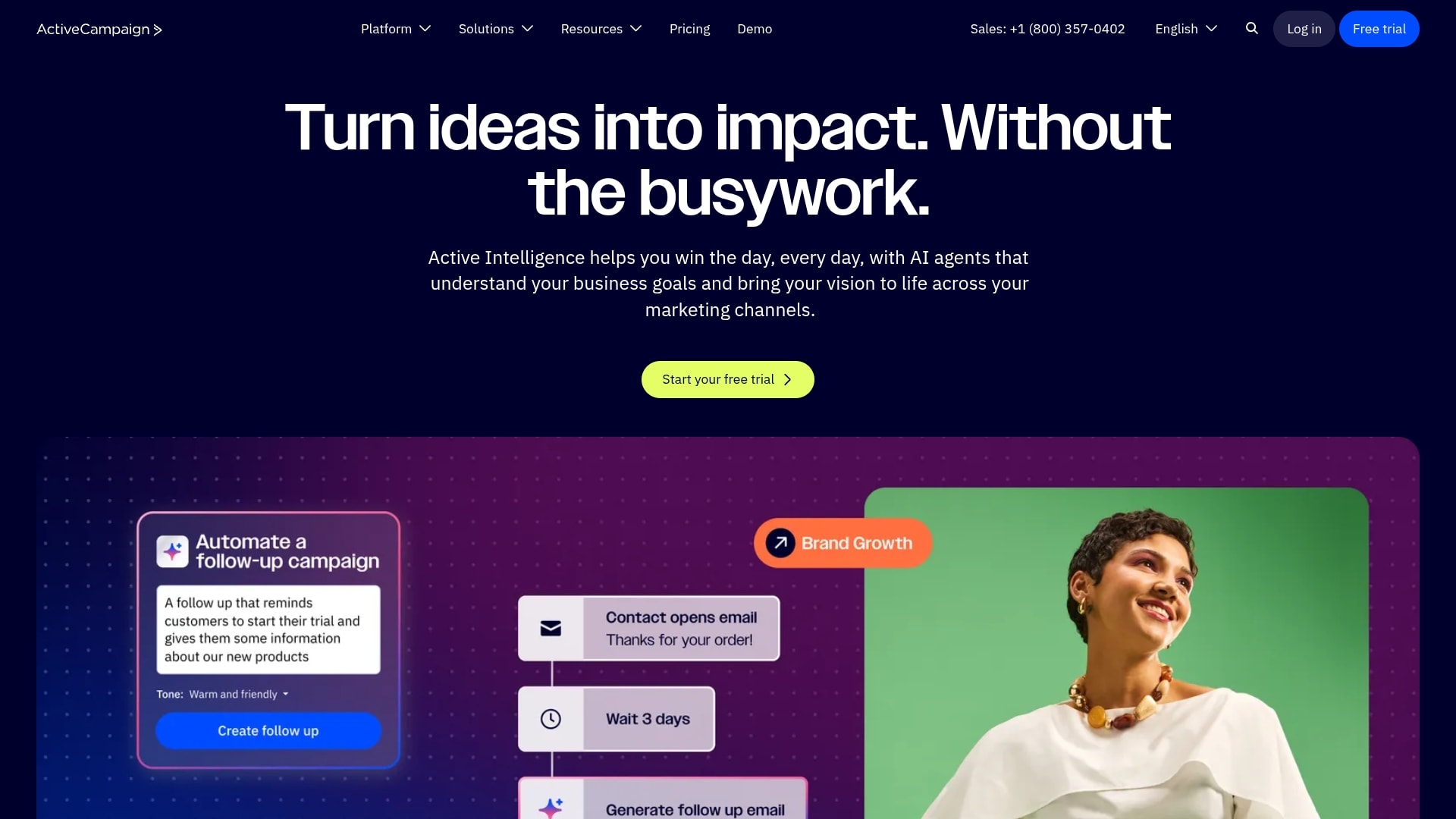
ActiveCampaign centers on deep automation. While many platforms offer basic drip sequences, strong CRM marketing automation supports multi-step, conditional workflows that respond to contact behavior. It’s a great fit for businesses that want to build targeted, behavior-driven campaigns.
Key features:
- Advanced marketing automation: You can use conditional logic, split testing, and goal tracking.
- Built-in CRM: Manage deal pipelines, lead scoring, and sales automation.
- Dynamic email content: Adapt your messaging based on what contacts do and who they are.
- Site tracking: Trigger automations based on what people do on your site.
- Predictive sending: Send emails at the best time for each contact.
Pricing: Paid plans start at $15/month for up to 1,000 contacts. No free plan is available.
CRM integration: It includes a built-in CRM that works mainly as a sales pipeline add-on. Integrations are available for Salesforce and HubSpot.
5. Klaviyo
Best for: Small e-commerce businesses that want data-driven email and SMS marketing tightly connected to their store platform.
Klaviyo is purpose-built for e-commerce, with segmentation that reflects that focus. It pulls in real-time purchase data and browsing behavior to run targeted campaigns. That makes it a strong choice for product-led businesses on Shopify or WooCommerce.
Key features:
- Pre-built e-commerce flows: You can launch abandoned cart, post-purchase, and win-back sequences fast.
- Predictive analytics: Forecast customer lifetime value, churn risk, and when they’ll buy next.
- Deep segmentation: Target customers based on what they’ve bought and what they’re doing right now.
- Unified messaging: Manage email and SMS in one place, with reporting that covers both.
- Native integrations: It connects directly with Shopify, WooCommerce, BigCommerce, and Magento.
Pricing: Free plan available for up to 250 contacts. Paid plans start at $20/month.
CRM integration: Klaviyo isn’t a CRM. It offers detailed behavioral data, but you’ll need third-party connectors to integrate with external CRMs.
6. Brevo (formerly Sendinblue)
Best for: Small businesses looking for a cost-effective platform with email, SMS, and basic CRM functionality in one place.

Brevo is an accessible, multi-channel marketing platform. It charges based on email sends, not contact list size — great if you have a big list. You get email, SMS, live chat, and basic CRM all in one place.
Key features:
- Multi-channel marketing: Manage email and SMS campaigns from one platform.
- Marketing automation: Build workflows that trigger based on what people do.
- Built-in CRM: Handle basic contact management, deal tracking, and see your pipeline.
- Transactional email support: Send automated emails reliably via SMTP and API.
- Signup forms: Create landing pages and forms on any plan.
Pricing: Free plan available for unlimited contacts and up to 300 emails per day. Paid plans start at $25/month.
CRM integration: It includes a lightweight CRM for basic deal management. You can connect to enterprise CRMs via Zapier.
7. Constant Contact
Best for: Small businesses and nonprofits that prioritize ease of use and need reliable email delivery with strong customer support.

Constant Contact has served the email marketing space for decades, and that experience shows in how accessible the platform is. It’s built for users who want to launch campaigns fast without a steep learning curve. The event management tools are great if you run in-person events.
Key features:
- Drag-and-drop email editor: Build campaigns fast using a big template library.
- List segmentation: Group contacts by activity, tags, and demographics.
- Event management tools: Handle event registration, ticketing, and follow-up emails.
- Social media scheduling: Manage ads and social posts right in the platform.
- Real-time reporting: Track opens, clicks, bounces, and unsubscribes in real time.
Pricing: A 60-day free trial is available, with paid plans starting at $12/month.
CRM integration: It doesn’t include a native CRM. It connects to Salesforce and other platforms through third-party tools.
8. GetResponse
Best for: Small businesses that want email marketing combined with webinar hosting, landing pages, and basic marketing automation in one platform.

GetResponse offers more features than most entry-level email platforms. You get webinar hosting, conversion funnels, and a website builder on top of email marketing. If you run online courses or virtual events, this consolidates the number of platforms you need.
Key features:
- Email marketing: Run A/B tests and use advanced segmentation to target better.
- Webinar hosting: Create registration pages and set up automated follow-ups.
- Conversion funnels: Build lead capture forms, sales pages, and post-purchase sequences.
- Marketing automation: Set up behavioral triggers using a visual workflow builder.
- Website builder: Design landing pages and sites on any plan.
Pricing: Free plan available for up to 500 contacts. Paid plans start at $19/month.
CRM integration: It offers basic contact management. It connects to external CRMs through Zapier and native connectors like Salesforce.
9. Drip
Best for: Small e-commerce businesses that want granular segmentation and behavior-based automation without the complexity of enterprise platforms.
Drip is built for e-commerce marketers who want tight control over customer communication. You can target customers based on purchase behavior, predicted lifetime value, and custom events. Automation workflows trigger based on real-time contact behavior, replacing static list criteria with dynamic targeting.
Key features:
- E-commerce segmentation: Target customers based on what they’ve bought and how they browse.
- Visual workflow builder: Create multi-step automation sequences without hassle.
- Unified campaigns: Run email and SMS marketing with connected contact profiles.
- Revenue attribution: Connect campaign activity directly to actual sales.
- Native integrations: Sync effortlessly with Shopify, WooCommerce, and Magento.
Pricing: Paid plans start at $39/month for up to 2,500 contacts. No free plan is available.
CRM integration: Manages customer profiles with rich behavioral data but does not include a sales pipeline. External CRM integrations require APIs or third-party connectors.
10. ConvertKit (now Kit)
Best for: Creators, solopreneurs, and small businesses built around content: newsletters, courses, and digital products.
Kit is designed for individual creators and small teams who want a straightforward platform for growing their audience. Its tagging and segmentation system is flexible, and the automation builder is approachable. The platform also includes native tools for selling digital products directly.
Key features:
- Tag-based segmentation: Manage your audience with flexible, behavior-driven tags.
- Visual automation builder: Set up simple conditional logic for user journeys.
- Landing pages: Capture leads with a built-in template library and signup forms.
- Commerce features: Sell digital products and paid subscriptions directly from the platform.
- Broadcast emails: Send one-time updates or automated nurture flows.
Pricing: Free plan available for up to 10,000 subscribers. Paid plans start at $25/month.
CRM integration: Does not include a CRM. Contact management relies on tags, and external CRM connections require Zapier.
11. Omnisend
Best for: Small e-commerce businesses that want to coordinate email, SMS, and push notifications from a single platform.

Omnisend is built for multi-channel e-commerce marketing, making it simple to coordinate campaigns across email, SMS, and push notifications. Its pre-built automation workflows cover common scenarios like abandoned carts and order confirmations. The segmentation pulls directly from your store data for accurate targeting.
Key features:
- Multi-channel campaigns: Coordinate messaging across email, SMS, and web push notifications.
- Pre-built workflows: Launch cart abandonment and order follow-up automations quickly.
- Behavioral segmentation: Filter audiences based on purchase behavior and engagement history.
- Campaign reporting: Track performance with clear revenue attribution per channel.
- Native integrations: Connect easily with Shopify, WooCommerce, BigCommerce, and Wix.
Pricing: Free plan available for up to 250 contacts. Paid plans start at $16/month.
CRM integration: Does not include a CRM. Contact profiles are built from e-commerce data, with external CRMs requiring third-party connectors.
12. Moosend
Best for: Small businesses and startups looking for a cost-effective email marketing platform with solid automation capabilities.

Moosend offers a competitive feature set at a price point that suits lean marketing teams. Its automation builder supports multi-step workflows with behavioral triggers. The reporting covers the core metrics most small businesses need without the overhead of a complex platform.
Key features:
- Drag-and-drop email editor: Build campaigns using a straightforward template library.
- Marketing automation: Set up behavioral triggers, conditional steps, and A/B testing.
- List segmentation: Group contacts based on data, engagement, and custom fields.
- Real-time analytics: Track opens, clicks, bounces, and revenue accurately.
- Subscription forms: Create landing pages and forms included across all plans.
Pricing: A 30-day free trial is available. Paid plans start at $9/month for up to 500 subscribers.
CRM integration: Does not include a native CRM. Integrates with external platforms via Zapier and direct connectors for tools like Salesforce.
13. AWeber
Best for: Small businesses and solopreneurs who want a reliable, straightforward email marketing platform with strong deliverability and responsive support.

AWeber has been a consistent presence in the email marketing space for over two decades. The platform prioritizes reliability and ease of use, making it a practical fit for small business owners. Its AI writing assistant and Canva integration add modern utility to a straightforward tool.
Key features:
- Drag-and-drop email editor: Design emails with a large template library and Canva integration.
- AI writing assistant: Generate email subject lines and body copy effortlessly.
- Autoresponder sequences: Build basic automation workflows to nurture leads.
- List segmentation: Organize contacts based on tags, engagement, and custom fields.
- Deliverability reporting: Monitor your spam score and detailed delivery metrics.
Pricing: Free plan available for up to 500 subscribers. Paid plans start at $15/month.
CRM integration: Does not include a CRM. Integrates with external platforms via Zapier and direct connectors, requiring manual configuration.
14. Zoho Campaigns
Best for: Small businesses already using the Zoho ecosystem that want email marketing natively connected to Zoho CRM.
Zoho Campaigns is the email marketing product within the broader Zoho suite. Its primary advantage is the native connection to Zoho CRM, removing the friction of syncing data across separate platforms. Campaign activity, contact engagement, and CRM records stay perfectly aligned without manual exports.
Key features:
- Email campaign builder: Use templates and a drag-and-drop editor for quick design.
- Automation workflows: Trigger actions based on CRM events, contact behavior, and list activity.
- Native Zoho CRM sync: Align contact management, lead scoring, and campaign attribution.
- A/B testing: Test subject lines and email content to improve engagement.
- Campaign reporting: Review performance with detailed engagement and conversion metrics.
Pricing: Free plan available for up to 2,000 contacts. Paid plans start at $4/month.
CRM integration: Native within the Zoho ecosystem. It connects directly to Zoho CRM, enabling two-way data sync between marketing and sales.
15. Campaigner
Best for: Small to mid-sized businesses that need advanced segmentation, A/B testing, and multi-channel campaign management with strong deliverability.
Campaigner sits at the more feature-rich end of the small business email marketing spectrum. Its segmentation capabilities are detailed, supporting behavioral, demographic, and purchase-based targeting. It’s a practical fit for businesses that have outgrown entry-level platforms but aren’t ready for enterprise pricing.
Key features:
- Advanced segmentation: Target users based on behavioral data, purchase history, and custom attributes.
- Multivariate testing: Run A/B tests for subject lines, content, and send times.
- Multi-channel management: Coordinate campaigns across both email and SMS.
- Automation workflows: Build sequences with conditional logic and goal-based triggers.
- Reputation defender: Monitor deliverability and protect your sender reputation.
Pricing: A 30-day free trial is available. Paid plans start at $59/month.
CRM integration: Does not include a native CRM. Integrates with Salesforce and other platforms via API and third-party connectors.
What makes monday campaigns different for small businesses
Most email marketing platforms treat CRM integration as an afterthought. You get a basic connector, maybe a third-party sync tool, and the promise that yourcampaign data will update “eventually.” monday campaigns takes a different approach. It’s built natively inside monday CRM, which means your contact data, email activity, and sales pipeline already live in the same place.
For small businesses, that changes everything. Marketing can see which leads sales is working. Sales can see who opened what and when. And both teams work from the same contact record, updated in real time. When a lead clicks through your campaign and moves to “qualified,” your sales team knows immediately. That’s the kind of visibility that turns email marketing from a broadcast tool into a revenue driver.
AI-powered campaign creation that pulls from your CRM
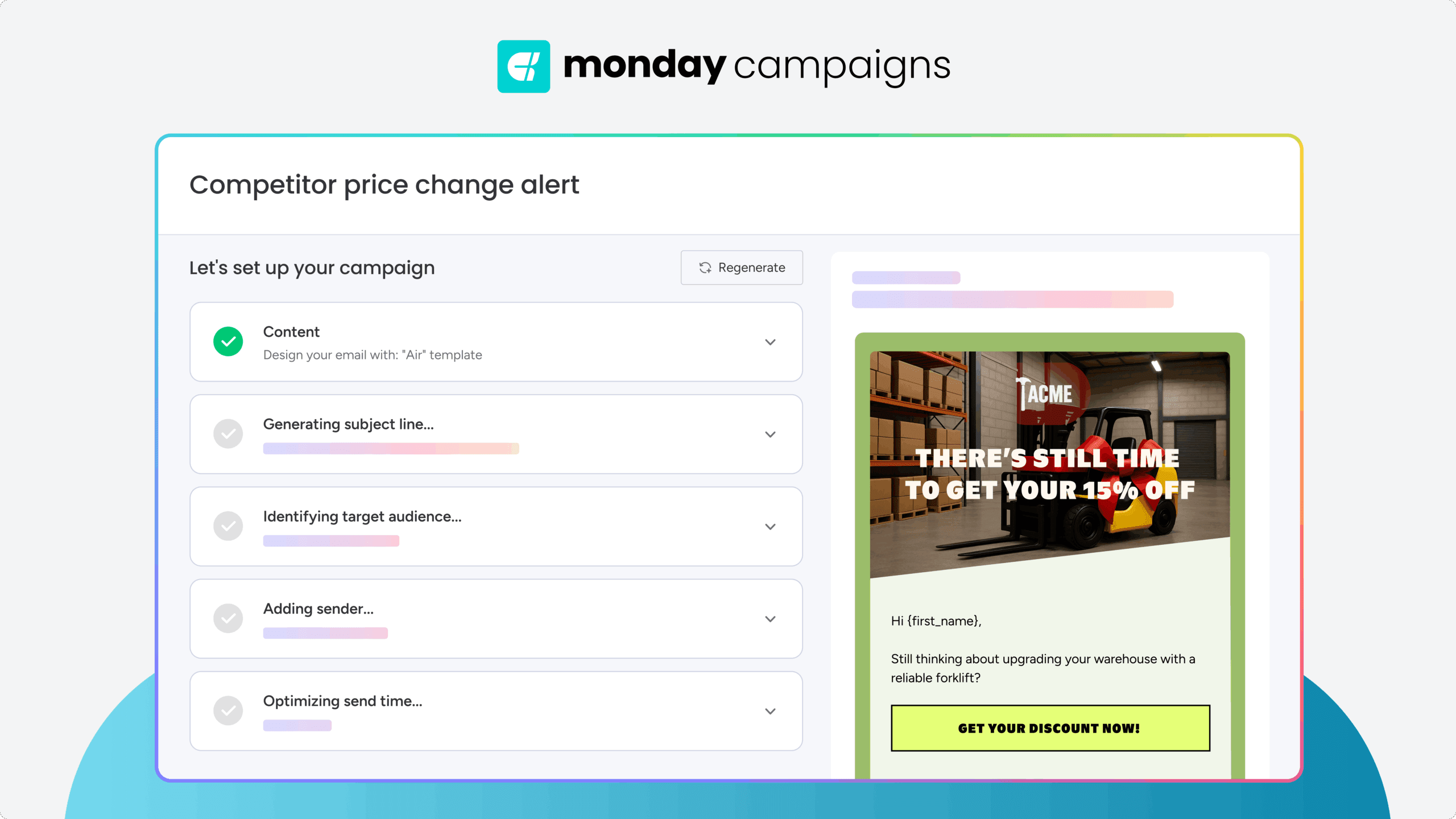
The AI email builder generates on-brand copy in seconds, pulling from your brand guidelines and past campaigns to maintain consistency. It drafts subject lines, body content, and calls to action that match your voice. You can validate brand alignment before sending, so every campaign feels like it came from your team, not a template.
Smart segmentation that updates automatically
Dynamic segmentation uses live CRM data to keep your audience lists accurate as contact information changes. The AI suggests segments based on behavior patterns, deal stages, and engagement history. You’re always targeting the right people without manually rebuilding lists or exporting spreadsheets.
Real-time campaign insights connected to revenue
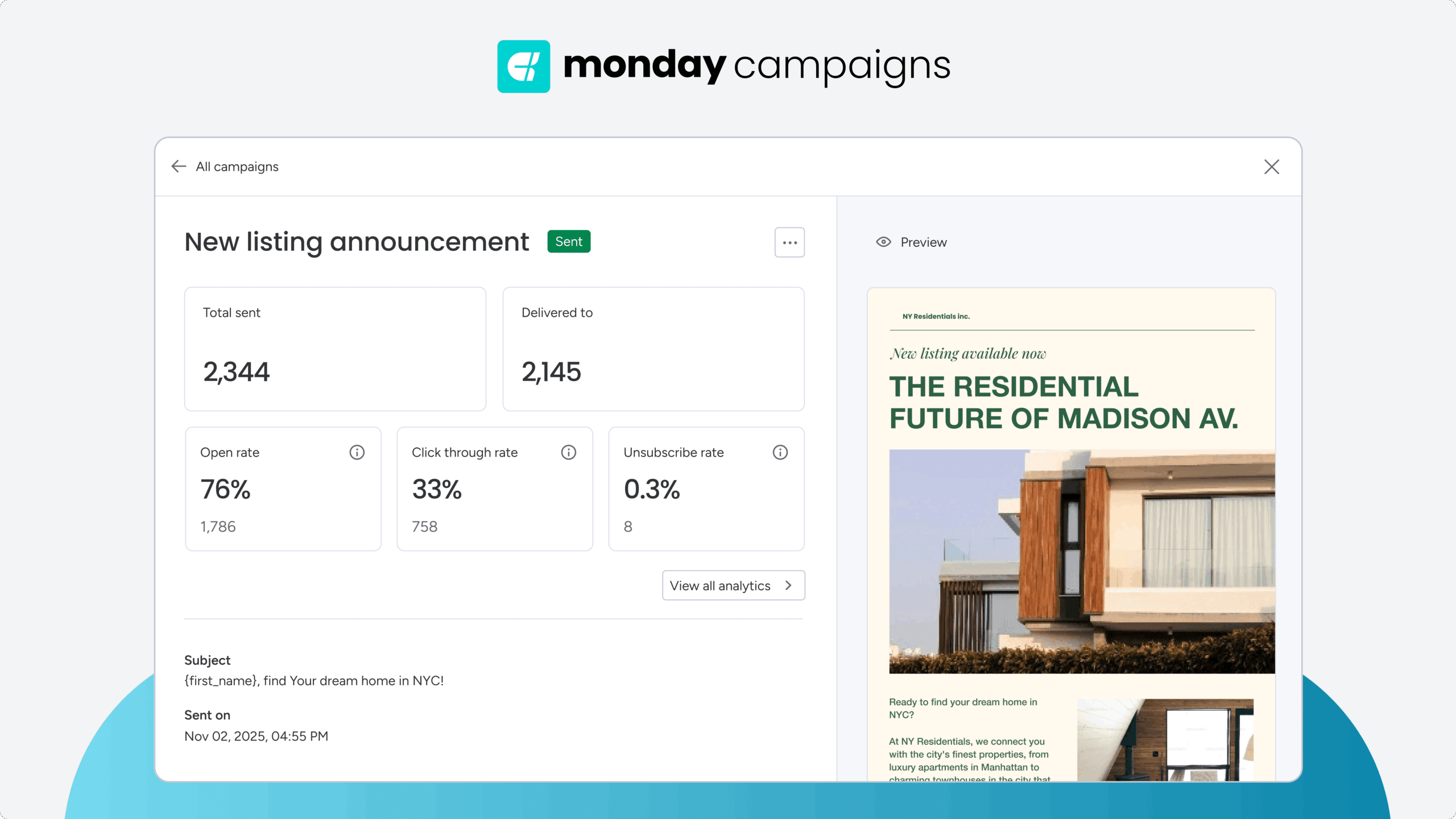
Track opens, clicks, and unsubscribes alongside deal progression and conversion data. AI-powered analytics surface which campaigns drive actual revenue, not just engagement. You can see exactly which emails move leads through your pipeline and apply those insights to future sends.
Unified contact management across marketing and sales
Every contact lives in a single database that both teams access simultaneously. Campaign activity flows directly into CRM records, so sales sees full context on every lead’s journey. No more asking what someone clicked or when they engaged. The data is already there, updated in real time.

"With monday campaigns, we can launch professional emails in minutes and instantly see who engaged. Our sales team follows up directly with those showing interest - making outreach faster and more effective."
Michael Fitzpatrick | National Workplace Training ManagerHow to choose the best email marketing software for your small business
Choosing the right email marketing platform starts with understanding where your biggest friction point actually lives, whether that’s campaign creation speed, audience targeting accuracy, or the gap between marketing activity and sales follow-up. The platform that solves your specific problem will deliver far more value than the one with the longest feature list.
Here’s what to prioritize:
- CRM integration depth: Does the platform connect to your CRM natively, or will you need to build the bridge yourself? Native integrations keep data flowing continuously. Third-party connectors introduce lag, manual updates, and the risk of working from outdated contact records.
- Automation capabilities: Can you trigger campaigns based on real customer behavior, or are you limited to basic drip sequences? The best platforms let you automate based on CRM events, deal stage changes, and contact activity.
- Segmentation flexibility: Do your audience lists update automatically as contact data changes, or do you need to rebuild them manually? Dynamic segmentation saves time and keeps your targeting accurate as your business grows.
- AI-powered features: Does the platform help you create campaigns faster, or does it just add AI as a checkbox feature? Look for tools that generate copy, suggest segments, and optimize send times based on your actual data.
- Pricing structure: Are you paying for contacts, sends, or features? Make sure the pricing model aligns with how your business actually uses email. Some platforms charge for unsubscribed contacts. Others cap automation at certain tiers. Read the fine print.
- Ease of use: Can your team launch campaigns without a developer, designer, or dedicated email specialist? The best platforms make professional email marketing accessible to small teams with limited resources.
The right platform connects campaign activity to customer data, keeps marketing and sales aligned, and helps you act on insights while they still matter. That’s the difference between a tool that sends messages and one that drives revenue.
Choose the platform that connects campaigns to revenue
Email marketing delivers real returns when your platform connects campaign activity to the rest of your business. The right choice depends on where your biggest friction point lives. If you’re spending too much time exporting contact lists and bridging the gap between marketing and sales, look for native CRM integration. If you need to launch campaigns fast without specialist skills, prioritize AI-powered tools and drag-and-drop builders.
The 15 platforms in this guide each solve different problems. Some prioritize ease of use. Others focus on e-commerce automation or multi-channel messaging. monday campaigns puts email marketing and customer data in the same place, so your data flows continuously, your teams stay aligned, and you can connect every email to real revenue.
Try monday campaignsFAQs
What is the best email marketing software for small businesses?
The best email marketing software for small businesses depends on your specific needs. If you want native CRM integration and AI-powered campaign creation, monday campaigns is a strong choice. If you're focused on e-commerce, Klaviyo or Drip may be a better fit. For budget-conscious teams, MailerLite and Brevo offer solid free tiers. The key is choosing a platform that connects to your existing workflows and helps you act on campaign data, not just send emails.
How much does email marketing software cost for small businesses?
Pricing varies widely. Many platforms offer free plans for small contact lists, typically 500 to 2,000 contacts. Paid plans generally start between $9 and $50 per month, depending on features and contact volume. Some platforms charge based on the number of contacts, while others charge based on email sends. Make sure to check whether unsubscribed contacts count toward your billing limit, and whether key features like automation and segmentation are available on lower-tier plans.
Do I need a CRM to use email marketing software?
Not necessarily, but having a CRM makes email marketing far more effective. A CRM stores customer data, tracks interactions, and helps you segment your audience based on real behavior. Platforms with native CRM integration, like monday campaigns, HubSpot, and ActiveCampaign, let you connect campaign activity directly to sales outcomes, so you can see which emails are driving revenue and which leads are ready to convert.
Can I automate email campaigns with small business email marketing software?
Yes. Most modern email marketing platforms include automation features, though the depth varies. Basic platforms offer simple drip sequences triggered by time delays. More advanced platforms let you trigger emails based on CRM events, contact behavior, and deal stage changes. The best automation tools respond to what your contacts actually do, not just when they signed up.
How do I integrate email marketing software with my CRM?
Integration methods vary by platform. Some platforms, like monday campaigns, HubSpot, and Zoho Campaigns, offer native CRM integration, meaning your email and CRM data live in the same place with no setup required. Others connect via third-party tools like Zapier or require API configuration. Native integrations are faster, more reliable, and keep your data synced in real time. Third-party connectors work, but they introduce lag and require ongoing maintenance.
What's the difference between email marketing software and a CRM?
Email marketing software helps you design, send, and track campaigns. A CRM helps you manage customer relationships, track sales pipelines, and store contact data. The best results come from using both together. Platforms like monday campaigns, HubSpot, and ActiveCampaign combine email marketing and CRM in one place, so your campaign activity and customer data stay connected. That alignment helps you act on insights faster and connect marketing efforts directly to revenue.
 Get started