


Sending thousands of emails that land with a thud is a marketer’s worst nightmare. When one campaign soars with a 30% open rate and the next barely cracks 10%, the inconsistency points to a deeper issue than subject lines or send times. The real differentiator is whether you’re connecting with the right people at the perfect moment. The best audience segmentation for email campaigns goes beyond basic demographics to focus on behaviors, purchase patterns, and real-time customer intelligence. When you group subscribers based on what they actually do rather than who they are, your messages land with precision.
This article breaks down 7 revenue-focused segmentation strategies that drive measurable growth. We’ll cover how to build segments using behavioral data, lifecycle stages, and predictive intelligence, giving you a playbook for implementing dynamic segmentation that scales with your business. You’ll see how platforms like monday campaigns make it possible to keep your targeting in sync with your customers without manual list updates.
Key takeaways
- Start with behavioral segmentation to drive immediate revenue impact: Track email opens, website visits, and purchase actions to create segments that reflect real customer intent, not just demographics.
- Map segments to customer lifecycle stages for precision targeting: Send welcome series to new subscribers, product education to browsers, and loyalty rewards to repeat customers based on their actual journey stage.
- Use dynamic segments that update automatically with CRM data: monday campaigns creates real-time segments connected to your CRM so lists refresh as contact information and deal stages change without manual updates.
- Focus on engagement scoring to optimize send frequency: Assign points for opens, clicks, and purchases to determine who gets daily emails versus monthly re-engagement campaigns.
- Collect first-party data strategically through progressive profiling: Gather essential information at signup, then gradually collect preferences and behaviors over time to build segments that improve targeting without overwhelming prospects.
Why email segmentation drives revenue growth
Email segmentation means splitting your subscriber list into groups that actually share something meaningful: behaviors, preferences, or where they are in the buying process. This means you stop sending generic messages to everyone and start delivering content that resonates with specific audiences.
Segmentation isn’t just about higher open rates, it’s about revenue.
Segmented campaigns have superior conversion rates because they hit people with the right message exactly when they need it.
When a subscriber receives content that speaks directly to their situation, they’re far more likely to take action. Gartner research found that active personalization makes customers 2.3x more likely to confidently complete critical purchase decisions.
| Metric | Unsegmented campaigns | Segmented campaigns |
|---|---|---|
| Open rate | 15–18% | 25–30% |
| Click-through rate | 2–3% | 6–9% |
| Conversion rate | 1–2% | 3–5% |
| Unsubscribe rate | 0.5–1% | 0.1–0.3% |
If you’re a marketing director who needs to prove email ROI, segmentation gives you the targeting accuracy that turns campaigns into pipeline. A campaign sent to 10,000 highly relevant subscribers will outperform one sent to 100,000 loosely targeted contacts.
What email segmentation actually delivers
Segmentation isn’t a nice-to-have feature. It’s the difference between campaigns that drive revenue and campaigns that drain budget. When you split your list into groups that share real behaviors, preferences, or buying stages, you stop broadcasting generic messages and start delivering content that lands. Here’s what changes when you segment strategically.
Boost campaign ROI through targeted messaging
Targeted campaigns beat mass emails because they speak to what someone actually cares about right now. When subscribers receive content that matches their interests, job role, or buying stage, engagement increases and marketing waste decreases. Here’s where segmentation hits your bottom line:
- Conversion rates climb: Messages align with subscriber intent, moving prospects toward action
- Customer lifetime value improves: Personalized communications build stronger relationships over time
- Marketing spend becomes more efficient: Resources focus on high-intent audiences rather than entire lists
Dynamic segments pull from your CRM in real time, so your lists stay current without you touching them. Segments connected to your CRM refresh in real time as contact information, deal stages, or engagement levels change.
Improve deliverability with engaged audiences
Your sender reputation controls deliverability, and engagement controls your reputation. ISPs reward senders whose emails get opened, clicked, and engaged with. They penalize senders whose emails get ignored or marked as spam.
Segmentation protects your sender reputation by keeping engagement high. Sending to engaged segments generates higher engagement rates, signaling to ISPs that recipients want your emails. Relevant content to interested audiences also reduces spam complaints. Microsoft’s anti-spam filtering system assigns Bulk Complaint Level scores from 1 to 9 to measure sender reputation, and high scores can damage deliverability for your entire domain.
Engagement-based segments catch inactive subscribers before they tank your deliverability. Practical approaches include:
- Re-engagement campaigns: Target subscribers with declining engagement patterns
- Contact suppression: Remove contacts with zero engagement over six months
- Engagement scoring: Adjust send frequency based on interaction levels
Create customer experiences that convert
Segmentation lets you personalize what people see based on where they are in the buying process. Instead of treating everyone the same, you can tailor content, offers, and timing based on where someone actually is with your brand.
| Customer stage | Segment criteria | Email experience |
|---|---|---|
| New subscriber | Signed up within 7 days | Welcome series introducing brand value |
| Active browser | Multiple site visits, no purchase | Product education and social proof |
| First-time buyer | Completed first purchase | Onboarding and cross-sell recommendations |
| Repeat customer | 3+ purchases | Loyalty rewards and early access |
| At-risk customer | Declining engagement | Win-back offers and feedback requests |
When people feel like you get them, they trust you faster and buy sooner. When customers feel understood, they’re more likely to convert and remain loyal over time.
Learn more: Marketing segment template
7 revenue-focused email segmentation strategies
These seven strategies hit revenue, not just vanity metrics. Each one solves a specific problem, and you can layer them for even sharper targeting.
How do you identify which segments deserve the most attention? A high-value customer who recently viewed pricing pages and is approaching renewal represents a prime upsell opportunity that warrants dedicated focus.
Strategy 1: Behavioral segmentation using real-time actions
Behavioral segmentation groups subscribers based on actions they take with emails, website, or product. Behavior beats demographics every time as it shows what people actually do, not just who they are. High-value behavioral triggers to track include:
- Email engagement: Opens, clicks, and forward actions
- Website activity: Page visits, pricing page views, and time spent
- Product interactions: Feature usage, login frequency, and trial activity
- Purchase signals: Cart additions, checkout starts, and abandoned purchases
Here’s how to make behavioral segmentation work:
- Identify conversion behaviors: Determine which actions correlate with purchase decisions
- Establish tracking mechanisms: Set up monitoring across email and website touchpoints
- Create automated workflows: Build triggers that add or remove contacts based on behaviors
- Test behavioral thresholds: Find optimal segment definitions through experimentation
Strategy 2: Customer lifecycle stage targeting
Lifecycle segmentation groups people by where they are in their relationship with you. Each stage needs different messaging, offers, and send frequency to convert.
| Stage | Definition | Email strategy | Frequency |
|---|---|---|---|
| Awareness | Knows brand, hasn't engaged deeply | Educational content, thought leadership | 1–2x weekly |
| Consideration | Actively evaluating options | Case studies, comparisons, demos | 2–3x weekly |
| Purchase | Ready to buy or recently purchased | Onboarding, quick wins, setup guides | Daily during onboarding |
| Retention | Active customer | Product tips, upsells, feature updates | 1–2x weekly |
| Advocacy | Loyal customer, potential promoter | Referral incentives, exclusive access | 2–4x monthly |
To make this work, you need specific stage definitions and triggers that move people between them:
- Define specific criteria: Establish measurable indicators for each lifecycle stage
- Map content to stages: Align messaging with stage-specific needs and goals
- Establish transition triggers: Create automated rules for moving contacts between stages
- Measure stage conversion rates: Identify bottlenecks and optimize transitions
CRM integration tracks lifecycle stages automatically across marketing and sales, so people move based on what they do, not just how long it’s been.
Strategy 3: Value-based segmentation with CLV data
CLV segmentation groups subscribers by how much revenue they’ll bring in over time. This way, you spend your time and budget on the customers who matter most. CLV calculation considers purchase frequency, average order value, retention rate, and profit margin. Segmentation tiers typically include:
- High-value customers: Receive VIP treatment and exclusive offers
- Mid-value customers: Receive growth campaigns and upgrade prompts
- Low-value customers: Receive cost-efficient automation and self-service resources
What happens when a high-CLV customer shows declining engagement? They trigger immediate intervention campaigns with personalized retention offers, protecting revenue that matters most.
Strategy 4: Engagement scoring for smart send frequency
Engagement scoring gives points to subscriber actions so you know how often to email them. It keeps you from annoying your best subscribers or ignoring hot prospects.
| Action | Points |
|---|---|
| Email open | $5 |
| Email click | $10 |
| Website visit | $8 |
| Content download | $15 |
| Conversion/purchase | $25 |
| Email ignore | -2 |
| Unsubscribe | -50 |
Use engagement scores to decide how often to email each group:
- Highly engaged subscribers: Daily emails with premium content
- Moderately engaged contacts: Weekly emails with valuable insights
- Inactive subscribers: Monthly re-engagement campaigns before suppression
Strategy 5: Purchase pattern and product affinity groups
Purchase pattern segmentation groups customers by what they buy, how often, and what they prefer. When you know what people buy and when, you can recommend products they’ll actually want. Here’s what works:
- Product category preferences: Group by frequently purchased product types
- Purchase frequency patterns: Segment by buying cadence and timing
- Seasonal buying behaviors: Target based on historical purchase seasons
- Price sensitivity indicators: Segment by average order value and discount response
- Cross-sell opportunities: Group by products frequently purchased together
Strategy 6: Event-triggered dynamic segmentation
Event-triggered segmentation moves people in and out of segments automatically based on what they do. Your messaging stays relevant because segments update in real time as things change.
For example, when someone downloads a whitepaper through a form submission, they’re automatically added to your “content engaged” segment. Start a free trial, and they move into the “trial user” segment. If that trial ends without a purchase, they shift to “trial expired” for targeted conversion campaigns. Complete a first order, and they graduate to the “customer” segment with appropriate onboarding. Show inactivity with no login for 14 days, and they’re flagged in an “at-risk” segment for re-engagement.
Workflow automation triggers segments based on CRM updates and external events, so your lists stay current without you lifting a finger.
Strategy 7: AI-predicted intent segments
AI-predicted intent uses machine learning to spot who’s about to convert, churn, or take action. You reach customers before they decide, not after. Looking ahead, Gartner predicts that by 2028, 60% of brands will use agentic AI to facilitate streamlined one-to-one interactions across marketing, sales, and support, making predictive intent segmentation a foundational capability to build now. Common predictive models include:
- Purchase propensity: Likelihood to buy within a specific timeframe
- Churn prediction: Risk of cancellation or disengagement
- Upsell readiness: Probability of upgrading or expanding usage
- Content preference scoring: Optimal content types and topics for each contact
These models look at past patterns, spot early signals, score your current customers, and build segments based on how confident the predictions are.
How to build high-converting email segments

Good segmentation needs clean data, a solid plan, and regular upkeep. Start simple, then layer in complexity as you learn what works. To build segments that drive revenue, focus on clean data, journey mapping, and automation that grows with you.
Step 1: Collect first-party data that matters
Good segmentation starts with collecting the right first-party data straight from subscribers. Collect data that sharpens your targeting without annoying people. Here’s how to collect the right data:
- Signup forms with essential fields only: Capture critical information without creating friction
- Progressive profiling: Gradually collect additional information over time
- Preference centers: Let subscribers self-select interests and communication preferences
- Behavioral tracking: Monitor actions across owned properties and touchpoints
Data collection rules to follow:
- Only collect data you’ll use: Avoid gathering information that doesn’t inform segmentation
- Be transparent about data use: Clearly explain how information improves their experience
- Make updates easy: Provide accessible preference centers for ongoing management
- Audit data quality regularly: Clean and validate information to maintain accuracy
Step 2: Map segments to customer journey stages
Good segments match how customers actually move through their journey with you. Map it right, and your messaging hits people exactly where they are in the decision process. Here’s how to map segments to journey stages:
- Identify key stages: Define the major phases in your customer journey
- Define stage goals and needs: Understand what customers want at each phase
- Determine transition indicators: Establish signals that show stage progression
- Map content and frequency: Align messaging cadence with stage requirements
- Establish transition triggers: Create automated rules for stage movement
Watch conversion rates between stages to spot where people get stuck. If people stall at a stage, fix the messaging that moves them forward.
Step 3: Create dynamic lists with CRM integration
Dynamic segments update automatically as data changes. At scale, automation is the only way to keep segments accurate. Here’s how to do it right:
- Start with simple dynamic segments: Begin with basic criteria before adding complexity
- Progressively add complexity: Layer additional criteria as you validate segment performance
- Test segment logic: Verify criteria work correctly before activating campaigns
- Monitor segment size changes: Watch for unexpected fluctuations that indicate errors
monday campaigns runs natively on monday CRM, so dynamic segments update automatically with CRM data, deal stages, and contact changes, no separate integration needed.
Try monday campaignsBuild smarter segments with monday campaigns
Segmentation only works when your data stays current and your lists update automatically. The gap between strategy and execution kills most segmentation efforts because manual list management doesn’t scale. You need a platform that connects email campaigns directly to your CRM so segments refresh as customer data changes.
monday campaigns runs natively on monday CRM, giving you real-time segmentation that syncs with contact updates, deal stages, and behavioral signals without manual intervention. Your targeting stays sharp because segments update automatically as customers move through their journey.
AI-powered segmentation that learns from your data
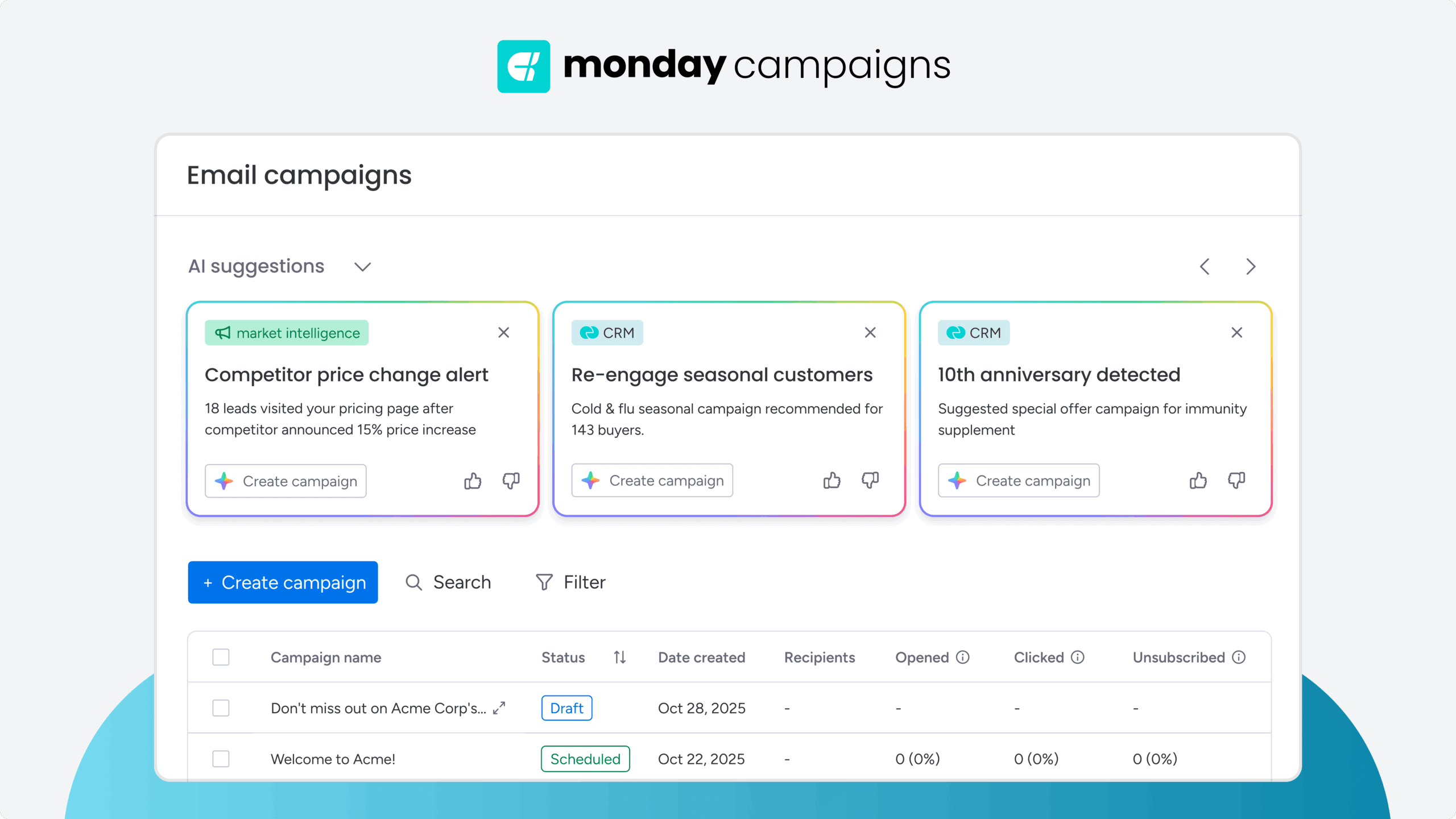
AI analyzes your contact data, engagement patterns, and conversion history to suggest high-performing segments you might have missed. The system identifies behavioral clusters and intent signals automatically, surfacing opportunities to target customers at exactly the right moment. You get predictive recommendations that improve targeting without building complex rules manually.
Dynamic segments that sync with CRM in real time
Segments update automatically as contact information, deal stages, and engagement levels change in your CRM. When a prospect moves from consideration to purchase stage, they shift into the appropriate email journey without you touching a list. Your targeting stays accurate because segments pull from live CRM data, not static exports.
Behavioral tracking across email and customer touchpoints
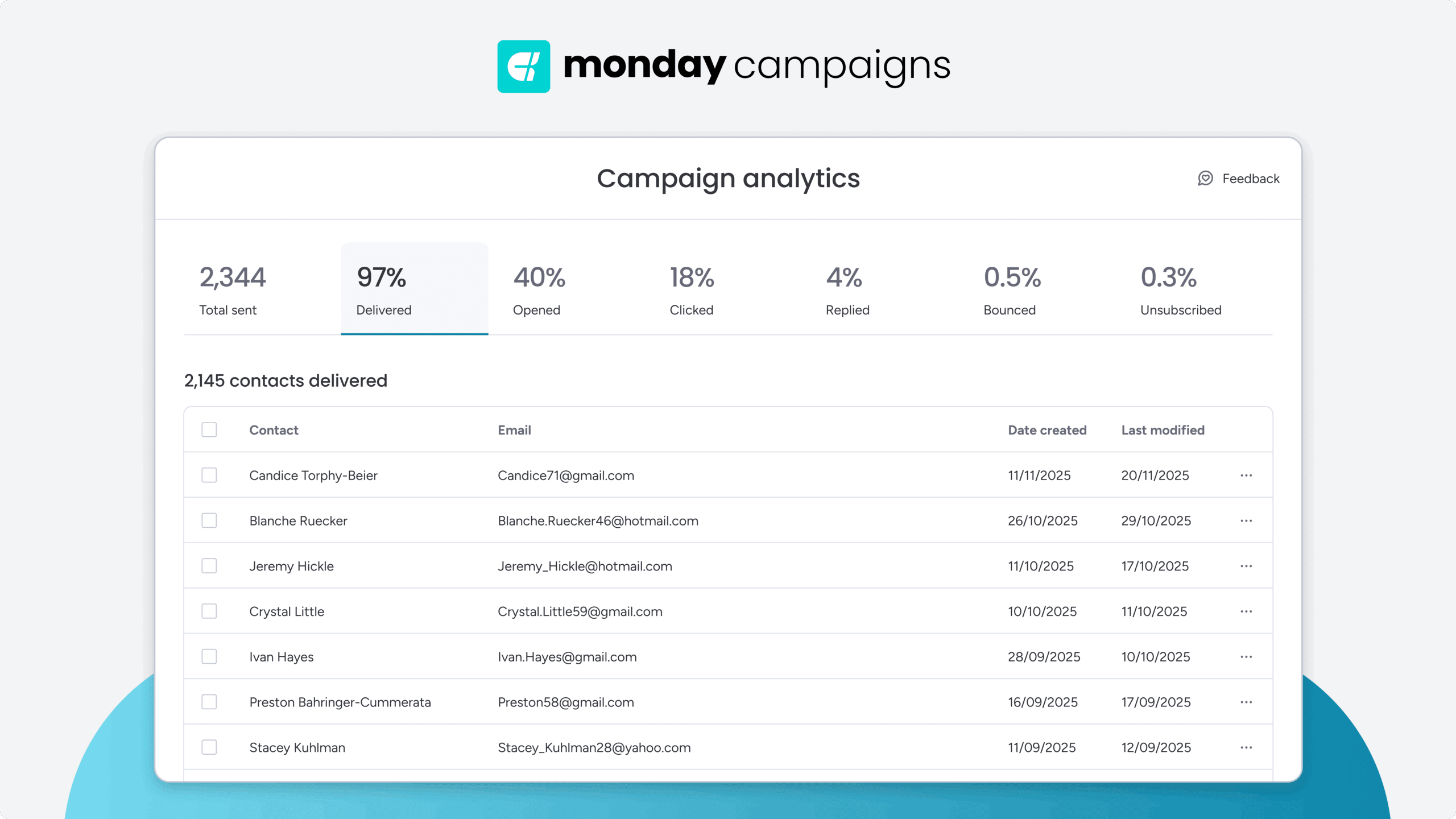
Track opens, clicks, website visits, and product interactions to build segments based on what people actually do. Behavioral data flows directly into your segmentation logic, so you can target based on recent actions rather than outdated demographics. Engagement scoring happens automatically, letting you adjust send frequency based on real interaction patterns.
Lifecycle automation that moves contacts between segments
Set up triggers that automatically transition contacts between lifecycle stages as they hit specific milestones. New subscribers enter welcome sequences, active browsers receive product education, and repeat customers get loyalty campaigns without manual list management. AI suggests optimal transition points based on conversion patterns in your data.
Turn email segmentation into sustainable revenue growth
Email segmentation turns guesswork into precise targeting that actually moves revenue. These strategies skip basic demographics and focus on behaviors, lifecycle stages, and predictive signals that actually drive purchases. Start with one or two segmentation strategies, then add more as you see what works. Start with behavioral or lifecycle segments, measure the revenue lift, then add CLV targeting or AI-predicted intent.
monday campaigns gives you CRM integration, dynamic segmentation, and automation to run these strategies at scale without juggling platforms or updating lists manually. Since it runs natively on monday CRM, your segments stay synced with real-time customer data, deal stages, and contact changes automatically. You get behavioral tracking, lifecycle mapping, and engagement scoring in one platform, so you can launch sophisticated segmentation strategies without stitching together multiple tools.
Try monday campaignsFAQs
What audience segments work best for email campaigns?
The best audience segments for email campaigns are those that mix behavioral data with lifecycle stage and CRM insights. Segments built on recent actions, purchase history, and engagement consistently outperform demographics-only targeting because they reflect real intent, not just assumptions.
How do I segment an email list using customer behavior and CRM data?
Track the behaviors that matter: email opens, site visits, and purchases. Add CRM data like deal stage, company size, and sales activity. Build dynamic segments that update automatically when people match (or stop matching) your criteria.
What makes an email segment effective enough to improve conversions?
Good segments are big enough to warrant their own campaigns, specific enough to personalize, and tied to real business results. Each segment should tackle a specific problem your content can actually solve.
Which segmentation strategy should I use for welcome emails versus win-back campaigns?
For welcome emails, segment by signup source, what people said they want, and how they engage early on. Win-back campaigns work best when you segment by dropping engagement, time since last purchase, and how valuable they were before.
How can I keep audience segments updated automatically and measure which segments drive revenue?
Connect dynamic segments to your CRM so lists update automatically when contact data changes. Track conversion rates, revenue per segment, and lifecycle movement — not just opens and clicks.
How many segments should I create for my email campaigns?
Start with 3–5 core segments (lifecycle stage or engagement work well), then add more based on what performs. Too many segments water down your messaging and make campaigns harder to manage. Too few, and you can't personalize enough.

 Get started