


Your marketing team sends thousands of emails every month, but only a fraction drive actual revenue. The rest disappear into inboxes, get deleted, or land in spam folders. Meanwhile, your sales team questions lead quality, attribution gets murky, and proving marketing ROI becomes an uphill battle. AI marketing bots flip this script. These bots analyze customer behavior, predict who’s ready to buy, and personalize campaigns at scale, all fully automated. Traditional email platforms follow rigid rules. AI bots learn from every interaction and optimize for revenue, not vanity metrics.
Here’s how AI marketing bots drive measurable revenue, the 7 categories that matter most, and the features you need to connect campaigns directly to closed deals. You’ll see how platforms that connect campaigns to CRM data give you accurate attribution and real marketing-sales alignment. Platforms like monday campaigns combine AI-powered creation with native CRM integration to turn marketing activity into measurable revenue growth.
Key takeaways
- AI marketing bots drive revenue by connecting campaigns directly to closed deals. Unlike traditional automation, AI bots learn from outcomes and optimize for actual revenue, not just engagement metrics.
- Native CRM integration eliminates data silos between marketing and sales. When campaigns and customer data live in the same platform, teams share one source of truth and track revenue impact automatically.
- Unified platforms combine AI creation with CRM data. Generate on-brand copy, segment audiences from your CRM, and track campaign performance from first touch to closed deal in one place.
- AI bots handle repetitive tasks so marketers focus on strategy. Automated lead scoring, dynamic personalization, and performance optimization free up time for creative direction and relationship building.
- Revenue attribution becomes automatic with connected data. Track which campaigns influence pipeline, calculate true ROI, and prove marketing’s direct impact on business growth without manual reconciliation.
What are AI marketing bots?

AI marketing bots are software that automates and optimizes marketing activities: campaign creation, lead scoring, and personalization. These bots analyze customer data, predict behaviors, and make decisions on their own.
Simple automation follows rigid if-then rules. AI bots learn from data, adapt to patterns, and become more effective over time.
AI bots are like team members who never clock out, learn from every campaign, and get sharper with each send.
AI marketing bots handle the repetitive analysis and execution that bogs teams down. McKinsey research indicates that agentic AI can help practitioners reclaim up to 40% of their time from reporting and other repetitive processes for higher-value work. They bring 3 capabilities that change how marketing teams work:
- Pattern recognition: Analyze customer data to identify engagement trends and conversion signals
- Predictive intelligence: Forecast which prospects are most likely to convert based on behavioral data
- Dynamic optimization: Personalize content at scale and optimize send times for individual recipients
How AI marketing bots actually work
AI marketing bots represent a fundamental shift from traditional automation. To use them effectively, you need to understand what makes them different and how they operate behind the scenes.
The evolution from traditional marketing automation
Traditional marketing automation operates on rule-based systems that execute predetermined workflows. A marketer sets up a trigger (like “send email 3 days after signup”), defines conditions, and programs every action manually. The system does exactly what it’s told, nothing more, nothing less.
AI marketing bots work completely differently. Here’s what separates them:
| Capability | Traditional automation | AI marketing bots |
|---|---|---|
| Learning | Follows static rules that never change unless manually updated | Learns from outcomes and adjusts strategies automatically |
| Decision-making | Executes exactly what you program | Makes independent decisions based on data patterns |
| Personalization | Uses basic merge tags like first name or company name | Creates dynamic content variations based on behavioral predictions |
| Optimization | Requires manual A/B testing setup and rule updates | Continuously tests and optimizes in real-time |
Traditional automation might send the same email to everyone who downloaded a whitepaper. An AI marketing bot analyzes each recipient’s engagement history, industry, company size, and browsing behavior, then determines the best follow-up message, timing, and channel for each individual.
This matters because AI bots handle complexity at scale that’s impossible to manage manually. A five-person marketing team can deliver personalized experiences to thousands of prospects while focusing on strategy, not execution.
How AI marketing bots operate behind the scenes
AI marketing bots operate through a continuous cycle of learning and optimization. Understanding this process helps you use bots more effectively and set realistic expectations. The bot workflow runs through four phases on repeat:
Phase 1: Data collection and integration
Bots connect to CRM systems, email platforms, website analytics, and other marketing sources to gather customer information, behavioral data, and campaign performance metrics. This data foundation determines bot intelligence. Fragmented data across disconnected systems limits what bots can learn and optimize. The most effective bots operate within unified platforms where marketing, sales, and customer data already live together.
Phase 2: Pattern recognition and analysis
Bots analyze historical data to identify patterns: which subject lines drive opens for different segments, what content converts enterprise prospects versus small businesses, when specific individuals are most likely to engage. This analysis happens continuously, not as a one-time setup. Bots refine their understanding as new data arrives.
Phase 3: Predictive decision-making
Using identified patterns, bots predict outcomes and make decisions. They predict which leads are most likely to convert, determine the optimal time to send a message to each recipient, and select which content variation to show each visitor. These predictions get sharper as bots learn what actually works.
Phase 4: Execution and feedback loop
Bots take action based on their predictions: sending emails, updating lead scores, triggering workflows, adjusting campaigns. After each action, they measure results and incorporate that feedback to improve future decisions.
Why AI marketing bots drive revenue growth
AI marketing bots measure success by revenue contribution—pipeline generated, deals closed, customer lifetime value—not activity metrics like emails sent or clicks. This changes how marketing teams work and prove their impact.
Marketing teams face increasing pressure to prove ROI and justify budgets. AI marketing bots provide the data connectivity and attribution capabilities needed to draw direct lines from marketing activities to closed revenue.
Three things drive this revenue impact:
1. Direct revenue attribution through connected data
Marketing teams struggle to prove which campaigns drive revenue. Data lives in disconnected systems; email platforms don’t talk to CRM, and website analytics don’t connect to sales pipelines. The result: marketing can show leads generated but not revenue influenced.
AI marketing bots solve this when they operate within or directly connected to CRM systems. Every marketing touchpoint automatically links to contact records and deal progression, creating a complete view of the customer journey.
Recent research shows that fewer than 10% of teams currently use AI to assist with a majority of decisions—a significant opportunity for competitive advantage.
Here’s what connected data enables:
- Multi-touch attribution modeling: Tracks every marketing interaction and assigns revenue credit to each touchpoint, showing which campaigns contribute to pipeline at different stages
- Campaign-to-revenue tracking: Connects specific campaigns to influenced deals, revealing actual closed revenue and customer lifetime value, not just lead counts
- Real-time revenue impact visibility: Monitors how current campaigns affect pipeline as they run, enabling quick pivots from underperformers
- Predictive revenue forecasting: Uses historical performance to predict future revenue impact, enabling smarter budget allocation before campaigns launch
Platforms that combine marketing campaigns with native CRM eliminate the data integration challenges that kill accurate attribution. When marketing and sales data live in the same system, attribution becomes automatic.
2. Breaking down marketing-sales silos
Marketing and sales teams usually work in separate systems with different priorities. Marketing doesn’t know which leads convert. Sales doesn’t understand the context behind each lead: what content they engaged with, what pain points they indicated, where they are in their buying journey.
The result: misalignment on lead quality, missed follow-up opportunities, and finger-pointing when revenue targets aren’t met.
AI marketing bots bridge this gap when they operate within the same platform as sales workflows. Both teams share one source of truth for customer data, lead intelligence, and pipeline progression.
Here’s what real marketing-sales alignment looks like:
- Unified lead scoring: AI analyzes both marketing engagement and sales signals to create comprehensive lead scores that both teams trust
- Automated lead handoff: Bots automatically route high-scoring leads to sales with complete context—recent campaign interactions, content consumed, pain points indicated
- Closed-loop feedback: AI tracks which marketing-generated leads convert to customers, feeding this intelligence back to campaigns so they optimize for lead quality, not just quantity
- Coordinated nurture and outreach: Marketing bots pause automated sequences when sales reps actively engage a prospect, then resume if the deal stalls
monday campaigns operates within this unified environment, connecting campaign execution directly to CRM records and sales activities. This native integration keeps data flowing constantly, so marketing and sales finally work in sync from lead to loyal customer.
Try monday campaigns3. Measuring real ROI from campaign to close
Marketing teams can easily track campaign costs and surface-level metrics: opens, clicks, leads generated. Connecting these activities to actual revenue and calculating true return on investment is far more difficult. Without ROI visibility, marketing budgets face scrutiny and teams can’t confidently optimize spending.
AI marketing bots solve this by maintaining continuous data connectivity from campaign execution through deal closure. Bots automatically calculate the revenue generated by each marketing initiative and compare it against costs.
This goes beyond simple lead generation metrics to track influenced pipeline, closed revenue, customer acquisition costs, and customer lifetime value — providing complete financial accountability.
Here’s what comprehensive ROI measurement looks like:
- Campaign-level revenue tracking: Automatically attribute closed revenue to the specific campaigns that influenced each deal
- Customer acquisition cost (CAC) calculation: Track all marketing spend associated with acquiring each customer, including campaign costs, platform expenses, and time investment
- Lifetime value (LTV) analysis: Connect marketing campaigns to customer retention and expansion revenue, identifying which acquisition campaigns generate the most valuable long-term customers
- Channel ROI comparison: Compare return on investment across different marketing channels based on actual revenue generated, not just engagement metrics
This ROI visibility changes budget conversations from defending costs to discussing investment returns. Marketing leaders can make data-driven decisions and position marketing as a revenue driver, not an expense to cut.
7 revenue-driving AI marketing bot categories

AI marketing bots span multiple categories, each addressing specific marketing challenges and revenue opportunities. Understanding what each type does helps teams figure out which capabilities they need to hit revenue goals.
Here are the bot types that drive the most revenue:
1. Intelligent campaign creation bots
Intelligent campaign creation bots automate the creative and production aspects of campaign development, representing some of the best AI for marketing. They generate on-brand copy, design email templates, create content variations for different segments, and optimize messaging based on performance data. monday campaigns exemplifies this with AI-powered creation that lets marketers generate copy, explore audience segments from CRM data, and build professional campaigns with no coding required.
2. Lead scoring and prioritization bots
Lead scoring and prioritization bots analyze prospect behavior, engagement patterns, and firmographic data to automatically assign scores indicating conversion likelihood. Unlike traditional rule-based scoring, AI-powered bots learn which signals predict closed deals and adjust scoring on the fly, helping sales teams focus on high-intent prospects instead of wasting time on low-quality leads.
3. Dynamic personalization bots
Dynamic personalization bots automatically customize marketing content for each recipient, adjusting messaging, offers, images, and calls-to-action based on individual behavior patterns and predicted preferences. This goes way beyond basic merge tags to create individualized experiences at scale, solving the impossibly time-consuming task of manually creating customized versions for different segments, industries, and buyer journey stages.
4. Performance analytics bots
Performance analytics bots continuously monitor campaign metrics, analyze patterns in performance data, and surface actionable insights automatically. monday campaigns provides this through real-time analytics that track opens, clicks, conversions, and revenue impact in a single dashboard, letting marketers see how campaigns performed and use those insights to optimize future sends.
5. Workflow automation bots
Workflow automation bots manage the operational processes behind marketing campaigns, coordinating approvals, triggering follow-up actions, and updating records across systems. monday campaigns integrates with monday.com to connect marketing campaigns to projects and portfolios, letting marketers move from planning to execution under one roof with intelligent automation triggering personalized campaigns from CRM updates.
6. Content generation and optimization bots
Content generation and optimization bots leverage AI to produce marketing copy, from email subject lines to landing page headlines to social media posts, while continuously testing and refining messaging based on engagement and conversion data. These bots handle both initial content creation and ongoing optimization to improve performance over time.
7. Conversational sales bots
Conversational sales bots interact with website visitors and prospects through chat interfaces, using natural language processing to understand questions, provide relevant information, qualify interest level, and route qualified prospects to sales teams. These bots handle initial engagement and qualification that traditionally required human sales development representatives.
Essential features for revenue-focused bot marketing
Not all AI marketing bots drive revenue equally. The features that matter most: connecting marketing to sales outcomes, real-time optimization, and data connectivity for accurate attribution and ROI. When evaluating AI marketing bot platforms, focus on features that drive revenue, not surface-level automation:
- Native CRM integration: Complete visibility into the customer journey from first touch to closed deal, not superficial API connections that create data gaps and sync delays
- Real-time data access: Marketing bots that access the same data as sales teams in real-time, eliminating the fragmented information that prevents accurate attribution
- Bidirectional data flow: Automatic enrichment of CRM records with marketing engagement data while triggering marketing actions based on CRM updates
- Unified customer view: One source of truth where marketing campaigns, lead data, and sales activities exist together without integration maintenance or sync delays
- Cross-functional alignment: Data connectivity that keeps marketing and sales in constant communication across the buyer’s journey, sharing one funnel and one set of goals
How monday campaigns turns AI into revenue
Marketing teams waste hours building campaigns, scoring leads, and trying to prove ROI across disconnected tools. monday campaigns changes this by combining AI-powered campaign creation with native CRM integration in one platform. You get intelligent automation that learns from your data, optimizes for revenue, and connects every marketing touchpoint directly to closed deals.
The platform eliminates the data silos that kill attribution. Marketing and sales share one source of truth, so you can finally track which campaigns drive pipeline and prove marketing’s direct impact on growth. AI handles the repetitive work while you focus on strategy and creative direction.
AI-powered campaign creation
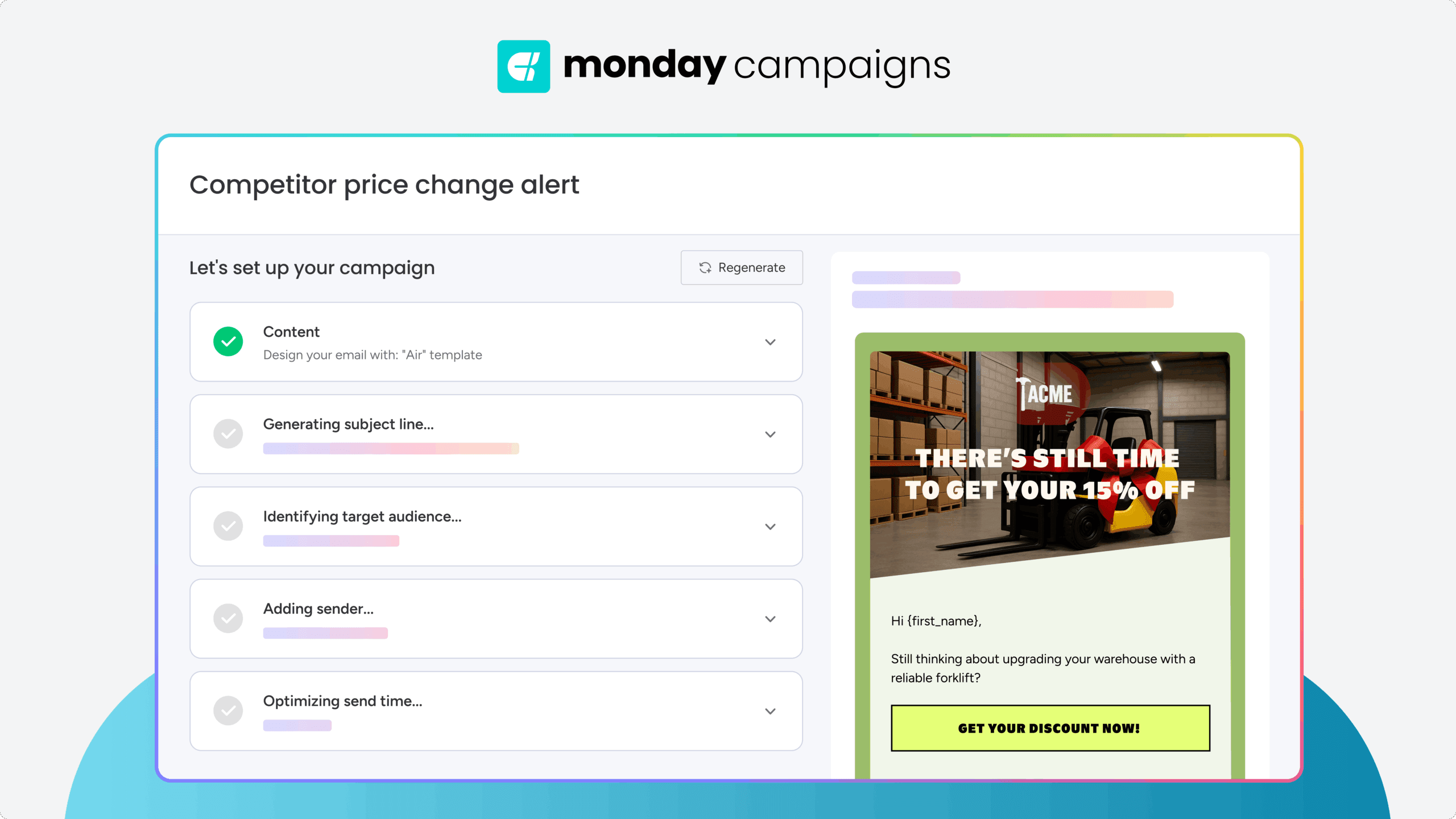
Generate on-brand email copy, subject lines, and content variations instantly with AI that understands your messaging and audience. The AI learns from your CRM data to create personalized campaigns that resonate with different segments. You can build professional campaigns in minutes without coding or design skills, then let AI continuously optimize messaging based on what actually drives conversions.
Native CRM integration for automatic attribution
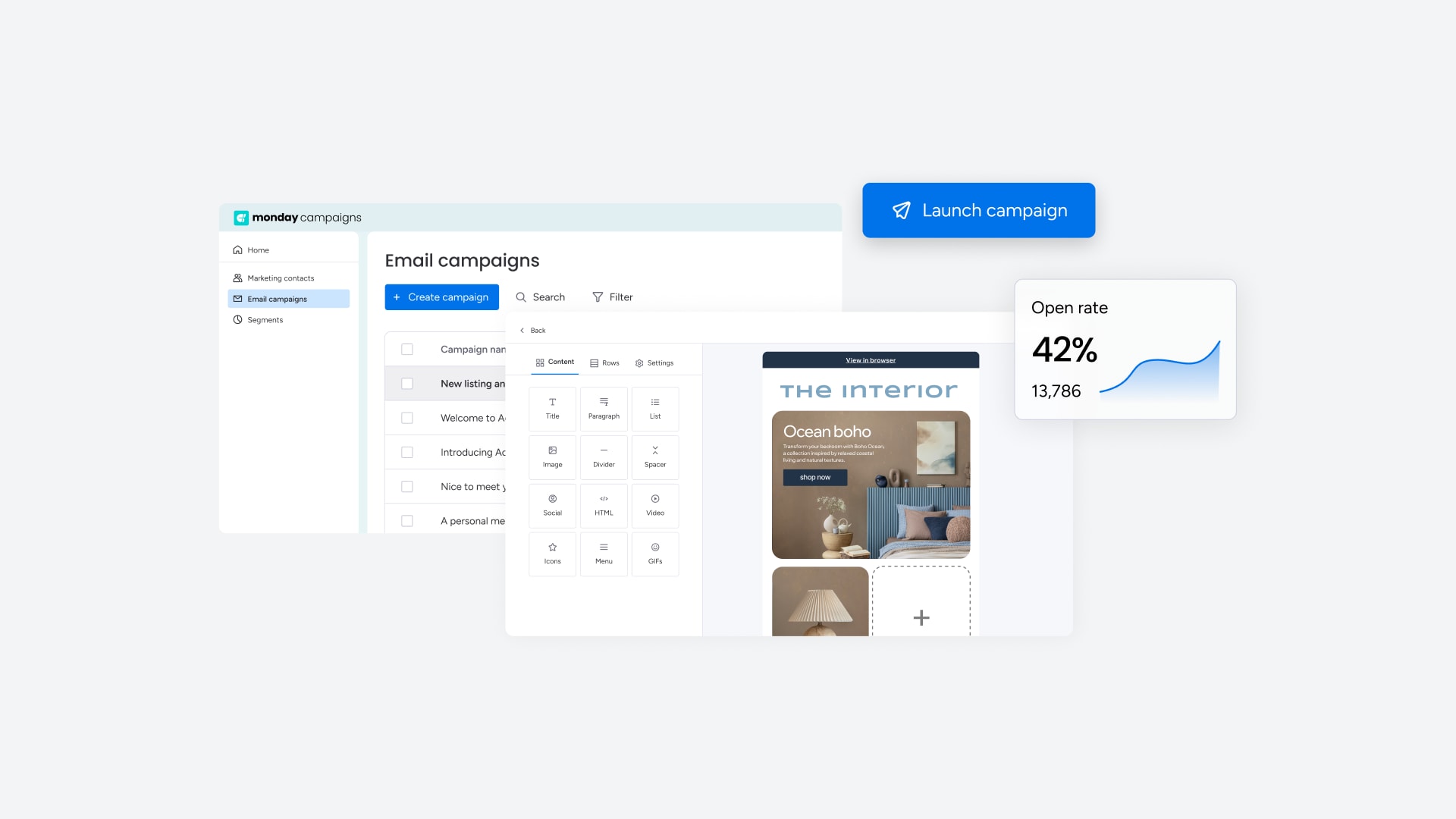
Campaigns connect directly to your CRM records, so every email, click, and conversion automatically links to contact data and deal progression. This native integration eliminates manual data reconciliation and gives you real-time visibility into which campaigns influence pipeline. You get accurate multi-touch attribution without integration headaches, proving exactly which marketing activities drive closed revenue.
Intelligent audience segmentation
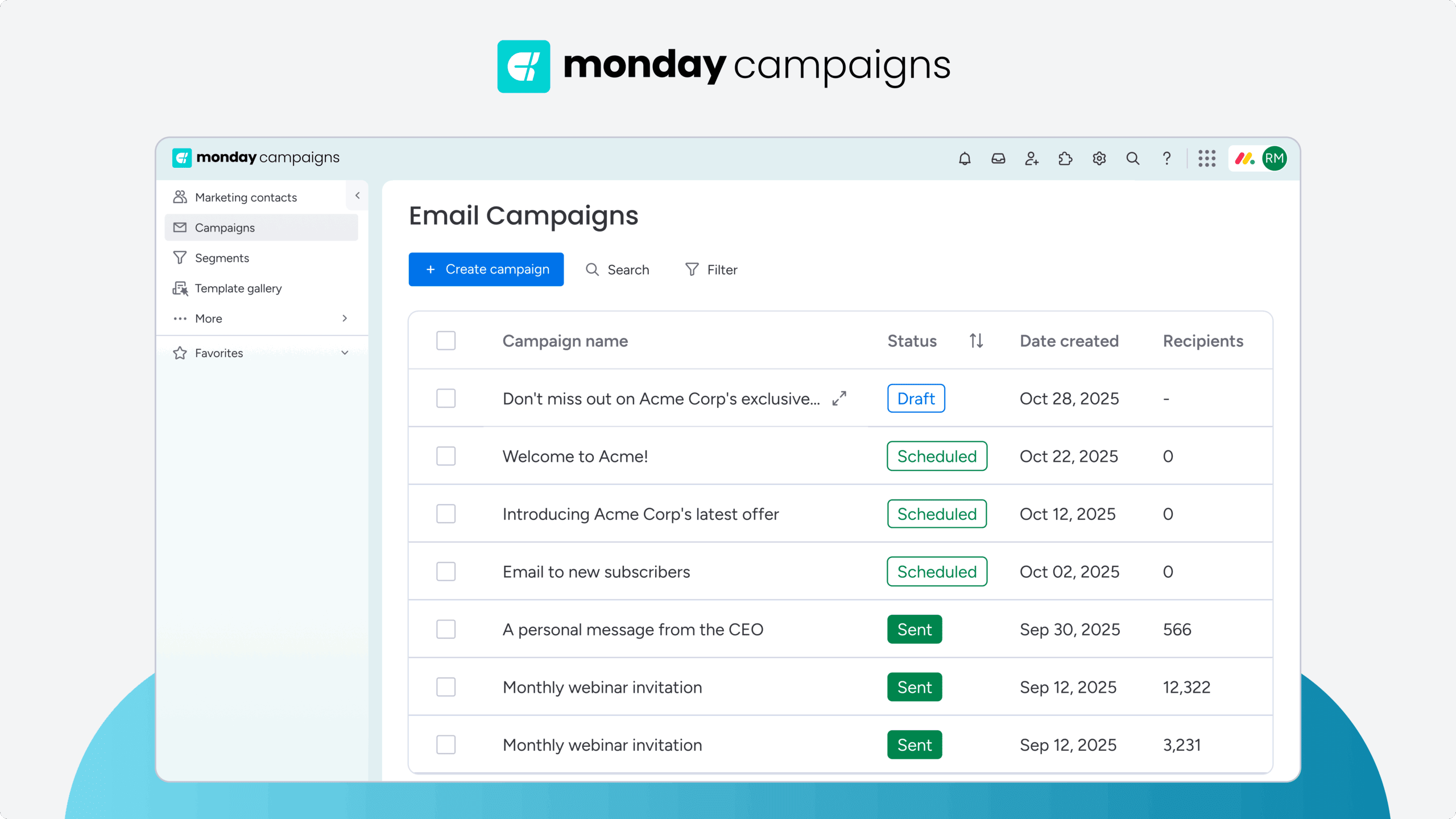
AI analyzes your CRM to surface high-value segments based on behavior patterns, engagement history, and conversion signals. You can explore audience segments directly from customer data and create targeted campaigns that reach the right people at the right time. The platform automatically updates segments as your CRM data changes, keeping your targeting sharp without manual list management.
Real-time analytics and revenue tracking
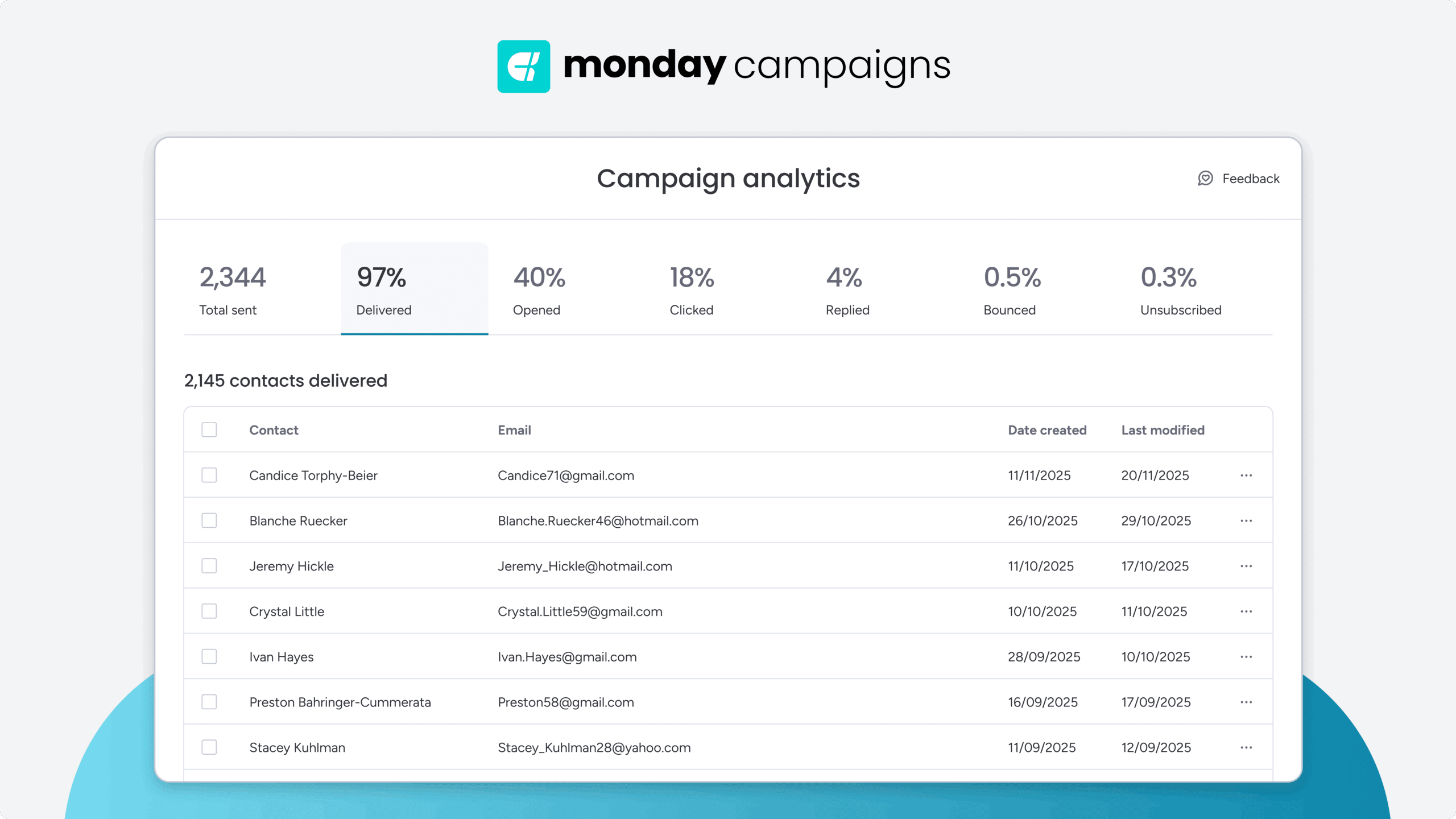
Monitor campaign performance from first touch to closed deal in one dashboard that connects marketing metrics to actual revenue. AI-powered analytics surface insights automatically, showing you which campaigns drive pipeline, influence deals, and generate the highest ROI. You can track opens, clicks, conversions, and revenue impact in real-time, then use those insights to optimize future campaigns for maximum revenue growth.

"With monday campaigns, we can launch professional emails in minutes and instantly see who engaged. Our sales team follows up directly with those showing interest - making outreach faster and more effective."
Michael Fitzpatrick | National Workplace Training ManagerTransform your marketing operations with AI-powered campaigns
AI marketing bots are more than automation. They’re the bridge between marketing activity and revenue results. With approximately 25% of UK businesses now using artificial intelligence, the technology has moved from experimental to mainstream business adoption.
Teams that use AI-powered campaign management get the data connectivity, attribution, and optimization intelligence to prove marketing’s direct impact on growth. Instead of managing rigid workflows and manual optimizations, marketers focus on strategy while AI handles execution, personalization, and continuous improvement. monday campaigns combines AI-powered creation with native CRM integration to deliver this transformation in one platform.
Try monday campaignsFAQs
What is an AI marketing bot?
An AI marketing bot is software that uses artificial intelligence to automate marketing activities like campaign creation, lead scoring, and personalization — learning from data and improving over time rather than following static rules.
How do AI marketing bots differ from traditional marketing automation?
AI marketing bots differ from traditional automation by learning from outcomes and adapting automatically, while traditional automation only executes predetermined rules that never change unless manually updated.
What are the most effective AI marketing bot examples?
The most effective AI marketing bot examples include lead nurturing sequences, customer onboarding campaigns, re-engagement campaigns for inactive contacts, upsell and cross-sell campaigns, and event promotion workflows.
How should marketers measure AI marketing bot impact?
Marketers should measure AI marketing bot impact through revenue metrics like attributed pipeline, influenced deals, customer acquisition cost, and customer lifetime value — not just engagement metrics like opens and clicks.
What features should I look for in an AI marketing bot platform?
Look for native CRM integration, revenue attribution capabilities, AI-powered personalization, real-time analytics, and ease of use that doesn't require technical setup or dedicated administrators.
Can AI marketing bots replace human marketers?
AI marketing bots cannot replace human marketers — they handle repetitive analysis and execution so marketers can focus on strategy, creative direction, and relationship-building that requires human judgment.

 Get started