


Your marketing team just spent three weeks building a campaign. By the time you hit send, the market moment has passed, your competitor launched something similar, and you’re already behind on next month’s goals.This scenario plays out everywhere. Teams know what good campaigns look like, but manual work consumes time that should go toward strategy and optimization. An AI marketing assistant changes this by handling campaign creation, audience analysis, and performance optimization, freeing marketers to focus on what drives results.
Here’s how AI marketing assistants work, why they matter for revenue-driven teams, and what separates strategic platforms from basic automation. We’ll cover how to evaluate AI marketing platforms, which features actually accelerate campaign launches, and how teams use AI to connect marketing activity directly to revenue. Platforms like monday campaigns demonstrate how AI-powered tools can transform your campaign workflow from concept to execution.
Key takeaways
- Speed beats perfection: AI marketing assistants compress campaign timelines from days to minutes, letting you test more ideas and capture opportunities faster.
- Real-time optimization drives results: AI adjusts targeting, content, and timing while campaigns run, capturing performance improvements immediately.
- Revenue attribution solves the ROI puzzle: Connect campaign performance directly to sales outcomes with native CRM integration that tracks leads from first touch to closed deals.
- Bridge the marketing-sales gap: Generate AI-powered campaigns using live CRM data, then track their impact on pipeline and revenue in one workspace.
- Focus on strategy, not execution: AI handles time-consuming tasks like audience analysis and content generation, freeing your team for customer understanding and strategic decisions.
What is an AI marketing assistant?
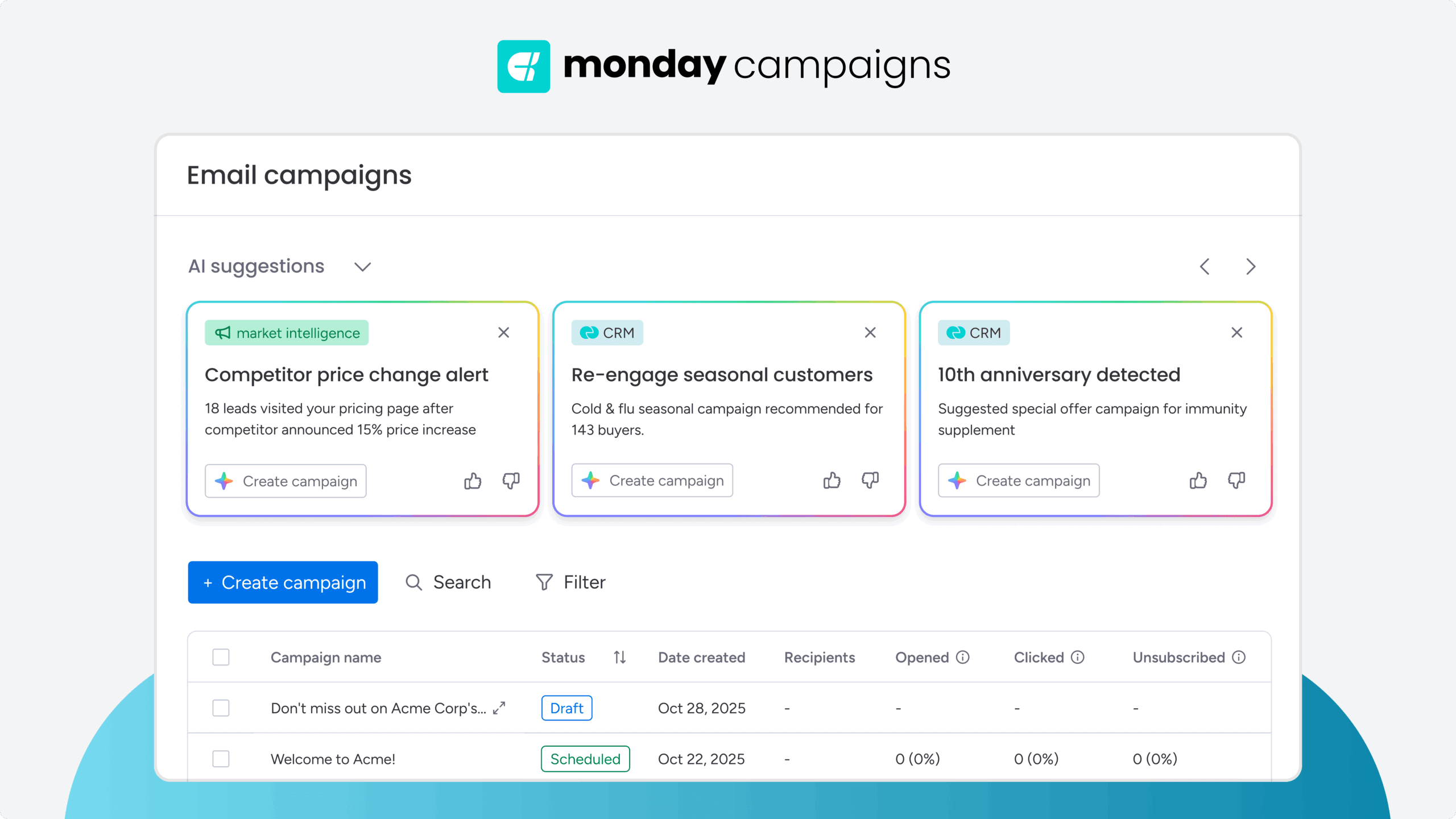
An AI marketing assistant is software that uses artificial intelligence to automate, optimize, and execute marketing tasks, from campaign creation to performance analysis. Traditional marketing platforms need manual setup and constant oversight. AI marketing assistants flip that: they analyze data, make decisions, and take action without you micromanaging every step.
Here’s the real difference: manual execution versus intelligent automation. Traditional platforms function as sophisticated to-do lists: marketers tell them exactly what to do, when to do it, and how to do it. AI marketing assistants flip this dynamic. They observe patterns in customer behavior, identify opportunities marketers might miss, and execute campaigns with minimal human intervention.
Why does this matter? Marketing needs speed, personalization, and precision at a scale manual processes can’t touch.
When an AI marketing assistant analyzes thousands of customer interactions to find the best send time for each person, it does in seconds what would take a human team weeks.
How AI marketing assistants actually work
Understanding how AI marketing assistants function helps you see why they deliver results that traditional automation simply can’t match. These platforms operate through intelligent systems that analyze data, recognize patterns, execute campaigns, and continuously improve over time. Here’s what sets them apart and why that matters for your marketing team.
The continuous cycle that powers AI marketing
AI marketing assistants operate through a continuous cycle that gets smarter with every interaction. This ongoing process separates AI-powered platforms from traditional automation tools that need constant manual oversight.
Here’s how the cycle works:
- Data analysis: AI continuously processes customer data, campaign metrics, and market signals. It examines email engagement, website behavior, purchase history, and CRM data to build a complete picture of customer preferences and intent.
- Pattern recognition: AI identifies trends humans might miss. It notices which industry segments respond to case study content, or that leads who visit the pricing page twice within a week convert at higher rates.
- Automated execution: AI takes action by creating campaigns, adjusting targeting, personalizing content, and optimizing send times without manual intervention.
- Continuous learning: Every campaign generates new data that feeds back into the system, refining strategies over time.
Here’s a practical example: an AI marketing assistant notices email open rates spike on Tuesday mornings for one segment but Wednesday afternoons for another. It automatically adjusts send schedules for each group, capturing engagement without anyone manually analyzing data or changing settings.
What makes AI different from traditional automation
Marketing technology has undergone a fundamental transformation, and this evolution shows why AI marketing assistants represent a real leap forward rather than just an incremental improvement. The differences between traditional automation and AI-powered platforms affect everything from setup requirements to how campaigns adapt in real time.
| Dimension | Traditional marketing automation | AI marketing assistants |
|---|---|---|
| Setup requirements | Manual configuration of every rule and workflow | AI learns patterns and suggests workflows automatically |
| Decision-making | Follows predetermined if-then logic | Makes intelligent decisions based on real-time data |
| Personalization | Segment-level (all customers in a group treated identically) | Individual-level (each customer receives tailored treatment) |
| Optimization | Manual analysis between campaigns | Continuous optimization during campaigns |
| Adaptability | Rigid; requires manual updates for changes | Flexible; adapts automatically to new patterns |
Traditional marketing automation operates reactively, with marketers manually configuring every workflow and defining rigid if-then rules that the system follows without deviation. If a customer downloads an ebook, the system sends email one, waits three days, then sends email two. The system executes instructions but cannot adapt when circumstances change or opportunities emerge.
AI marketing assistants operate proactively, identifying opportunities and creating campaigns without waiting for manual triggers. They adapt strategies based on real-time performance data and anticipate customer needs, often acting before marketers even recognize the opportunity exists.
Why AI marketing assistants matter for revenue-driven campaigns
Marketing teams face unprecedented pressure to prove ROI, do more with less, and drive measurable revenue impact. According to Gartner, 59% of CMOs say they have insufficient budget to execute their strategy. These demands have turned AI marketing assistants from nice-to-have platforms into must-have infrastructure. Three core challenges directly limit your revenue potential.
Challenge 1: Manual campaign creation holds teams back
Campaign creation consumes disproportionate time relative to its strategic value. How much of your team’s week goes toward building campaigns versus optimizing them?
The typical campaign launch involves multiple time-intensive stages. Every stage represents time you’re not reaching customers, driving conversions, or generating revenue.
- Campaign planning and briefing: Days or weeks of stakeholder alignment and strategy development
- Content creation and approval: Multiple rounds of revisions across copy, design, and legal review
- Audience segmentation: Hours of data analysis to identify and build target lists
- A/B test setup and monitoring: Constant manual oversight to track variant performance
- Performance reporting: Time spent compiling data instead of acting on insights
Three days building a campaign means three days of missed opportunities. The faster you launch, the better your campaigns perform. Delayed campaigns miss market moments, competitive opportunities, and seasonal windows you can’t get back.
Challenge 2: The pressure to prove marketing ROI
Marketing teams face constant pressure to justify budgets by demonstrating direct connections between campaigns and business outcomes. The problem? Traditional marketing platforms create visibility gaps that make attribution nearly impossible.
Marketers can see email open rates and click-through rates in a marketing dashboard. They can track website visits and form submissions. But connecting those metrics to actual revenue requires visibility into what happens after marketing hands off a lead to sales, visibility that most marketing platforms cannot provide.
When marketing and sales operate in disconnected systems, marketing silos turn attribution into guesswork. Marketing claims credit for leads generated. Sales disputes the quality of those leads. Neither team has complete visibility into the customer journey, and revenue attribution devolves into organizational politics rather than data-driven analysis.
Challenge 3: Disconnected platforms create revenue gaps
The typical marketing technology stack includes marketing automation in one platform, CRM in another, analytics in a third, and project management in a fourth. This fragmentation slows you down and costs you revenue.
Data doesn’t flow naturally between systems. Marketing exports lead lists, imports them into the CRM, and hopes the sync works correctly. Marketing cannot see what happens to leads after handoff to sales. Sales cannot see which marketing touches influenced a deal. Campaign insights do not inform sales conversations.
These gaps cost you deals. When marketing and sales work in silos, opportunities slip through, follow-up gets delayed, and you can’t optimize campaigns based on actual sales outcomes.
How AI marketing assistants accelerate campaign launches
AI marketing assistants compress campaign timelines by automating the most time-consuming tasks in the campaign creation process. Faster launches mean more opportunities to test, learn, and optimize, which directly improves campaign performance and revenue impact.
Generate audience insights in minutes, not days
Traditional audience analysis requires marketers to export data, build spreadsheets, analyze patterns, and create static lists. This process takes hours or days, and by the time segments are ready, the data may already be outdated.
AI marketing assistants transform this process. They analyze customer data in real-time, automatically identifying high-value segments based on behavior, engagement, purchase history, and intent signals. They continuously update segments as customer behavior changes, so targeting stays accurate.
An AI marketing assistant might automatically identify customers who viewed your pricing page three times in the past week but haven’t purchased yet. That’s a high-intent segment perfect for a targeted offer. It recognizes this pattern across thousands of contacts and creates the segment instantly, without manual analysis.
Create AI-powered campaigns
What if your next campaign could be ready in minutes instead of days? AI marketing assistants handle the creative and technical work of building campaigns, freeing marketers to focus on strategy. The best AI-powered marketing tools make that trade-off transparent, showing you exactly what’s automated and where your team still has final say.
AI capabilities span the entire campaign development process:
- Campaign copy: Subject lines optimized for open rates, email body content that drives engagement, calls-to-action that convert
- Visual elements: On-brand designs, layouts, and formatting that maintain consistency
- Personalization: Dynamic content tailored to individual recipients based on their data and behavior
- A/B test variants: Multiple versions optimized for different audience segments and objectives
Optimize performance in real-time
Traditional campaign optimization follows a slow cycle: launch campaigns, wait for results, manually analyze performance, identify improvements, and implement changes in the next campaign. This cycle takes days or weeks, and optimization happens between campaigns, not during them.
AI-powered real-time optimization changes this dynamic entirely. AI monitors campaign performance as it happens, identifies what works and what doesn’t, and makes adjustments on the fly. If an AI marketing assistant notices one subject line getting way more opens, it can automatically send that version to everyone else. You capture the win immediately instead of waiting for the next campaign.
7 ways AI marketing assistants drive revenue growth
These seven capabilities drive measurable results. Each one shows how AI marketing assistants drive revenue, not just efficiency. These benefits help you figure out which capabilities matter most for your revenue goals.
1. Slash campaign creation time
AI marketing assistants compress campaign timelines from days to minutes, creating more opportunities to reach customers and drive revenue. This speed multiplies campaign volume. Teams can launch more campaigns, test more ideas, and respond to market opportunities faster.
2. Deliver personalization at scale
True one-to-one personalization across thousands or millions of customers is impossible to achieve manually. AI marketing assistants make it practical. Real personalization drives higher open rates, click rates, and conversions.
3. Optimize campaigns in real-time
AI marketing assistants improve campaign performance in real-time, not just between campaigns. Every percentage point improvement in conversion rate directly impacts revenue.
4. Align marketing and sales efforts
Integrating AI for sales and marketing with CRM systems breaks down silos between marketing and sales, creating unified revenue teams. When marketing and sales align, leads move faster through the funnel, follow-up gets better, and more deals close.
5. Automate repetitive campaign tasks
AI marketing assistants eliminate time-consuming manual work, freeing marketers to focus on strategy and creativity. Tasks that ate up hours every week now happen automatically.
6. Track revenue impact directly
AI marketing assistants show exactly how marketing campaigns contribute to revenue, solving the attribution puzzle marketers have struggled with for years. When you can prove ROI, you get bigger budgets, executive support, and clear data on where to invest next.
7. Orchestrate multi-channel campaigns
AI marketing assistants coordinate campaigns across multiple channels to create cohesive customer experiences, a capability that matters more than ever given that digital channels now account for 61.1% of total marketing spend. Coordinated campaigns work better: consistent messaging across channels drives higher engagement and conversion than one-off efforts.
Try monday campaignsCore capabilities of AI marketing assistants
AI marketing assistants vary in features, but certain core capabilities make them effective. These aren’t nice-to-haves. They’re must-haves. These capabilities help you evaluate platforms and set realistic expectations for what AI can do.
Content generation and brand consistency
AI marketing assistants generate campaign content while maintaining brand voice and consistency across all touchpoints. Effective AI doesn’t generate generic content. It learns your brand voice, understands your messaging guidelines, and creates content that sounds authentically like your brand.
Smart audience segmentation
AI marketing assistants analyze customer data to create precise, high-performing audience segments automatically. Precise targeting ensures marketing budget goes to the audiences most likely to convert, while dynamic segmentation means personalization stays current as customer data updates, Taken together, this ensures every message remains relevant to the recipient.
Performance analysis and insights
AI marketing assistants analyze campaign performance and surface actionable insights that drive decisions. AI doesn’t just report numbers. It interprets them, identifies what matters, and suggests specific actions.
Workflow automation beyond basic rules
AI marketing assistants go beyond simple if-then automation to create intelligent, adaptive workflows.
| Dimension | Basic automation | AI-powered workflows |
|---|---|---|
| Logic | Follows rigid if-then rules | Adapts based on customer behavior and context |
| Learning | Static; requires manual updates | Learns from results and improves over time |
| Complexity | Handles simple, linear processes | Manages complex, multi-step scenarios |
| Personalization | Treats all customers the same within rules | Personalizes actions for individual customers |
| Maintenance | Requires constant manual oversight | Self-optimizing with minimal intervention |
What to look for in an AI marketing assistant
When evaluating AI marketing assistants, focus on capabilities that connect campaigns to revenue. The most valuable platforms work across the full campaign lifecycle (build, launch, and optimize) rather than stopping at content generation. Here’s what separates strategic platforms from basic tools.
- Native CRM integration: Strategic platforms access live customer data, use deal stages for targeting, and connect campaign performance to pipeline impact. Research shows 57% of CRM users consider their CRM “critical” to their revenue operations.
- Revenue attribution capabilities: Track campaigns from engagement to closed-won deals with reporting that shows both marketing metrics and sales outcomes.
- Ease of adoption: Your team should launch campaigns quickly without heavy technical expertise or extensive training.
- Context and data sources: AI should access sales call notes, external data, and customer insights to generate campaigns based on business context and personalize at the individual level.
monday campaigns demonstrates these principles in action. The platform uses AI to generate copy, suggest audience segments based on CRM data, and verify brand consistency, moving from insight to execution in a single workflow. Native integration with monday CRM creates continuous data flow between marketing campaigns and sales pipeline, enabling lead conversion tracking from first touch to closed-won revenue.
Try monday campaignsHow monday campaigns turns AI into revenue-driving campaigns
Marketing teams need platforms that connect campaign execution directly to business outcomes. monday campaigns brings AI-powered campaign creation together with native CRM integration, creating a unified workspace where marketing and sales collaborate on revenue growth rather than operating in silos.
The platform transforms how teams move from strategy to execution. Instead of juggling disconnected tools for campaign creation, audience management, and performance tracking, you work in a single environment where AI handles the heavy lifting while you maintain creative control and strategic direction.
AI-powered campaign generation
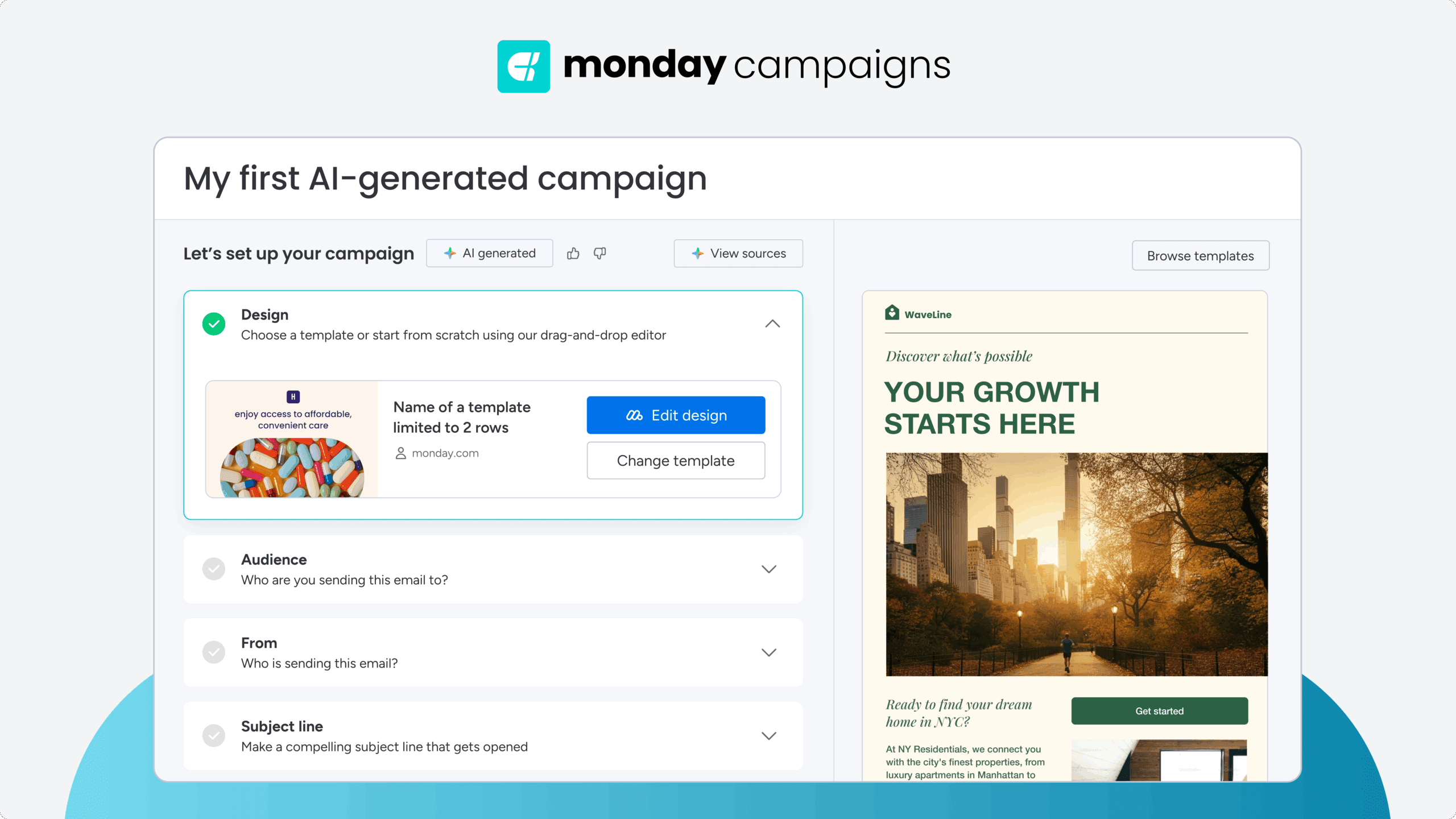
Generate complete email campaigns in minutes using AI that learns your brand voice and messaging guidelines. The AI analyzes your CRM data, past campaign performance, and customer behavior to create personalized copy, subject lines, and calls-to-action that drive engagement. You provide strategic direction and approval while AI handles the time-consuming execution work.
Smart audience segmentation from live CRM data
Build precise audience segments using real-time data from monday CRM without manual exports or imports. AI suggests high-value segments based on deal stages, customer behavior, and engagement patterns, then automatically updates these segments as your CRM data changes. Target the right customers at the right moment with segmentation that stays current.
Native CRM integration for revenue attribution
Track campaign performance from first touch to closed-won revenue in a single workspace. Native integration with monday CRM means every lead generated by marketing flows directly into your sales pipeline, and you can see exactly which campaigns drive actual revenue. Marketing and sales work from the same data, eliminating attribution guesswork and alignment friction.
Real-time campaign optimization
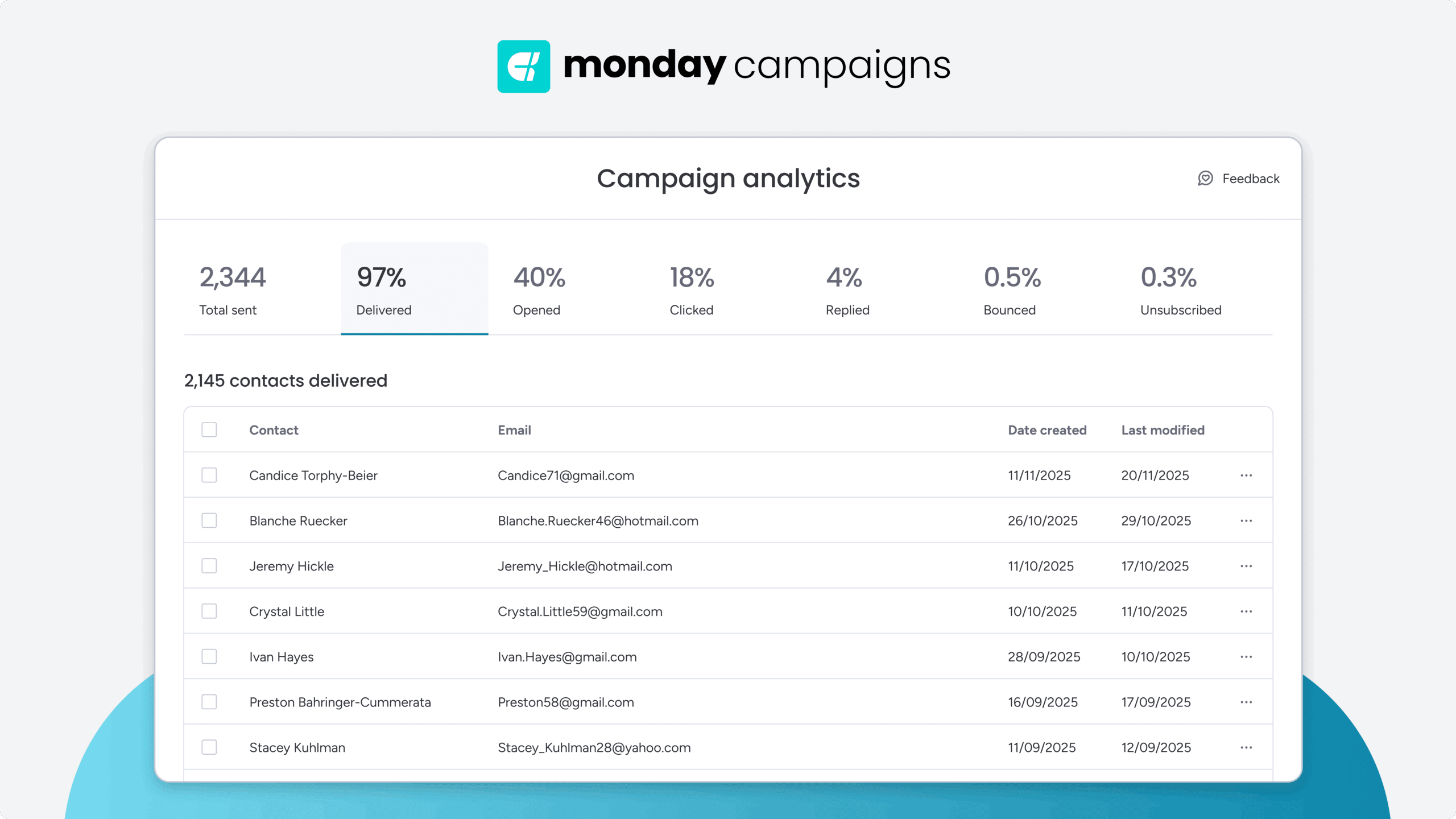
AI monitors campaign performance as it happens and surfaces actionable insights that improve results. The platform identifies which messages resonate with specific segments, suggests optimizations based on engagement patterns, and helps you capture performance improvements immediately rather than waiting for the next campaign cycle.
Transform your marketing with AI-powered campaign management
AI marketing assistants fundamentally shift how teams create, launch, and optimize campaigns. The difference isn’t just efficiency, it’s reaching customers at the right moment with the right message at scale manual processes can’t match.The biggest wins come from using AI to amplify strategy, not replace creativity. AI handles audience analysis, content generation, and optimization, freeing marketers to focus on what drives revenue: customer understanding and strategic decisions.
Ready to see how AI can transform your campaign creation process? monday campaigns combines intelligent automation with native CRM integration, giving you the power to launch personalized campaigns in minutes while tracking their impact on actual revenue outcomes.
Try monday campaignsFAQs
What is an AI marketing assistant?
An AI marketing assistant is software that uses artificial intelligence to automate, optimize, and execute marketing tasks, from campaign creation to performance analysis. This shift is part of a broader move toward AI marketing agents that take ownership of specific campaign responsibilities rather than just assisting with them. Traditional marketing platforms need manual setup and constant oversight. AI marketing assistants flip that: they analyze data, make decisions, and take action without you micromanaging every step.
How do AI marketing assistants differ from traditional marketing automation?
AI marketing assistants identify patterns automatically, adapt strategies based on real-time data, and improve over time by learning from results, while traditional automation follows rigid if-then rules that marketers must manually configure.
Can AI marketing assistants replace human marketers?
AI marketing assistants amplify human capabilities by handling time-consuming execution tasks, while marketers focus on strategy, creative direction, and customer understanding.
How do AI marketing assistants improve campaign ROI?
AI marketing assistants improve ROI through faster campaign launches, personalization at scale, real-time optimization, and native CRM integration that provides attribution connecting marketing activity to revenue outcomes.
What should I look for when choosing an AI marketing assistant?
Prioritize native CRM integration, AI-powered content generation that maintains brand consistency, smart audience segmentation that updates dynamically, and real-time optimization capabilities.
How long does it take to see results from an AI marketing assistant?
Efficiency gains appear immediately as campaign creation time drops, while performance improvements accumulate over time as the AI learns from campaign results and optimizes based on patterns.

 Get started