


Content marketing used to rely on instincts, endless manual work, and a whole lot of “hope this performs.” AI flips that model on its head. Instead of guessing what audiences want, you can use real data to create, personalize, and optimize content that directly impacts revenue — and do it in a fraction of the time.
In this guide, you’ll learn how AI streamlines your workflow, speeds up production, and connects every piece of content to measurable business outcomes. You’ll also see how pairing AI with your CRM unlocks true marketing–sales alignment, giving you a complete view of the customer journey from first touch to repeat purchase.
Try monday campaignsKey takeaways
- AI can cut manual work and uses real customer data to make your content more targeted, relevant, and revenue-generating.
- Teams can ship campaigns significantly faster with AI, giving you a speed-to-market advantage competitors can’t match.
- Measure what matters: time saved, engagement quality, and the content that actually drives pipeline and revenue.
- Roll out AI gradually, starting with quick wins, test, refine, and scale what works.
- Using AI with your CRM unlocks smarter segmentation, personalized content, and clearer visibility into pipeline impact — all inside monday campaigns.
What is AI for content marketing?
AI for content marketing is the use of artificial intelligence to automate, optimize, and personalize content creation, distribution, and analysis. Today, 71% of organizations regularly use generative AI in at least 1 business function, with marketing and sales among the most commonly cited applications.
AI transforms content strategies by automating complex tasks and uncovering insights you’d miss manually. Instead of guessing what content will resonate, AI analyzes real-time data and provides insights to support decision-making. AI scans search trends and competitor activity to suggest topics your audience actually wants, and AI customizes headlines and CTAs based on individual user behavior.
Together, these capabilities help you move from reactive planning to data-driven strategy that updates in real time.
AI vs. traditional content creation methods
Traditional content creation relies on manual research, writing, and basic segmentation. AI-powered approaches automate ideation, enable dynamic personalization, and analyze performance in real time.
Where traditional methods require hours of manual work per asset, AI reduces production time to minutes. McKinsey reports marketers have deployed gen AI to personalize content development up to 50× faster than manual approaches.
7 game-changing benefits of AI content marketing
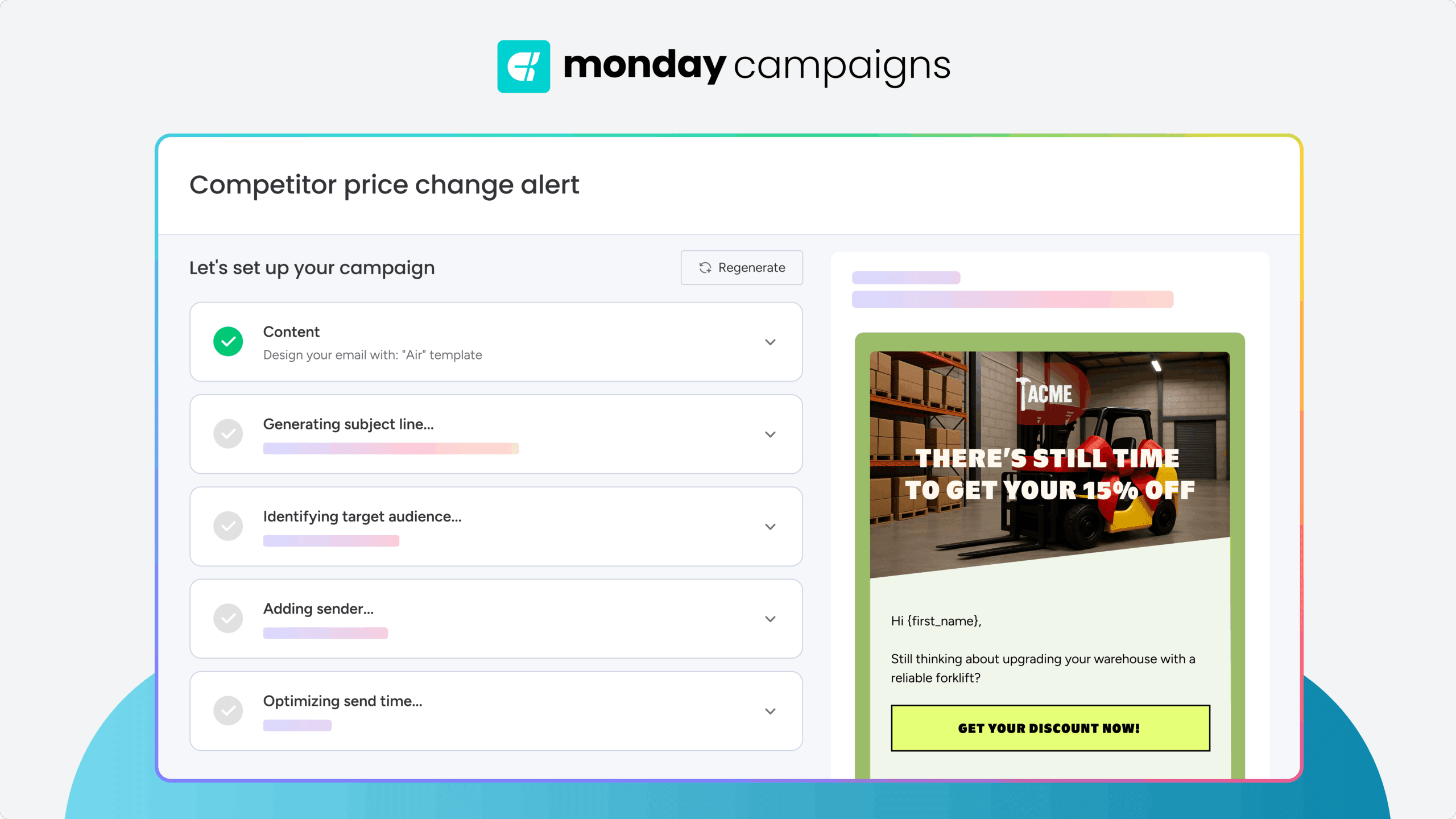
AI delivers measurable advantages that directly impact your marketing performance. These benefits help teams create stronger customer connections while linking content efforts to revenue outcomes.
1. Create personalized content at scale
AI for sales and marketing enables you to deliver unique experiences to thousands of users simultaneously. Dynamic email content adapts to each recipient. Website pages personalize based on visitor behavior. Product recommendations match individual preferences.
2. Launch campaigns faster
AI accelerates every step of campaign creation. Generate multiple content variations in minutes. Set up A/B tests directly inside the platform to compare performance. AI speeds up creation and testing so campaigns move through approvals faster. This speed lets you capitalize on trending topics and timely opportunities. What once took weeks now takes hours.
3. Boost content ROI with data-driven insights
AI analyzes performance data to surface actionable insights. Spot emerging topics before competitors. By learning from every interaction, AI helps you focus resources on high-impact activities that drive measurable returns.
4. Automate repetitive marketing tasks
Automation frees your team to focus on strategy instead of execution. AI handles time-consuming tasks that previously required significant manual effort:
- Automated testing: Sets up and monitors A/B tests continuously
- Instant reporting: Generates performance reports without manual data collection
- List management: Cleans email lists and segments contacts based on behavior
5. Improve audience targeting accuracy
AI in B2B marketing analyzes behavioral data, purchase history, and engagement patterns to identify high-value prospects. Predictive models match content to user intent, resulting in more relevant messaging and higher conversion rates.
This goes beyond demographics. AI understands what your audience wants based on their actions, not just their attributes.
6. Optimize content performance in real-time
AI surfaces real-time insights so you can adjust campaigns quickly. Shift budgets to winning variations, and swap underperforming content. These real-time optimizations ensure campaigns stay competitive even as conditions change throughout the day.
7. Connect content efforts to revenue
According to McKinsey, 66% of marketing-and-sales functions that use gen AI reported revenue increases over the prior 12 months, with 8% reporting gains above 10%. Attribution modeling links engagement to pipeline and closed deals. Reporting shows how campaigns contribute to engagement and pipeline activity when connected to your CRM.
Examples of AI in content marketing
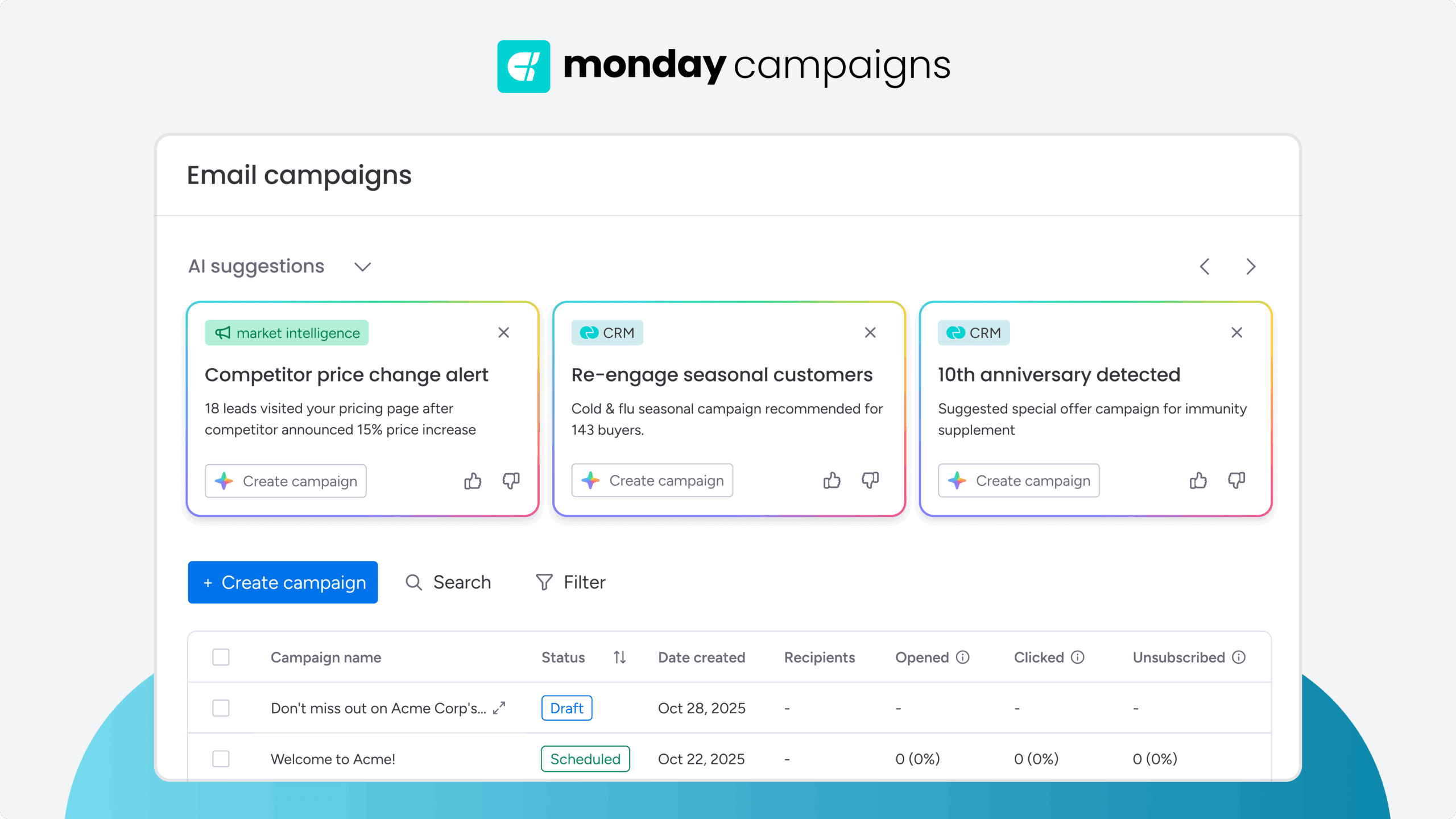
AI isn’t just theoretical — it’s already reshaping the marketing workflows teams use every day. Here are practical, high-impact examples of how AI improves speed, relevance, and revenue across channels:
- Email campaign creation and optimization: AI generates subject lines, drafts copy, recommends send times, and personalizes message blocks based on behavior.
- Social media content that converts: AI helps you draft captions, find trending hashtags, and schedule posts when your audience is most active. It can also predict which creative variations are most likely to drive engagement, helping you choose winning posts faster.
- SEO content that ranks: AI identifies keyword opportunities, analyzes search intent, and generates comprehensive outlines that match what users actually want. As algorithms shift, AI updates recommendations so your content stays competitive.
- Dynamic audience segmentation: AI continuously updates segments based on behavior, intent signals, and lifecycle stage — not just static fields. With monday campaigns, segments refresh using CRM data, ensuring each campaign goes to the most relevant audience.
7 steps to implement AI in content marketing
Rolling out AI in marketing should focus on improving the parts that slow you down. These 7 steps give you a clear, confident path to introduce AI gradually, build trust with your team, and scale what delivers the highest impact.
Step 1: Map your content workflow gaps
Audit your current processes to find inefficiencies. Where does your team spend the most time? What tasks cause consistent delays? Look for bottlenecks in ideation, production, distribution, and measurement.
Step 2: Choose AI solutions that align with goals
Select AI for sales and marketing platforms based on your specific needs. Consider integration requirements, costs, and learning curves. Not every solution fits every team.
Software like monday campaigns serves as an all-in-1 solution, connecting to monday CRM and monday work management natively. This eliminates the need for multiple platforms while creating true marketing-sales alignment.
Step 3: Build your AI governance playbook
Clear guidelines maintain quality and consistency. Define brand voice rules for AI-generated content. Set quality benchmarks. Establish review processes. Create ethical use policies.
Regular updates keep your AI aligned with evolving brand standards and market expectations.
Step 4: Start with quick-win pilot projects
Choose low-risk projects that deliver visible results fast. Email subject line optimization shows impact within days. Automated social posting saves hours weekly. Content personalization boosts engagement quickly.
These early wins build momentum and support for broader adoption.
Step 5: Train your team for AI success
Train teams to use AI tools confidently, review outputs effectively, and interpret AI-driven insights. Build adoption by giving people space to practice and ask questions.
Step 6: Measure and document early results
Track metrics that matter in AI in B2B marketing. Monitor engagement rates before and after AI adoption. Measure time savings in content production. Calculate cost reductions. Document successful pilots for future reference.
Clear documentation justifies continued investment and guides scaling decisions.
Step 7: Scale what works across channels
Expand successful approaches carefully. Prioritize pilots with proven ROI. Apply winning tactics to new platforms. Communicate successes to maintain support. Integrate AI into long-term planning.
Not every approach works everywhere, so evaluate what fits each channel best.
Try monday campaignsHow to measure the ROI of an AI-driven content strategy
Measuring ROI is how you prove AI is working — not just saving time, but driving revenue. Focus on metrics that reflect efficiency, relevance, and business impact, rather than vanity numbers. Here are some key metrics to track:
- Production time saved: Compare time spent writing, editing, and launching campaigns before vs. after AI.
- Speed to market: Track how long it takes to move from brief → publish. Faster teams capture more opportunities.
- Engagement quality: Measure clicks, replies, scroll depth, and conversions — not impressions.
- Cost per asset: Calculate how AI reduces outsourcing needs, revising cycles, or platform spend.
- Revenue attribution: Use your CRM to see which campaigns influence pipeline, opportunities, and closed deals.
Calculate content cost reduction
Estimate time saved per asset or campaign and multiply by hourly cost. If AI cuts creation time from 10 hours to 2 hours and you run 20 campaigns a month, that’s 160 hours saved — a clear, measurable cost reduction.
Track revenue contribution
Use attribution models to understand how AI-powered content moves leads through the pipeline. Identify which assets accelerate deal velocity or increase conversion rates.
Measure agility and competitive advantage
Faster launches mean more chances to win early. Compare your brief-to-launch timeline before and after AI adoption to quantify how speed impacts results.
Prove marketing’s impact on pipeline
AI-supported workflows and CRM data make it easier to link content performance to business outcomes, so you can map content influence across the entire buyer journey — from first touch to deal won. This makes ROI visible not only to marketing, but also to sales leadership.
Smart solutions to AI marketing challenges
The smartest marketers still run into challenges with AI in content marketing, but they also have solutions. Check these out:
| Challenge | Solution |
|---|---|
| Keeping brand voice consistent | Train AI on approved examples, set brand guidelines, and require quick human review before publishing. |
| Ensuring accuracy and originality | Fact-check AI outputs, run plagiarism checks, and maintain a lightweight QA process for high-stakes content. |
| Protecting customer data | Use platforms that honor privacy standards, anonymize personal data when possible, and restrict access to CRM-connected AI tools. |
| Team resistance or uncertainty | Provide hands-on training, share early wins, and show how AI reduces workload instead of replacing roles. |
| Maintaining quality at scale | Use templates, enforce review workflows, and monitor performance to identify where AI content needs refinement. |
How an AI-powered CRM unlocks the highest ROI
AI becomes exponentially more powerful when it has access to real customer data — not just general prompts. Connecting AI to your CRM unlocks deeper personalization, more precise targeting, and measurable revenue impact.
- Use CRM data to fuel smarter personalization: AI tailors messages based on lifecycle stage, past engagement, lead score, and behavior, creating content that feels relevant instead of generic.
- Track content influence across the full customer journey: With integrated systems, you can see exactly which campaigns move leads forward, accelerate deals, or re-engage existing customers.
- Improve collaboration between marketing and sales: A shared data source means shared visibility. Marketing sees what turns into revenue; sales sees what content supports deals. Everyone works from the same source of truth.
What's next for AI in marketing content: Trends and predictions
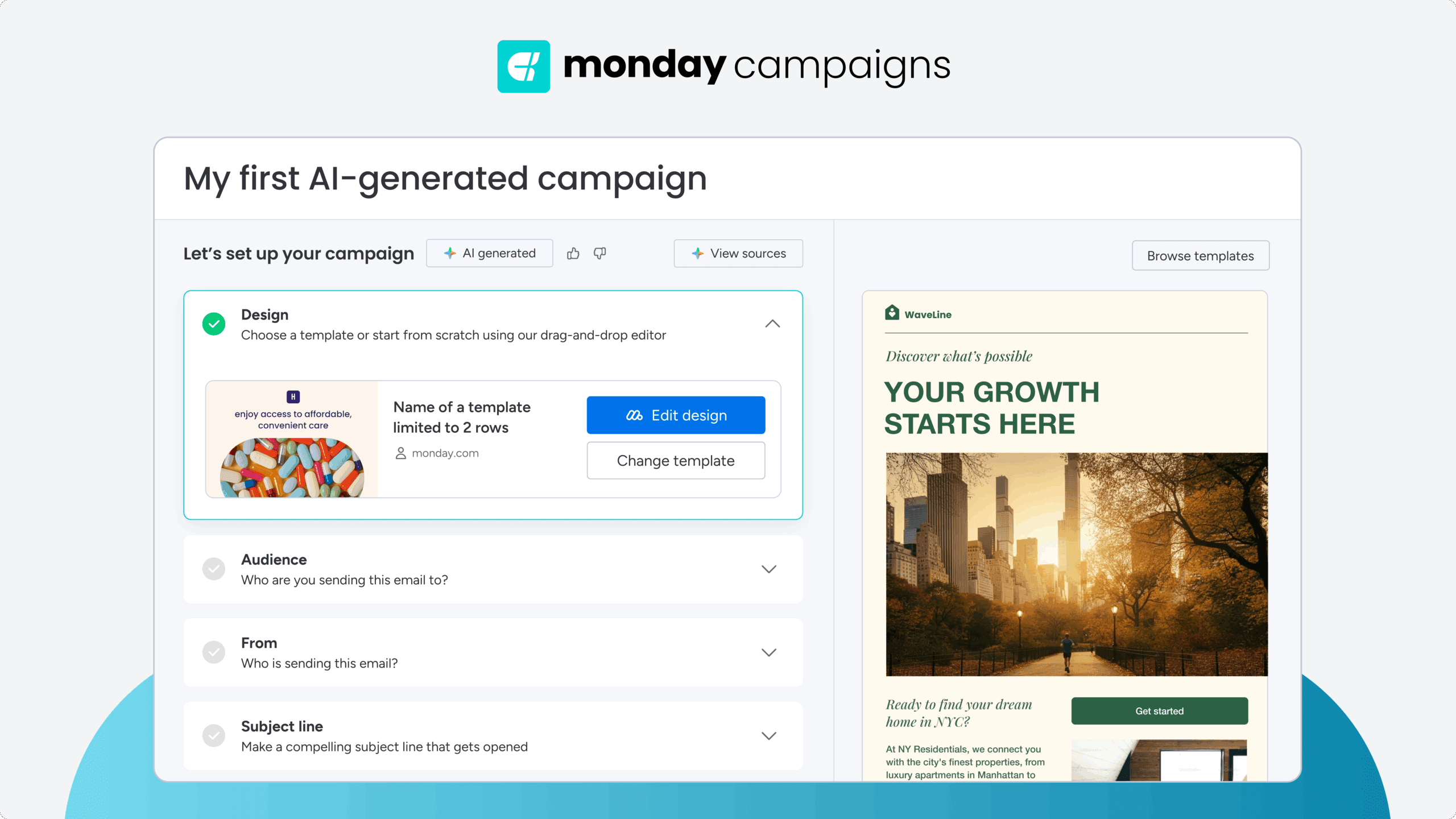
AI is evolving quickly, and the next wave of innovation will reshape how teams plan, create, and optimize campaigns. Here are a few trends to watch.
- Faster campaign execution: AI won’t replace marketers, but it will start handling multi-step workflows — drafting content, suggesting audiences, scheduling sends, and flagging issues — with minimal oversight.
- Hyper-personalization powered by real-time data:Personalization will continue to improve as AI models use richer customer data responsibly
- Unified cross-channel marketing orchestration: AI will coordinate campaigns across email, social, SMS, and ads, adjusting in real time as platforms and audience preferences shift.
- Smarter creative generation: Expect improvements in AI-generated videos, animations, and design assets, reducing reliance on external production.
- More transparent, accountable AI: Better controls, clearer data policies, and built-in guardrails will help teams use AI responsibly without sacrificing creativity or compliance.
Launch AI-powered campaigns that drive revenue with monday campaigns
With built-in AI capabilities, monday campaigns helps teams create, personalize, and measure marketing campaigns faster — all connected to the customer data in monday CRM.
AI-assisted campaign creation
Generate campaign assets in minutes. AI drafts email copy, recommends send times, and suggests audience segments based on your CRM filters. Set up A/B tests directly inside the platform to compare performance and refine your approach.
Seamless CRM integration
Native integration with monday CRM enables precise targeting and clearer attribution. Track interactions from first touch to closed deal, and use customer insights to inform ongoing optimization. Information flows automatically between systems so teams stay aligned.
Get to impact faster
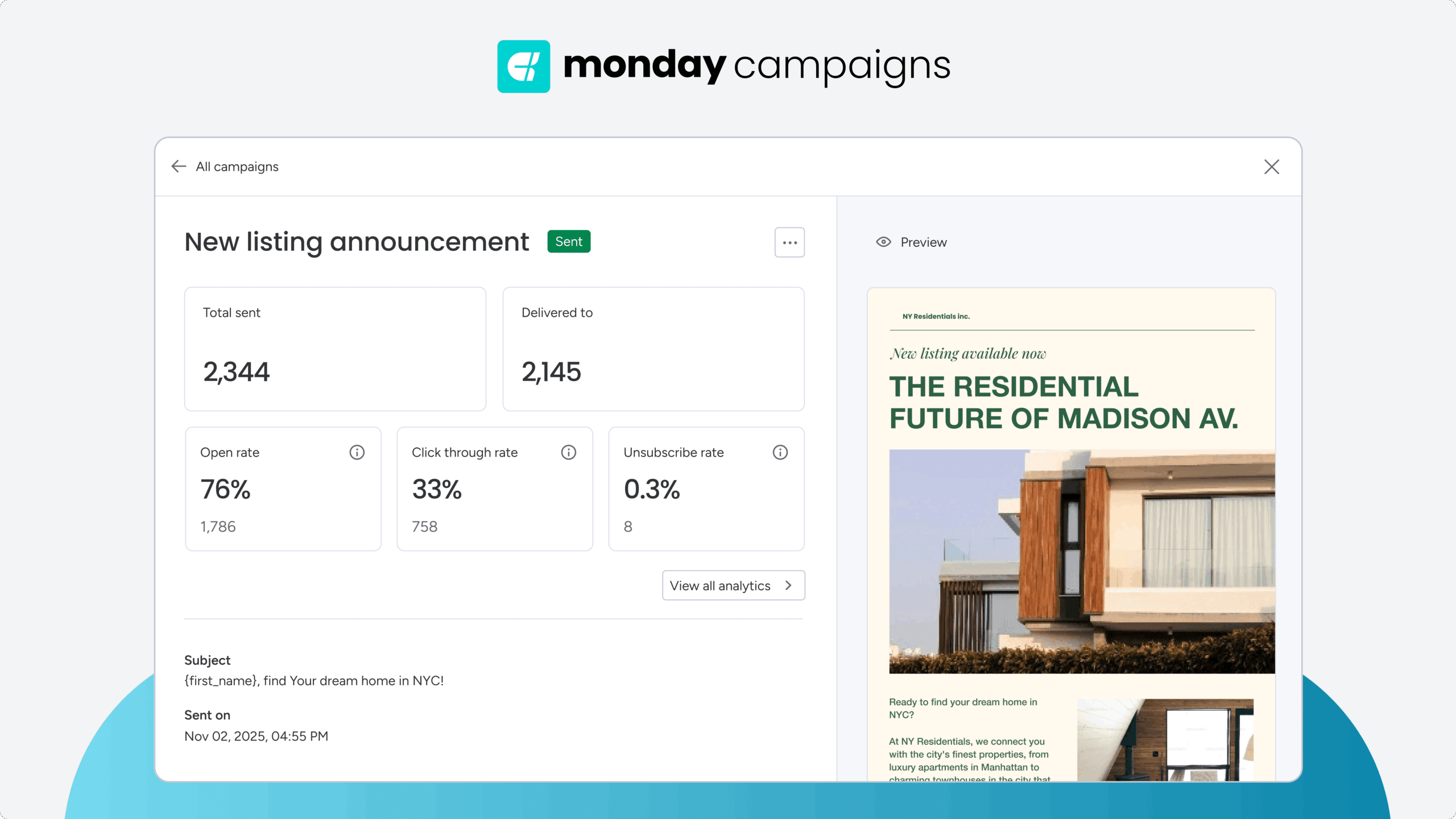
Streamlined setup makes it easy to get started. Intuitive dashboards display performance instantly and help you understand which campaigns drive engagement and pipeline movement.
Transform your content marketing with AI today
Using AI in content marketing means amplifying human creativity. The teams seeing the biggest wins are those who start now, learn fast, and scale what works. Every day you wait is another day competitors gain ground with faster campaigns, deeper personalization, and clearer revenue attribution.
The path forward is clear: map your workflow gaps, choose tools that integrate with your existing systems, and launch pilot projects that deliver quick wins. monday campaigns makes this journey straightforward by combining AI-powered content creation with native CRM integration, giving you everything you need to launch revenue-driving campaigns in minutes instead of weeks.
Stop guessing what content will resonate. Start using AI to know what works, automate what doesn’t matter, and focus your energy on strategy that drives real business growth. Your first AI-powered campaign is just minutes away.
Try monday campaignsFAQs
Will AI replace content marketers?
AI won't replace content marketers, but content marketers who know how to use AI will replace those who don't know how to use AI effectively.
How quickly can I see ROI from AI content marketing platforms?
Most teams see measurable ROI from AI content marketing platforms within 1 to 3 months. Quick wins like automated emails and optimized send times deliver immediate results, while broader transformations develop over time.
Do I need technical skills to use AI for content marketing?
Regarding whether you need technical skills to use AI for content marketing, the answer is no for most platforms, as they offer intuitive interfaces designed for marketers. Platforms like monday campaigns provide user-friendly workflows that anyone can master with basic training.
How do I maintain brand consistency with AI-generated content?
Maintain brand consistency by setting clear guidelines, implementing quality control processes, and using human oversight. monday campaigns allows you to embed brand rules directly in the platform, ensuring AI-generated content stays on-brand automatically.
Can AI help with video and visual content creation?
AI can generate videos, graphics, and images based on prompts or templates, though creative direction helps achieve best results. As visual AI advances, more content types become accessible without specialized design skills.

 Get started