


Marketing teams often get stuck choosing between overly manual personalization or generic blasts that don’t convert. An AI email generator removes that trade-off by helping you produce relevant, polished emails in seconds — all while using your CRM data to tailor messaging to the right audience.
In this guide, you’ll learn how AI automates email creation, streamlines campaign workflows, and enhances targeting and performance. We’ll also cover how connecting an AI email generator to your CRM elevates it from a simple writing tool to a strategic engine that builds smarter segments, optimizes results in real time, and ties every message directly to revenue impact.
Try monday campaignsKey takeaways
- Create professional emails in under 30 seconds, freeing up hours each week that teams previously spent on manual writing and editing.
- Scale personalized outreach across large contact lists using CRM and behavioral insights to tailor messaging at scale.
- Maintain consistent branding across all communications while improving open rates with AI-optimized subject lines and data-driven content enhancements.
- Connect AI email tools to your existing marketing automation and CRM systems to build seamless workflows that to build seamless workflows that help you connect email engagement to downstream results.
- With monday campaigns, you can combine AI email generation with full campaign management, CRM integration, and revenue insights to optimize your entire customer journey in one platform.
What is an AI email generator?
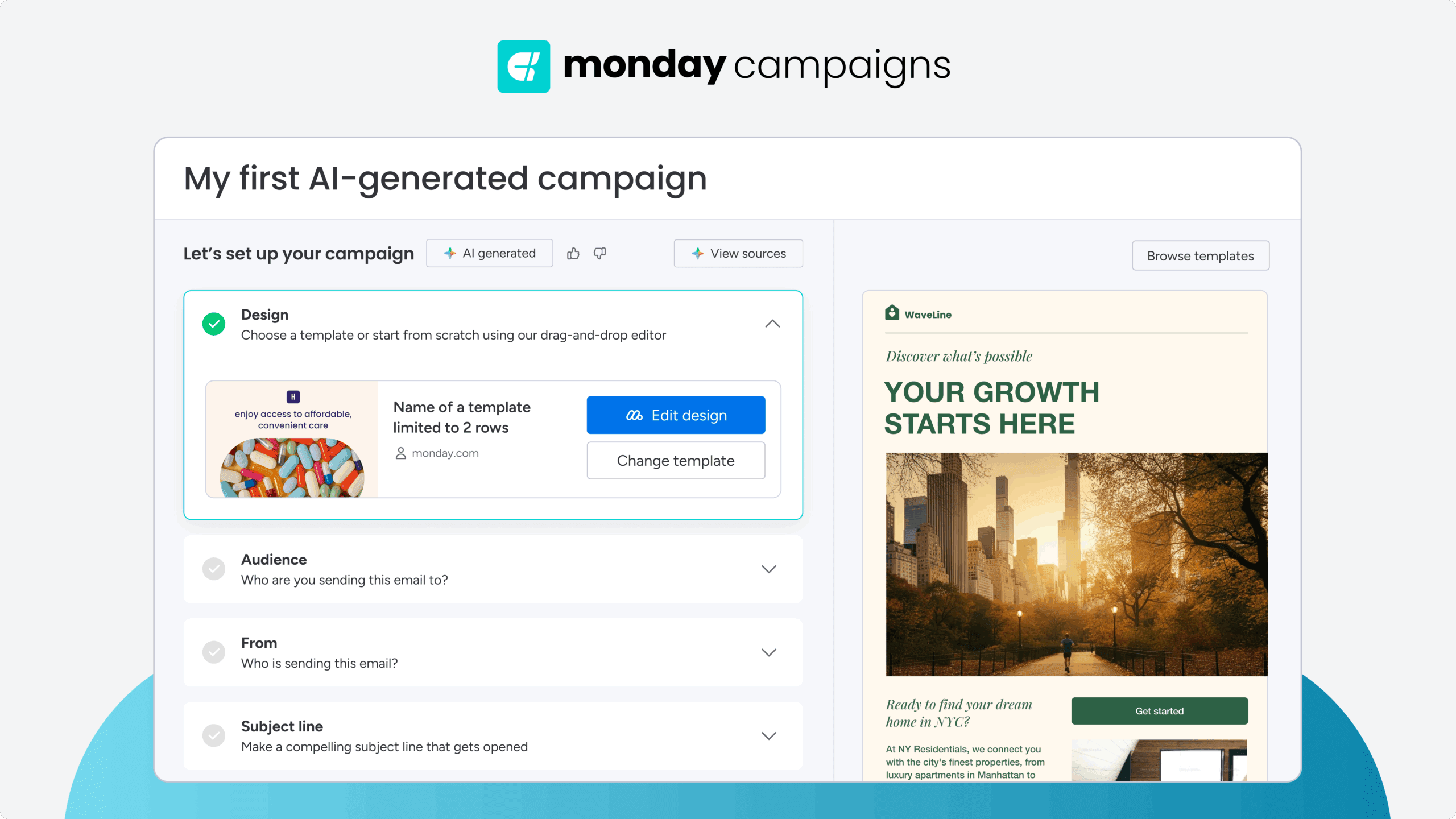
An AI email generator is software that uses artificial intelligence to automatically create email content based on your inputs. This means you provide context — like your audience, objective, and key message — and the AI produces a complete draft in seconds.
These platforms analyze patterns from successful emails and use natural language processing to generate messages that sound human and relevant. You get professional, on-brand content without spending hours crafting every sentence.
How AI email writers transform business communication
AI email writers change how organizations approach email creation. Speed increases dramatically — what once took 30 minutes now takes seconds. Consistency improves because every email maintains the same professional quality and brand voice.
The technology enables teams to scale their outreach without sacrificing personalization. You can generate hundreds of personalized variations simultaneously, each aligned to segment or recipient context, or leverage an AI sales pitch generator for specialized outreach.
AI email generation vs. traditional email platforms
Traditional email tools rely heavily on manual effort and static templates, which slows content creation and limits personalization. AI email generators take a fundamentally different approach. They create dynamic, context-aware content at scale — and can be refined over time based on performance data and team feedback. Here’s what sets them apart:
- Speed: Generate complete emails in seconds instead of spending 30–60 minutes writing.
- Personalization: Tailor each message to the recipient’s role, industry, history, and behavior.
- Learning ability: Improve output quality over time as the AI learns from engagement data.
- Consistency: Maintain a unified brand voice across all customer and internal communications.
Key features every professional email generator needs
A strong AI email generator should include:
- Advanced natural language processing (NLP): Helps the AI understand context and produce human-sounding content
- Brand voice training: Ensures every email reflects your organization’s tone and style
- Multi-language support: Enables global outreach without relying on external translation tools
- CRM and marketing platform integrations: Pulls in customer data and connects emails directly to your existing workflows
- Performance analytics: Tracks opens, clicks, conversions, and other metrics to measure ROI and refine future messaging
How AI email generators create professional emails
AI email generators produce professional emails by analyzing successful message patterns and applying natural language processing. The process ensures every email is relevant, on-brand, and optimized for engagement.
Understanding natural language processing for email AI
Natural language processing (NLP) is the AI’s ability to understand and generate human language. When you provide a prompt like “write a follow-up email for a demo no-show,” NLP interprets the situation and produces an appropriate message.
NLP enables the AI to distinguish between different contexts. A sales follow-up sounds different from a customer support reply, even when generated by the same platform.
Teaching AI your brand voice and tone
AI maintains brand consistency by learning from your existing communications. You provide sample emails and set tone preferences — formal or casual, technical or conversational.
The AI then mirrors these qualities in every message. A tech startup gets friendly, energetic emails while a law firm receives polished, professional messages. This happens automatically once you train the AI on your brand guidelines.
The 30-second email generation process
The AI email generation process unfolds quickly:
- First, the AI analyzes your input — context, recipient details, and objectives. This takes about 5 seconds.
- Next, the AI drafts a complete email using its database of high-performing patterns and your brand parameters. This step takes around 20 seconds.
- Finally, the finished email appears, ready for review. Total time: under 30 seconds.
7 game-changing benefits of using AI to generate emails
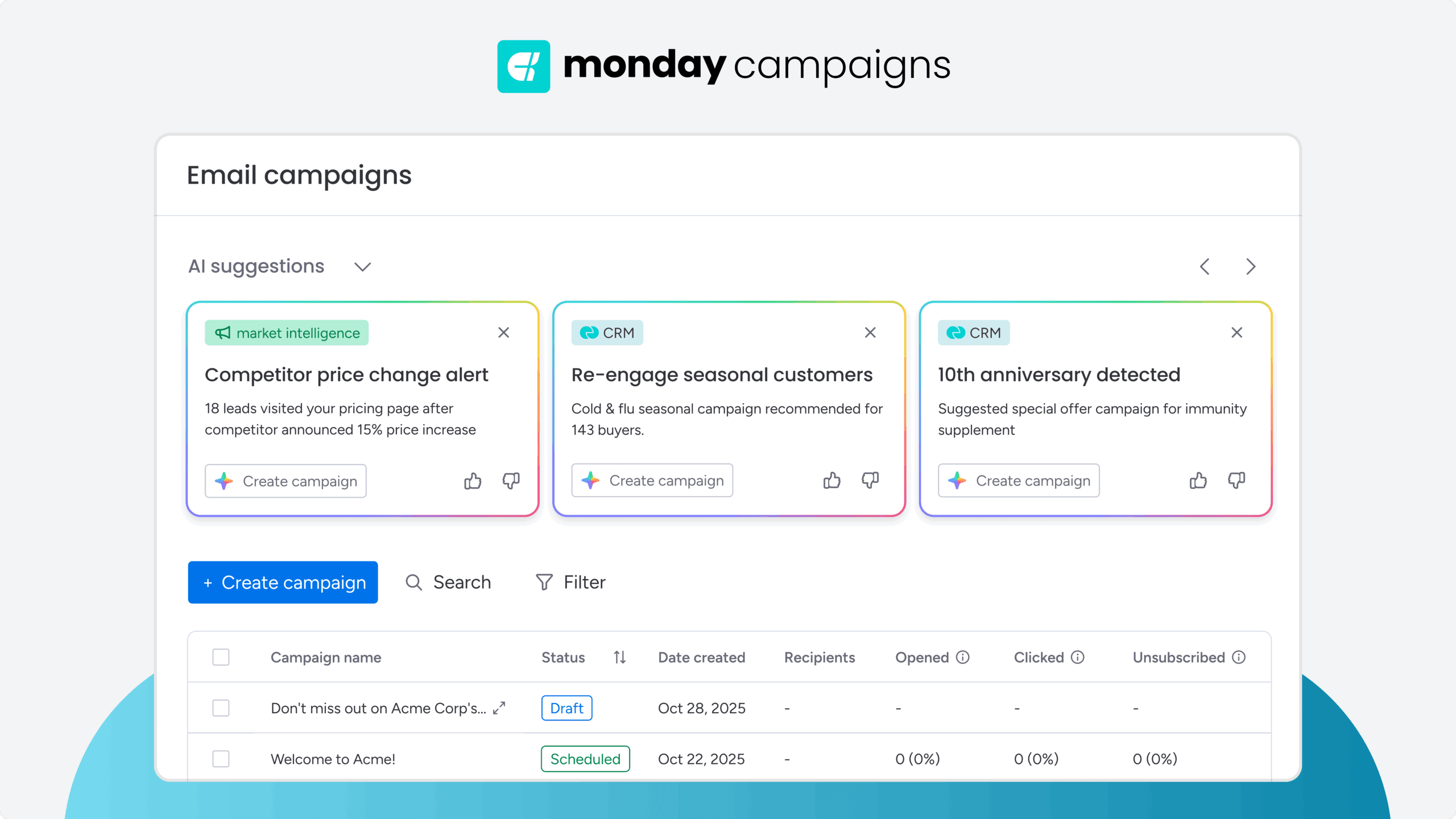
AI email writing addresses the challenges that slow marketing and sales teams down, and adopting AI sales and marketing solutions can amplify results across the board. These benefits translate into measurable business outcomes that impact your bottom line.
1. Create emails faster without sacrificing quality
Traditional email creation consumes 45-60 minutes per message when you include research, drafting, and editing. AI reduces this to mere minutes by eliminating the blank page problem. This aligns with broader findings that 55% of people believe AI helps save time in daily life.
Teams that previously spent 8 hours weekly on email creation now achieve the same output in 45 minutes. That freed time goes toward strategy and analysis instead of writing. Organizations with mature AI implementations are already seeing 22% efficiency gains that they can reinvest in growth initiatives.
2. Scale personalization across thousands of contacts
AI enables mass personalization beyond basic mail merge. Emails can incorporate role- or industry-relevant messaging when you provide the context. This level of personalization drives higher response rates than generic mass emails.
3. Maintain brand consistency every time
Brand voice consistency is challenging when multiple people write emails. AI solves this by producing uniform messaging regardless of who initiates the process.
Once trained on your guidelines, every email reflects the same tone and standards. This reduces approval delays and ensures a unified customer experience.
4. Boost open rates with AI-optimized subject lines
Subject lines determine whether emails get opened or ignored. AI analyzes high-performing subject lines and generates variations for testing.
You can instantly test 10 subject line options and identify top performers. This optimization previously required specialized copywriting skills and lengthy reviews.
5. Overcome language barriers and writer’s block
AI addresses 2 major obstacles: global communication and creative blocks. The technology produces fluent, natural-sounding emails in multiple languages. For writer’s block, AI provides instant starting points. You never face a blank page because the AI generates structured drafts immediately.
6. Generate data-driven content that converts
Teams can use performance data to refine prompts and content generated by AI. They analyze which phrases, structures, and calls-to-action generate results, then incorporate these elements into new emails.
As campaigns progress, the AI learns and improves. Click-through rates increase, more meetings get booked, and conversion rates rise over time.
7.Reinvest saved time into revenue-driving initiatives
By automating routine writing, AI unlocks your most valuable resource: time. Instead of spending hours drafting and editing emails, teams can shift their focus to campaign planning, customer conversations, and strategic initiatives that directly drive growth.
How to write emails with AI in 3 simple steps
Getting started with AI email generation is straightforward. This 3-step process produces professional results from day 1.
Step 1: Choose your email type and goal
AI needs context to create relevant content. Start by selecting your email type and desired outcome. Common types include:
- Cold outreach: Engaging new prospects
- Follow-up: Continuing conversations after meetings
- Marketing announcements: Launching products or features
- Event invitations: Driving attendance
- Customer onboarding: Welcoming new users
- Re-engagement: Winning back inactive customers
Specify your goal: booking meetings, driving traffic, or nurturing leads. This guides the AI to produce targeted content.
Step 2: Add context and key information
Provide details that help the AI understand your situation. Include recipient information like name, company, and role. Add relevant background such as previous interactions or known pain points.
More context produces richer emails. Even minimal information generates effective messages, but details like purchase history enable more personalized content.
Step 3: Refine and personalize AI output
AI-generated emails provide strong starting points. Review the content, adjust messaging as needed, and add personal touches.
This refinement takes minutes because the heavy lifting is done. If the first draft needs work, regenerate with different parameters for an improved version.
6 types of high-converting emails that AI excels at
AI email generators excel at creating specific email types designed to convert. Each serves a distinct purpose and drives measurable outcomes.
1. Cold outreach that actually gets responses
AI-generated cold emails avoid generic messaging. Each includes a personalized opening, identifies pain points, presents value, and ends with a soft call-to-action.
An email to a healthcare executive highlights compliance challenges. One to a startup founder focuses on growth. Both come from the same template but feel individually crafted.
2. Follow-up sequences that close deals
AI creates follow-ups that maintain momentum. These acknowledge previous interactions, offer value, address concerns, and guide recipients forward.
The AI adjusts tone based on sales stage. Early follow-ups are friendly, while later ones create appropriate urgency. This approach shortens sales cycles.
3. Marketing campaigns that drive action
AI optimizes marketing emails for specific actions — trial signups, event registrations, or purchases. Each includes compelling subject lines, benefit-focused messaging, and clear calls-to-action.
You can generate campaign variations for different segments simultaneously. This improves conversion rates without manual content creation for each group.
4. Customer success emails that build loyalty
AI powers retention emails for onboarding, feature announcements, and renewal reminders. Each maintains a helpful tone and delivers value.
These communications reduce churn and increase product adoption. Customers stay engaged because every email feels relevant to their needs.
5. Re-engagement campaigns that win back customers
AI targets inactive contacts by acknowledging the gap, providing new value, and offering simple re-engagement paths. Different approaches — special offers, updates, or check-ins — can be tested simultaneously.
This recovers lost opportunities and increases database value. Instead of letting contacts go cold, you re-engage them with fresh messaging.
6. Internal updates that get read
AI improves internal communications by creating concise, action-oriented emails. Clear subject lines, scannable content, and explicit next steps ensure messages get read and acted upon.
Teams stay aligned without lengthy meetings or follow-up clarifications. Information flows efficiently across the organization.
Try monday campaignsAdvanced personalization strategies with AI
AI-powered email generators go far beyond writing sentences. When used effectively, they enable deep personalization at scale, so every recipient gets messaging that feels tailored to them without requiring hours of manual editing.
Leverage CRM data for hyper-relevant messaging
Advanced AI tools can connect to CRM or customer data sources to personalize emails based on:
- Recent activity (support tickets, purchases, product usage)
- Behavioral patterns (opens, clicks, page visits)
- Role and industry
- Stage in the customer journey
- Custom data fields your team maintains
For example, a renewal reminder could mention a recent milestone (“Your team reached 85% feature adoption this quarter!”), a past support interaction, or an upcoming contract date. This level of relevance drives higher response rates and stronger customer relationships.
Create dynamic segments with AI intelligence
Instead of relying solely on static filters, advanced AI tools can help identify or support more granular segments when connected to your existing data. For example:
- High conversion likelihood
- Engagement recency
- Preferred communication style
- Product usage profiles
- Optimal send times
AI can generate variations tailored to different segments at scale — far beyond what manual segmentation can support.
Test multiple variations simultaneously
Large-scale testing is 1 of AI’s biggest advantages. AI can generate multiple variations of subject lines, email formats, CTAs, and tones all at once. Performance data then determines the winning versions, which the AI can incorporate into future drafts for continuous improvement.
Here’s how traditional testing compares to AI-driven testing:
| Task | Manual approach | AI-Powered approach |
|---|---|---|
| Create variations | Requires writer time | AI generates instantly |
| Deploy tests | Limited by resources | Test across many segments at once |
| Analyze results | Manual analytics review | AI identifies patterns automatically |
| Apply learnings | Needs writer/editor | AI adapts instantly for the next draft |
Use AI insights for continuous improvement
AI learns from every campaign. Over time, it begins to refine:
- Subject lines: based on open-rate patterns
- Content structure: based on click-through and scroll depth
- Timing: based on engagement windows
- Messaging themes: based on what resonates with specific segments
The result is a compounding effect—each campaign performs better than the last.
Integrating AI email generation into your marketing workflows
AI is most powerful when it’s not a standalone writing tool but a connected part of your CRM, automation, and analytics ecosystem. Integrations ensure smoother workflows and smarter decisions.
Connect AI tools to CRM for smarter campaigns
When AI has access to CRM data, teams can:
- Generate context-aware emails automatically
- Sync engagement data back to contact records
- Maintain consistent messaging across marketing and sales
- Build a unified view of each customer’s journey
This removes data silos and keeps every team operating from the same source of truth.
Sync AI with automation platforms
AI-powered emails can flow directly into:
- Automated sequences
- Trigger-based workflows
- Post-purchase nurturing
- Sales follow-up motions
- Onboarding journeys
This reduces repetitive manual work and ensures customers receive the right message at the perfect moment. Here are some example triggers AI can support:
| Trigger | Automated AI Action |
|---|---|
| Form submission | Sends personalized welcome email |
| Demo booked | Sends next-step instructions |
| Inactivity | Generates re-engagement email |
| Contract milestone | Creates renewal reminder |
Track revenue impact with integrated systems
When your email generation, CRM, and analytics connect, you gain full-funnel visibility:
- Which emails drive meetings
- Which sequences convert opportunities
- How email touches influence revenue
- Where to invest more (or less) effort
This attribution helps teams optimize strategy and justify investment in AI and automation.
Build complete AI-powered campaigns with monday campaigns
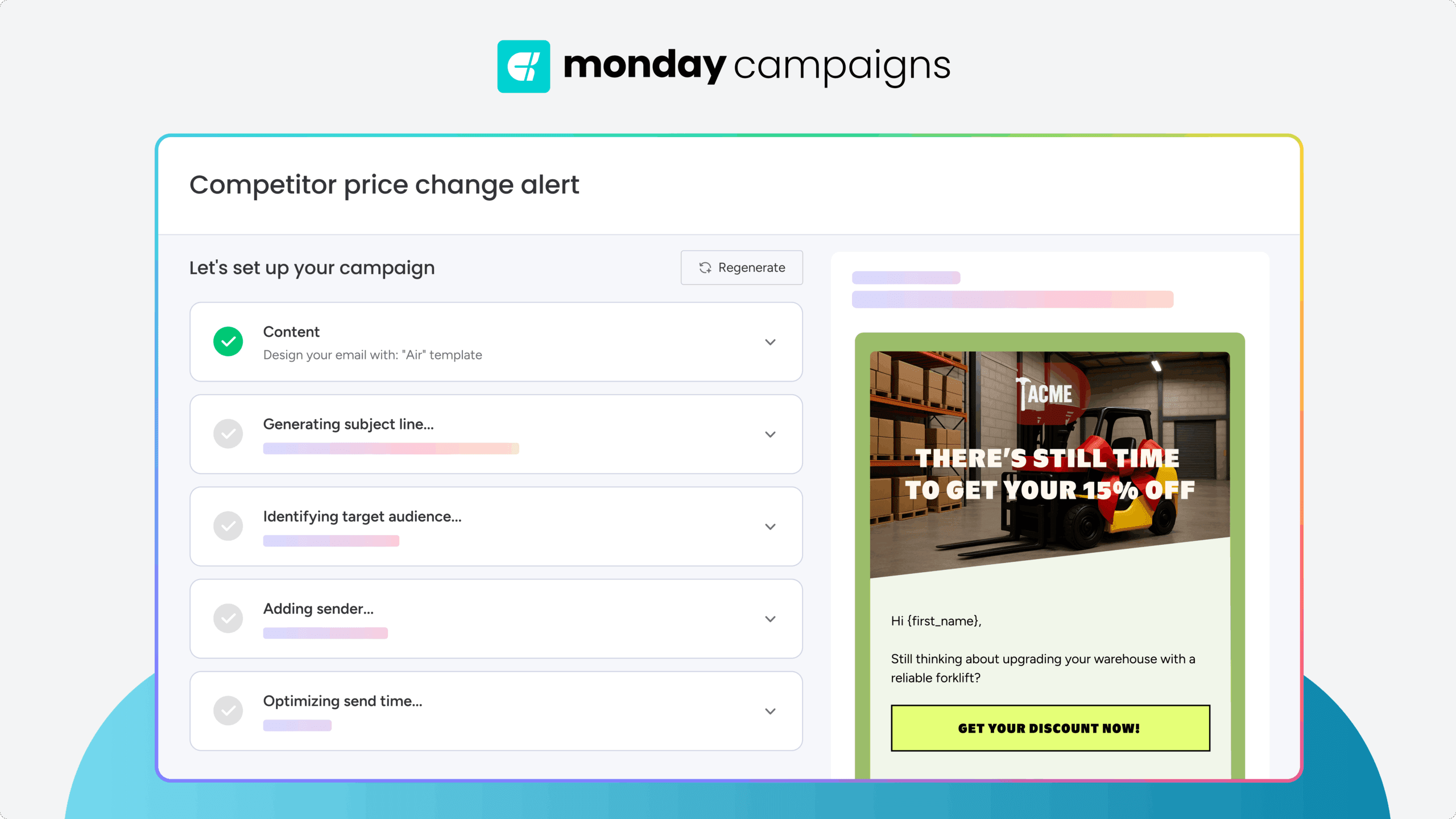
From personalization to segmentation to attribution, everything becomes significantly easier with monday campaigns. Instead of juggling disconnected tools, teams can manage the entire email lifecycle inside 1 unified platform.
Beyond single emails: Full campaign orchestration
With monday campaigns, you get support for end-to-end workflow execution:
- Plan campaigns
- Build segments
- Generate AI-powered email content
- Automate sends based on triggers or schedules
- Track engagement and revenue
This eliminates tool-switching and creates a smooth, efficient process for teams of every size.
AI that learns draws data from teams for better performance
Because monday campaigns lives inside monday CRM, the AI benefits from insights across sales, marketing, customer success, and support. This shared intelligence helps the AI produce smarter, more relevant messaging that aligns with your entire go-to-market motion.
Native CRM integration for frictionless workflows
Fully integrated into monday CRM, contacts, deals, and activities stay in sync. Follow-ups generate automatically, deal-based messaging can trigger on status changes, and sales and marketing collaborate with shared visibility. No third-party connectors. No syncing issues. Just seamless execution.
Track impact from lead to loyal customer
Attribution is easier with monday campaigns, too. You can measure open and click-through rates, track meetings booked and deals influenced, see the full journey from first email to closed-won, and understand which campaigns drive long-term retention.
This clarity helps teams double down on what works — and confidently retire what doesn’t.
Transform your email marketing with AI
AI email generation unlocks smarter campaigns that actually convert, and it’s easier than ever with monday campaigns. It combines AI-powered content creation with full CRM integration, automated workflows, and real-time revenue tracking, so you can personalize at scale without the manual work.
Ready to turn every email into a revenue opportunity? Try monday campaigns today and see how AI transforms your entire email strategy.
Try monday campaignsFAQs
Can AI email generators create entire campaign sequences?
Yes, AI email generators can create complete multi-email sequences including welcome series, nurture campaigns, and follow-up sequences. They maintain consistency across messages while personalizing content for individual recipients.
How do AI email platforms ensure enterprise data security?
Most professional AI email platforms prioritize enterprise data security with measures like encryption and GDPR-compliant practices. Be sure to review each vendor’s security documentation to confirm it meets your organization’s requirements.
Will AI-generated emails avoid spam filters?
AI-generated emails follow deliverability best practices to avoid spam filters, including proper formatting and avoiding trigger words. However, deliverability also depends on sender reputation, authentication setup, and list quality.
Can AI write effective emails in multiple languages?
Yes, many advanced AI email generators support multiple languages and can produce fluent, natural-sounding content. Some tools also offer features that help adapt tone and style for different regions and audiences.
What is the real cost of professional AI email generators?
Professional AI email generators typically cost less than hiring dedicated copywriters or agencies, especially at scale. Pricing varies by features and usage, but most organizations see positive ROI within months.
Do AI email generators work with existing marketing automation platforms?
Most professional AI email generators integrate with popular marketing automation platforms through APIs or native connections. This allows teams to enhance existing workflows without replacing current systems.

 Get started