


It’s easy to celebrate big numbers like rising website traffic, buzzing social posts, and a steady stream of new leads. However, when the conversation shifts to how much revenue that effort actually generated, the room often goes quiet. This gap between activity and impact is more than just frustrating; it makes it difficult to prove that marketing is truly driving growth.
Establishing clear marketing goals that link daily tasks to real business outcomes bridges this divide, making results both visible and undeniable.
Below, we explore practical ways to define and track impactful marketing goals, build SMART objectives aligned with company priorities, and adapt targets as market conditions evolve. By focusing on outcome-based goals, teams can move beyond flashy vanity metrics and consistently prove value through tangible business results.
Key takeaways
- Marketing goals connect activity to outcomes: Clearly defined goals ensure every marketing effort drives measurable business results, bridging the gap between daily tasks and revenue growth.
- SMART goals improve accountability: Using Specific, Measurable, Achievable, Relevant, and Time-bound objectives turns vague aspirations into actionable plans that teams can realistically achieve.
- Hierarchy ensures focused execution: Differentiating between goals, objectives, and KPIs aligns teams on priorities, so daily activities directly contribute to strategic outcomes.
- Data-driven tracking boosts performance: Regular measurement, dashboards, and analytics enable timely decisions and allow marketing to adapt tactics while keeping goals intact.
- Centralized goal management enhances alignment: Platforms like monday work management help link strategy to execution, giving teams visibility across projects and ensuring everyone is working toward the same objectives.
What are marketing goals?
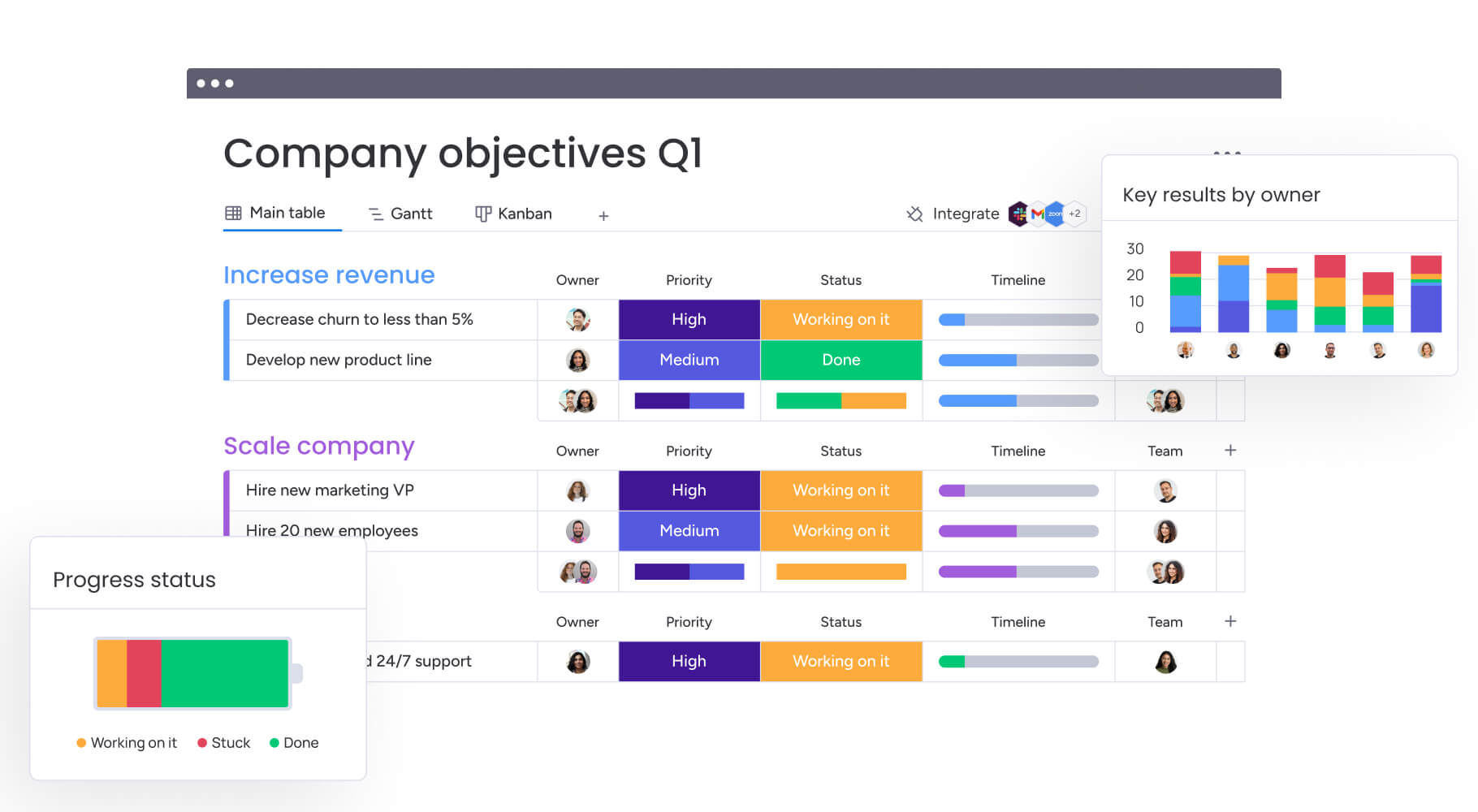
Marketing goals are clear, measurable outcomes that guide a team’s efforts and connect daily work to real business results. They act as a bridge between company vision and the campaigns that drive revenue, customer acquisition, and brand growth. With concrete goals, marketing becomes more than an expense, it transforms into a growth engine that brings measurable impact.
When goals are well-defined, teams can confidently justify budgets, forecast results, and demonstrate tangible progress. They provide a framework for making smart decisions, allocating resources effectively, and identifying what’s actually driving success. Clear targets turn uncertainty into action and give everyone a shared direction.
Marketing goals drive tangible business impact by transforming abstract visions into measurable results:
- Revenue predictability: Goals transform revenue targets into actionable steps. By reverse-engineering revenue into marketing deliverables, teams can forecast outcomes with confidence.
- Resource optimization: Clear objectives prevent wasted spend. Knowing exactly what to achieve ensures money isn’t poured into channels that underperform.
- Organizational alignment: Shared goals keep marketing, sales, product, and leadership on the same page. Everyone understands how individual contributions fit into the broader strategy, which strengthens collaboration and accountability.
Leading organizations address this challenge by centralizing goals alongside the work that supports them. Additionally, when goals live in the same workspace as campaigns, budgets, and team assignments, everyone maintains visibility into what matters most.
When goals are well-defined, teams can confidently justify budgets, forecast results, and demonstrate tangible progress.
Marketing goals vs objectives vs KPIs
Confusing goals, objectives, and KPIs can lead to messy execution and unmet expectations. The most effective marketing strategies follow a clear hierarchy: day-to-day work feeds specific targets, which collectively drive larger strategic outcomes.
Understanding these distinctions helps teams focus on meaningful work and achieve measurable wins:
| Level | Definition | Scope | Example |
|---|---|---|---|
| Marketing goal | Broad, long-term outcome the strategy intends to achieve | Strategic/annual | Establish the brand as the primary thought leader in the fintech space |
| Marketing objective | Specific, measurable steps taken to achieve the goal | Tactical/quarterly | Publish four expert whitepapers per quarter and secure two keynote speaking slots at major industry conferences |
| Marketing KPI | Precise metrics are used to track progress toward the objective | Operational / weekly | Whitepaper download rate, keynote attendee engagement score, and organic traffic to research pages |
11 essential marketing goals that generate measurable results
The most effective marketing goals focus on tangible business outcomes, not just vanity metrics. These eleven goals drive measurable growth for mid-to-large organizations by linking everyday efforts to real results. Below, each goal is explained with why it matters, the metrics that show success, and what it takes to achieve it.
1. Build brand awareness that converts to revenue
Brand awareness ensures the target audience knows the brand exists and understands its offerings. It fills the top of the funnel and sets up every other marketing initiative.
- Share of voice (SOV): Measures your brand’s presence compared to competitors.
- Direct traffic growth: Tracks visitors who come to your site by typing your URL directly.
- Brand search volume: Monitors how often people search for your specific brand name.
Implementation requires consistent messaging across channels, including social media marketing. The challenge lies in connecting awareness to revenue, which requires long-term tracking and robust attribution models.
2. Generate high-quality leads at scale
Lead generation equips the sales team with qualified prospects to meet revenue goals. In this context, both quantity and quality matter for building a reliable pipeline.
- Marketing Qualified Leads (MQLs): These are leads that marketing has vetted as potentially ready for sales.
- Sales Qualified Leads (SQLs): Represent leads that the sales team has accepted for direct follow-up.
- Lead-to-opportunity conversion rates: This percentage tracks how many leads successfully move into the sales pipeline.
Alignment between sales and marketing is critical. Defining what qualifies as a valuable lead ensures the pipeline remains filled with opportunities that can truly convert.
3. Accelerate the customer acquisition rate
Moving prospects through the funnel faster shortens sales cycles and speeds up revenue recognition. Identifying bottlenecks and streamlining processes makes a big difference.
- Customer Acquisition Cost (CAC): Calculates the total cost required to gain a new customer.
- Time-to-close: Measures the average duration from first contact to a signed deal.
- Conversion rate by stage: Highlights where prospects drop off during the buyer’s journey.
Collaboration with sales operations helps pinpoint stages where acceleration is possible, allowing marketing to intervene strategically.
4. Maximize customer lifetime value (CLV)
CLV optimization means squeezing more profit from each customer over time. It shifts your focus from just acquiring customers to building long-term value.
- Average revenue per user (ARPU): Tracks the average income generated by a single customer.
- Purchase frequency: Monitors how often customers return to buy again.
- Gross margin per customer: Reveals the actual profit remaining after service delivery costs.
Marketing must shift focus from acquisition to engagement, requiring a refined marketing strategy based on customer usage and satisfaction patterns.
5. Drive customer retention and loyalty
Retention stabilizes revenue and reduces churn, making growth more predictable. Moreover, keeping existing customers costs less than acquiring new ones, so retention programs are highly efficient.
- Churn rate: Measures the percentage of customers who stop using your service.
- Net Promoter Score (NPS): Gauges customer satisfaction and likelihood of referral.
- Renewal rate: Tracks the percentage of customers who extend their contracts.
To succeed, you’ll need proactive communication and tight alignment with customer success to catch at-risk accounts early.
6. Increase revenue through strategic upselling
Upselling grows revenue from existing accounts by moving them to higher-tier plans or adding products. It uses relationships you’ve already built to drive growth.
- Expansion revenue: Calculates the new revenue generated from existing customers.
- Upsell conversion rate: Tracks how effectively you move customers to premium tiers.
- Average order value: Measures the typical amount spent per transaction.
Ultimately, success comes down to timing and data. Marketing needs to see how customers use the product so they can trigger the right offers at the right time.
7. Expand market share in target segments
Market share expansion means beating competitors and grabbing a bigger slice of your total addressable market.
- Market penetration rate: Shows your reach within a specific industry or demographic.
- Relative market share: Compares your sales volume directly against your top competitors.
Because of the competitive nature of this goal, it demands aggressive positioning and usually more ad spend to get noticed.
8. Establish industry thought leadership
Thought leadership builds trust and authority, so your brand becomes the go-to for complex solutions. You become the expert buyers call first.
- Media mentions: Tracks how often your brand or experts are cited in the press.
- Speaking invitations: Measures your influence at major industry conferences and events.
- Backlink quality: Monitors links from authoritative sites, boosting SEO and credibility.
Implementation demands high-quality, original research and expert content through a solid creative strategy, not just promotional material.
9. Optimize marketing ROI across channels
ROI optimization means putting your budget where it performs best. Therefore, every dollar should work as hard as possible.
- Return on Ad Spend (ROAS): This measures revenue earned for every dollar spent on advertising.
- Cost per acquisition by channel: This highlights which platforms provide the cheapest new customers.
- Overall marketing ROI: This provides the total financial return on all marketing investments.
Accurate attribution modeling is vital, allowing teams to evaluate performance and make data-driven budget decisions.
10. Create scalable brand advocacy
Brand advocacy turns happy customers into a marketing channel through referrals and word-of-mouth. Real customer voices beat paid ads every time.
- Referral traffic: Monitors visitors coming from customer-shared links.
- Number of case studies: Tracks the creation of social proof through success stories.
- Customer reviews: Measures the volume and sentiment of public feedback.
While powerful, building advocacy programs is tricky. You need to incentivize customers without making their praise feel bought.
11. Build valuable first-party data assets
First-party data means you own your audience data instead of relying on third-party cookies and platforms. It protects your marketing as privacy regulations get stricter.
- Database growth rate: Tracks the expansion of your owned audience over time.
- Profile completeness: Measures the depth of data collected for each lead.
- Email list engagement: Reflects how actively your audience interacts with your communications.
It’s critical for protecting your marketing future, but you’ll need strict privacy compliance and clear value exchanges with customers.
These eleven goals drive measurable growth for mid-to-large organizations by linking everyday efforts to real results.
How to create SMART marketing goals your team will achieve?
The SMART framework transforms vague aspirations into actionable plans. For marketing teams, this methodology ensures creativity is grounded in operational reality. Each piece fixes a common problem with traditional goal-setting.
- Specific: A goal must clearly define what you want to achieve, who is responsible, and which resources are required. For instance, “increase traffic” is vague. “Increase organic blog traffic by 20% among enterprise users” answers the what, who, and where.
- Measurable: Success must be quantifiable. Because establishing a baseline ensures you can track progress accurately, you should understand the difference between leading indicators like publishing frequency and lagging indicators like revenue.
- Achievable: Goals should be ambitious yet realistic. Consider budget, team capacity, and available technology. If achieving a goal would require a 50% budget increase that isn’t available, it’s not feasible.
- Relevant: Every marketing goal should tie back to company priorities. For example, aggressive acquisition may be off-target if leadership focuses on retention. Ensure your team is solving the right business challenges.
- Time-bound: Deadlines create focus and urgency. Set a final date and intermediate milestones. This prevents procrastination and allows adjustments if early progress falls short.
SMART goal validation template
Before committing, validate each goal with this template to ensure alignment and feasibility:
| Component | Question to answer | Example |
|---|---|---|
| Specific | What exactly will you achieve? | Generate 500 qualified leads from the healthcare sector |
| Measurable | What metric proves success? | Validated MQLs in the CRM |
| Achievable | Do you have the budget/team? | Yes, utilizing the Q3 paid social budget and existing content assets |
| Relevant | Does this help the business? | Yes, supports the company's Q3 objective to enter the healthcare vertical |
| Time-bound | When is the deadline? | By September 30th, with monthly checkpoints |
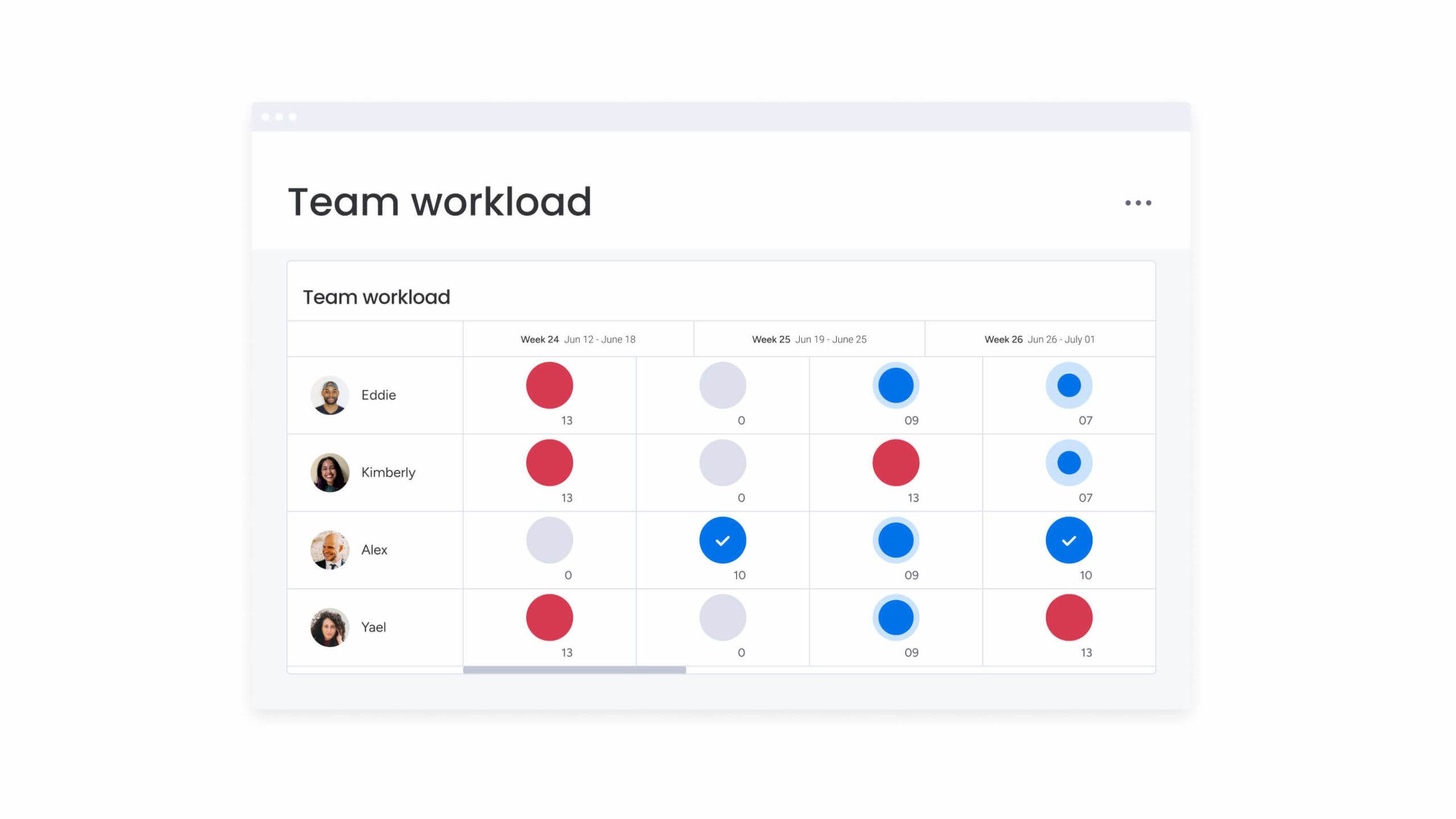
With monday work management, each SMART component can be built directly into goal boards. Moreover, this ensures every goal has clear success criteria before it enters execution.
5 steps to align marketing goals with business strategy
Marketing goals should directly connect to the financial and operational company targets. These five steps help translate executive strategy into marketing execution, ensuring each initiative drives measurable results.
Step 1: start with company revenue targets
Start with the top-line revenue number. If the company aims for $50M in annual recurring revenue, marketing leadership must understand the gap between current revenue and that target. This number keeps marketing focused on solving a math problem, not just running creative campaigns.
Step 2: calculate required marketing contribution
Determine how much marketing needs to contribute to reach revenue targets. Examine historical data such as:
- Average deal size: Represents the typical revenue generated from a single closed customer.
- Sales cycle length: Tracks the total time from initial lead capture to a final purchase decision.
- Close rates: Measures how many sales opportunities ultimately convert into paying customers.
If marketing drives 40% of your pipeline and your close rate is 20%, you can calculate exactly how many leads you need.
Step 3: map goals to customer journey stages
Because revenue takes time to materialize, you must spread goals across your funnel to keep the pipeline flowing consistently. To achieve this, you should categorize your objectives as follows:
- Early-stage goals: Focus on awareness and traffic.
- Mid-stage goals: Emphasize lead capture and nurturing.
- Late-stage goals: Support sales enablement and conversion.
This keeps your pipeline healthy and moving.
Step 4: allocate resources based on potential impact
Some goals matter more than others. Put your resources where they’ll have the biggest impact. If 80% of revenue comes from enterprise clients, 80% of the budget and headcount should support enterprise-focused goals. Focus your resources for maximum impact.
Step 5: create cross-departmental accountability
Marketing cannot succeed alone. Sales must follow up on leads, product teams must deliver features, and customer success needs to retain users. Shared OKRs encourage other departments to support marketing outcomes, creating collective ownership.
A modern platform like monday work management makes this easy. Teams can assign ownership across departments and track dependencies in real time using connected boards and dashboards.
Track and measure marketing goal performance

Measurement is continuous, not a one-time check. Effective tracking provides insights that allow immediate action. Different goals require different measurement frequencies based on data speed and campaign impact.
Goal measurement frequency framework
Use this framework to monitor performance across different marketing goal categories:
| Goal category | Primary metric | Secondary metric | Measurement frequency |
|---|---|---|---|
| Awareness | Share of voice | Brand search volume | Monthly |
| Lead generation | Cost per lead (CPL) | Lead quality score | Weekly |
| Conversion | Funnel conversion rate | Sales cycle length | Monthly |
| Retention | Net revenue retention | NPS / CSAT | Quarterly |
Building real-time performance dashboards
To act quickly, dashboards must provide live insights from all data sources in one single view. Therefore, highly effective dashboards should include:
- High-level status indicators: Should be placed at the top for immediate visibility.
- Trend lines: Show progress over time to identify growth patterns.
- Detailed breakdowns: Allow for a much deeper analysis of specific segments.
Ultimately, the goal is answering “Are you on track?” in less than five seconds.
Using AI to predict goal achievement
AI analyzes current performance against historical trends, alerting teams if a goal is at risk. This lets leaders intervene early, adjusting spend or tactics to keep teams on target.
For instance, monday work management integrates AI insights into goal tracking. Portfolio Risk Insights flags issues by severity and generates actionable alerts, helping teams proactively stay on course.
When to review and adjust marketing goals?
Agility is a competitive advantage, but constant shifting creates chaos. A structured review cadence balances consistency with market reality, ensuring teams stay responsive without losing focus on long-term objectives.
Three-tier review structure
Here’s a structured approach to reviewing marketing goals regularly, ensuring your team stays on track while adapting to changing market conditions:
- Monthly check-ins: Focus on tactical execution and adjust campaigns, messaging, or channels if metrics are off.
- Quarterly realignment: Review whether the goals themselves need adjustment due to market changes. Pivot strategy when necessary.
- Annual planning: Audit successes and failures to guide next year’s strategy, resource allocation, and goal priorities.
Decision framework for adjustments
Know when to adjust tactics versus the goal itself:
- Adjust tactics: When the goal is right, but the method is failing (e.g., lead volume is low, so you try a new ad platform).
- Adjust goals: When the market or business context has changed fundamentally (e.g., product launch delayed, rendering the Q1 acquisition goal impossible).
- Adjust resources: When the goal is right, and tactics are sound, but volume is insufficient (e.g., CPA is good, but the budget is too low to hit the total volume).
Turn marketing goals into real results with monday work management


“monday.com has been a life-changer. It gives us transparency, accountability, and a centralized place to manage projects across the globe".
Kendra Seier | Project Manager
“monday.com is the link that holds our business together — connecting our support office and stores with the visibility to move fast, stay consistent, and understand the impact on revenue.”
Duncan McHugh | Chief Operations OfficerMarketing teams often struggle to translate daily tasks into measurable business growth. monday work management addresses this challenge by connecting everyday work to strategic goals, making impact visible across departments.
- Fragmented visibility across teams: Centralized dashboards provide a unified view of campaigns, budgets, and KPIs.
- Time lost to repetitive updates: Automation triggers and alerts reduce manual reporting and ensure timely notifications.
- Misalignment between strategy and execution: Connected workflows break high-level goals into actionable processes for each team member.
- Difficulty predicting outcomes: AI-powered insights analyze trends and forecast potential risks, enabling proactive decision-making.
- Scaling complex initiatives: Enterprise-grade structure supports thousands of projects without compromising oversight.
By linking strategy, execution, and analytics in one platform, teams gain efficiency, alignment, and measurable impact, allowing marketing to drive real business results without added complexity.
Frequently asked questions
What are the 5 most important marketing goals?
The five most important marketing goals are lead generation, customer acquisition, customer retention, brand awareness, and marketing ROI optimization. These cover the full lifecycle of revenue generation and business sustainability.
How do you write SMART marketing goals?
To write a SMART goal, ensure it is Specific, Measurable, Achievable, Relevant, and Time-bound. For example: "Generate 500 MQLs from the finance sector by Q3 using existing content assets to support the sales expansion target."
What is the difference between marketing goals and marketing objectives?
Marketing goals are broad, long-term strategic outcomes like "become the market leader." Marketing objectives are specific, measurable steps taken to achieve those goals, such as "increase market share by 5% in the next twelve months."
How often should marketing goals be reviewed?
Performance against goals should be reviewed monthly to allow for tactical adjustments. A deeper strategic review should happen quarterly to assess whether the goals themselves remain relevant to business conditions.
What metrics best measure marketing goal success?
The best metrics measure business outcomes rather than activity. To best measure marketing goal success, focus on metrics that measure business outcomes, such as conversion rate, cost per acquisition (CPA), customer lifetime value (CLV), and revenue attribution.
How do you align marketing goals with sales targets?
Alignment requires shared definitions and shared incentives. Marketing and sales should agree on the definition of a qualified lead and set goals based on the revenue pipeline required to hit the company's total sales target.

 Get started