


A founder you passed on 18 months ago lands back in your inbox with traction, a new lead investor, and real momentum. The context exists somewhere — scattered across email threads, docs, and a half-filled CRM record — but pulling it together shouldn’t be this hard.
This article covers what makes a CRM fit for venture capital, which features matter most, and how 12 platforms handle deal flow that pauses, loops back, and keeps evolving. We’ll explore AI capabilities, integrations, pricing, and the tradeoffs between purpose-built VC software and flexible platforms that adapt to how your fund actually works.
What is a CRM for venture capital?
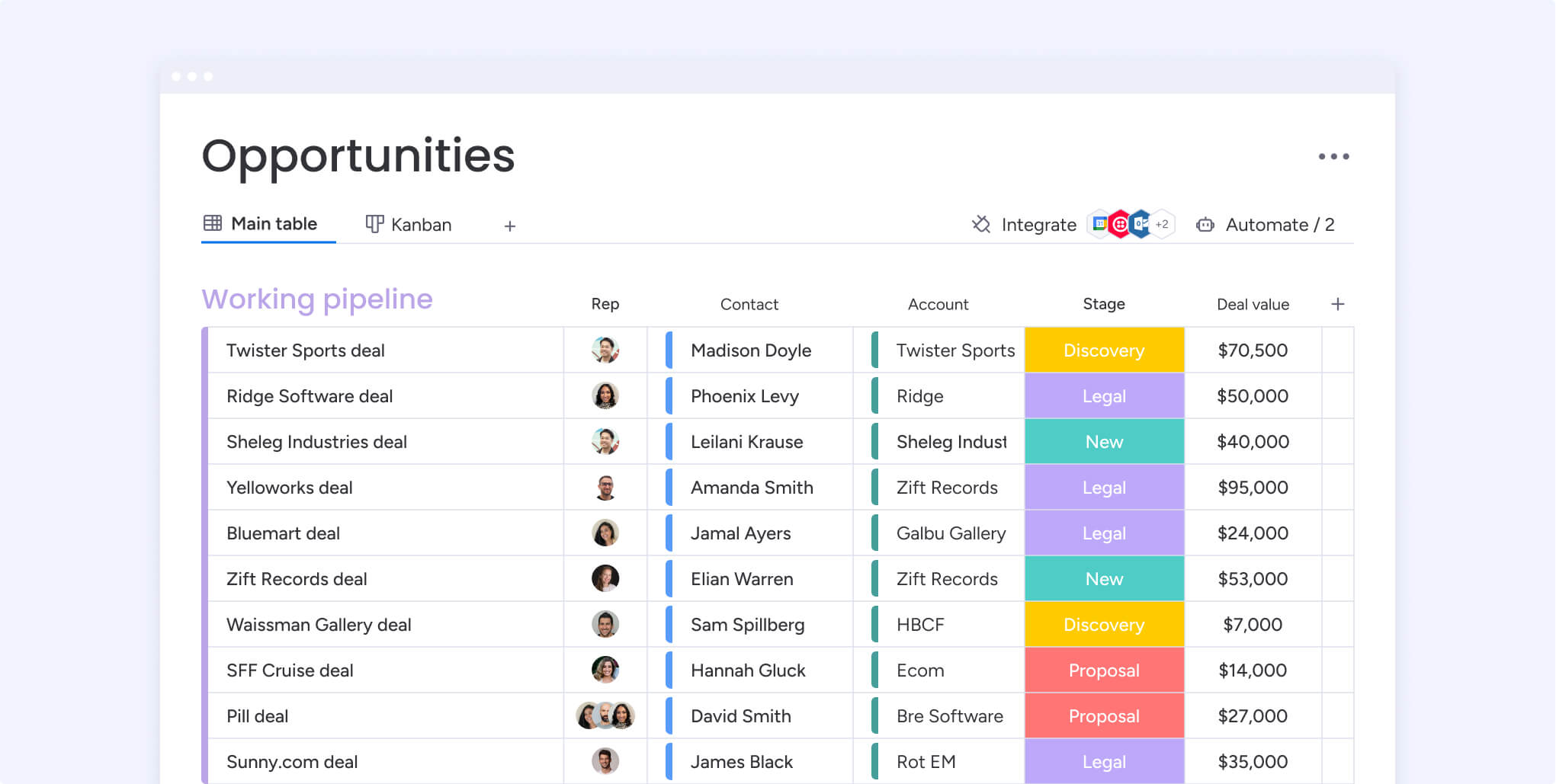
Standard CRMs assume progress happens in a neat sequence. Venture capital doesn’t work that way. It runs on layered, long-range relationships rather than a predictable sales funnel, and a “no” this quarter may easily become a “yes” 3 years from now. If you’re still forcing complex deal activity into a basic pipeline, the system is probably working against you.
A VC-ready CRM tracks the relationships, context, and history that matter when opportunities stretch across years instead of sales cycles. Instead of treating every interaction like a linear push toward close, you see the full network around each opportunity. That includes:
- Complex deal flow: Keep tabs on opportunities, even the ones that go quiet and pop back up months later.
- Network intelligence: See how everyone is connected — founders, LPs, and co-investors — so you never miss an angle.
- Full-cycle oversight: Monitor portfolio companies and source new deals from the same place, long after a term sheet is signed.
Some firms want rigid, purpose-built systems. Others need room to shape the platform around how they already work. monday CRM lets teams design the workflows they need to track deals, map relationships, and manage the portfolio on their own terms. That adaptability is the difference between a useful operating system and a silo no one trusts.
Try monday CRMWhy venture capital needs a CRM built for non-linear deal flow
Traditional CRMs treat every opportunity like a one-way path: move it forward or mark it lost. Venture capital doesn’t behave that way. A founder you passed on years ago might now be raising a Series A, and if your CRM can’t surface that history, you’re starting from zero when you shouldn’t be.
Manage deals that pause, restart, and reappear
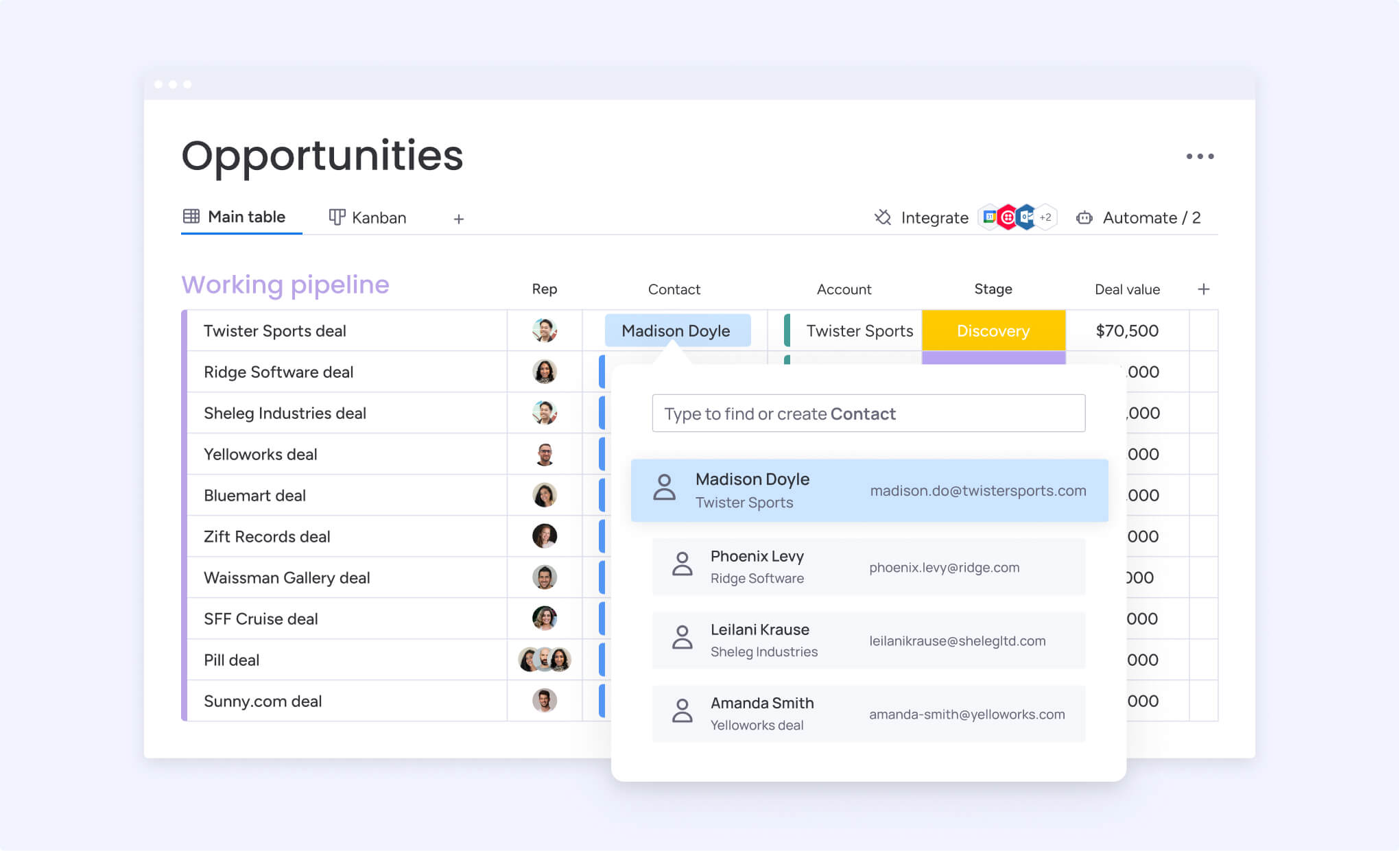
Dormant deals come with the territory in venture. A company that feels premature now can become a strong fit later. If those earlier conversations disappear into an archive, the cost isn’t administrative — it’s missed opportunity.
You need a pipeline that can flex with reality. monday CRM lets teams create stages that reflect how VC actually works instead of mirroring a rigid sales process. A deal can move from “Watching” back to “Diligence” and keep every note, update, and thread intact.
Track relationships across founders, LPs, and co-investors
Roles change fast in venture. A founder becomes an LP, then a co-investor on another deal. Standard CRMs flatten that nuance into a single contact record.
The right setup captures the relationship in full. Keep founders, LPs, and co-investors in one system, but give each their own workflow and context. You need to understand who knows whom without rummaging through scattered docs and spreadsheets.
Extend workflows beyond the investment team
Investment work doesn’t end at the deal record. It spills into legal review, LP updates, and portfolio support. When the CRM only serves the investment team, everyone else relies on side channels and manual handoffs.
monday CRM gives you one workspace for deal flow, LP relationships, and portfolio tracking. Instead of adding another disconnected platform to the stack, you keep those workflows under one roof.
Done well, a CRM becomes more than a tracker. It sharpens decisions, strengthens relationships, and surfaces context exactly when your team needs it.
12 popular CRMs for venture capital firms
Not every CRM here was created specifically for venture capital, and that’s part of the appeal. Some products are tailored for deal flow from the start; others earn their place by being flexible enough to fit a fund’s process. Below, we’ve broken out the leading options so you can weigh what matters most for your team.
| Platform | Use case | Free trial* | Notable feature | Starting price* |
|---|---|---|---|---|
| monday CRM | Flexible deal flow and relationship management for funds that want to shape the system around their process | 14 days | Custom fund apps with monday vibe | $12/seat/month |
| Affinity | Network-driven sourcing with automated relationship intelligence | No | Relationship strength scoring | $2,000/user/year |
| Salesforce | Enterprise-grade CRM for established VC firms managing complex data structures | No | Zero-copy data federation | $25/user/month |
| Pipedrive | Visual pipeline for solo GPs and lean teams that want simple deal tracking | No | Activity-based sales model | $14/seat/month |
| 4Degrees | Relationship intelligence for firms that source through warm introductions | No | Warm intro path mapping | Quote-based |
| DealCloud | AI-enabled platform for mature funds managing deal flow, LPs, and fund administration | No | Integrated market data via DataCortex | Quote-based |
| HubSpot | Content-driven sourcing and LP outreach with marketing automation | No | Email automation and sequencing | $20/seat/month |
| Navatar | Venture-specific workflows built on Salesforce infrastructure | No | Network-led sourcing | Quote-based |
| Dialllog | Lightweight deal flow for smaller VC firms and angel groups | No | Workflow-based deal management | Quote-based |
| Attio | Custom data modeling for firms that want to build their own CRM structure | No | AI-native workflows | $29/user/month |
| Clarify | AI-driven deal capture and outreach automation | No | Meeting intelligence | $50/month |
| Rings AI | Relationship mapping and real-time signal detection for sourcing | No | Pathpower relationship mapping | ~$1,000/user/year |
*Note: Prices may vary based on plan, billing cycle, or region. Contact vendors for current enterprise pricing.
1. monday CRM
For venture teams that want flexibility without a heavy technical build, monday CRM offers a configurable deal flow and relationship management platform on top of the monday.com Work OS. It adapts well to firms that want to shape the system around their own process, then keep expanding it as operations grow.
Rather than forcing venture activity into a standard sales model, monday CRM supports deals, LP engagement, and portfolio workflows in a shared workspace, with reporting that holds up in partner meetings.

Use case: Teams that want one place to prep for founder calls, assign next steps after IC, and share progress with partners
Key features
- Portfolio and post-deal workflows: Track onboarding progress, manage renewals, calculate billable hours, and collaborate with stakeholders across teams when your firm supports portfolio ops.
- Account and contact management with deeper context: Use the expanded item view to see relevant account and contact info, plus connected deals, accounts, contacts, and projects in one place.
- Custom fund apps with monday vibe: Turn a prompt into a shareable app that can connect up to 5 boards, for example, an LP update portal, a portfolio KPI rollup, or an IC prep dashboard. You can also export a vibe app screen as a PDF for board decks or weekly partner packs.
Pricing
- Basic: $12/seat/month (billed annually) or $18/seat/month (billed monthly)
- Standard: $17/seat/month (billed annually) or $25/seat/month (billed monthly)
- Pro: $28/seat/month (billed annually) or $41/seat/month (billed monthly)
- Ultimate (Enterprise): Quote-only — contact sales
- Annual discount: Save 18% on any plan billed yearly
- Free trial: 14 days, no credit card required
- Seat minimum: Plans start at 3 seats; teams over 40 seats should request a quote
- Note: AI credits and AI Sidekick are available as usage-based add-ons, and some accounts include a monthly AI credit allowance. Crunchbase enrichment requires a separate Crunchbase API key.
Why it stands out
- Grows with the fund: Start with deal management, then add boards for LP communication cadences, portfolio check-ins, renewals, or collections tracking if your fund supports revenue operations post-investment.
- Built for real reporting: Build dashboards to track pipeline status, activity status, and performance, then use sales-focused widgets like the leaderboard and funnel to spot where momentum is building or stalling.
- Makes collaboration less painful: When legal, finance, and ops need to weigh in, you can track requests, docs, and statuses in the same workspace, rather than chasing updates across email threads.
2. Affinity
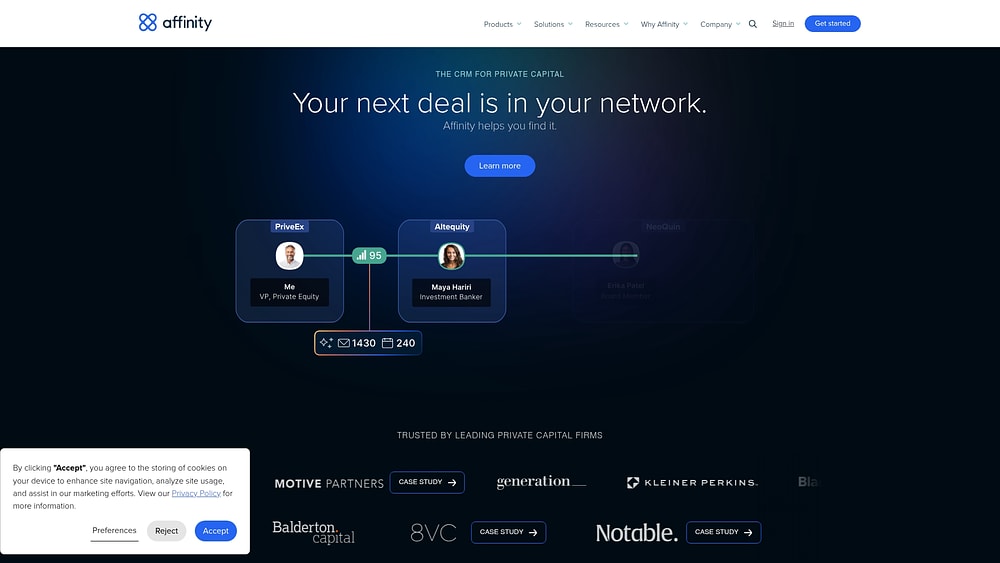
Affinity is built around one of VC’s biggest advantages: the network your firm already has. It maps those relationships automatically and keeps them current by capturing emails, meetings, and interactions without manual entry. In firms where a warm introduction can change the outcome of a deal, that kind of visibility matters.
Use case:
Affinity is purpose-built for venture firms that care deeply about relationship strength, rely on warm intros for sourcing, and want a deal flow system that updates itself as communication happens.
Key features
- Automated activity capture: Every email, meeting, and interaction is logged automatically, building a full interaction history for every contact without requiring manual updates.
- Relationship strength scoring: Scores each team member’s connection to founders, LPs, and co-investors based on interaction frequency and recency, so you always know who has the warmest path to a target.
- AI-powered deal assist: Connects Affinity data to AI tools like ChatGPT, Claude, and Copilot via an MCP layer for meeting prep, search, and CRM write-back — plus a built-in Notetaker for meeting intelligence.
Pricing
- Essential: $2,000/user per year
- Scale: $2,300/user per year
- Advanced: $2,700/user per year
- Enterprise: Contact for pricing
- Some data integrations (e.g., PitchBook) require separate subscriptions; Crunchbase data is view-only with export and API restrictions.
- Custom integrations may carry additional professional services fees.
Considerations
- Affinity centers on relationship intelligence and sourcing. LP management, portfolio tracking, and broader cross-functional workflows often require separate tools, which can raise both cost and operational complexity for firms seeking an all-in-one setup.
- Its public pricing places it at the higher end compared with general-purpose CRMs, and some G2 reviewers also mention wanting more customization given the cost.
3. Salesforce
For firms operating at scale, Salesforce offers a highly configurable CRM on top of enterprise-grade infrastructure. It fits venture organizations that need detailed data modeling across deal flow, LP relations, and portfolio operations, all inside one broad platform. Its Global Private Equity & Venture Capital Practice adds industry-specific depth for firms managing the full investment lifecycle.

Use case: Established VC firms that want precise control over data structures and are prepared to invest in implementation, customization, and ongoing administration
Key features
- Custom objects and data modeling: Build fund, LP, deal, and portfolio company data structures with full control over fields, relationships, and permissions — no off-the-shelf compromises.
- Salesforce Flow automation: Trigger complex workflows automatically, such as initiating legal review when a deal hits term sheet stage or sending LP updates based on commitment milestones.
- Zero-copy data federation: Connect CRM data directly to Snowflake, Databricks, or BigQuery via Data 360 to analyze portfolio KPIs in real time, without moving or duplicating data.
Pricing
- Starter: $25/user/month (annual)
- Pro: $100/user/month (annual)
- Enterprise: $175/user/month (annual)
- Unlimited: $350/user/month (annual)
- Financial Services Cloud: From $325/user/month (annual)
- Add-ons such as Data 360, Slack, Tableau, and Salesforce Shield are licensed separately and can significantly increase total cost.
Considerations
- Getting value from Salesforce usually requires meaningful implementation work and dedicated admin support. For smaller funds and emerging managers, that setup burden can outweigh the benefit early on.
- VC-specific workflows like fund objects, LP capital accounts, and investor portals generally depend on partner accelerators or custom configuration, which adds cost and complexity beyond the base subscription.
4. Pipedrive
Clean, visual, and quick to learn, Pipedrive brings an activity-based sales model to venture teams that want simple deal tracking without much setup. It works especially well for solo GPs or lean firms that need founder communication synced automatically and don’t want the overhead of a more complex platform.

Use case: Small VC teams that want a configurable visual pipeline, automatic email logging, and follow-up reminders that keep founder conversations from slipping through
Key features
- Visual deal pipeline: Drag-and-drop Kanban-style pipeline shows exactly where every deal sits and what action is needed next.
- Automated email sync and follow-ups: Logs all founder communication automatically and triggers follow-up reminders based on activity or deal stage.
- Forecasting and reporting dashboards: Tracks fundraising progress and capital projections with AI-assisted reports available across all pricing tiers.
Pricing
- Lite: $14/seat/month (billed annually)
- Growth: $39/seat/month (billed annually)
- Premium: $59/seat/month (billed annually)
- Ultimate: $79/seat/month (billed annually)
- Annual billing saves up to 42%
- Add-ons like LeadBooster, Projects, and Campaigns are billed separately per company, with prices starting at $6.67/month and varying by feature.
Considerations
- There’s no native LP management, capital call workflow, or investor portal layer in Pipedrive. As funds scale, those gaps often get filled with integrations or by moving to a more purpose-built product.
- Advanced permissions, role-based controls, and sandbox environments are reserved for Premium and Ultimate plans, which may matter for firms handling sensitive investor data.
5. 4Degrees
Built by former investors, 4Degrees turns a firm’s collective network into something searchable, measurable, and operational. It’s designed for private markets teams that source through relationships rather than inbound lead flow. If warm introductions drive your pipeline, 4Degrees lines up closely with that model.

Use case: Venture capital firms that rely on network-driven deal sourcing and need relationship intelligence embedded directly into their pipeline
Key features
- Relationship strength scoring: Quantifies each team member’s connection to a target contact using real interaction data, so you always know who should make the introduction.
- Warm intro path mapping: Surfaces second-degree connections through co-investors, advisors, and portfolio founders — revealing routes to target companies that aren’t visible from a contact list alone.
- AI Document Intelligence: Converts pitch decks and CIMs into structured CRM fields with a human review step before data is written back, reducing manual entry and intake errors.
Pricing
- All plans: Quote-based, per user/per month.
Considerations
- 4Degrees can handle LP tracking and engagement reporting, but its core strength is relationship intelligence and sourcing. Firms that want deeper LP management, portfolio monitoring, or back-office fund operations will still need other systems.
- Because pricing is quote-only and not published in tiers, early-stage budgeting is harder without entering a sales process.
6. DealCloud
DealCloud is a purpose-built platform for private capital firms that want deal flow, relationship intelligence, LP management, and fund administration in one governed system. Founded in 2010 and now part of Intapp, it’s used across a large slice of the private capital market. For mature VC funds that need deep integrations, compliance-oriented controls, and embedded AI, it’s built for that level of complexity.

Use case: Established venture firms that want an AI-enabled, controlled platform for sourcing deals, managing LP relationships, and running investment workflows from a single environment
Key features
- Relationship intelligence with automated activity capture: Automatically logs emails and calendar activity from Microsoft Outlook, so your team’s relationship data stays current without manual entry.
- Integrated market data via DataCortex: Connects proprietary firm data with third-party feeds from providers like Preqin, PitchBook, and FactSet to accelerate sourcing and diligence.
- LP fundraising and investor management: Tracks LP commitments, capital call schedules, and distribution history, giving IR teams a single source of truth for fund reporting.
Pricing
- Enterprise Pricing Quote-only.
- No free trial or free version available.
- Add-ons such as Intapp Assist (AI features) and Intapp Data enrichment are available separately; third-party data subscriptions through DataCortex are also priced independently.
Considerations
- Its relational data model and implementation approach come with a meaningful learning curve. Some users report that data uploads and admin configuration require substantial effort, which can slow adoption early on.
- Optional AI modules and enrichment services increase total cost, making DealCloud a significant investment for emerging managers or smaller firms without dedicated ops support.
7. HubSpot
HubSpot combines CRM, marketing automation, and content tools in one system, which makes it particularly relevant for VC firms running structured LP outreach or content-driven sourcing. In a venture context, its strongest application is usually communications and inbound pipeline rather than core deal intelligence.

Use case: VC firms that rely on content marketing, LP newsletters, or structured outreach campaigns to source deals and maintain investor relationships
Key features
- Email automation and sequencing: Build LP outreach campaigns, founder nurture sequences, and post-event follow-up workflows without manual intervention.
- Contact timeline and activity logging: Every email, meeting, and website visit is captured in a unified contact view, so your team always knows where a relationship stands.
- Custom objects and pipeline management: Model VC-specific entities like funds, LPs, and portfolio companies using custom objects (Enterprise tier required), with automated stage triggers to keep deals moving.
Pricing
- Free CRM tier: $0
- Starter: From $20/seat/month
- Sales Hub Professional: $100/seat/month
- Sales Hub Enterprise: $150/seat/month
- Marketing Hub Professional: From $890/month (includes 3 seats)
- Marketing Hub Enterprise: From $3,600/month (includes 5 seats)
- Onboarding fees apply for Professional and Enterprise tiers across several hubs
- Promotional discounts available periodically (e.g., up to 40% off Starter for the first year for new customers)
- Additional costs apply for HubSpot Credits (AI and automation usage), Commerce transaction fees, and contact volume limits on Marketing Hub
Considerations
- HubSpot doesn’t include a native VC module. Fund management, capital calls, and relationship intelligence all require either configuration or third-party tools, which adds time and expense.
- The custom objects needed to model LPs and portfolio structures are only available on Enterprise, so smaller funds may outgrow the lower tiers before getting access to the functionality that makes HubSpot truly workable for VC.
8. Navatar
Navatar brings private-markets workflows onto Salesforce infrastructure, pairing CRM flexibility with venture-specific templates and automation. It’s built for venture capital, private equity, and alternative asset managers that want network mapping, automated relationship capture, and stronger institutional memory without abandoning the Salesforce ecosystem. Firms already invested in Salesforce will usually find adoption more straightforward.

Use case: VC firms that want venture-specific workflows built on top of Salesforce’s enterprise foundation
Key features
- Network-led sourcing: Maps founder, co-investor, and scout networks across the firm, identifies warm introduction paths, and prioritizes deals based on relationship strength and funding signals.
- Institutional memory on demand: Auto-surfaces past interactions, partner notes, prior outcomes, and co-investor views when evaluating a new founder — so no context gets lost between meetings.
- Venture-specific data model: Tracks rounds, cap tables, portfolios, advisors, and board seats in a single connected view, with integrations for Outlook, Slack, LinkedIn, and DocuSign.
Pricing
- No public pricing is available.
Considerations
- Navatar depends on Salesforce licenses and implementation work, so firms without an existing Salesforce environment should expect additional cost and complexity.
- Since pricing is not public and every purchase begins with a sales conversation, budget planning requires direct engagement before you can assess fit.
9. Dialllog
Dialllog takes a narrower, workflow-first approach to venture CRM. Built for early-stage VCs and angel investors, it focuses on deal flow and relationship tracking without asking users to architect a complex system first. For lean firms that want structure quickly, that simplicity is part of the appeal.

Use case: Smaller VC firms, angel groups, and solo GPs that need a secure, lightweight system for deal sourcing, diligence, and contact management
Key features
- Workflow-based deal management: Organizes deals into structured projects with customizable templates and clear progress visualization to keep diligence on track.
- Embedded inbox and calendar: Syncs your email and calendar with privacy controls, linking threads directly to deals to kill context-switching.
- Unified contact management: Keeps track of founders, LPs, and other contacts in one place, linking communications directly to deals to keep context clear.
Pricing
- No public pricing page.
Considerations
- Dialllog stays tightly focused on deal flow and relationships, which means it doesn’t offer the same depth for advanced LP management or portfolio monitoring that larger funds may require.
- Reporting is relatively light, and because there’s no self-serve sign-up, getting started means going through a demo first.
10. Attio
Attio is designed for teams that want to define their CRM around their own operating model rather than inherit someone else’s. With flexible custom objects and AI-native functionality, it gives technically capable venture firms room to build a bespoke structure for deal flow, relationships, LPs, and portfolio work. That flexibility makes it attractive to teams that have outgrown rigid systems.

Use case: VC firms that want to create a custom data model for deal flow, LP management, and portfolio tracking rather than work inside a predefined structure
Key features
- Custom objects and relationship mapping: Build entities for LPs, managed funds, investor commitments, and warm intro sources — then connect them with relationship attributes that reflect how your firm actually tracks deals and relationships.
- AI-native workflows: Ask Attio lets you query your data conversationally, while AI agents trigger actions based on real signals like stage changes or referral sources, and call intelligence extracts insights from investment reviews automatically.
- Real-time enrichment and sourcing: One-click sourcing from LinkedIn via the Chrome extension, automatic company data enrichment from public sources, and full email and calendar sync reduce manual data entry for associates and partners.
Pricing
- Free: $0/user/month (up to 3 seats)
- Plus: $36/user/month (monthly) or $29/user/month (annual)
- Pro: $86/user/month (monthly) or $69/user/month (annual)
- Enterprise: Custom pricing
- Annual billing saves 20% on Plus and Pro plans
- Additional workspace credits available as paid add-ons for automation and AI-heavy usage
Considerations
- That flexibility comes with an upfront planning cost. Teams need to design their data model before Attio delivers full value, which can slow rollout for firms without technical comfort.
- Advanced capabilities such as custom relationship attributes sit behind Pro and Enterprise plans, and object or record limits by tier require careful planning for larger networks or multi-fund structures.
11. Clarify
Clarify takes an AI-native approach to CRM, aiming to remove the manual upkeep that usually drags systems down. Launched in 2024, it targets founder-led startups and B2B teams with autonomous capture for meetings, contact enrichment, and deal detection. For VC firms that care about relationship context but dislike CRM maintenance, that automation-first design is the main draw.

Use case: Forward-looking VC teams that value AI-driven deal capture and outreach automation more than deep private-markets functionality such as LP management or fund administration
Key features
- Meeting intelligence: Generates pre-meeting briefs 72 hours in advance, then automatically produces summaries and action items after recorded calls — keeping deal context current without manual note-taking.
- AI fields and deal detection: Automatically proposes field updates, detects new opportunities from email and calendar activity, and auto-fills custom fields to turn qualitative notes into structured, comparable data.
- Built-in prospecting and outreach: Lead Finder searches a 100M+ contact and company database by prompt, while built-in Campaigns run cadence-based outreach — useful for deal sourcing or LP communications without adding separate platforms.
Pricing
- Free: $0/month, unlimited seats, up to 1k credits/month
- Starter: $50/month, unlimited seats, 5k credits/month; additional 5k credits available at $50
- Growth: Custom pricing, unlimited seats, custom credit packages; includes workflows, CRM migration, and SSO/SAML
Considerations
- Clarify does not publish dedicated modules for LP/IR workflows, co-investor mapping, or fund administration, so firms that need those capabilities will likely pair it with additional tools.
- AI credit consumption is not fully spelled out on the pricing page, which makes forecasting monthly spend harder before a pilot.
12. Rings AI
Rings AI focuses on turning relationship data into a sourcing advantage. It maps networks in real time, highlights warm intro paths, and layers in market signals so firms can spot opportunities earlier. Built for venture capital, private equity, and investment banking teams, it combines relationship intelligence with live enrichment in a way that can strengthen a pipeline quickly.

Use case: VC firms that want to use AI to turn their network into a sourcing edge, identifying the strongest route to a target founder while flagging deal signals from funding news, LinkedIn activity, and broader market data
Key features
- Pathpower relationship mapping: Visualizes who-knows-who across founders, investors, advisors, and co-investors, then identifies the warmest introduction path to any target.
- Real-time signal detection: Monitors news, funding announcements, and market data daily across 100M+ datapoints to surface opportunities that match a firm’s investment thesis.
- AI deal scoring: Ranks companies, investors, and funds by momentum, growth efficiency, and syndicate quality — giving deal teams prioritized, insight-backed pipelines.
Pricing
- Paid plan: While pricing isn’t public, a company resource suggests plans start around $1,000 per user/year.
- Enrichment is included with no credit limits or incremental data costs.
- Contact Rings AI directly for a custom quote.
Considerations
- Rings AI can operate as either a standalone CRM or an enrichment layer on top of an existing system. It does include pipeline, portfolio, and LP management features, but its clearest strength remains relationship intelligence and sourcing, so firms should decide whether it can serve as the primary system or works better alongside one.
- The platform shows early promise but has a smaller public track record than longer-established VC CRM vendors.
7 must-have features in a venture capital CRM
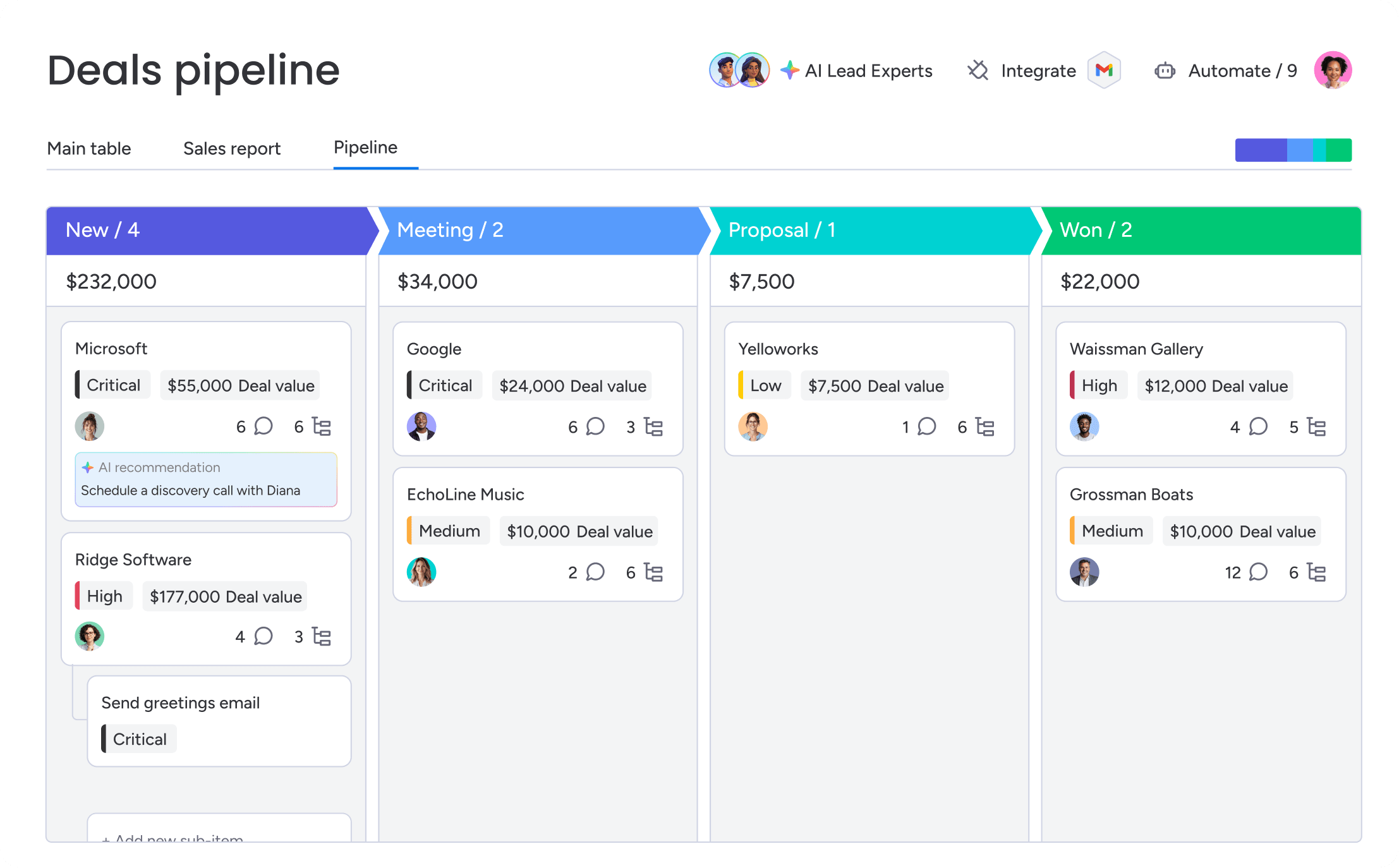
Most CRMs don’t fit how venture capital actually works. Deal flow branches, relationships compound, and the operational load keeps going long after the term sheet goes out. How much of your team’s week disappears into manually logging emails?
These aren’t nice extras. They’re the features that separate a usable CRM from one your team constantly has to work around.
1. Customizable pipelines for a non-linear world
VC deals don’t move in straight, predictable stages. A founder may postpone a round, or a deal can jump from “Term Sheet” back to “Watching.” The CRM needs to support that without friction.
- Custom stages: Build workflows that match your exact process.
- Drag-and-drop flexibility: Move deals backward or forward instantly.
- Context retention: Revive a deal without losing 6 months of history.
2. Automated activity capture from email and calendar
Most VC work happens in the inbox, not inside a record view. If logging calls and emails depends on manual effort, it won’t happen. And once that habit breaks, the CRM turns into a graveyard of partial data.
The system needs to pull emails, meetings, and notes into a unified timeline automatically. With monday CRM, you walk into any call with a complete interaction history already there. No manual logging required.
3. Relationship intelligence that maps your real network

Which partner has the strongest path to that founder? Which co-investor can make the warm intro? A spreadsheet won’t answer that, but your CRM should.
It’s more than storing names and email addresses. It’s about turning your firm’s network into something visible and actionable, so the right connection surfaces before outreach starts.
4. LP management that isn’t an afterthought
LPs don’t behave like prospects in a generic pipeline. Their reporting cycles, communication needs, and data requirements don’t fit the standard CRM model.
Trying to squeeze them into a standard sales workflow creates mess fast. You need a dedicated space for tracking commitments, managing communications, and handling reporting — all without bouncing between systems.
5. Portfolio monitoring beyond the deal memo
Once the check goes out, the work shifts — it doesn’t stop. Your CRM should support portfolio health tracking, board activity, and founder support from the same environment.
The goal is simple: know which companies are hitting KPIs, which ones need help, and which founders haven’t heard from your team in 90 days, all without opening 3 more apps.
6. AI that does the work, not just the data entry
AI should be more than a flashy add-on. In the right CRM, it functions like another analyst: drafting outreach, summarizing meetings, and spotting deals that are cooling off before someone notices manually.
Picture asking, “Which of our Series A companies are showing signals for a follow-on round?” and getting a direct answer. monday CRM helps organizations use AI that way, turning stored data into something operationally useful.
7. Integrations that connect to your world
A disconnected CRM creates overhead instead of reducing it. It needs to work with the systems your team already depends on, from PitchBook and Crunchbase to fund administration tools.
When data enrichment software works automatically, manual research drops off. And when platforms like Carta or Allvue connect seamlessly, deal activity and fund operations stop living in separate universes. That’s what makes a CRM a central workspace rather than another isolated system.
Put together, these capabilities turn a CRM from a passive database into an active part of your investment process. The right platform helps the team keep moving without getting buried in admin.
Try monday CRMHow to choose the right CRM for venture capital
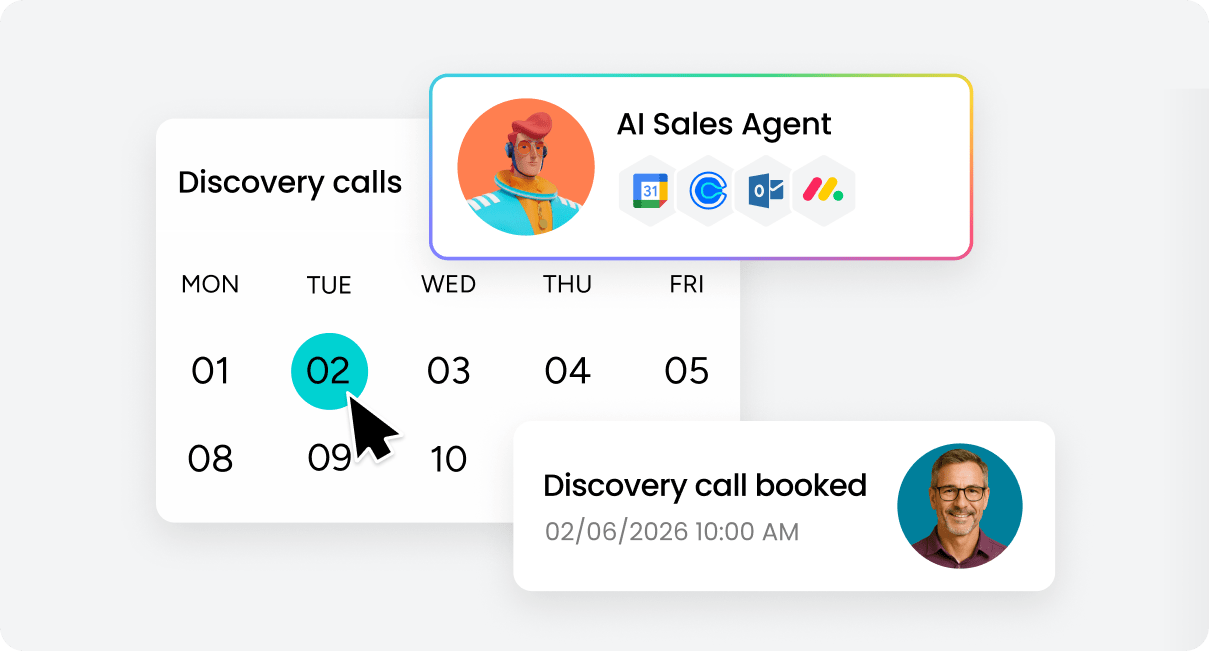
CRM projects rarely fail because the software is inherently bad. More often, the platform simply doesn’t match the fund, the team, or the timing. Choosing well means judging your current reality honestly, not buying for an imagined version of the firm 3 years from now. Here’s how to approach the decision:
- Match the platform to your fund stage. Emerging managers need lightweight deal tracking. Seed or Series A teams should prioritize relationship intelligence and automation. Growth stage firms require platforms that connect investment, ops, and legal teams to prevent silos.
- Choose between specialized and flexible platforms. Specialized tools move faster out of the box but often require additional software for LP management or portfolio tracking. Flexible platforms take more setup but can run your entire operation in one place.
- Look beyond the initial sticker price. Implementation time, training effort, and ongoing maintenance matter just as much as license cost. A platform that takes 6 months to launch slows momentum no matter what the monthly rate says.
- Evaluate the real utility of AI features. AI is quickly becoming baseline, but labels alone don’t mean much. The better test is whether AI works directly on live fund data inside the CRM, summarizing email history and autofilling records automatically.
Approach the decision this way and you’re more likely to land on a platform that speeds up deal flow instead of complicating it. Reality should drive the choice, not the length of a feature list.
How monday CRM supports venture capital workflows
Venture capital doesn’t move in a straight line, and most CRMs are built as if it does. Deals get messy, relationships carry years of context, and key information often ends up trapped in spreadsheets or in someone’s head. How many separate apps is your team using to manage deals, LPs, and portfolio updates right now?
monday CRM is not marketed as a purpose-built VC system, and that’s part of the point. It’s a flexible workspace that can be shaped around a fund’s actual workflow in days, not months — no code and no long consulting engagement required.
Adapt pipelines to any deal cycle without code
No 2 VC deals move the same way. A founder may pause the raise, a warm intro may skip half the process, and a passed deal can come back a year and a half later. Your CRM has to absorb that without forcing awkward workarounds.
With monday CRM, the pipeline can reflect how your team actually operates. Move a deal from “Watching” to “Term Sheet,” trigger a notification to legal, and create a diligence checklist automatically. Whether a deal moves forward, backward, or sideways, the history remains intact.
See deals, LPs, and portfolio companies in one place
Fragmented systems don’t just cost money. They cost focus, continuity, and time.
monday CRM helps teams connect deals, LP workflows, and portfolio tracking on a single platform. If a founder is also a portfolio CEO and later becomes a potential co-investor, that context can exist in one connected view with a unified timeline. Fewer tabs. Less hunting. More time spent on the relationship itself.
Automate busywork
Teams abandon CRMs when the software creates more upkeep than value. Manual logging, status updates, and repetitive drafting usually get dropped first when the week gets busy.
That’s where the AI layer comes in. You can pull up a summary of a year’s worth of emails before a call, draft outreach in your own workflow, or ask monday Sidekick, “Which deals haven’t we talked to in 60 days?” and get an immediate answer. That kind of support is not cosmetic — it often determines whether the CRM becomes part of the team’s real operating rhythm or just another neglected system.
When the platform bends to the workflow instead of the other way around, usage improves. Better usage leads to better data, faster calls, and stronger portfolio support.
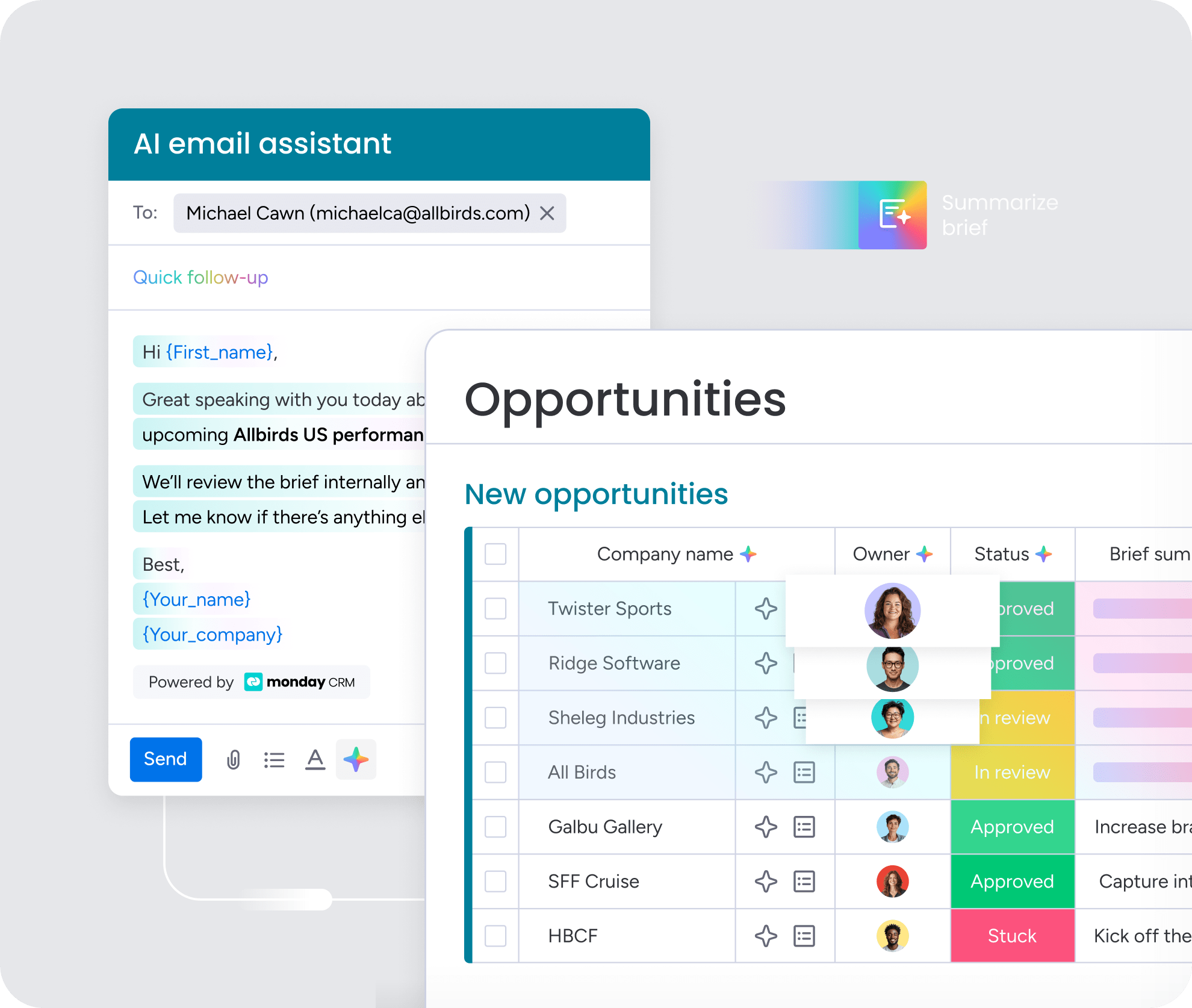
Master your deal flow and relationships
Venture capital moves quickly, and the systems supporting it need to do the same. Rigid tools and scattered spreadsheets slow decisions down and make it easier to lose valuable context along the way. A flexible, intelligent platform gives your team one place to track relationships, deal stages, and portfolio updates with accuracy.
Bringing those workflows together cuts the administrative drag that pulls attention away from sourcing, diligence, and relationship-building. It also gives you greater visibility for internal reporting and more precise control over how time and resources are allocated across the fund.
Try monday CRM
“With monday CRM, we’re finally able to adapt the platform to our needs — not the other way around. It gives us the flexibility to work smarter, cut costs, save time, and scale with confidence.”
Samuel Lobao | Contract Administrator & Special Projects, Strategix
“Now we have a lot less data, but it’s quality data. That change allows us to use AI confidently, without second-guessing the outputs.”
Elizabeth Gerbel | CEO
“Without monday CRM, we’d be chasing updates and fixing errors. Now we’re focused on growing the program — not just keeping up with it."
Quentin Williams | Head of Dropship, Freedom Furniture
“There’s probably about a 70% increase in efficiency in regards to the admin tasks that were removed and automated, which is a huge win for us.“
Kyle Dorman | Department Manager - Operations, Ray White
"monday CRM helps us make sure the right people have immediate visibility into the information they need so we're not wasting time."
Luca Pope | Global Client Solutions Manager at Black Mountain
“In a couple of weeks, all of the team members were using monday CRM fully. The automations and the many integrations, make monday CRM the best CRM in the market right now.”
Nuno Godinho | CIO at Velv
“monday.com provides developmental flexibility, operational efficiency, and data transparency — all in one place. We became a company that moved from chasing data to leading with it.”
Hyunghan Lee | Team Lead, Sandbox Network
"monday.com brought every part of our business into one connected space. The harmony between work management and CRM has become our operating system — giving us the clarity and confidence to scale.”
Jennifer Chinburg | Executive Vice President of Corporate Development & Brand, Chinburg Properties
“We just weren’t getting value from our old CRM. With monday.com, it's a thousand times better. Our sales teams are more informed, more consistent, and far more connected."
James Arnold | Chief Operating Officer, CenversaFAQs
What is a CRM for venture capital?
A VC CRM is a platform built to manage venture capital's non-linear, relationship-driven workflow. It helps firms track deal flow, relationship context, network intelligence, and portfolio activity in one place.
Do venture capital firms need a specialized VC CRM?
Not always. Specialized VC CRMs come with pre-built workflows, but they can also be rigid. Flexible platforms can be configured to support deal flow, LP management, and portfolio operations in a single workspace.
What are the most important features in a VC CRM?
The essentials include customizable pipelines, automated activity capture, relationship intelligence, and portfolio monitoring. Strong integrations and useful AI features also matter if you want to avoid filling process gaps with spreadsheets.
How much does a venture capital CRM cost?
Pricing varies widely, from lower-cost per-seat plans on flexible platforms to premium pricing for specialized tools. The total cost of ownership matters most, since slow implementation and heavy admin demands can erase early savings.
Can monday CRM replace a specialized VC CRM?
For many funds, yes — especially those that value flexibility and want to run more of their operation in one system. Its customizable workflows and AI features can support deal flow, LP management, and portfolio tracking without requiring multiple point solutions.
How is AI changing venture capital CRM software?
AI is moving beyond simple assistance and toward autonomous action. Modern CRM tools can help research founders, summarize decks, update deal records, and surface signals automatically, giving firms that adopt them a meaningful structural advantage.
