


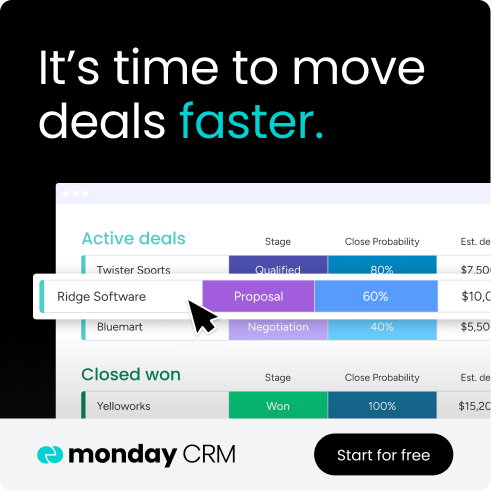
A sales strategy template transforms your revenue goals into a repeatable framework that guides your team’s daily execution. It’s your operational blueprint — defining target customer profiles, resource allocation, and success metrics — so everyone stays focused on what drives results.
This guide covers the essential components every sales strategy needs, 7 steps to build one, and different approaches for various business models. You’ll also learn how to customize your template and integrate automation, turning your plan into a living document that your team can execute from a single, centralized workspace.
Key takeaways
- Build your strategy around specific revenue goals and detailed ideal customer profiles first, as everything else flows from knowing who you’re selling to and what you need to achieve.
- B2B, SaaS, enterprise, and SMB sales each need different approaches because buying cycles, decision-makers, and resource requirements vary dramatically between segments.
- Focus on the 6 essential components — revenue goals, customer profiles, sales channels, team structure, budget, and metrics — to gain full visibility and create a complete system.
- The best strategy means nothing without consistent implementation, so define specific activities, set measurable goals, and review progress quarterly to stay on track.
- Centralized platforms like monday CRM give teams visibility into every deal stage, automate follow-ups, and free up reps to focus on closing instead of administrative work.
What is a sales strategy template?
A sales strategy template translates revenue goals into a system your team executes weekly. It’s the blueprint your revenue team follows for every decision, including territory assignments, channel selection, and resource allocation.
The core purpose includes:
- Alignment across teams: Everyone pursues the same objectives with shared understanding.
- Roadmap for execution: Eliminates guesswork through defined processes and milestones.
- Measurable benchmarks: Reveals whether your approach delivers results.
Templates matter because they cut planning time and make sure nothing gets overlooked. They create consistency that builds momentum over time. A comprehensive sales strategy template includes:
- Revenue targets: Cascade from company-level to individual quotas
- Customer profiles: Detailed firmographics and pain points
- Sales tactics: From outbound prospecting to partner referrals
- Resource allocation: Team structure and budget distribution
These templates flex across different business models and sales cycles. Whether you’re running high-velocity SMB motion or complex enterprise sales, the framework stays consistent. The specifics flex to fit your reality.
Sales strategy vs. sales plan: Know the key differences
Sales strategy and sales plan serve fundamentally different purposes and operate at different levels of detail. Understanding this distinction keeps you from jumping into tactics without strategy — or getting stuck in planning without action.
| Dimension | Sales strategy | Sales plan |
|---|---|---|
| Scope | High-level direction and approach | Detailed tactical execution |
| Timeframe | Long-term (1–3 years) | Short-term (quarterly or annual) |
| Focus | What you're trying to achieve and why | How you'll achieve it and when |
| Content | Target markets, positioning, competitive advantage | Specific activities, quotas, timelines |
| Flexibility | Stable framework that guides decisions | Adjusted frequently based on performance |
The strategy gives you foundation and direction. The plan turns that into actionable steps with specific owners and deadlines. Your strategy might identify enterprise SaaS companies as your ideal customer profile and position your solution around efficiency gains. Your strategic sales plan then details the specific outreach cadence, email sequences, demo scheduling, and quota assignments for Q1.

6 essential components every sales strategy template needs
Missing any component creates blind spots. You get misalignment between teams, wasted resources on low-potential activities, or missed targets you should’ve seen coming. Each element builds on the others to create a complete system. Here’s what every effective template needs to deliver results.
1. Revenue goals and objectives
Revenue goals guide all sales activities and resource allocation decisions. Without specific targets, every deal feels equally important and nothing gets prioritized effectively.
Goals should be quantifiable, time-bound, and aligned with business objectives. Include:
- Annual revenue targets: Broken down by quarter
- Growth rate expectations: Grounded in market conditions
- Revenue breakdown: By product line or customer segment
- Profitability metrics: Ensure sustainable growth
Goals cascade from company-level to team-level to individual sales quotas. Each level supports the one above.
2. Identify your ideal customer profile
An ideal customer profile (ICP) describes the companies or individuals most likely to buy your product, benefit from it, and stick around. Targeting everyone means you’re targeting no one.
A complete ICP documents:
- Firmographic data: Company size, revenue range, industry vertical, geographic location
- Behavioral indicators: Buying patterns, technology adoption level, decision-making speed
- Pain points: Specific challenges your solution addresses
- Budget capacity: Typical investment range for solutions like yours
Serving different segments? Create multiple ICPs and keep each one distinct. Base your ICPs on data from your best existing customers — the ones who close quickly, expand over time, and rarely churn.
3. Map sales channels and tactics
This component shows how your team reaches prospects and moves them through the buying journey. Channels are how you engage. Tactics are your specific approaches within those channels.
Key considerations include:
- Primary channels: Based on ICP behavior
- Channel coordination: How different channels work together
- Specific methods: Outbound sequences or partner programs
- Touchpoint sequence: Throughout the buying journey
Pick channels where your ICP naturally spends time and prefers to engage with vendors.
4. Plan team structure and resources
The best strategy fails without adequate resources and clear role definitions. Team planning means defining team size, role specialization (SDRs for prospecting, AEs for closing), territory assignment, reporting structure, and skill requirements.
Capacity planning calculates how many deals each rep can realistically handle based on sales cycle length and complexity. Then work backward from revenue goals to determine headcount.

5. Set budget and technology requirements
Budget covers people costs and operational investments that enable productivity. Categories to address include:
- Compensation structure
- Technology stack investments
- Marketing support allocation
- Training and development programs
- Operational expenses
Choose technology that integrates well, provides visibility into your pipeline, and is simple for your team to adopt and manage. Revenue teams using monday CRM get an intuitive interface that cuts implementation complexity and provides the visibility needed to track deals, automate follow-ups, and forecast accurately.
6. Establish metrics and KPIs
Metrics give you the feedback loop that shows whether your strategy works and where you need adjustments. The right sales metrics are leading indicators that predict future outcomes — not just lagging indicators reporting what already happened.
| Category | Metrics | Purpose |
|---|---|---|
| Activity | Calls made, emails sent, meetings booked | Measures effort and identifies capacity issues |
| Pipeline | Opportunities created, pipeline value, stage progression | Tracks deal flow and identifies bottlenecks |
| Conversion | Lead-to-opportunity rate, win rate | Reveals process effectiveness |
| Efficiency | Sales cycle length, average deal size | Measures productivity and unit economics |
| Revenue | Quota attainment, revenue by segment | Confirms overall strategy success |
Track metrics consistently and review at the right intervals: weekly for activities, monthly for pipeline health, quarterly for strategic adjustments.
Try monday CRM7 steps to build your sales strategy template
These steps take the components above and put them into action. The process is sequential — each step builds on the last. But you’ll refine as you learn from market feedback and performance data. Follow this framework to turn your revenue goals into an executable strategy.
Step 1: Set SMART revenue goals
SMART goals create accountability that vague aspirations can’t. A well-formed goal looks like: “Achieve $5M in new annual recurring revenue from enterprise customers by December 31, 2025, representing 40% growth over 2024.”
Setting these strategic goals requires:
- Analyzing historical sales performance trends
- Considering market growth rates
- Factoring in planned investments
- Accounting for seasonality
Goals cascade down proportionally. If the company needs $10M and you have 2 teams, each team owns $5M, with individual quotas based on tenure and territory potential.
Step 2: Research and define your target market

This step turns your ICP from concept to detailed profile based on real data. Research activities include:
- Analyzing existing customers
- Interviewing sales and customer success teams
- Studying market data
- Reviewing win/loss analysis
- Testing assumptions with small campaigns
The result: 1-3 defined ICPs with enough detail that your team immediately spots qualified prospects and disqualifies poor fits. Update ICPs quarterly as you learn from market interactions.
Step 3: Map your sales process to buyer journey
This step aligns what your team does with how customers actually buy. Misalignment causes friction, like sales pushing for a close while the buyer is still researching.
The buyer journey typically progresses through:
- Awareness
- Consideration
- Decision
- Retention
Your sales funnel includes prospecting, qualification, discovery, proposal, negotiation, and close. Define what activities happen at each stage, identify handoff points, and document exit criteria before advancing.
Step 4: Select the right sales channels
Pick channels based on where your ICP is most reachable and receptive. Common options include:
- Outbound prospecting
- Inbound marketing
- Partner channels
- Events
- Account-based marketing
Most successful sales growth strategies use a multi-channel approach, with channels reinforcing each other rather than operating independently. Let your ICP’s engagement preferences drive your channel mix.
Step 5: Allocate team and resources
This step turns revenue goals into headcount and organizational structure. Work backward from your revenue goals. If each rep closes $500K annually and you need $5M, you need 10 fully-ramped reps.
Account for:
- Ramp time: New hires take 3-6 months to reach full productivity
- Annual attrition: Factor in 15-20% turnover
- Territory design: Ensure balanced opportunity distribution
Review resource allocation quarterly and adjust based on performance data.
Step 6: Build your tech stack
Technology should enable your strategy, not dictate it. Core categories include:
- CRM platform
- Sales engagement
- Analytics and reporting
- Enablement
- Communication platforms
Prioritize ease of use (adoption rates tank with complex platforms), integration capabilities (avoid data silos), scalability for growth, and reasonable implementation requirements.
Step 7: Create your implementation timeline
A timeline turns your strategy from a document into an execution plan with milestones and accountability.
- Phase 1 (Weeks 1-4): Finalize ICP, hire critical roles, implement core technology
- Phase 2 (Weeks 5-8): Train team, launch initial campaigns, establish reporting cadence
- Phase 3 (Weeks 9-12): Optimize based on early results, scale successful tactics
- Ongoing (Continuous): Monthly reviews, quarterly strategy adjustments
Build in buffer time for unexpected challenges. Make timelines visible to the entire team for shared accountability.
5 types of sales strategy templates for different business models
Core components stay consistent, but the right sales strategy template depends on your business model. Use the table below to quickly compare how strategies differ across B2B, SaaS, enterprise, SMB, and hybrid approaches.
Here’s a quick comparison:
| Business model | Key characteristics | Strategic focus |
|---|---|---|
| B2B | Longer cycles, multiple stakeholders | Relationship building, ROI-driven selling |
| SaaS | Recurring revenue, fast scaling | Conversion, retention, expansion |
| Enterprise | Large deals, long cycles | Stakeholder alignment, customization |
| SMB | Short cycles, price sensitivity | Efficiency, volume, automation |
| Hybrid | Multiple segments | Segmentation and channel coordination |
1. B2B sales strategy template
B2B sales involves longer cycles, relationship-driven engagement, value-based selling focused on ROI, and account-based approaches that require a comprehensive strategic sales plan.
B2B-specific components include stakeholder mapping and proof points like case studies and references. This also includes relationship nurturing strategies and post-sale expansion planning.
2. SaaS sales strategy template
SaaS involves recurring revenue models, product-led growth potential, rapid scaling, and usage-based metrics.
SaaS-specific components include trial-to-paid conversion strategies, expansion revenue planning, churn prevention, and customer success integration. Expansion revenue often drives major growth for mature SaaS organizations.
3. Enterprise sales strategy template
Enterprise sales targets large organizations with high deal values, extended sales cycles, and executive engagement requirements.
Enterprise-specific components include executive sponsorship, proof of concept structures, security and compliance processes, and strategic account management.
4. SMB sales strategy template
SMB sales features shorter cycles, price sensitivity, efficiency focus, and simpler decision-making. SMB-specific components include streamlined processes, self-service options, standardized offerings, and digital-first channels.
SMB strategies prioritize volume and efficiency through inside sales teams and automation.
5. Hybrid sales strategy template
Hybrid sales combines multiple approaches to serve different customer segments efficiently.
Components include segmentation rules for customer routing and handoff processes between inside and field sales. They also include channel coordination and unified metrics across different approaches.
How to customize your sales strategy template
Templates provide structure, but customization makes sure your strategy reflects your unique market position and what your organization can actually do. Effective customization means understanding your specific context and adapting frameworks to fit your reality.
Adapt for your industry
Different industries have distinct buying behaviors, regulatory requirements, and competitive dynamics. Healthcare technology companies must account for compliance and lengthy procurement cycles. Financial services solutions must address regulatory scrutiny.
Base industry adaptation on conversations with existing customers, not assumptions.
Align with your sales cycle
Sales cycle length affects resource allocation and forecasting. Short cycles need 3-4X pipeline coverage; long cycles may need 6-8X. Short cycles track daily activities; long cycles focus on strategic milestones.
Understanding your actual sales cycle based on historical data matters for realistic planning.
Account for market dynamics
Market conditions require strategic adjustments:
- Emerging markets: Need education and category creation
- Mature markets: Require differentiation
- Economic downturns: Require ROI focus and flexible terms
- Growth periods: Enable premium positioning
Reassess market dynamics quarterly.
Integrate AI and automation into your sales strategy

AI and automation let teams focus on high-value activities while technology handles repetitive work. Smart implementation of these technologies improves efficiency and results without needing extensive technical expertise.
Use AI for lead scoring and prioritization
AI analyzes patterns across data points to predict which leads are most likely to convert. AI-powered scoring evaluates fit indicators, engagement signals, buying intent, timing factors, and historical patterns.
Organizations implementing sales growth strategies achieve better results when monday CRM automatically prioritizes leads based on conversion likelihood, helping teams focus on opportunities with the highest probability of closing.
Automate repetitive sales tasks
Sales reps spend significant time on administrative work that doesn’t directly generate revenue. Tasks to automate include data entry, follow-up sequences, meeting scheduling, task creation, and alert notifications.
Revenue teams find success using monday CRM’s automation capabilities to handle routine tasks without requiring technical expertise, building workflows that trigger actions based on deal progression.
Implement predictive analytics

Predictive analytics uses historical data to forecast future outcomes, enabling proactive decision-making. Applications include deal forecasting, revenue projections, churn prediction, and resource allocation. Predictions should inform decisions, not replace human judgment.
Build a winning sales strategy with monday CRM
The best sales strategy template means nothing without a platform that turns it into daily execution. monday CRM gives revenue teams a centralized workspace to build, customize, and execute their sales strategy from a single source of truth.
Create customizable sales strategy templates

Build sales strategy templates that match your specific business model and sales process. The platform’s flexibility means you can:
- Design custom workflows: Map your exact sales process stages without requiring technical expertise.
- Build reusable templates: Create standardized frameworks for different deal types that your team can deploy instantly.
- Visualize your strategy: Use boards, timelines, and dashboards to make your sales strategy visible to everyone.
Execute your strategy with automation and visibility

Transform your sales strategy from a static document into an active system that guides daily execution. Key capabilities include:
- Automated workflows: Set up triggers that automatically move deals forward, assign tasks, and send follow-ups based on deal progression.
- Real-time pipeline visibility: Track every opportunity with customizable views that show exactly where deals stand and what actions come next.
- Performance tracking: Monitor the metrics that matter most with dashboards that update automatically as your team executes.
Revenue teams using monday CRM spend less time on administrative work and more time on activities that directly drive results.
Align teams around shared goals
With monday CRM, you gain alignment by connecting everyone to the same strategy and execution plan. Sales, marketing, and customer success work together within the same platform, eliminating handoff friction. Clear ownership and visible progress toward goals create natural accountability without micromanagement.
The platform scales with your strategy, supporting everything from high-velocity SMB sales to complex enterprise deals.
“With monday CRM, we’re finally able to adapt the platform to our needs — not the other way around. It gives us the flexibility to work smarter, cut costs, save time, and scale with confidence.”
Samuel Lobao | Contract Administrator & Special Projects, Strategix
“Now we have a lot less data, but it’s quality data. That change allows us to use AI confidently, without second-guessing the outputs.”
Elizabeth Gerbel | CEO
“Without monday CRM, we’d be chasing updates and fixing errors. Now we’re focused on growing the program — not just keeping up with it."
Quentin Williams | Head of Dropship, Freedom Furniture
“There’s probably about a 70% increase in efficiency in regards to the admin tasks that were removed and automated, which is a huge win for us.“
Kyle Dorman | Department Manager - Operations, Ray White
"monday CRM helps us make sure the right people have immediate visibility into the information they need so we're not wasting time."
Luca Pope | Global Client Solutions Manager at Black Mountain
“In a couple of weeks, all of the team members were using monday CRM fully. The automations and the many integrations, make monday CRM the best CRM in the market right now.”
Nuno Godinho | CIO at VelvTurn your sales strategy template into revenue growth
Building a sales strategy template is just the beginning. The real value comes from consistent execution, regular optimization, and team alignment around shared goals. Your template becomes the foundation for predictable revenue growth when every team member understands their role and how their activities contribute to company objectives.
Start with the framework that matches your business model, then customize based on your industry and market dynamics. Remember that the best strategy is one your team actually uses. Focus on creating something practical and actionable rather than perfect on paper.
Revenue teams that implement these templates see faster ramp times for new hires, improved forecast accuracy, and more consistent quota attainment across the organization. The investment in strategic planning pays dividends through improved efficiency and results.
Try monday CRMFAQs
What should a sales strategy template include?
A sales strategy template should include revenue targets, ideal customer profiles, sales channels and tactics, team structure and resources, budget and technology requirements, and metrics and KPIs to measure success.
How is a sales strategy different from a sales plan?
A sales strategy defines the high-level direction and approach over 1-3 years, while a sales plan details the specific tactical execution, activities, and timelines for a quarter or year.
How often should you update your sales strategy template?
You should review your sales strategy template quarterly and make adjustments based on market conditions, performance data, and organizational changes, with a comprehensive annual review.
What KPIs should you track in a sales strategy template?
Track activity metrics like calls and meetings, pipeline metrics including opportunities and stage progression, conversion rates, efficiency metrics such as cycle length and deal size, and revenue metrics including quota attainment.
Can one sales strategy template work for all business models?
One template cannot work for all business models because B2B, SaaS, enterprise, and SMB sales each have distinct cycle lengths, decision-making processes, and resource requirements that demand customized approaches.
How do you turn a sales strategy template into weekly execution?
Turn your template into weekly execution by defining specific activities for each pipeline stage, setting activity goals for reps, creating automated follow-up triggers, and establishing regular review cadences to track progress against targets.

 Get started