


More prospecting activity does not automatically translate into more closed deals. In fact, when sales teams burn time on manual research, repetitive data entry, and generic outreach, the result is often a stalled pipeline and declining morale. Ultimately, high effort without focus creates exhaustion rather than revenue, proving that modern sales success depends on working smarter rather than simply increasing volume.
To address this, lead generation automation tools remove low-value tasks so teams can focus on high-intent opportunities. However, automation requires a unified foundation; if data remains disconnected, visibility suffers. Therefore, centralized platforms are essential to structure the sales process, ensuring teams understand exactly where momentum is being built or lost.
With these priorities in mind, this article explores the 20 best tools for sales prospecting in 2026. We break down core capabilities, pricing models, and ideal use cases, while outlining the factors that truly matter when evaluating a prospecting platform, from data accuracy and automation to scalability and the long-term impact on your revenue performance.
Key takeaways
- Automation is critical to reclaim selling time: modern prospecting platforms eliminate manual research, data entry, and repetitive follow-ups, allowing sales teams to focus on qualified conversations that directly impact pipeline and revenue.
- Data accuracy underpins every successful outreach effort: verified emails, direct dials, and real-time validation protect deliverability, improve connect rates, and prevent wasted effort on outdated or irrelevant contacts.
- Multi-channel engagement outperforms single-channel outreach: coordinating email, LinkedIn, and phone touchpoints within structured sequences increases response rates and keeps prospect conversations consistent and measurable.
- Tight CRM integration prevents silos and lost momentum: platforms that sync prospecting activity directly into a CRM, such as monday CRM, reduce manual work, improve visibility across the lead generation sales funnel, and keep teams aligned around a single source of truth.
- The right tool is defined by workflow fit, not feature volume: sustainable results come from platforms that match team size, sales motion, and operational complexity, delivering clear ROI through faster cycles, better prioritization, and cleaner execution.
What are sales prospecting platforms?
Sales prospecting platforms streamline sales lead generation by replacing manual research with intelligent automation. In doing so, these platforms help sales teams identify, research, and engage potential customers through structured, data-driven workflows that remove inefficiencies from traditional prospecting approaches.
Furthermore, by aligning prospect discovery with an ideal customer profile, these platforms ensure teams focus on qualified opportunities instead of unproductive outreach. Contact discovery, enrichment, and outreach sequences are automated to maintain consistent follow-up cadences throughout the sales cycle.
The result is a more efficient, data-driven pipeline. Real-time analytics improve visibility into campaign performance, while native CRM integrations remove the need for manual data entry. This allows sales teams to focus on high-value work such as building relationships and progressing deals toward close.
How to evolve your prospecting playbook?
Traditional sales approaches no longer deliver the results modern teams require. The reason is that, today’s buyers conduct extensive research independently before engaging with sales representatives, while sales teams face increasing administrative burdens.
Relying solely on manual sales lead generation processes and legacy methods creates significant gaps in pipeline development and opportunity identification.
To brigde those gaps, advanced prospecting platforms provide the infrastructure needed to meet revenue targets consistently. These tools streamline time-intensive tasks, enable more meaningful prospect engagement, and deliver the operational visibility required for sustainable growth.
The strategic question for sales leaders is not whether to adopt these solutions, but rather how quickly implementation can begin.
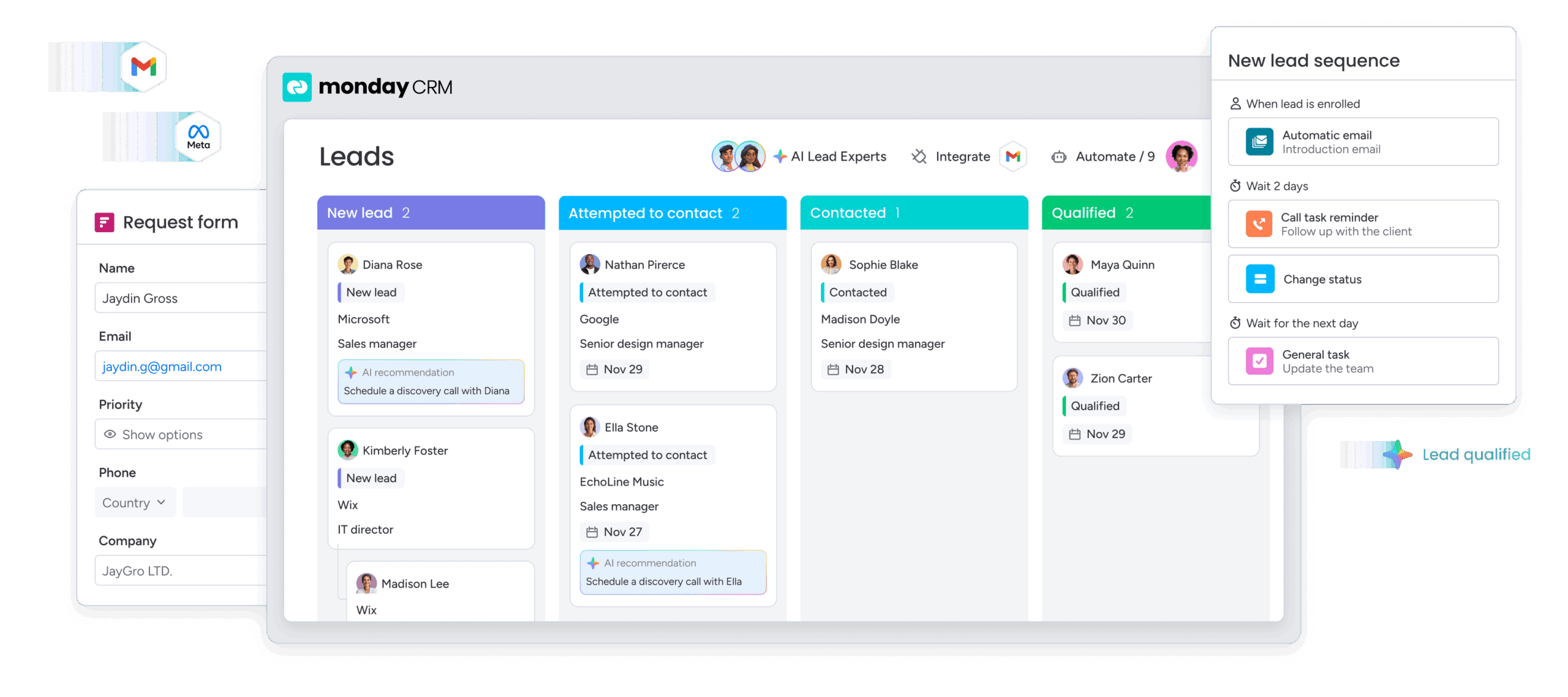
- Give reps back their selling time: your best reps shouldn’t act as data-entry clerks. Automating lead research, email discovery, and data entry frees them to focus on selling. They can build targeted prospect lists in minutes instead of hours, gaining valuable selling time every week. With platforms like monday CRM, prospect data stays centralized and automated follow-ups keep conversations moving, so your team stays focused on results.
- Turn cold outreach into warm conversations: generic email blasts no longer work. Smart tools identify prospects who are actively showing buying intent, helping reps focus on the right people. Fewer random conversations lead to shorter sales cycles, higher close rates, and a more confident team.
Key features of a high-performing prospecting platform
Not all prospecting platforms deliver the same impact. A small set of critical capabilities separates platforms that build pipeline momentum from those that introduce friction. The features below define what high-performing sales teams should prioritize.
- CRM integration that works consistently: prospect activity should sync automatically with the CRM, keeping records accurate and maintaining a single source of truth across teams.
- Reliable, verified contact data: fresh, accurate contact information protects deliverability, preserves brand reputation, and ensures outreach reaches the right stakeholders.
- Multichannel engagement without losing context: effective platforms support email, LinkedIn, and phone outreach while maintaining a complete interaction history for each prospect.
- Lead scoring that prioritizes intent: behavioral signals help sales teams focus attention on prospects most likely to convert, improving efficiency and win rates.
- Timely engagement alerts: notifications triggered by website visits or content engagement allow sales teams to connect when interest is highest.
- Automation that supports human interaction: routine follow-ups and reminders are automated so sales reps can invest more time in relationship building.
- Analytics tied directly to revenue outcomes: clear reporting connects outreach activity to meetings booked and deals closed, enabling data-backed decisions.
20 best sales prospecting platforms for lead generation
Long sales cycles kill momentum. Manual outreach burns out top reps, and another clunky platform is the last thing any team needs. Sales teams deserve tools that actually work, not ones that deliver spreadsheet-level frustration.
The right tools get straight to the point. Not only do they find quality leads fast, but also automate the grunt work without sounding like a robot, and give teams more time to actually sell. This provides a data-driven approach that fills pipelines with real opportunities.
This list focuses on what truly matters: data so accurate reps are never caught off guard on a call and integrations that play nice with current setups. Built on what works. No fluff, just the best options to help teams win more deals.
1. monday CRM
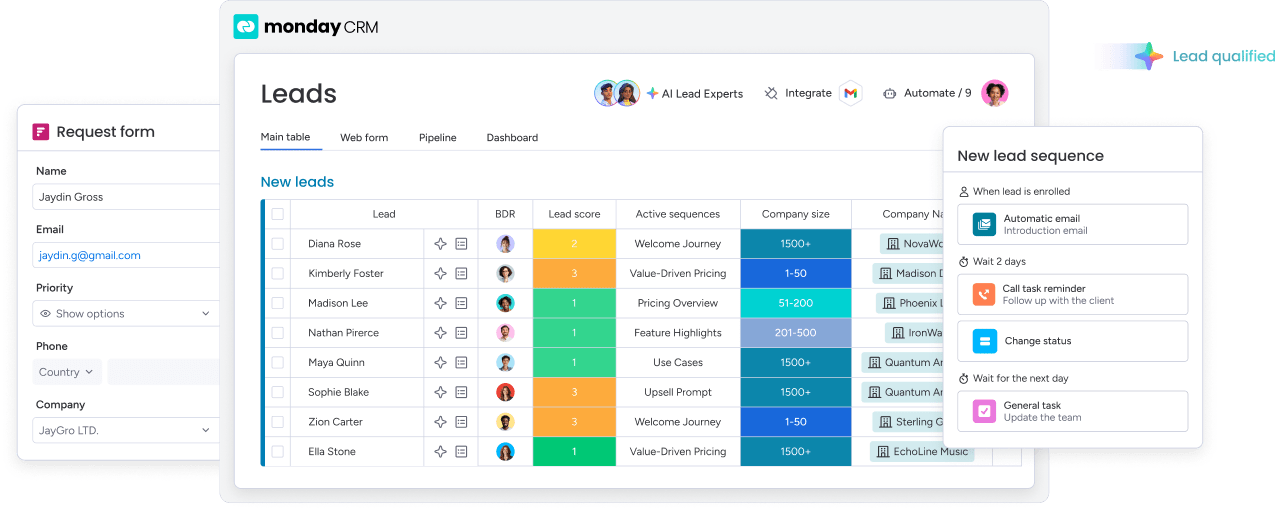
Sales prospecting transforms from scattered chaos into a unified command center with monday CRM, where every lead, interaction, and opportunity lives in one place. Built on the flexible monday.com Work OS, it adapts to any sales process without forcing teams into rigid workflows.
The platform combines AI-powered lead scoring with visual pipeline management, making it perfect for growing teams who need serious prospecting power without the complexity.
Example:
Lead capture, qualification, and outreach are centralized in one customizable platform that grows with your sales process, that’s monday CRM.
Key features:
- Native email sequences: conditional logic and tracking that keeps prospects engaged without leaving the CRM.
- AI-powered lead enrichment: Crunchbase integration plus automated scoring to prioritize your hottest opportunities.
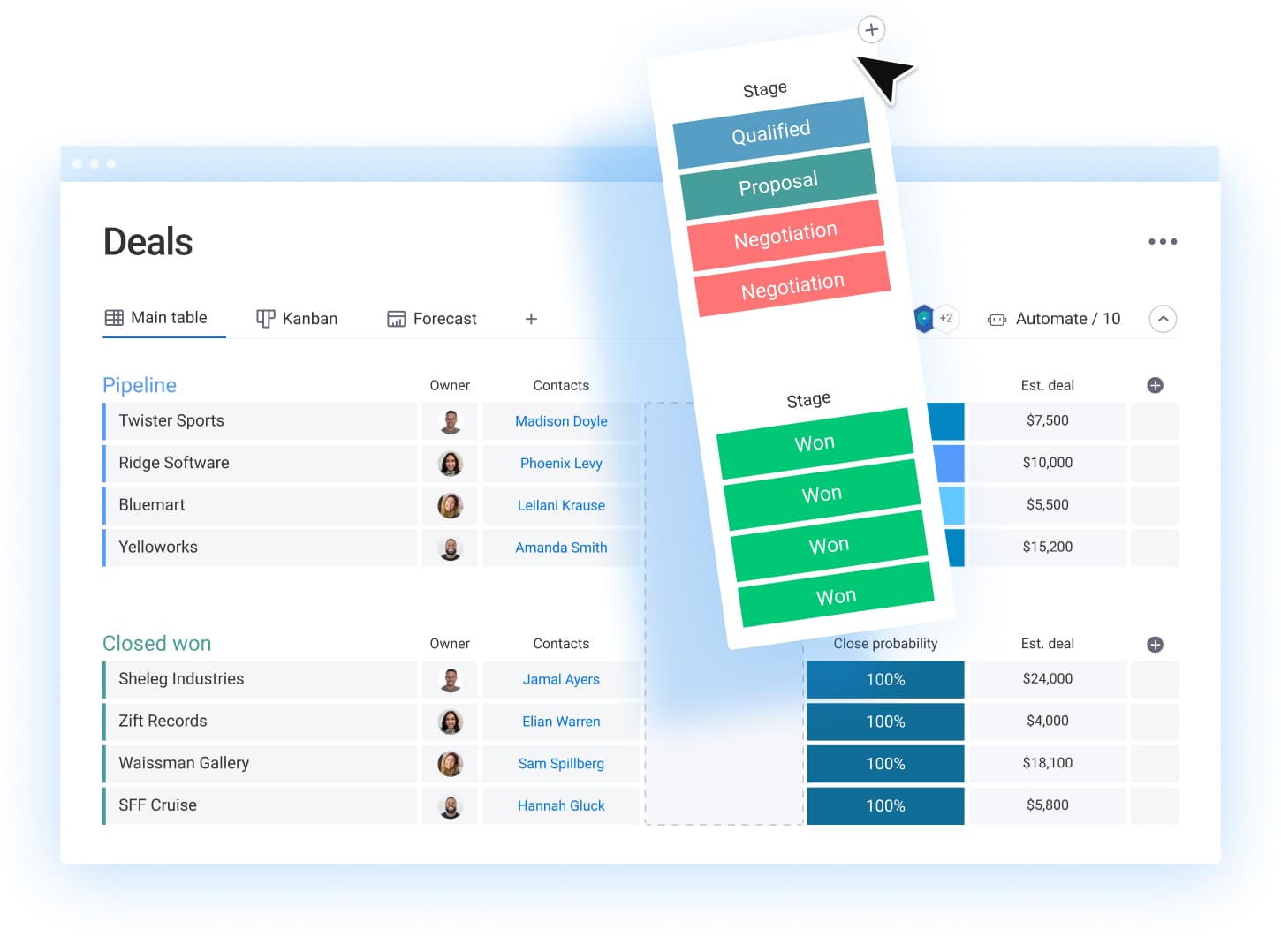
- Visual pipeline boards: no-code customization that adapts to any sales methodology or industry workflow.
Pricing:
- Basic: $12/month per seat (billed annually) with 1,000 active contacts/deals, unlimited pipelines, and mobile apps.
- Standard: $17/month per seat (billed annually) with two-way email sync, AI email generator, and 250 automations per month.
- Pro: $28/month per seat (billed annually) with email sequences, mass emails, forecasting, advanced analytics, and 25k automations per month.
- Ultimate: custom pricing with unlimited dashboards, enterprise automations, HIPAA compliance, and multi-level permissions.
- Annual billing: saves approximately 18% compared to monthly plans.
Why it stands out:
- Work OS flexibility: build prospecting workflows that actually match how your team sells, not the other way around.
- Built-in engagement stack: eliminate tool switching with native email tracking, sequences, and mass outreach capabilities.
- Unified pre-to-post-sales platform: connect prospecting directly to project delivery and customer success workflows.
- AI-powered automation: AI sales agent (beta) automatically qualifies leads and places calls with full transcript logging, while smart automations extract and label prospect data without manual entry.
- Enterprise-grade integrations: native Gmail and Outlook sync, 100+ marketplace apps including Aircall and Crunchbase, plus open API access for custom connections.
2. Apollo.io
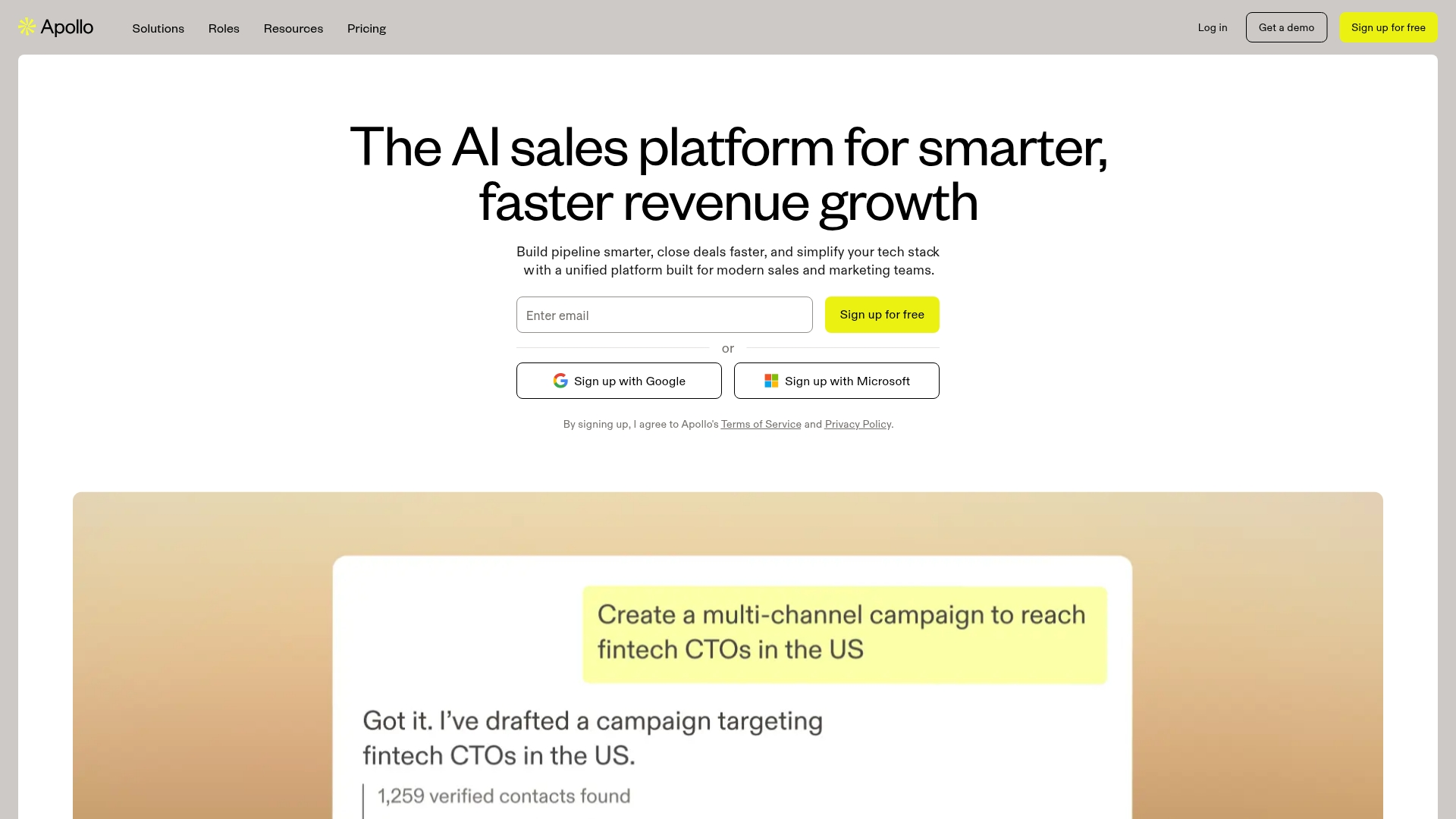
By integrating a vast contact database with robust engagement and analytics tools, Apollo.io creates a unified platform for end-to-end prospecting. This all-in-one approach enables teams to discover leads, automate outreach, and monitor campaign performance from a single dashboard, with a strong reputation for high email deliverability across 500,000+ companies.
Example:
Apollo.io serves as an end-to-end prospecting command center that combines verified data, multi-channel outreach, workflows, AI writing assistance, and buyer intent signals to help sales teams find, prioritize, and engage prospects without switching between multiple platforms.
Key features:
- Massive verified database: access to 275M+ verified contacts and 73M+ companies with 65+ filters for precise ICP targeting, plus real-time enrichment and job change alerts.
- Multi-channel engagement: built-in email sequences, dialer with recording and transcription, LinkedIn task automation, and AI writing assistant for personalized outreach at scale.
- Buying intent integration: LeadSift/Bombora intent signals built directly into search and Chrome extension to identify prospects showing purchase signals.
Pricing:
- Free: one user with limited monthly credits and basic sequences.
- Basic: $49/month per user (annual billing).
- Professional: $79/month per user (annual billing).
- Organization: $119/month per user (annual billing, 3+ seats required).
- Credit-based system: for verified emails, phone numbers, and data exports.
- Additional credits: available for purchase in-app.
Considerations:
- Data size figures vary across Apollo pages: which can create confusion when scoping coverage for specific regions or segments.
- Credit model adds complexity: since verified emails, phone numbers, exports, and dialer minutes all consume different credit types that vary by plan.
3. LinkedIn Sales Navigator
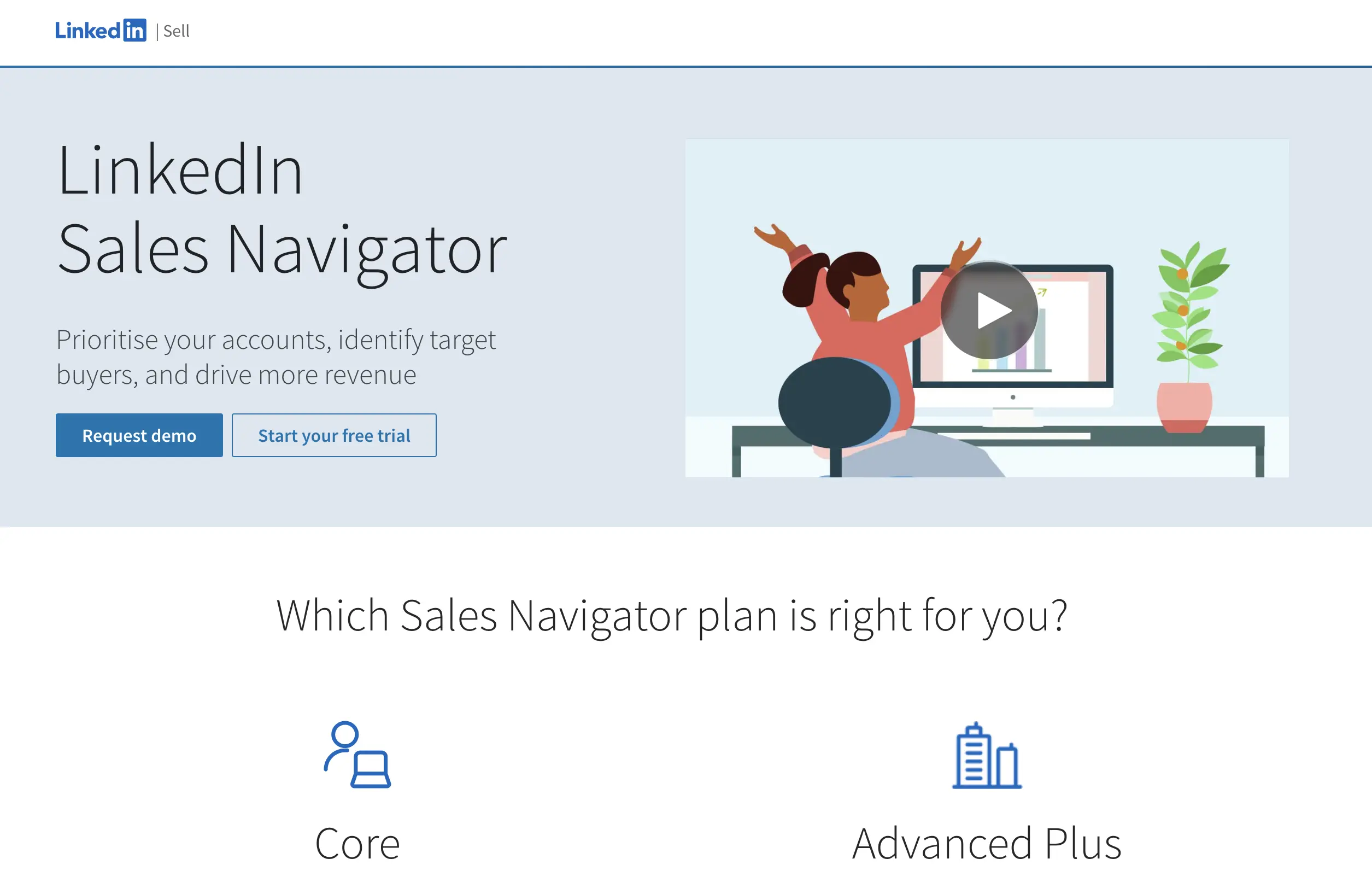
Leveraging the world’s largest professional network, LinkedIn Sales Navigator is a powerhouse for relationship-driven selling. The platform specializes in advanced search capabilities and real-time buyer intent signals, making it essential for teams who prioritize warm introductions and social selling.
Example:
LinkedIn Sales Navigator helps B2B sales teams identify high-intent prospects through first-party professional signals and leverage warm relationship paths for higher response rates.
Key features:
- Advanced search filters: buyer intent signals that surface prospects showing real engagement with your industry or competitors.
- TeamLink relationship mapping: reveals warm introduction paths through your colleagues’ networks.
- 50 monthly InMail credits: AI-powered message assistance to craft personalized outreach that cuts through inbox noise.
Pricing:
- Core: $119.99/month or $1,079.88/year per user.
- Advanced: $179.99/month or $1,679.88/year per user.
- Advanced Plus: custom pricing (sales-quoted only).
- Annual billing: provides significant savings compared to monthly rates.
- Free trial: available for eligible users (credit card required, one trial per 365 days).
Considerations:
- InMail credits are capped at 50 per month: no option to purchase additional credits, requiring careful usage management for high-volume outreach teams.
- Advanced features require higher-tier plans: buyer intent signals and CRM sync need upgraded tiers, with the most robust integrations only available through custom-priced Advanced Plus.
4. Cognism
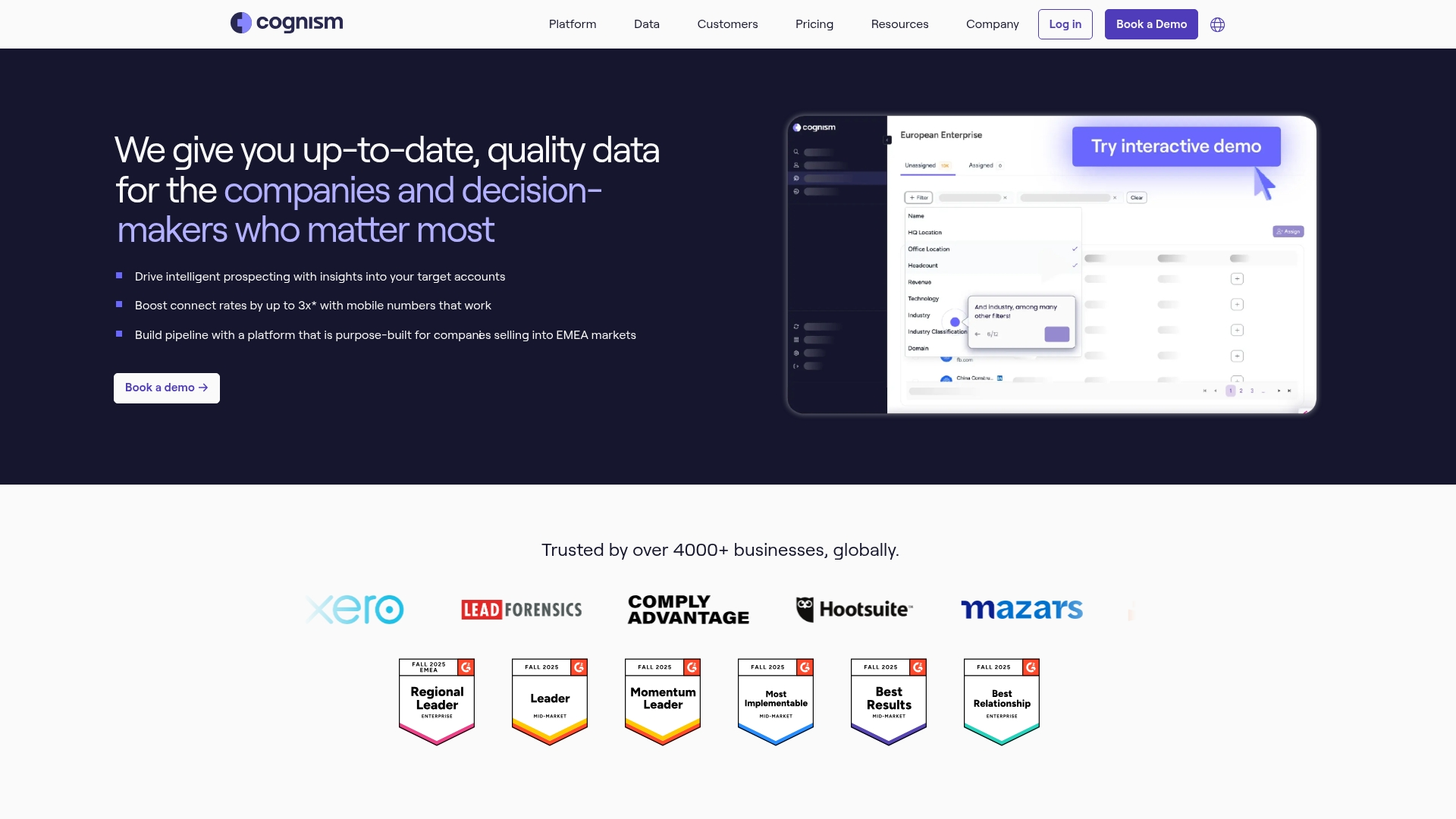
For revenue teams that require accurate, legally sound outreach, Cognism provides phone-verified contact data with a compliance-first approach. The platform specializes in GDPR compliance and data quality, particularly for European markets where regulatory adherence is non-negotiable. With Diamond Data mobile verification and DNC screening across 14 countries, it’s built for teams who refuse to compromise on data accuracy or legal safety.
Example:
Cognism helps sales teams prospect with confidence by providing phone-verified contact data and compliance guardrails that keep outreach legally sound while maximizing connect rates.
Key features:
- Diamond Data phone verification: delivers up to 3x higher dial-to-connect rates with machine-verified mobile numbers.
- AI Search: enables natural language prospecting and voice commands to accelerate list building across LinkedIn and company websites.
- Comprehensive DNC screening: across 14 countries with GDPR/CCPA compliance built into every data point.
Pricing:
- Grow: quote-only pricing (includes core contact/company data with Diamond Data).
- Elevate: quote-only pricing (adds advanced intelligence, signals, intent data, and larger list allowances).
- Add-ons: include Diamonds-on-Demand verification and additional Bombora intent topics.
- No hidden platform fees: or credit ceilings.
- Onboarding, training, and live chat support: included.
Considerations:
- ZoomInfo is acknowledged to have stronger US coverage: which may impact US-focused teams.
- Quote-only pricing can create procurement friction: compared to self-serve competitors.
5. ZoomInfo
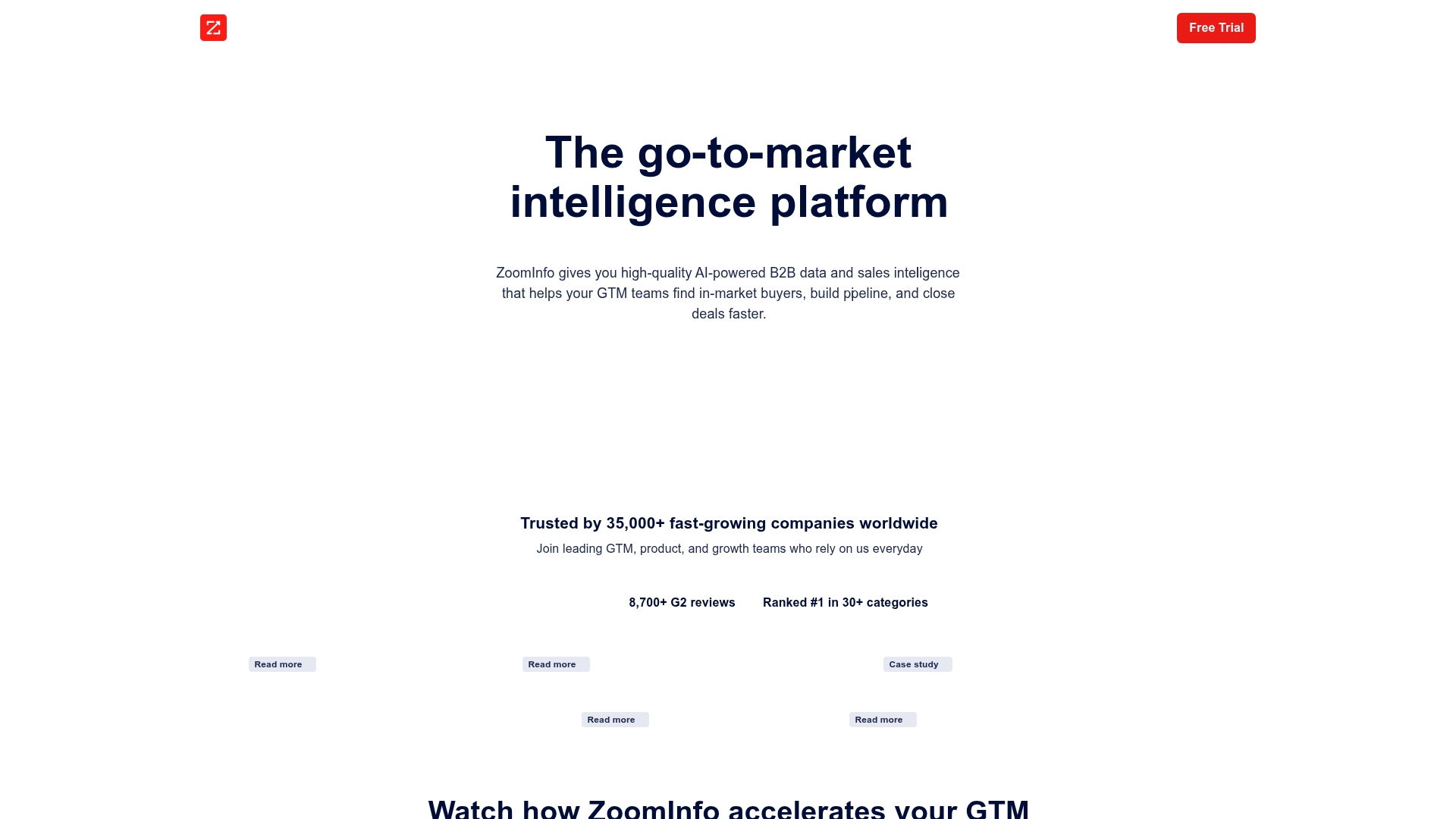
Enterprise-grade sales intelligence is the core of ZoomInfo, which uses comprehensive company and contact data to help teams identify high-intent prospects. The platform combines AI-powered data insights with intent signals to pinpoint exactly when prospects are ready to buy, making it a go-to choice for sales teams who need deep prospect intelligence and precise targeting.
Example:
ZoomInfo excels at providing detailed prospect intelligence and intent data to help sales teams identify and connect with decision-makers who are actively showing buying signals.
Key features:
- Comprehensive contact database: direct dials, emails, and organizational charts for precise decision-maker targeting.
- Intent data and buying signals: identify prospects actively researching solutions in your space.
- Native CRM integrations: Salesforce, HubSpot, and Microsoft Dynamics for seamless workflow automation.
Pricing:
- Quote-only pricing: through sales consultation.
- Buyer-reported median annual spend: typically around $30,000 based on industry data.
- Additional platform fees: may apply for enrichment credits, bulk data access, and advanced integrations.
- Contracts: typically range from one to three years, with over 49% being multi-year agreements.
Considerations:
- High total cost of ownership: can be prohibitive for smaller sales organizations.
- Limited pricing transparency: due to a sales-led purchasing model.
6. HubSpot Sales Hub
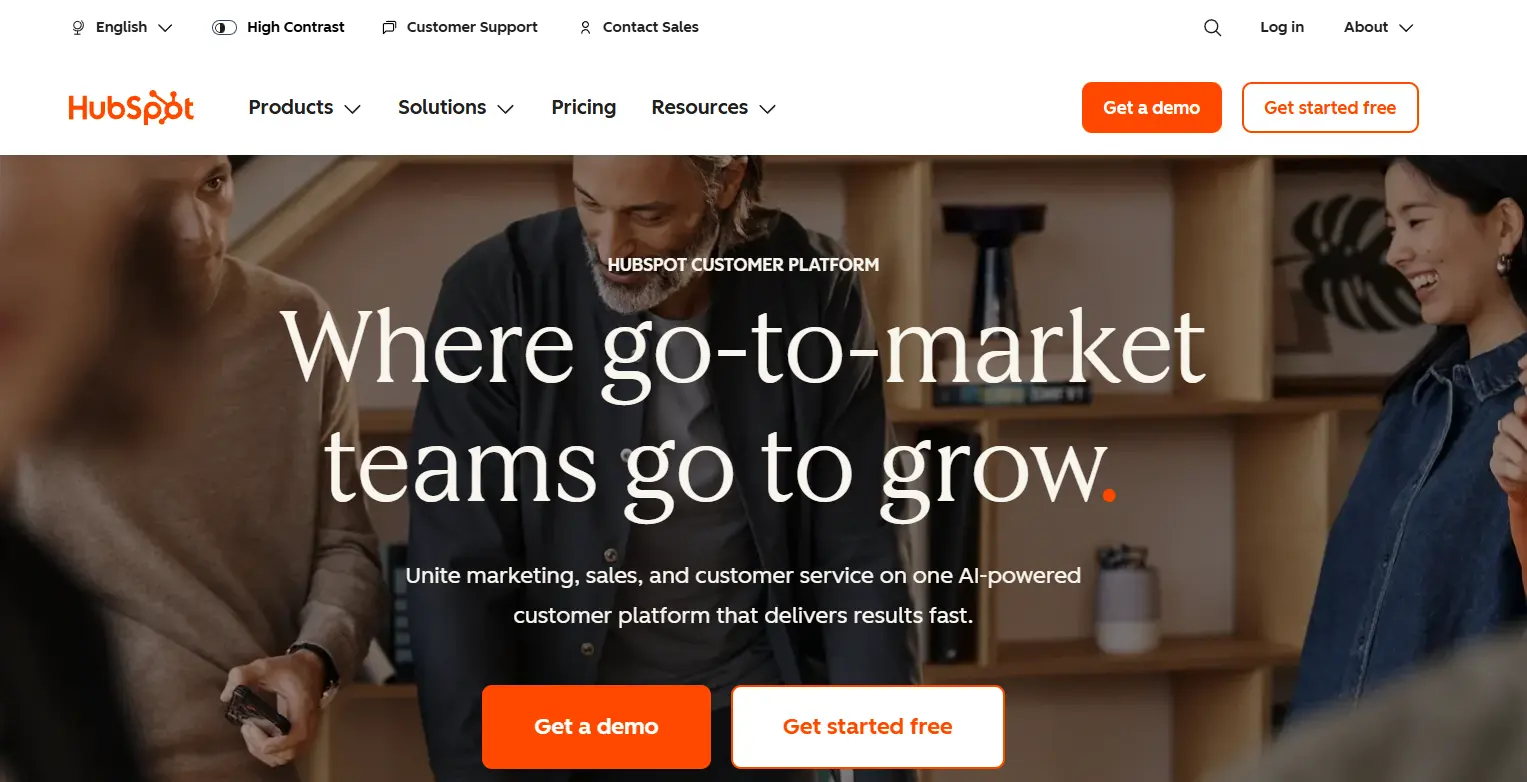
To eliminate the chaos of switching between tools, HubSpot Sales Hub integrates prospecting, engagement, and CRM data into a single, AI-guided workspace. The platform specializes in automated prospect monitoring and signal-based outreach, making it ideal for scaling companies that want to consolidate their sales stack. With its AI prospecting agent watching for buying signals and timing outreach automatically, teams can focus on building relationships instead of managing multiple tools.
Example:
HubSpot Sales Hub delivers an integrated customer platform where prospecting, engagement, and deal management happen in one workspace, reducing context-switching and accelerating sales cycles.
Key features:
- AI prospecting agent: monitors buying signals like leadership changes and funding rounds, then crafts personalized outreach timed to those moments.
- Unified sales workspace: centralizes daily tasks, prioritized actions, and AI guidance for next best actions in one dashboard.
- Automated sequences: multi-step email campaigns with dynamic branching based on engagement, plus built-in meeting scheduling and call integration.
Pricing:
- Free: $0 (five users included).
- Starter: from $15/seat/month.
- Professional: from $1,450/month (five seats included, $1,500 onboarding fee).
- Enterprise: from $4,700/month (seven seats included, $3,500 onboarding fee).
- Additional calling minutes and AI credits: available as paid add-ons.
Considerations:
- Advanced prospecting features require higher tiers: limiting access for smaller teams.
- AI usage consumes HubSpot credits: which can increase costs beyond base subscriptions.
7. Clay
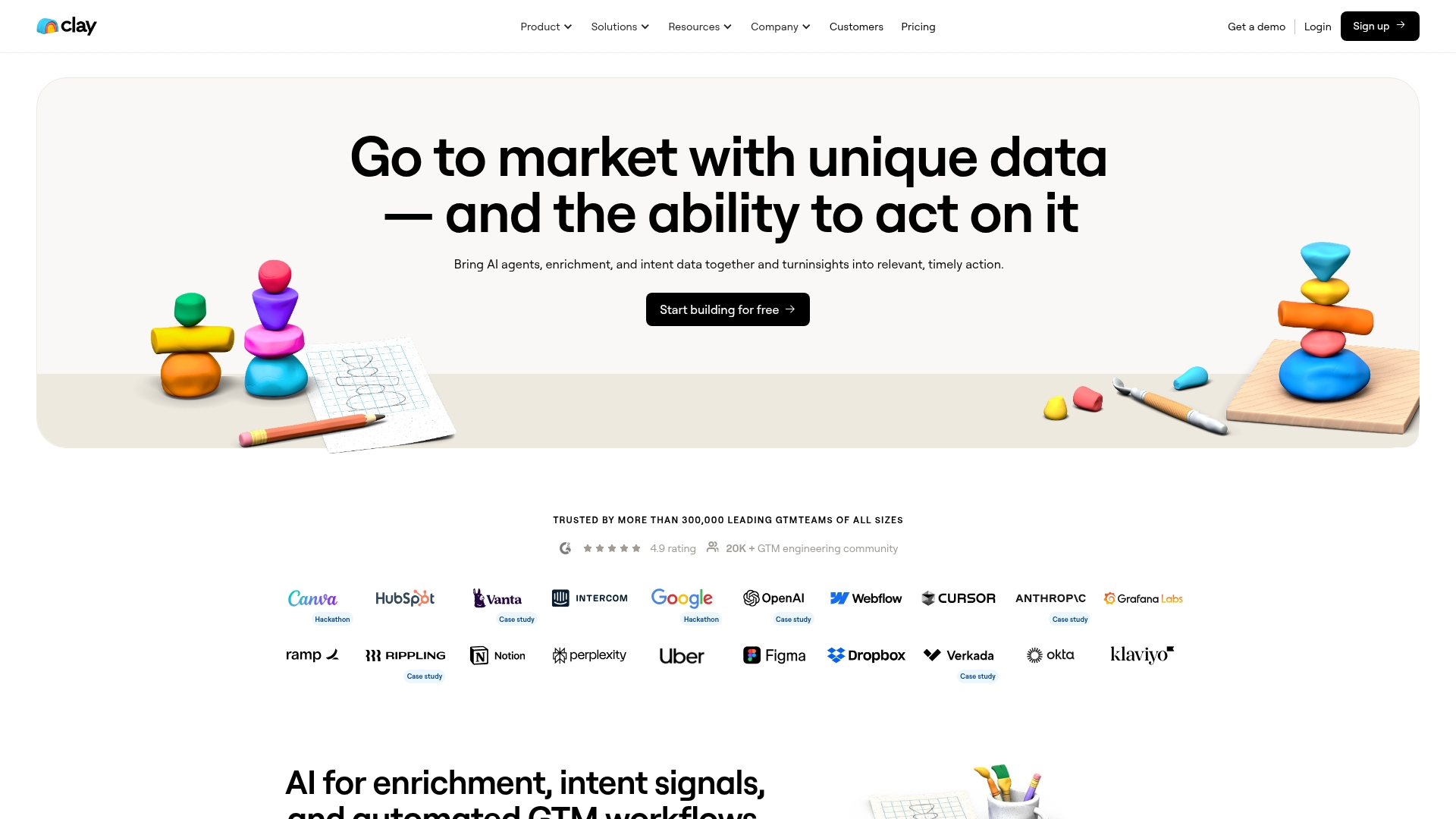
Prospecting evolves from a data scavenger hunt into a precision operation with Clay, which merges over 150 data sources with AI-powered research agents. The platform specializes in waterfall enrichment and contextual automation, making it perfect for teams that need comprehensive prospect data without the usual coverage gaps.
Example:
Clay serves as a GTM development environment that unifies data enrichment, AI research, and outreach orchestration to help teams prospect anywhere on the web and act on signals with personalized campaigns.
Key features:
- Waterfall enrichment: chain multiple data providers to maximize coverage and reduce gaps, with transparent wholesale pricing across 150+ sources.
- AI research agents: Claygent navigates websites, fills forms, and extracts specific data points while connecting to first-party systems for context-aware research.
- Native sequencing: built-in email campaigns with deliver ability controls, domain rotation, and AI-generated personalization tied to live prospect data.
Pricing:
- Free: 1,200 credits/year (100/month), unlimited users, basic search and AI features.
- Starter: from $134/month (billed annually), higher search caps, use your own API keys.
- Explorer: from $314/month (billed annually), HTTP API, web hooks, sequencing integrations.
- Pro: from $720/month (billed annually), CRM integrations for Salesforce and HubSpot.
- Enterprise: custom credits with SSO, Snowflake integration, unlimited rows, dedicated support.
- Email sequencing: costs 0.03 credits per email sent.
- Annual billing:10% discount with credits rolling over between months.
Considerations:
- Learning curve requires testing: waterfalls, prompts, and logic configurations need experimentation to achieve optimal results.
- Credit-based pricing demands careful planning: estimation and monitoring are essential, though Clay provides calculators to help predict usage.
8. Leadfeeder
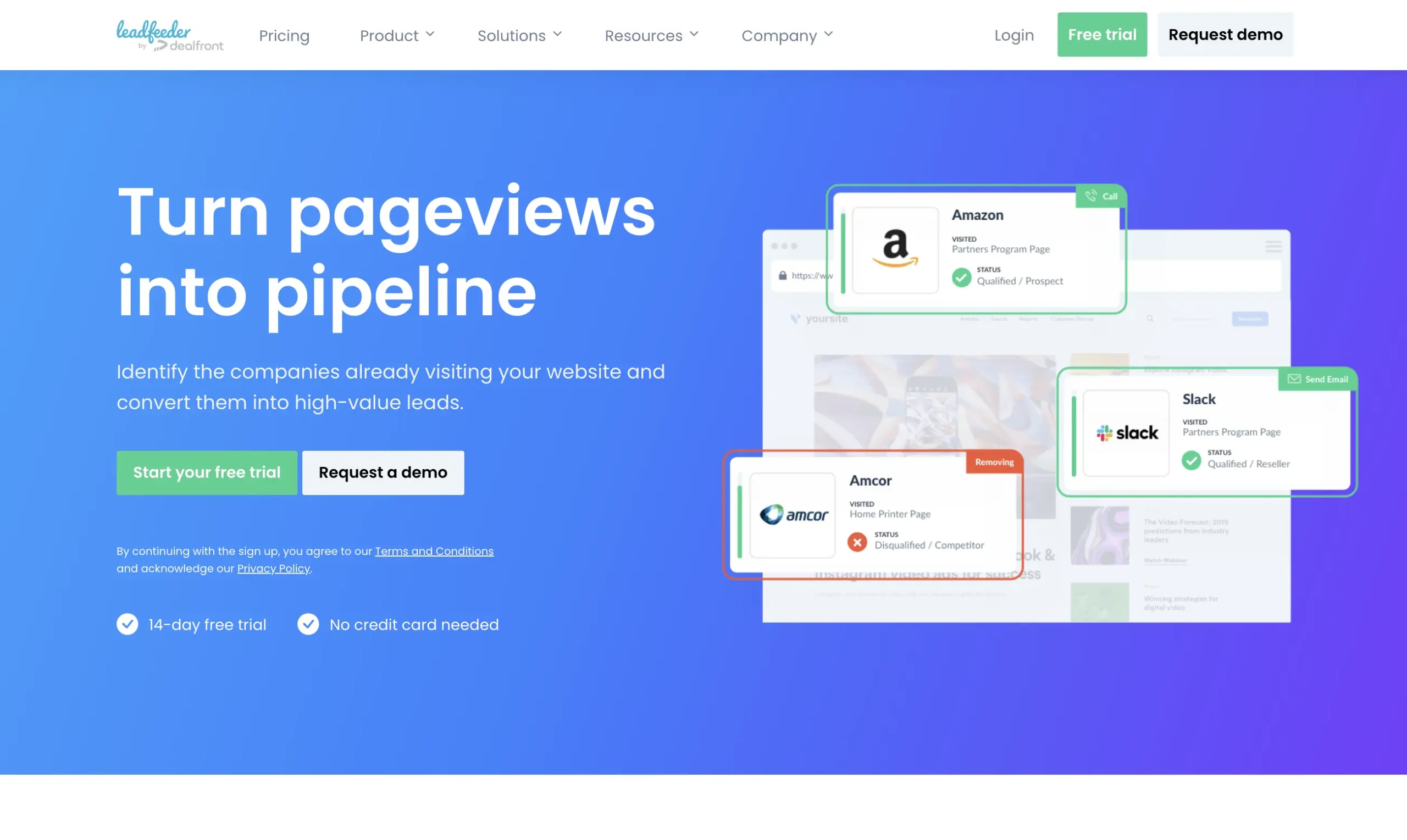
By identifying the anonymous companies browsing your website, Leadfeeder converts your site visitors into a pipeline of qualified leads. The platform specializes in real-time visitor tracking and intent signals, making it ideal for sales teams who want to reach prospects already showing interest in their products.
Example:
Leadfeeder helps B2B sales teams identify which companies are visiting their website and track their behavior to prioritize outreach efforts based on real buying intent.
Key features:
- IP-to-company identification: reveals anonymous website visitors with detailed behavioral context to understand who’s browsing your site.
- 50+ qualification filters: automatic lead scoring prioritizes high-intent prospects based on engagement patterns.
- Two-way CRM integrations: real-time alerts enable immediate follow-up on hot leads without manual monitoring.
Pricing:
- Free plan: up to 100 identified companies per month with seven days of data retention.
- Paid plans: starting at $99/month (annual billing) for up to 50 identified companies per month.
- Higher tiers: scale from $299/month (401-700 companies) to $1,199/month (20,001-40,000 companies).
- Annual billing: saves 30% compared to monthly payments.
- Unlimited users and data storage: across all plans.
Considerations:
- Identification works at the company level by default: individual visitor tracking requires additional opt-ins or form submissions.
- Data quality can vary by region: depends heavily on your website’s traffic volume to generate meaningful insights.
9. Lusha
Focused on accurate B2B data, Lusha offers real-time contact discovery through a browser extension. The platform specializes in AI-powered prospecting with verified contact information, making it ideal for sales reps who need quick access to decision-maker details while browsing LinkedIn or company websites. Its compliance-first approach and credit-based pricing model help teams pay only for the contacts they actually use.

Example:
Lusha helps sales teams discover, stream, and automate prospecting workflows with AI-assisted search capabilities and verified contact data that integrates directly into existing CRM systems.
Key features:
- AI Flex Search: natural language queries and automated contact discovery based on ideal customer profiles.
- Chrome extension: reveals verified emails and phone numbers directly on LinkedIn and company websites.
- Intent data integration: Bombora Company Surge to prioritize in-market accounts with buying signals.
Pricing:
- Free: up to 70 credits per month.
- Professional, Premium, and Scale: custom pricing (contact sales for quotes).
- Annual plans: include 25% discount and all credits provided upfront.
- Credit system: one credit per email, ten credits per phone number.
Considerations:
- Higher-tier features like CSV exports and full intent data are locked behind Scale plans: limiting functionality for smaller teams.
- Credit consumption for phone numbers (ten credits each) can add up quickly: for dial-heavy sales approaches.
10. Seamless.AI
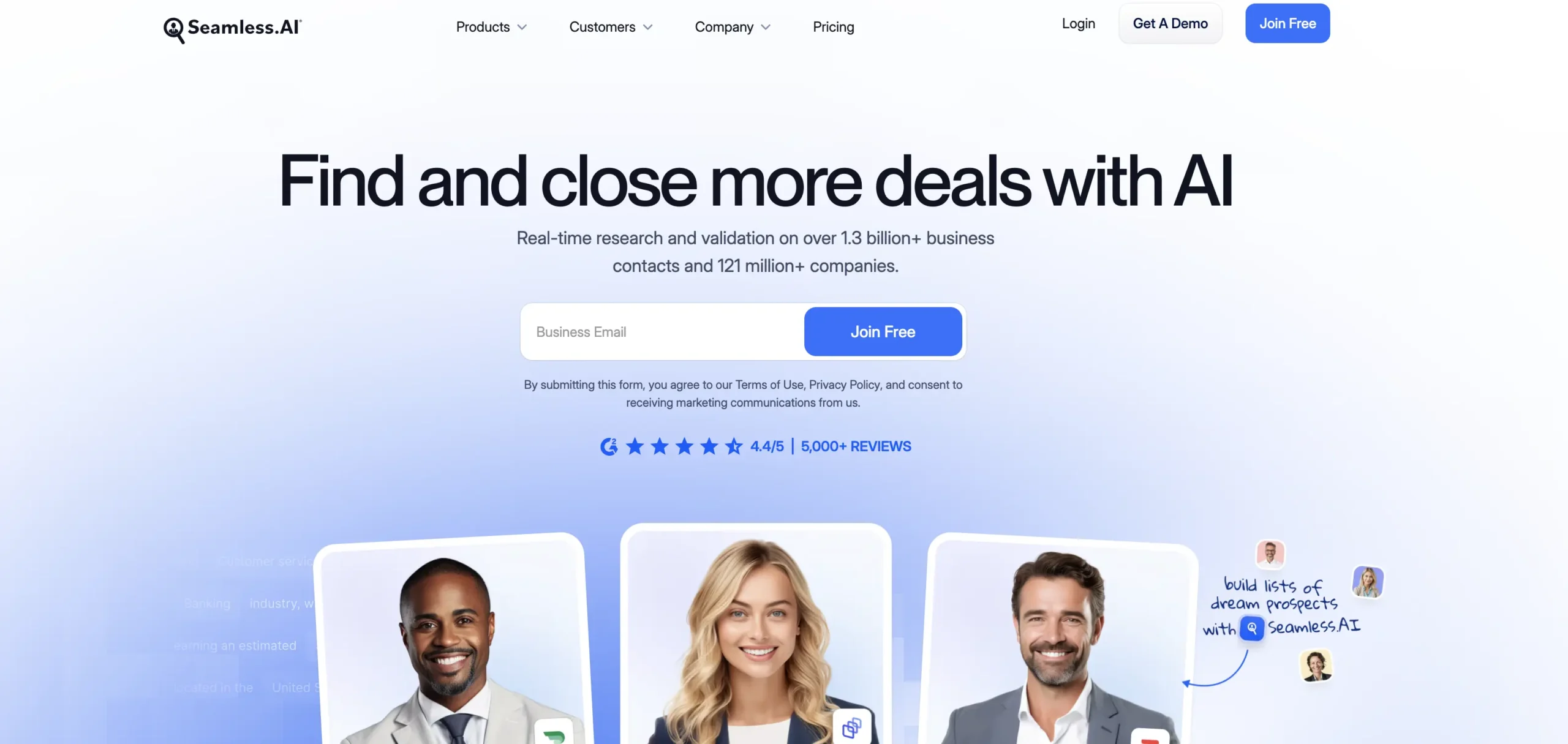
Sales teams hunting for fresh leads can utilize Seamless.AI for its real-time contact search capabilities, backed by AI-verified data. The platform specializes in in-browser prospecting with 100+ search filters, making it perfect for reps who need accurate contact info without the CSV shuffle.
Example:
Perfect for sales teams who need to build targeted prospect lists quickly with verified emails and direct-dial phone numbers while prospecting directly on LinkedIn and company websites.
Key features:
- Real-time contact search: 100+ filters for precise ICP targeting and instant prospect discovery.
- Chrome extension: prospect anywhere on the web with one-click lead capture from any page.
- AI-verified contacts: emails and direct-dial phone numbers with live validation before outreach.
Pricing:
- Free: 50 credits for one user.
- Pro: pay per user with daily credit refresh (contact sales for pricing).
- Enterprise: unlimited users with custom credits (contact sales for pricing).
- Add-ons available: Data Enrichment, Autopilot, Job Changes, Buyer Intent Data, API.
- Annual billing discounts: “Switch & Save” program offers up to 50% off current provider.
Considerations:
- Credit-based pricing can limit large exploratory searches: unless you upgrade to higher tiers.
- Some users report occasional data accuracy issues: outside core markets, especially in SMB segments.
11. Outreach
With its AI-powered revenue orchestration, Outreach transforms prospecting into a systematic and scalable workflow. The platform specializes in multi-channel sequences and autonomous AI SDR agents, making it ideal for enterprise sales teams who need governance, compliance, and measurable results at scale.
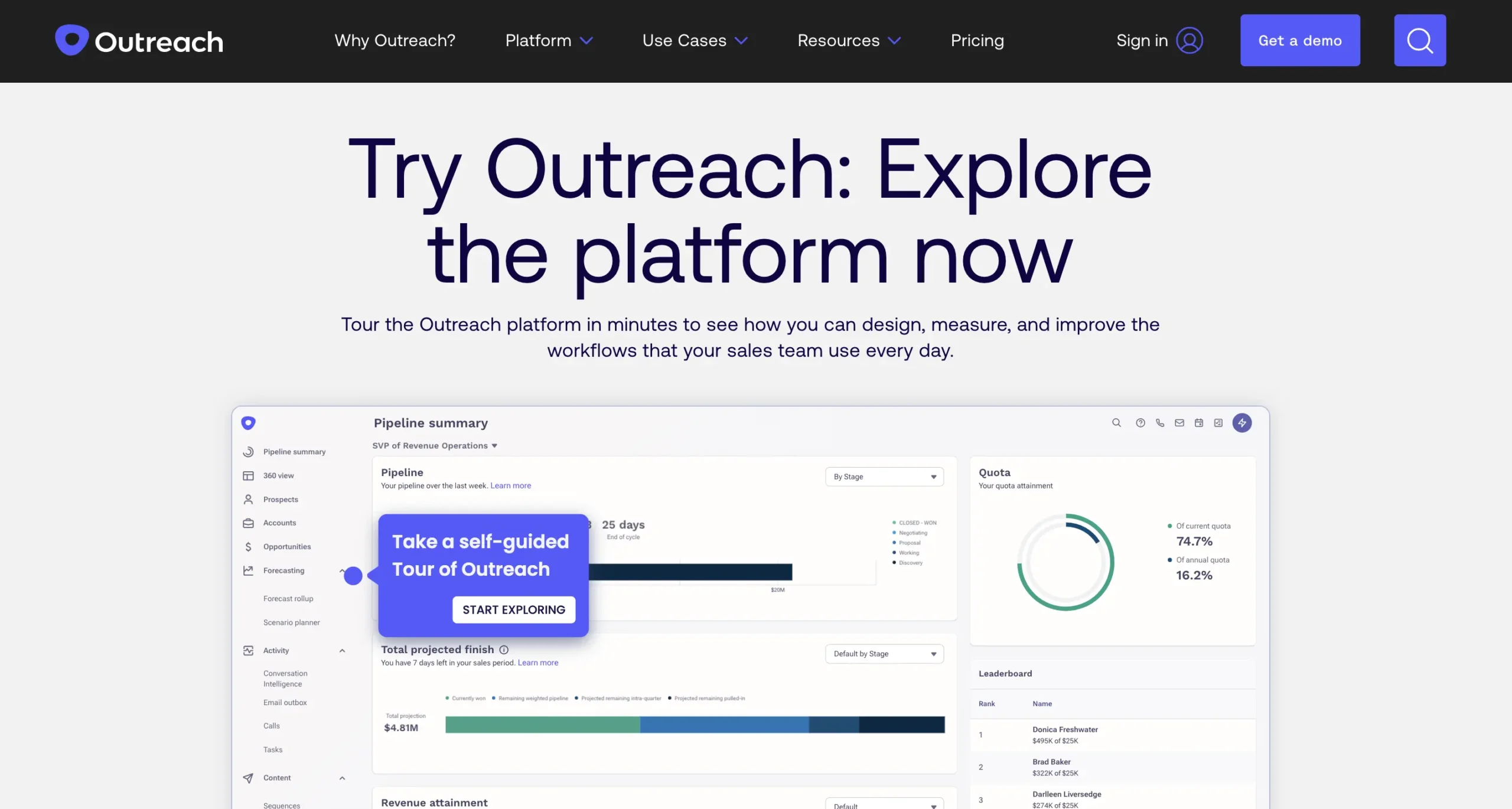
Example:
Outreach helps enterprise sales teams automate personalized prospecting across email, phone, and LinkedIn while maintaining strict governance controls and measuring what actually drives the pipeline.
Key features:
- AI Prospecting Agent: autonomously personalizes and executes outreach within configured guardrails, handling content creation and sequence management.
- Multi-channel sequences: orchestrate email, calls, LinkedIn tasks, and SMS with enrollment rules, throttling controls, and role-based activation.
- Sequence Engagement Score: quantifies prospect engagement (0-100) and tracks “Interested” metrics to identify top-performing steps and channels.
Pricing:
- Engage: quote-only pricing for core sales engagement features including sequences, templates, automations, and CRM sync.
- Call (Voice): usage-based or subscription calling plans with phone numbers, dialer, and AI call summaries.
- Meet (Kaia/CI + AI Agents): quote-only pricing for conversation intelligence, AI Revenue Agent, AI Deal Agent, and AI Research Agent.
- Professional services: packages available for onboarding and change management.
- Negotiated discounts: average around 12% according to G2 purchaser data.
Considerations:
- Complex governance rules can slow iteration: sequence editing is locked in-flight, and enrollment failures often stem from exclusivity or re-enrollment restrictions.
- Steep learning curve for mastering sequencing: reporting and CRM sync mappings, typical of enterprise-grade platforms require significant time investment.
12.Reply.io
Giving sales teams a single platform to find, engage, and convert leads, Reply.io merges prospecting data with multi-channel outreach automation. The platform specializes in real-time contact discovery and deliverability optimization, making it ideal for smaller teams who want to scale outbound without juggling multiple tools.
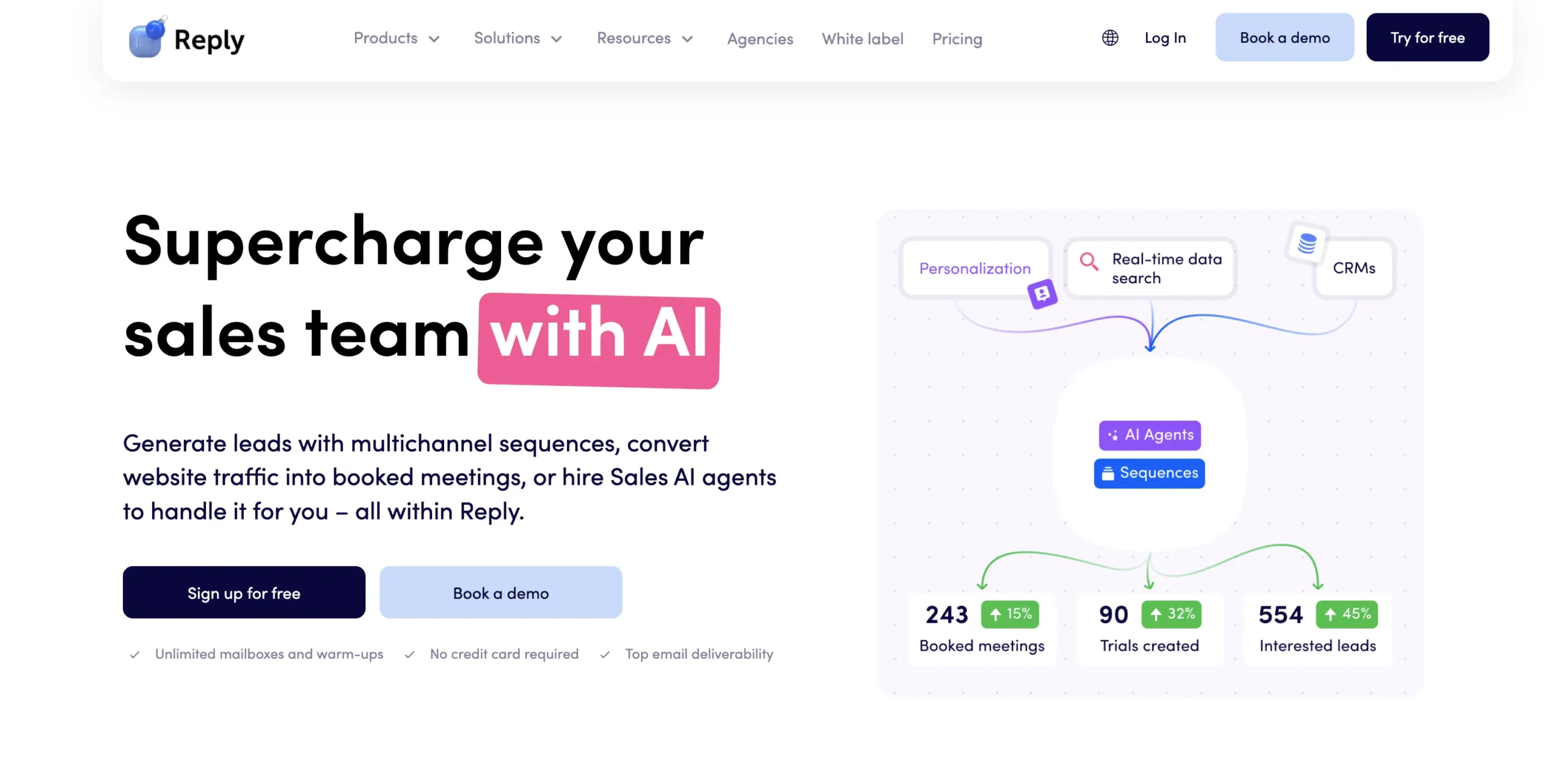
Example:
Reply.io helps sales teams discover prospects with intent data, verify contacts, and launch multi-channel sequences across email, LinkedIn, and phone, all while maintaining high deliverability rates.
Key features:
- Real-time prospecting database: 1B+ contacts with 16 filters, including hiring intent and technology usage for precise targeting.
- Multi-channel automation: orchestrates email, LinkedIn, phone, SMS, and WhatsApp with built-in safety controls.
- Advanced deliverability suite: mailbox warm-up, Gmail API sending, and Postmaster integration to protect sender reputation.
Pricing:
- Email Volume: $59/user/month (billed annually) for 1,000 active contacts.
- Multichannel: $89-$99/user/month (billed annually) with unlimited active contacts.
- AI SDR “Jason”: $500/month for automated end-to-end prospecting.
- Add-ons: LinkedIn automation ($69/account), Calls & SMS ($29/account).
Considerations:
- Base plans include only 50 Live Data credits per month: requiring additional purchases for larger prospecting volumes.
- LinkedIn automation and telephony features require paid add-ons: that can significantly increase total costs.
13. Instantly
Designed for high-volume cold email campaigns, Instantly provides unlimited email outreach fortified with built-in deliverability protection. The platform combines lead discovery, email automation, and reply management in one flat-fee system, making it ideal for agencies and founders who need to scale across multiple inboxes without per-seat costs.
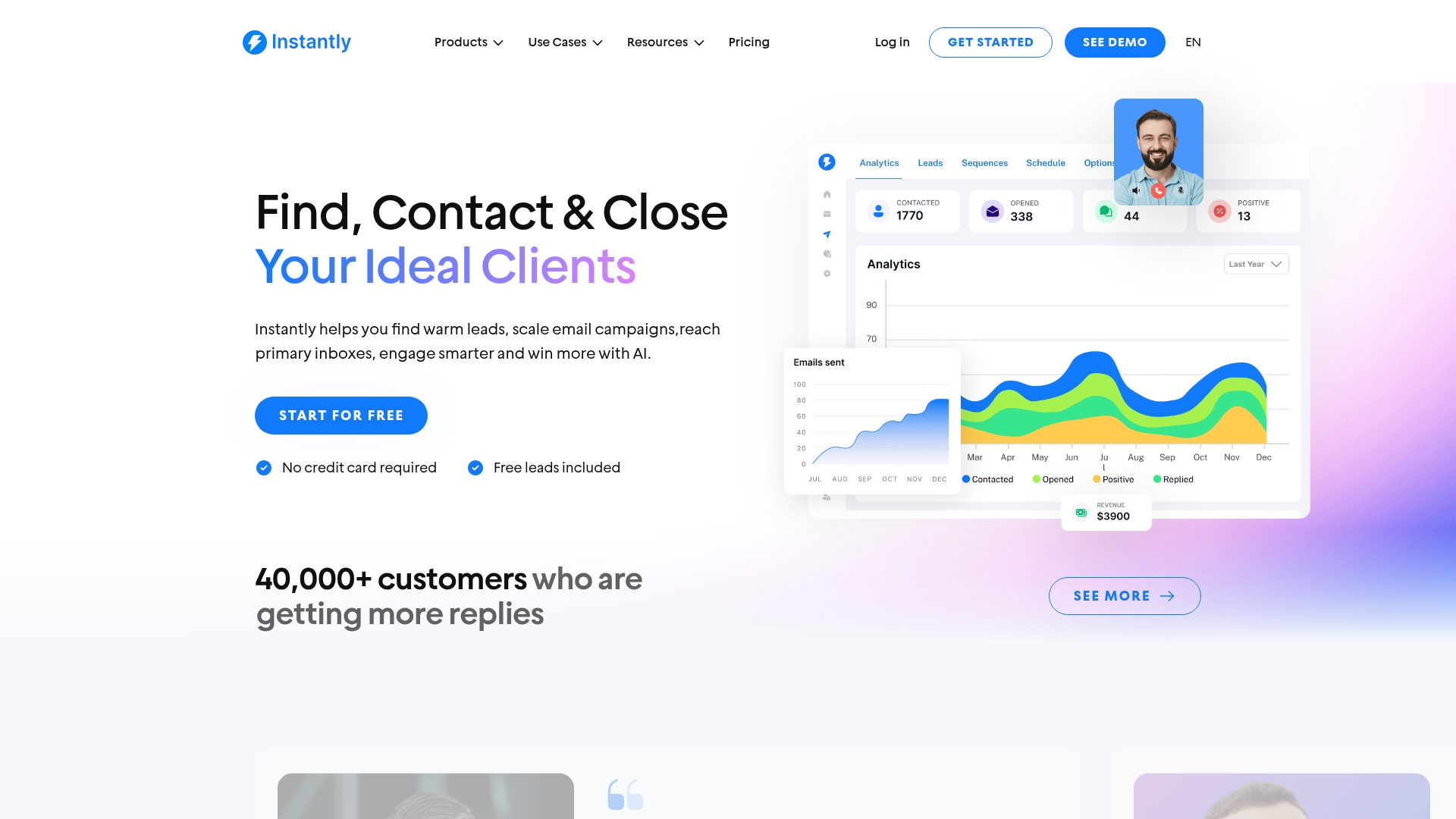
Example:
Instantly helps sales teams run large-scale cold email campaigns with unlimited sending accounts and automated warm-up to protect domain reputation while maximizing inbox delivery rates.
Key features:
- SuperSearch lead database: access 450M+ contacts with waterfall email enrichment across multiple providers and AI-powered prospect research.
- Unlimited inbox management: connect unlimited email accounts with automated warm-up and deliverability monitoring on all plans.
- Unified reply handling: centralize responses from all connected accounts in Unibox with AI-powered reply assistance and automated scheduling.
Pricing:
- Growth: $37/month (1,000 uploaded contacts, 5,000 emails/month, unlimited accounts, and warm-up).
- Hypergrowth: $97/month (25,000 uploaded contacts, 100,000 emails/month, A/Z testing, in-app replying).
- Light Speed: $358/month (100,000 uploaded contacts, 500,000 emails/month, dedicated IP pools).
- SuperSearch credits: starting at $9/month for 150 credits (lead data is a separate subscription).
- CRM add-on: $47-97/month for reply management and pipeline tracking.
- Annual billing: ~20% discount available across all plans.
Considerations:
- Advanced features like A/Z testing and in-app reply management require higher-tier plans: limiting testing capabilities for entry-level users.
- Full-stack usage with lead credits, CRM, and deliverability testing can increase total monthly costs: significantly beyond the base outreach pricing.
14. RocketReach
To help sales teams find decision-makers quickly, RocketReach supplies verified contact data and performs real-time email validation. The platform combines a massive database of 700M+ contacts with real-time SMTP validation, making it perfect for teams that need accurate prospect information without the guesswork. Their Chrome extension lets you prospect directly on LinkedIn and company websites, turning any page into a lead generation opportunity.
Example:
RocketReach helps sales teams skip the manual research phase by instantly revealing verified contact information and automating simple outreach sequences.
Key features:
- Real-time email validation: SMTP checks reduce bounce rates and protect sender reputation before you hit send.
- Browser extension: works on LinkedIn and millions of websites for prospect-in-context discovery wherever you browse.
- Autopilot automation: dynamic list building, AI-powered messaging, and multi-step sequences that run on their own.
Pricing:
- Free: five look-ups per month.
- Essentials: ~$80/month (email contacts only, annual billing).
- Pro: ~$150/month (email + phone numbers, annual billing).
- Ultimate: ~$300/month (advanced features, annual billing).
- Annual billing discount: ranges from 26–44% off monthly rates.
- Team and enterprise plan: available with custom pricing.
Considerations:
- Credit-based system can get expensive: for high-volume prospecting campaigns.
- Some users report occasional outdated contact information: especially for smaller companies.
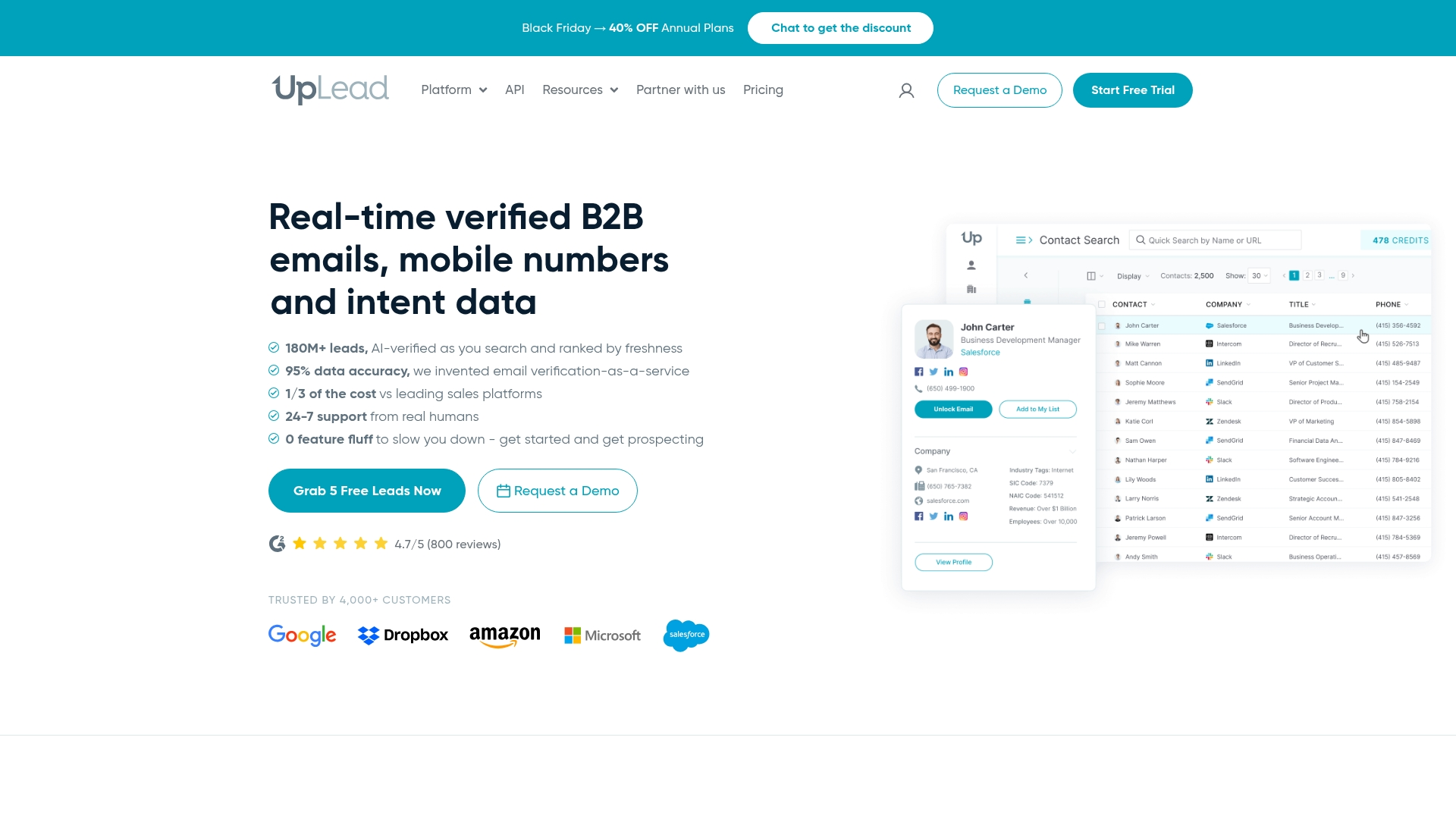
15. UpLead
A 95% accuracy guarantee on verified B2B contact data is the promise of UpLead, designed to help sales teams eliminate bounced emails and wasted outreach. The platform specializes in real-time email verification and technographic filtering, making it ideal for teams that need reliable contact information without paying for invalid data.
Example:
UpLead helps sales teams build targeted prospect lists with verified contact data and technographic insights, ensuring higher deliverability rates and more qualified leads.
Key features:
- Real-time email verification: 95% accuracy guarantee at download, with credits refunded for invalid emails.
- 50+ search filters: technographics, intent data, and firmographics to target ideal customer profiles.
- Chrome extension: LinkedIn prospecting with verified emails and direct dial numbers when available.
Pricing:
- Free trial: seven days with five credits.
- Essentials: $99/month (170 credits), monthly or $74/month billed annually (2,040 credits/year).
- Plus: $199/month (400 credits), monthly or $149/month billed annually (4,800 credits/year).
- Professional: custom quote (annual billing), includes buyer intent data and full API access.
- Additional credits: available at tier-dependent rates.
Considerations:
- Smaller database size compared to volume-focused providers: which may limit coverage for niche industries.
- Intent data and advanced features require Professional tier: with an annual commitment.
16. Kaspr
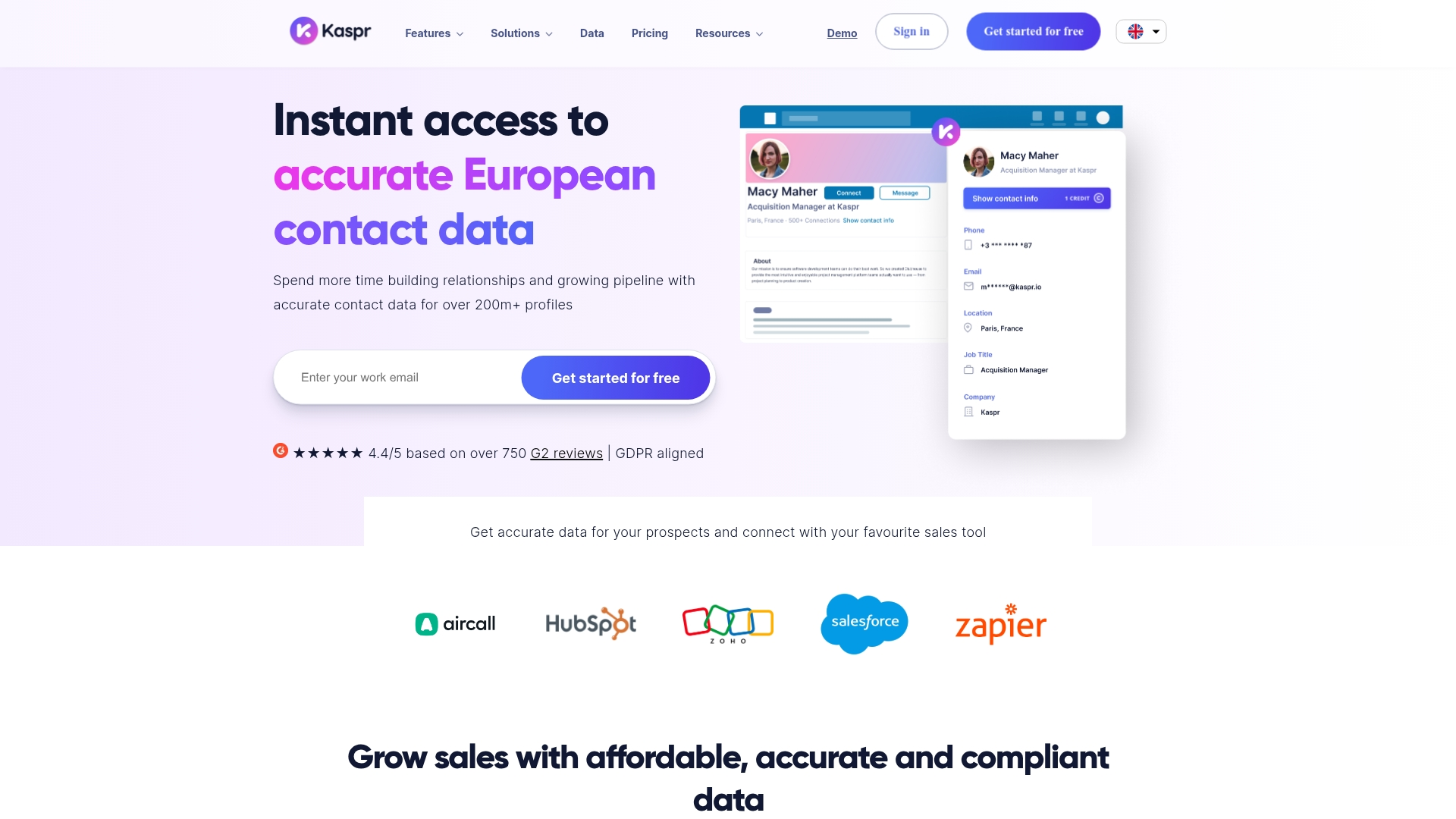
With a focus on European markets, Kaspr enables LinkedIn-first prospecting through real-time, GDPR-compliant contact enrichment. The platform specializes in data extraction directly from LinkedIn profiles, making it ideal for sales teams who rely heavily on LinkedIn for lead generation.
Example:
Kaspr enables sales teams to extract verified emails and phone numbers directly from LinkedIn profiles with one-click enrichment across LinkedIn, Sales Navigator, and Recruiter Lite.
Key features:
- Chrome extension: instant contact enrichment on LinkedIn profiles and search results for seamless prospecting.
- Bulk automation workflows: process up to 2,500 contacts per Sales Navigator search to scale list building.
- Real-time verification: checks against 120+ sources with GDPR compliance features built in.
Pricing:
- Free: $0/month with fifteen B2B email credits and five phone credits monthly.
- Starter: $49/month (annual) or $65/month (monthly) with unlimited B2B emails and 100 phone credits.
- Business: $79/month (annual) or $99/month (monthly) with 200 phone and direct email credits.
- Organization: custom pricing for enterprise teams with unlimited exports and credits.
- Annual billing: offers up to 25% discount across paid plans.
Considerations:
- LinkedIn dependency means users face potential rate limits: platform restrictions that can slow prospecting velocity.
- California residents cannot access the platform: due to CCPA compliance restrictions.
17. Lead411
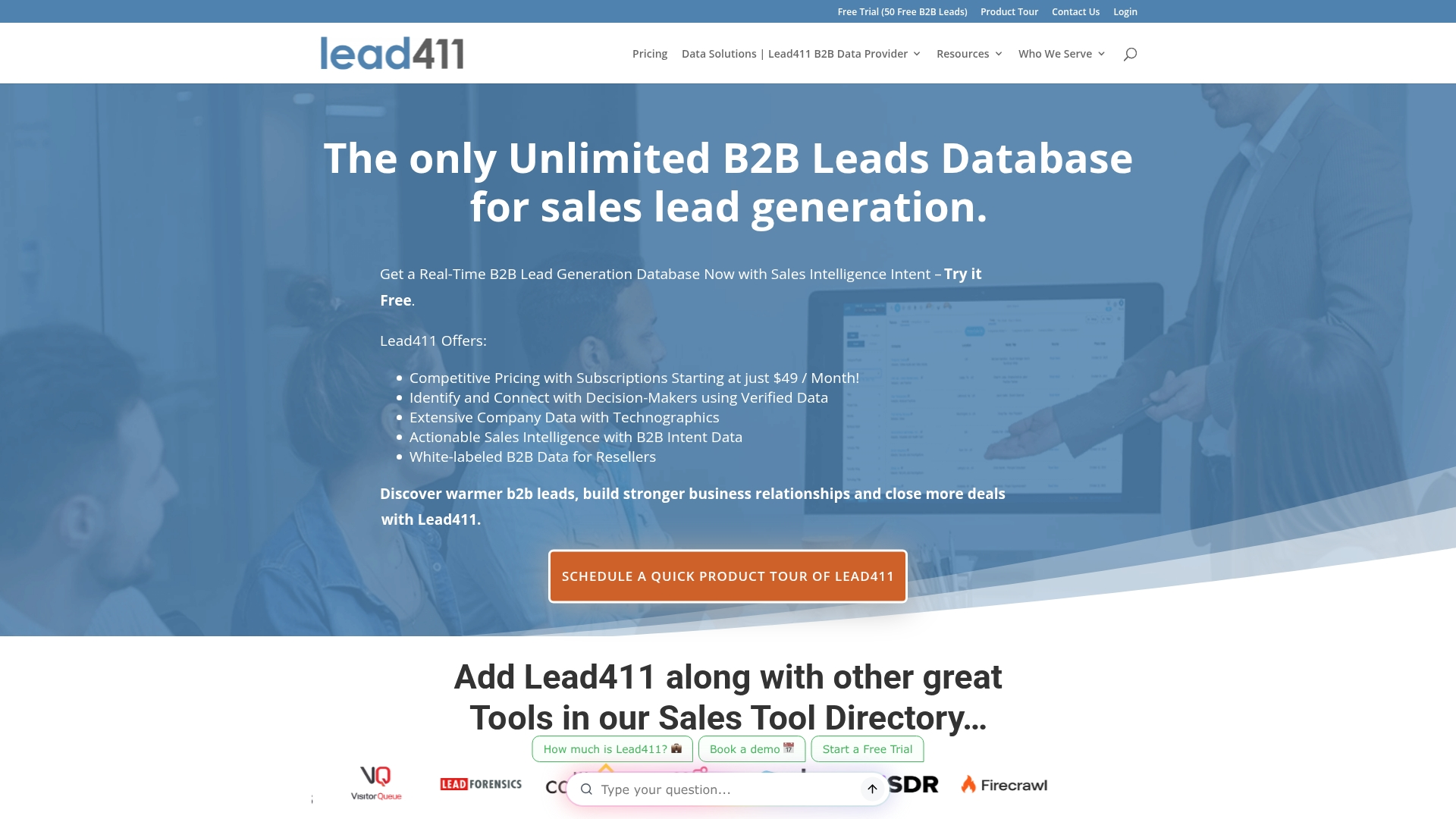
Reaching prospects at the perfect moment is the goal of Lead411, which pairs verified contact data with growth-intent triggers. The platform specializes in triple-verified emails and direct dials, making it ideal for teams who need reliable contact information without the guesswork. Their AI-powered dashboard monitors target accounts for hiring, funding, and executive changes.
Example:
Lead411 helps sales teams identify prospects who are actively in growth mode through intent signals like new hires, funding rounds, and executive changes.
Key features:
- Triple-verified emails and double-verified direct dials: 96% average deliverability protects your sender reputation and ensures you’re reaching real decision-makers.
- Growth-intent triggers: alerts when target accounts show buying signals like new hires, funding rounds, or executive changes.
- Built-in sales engagement platform (Reach): email and SMS cadences that keep prospects engaged without switching tools.
Pricing:
- Free trial: seven days with 50 exports.
- Spark: $49/month or $490/year (1,000–12,000 exports).
- Ignite: quote-only (annual plans with flexible export limits).
- Blaze: quote-only (unlimited exports for large-scale outreach).
Considerations:
- Data accuracy can vary by record: with some users reporting outdated contacts in certain segments.
- Coverage depth may be uneven: for certain departments or specialized roles depending on your target market.
18. BookYourData
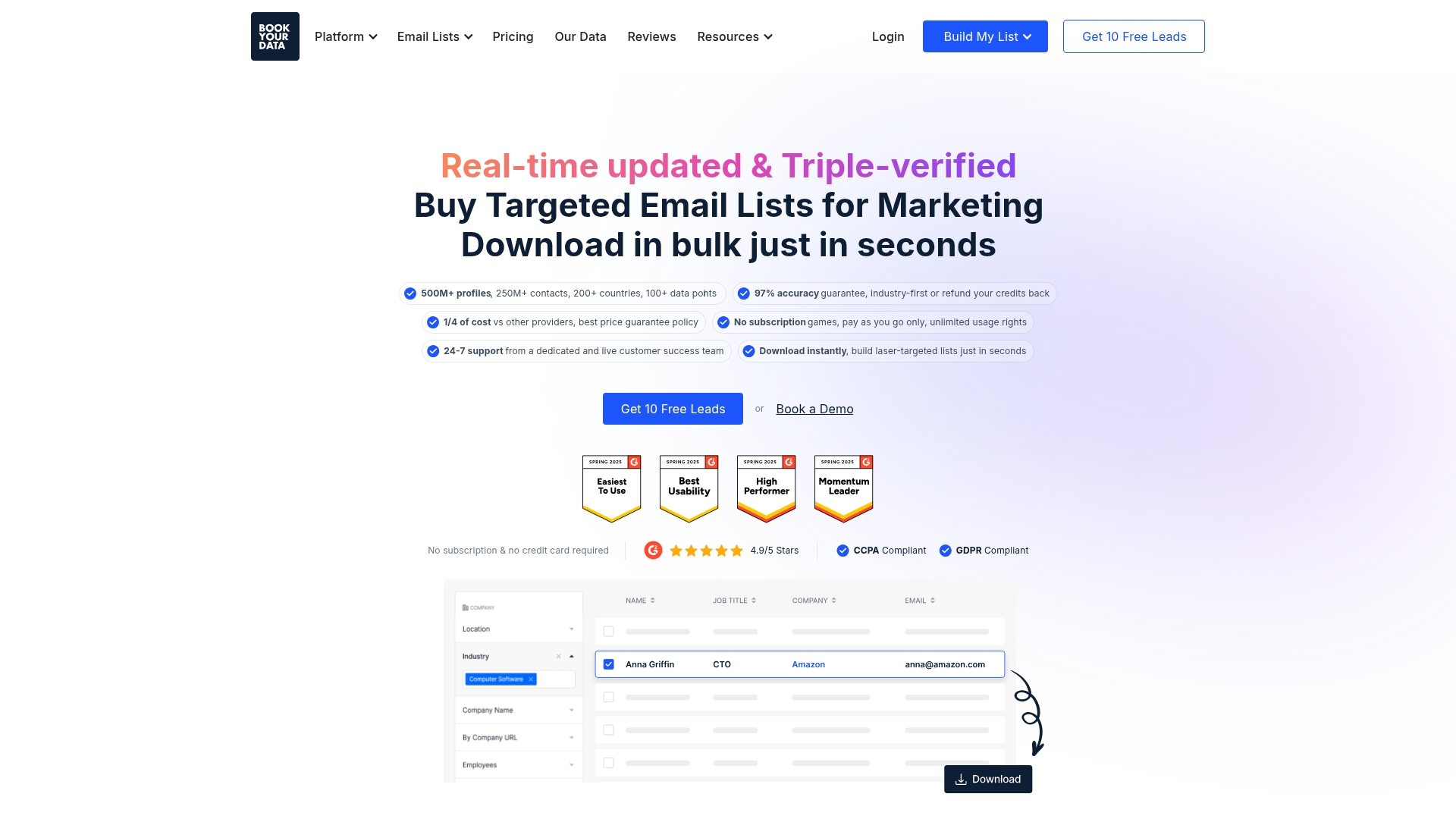
Operating on a pay-per-contact model with a 97% accuracy guarantee, BookYourData is ideal for teams seeking verified leads without the burden of a subscription. The platform specializes in real-time email verification and precision targeting through 100+ filters, perfect for sales teams who need quality data on demand.
Example:
BookYourData helps sales teams build targeted prospect lists with verified contact data, ensuring higher deliverability rates and reduced bounce backs through real-time email verification.
Key features:
- Real-time email verification at export: credits charged only for deliverable contacts to protect your sender reputation and budget.
- 100+ precision filters: technographics, funding signals, and hiring data for laser-focused targeting of your ideal customer profile.
- Global database coverage: 250M+ verified B2B contacts across 200+ countries for worldwide prospecting reach.
Pricing:
- Pay-as-you-go credits: starting at $99 for 250 leads (~$0.40 per contact).
- Pre-built flat files: $999 for 100k contacts, $1,999 for 250k contacts, $2,999 for 500k contacts.
- Monthly subscriptions: available with volume discounts for 1k–100k contacts per month.
- Credits never expire: volume discounts apply for larger purchases.
Considerations:
- No native outreach or sequencing features: requires integration with external email tools for campaign automation.
- Some advanced features like API access and Chrome extension, are still listed as coming soon: which may limit functionality for teams needing immediate access.
19. GetEmail.io
Specializing in email discovery and bulk processing, GetEmail.io simplifies the generation of large, verified contact lists for outbound campaigns. The platform focuses on LinkedIn-driven prospecting workflows, allowing sales teams to discover and verify professional emails directly from profile pages, search results, and company directories. Its simplicity and speed appeal to teams running high-volume outreach without the complexity of full data platforms.
Example:
GetEmail.io helps sales teams quickly find and verify professional email addresses using LinkedIn profiles and company domains, streamlining the contact discovery process for outbound campaigns.
Key features:
- LinkedIn email finder extension: discovers emails directly from profile pages, search results, and company directories for seamless prospecting.
- Bulk CSV processing: large-scale email discovery and verification with SMTP validation to ensure deliverability at scale.
- API access across all pricing tiers: integrations for Zapier, Make, and popular CRM platforms to automate workflows.
Pricing:
- Free: $0/month (ten credits/month).
- Basic: $49/month (300 credits/month).
- Standard: $99/month (1,000 credits/month).
- Premium: $149/month (2,000 credits/month).
- Ultra: $399/month (10,000 credits/month with 24/7 support).
- Annual billing discounts: available across all paid plans.
- Each email request: uses one credit.
Considerations:
- Email-only focus means no phone numbers or additional contact data included: limiting multi-channel prospecting capabilities.
- Accuracy varies by target: some users report mixed hit rates around 60%, which may impact outreach effectiveness.
20. FlashInfo
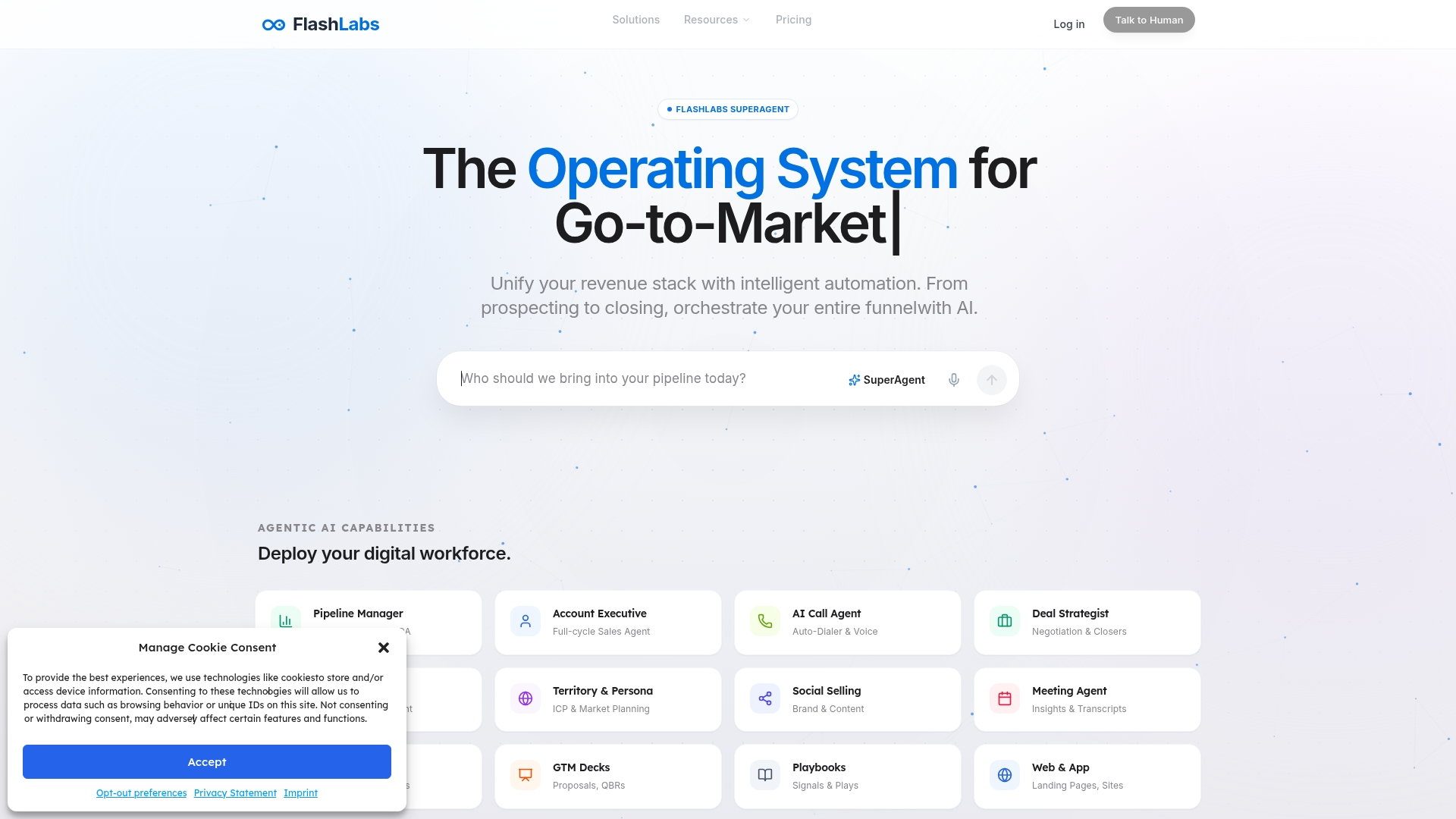
To accelerate lead generation at scale, FlashInfo integrates AI-powered prospecting with comprehensive data enrichment. The platform specializes in real-time buyer intent signals and unified workflows, making it ideal for revenue teams who want to move from discovery to outreach without switching tools. Their “In-Market-Timing Engine” helps sales teams prioritize prospects based on job changes, social activity, and technology signals.
Example:
FlashInfo consolidates prospecting data, intent signals, outreach sequences, and parallel dialing into one platform to eliminate tool-switching and reduce time-to-first-touch.
Key features:
- Chrome extension: reveals verified contact data directly within LinkedIn, HubSpot, and Salesforce pages for seamless prospecting.
- AI-powered intent engine: tracks job changes, social activity, topic engagement, and technology adoption to identify buying signals.
- Built-in parallel dialer: five to ten lines with call recording, transcripts, and personal caller ID options to maximize connect rates.
Pricing:
- Free: $0 (one-time 200 tokens).
- Basic: $39/month (billed annually).
- Growth: $119/month (billed annually).
- Explorer: $250/month (billed annually).
- Pro: $624/month (billed annually).
- Enterprise: custom pricing.
- Parallel Dialer: $325–$399/user/month with unlimited US/Canada calling.
- Additional phone numbers: $10/month each.
Considerations:
- Data coverage can vary by niche or region: with some users reporting outdated or missing records.
- Multiple pricing pages and product modules may create confusion: when comparing total costs to single-SKU alternatives.
4 types of B2B prospecting platforms you should know
Prospecting tools aren’t one-size-fits-all. Some find contacts, some automate outreach, and a few run your whole sales process. Using the wrong one is like bringing a screwdriver to a hammer job, a great way to waste time and kill momentum.
| Tool type | Primary functions | Ideal use cases | Example platforms |
|---|---|---|---|
| CRM-integrated prospecting | Lead management, workflow automation, reporting | Centralized sales process, team collaboration | monday CRM |
| Sales intelligence & data | Company/contact research, data enrichment | Targeted list building, account-based selling | Data providers |
| Multi-channel engagement | Outreach automation, sequencing, personalization | Scalable, personalized outbound campaigns | Outreach tools |
| Email discovery & verification | Contact finding, email validation | Building verified lists, ensuring deliverability | Contact finders |
- CRM-integrated prospecting platforms: this is your command center. It handles everything from finding leads to closing deals, all in one place. With solutions like monday CRM, your prospecting tools are built right into your sales system, ending the constant tab-switching and data silos for good. When your prospect data flows straight into your pipeline, the busywork disappears.
- Sales intelligence tools and data providers: these tools are your secret weapon for research. They give you the company and contact data you need to find the right prospects and know what they care about before you ever reach out. This is your go-to for building targeted lists or running account-based plays.
- Multi-channel engagement software: time to put your outreach on autopilot, without sounding like a robot. These platforms automate your emails, calls, and social messages in a smart sequence that keeps the conversation going. It’s perfect for running outbound campaigns that need to feel personal, even when you’re contacting hundreds of prospects.
- Email discovery and verification services: these tools do one thing, and they do it well: find and verify contact info. They make sure your emails hit a real person’s inbox, not a bounce-back report or a spam folder. Use these to build clean lists from scratch or to scrub the data you already have. It’s the simple step that ensures your whole sales effort doesn’t go to waste on bad data.
How to choose the right prospecting tools for your business?
Selecting the right prospecting tool requires a strategic approach grounded in your team’s actual needs. Rather than pursuing feature-rich platforms that may not align with your workflow, begin by identifying specific bottlenecks in your current sales process and the operational challenges your team faces daily.
Keep in mind to avoid platforms that force rigid, predefined workflows onto your sales methodology. Implementation complexity should scale appropriately with team size: smaller teams need solutions they can deploy quickly without requiring dedicated administrative resources. Evaluate the total cost of ownership beyond subscription fees, including time invested in configuration, data management, and ongoing training requirements.
Integration capabilities directly impact sales productivity. Since disconnected systems create data silos and force manual data transfer between platforms, they divert valuable time from revenue-generating activities. Prioritize platforms that consolidate prospecting activities and sync seamlessly with your existing CRM, ensuring prospect data flows automatically into your pipeline without additional manual effort.
Leveraging AI in sales prospecting
Manual research and data entry reduce momentum across sales teams. AI capabilities within modern platforms help automate repetitive work, allowing teams to focus on relationship building and strategic outreach.
Because AI functions best as a support layer rather than a replacement, it should be used to prioritize high-intent leads and maintain follow-up consistency. By doing so, sales reps remain responsible for the high-level conversations and outcomes that machines cannot replicate.
Efficiency must be paired with quality. With appropriate oversight, AI-driven workflows preserve personalization and relevance while improving speed and consistency.
5 steps to drive adoption for your new prospecting platform
Driving adoption is often harder than selecting the right prospecting platform. Even the most powerful solution fails to deliver ROI if teams don’t actively use it in their daily workflows. A structured rollout plan helps reduce resistance, build early confidence, and ensure the platform becomes part of how sales teams actually work, not just another system they’re asked to log into. The following five steps focus on practical adoption, measurable impact, and long-term usage.
Step 1: start with a real-world test drive
Begin with a pilot program rather than a company-wide launch. Select a small group of high-performing reps to test the tool for 30 days and establish clear success metrics: more qualified leads, faster response times, reduced administrative work. Their feedback provides valuable insights into how the platform performs in actual sales scenarios before full deployment.
Step 2: train for impact, not just features
Focus training on how the platform improves daily workflows, not just its technical capabilities. Conduct hands-on sessions using real accounts, so reps immediately understand the value. If the training doesn’t clearly answer “what’s in it for me?”, adoption will struggle from the start.
Step 3: connect it to your CRM
Disconnected data creates friction in the sales process. Your new tool must integrate seamlessly with your CRM, eliminating manual data entry that reduces productivity. With modern platforms like monday CRM, you can establish that two-way connection quickly, ensuring data accuracy and maintaining workflow continuity.
Step 4: build one dashboard to see it all
Consolidate your prospecting and sales KPIs into a single dashboard rather than searching across multiple platforms. This unified view provides complete visibility from initial outreach to closed deals. When teams can clearly see how their activities drive results, platform adoption naturally increases.
Step 5: track what’s happening and what happened
Monitor both leading indicators (daily activity) and lagging indicators (final results). This dual approach enables you to identify issues early and optimize what’s working effectively. It’s the difference between reactive guesswork and proactive decision-making.
Why does monday CRM stand out for sales prospecting?
Sales prospecting in 2026 is no longer about sheer volume, more activity doesn’t guarantee more closed deals. Sales teams face fragmented workflows, manual data entry, repetitive outreach, and siloed systems, all of which slow momentum and drain morale. The solution lies in smarter prospecting: centralized, automated, and data-driven.
These challenges are transformed into opportunities by monday CRM by:
- Centralizing prospect data: keep every lead, interaction, and opportunity in one unified platform, eliminating tab-switching and lost information.
- Automating routine tasks: AI-powered lead scoring, enrichment, and follow-ups frees reps to focus on high-intent conversations.
- Seamless CRM integration: two-way sync ensures accurate, real-time data across the pipeline, improving visibility and team alignment.
- Flexible workflows: build and adapt prospecting processes to match your team’s sales motion, without coding or rigid templates.
- Actionable insights: visual dashboards and analytics connect outreach activity directly to revenue outcomes for smarter decision-making.
With monday CRM, sales teams gain efficiency, alignment, and measurable impact, transforming scattered workflows into a strategic engine for faster, higher-quality deal closures, all without added complexity.
Frequently asked questions
Which tool is best for lead generation?
The best tool is the one your team will actually use. Look for a platform with accurate contact data and powerful automation that fits right into your current workflow. Prioritize solutions that offer verified emails and direct dials, native CRM integration to eliminate manual data entry, and multi-channel engagement across email, LinkedIn, and phone.
What is a sales prospecting tool?
It's software that helps your sales team find and connect with the right customers, faster. It automates the grunt work of finding contacts and managing outreach, so your team can focus on selling. These platforms combine contact databases with engagement features like email sequences, lead scoring, and activity tracking to keep your pipeline full.
What are the 5 P's of prospecting?
They are Purpose, Preparation, Personalization, Persistence, and Performance. Purpose means knowing exactly why you're reaching out. Preparation involves researching your prospect's business challenges. Personalization ensures your message speaks directly to their needs. Persistence keeps you following up consistently without being pushy. Performance tracks what's working so you can refine your approach.
Can ChatGPT be used for lead generation?
ChatGPT is great for drafting emails or researching a company, but it can't find verified contacts or automate outreach. It won't integrate with your CRM, track engagement metrics, or tell you when a prospect opens your email. Use it as a writing partner to craft compelling messages, not a replacement for a real prospecting tool.
How much do sales prospecting tools cost?
Costs typically range from $50 to over $200 per user each month, based on features and data access. Entry-level plans offer basic contact discovery and limited credits, while mid-tier options ($100-150/user/month) include verified phone numbers, email sequences, and CRM integrations. Enterprise plans with advanced AI features and intent data can exceed $200 per user monthly.
What are the best free prospecting tools?
Free tools are good for a test run, but they lack the data quality and automation needed to scale. Most free plans cap you at 5-50 contacts per month with limited access to phone numbers, no email sequences, and basic search filters. If you're serious about growth, you need a tool built for it: one that offers verified data, robust automation, and integrations that keep your entire sales process connected.

 Get started